Extension and Outreach Research and Scholarship
Extension and Outreach
6-2013
Improving Extension Programs: Putting Public
Value Stories and Statements to Work
Nancy K. Franz
Iowa State University, [email protected]
Follow this and additional works at:
http://lib.dr.iastate.edu/extension_research
Part of the
Adult and Continuing Education and Teaching Commons
This Article is brought to you for free and open access by the Extension and Outreach at Iowa State University Digital Repository. It has been accepted for inclusion in Extension and Outreach Research and Scholarship by an authorized administrator of Iowa State University Digital Repository. For more information, please [email protected].
Recommended Citation
Franz, Nancy K., "Improving Extension Programs: Putting Public Value Stories and Statements to Work" (2013).Extension and Outreach Research and Scholarship. 6.
Improving Extension Programs: Putting Public Value Stories and
Statements to Work
Abstract
Extension has begun to embrace the public value movement that originated in public administration circles.
The motivation appears to be driven by external accountability rather than internal interest in improving
programming and results. The development of public value statements and stories can be used throughout the
program cycle and for other program and professional tasks to help address internal and external cries for the
articulation of public value. Extension workers should use public value statements and stories in their work on
a daily basis in a variety of ways to enhance their effectiveness and the transformative impact of their
programs.
Keywords
School of Education, value, public value, marketing, transformative education, program development
Disciplines
Adult and Continuing Education and Teaching
Comments
This article is from
Journal of Education
51 (2013): 3TOT1. Posted with permission.
June 2013
Volume 51
Number 3
Article # 3TOT1
Improving Extension Programs: Putting Public Value Stories
and Statements to Work
Abstract
Extension has begun to embrace the public value movement that originated in public administration circles. The motivation appears to be driven by external accountability rather than internal interest in improving programming and results. The development of public value statements and stories can be used throughout the program cycle and for other program and professional tasks to help address internal and external cries for the articulation of public value. Extension workers should use public value statements and stories in their work on a daily basis in a variety of ways to enhance their effectiveness and the transformative impact of their programs.
The public value movement found throughout public administration has spread to Extension work in the last decade. As a result, numerous presentations and workshops have been conducted to help Extension staff learn the differences between private and public value derived from programming and how to measure and articulate public value through the creation of impact statements and stories. (Franz, 2011; Kalambokidis, 2004; Kalambokidis 2011).
The focus on public value in Extension work appears to be externally fueled by accountability requirements rather than an internal norm to improve Extension programming. Public value should be included in a variety of ways in the Extension programming cycle and related products to improve programming processes and results.
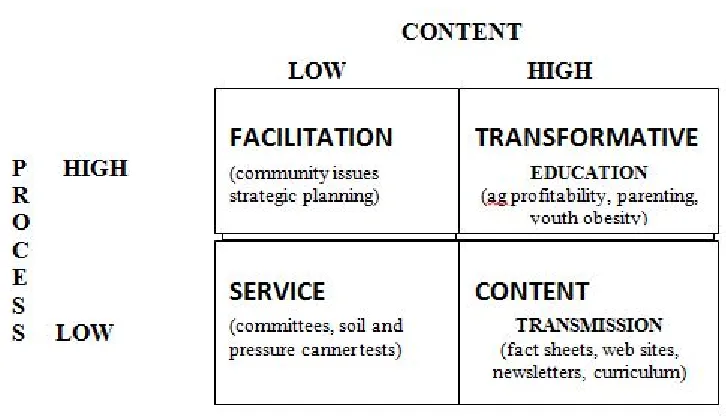
Figure 1 shows that Extension educators approach programming in a variety of ways. This model focuses on "process" and "content" as the determinants of approaches to Extension work. Process refers to the ways educational programs are delivered. Content refers to the information shared to drive a learner's change in knowledge or behavior. Combining these two determinants creates four domains describing approaches to Extension work (Franz & Townson, 2008).
Nancy K. Franz Associate Dean for Extension and Outreach Director, ISU Extension and Outreach to Families Iowa State University Extension and
Outreach
Figure 1.
Extension Educational Approaches
Public value most often is realized through the transformative education approach to Extension work. Social, economic, and environmental condition changes desired for public value require
transformative education practices, including critical events and critical reflection (Franz, Garst, Baughman, Smith, & Peters 2009). However, Extension workers sometimes fail to use transformative approaches to realize public value. They also fail to measure and articulate program value in spite of a variety of potential uses of public value statements and stories to improve programming and gain recognition for their good work.
Program Improvement and Public Value Stories and
Statements
Most Extension systems have been creating public value statements and stories for reporting program impact to stakeholders. The development of these stories requires strong and persistent leadership to help staff and faculty change because measuring and articulating public value requires an intentional process and behavior changes that can take time (Franz, 2011; Kalambokidis, 2004; Kalambokidis, 2011). Public value stories and statements can be used in many important ways to improve programming by:
Framing questions for program needs assessment and environmental scanning
Selecting programs to develop based on the importance of the issue for the public and the organizational capacity available to deliver it
Building public value into program design using logic models to set condition outcomes (i.e., public value) and determine what outcomes will be measured
Including time in program delivery to reflect on and measure the public value of the program
June 2013 Improving Extension Programs: Putting Public Value Stories and Statements to Work JOE 51(3)
Conducting and analyzing data after the program to determine anticipated and unanticipated public value
Specific daily uses of public value statements and stories include:
Media releases
Policy change proposals
Reports and publications
Conference presentation and poster proposals
Volunteer recruitment
Partnership development
Web content
Grants, contracts, and other funding proposals
Awards and recognition nominations
Marketing materials
Talks, speeches, and brag points
Promotion, tenure, and reclassification dossiers and annual performance reports
Celebrations, including stories for retirement parties
Public value statements and stories have three important elements: 1) the relevance or issue being addressed, 2) the response by Extension to the issue, and the 3) results of the program including the public value. Templates are often created for statewide consistency in data aggregation and reporting (Boyer et al., 2009; Franz 2011). Statements tend to be a few sentences long, while stories are about a page in length and contain more details for each section.
Lessons Learned About Public Value Statements and Stories
Best practices and lessons learned about creating and using public value statements and success stories have some parallels with those discovered through efforts to improve impact reporting. These lessons include hiring staff or faculty specifically to measure and articulate public value; training administrators, faculty, and staff; providing individual and small group technical assistance;developing reporting tools; and tying public value reporting to performance and recognition (Franz & McCann, 2007).
June 2013 Improving Extension Programs: Putting Public Value Stories and Statements to Work JOE 51(3)
Specific best practices have been documented related to public value articulation. These include creating clear examples of the differences between public and private value derived from Extension programs, creating the case for and urgency of focusing on public value, listing and prioritizing the unit's public values, and using both public value statements and stories depending on the audience and venue (Franz, 2011). Kalambokidis (2004, 2011) also found the importance of working with Extension program teams to develop public value statements and the benefit of developing multiple drafts of public value statements in workshops, having those statements reviewed by applied
economists, and working with program teams to revise their public value statements based on feedback and preparing to present their statements to peers.
All Extension units and employees develops their own best practices regarding the development and use of public value statements and stories over time to fit their context. It is critical that not every program or educational activity becomes subject to a public value lens. Some efforts are best described as service or tradition that is compelling to continue for other types of impact. Private value derived from programming may be appropriate for clients who can afford to pay all costs related to the program. Some Extension workers have found they enjoy working with others on public value when it is not their personal strength.
Summary
Extension has begun to embrace the public value movement that originated in public administration circles. The motivation behind participation in this movement appears to be driven by external accountability rather than internal interest in improving programming and results. The development of public value statements and stories can be used throughout the program cycle and for other program and professional tasks to help address internal and external cries for the articulation of public value. Extension workers should use public value statements and stories in their work on a daily basis in a variety of ways to enhance their effectiveness and the transformative impact of their programs.
References
Boyer, R., Benson, M. Boyd, H. Forrester, M, Franz, N. Gehrt, K., Pelland, P., & Roan, K. (2009). Enhancing accountability: ServSafe impact template delivers. Journal of Extension [On-line], 47(3). Article 3TOT5. Available at: http://www.joe.org/joe/2009june/tt5.php
Franz, N. (2011). Advancing the public value movement: Sustaining Extension during tough times. Journal of Extension [On-line], 49(2). Article 2COM2. Available at:
http://www.joe.org/joe/2011april/comm2.php
Franz, N., & McCann, M. (2007). Reporting program impacts: Slaying the dragon of resistance. Journal of Extension [On-line], 45(6). Article 6TOT1. Available at:
http://www.joe.org/joe/2007december/tt1.php
Franz, N., Garst, B., Baughman, S., Smith, C., & Peters, B. (2009). Catalyzing transformation: Conditions in Extension educational environments that promote change. Journal of Extension
[On-June 2013 Improving Extension Programs: Putting Public Value Stories and Statements to Work JOE 51(3)
line], 47(4). Article 4IRB1. Available at: http://www.joe.org/joe/2009august/rb1.php
Franz, N., & Townson, L. (2008). The nature of complex organizations: The case of Cooperative Extension. In M. Braverman, M. Engle, M. Arnold, & R. Rennekamp (Eds.).Program evaluation in a complex organizational system: Lessons from Cooperative Extension. New Directions for Evaluation, 120, 5-14.
Kalambokidis, L. (2004). Identifying the public value in Extension programs. Journal of Extension [On-line], 42(2). Article 2FEA1. Available at: http://www.joe.org/joe/2004april/a1.php
Kalambokidis, L. (2011). Spreading the word about Extension's public value. Journal of
Extension [On-line], 49(2). Article 2FEA1 Available at: http://www.joe.org/joe/2011april/a1.php
Copyright © by Extension Journal, Inc. ISSN 1077-5315. Articles appearing in the Journal become the property of the Journal. Single copies of articles may be reproduced in electronic or print form for use in educational or training activities. Inclusion of articles in other publications, electronic sources, or systematic large-scale distribution may be done only with prior electronic or written permission of the
Journal Editorial Office, [email protected].
If you have difficulties viewing or printing this page, please contact JOE Technical Support
June 2013 Improving Extension Programs: Putting Public Value Stories and Statements to Work JOE 51(3)