Everyday Memory Measures in Multiple Sclerosis: A Systematic
Review
Roshan dasNair
1,2*, Holly Griffiths
1, Sara Clarke
1, Abigail Methley
3, Ian
Kneebone
4, & Gogem Topcu
11Division of Psychiatry and Applied Psychology, School of Medicine, University of Nottingham, Nottingham, United Kingdom
2Institute of Mental Health, University of Nottingham, Nottingham, United Kingdom
3Section for Clinical and Health Psychology, School of Psychological Sciences, University of Manchester, Manchester, United Kingdom
4Discipline of Clinical Psychology, Graduate School of Health, University of Technology Sydney, Sydney, Australia
*Corresponding address: Prof Roshan dasNair, C22, Institute of Mental Health, Jubilee
Campus, University of Nottingham, Nottingham NG7 2TU, UK
Everyday Memory Measures in Multiple Sclerosis: A Systematic
Review
Everyday memory is one of the most affected cognitive functions in Multiple
Sclerosis (MS). Assessing everyday memory problems is crucial for monitoring
the impact of memory deficits on individuals’ day-to-day lives and evaluating the
effectiveness of interventions that aim to improve cognitive functions. The aim of
this systematic review was to identify the research literature on everyday memory
measures used with people with MS, describe the types of measures used, and
summarise their psychometric properties. Empirical studies of cognitive function
in MS using standardised everyday memory measures were included. Online
databases (MEDLINE, PsycINFO, PsycARTICLES, Embase) and Google
Scholar were searched. Forty-four studies met the inclusion criteria. A total of
twelve measures were identified, with varied uses and administration methods.
The majority of papers did not report any psychometric properties for MS
populations. The few papers that did, reported that the measures have good
reliability and appear to have good face, concurrent and ecological validity, but
these need to be evaluated further. This review presents researchers and clinicians
with an overview of the various everyday memory measures used in studies with
people with MS, to help them choose the appropriate measure for their
evaluations.
Keywords: everyday memory; multiple sclerosis; systematic review;
psychometric properties
Introduction
Cognitive deficits affect up to 80% of individuals with Multiple Sclerosis (MS) (Fischer
et al., 2014), with attention, memory, information processing, and executive functions
being the most affected cognitive functions (Mackenzie, Morant, Bloomfield,
MacDonald, & O’Riordan, 2014; McIntosh-Michaelis et al., 1991; Rao, Leo, Bernardin,
& Unverzagt, 1991). Cognitive problems adversely affect individuals’ activities of daily
life, work, domestic, leisure and social activities, and cause distress and mood problems
1994; Peyser, Rao, LaRocca, & Kaplan, 1990).
Everyday memory refers to memory functions associated with daily life.
Examples include remembering names or faces, directions, shopping lists, locations of
objects, future events or appointments. Tests of everyday memory have questionnaire
items or activities that relate to, or closely resemble, routine everyday tasks. There is a
variety of everyday memory measures available, most of which are subjective
patient-reported measures (Chipchase & Lincoln, 2001; Sunderland, Harris & Baddeley, 1983).
Some ‘objective’ measures have also been developed to capture everyday memory
(Rendell & Craik, 2000; Smith, Della-Sala, Logie, & Maylor, 2000; Wilson, Cockburn
& Baddeley, 1985; Wilson et al., 2005).
The assessment of everyday memory problems is important for monitoring the
impact of memory deficits on an individual’s daily life throughout disease progression
and for evaluating the impact of interventions (e.g., memory rehabilitation) that aim to
improve cognitive functions or help people cope with cognitive problems. Several trials
of memory rehabilitation, however, have used impairment level measures of outcome,
and not functional outcomes that map onto the International Classification of
Functioning, Disability and Health’s domains of activity limitation and participation
restrictions, despite these domains being the focus of rehabilitation (World Health
Organization, 2007). In a recent Cochrane review only five out of 15 trials that
evaluated the effectiveness of memory rehabilitation in MS used subjective everyday
memory measures, and most used list-learning tasks as objective memory assessments
(das Nair, Martin, & Lincoln, 2016).
To our knowledge, no systematic review has been conducted on everyday
memory measures in MS (or any other clinical groups specifically), and this is the first
Additionally, although the psychometric properties of the everyday memory measures
have been adequately demonstrated for the general population or other clinical groups,
we have a limited information with regards to their psychometric properties when used
with people with MS.
Our aim, therefore, was to systematically review the research literature on
everyday memory measures used with people with MS, describe the types of measures
used, summarise their psychometric properties in relation to their use with people with
MS, and describe how these measures have been used and what they have been used
for. We believe this review may help clinicians and researchers choose the appropriate
measures for their evaluations with people with MS.
Methods
A systematic search was conducted using the following electronic databases: Ovid
MEDLINE (R), PsycINFO, PsycARTICLES and Embase, from their inception until 2nd
May 2017. A search strategy was developed for Ovid MEDLINE (R) by two reviewers
(A2 and A3) in consultation with a third reviewer (A1) [Author names removed to
maintain the integrity of the review process]. Key words included: MS, disseminated
sclerosis, multiple sclerosis; combined with everyday memory, daily memory, and real
life memory. A two-step search process was used. First, an overview of everyday
memory measures was compiled from the bookA Compendium of Tests, Scales and
Questionnaires(Tate, 2010). The name of each measure was combined with the above
mentioned search terms. The search strategy for the everyday memory measures is
available as supplementary material A. Second, where searches identified additional
everyday memory measures used with samples of people with MS, these were then
systematically searched in MEDLINE (2nd May 2017) and Google Scholar (24th
Papers obtained from the systematic search were independently screened by four
reviewers (A2, A3, A4 and A6) [Author names removed to maintain the integrity of the
review process]. Papers were initially screened by their titles and abstracts for
eligibility. The fifth reviewer (A1) confirmed eligibility [Author name removed to
maintain the integrity of the review process]. Eligibility of papers was determined
according to the following inclusion criteria: (a) study participants had a diagnosis of
any type of MS (relapsing-remitting, primary progressive, etc.); (b) participants were
over the age of 16 years; (c) everyday memory of the person with MS was assessed (as
outlined in the search strategy keywords) by the researcher/clinician, the individual with
MS or their carer; (d) papers reported peer-reviewed empirical studies (excluding
dissertations and protocols); (e) papers were available in English. Although measures
such as the Perceived Deficits Questionnaire (PDQ; Sullivan, Edgley, & DeHoux, 1990)
can be used as a screening tool of cognitive functioning for studies on any topic, for this
review we only considered studies using the PDQ where the focus of the study was
everyday memory.
A paper was discarded if the abstract clearly did not meet the inclusion criteria
or if it was a duplicate of another paper in the search results. Where the abstract
provided insufficient detail, full texts were accessed.
Three reviewers (A2, A3 and A6) independently extracted data from the full
texts. Any discrepancies were resolved through discussion, with another reviewer (A1)
arbitrating where necessary [Author names removed to maintain the integrity of the
review process]. All relevant data from the papers were entered onto a bespoke data
extraction form (Supplementary material B) to enable final decisions regarding
inclusion. We extracted the following data using a data extraction table (Supplementary
everyday memory measure used, how the measure was used, psychometric properties,
and conclusions.
Results
Characteristics of included studies
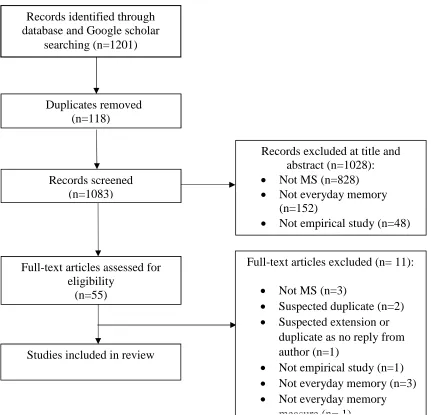
The database searches produced a combined total of 1201 hits from which 44 papers
were included in this review. These papers included studies from the UK (1, 4, 7-11,
26), Germany (2), Australia (3, 5, 12), USA (6, 13-21, 27, 33- 37, 39, 41, 43), Canada
(22, 23, 28, 42, 44), Italy (24), Finland (25, 31, 32), Iran (29), The Netherlands (30),
Greece (38) and Spain (40). Sixteen studies used correlational designs (1, 3, 6, 7, 13, 14,
18, 19, 23, 26, 27, 30, 37-39, 41), eleven had comparison group designs (2, 5, 12, 16,
21, 22, 25, 28, 29, 35, 44). Eight studies were randomised controlled trials (4, 9, 11, 17,
32, 40, 43), four were longitudinal (24, 34, 36, 42), two studies were quasi-experimental
(15, 33), one study was an extension of another study (31, 32), one study used a
retrospective design (8), one study used a survey design (10), and another was a
longitudinal case study (20). See figure 1 for PRISMA flow diagrams for Ovid and
Google Scholar searches (Moher, Liberati & Tetzlaff, 2009).
---Figure 1 here
---Characteristics of the samples
In total, 4402 people with MS participated in these studies, and 17 studies also included
healthy controls (n = 779) (2, 5, 8, 12, 18, 19, 21, 22, 25, 27-29, 34, 35, 37, 42, 44).
37), two studies included people with stroke (n = 107) (4, 8), one included participants
with traumatic brain injuries (n = 16) (4), and one included 51 carers of 51 people with
MS (1).
Demographics and illness characteristics of the samples
The mean age of the MS participants ranged from 35.9 to 71 years old (SD range 6.4 to
13.78), with the youngest being 17 and oldest 84 years old (8, 44). Gender weightings in
the sample were between 46% (21) to 100% women (20). Participants’ educational level
was variously coded in the studies. Thirty-six papers reported information on education
and of these, only 27 papers reported the mean years of education of the participants (3,
4-6, 12-14, 16, 18, 19, 21- 23, 25-27 31, 32, 34-37, 40-44). The mean years of education
ranged from 10.21 to 15.7 years for the overall sample (SD range 1.93 to 3.77). The
other nine papers reported education in the following ways: ‘levels’ of formal education
(2); the total number of participants within each education level (17, 23, 33, 30,); age at
which participants left education (16 years old; 9); percentages of the overall sample
(15, 38); and the participants’ highest qualification attained (20). Eight papers did not
report this demographic characteristic (1, 7, 8, 10, 11, 24, 29, 39).
Only 25 papers reported participants’ ethnicity, with 90% to 100% of the sample
reported as ‘Caucasian’ in 10 papers (13, 15-18, 27, 33-35, 39). African-American
people represented 3% to 14.3% in seven papers (15, 16-18, 27, 33, 39),
American-Indian represented 4% in one paper (27), and Hispanic people represented 1% to 5% of
the overall sample in four papers (15, 16, 18, 27). Other ethnic minorities were simply
described as ‘other’ in five papers (15, 16-18, 33) with one paper using the term ‘other’
with the exception of Asian or Pacific Islander, Native American or Hispanic (39).
reported as ‘declined’ in one paper (27). Two papers reported some ethnicity categories
but not others (34, 35).
Thirty-four papers specified the types of MS participants had, whereas ten did
not report this (1, 4, 5, 8, 10, 17, 29, 33, 38, 44). Three studies had samples of
participants with relapsing-remitting MS only (20, 31, 32). Most papers had mixed
samples with relapsing-remitting in 25 papers (2, 3, 6, 7, 9, 11, 12, 16, 18, 19, 21,
25-28, 30, 34-37, 39- 43), primary progressive in 22 papers (2, 3, 6, 7, 9, 11, 14, 16, 19, 22,
27, 28, 30, 34-37, 39-43), secondary progressive in 26 papers (3, 6, 9, 11, 13-16, 18, 19,
21-23, 26-28, 30, 34-37, 39-43), progressive-relapsing in three papers (27, 35, 41),
clinically isolated syndrome in two papers (28, 30), and benign MS in one paper (11).
Type of MS was unknown in four papers (6, 7, 9, 11) and defined as ‘uncertain’ in one
paper (27).
Characteristics of everyday measures
There were 12 everyday measures identified in the 44 papers. In this section, we
describe the types of measures used, why they were used, how they were administered,
and the reported psychometric properties of these measures based on samples of people
with MS, as described by the studies using these measures.
Types of everyday measures
The MS Neuropsychological Questionnaire (MSNQ; Benedict et al., 2003) was the
most frequently used measure of everyday memory, used in 14 studies (15, 17, 23, 26,
28, 30-35, 37, 40, 42). Six studies also used the MSNQ informant version (15, 23, 30,
31, 37, 42). Eight studies used the Perceived Deficits Questionnaire (17, 31, 32, 36, 38,
39, 41, 44), and 6 studies used the Everyday Memory Questionnaire (EMQ; Sunderland
Questionnaire (PRMQ; Smith et al., 2000) (16, 18, 20, 22, 29). Four studies used the
Memory Functioning Questionnaire (MFQ; Gilewski et al., 1990) (6, 14, 15, 43) and
four used the Virtual Week task (Rendell et al., 2000) (5, 12, 20, 21). Three studies used
the Rivermead Behavioural Memory Test (RBMT; Wilson et al., 1985) (2, 4, 24), one
of which used its Extended version (Wilson et al., 1999) (4). Two studies used the
Cognitive Failures Questionnaire (CFQ; Broadbent et al., 1982) (7, 19) and two used
the Memory for Intentions Screening Test (MIST; Raskin, Buckeit & Sherrod, 2010)
(16, 27). The other tests used were the Cambridge Prospective Memory Test
(CAMPROMT; Wilson et al., 2005) (3), the Memory Rating Scale (MRS; Rao, 1984)
(13), and the Self-Evaluation of Everyday Memory and Learning Questionnaire (25).
The scoring, administration, reliability and validity of the measures are presented in
Table 1.
Uses of everyday memory measures
Eleven studies used everyday memory measures to correlate everyday memory with
another measure of memory (e.g., another everyday memory measure, or other memory
measures) (6, 13, 15, 18, 19, 30, 35, 36, 39, 41, 42), and 12 studies used measures to
correlate everyday memory with another variable (e.g., quality of life or mood) (13, 14,
18, 22-24, 27, 37-39, 41, 42). Everyday memory measures were also used as a predictor
variable (e.g., for quality of life or carer strain) in five papers (1, 3, 7, 37, 38) and a
predicted variable in three papers (19, 27, 34). In 23 studies, everyday memory
measures were used to compare the difference in performance between groups (e.g.,
between people with MS and healthy controls) (2, 4, 5, 9, 11, 12, 16, 17, 19, 21, 22,
25-27, 29, 31, 32, 34-36, 40, 42, 43). Everyday memory measures were also used in seven
studies as outcome measures in randomised controlled trials of memory rehabilitation
people with MS as having impaired or unimpaired memory (10); to determine whether
people with MS had over-estimated or underestimated their cognitive ability (35); to
screen participants for eligibility into a trial (17, 28, 33); or as part of a battery to
describe memory deficits for a case study (20). Eight papers analysed the psychometric
properties of an everyday memory measure (8, 15, 23, 30, 34, 35, 37, 44).
Administration of Everyday Memory Measures
Everyday memory measures were mostly administered face-to-face (see Table 1) or this
was inferred from 27 papers (2-5, 9, 12, 14-16, 18-24, 26-28, 31, 32, 34, 35, 37, 40, 42,
43). They were also used as postal measures in seven studies (1, 4, 7, 10, 11, 30, 39), or
administered over the phone in two studies (17, 33). Only three papers explicitly
reported that the measure was self-administered (25, 30, 38) (we made an assumption in
the absence of information in the paper that when used as a postal measure, the measure
was self-administered). One paper posted the measure in a newsletter (44). Seven
papers did not report how the everyday memory measures were administered (6, 8, 13,
17, 29, 36, 41).
---Table 1 here
---Psychometric properties of Everyday Memory Measures
The following psychometric properties were reported for the reliability and validity of
the everyday memory measures as described within the included studies that used these
measures with samples of people with MS (see Table 2).
Of the six papers that used the EMQ, only one reported the internal consistency
Two papers reported on its validity, both reporting ‘good face validity’ (4, 8). One paper
assessed this by comparing the original scale with a 13-item revised scale, and also
assessed the construct validity by comparing patients with memory problems with
healthy participants (8).
Of the 14 papers that used the MSNQ, four reported on the internal consistency,
with two only referring to it as ‘reliable’ (23), and having ‘excellent internal
consistency’(35), and another two papers reported Cronbach’s alphas ranging from 0.93
to 0.95 (17, 30). Two papers reported on the interrater reliability, with one paper
referring to it as ‘moderate’ with an intraclass correlation coefficient of -0.59 (95% 0.49
– 0.69), along with low to moderate weighted kappa values for item scores (0.25 – 0.50)
(30). Another paper reported correlation scores between Self report and
MSNQ-Informant report scores (r = .55, p< .01) (37). Two papers reported on the test-retest
reliability; Cronbach’s alpha ranged from 0.86 to 0.90 for one of the papers (34),
whereas the other paper referred only to the measure having ‘excellent test-retest
reliability’ (35).
Validity was reported by five papers. Construct validity was reported in one
paper by testing six hypotheses by calculating Spearman correlations between the
MSNQ-P (self-report) and MSNQ-Informant report, an observational measure of
memory and measures of anxiety and depression (correlations ranged from 0.26 – 0.49)
(30). One study assessed construct validity via regression and reported R2 values ranged
from 0.28 – 0.40 and reported that two combined measures (the Symbol Digits
Modalities Test (SDMT; Smith et al., 1982) and the Beck Depression Inventory Fast
Screen (BDIFS; Benedict et al., 2003) accounted for a third of the variance in the
MSNQ (34). One study assessed the validity of the MSNQ discrepancy scores in all MS
impairment, and then in a subgroup of cognitively impaired patients (35). This paper
reported discrepancy scores ranging from 16 – 30 (M = 21.1, SD = 3.6) in the
underestimator group, 4 – 11 (M = 2.4, SD = 4.2) in the accurate underestimator group, and 37 –
-11 (M = -20.6, SD = 7.4) in the over-estimator group. For MS patients categorised as
‘cognitively impaired’, discrepancy scores ranged from 16 – 30 (M = 20.6, SD = 4.3) in
the under-estimator group, -3 – 10 (M = 2.5, SD = 4.0) in the accurate estimator group,
and -37 - -11(M = -20.4, SD = 7.5) in the over-estimator group (35). The fourth paper
reported MSNQ sensitivity as .52 (95% confidence interval [CI] .32 - .72) and
specificity as 0.70 (95% CI .51 - .82) when categorising patients in the ‘global cognitive
impairment categories’ (37). With a cut-off score of 24 on the MSNQ, only 62% of the
MS patients were correctly categorised as either impaired or not impaired. A cut-off
score of 7.5 produced the maximum sensitivity (.90) and specificity (.96) for the MSNQ
(37).
Only one of the five studies that used the PRMQ reported the internal
consistency, with Cronbach’s alpha reported as 0.89, 0.84 and 0.80 (16). Again, validity
was not reported. None of the three papers using the RBMT reported the reliability or
validity of the measure, with only one paper suggesting that the test had been ‘validated
by five to ten years follow ups of patients with memory problems’ (p. 161) (2). Of the
four papers that used the Virtual Week, only one reported the split-half reliability
(Cronbach’s alpha ranged from 0.71 to 0.85) and none reported on the measure’s
validity (5). One of the two papers that used the CFQ reported the internal consistency
reliability (Cronbach’s alpha of 0.95) (7). Neither reported the validity. Only one of the
four papers using the MFQ referenced the internal consistency reliability of the measure
from other studies (Cronbach’s alpha ranged from 0.84 to 0.94) and also stated that the
commonly used metamemory measure’ (p. 265, 14) (Gilewski et al., 1990; Hertzog,
Hultsch, & Dixon, 1989; Randolph et al., 2004; Zelinski, Gilewski, &
Anthony-Bergstone, 1990). The study that used the CAMPROMPT reported inter-rater reliability
(r = .99) and ‘adequate test-retest reliability over 7-10 days (Kendall’s Tau-b = 0.64),
and suggested the measure was ‘ecologically valid’ (3). Of the two papers that used the
MIST, one paper referenced ‘strong evidence of reliability and construct validity’ (p.
890, 27) from other studies (Gupta et al., 2010; Woods et al., 2008), and one paper did
not report the reliability or validity (16). Of the eight papers that used the PDQ, only
two papers reported on reliability. One of the papers (36) reported internal consistency
by referencing Cronbach’s alpha ranges 0.77 – 0.97 from other studies (Fischer et al.,
1999; Marrie et al., 2003) and also reported test-retest reliability r = .564, p < .001. The
other paper reported internal consistency reliability from its own dataset with
Cronbach’s alpha ranging from 0.76 to 0.84 (44). Only three papers reported on the
validity of the PDQ. The first paper reported the PDQ has ‘good…validity in persons
with MS’ (p. 616, 36). The second paper did not find any correlations with objective
cognitive tests and was ‘uncertain’ as to what the PDQ assesses (39). The third paper
reported ‘the validity of self-report measures of cognitive problems may best be
addressed by examining whether these measures predict disruptions in daily living, not
whether they predict neuropsychological test scores’. (p.103, 44). Papers using the
MRS-C (13), and the Self-Evaluation of Everyday Memory and Learning Questionnaire
(25) did not report on the reliability or validity of the measures.
---Table 2 here
---Discussion
Everyday memory measures were used with a wide age range of people diagnosed with
MS, with the mean number of years of education ranging from 11 to 15.7 years. Most of
the participants were women and of White ethnicities, which is representative of the MS
population. All MS sub-types were represented in the literature. Of the 12 everyday
measures identified in the 44 papers, the majority were questionnaires, with only four
being observer-assessed ‘objective’ tests that required the respondent to follow certain
actions. These objective measures were the RBMT, CAMPROMPT, Virtual Week, and
MIST.
Everyday memory measures were used for a variety of reasons: to assess how
different everyday memory measures compare with each other, how everyday memory
relates to other symptoms of MS (such as mood problems), and whether everyday
memory can predict an outcome. Everyday memory measures were also used to screen
participants for memory problems, and to classify and describe people’s memory
problems. Some trials of cognitive rehabilitation used everyday memory measures as a
primary or secondary outcome to evaluate the impact of the intervention on everyday
memory performance.
The variability of the use of these measures also suggests their versatility. Their
versatility is also reflected in their administration formats, with the everyday memory
questionnaires being administered face-to-face, over the phone, or by post. The
questionnaires could also be self-administered. This is important for their use as
outcome measures in intervention trials, because most of these trials are
observer-blinded and the chances of the outcome assessor becoming unobserver-blinded increases if they
are in direct contact with participants. Indeed, many trials have imperfect blinding
problems who even when told not to reveal their group allocation sometimes forget this
instruction and inadvertently unblind the assessor (Lincoln, personal communication,
2017).
The majority of papers did not report or reference information related to
reliability. Of the measures that did discuss reliability, one reported test-retest reliability
(Kendall’s Tau = b-0.64) (Honan et al., 2015) and inter-rater reliability (r =.99), and six
discussed internal consistency (Cronbach’s alphas ranging from 0.80 to 0.95). The
validity of the measures was even less frequently presented. Where validity was
discussed most authors presented a verbal description of the face validity, concurrent
validity with independence and employment, and ‘ecological validity’. Ecological
validity refers to the extent to which cognitive tests relate to cognitive problems in daily
living or functional limitations, emphasising how these tests predict function in real-life
settings (Ginsberg, Kibby & Long, 1996). Higginson et al. (2000) highlight the EMQ
and RBMT as examples of ecologically valid tests of memory for use with people with
MS; the EMQ, a rating scale assessing the frequency and of real-life memory problems,
and the RBMT, a test which assesses analogues of everyday memory situations. Their
study, which compared ecologically valid measures (memory questionnaires and tests)
with standard neuropsychological tests (e.g., list learning and symbol-digit modalities
test), found that the ecologically valid tests were better predictors of functional
disability than both memory questionnaires and standard neuropsychological tests
commonly used in assessing people with MS. The lack of correlations between some of
these tests suggested that the ecologically valid tests measured something different than
what was measured by the standard neuropsychological tests.
Everyday memory measures, therefore, have an important role to play in
establishing how everyday memory relates to other symptoms of MS, evaluating change
over time, and examining the effectiveness of interventions.
One limitation of our review is that we did not assess the risk of bias or
methodological quality of the included papers through a standardised checklist. Our aim
was to clearly report all available evidence and synthesise findings, rather than
presenting the ‘weight’ of the evidence. Thus, we cannot determine whether the
included studies provide robust or generalisable findings.
Conclusions
This review presents researchers and clinicians with an overview of the various
everyday memory measures that have been used in studies with people with MS.
Everyday memory measures have been used for a variety of reasons with people with
MS of different demographics and different MS subtypes. These measures are often
questionnaires or objective tests with prescribed activities. The questionnaires are
versatile, can be self-administered and can be used over the telephone or by post. Both
the questionnaires and tests have been used as outcome measures in trials of cognitive
rehabilitation. The measures have good reliability and appear to have good face,
concurrent and ecological validity, but these need to be evaluated further in samples of
people with MS.
References
Benedict, R. H. (2005). Effects of using same-versus alternate-form memory tests
during short-interval repeated assessments in multiple sclerosis.Journal of the International Neuropsychological Society, 11(6), 727-36.
doi.org/10.1017/S1355617705050782
Benedict, R. H., Cox, D., Thompson, L. L., Foley, F., Weinstock-Guttman, B., &
in multiple sclerosis.Multiple Sclerosis Journal, 10(6), 675–678. doi: 10.1191/1352458504ms1098oa
Benedict, R. H., Duquin, J. A., Jurgensen, S., Rudick, R. A., Feitcher, J., Munschauer,
F. E., Panzara, M. A., & Weinstock-Guttman, B. (2008). Repeated assessment of
neuropsychological deficits in multiple sclerosis using the Symbol Digit
Modalities Test and the MS Neuropsychological Screening Questionnaire.
Multiple Sclerosis Journal, 14(7), 940-946. doi: 10.1177/1352458508090923. Benedict, R. H., Fishman, I., McClellan, M. M., Bakshi, R., & Weinstock-Guttman, B.
(2003). Validity of the beck depression inventory-fast screen in multiple
sclerosis.Multiple Sclerosis Journal, 9(4), 393-396.
Benedict, R. H., Munschauer, F., Linn, R., Miller, C., Murphy, E., & Foley, F. W.
(2003). Screening for multiple sclerosis cognitive impairment using a
self-administered 15-item questionnaire.Multiple Sclerosis Journal, 9(1), 95–101. doi: 10.1191/1352458503ms861oa
Benedict, R. H., & Zivadinov, R. (2006). Predicting neuropsychological abnormalities
in multiple sclerosis.Journal of the Neurological Sciences, 245(1), 67–72. https://doi.org/10.1016/j.jns.2005.05.020
Broadbent, D. E., Cooper, P. E., Fitzgerlad, P., & Parkes, K.R. (1982). The cognitive
failures questionnaire and its correlates.British Journal of Clinical Psychology, 21, 1–16. DOI: 10.1111/j.2044-8260.1982.tb01421.x
Bruce, J. M., & Arnett, P. A. (2004). Self-reported everyday memory and depression in
patients with multiple sclerosis.Journal of Clinical and Experimental Neuropsychology, 26(2), 200–214. DOI: 10.1076/jcen.26.2.200.28081 Bruce, J. M., Bruce, A. S., Hancock, L., & Lynch, S. (2010). Self-reported memory
problems in multiple sclerosis: Influence of psychiatric status and normative
dissociative experiences.Archives of Clinical Neuropsychology, 25(1), 39–48. doi:10.1093/arclin/acp092
Campbell, J., Rashid, W., Cercignani, M., & Langdon, D. (2016). Cognitive impairment
among patients with multiple sclerosis: associations with employment and
quality of life.Postgraduate Medical Journal, 93(1097), 143-147. doi.org/10.1136/postgradmedj-2016-134071
Carone, D. A., Benedict, R. H., Munschauer, III. F. E., Fishman, I., &
cognitive symptoms in MS.Journal of the International Neuropsychological Society, 11(5), 574-83. DOI: https://doi.org/10.1017/S135561770505068X Carr, S. E., dasNair, R., Schwartz, A. F., & Lincoln, N. B. (2014). Group memory
rehabilitation for people with multiple sclerosis: a feasibility randomized
controlled trial.Clinical Rehabilitation, 28(6), 552–561. DOI: 10.12968/ijtr.2014.21.12.590
Chiaravalloti, N. D., DeLuca, J., Moore, N. B., & Ricker, J. H. (2005). Treating learning
impairments improves memory performance in multiple sclerosis: a randomized
clinical trial.Multiple Sclerosis Journal, 11(1), 58-68. DOI: 10.1191/1352458505ms1118oa
Chipchase, S. Y., & Lincoln, N.B. (2001). Factors associated with carer strain in carers
of people with multiple sclerosis.Disability and Rehabilitation, 23(17), 768– 776. doi.org/10.1080/09638280110062158
Christodoulou, C., Melville, P., Scherl, W. F., Morgan, T., MacAllister, W. S., Canfora,
D. M., Berry, S. A., & Krupp, L. B. (2005). Perceived cognitive dysfunction and
observed neuropsychological performance: longitudinal relation in persons with
multiple sclerosis.Journal of the International Neuropsychological Society, 11(5), 614-619. DOI: 10.10170S1355617705050733
Crawford, J., Smith, G., Maylor, E., Della Sala, S., & Logie, R. (2003). The Prospective
and Retrospective Memory Questionnaire (PRMQ): Normative data and latent
structure in a large non-clinical sample.Memory, 11(3), 261-275. DOI: 10.1080/09658210244000027
Cutajar, R., Ferriani, E., Scandellari, C., Sabattini, L., Trocino, C., Marchello, L. P., &
Stecchi, S. (2000). Cognitive function and quality of life in multiple sclerosis
patients.Journal of Neurovirology, 6(2), S186. doi: 10.1186/1471-2377-11-17. Dagenais, E., Rouleau, I., Demers, M., Jobin, C., Roger, E., Chamelian, L., & Duquette,
P. (2013). Value of the MoCA test as a screening instrument in multiple
sclerosis.Canadian Journal of Neurological Sciences, 40(3), 410–415. DOI: 10.1017/S0317167100014384
Dagenais, E., Rouleau, I., Tremblay, A., Demers, M., Roger, É., Jobin, C., & Duquette,
P. (2016). Prospective memory in multiple sclerosis: The impact of cue
dasNair, R., & Lincoln, N.B. (2012). Evaluation of rehabilitation of memory in
neurological disabilities (ReMiND): a randomized controlled trial.Clinical Rehabilitation, 26(10), 894–903. DOI: 10.1177/0269215511435424
dasNair, R., Martin, K.-J., & Lincoln, N. (2016). Memory rehabilitation for people with
multiple sclerosis.Cochrane Database of Systematic Reviews, 3, CD008754-CD008754.
Demers, M., Rouleau, I., Scherzer, P., Ouellet, J., Jobin, C., & Duquette, P. (2011).
Impact of the cognitive status on the memory complaints in MS patients.
Canadian Journal of Neurological Sciences, 38(5), 728–733. DOI: https://doi.org/10.1017/S031716710005410X
Erlanger, D. M., Kaushik, T., Caruso, L. S., Benedict, R. H., Foley, F. W., Wilken, J.,
Cadavid, D., & Deluca, J. (2014). Reliability of a cognitive endpoint for use in a
multiple sclerosis pharmaceutical trial.Journal of the Neurological Sciences, 340(1), 123–129. doi: 10.1016/j.jns.2014.03.009.
Feinstein, A. (2006). Mood disorders in multiple sclerosis and the effects on cognition.
Journal of the Neurological Sciences, 245(1), 63–66. DOI: 10.1016/j.jns.2005.08.020
Fergusson, D., Glass, K. C., Waring, D., & Shapiro, S. (2004). Turning a blind eye: the
success of blinding reported in a random sample of randomised, placebo
controlled trials.BMJ, 328(7437), 432. doi:
https://doi.org/10.1136/bmj.328.74327.37952.631667.
Fischer, M., Kunkel, A., Bublak, P., Faiss, J. H., Hoffmann, F., Sailer, M., ... Köhler,
W. (2014). How reliable is the classification of cognitive impairment across
different criteria in early and late stages of multiple sclerosis?Journal of the Neurological Sciences, 343(1–2), 91-99. doi.org/10.1016/j.jns.2014.05.042 Fischer, J. S., LaRocca, N. G., Miller, D. M., Ritvo, P. G., Andrews, H., & Paty, D.
(1999). Recent developments in the assessment of quality of life in multiple
sclerosis (MS).Multiple Sclerosis Journal, 5(4),251-259. Doi: 10.1177/135245859900500410
Foley, J., Wilson, B., & Shiel, A. (2004). Prospective memory in multiple sclerosis.
Brain Impairment, 5(1), 99.
Gilchrist, A.C., & Creed, F. H. (1994). Depression, cognitive impairment and social
Gilewski, M. J., Zelinski, E. M., & Schaie, K.W. (1990). The memory functioning
questionnaire for assessment of memory complaints in adulthood and old age.
Psychology and Aging, 5(4), 482–490.
Ginsberg, J. P., Kibby, M. Y., & Long, C. J. (1996). Ecological validity of
neuropsychological data as indicated by interrelationships with vocational data.
Archives of Clinical Neuropsychology, 11(5), 394–395.doi: https://doi.org/10.1093/arclin/11.5.394b
Gupta, S., Woods S. P., Weber, E., Dawson, M. S., Grant, I., & HIV Neurobehavioral
Research Center Group. (2010). Is prospective memory a dissociable cognitive
function in HIV infection?Journal of Clinical and Experimental
Neuropsychology, 32(8), 898-908. doi.org/10.1080/13803391003596470 Haupts, M., Calabrese, P., Babinsky, R., Markowitsch, H. J., & Gehlen, W. (1994).
Everyday memory impairment, neuroradiological findings and physical
disability in multiple sclerosis.European Journal of Neurology,1(2), 159–163. DOI: 10.1111/j.1468-1331.1994.tb00065.x
Herrmann, D.J. (1984). Questionnaires about memory. In J.E. Harris & P.E. Morris
(eds.).Everyday Memory Actions and Absent-Mindedness. New York: Academic Press.
Hertzog, C., Hultsch, D. F., & Dixon, R. A. (1989). Evidence for the convergent
validity of two self-report metamemory questionnaires.Developmental Psychology, 25, 687–700. doi.org/10.1037/0012-1649.25.5.687
Honan, C. A., Brown, R. F., & Batchelor, J. (2015). Perceived cognitive difficulties and
cognitive test performance as predictors of employment outcomes in people with
multiple sclerosis.Journal of the International Neuropsychological Society, 21(2), 156–168. DOI: https://doi.org/10.1017/S1355617715000053
Higginson, C. I, Arnett, P., & Voss, W. D. (2000). The ecological validity of clinical
tests of memory and attention in multiple sclerosis.Archives of Clinical Neuropsychology, 15, 185–204. doi.org/10.1016/S0887-6177(99)00004-9 Kardiasmenos, K. S., Clawson, D. M., Wilken, J. A., & Wallin, M. T. (2008).
Prospective memory and the efficacy of a memory strategy in multiple sclerosis.
Neuropsychology, 22(6), 746-754. DOI: 10.1037/a0013211
Kinsinger, S. W., Lattie, E., & Mohr, D. C. (2010). Relationship between depression,
fatigue, subjective cognitive impairment, and objective neuropsychological
Koss, E., Patterson, M. B., Ownby, R., Stuckey, J. C., & Whitehouse, P. J. (1993).
Memory evaluation in Alzheimer's disease: caregivers' appraisals and objective
testing.Archives of Neurology, 50(1), 92-97. DOI: 10.1001/archneur.1993.00540010086023
Krch, D., Sumowski, J. F., DeLuca, J., & Chiaravalloti, N. (2011). Subjective memory
in multiple sclerosis is associated with initial-trial learning performance.Journal of the Neuropsychological Society, 17(3), 557–561. DOI:
https://doi.org/10.1017/S1355617711000336
Kujala, P., Portin, R., & Ruutiainen, J. (1996). Memory deficits and early cognitive
deterioration in MS.Acta Neurologica Scandinavica, 93(5), 329–335. DOI: 10.1111/j.1600-0404.1996.tb00005.x
Lester, K., Stepleman, L., & Hughes, M. (2007). The association of illness severity,
self-reported cognitive impairment, and perceived illness management with
depression and anxiety in a multiple sclerosis clinic population.Journal of Behavioral Medicine, 30(2), 177-186. DOI: 10.1007/s10865-007-9095-6 Lincoln, N. B., Dent, A., Harding, J., Weyman, N., Nicholl, C., Blumhardt, L. D., &
Playford, E. D. (2002). Evaluation of cognitive assessment and cognitive
intervention for people with multiple sclerosis.Journal of Neurology, Neurosurgery & Psychiatry, 72(1), 93–98.
http://dx.doi.org/10.1136/jnnp.72.1.93
Lincoln, N. B., & Tinson, D. J. (1989). The relation between subjective and objective
memory impairment after stroke.British Journal of Clinical Psychology, 28(1), 61–65. DOI: 10.1111/j.2044-8260.1989.tb00812.x
Lovera, J., Bagert, B., Smoot, K. H, & Wild, K. (2006). Correlations of perceived
deficits questionnaire of multiple sclerosis quality of life inventory with beck
depression inventory and neuropsychological tests.Journal of Rehabilitation Research and Development, 43(1), 73-82. DOI: 10.1682/JRRD.2004.09.0118 Mackenzie, I. S., Morant, S. V., Bloomfield, G. A., MacDonald, T. M., & O’Riordan, J.
(2014). Incidence and prevalence of multiple sclerosis in the UK 1990–2010: a
descriptive study in the General Practice Research Database.Journal of Neurology, Neurosurgery & Psychiatry, 85(1), 76 –84. doi.org/10.1136/jnnp-2013-305450
Mäntynen, A., Rosti-Otajärvi, E., Koivisto, K., Lilja, A., Huhtala, H., & Hämäläinen, P.
performance but reduces perceived cognitive deficits in patients with multiple
sclerosis: a randomised, controlled, multi-centre trial.Multiple Sclerosis Journal, 20(1), 99-107. doi: 10.1177/1352458513494487.
Marrie, R. A., Miller, D. M., Chelune, G. J., & Cohen, J. A. (2003). Validity and
reliability of the MSQLI in cognitively impaired patients with multiple sclerosis.
Multiple Sclerosis Journal, 9(6), 621-626.doi: 10.1191/1352458503ms971oa McGlone, J., Gupta, S., Humphrey, D., Oppenheimer, S., Mirsen, T., & Evans, D. R.
(1990). Screening for early dementia using memory complaints from patients
and relatives.Archives of Neurology, 47(11), 1189-1193. doi:10.1001/archneur.1990.00530110043015
McIntosh-Michaelis S. A., Roberts, M. H., Wilkinson, S. M., Diamond, I. D., McLellan,
D. L., Martin, J. P., & Spackman, A. J. (1991). The prevalence of cognitive
impairment in a community survey of multiple sclerosis.British Journal of Clinical Psychology, 30(4), 333-348. DOI: 10.1111/j.2044-8260.1991.tb00954.x Middleton, L. S., Denney, D. R., Lynch, S. G., & Parmenter, B. (2006). The relationship
between perceived and objective cognitive functioning in multiple sclerosis.
Archives of Clinical Neuropsychology, 21(5), 487–494. doi.org/10.1016/j.acn.2006.06.008
Miller, A. K., Basso, M. R., Candilis, P. J., Combs, D. R., & Woods, S. P. (2014) Pain
is associated with prospective memory dysfunction in multiple sclerosis.Journal of Clinical and Experimental Neuropsychology, 36(8), 887-896.
doi.org/10.1080/13803395.2014.953040
Moher, D., Liberati, A., Tetzlaff, J., Altman, D.G., & The PRISMA Group. (2009).
Preferred reporting items for systematic reviews and meta-analyses: the
PRISMA statement.PLoS Medicine, 6(7), e1000097. doi.org/10.1371/journal.pmed.1000097
Moradi, A., Afsardeir, B., Parhoon, H., & Sanaei, H. (2016). Cognitive performance of
patients with Multiple Sclerosis (MS) in autobiographical, working and
prospective memory in comparison with normal people.International Journal of Behavioral Sciences, 10(2),49-54.
O’Brien, A., Gaudino-Goering, E., Shawaryn, M., Komaroff, E., Moore, N. B., &
DeLuca, J. (2007). Relationship of the Multiple Sclerosis Neuropsychological
outcomes.Archives of Clinical Neuropsychology, 22(8), 933-948. doi.org/10.1016/j.acn.2007.07.002
Pérez-Martín, M. Y., González-Platas, M., Eguía-del Río, P., Croissier-Elías, C., &
Sosa, A. J.(2017). Efficacy of a short cognitive training program in patients with
multiple sclerosis.Neuropsychiatric Disease and Treatment, 13, 245-252. doi: 10.2147/ndt.s124448
Peyser, J. M., Rao, S. M., LaRocca, N. G., & Kaplan, E. (1990). Guidelines for
neuropsychological research in multiple sclerosis.Archives of Neurology, 47(1), 94-97. doi:10.1001/archneur.1990.00530010120030
Phillips, L.H., Saldias, A., McCarrey, A., Henry, J. D., Scott, C., Summers, F., &
Whyte, M. (2009). Attentional lapses, emotional regulation and quality of life in
multiple sclerosis.British Journal of Clinical Psychology, 48(1), 101–106. DOI: 10.1348/014466508X379566
Randolph, J. J., Arnett, P. A., & Freske, P. (2004). Metamemory in multiple sclerosis:
Exploring affective and executive contributors.Archives of Clinical
Neuropsychology, 19(2), 259–279. doi.org/10.1016/S0887-6177(03)00026-X Rao, S. M., Hammeke, T. A., McQuillen, M. P., Khatri, B. O., & Lloyd, D. (1984).
Memory disturbance in chronic progressive multiple sclerosis.Archives of Neurology, 41(6), 625-631.
Rao, S. M., Leo, G. J., Bernardin, L., & Unverzagt, F. (1991). Cognitive dysfunction in
multiple sclerosis. I. Frequency, patterns, and prediction.Neurology, 41(5), 685 –691. DOI: 10.1212/WNL.41.5.685
Raskin, S. A. (2009). Memory for intentions screening test: Psychometric properties and
clinical evidence.Brain Impairment, 10(1), 23–33. DOI: 10.1375/brim.10.1.23 Raskin, S., Buckheit, C., & Sherrod, C. (2010).MIST Memory for Intentions Test
professional manual. Lutz: Psychological Assessment Resources.
Rendell, P.G., & Craik, F. I. M. (2000). Virtual week and actual week: Age-related
differences in prospective memory.Applied Cognitive Psychology, 12, S43–S62. DOI: 10.1002/acp.770
Rendell, P. G., Henry, J. D., Phillips, L. H., de la Piedad Garcia, X., Booth, P., Phillips,
P., & Kliegel, M. (2012). Prospective memory, emotional valence, and multiple
Rendell, P. G., Jensen, F., & Henry, J. D. (2007). Prospective memory in multiple
sclerosis.Journal of the International Neuropsychological Society, 13(3), 410– 416. DOI: https://doi.org/10.1017/S1355617707070579
Rendell, P. G., Karpivensky, N., Wallis, A., et al. (2002). Bipolar disorder and
prospective memory. In:Inaugural Australian Bipolar Disorder Conference: The ups and downs of a neglected disorder, Melbourne, Australia.
Richardson, J. T. (1996). Memory impairment in multiple sclerosis: reports of patients
and relatives.British Journal of Clinical Psychology, 35(2), 205–219. DOI: 10.1111/j.2044-8260.1996.tb01177.x
Robertson, I. H., Manly, T., Andrade, J., Baddeley, B. T., & Yiend, J. (1997). ‘Oops!’:
performance correlates of everyday attentional failures in traumatic brain injured
and normal subjects,Neuropsychologia, 35, 747–758. doi.org/10.1016/S0028-3932(97)00015-8
Rosti-Otajärvi, E., Mäntynen, A., Koivisto, K., Huhtala, H., & Hämäläinen, P. (2013).
Neuropsychological rehabilitation has beneficial effects on perceived cognitive
deficits in multiple sclerosis during nine-month follow-up.Journal of the Neurological Sciences, 334(1), 154-160.
Royle, J., & Lincoln, N.B. (2008). The Everyday Memory Questionnaire–revised:
Development of a 13-item scale.Disability and Rehabilitation, 30(2), 114–121. doi.org/10.1080/09638280701223876
Samartzis, L., Gavala, E., Zoukos, Y., Aspiotis, A., & Thomaides, T. (2014). Perceived
cognitive decline in multiple sclerosis impacts quality of life independently of
depression.Rehabilitation Research and Practice, 1-6. doi.org/10.1155/2014/128751
Shevil, E., & Finlayson, M. (2010). Pilot study of a cognitive intervention program for
persons with multiple sclerosis.Health Education Research, 25(1), 41-53. doi.org/10.1093/her/cyp037
Smith, A. (1982).Symbol Digit Modalities Test: manual. Los Angeles: Western Psychological Services.
Smith, G., Della-Sala, S., Logie, R., & Maylor, E. A. (2000). Prospective and
retrospective memory in normal ageing and dementia: A questionnaire study.
Memory, 8, 311–321. DOI: 10.3758/BF03195773
Sonder, J. M., Mokkink, L. B., van der Linden, F. A., Polman, C. H., & Uitdehaag, B.
Sclerosis Neuropsychological Screening Questionnaire.Journal of the Neurological Sciences, 320(1), 91-96. doi: 10.1016/j.jns.2012.06.024
Strober, L. B., Binder, A., Nikelshpur, O. M., Chiaravalloti, N., & DeLuca, J. (2016).
The Perceived Deficits Questionnaire: Perception, Deficit, or Distress?.
International Journal of MS Care, 18(4), 183-190. doi: 10.7224/1537-2073.2015-028.
Stuifbergen, A. K., Becker, H., Perez, F., Morison, J., Kullberg, V., & Todd, A. (2012).
A randomized controlled trial of a cognitive rehabilitation intervention for
persons with multiple sclerosis.Clinical Rehabilitation, 26(10), 882–893. doi: 10.1177/0269215511434997
Sullivan, J. I. L, Edgley, K., & DeHoux, E. (1990). A survey of multiple sclerosis: Part
1. Perceived cognitive problems and compensatory strategy use.Canadian Journal of Rehabilitation, 4, 99–105.
Sunderland, A., Harris, J.E., & Baddeley, A.D. (1983). Do laboratory tests predict
everyday memory? A neuropsychological study.Journal of Verbal Learning and Verbal Behavior, 22, 341–357. DOI: 10.1016/S0022-5371(83)90229-3 Tate, R. L. (2010).A compendium of tests, scales, and questionnaires: The
practitioner's guide to measuring outcomes after acquired brain impairment. Hove: Psychology Press.
Thelen, J. M., Lynch, S. G., Bruce, A. S., Hancock, L. M., & Bruce, J. M. (2014).
Polypharmacy in multiple sclerosis: relationship with fatigue, perceived
cognition, and objective cognitive performance.Journal of Psychosomatic Research, 76(5), 400–404. doi: 10.1016/j.jpsychores.2014.02.013.
Vanotti, S., Benedict, R. H, Acion, L., & Caceres, F. (2009). Validation of the multiple
sclerosis neuropsychological screening questionnaire in Argentina.Multiple Sclerosis Journal, 15(2), 244-50. Doi: 10.1177/1352458508097924
Walker, L. A., Osman, L., Berard, J. A., Rees, L. M., Freedman, M. S., MacLean, H., &
Cousineau D. (2016). Brief International Cognitive Assessment for Multiple
Sclerosis (BICAMS): Canadian contribution to the international validation
project.Journal of the Neurological Sciences 362,147-52. doi: 10.1016/j.jns.2016.01.040.
West, R., McNerney, M. W., & Krauss, I. (2007). Impaired strategic monitoring as the
Wilson B. A. (1991). Long-term prognosis of patients with severe memory disorders.
Neuropsychological Rehabilitation, 1(2): 117–134. doi.org/10.1080/09602019108401386
Wilson, B. A., Cockburn, J., & Baddeley, A. D. (1985).The Rivermead Behavioural Memory Test. London: Pearson Assessment.
Wilson, B. A., Clare, L., Baddeley, A. D., Cockburn, J., Watson, P., & Tate, R. (1999).
The Rivermead Behavioural Memory Test – Extended Version. Bury St. Edmunds: Thames Valley Test Company.
Wilson, B. A., Emslie, H., Foley, J., Shiel, A., Watson, P., Hawkins, K., Groot, Y. &
Evans, J.J. (2005).The Cambridge Prospective Memory Test (CAMPROMPT) London: Harcourt Assessment.
Woods, S. P., Ludicello, J. E., Moran, L. M., Carey, C. L., Dawson, M. S., & Grant, I.
(2008). HIV-associated prospective memory impairment increases risk of
dependence in everyday functioning.Neuropsychology, 22(1),110-117. doi: 10.1037/0894-4105.22.1.110
Woods, S. P., Moran, L. M., Dawson, M. S., Carey, C.L., Grant, I., & HIV
Neurobehavioral Research Center Group. (2008). Psychometric characteristics
of the memory for intentions screening test.Clinical Neuropsycholist, 22(5), 864–878. doi:10.1080/13854040701595999.
World Health Organization. (2007).International Classification of Functioning, Disability, and Health: Children & Youth Version: ICF-CY. Geneva: World Health Organization.
Zelinski, E., Gilewski, M., & Anthony-Bergstone, C. (1990). The Memory Functioning
Questionnaire: Concurrent validity with memory performance and self-reported
Table 1. Scoring, administration, reliability and validity of EM measures.
Table 2. Reliability and validity of EM measures in MS samples.
Table 1. Scoring, administration, reliability and validity of EM measures
Questionnaires/ Tests
Number of items/subtests
Scaling and scoring Administration time
Administration modality Reliability and validity
CFQ 25 items Likert scale scored 0
(never) to 4 (very often)
Not reported Two papers reported using postal
administration (7) and face-to-face
administration (19)
The factor structure of the CFQ varied between occupational groups (Broadbent et al., 1982).
EMQ 35 items (28 in
revised version)
Likert scale scored 0 (never) to 4 (more than once a day). Total score is sum of all items.
Not reported Five papers reported using postal and inferred postal administration (1, 4, 10, 11) and inferred face-to face (9)
MFQ 64 items, 7
sections
7 point Likert scale (never to always)
Not reported Three papers reported face-to-face and inferred face-to-face
administration (14, 15, 43)
MRS-C 31 items Likert scale scored 1 (much worse than the average person) to 5 (much better than the average person)
Questionnaires/ Tests
Number of items/subtests
Scaling and scoring Administration time
Administration modality Reliability and validity
MSNQ 15 items Likert scale scored 0
(never) to 4 (very often)
Not reported Thirteen papers reported using face-to-face or inferred face-to-face administration (15, 23, 26, 28, 31, 32, 34, 35, 37, 40, 42),
self-administration and postal administration (30) and telephone administration (33)
“Cronbach's alpha coefficients were 0.93 and 0.94 for the patient- and informant-report forms, respectively, and both forms of the test were strongly correlated with a more general cognitive complaints questionnaire. The patient MSNQ form correlated significantly with measures of depression but not with objective tests of cognitive function. In contrast, the informant form was correlated with patient cognitive performance but not depression. A cut-off score of 27 on the informant form of the MSNQ optimally separated patients based on a
neuropsychological summary score encompassing measures of processing speed and memory. There were two false-negatives and one false-positive, giving the test a sensitivity of 0.83 and a
specificity of 0.97” (Benedict et al., 2003)
PDQ 20 items Likert scale scored 1
(never) to 5 (almost always)
Not reported Six papers reported using telephone administration (17), inferred face-to-face ( 31, 32),
self-administration (38), postal administration (39) and
Analyses revealed that the 4 subscales were internally consistent:
Questionnaires/ Tests
Number of items/subtests
Scaling and scoring Administration time
Administration modality Reliability and validity
posted in a newsletter (44)
oblique rotation yielded a 4-factor solution that paralleled the subscale structure. Inter-factor correlations averaged 0.45 (p.102) (44).
PRMQ 16 items Likert scale scored 1
(never) to 5 (very often)
Not reported Four papers reported using face-to-face and inferred face-to-face administration (18, 22, 16, 20)
Has self and proxy rating versions, normative data from 555 healthy controls aged 17-94 years (Crawford et al., 2003). “We examined the split half reliability of the questionnaire, comparing the two questions within each category from the elderly and young control participants only (n= 406). Using the Spearman-Brown formula, the split half reliability wasrSB=0.84.” (p. 315) (Smith et al. 2000)
Self-evaluation of memory and learning
Data Unavailable
Likert scale scored 1 (never) to 5 (often)
Not reported Self-administered From personal communications with author (24th August 2016), no
psychometric properties were available.
CAMPROMPT 6 tasks Data unavailable 25 mins Needs trained
administrator; Face-to-face
MIST 8 tasks 6 subscales ranging
0-8, summed into summary score ranging 0-48
30 mins Needs trained
Questionnaires/ Tests
Number of items/subtests
Scaling and scoring Administration time
Administration modality Reliability and validity
RBMT 14 tasks Gives standardised
scores and percentile rank with cut-off data for impairment level
30 mins Needs trained
administrator; Face-to-face
Virtual Week 3 different types of tasks
Scored on tasks correct, incorrect, late or missed.
75-120 mins Needs trained administrator; Board game or computerised, individual or group
Table 2. Reliability and validity of EM measures in MS samples
EM Measure (no. of papers used in)
Reliability in MS samples Validity in MS samples Other Comments
EMQ (6)
Not Reported
The EMQ ‘has good face validity, assesses real-life situations…’ (p.897) (das Nair et al. 2012)
‘…and is used in clinical practice’ (p.897) (das Nair et al. 2012)
‘Cronbach’s alpha for the scale was high (0.91)’ (p.117) (Royle et al. 2008) (controls only)
‘Cronbach’s alpha for the shortened scale was high (0.89) and all items showed corrected item-total correlations of at least 0.3,
indicating strong internal reliability’ (p.117-8) (Royle et al. 2008) (both groups)
‘…good face validity’ (p. 114) (Royle et al. 2008)
‘Further evidence of the validity of the revised scaled was confirmed by the strong relationships between the original and revised versions, suggesting that the revised 13-item questionnaire could provide a valid and reliable tool for clinical use…’ (p.119) (Royle et al. 2008)
The EMQ ‘was initially developed for use with survivors of head injury …further refined…with both non-clinical and non-clinical samples’. (p. 115) (Royle et al.2008)
‘The original questionnaire consisted of 35 items, which has since been altered to 28-item questionnaire to increase the measure’s validity and facilitate self-administration’. (p. 115) (Royle et al. 2008)
Not Reported Not Reported
‘The outcome measures used (including EMQ) may not be appropriate to detect the benefits of providing an
intervention’ (p.97)(Lincoln et al. 2002)
Not Reported Not Reported
EM Measure (no. of papers used in)
Reliability in MS samples Validity in MS samples Other Comments
with carer strain, and there was no apparent difference between those items that were related…and those that were not…’ (p. 772) (Chipchase et al. 2001)
Not Reported Not Reported
Not Reported Not Reported
The EMQ ‘was used as there was no appropriate alternative available with good psychometric properties’ (p.559) (Carr et al. 2014)
MSNQ (14)
Not Reported Not Reported
The MSNQ ‘appears reliable to detect cognitive impairment (p.410) (Stuifbergen et al. 2012)
Not Reported
‘There was a strong correlation between the results obtained on the
neuropsychological tests at least for memory functioning, and the score on the MSNQ-informant.’ (p.413)
(Stuifbergen et al. 2012)
‘The Cronbach’s alpha for internal consistency reliability ranged from 0.94 to 0.95’ (p.886) (Cutajar et al. 2000)
Not Reported
EM Measure (no. of papers used in)
Reliability in MS samples Validity in MS samples Other Comments
Not Reported Not Reported
Not Reported Not Reported
Cronbach’s alpha for MSNQ-P 0.93 and MSNQ-I 0.94 showed good internal consistency.
Interrater reliability between MSNQ-P and MSNQ-I was moderate, with Intraclass
Correlation coefficient of 0.59 (95% CI: 0.46-0.69).
Weighted kappa values for item scores were low to moderate (0.25-0.50)
Construct validity was confirmed through six hypotheses:
1) Correlation between MSNQ-P and BRBN small positive, 0.26 2) Correlation between MSNQ-I
and BRBN moderate and positive, 0.39
3) Correlation between MSNQ-P and anxiety and depression scales (HADS) moderate and positive, 0.49 and 0.47 respectively
4) Correlation between MSNQ-I and anxiety and depression small positive, 0.36 and 0.33
5) Correlations between MSNQ-P and BRBN small positive, 0.26 and correlation between MSNQ-I and BRBN is higher , 0.39 6) Correlation between MSNQ-P
and anxiety and depression, 0.47
‘Internal consistency was good for both scales. Assessment of construct validity showed that all hypotheses based on previous studies were confirmed (Benedict et al. 2003; Vanotti et al. 2009)’.
‘The interrater reliability of the total score and the item scores between the patient and informant versions was moderate’.
‘Interrater agreement was poor’.
‘The main outcome is that the MSNQ-I is more promising to screen for
cognitive impairment in MS patients. The patient version has no added value, so when screening for cognitive
EM Measure (no. of papers used in)
Reliability in MS samples Validity in MS samples Other Comments
and 0.49 respectively.
Correlation between MSNQ-I and anxiety and depression is lower, 0.33 and 0.36
respectively. (p. 94) (Sonder et al. 2012)
Not Reported Not reported
Not Reported Not Reported
Not Reported Not Reported
‘Test-retest correlations ranged from.0.86 [test 2 to test 3] to 0.90 [test 3 to test 4 for MSNQ.’ (p. 943) (Benedict et al. 2008)
‘Our results clearly show that
SDMT and MSNQ are reliable when administered by nursing staff at monthly intervals.’ (p. 944) (Benedict et al. 2008). ‘Test-retest coefficients were acceptable to strong for both tests and showed very little variation over the course of the study.’ (p. 944) (Benedict et al. 2008)
R2final model:
Month 2=0.40 (BDIFS and SDMT), Month 3=0.37(BDIFS), Month 4=0.38 (BDIFS), Month 5=0.28 (BDIFS and SDMT), Month 6=0.38 (BDIFS and SDMT)
‘The final R2values ranged from 0.28 to 0.40, suggesting that SDMT and BDIFS combined account for roughly 1/3 of the variance in MSNQ.’
‘The question of validity was also examined in the regression models where we attempted to determine the
‘The current findings parallel previous showing good test-retest reliability with these measures using a weekly
EM Measure (no. of papers used in)
Reliability in MS samples Validity in MS samples Other Comments
most significant correlate of the MSNQ…..it was understood that
correlations between MSNQ and tests of depression were higher than with
neuropsychological testing.’ (p. 944) (Benedict et al. 2008)
‘The test has excellent internal consistency and test-retest reliability (Benedict et al. 2003; Benedict et al. 2004)(p. 575) (Carone et al. 2005)
MSNQ Discrepancy scores for all MS patients:
Underestimator group: 16-30 (M=21.1, SD=3.6)
Accurate estimator group: -4 – 11 (M=2.4, SD= 4.2)
Overestimator group: -37 - -11 (M=-20.6, SD=7.4)
MSNQ Discrepancy scores for cognitively impaired MS patients: Underestimator group: 16 – 30 (M=20.6, SD=4.3)
Accurate estimator group: -3 – 10 (M=2.5, SD=4.0)
Overestimator group: -37 - -11 (M=-20.4, SD=7.5)
‘While the validity of such informant report questionnaire responses is demonstrated in MS (Benedict et al. 2003), and other conditions (Koss et al. 1993; McGlone et al. 1990) ;
EM Measure (no. of papers used in)
Reliability in MS samples Validity in MS samples Other Comments
‘…our study assessed the validity of the MSNQ discrepancy scores in all MS patients first, and then in a subsample of cognitively impaired patients…we found that discrepancy scores reflecting over-estimation of ability were
associated with poor
neuropsychological test performance in both analyses’. (p. 580) (Carone et al. 2005)
Interrater reliability: Correlation between MSNQ-S and MSNQ-I scores r=.55, p<.01
Sensitivity and Specificity:
MSNQ-S demonstrated sensitivity=.52 (95% confidence Interval (CI) .32 .72) and specificity= .70 (95% CI .51 -.82) when categorising persons in the global cognitive impairment categories, utilising the recommended cut-off score of 24.
MSNQ-I demonstrated sensitivity=.66 (95% CI .44 - .84) and specificity=.77 (95% CI .56 - .89) when categorising persons in the global cut-off score
‘With a cut-off score of 24 on the MSNQ-S, only 62% of the MS sample was correctly classified as either impaired or not impaired.
A cut-off score of 22 on the MSNQ-I resulted in 70% of the MS sample correctly classified as either impaired or not impaired.’ (p. 943) (O’Brien et al. 2007)
EM Measure (no. of papers used in)
Reliability in MS samples Validity in MS samples Other Comments
utilising the recommended cut-off score of 22.
ROC curve analysis: MSNQ-S, area under ROC Curve is .62% (S.E.=.09, p> .05). This value was not significant. In the current study, a score of 7.5 on the MSNQ-S produced maximum sensitivity (.90) and specificity (.96) for this measure.
MSNQ-I, area under ROC curve is .74 (S.E=.08, p> .05. This did not provide a strong support for the ability to
differentiate between cognitively impaired and non-impaired groups. In this current study, a score of 10 on the MSNQ-I produced the maximum sensitivity (.94) and specificity (.55) for this measure. (p.943-45) (O’Brien et al. 2007)
for cognitive impairment in persons with MS’. (p. 945) (O’Brien et al. 2007)
Not Reported Not Reported
Not Reported Not Reported
EM Measure (no. of papers used in)
Reliability in MS samples Validity in MS samples Other Comments
groups at both baseline and follow-up’. (p.150) (Walker et al. 2016)
PRMQ (5)
Not Reported Not Reported
(post hoc rationale) ‘One can also question the reliability of the answers given on the PRMQ. However there are two arguments in favour of the
reliability of the data. On the one hand, there is the effect size…on the other hand, there is convergence between some of our results and those obtained by others…’ (p. 732-733) (Demers et al. 2011)
Cronbach’s alpha 0.89, 0.84, 0.80
(p. 401) Not Reported
Not Reported Not Reported
‘The PRMQ can be broken down into prospective and retrospective memory factors… given a very high correlation between these factors (r>.80)’ (p. 41) (Bruce et al. 2010)
Not Reported Not Reported
Not Reported Not Reported
RBMT (3) Not Reported ‘Furthermore, this test has been
validated by five to ten years follow ups
EM Measure (no. of papers used in)
Reliability in MS samples Validity in MS samples Other Comments
of patients with memory problems, thus showing a close association between test performance and independence and/or employment’ (Wilson et al. 1991) (p.161) ( Haupts et al. 1994)
such as the Wechsler Memory scale and subjects’ self-assessment
reports’(Lincoln & Tinson, 1989) (p.161) (Haupts et al. 1994)
Not Reported Not Reported
Not Reported Not Reported
‘It evaluates the mnemic function understood in its ‘ecological’ sense’. (p. 189) (Cutajar et al. 2000)
Virtual Week (4)
Split half reliability of tasks for MS group: regular (.85), irregular (.71), time check (7.1) (.79, .75, .73 for controls) (p. 742) (Rendell et al. 2012)
Not Reported
‘Virtual Week is a laboratory measure of PM that closely represents the types of PM tasks that actually occur in everyday life’ (p. 739) (Rendell et al. 2012)
Not Reported Not Reported
‘It has been found to be very sensitive to the effects of ageing on prospective memory (Rendell & Craik, 2000) and also discriminates between patients with bipolar disorder and healthy controls’ ( Rendell et al. 2012) (p. 411) (Rendell et al. 2007)
EM Measure (no. of papers used in)
Reliability in MS samples Validity in MS samples Other Comments
Not Reported Not Reported
‘…this board game has been found to be sensitive to PM deficits in other
populations, as well…’ (p747) (Kardiasmenos et al. 2008)
CFQ (2)
Cronbach’s alpha was 0.95. (p. 103)
(Phillips et al. 2009) Not Reported
‘There are also indicators from previous studies that the CFQ and ERQ are associated with objective indicators of performance’ (see Robertson et al. 1997) (TBI study)). (p. 104) (Phillips et al. 2009)
Not Reported Not Reported
MFQ (4)
Not Reported Not Reported
‘The dependant variable used in these analyses was the Total MFQ score, which has a possible range of 64 (lowest rating of one’s memory faculties) to 448 (highest rating).’ (p. 558) (Krch et al. 2011)
‘internal consistency of factors ranging from 0.84 to 0.94 across’(Gilewski et al. 1990; Zelinski et al. 1990) (p. 265) (Randolph et al. 2004)
‘…has demonstrated concurrent validity with memory performance measures and convergent validity with another commonly used metamemory measure’. (Zelinski et al. 1990; Hertzog et al. 1989) (p. 265) (Randolph et al. 2004)
‘Associations were found between MFQ scales and various measures of
EM Measure (no. of papers used in)
Reliability in MS samples Validity in MS samples Other Comments
Not Reported Not Reported
Not Reported Not Reported
CAMPROMPT (1)
‘Excellent interrater reliability (r= .99), adequate test-retest reliability over 7-10 days (Kendall’s Tau-b= .64).’ (p. 158) (Honan et al. 2015)
The CAMPROMPT ‘is an ecologically valid 25-min measure of prospective memory’ (p, 158) (Honan et al. 2015)
The CAMPROMPT ‘is moderately correlated with other measures of memory, attention and executive functioning (Wilson et al., 2005), and can also distinguish the performance of those with MS from healthy
controls’(Foley et al. 2004) (p. 158) (Honan et al. 2015)
MIST (2) Not Reported Not Reported
The MIST ‘demonstrates strong psychometric properties and has been shown to accurately reflect prospective memory in a variety of neurologic patient populations’(Woods et al. 2008; Raskin et al. 2009) (p. 401) (Thelen et al. 2014)
Not reported for the current sample ‘The research version of the MIST shows strong evidence of
reliability’(Woods et al. 2008) (p. 890) (Miller et al. 2014)
Not reported for the current sample ‘…and construct validity ‘(Gupat et al .2010) (p.890) (Miller et al. 2010)