COMMISSION OF THE EUROPEAN COMMUNITIES
Brussels, 18.6.2007 SEC(2007) 808
COMMISSION STAFF WORKING DOCUMENT
Annex to the
REPORT FROM THE COMMISSION
based on Article 9 of the Council Framework Decision 2003/568/JHA of 22 July 2003 on combating corruption in the private sector
TABLE OF CONTENTS
1. INTRODUCTION Background
Joint Action on corruption in the Private Sector, 1998 The Danish Initiative
Comparison of the Council Framework Decision and the previous Joint Action Adoption of the Framework Decision
Method
2. ANALYSIS OF NATIONAL MEASURES TAKEN TO COMPLY WITH THE FRAMEWORK DECISION (FD)
2.1 National Measures
Setting the scene: compliance with Article 9 (2) Article 1, Definitions
General comments "Legal person" "Breach of duty"
Article 2, Active and Passive Corruption in the Private Sector General comments
Summary table of transposing legislation adopted by Member States Methodology for the analysis of Article 2 (1) (a) and 2 (1) (b) Summary account of the transposition
Table providing details of the transposition of Article 2 (1) (a) Table providing details of the transposition of Article 2 (1) (b) Summary table of the transposition of Article 2
Analysis of Member States Austria
Denmark Estonia Finland France Germany Hungary Ireland Italy Latvia Lithuania Luxembourg The Netherlands Poland
Portugal
Slovak Republic Slovenia
Sweden
United Kingdom
Article 3, Instigation, aiding and abetting - General comments
- Summary table of the transposing legislation adopted by Member States - Summary account of the transposition
- Summary table of the transposition - Analysis of Member States
Article 4, Penalties and other sanctions - General comments
- Summary account of the transposition - Summary table of the transposition - Article 4 (1) Analysis of Member States - Article 4 (2) comments
- Article 4 (3) Analysis of Member States Article 5, Liability of legal persons
- General comments
- Summary table of the transposing legislation adopted by Member States - Summary account the transposition
- Summary table of the transposition - Article 5 (1) Analysis of Member States - Article 5 (2) Analysis of Member States - Article 5 (3) Analysis of Member States Article 6, Penalties for legal person
- General comments
- Summary table of the transposing legislation adopted by Member States - Summary acccount of the transposition
- Summary table of the transposition - Article 6 (1) Analysis of Member States - Article 6 (2) Analysis of Member States Article 7, Jurisdiction
- General comments
- Article 7 (1) Summary table of the transposing legislation adopted by Member States - Article 7 (1) Summary account of the transposition
Article 10, Territorial Application - Gibraltar
2.2 Analysis of legislation in progress The Czech Republic
3. NEXT STEPS FOR THE FRAMEWORK DECISION 'Reformattage'
Review of Article 2 by Council, as provided by Article 2(5) 4. CONCLUSIONS
General comments
1. INTRODUCTION
The Council1 adopted the Council Framework Decision 2003/568/JHA of 22 July 2003 on combating corruption in the private sector2 pursuant to Title VI of the Treaty on European Union. As stated at paragraph (10) of the Preamble:
“The aim of this Framework Decision is in particular to ensure that both active and passive corruption in the private sector are criminal offences in all Member States, that legal persons may also be held responsible for such offences, and that these offences incur effective, proportionate and dissuasive penalties.”
The purpose of this Annex (staff working paper) to the Report on the transposition of the Framework Decision to the Council pursuant to Article 9 of the Framework Decision is to set out in detail the information and analysis which underpin the Report itself. Article 9 of the Framework Decision required Member States3 to take the necessary steps to comply with its provisions before 22 July 2005 and to transmit to the General Secretariat of the Council and the Commission the text of the provisions transposing into their national law the obligations imposed on them under this Framework Decision by the same date. Accordingly, the Report considers whether and to what extent Member States have met this obligation.
Although Article 9 of the Framework Decision foresaw that the Commission’s report would be submitted to the Council prior to 22 October 2005, unfortunately it was not possible for the Commission to meet this deadline. The enlargement process meant that the number of Member States to be considered had increased from 15 to 25. While only 2 MS (NL, FI) met the original deadline for submission of the details of their transposition of the Framework Decision, as of October, 2006 a further 21 replies have been received. Many of these contributions required translation. Furthermore, the larger membership has of course increased the complexity of the analytical exercise which was required for the preparation of this report.
BACKGROUND
The prevention of and fight against corruption has long been a priority of the EC. A number of legal instruments dealing with corruption were adopted by the EC prior to giving attention to corruption in the private sector. These earlier instruments were as follows:
- Convention on the Protection of the European Communities' Financial Interests, 1995 and its associated Protocols4
- Convention on the Fight against Corruption involving Officials of the European Communities or Officials of Member States of the European Union, 19975
1
2524th Meeting of the Council of the European Union (Agriculture and Fisheries) held in Brussels on 22 July 2003
2
OJ L 192/54 of 31.7.2003
3
Throughout this staff working paper, the term "Member States" will be taken to refer to the EU-25; Romania and Bulgaria will be invited to contribute to any subsequent Report which may be prepared
4
The current basis for addressing Third Pillar aspects of corruption is Article 29, Treaty on European Union which declares that:
"Without prejudice to the powers of the European Community, the Union's objective shall be to provide citizens with a high level of safety within an area of freedom, security and justice by developing common action among the Member States in the fields of police and judicial cooperation in criminal matters…That objective shall be achieved by preventing and combating crime, organised or otherwise, in particular…corruption…"
Joint Action on corruption in the Private Sector 1998
Subsequently, attention turned to the private sector, and a Joint Action (Joint Action of 22 December 1998 (98/742/JHA))6 was developed. This Joint Action sought to address the impact of corruption on the internal market and in international trade, as well as ensuring that the concept of "breach of duties" was sufficiently addressed in national law (Preamble refers).7 The Joint Action called on Member States to establish both passive (Article 2) and active corruption (Article 3) as criminal offences, at least, in both instances, with regard to "…conduct which involves, or could involve, the distortion of competition, as a minimum within the common market, and which results, or might result, in economic damage to others by the improper award or improper execution of a contract."
Identical wording was used in both instances (Articles 2 (2) and 3 (2) respectively refer). Secondly, the Joint Action called on Member States to establish the liability of legal persons in relation to an offence of active corruption, of the type described at Article 3 of the instrument, where the offence had been committed on its behalf in the circumstances set out in the Joint Action (Article 5). The Joint Action also calls on Member States to provide that a legal person would be punishable by effective, proportionate and dissuasive sanctions, in relation to the circumstances at Articles 5 (1) and 5 (2) respectively (Article 6 refers). The standard provisions regarding jurisdiction were provided at Article 7.
The Joint Action provided for a future assessment by the Council of Member States' fulfilment of their obligations within three years after its entry into force. In effect, this assessment was due to take place by 31/12/2001 but instead it appears that such an assessment was overtaken by events.
The Danish Initiative
In July 2002 Denmark presented an Initiative for a Framework Directive8, following the adoption of which, the Joint Action would be repealed.
6
Joint Action of 22 December 1998 adopted by the Council on the basis of Article K.3 of the Treaty on European Union, on corruption in the private sector (98/742/JHA) OJ 31.12.98 L 358/2 - 358/4
7
"Whereas corruption distorts fair competition and undermines the principles of openness and freedom of markets, and in particular the smooth functioning of the internal market, and also militates against transparency and openness in international trade; whereas for the purpose of this Joint Action, it is of importance that the concept of "breach of duties" is covered in a sufficiently broad way by national law of Member States" (Preamble, paragraphs 10-11, 98/742/JHA)
8
The Initiative set a broader context than previously by including a specific reference to the threat which corruption posed to "a law-abiding society" as well as its distortion of "competition" and impeding of "sound economic development" (Paragraph 7, Preamble). The Initiative stated that the aim of the Framework Decision was
"…in particular to ensure that both active and passive corruption in the private sector is a criminal offence in all Member States, that legal persons may also be held responsible for such offences, and that the offences incur effective, proportionate and dissuasive penalties." (Paragraph 8, Preamble).
Comparison of the Council Framework Decision and the previous Joint Action Article 1 - Definitions
Article 1 of the 1998 Joint Action contained three definitions – the first of which, a definition of "person", was not included separately within the Framework Decision, but incorporated into the definition of "breach of duty" – see below.
- “legal person”
This definition is identical to that in the earlier Joint Action. - “breach of duty”
The definition of "breach of duty" in the Framework Decision incorporates a definition of "person" which closely reflects the inclusive approach taken in the 1998 Joint Action but deletes the time-related aspect of the definition, by now referring to a person "who in any capacity directs or works for a private sector entity" (FD) rather than to a person "when directing or working in any capacity for or on behalf of a natural or legal person operating in the private sector" (JA).
Article 2 – Active and passive corruption in the private sector
Article 2 is a significant Article of the 2003 Framework Decision (FD) which not only combines the definitions and offences relating to active and passive corruption respectively, formerly dealt with in separate Articles (Articles 2 and 3) of the 1998 Joint Action (JA), but weakens the limitation on the scope of the offences which were previously linked to the internal market.
With certain minor changes, such as removal of the flexibility to provide for other types of penalties in relation to minor cases of active and passive corruption and changes in word order, Article 2 (1) of the FD repeats the elements of the offences of active and passive corruption and the contextual link to "business activities", previously contained in the JA. The FD then explicitly states that the scope of Article 2 (1) includes business activities in both profit and non-profit entities, reflecting the general move away from the JA's economic focus on the internal market.
award or improper execution of a contract", the FD partially removes this facility. At Article 2 (3), the FD provides that a Member State may limit the scope of the criminal offences of active and passive corruption to conduct involving a distortion of competition but requires that it provide a declaration to this effect, and Article 2 (4) of the FD not only provides for the communication of such a declaration to the Council when the FD is adopted, but limits their validity to five years from 22 July 2005, while Article 2 (5) requires the Council, before that deadline expires, to review whether or not such declaration(s) may be renewed.
With regard to the phrase in Article 2.1 that the conduct be carried out "in the course of business activities" in order to constitute an offence, Germany stated for entry in the record of the Council meeting at which the FD was adopted that this phrase was to be interpreted as referring to activities relating to the purchase of goods or commercial services.
Article 3 – Instigation, aiding and abetting
This Article is new to the Framework Decision. Previously, this issue was embedded in the Articles on penalties (JA Article 4(1)) and Liability of Legal Persons (JA Article 5(3)).
Article 4 – Penalties and other sanctions
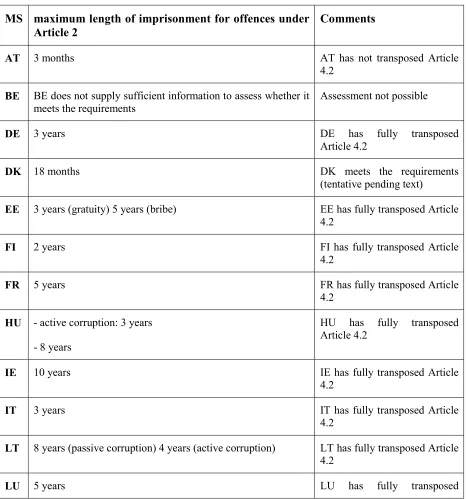
This Article of the Framework Decision is more extensive than the equivalent Article of the Joint Action. In addition to repeating the earlier requirements that offences should be punishable by criminal penalties which are "effective, proportionate and dissuasive", it requires Member States to have in place a "minimum-maximum" range of at least one and three years imprisonment as a penalty for the offences of active and passive corruption, and omits any reference to the provision of other kinds of penalties for minor cases of active or passive corruption. Article 4 (3) is innovative in that it sets out a requirement that Member States, in accordance with their constitutional rules and principles, provide in certain circumstances for the temporary prohibition of natural persons from carrying on that particular or comparable business activity in a similar position or capacity.
Article 5 – Liability of legal persons
Whereas the Joint Action provided for the liability of legal persons in relation to active corruption, the Framework Decision extends this provision to include passive corruption. Article 6 – Penalties for legal persons
This Article of the Framework Decision repeats its predecessor in the Joint Action (the one difference is the replacement of the word "sanctions (JA)" with "penalties" (FD)).
Article 7 – Jurisdiction
This is a standard feature of such instruments, and any differences reflect developments in language between 1998 and 2003.
Adoption of the Framework Decision
- Germany made two statements:
(1) "Germany declares that the term "in course of business activities" in Article 2(1) of the Framework Decision on combating corruption in the private sector is interpreted in the sense that reference is made to activities in relation to the purchase of goods or commercial services."
(2) "Pursuant to Article 2 (3) of the Framework Decision, Germany declares that it will limit the scope of paragraph 1 of that Article to conduct which involves, or could involve, a distortion of competition in relation to the purchase of goods or commercial services."
- Statement by Ireland:
"Ireland declares that the definition of "breach of duty" in Article 1 of the Framework Decision on combating corruption in the private sector, which refers to "disloyal behaviour", does not encompass "whistle-blowing activities"."
- Statement by Italy:
"Pursuant to Article 2(3) of the Framework Decision, Italy declares that it will limit the scope the paragraph 1 of that Article to conduct which involves, or could involve, a distortion of competition in relation to the purchase of goods or commercial services."
Method
Although the Framework Decision was adopted in 2003, that is prior to the 2004 enlargement, all 25 Member States come within the scope of the report.
Two Member States (NL, FI) met the transposition deadline of 22 July 2005 set out at Article 9 of the Framework Decision. Nevertheless, reflecting the large number of replies subsequently received, the report also takes into account the replies from a total of 23 Member States. Two Member States have not replied to date, namely CY and MT. Furthermore, 3 MS which replied either provided a copy of their draft legislation (CZ), an analysis of which is provided at section 2.2 of this Report, or simply stated that draft legislation was in preparation (EL and ES).
The Report concentrates on Articles 1 to 7 (with a brief reference to Article 10 where relevant), and records the Declarations made by Member States under Articles 2 and 7. It does not discuss Articles 8, 9 nor 11 as these provisions do not require implementation.
The evaluation criteria adopted by the Commission for this Report are the general criteria adopted in 20019 to evaluate the implementation of framework decisions (practical effectiveness, clarity and legal certainty, full application and compliance with the time limit for transposition). Secondly, criteria specific to this Framework Decision are also used, and further details are provided in the context of the analysis of the individual Articles at Section 2.
2. ANALYSIS OF NATIONAL MEASURES TAKEN TO
COMPLY WITH THE FRAMEWORK DECISION (FD)
2.1 National Measures
Setting the scene: compliance with Article 9(2)
Article 9(1), Framework Decision required Member States to take the necessary measures to comply with the provisions of this Framework Decision before 22 July 2005. Article 9 (2) required them to transmit to the General Secretariat of the Council and the Commission the text of the provisions transposing into national law the obligations imposed on them under this Framework Decision.
Two (NL, FI) MS issued their responses and supplied their legislation to the Commission before the due date, and indeed NL was the first to reply, forwarding its details as early as September 2003. A further 21 MS (AT, BE, CZ, DE, DK, EE, EL, ES, FR, HU, IE, IT, LT, LU, LV, NL, PL, PT, SK, SI, UK) have subsequently responded.
Of all respondents to date, 16 MS (BE, DE, DK, EE, FI, FR, HU, LT, LU, LV, NL, PL, PT, SE, SI, UK) had either developed the view that their existing legislation was sufficiently comprehensive in this regard, or had put in place additional measures for this purpose. Of course, the question of whether or not the legislation which MS either already had in place or introduced actually meets the requirements of the FD is the subject of this report.
A further 7 respondents (AT, CZ, EL, ES, IE, IT, SK) stated that they were in the process of putting full or partial measures in place. EL's response was in the form of a brief letter, informing the Commission that the Minister for Justice had established a special legislative preparatory committee which expected to complete its task by the end of September 2005. ES's response was also brief, indicating that it was preparing the relevant modifications to its penal code. The Commission notes with concern that neither EL nor ES have provided any further information to date.
CZ forwarded to the Commission draft legislation in respect of all Articles, except Articles 5 and 6, FD. It stated that:
"On 2 November 2004 the Chamber of Deputies of the Czech Republic rejected the Government Draft Act on criminal liability of legal persons, aiming to introduce into Czech legislation the concept of liability of legal persons for criminal offences. This Act was meant to be part of the recodification of the criminal substantive law. At present another way of addressing the issue of criminal liability of legal persons is being sought."
The remaining MS, IE, informed the Commission that it would require new national measures to meet one aspect of Article 2 – to introduce the concept of corruptly offering "advantage"; and to meet Articles 5.2 and Article 7 (1) (c). These issues would be addressed in a forthcoming Criminal Justice (Miscellaneous Provisions) Bill, which was currently being drafted.
It is noted that 2 MS (CY MT) have not yet responded. While the overall response rate is comparatively high, yet it is a matter for concern that these MS have not yet provided any information on their situation to the Commission, despite the obligation set out in Article 9 of the FD.
Table showing Date of notification by MS
MS Date on letter of notification from MS Legislation Met
transposition date?
Y=yes
AT 05 August 2005 - Text of legislation received did not indicate date of enactment.
- Legislation to meet requirements of Articles 5 and 6 under preparation
BE 19 September 2005 Takes the view that its legislation was already in conformity
CZ 05 September 2005 Draft legislation supplied for all Articles except Articles 5 and 6
DE 18 August 2005 Takes the view that its legislation was already in conformity
DK 26 July 2005 Takes the view that its legislation was already in conformity
EE 28 December 2005 Text of legislation received did not indicate date of enactment
EL 05 September 2005 Legislation is at an early stage of preparation
ES 06 December 2005 Legislation is under preparation
FI 20 July 2005 Legislation addressed all Articles of FD Y
FR 06 September 2005 Updated its legislation with Law No. 2005-750 of 4 July 2005
HU 02 October 2006 Takes the view that its legislation was fully in place before 22 July 2005
Articles 2 (one aspect), 5 and 6 under preparation
IT 21 November 2005 Legislation in place to meet all Articles except Articles 5 and 6, FD
LT 05 September 2005 Text of legislation received did not indicate date of enactment
LU 15 September 2005 Updated its legislation by law of 23 May 2005
LV 16 September 2005 Updated its legislation to meet requirements of FD
NL 04 September 2003 Takes the view that its legislation conformed with the FD
PL 7 September 2005 (and notification of declaration received separately, dated 21 September 2005
Text of legislation received did not indicate date of enactment
PT 2 September 2005 Updated its legislation by law of 28 November 2001
SE 19 July 2005 Takes the view that its legislation conformed with the FD
Y
SK 22 July 2005 Updated its legislation, except Articles 5 and 6, FD
SI 13 September 2005 Text of legislation received did not indicate date of enactment
UK 05 December 2005 Takes the view that its legislation conformed with the FD
Article 9 (2), FD required Member States to transmit to the General Secretariat of the Council and the Commission the text of the provisions transposing into their national law the obligations imposed on them under the FD. Many Member States provided some form of cover note in which they drew attention to any Declarations they wished to make, others used the opportunity of supplying a cover note and concordance table in which they explained the general and particular approach taken in their legislation, supported by relevant legislative references. As regards the obligation to transmit the text of their transposing provisions, DK did not provide any text to support what was nevertheless a very detailed commentary, while a number of other MS made partial omissions. These are indicated in more detail when the relevant measures are discussed.
The following general comments are also of note:
- DK informed the Commission that it had already amended its legislation to meet the terms of a number of international instruments on corruption and of the 1998 Joint Action. These amendments were incorporated into section 299(2) of the Danish Criminal Code. Consequently, DK took the view that it was unnecessary for it to further amend its national law and that it had thereby met the requirement to transpose the FD by the due date. DK had, of course, provided the initiative for the FD.
- LU informed the Commission that it had met the conditions of the FD by introducing new legislation, the Act of 23.05.2005. However, while the net effect of the new law is to enable LU to so do, it is noted that the Act itself does not mention the FD within the list of those instruments which it approves. The instruments listed in the Act are:
- Convention on the Fight against Corruption involving Officials of the European Communities or officials of Member States of the European Union, 1997 (OJ C 195 of 25.06.1997)
- Second Protocol to the Convention on the Protection of the Communities' Financial Interests, 1997 (OJ C 221 of 19.07.1997)
- Council of Europe Criminal Law Convention on Corruption, 1999 (ETS No. 173)
- additional Protocol to the Council of Europe Criminal Law Convention on Corruption, 2003 (ETS No. 191).
- FI confirmed that its national legislation automatically applied in the province of Åland. It should be noted that in some instances, FI supplied multiple versions of certain sections of legislation, dating from different years. In those instances, this analysis has been confined to the most recent version of such sections.
- PT stated that corruption in the private sector was made a criminal offence, and the relevant penalties laid down, in specific criminal legislation, which was inserted into Decree-Law No 28/84 of 20 January 1984 on offences against the economy and public health by Law No 108/2001 of 28 November 2001, that is, in advance of the adoption of the FD.
- The UK informed the Commission that UK law met all the mandatory requirements of the FD. Unless otherwise stated, references to law should be taken as references to the law as applicable in England, Wales, Scotland and Northern Ireland. Otherwise, an explicit reference is given to the application of a law, eg "…(Scotland) Act…".
Article 10, FD
With reference to Article 10, the UK stated that Gibraltar "intends to transpose this measure as soon as legislative time allows" but has not to date supplied the text of the enacted legislation.
Article 1 - Definitions
General Comments
Commission's view is that information on the application of these definitions in national legislation would be extremely useful in order to have clarity on how these concepts are handled in national legislation. In the absence of such information, it is not possible for the Commission to be certain that the FD has been correctly transposed – for example, information on the definition of a "legal person" is essential in relation to analysing the transposition of Article 5.
"Legal person"
Six MS (EE, IE, IT, PL, PT, SL) addressed this definition by supplying direct information. Thirteen MS (AT, BE, DE, DK, FI, FR, LT, LU, LV, NL, SE, SK, UK) did not supply any material. However, where information relevant to this definition was supplied by a MS (BE, DK, FI, HU, LT, UK) for use in the analysis of a later Article of the FD, it has been discussed in this section of the Report.
This definition is identical to that in the earlier Joint Action. Summary table of the transposition
MS Legislation Comments
AT No specific provision has been forwarded.
BE No specific provision has been forwarded in respect of the definition in this Article, but in its commentary on Article 5, FD BE refers to Article 5, Criminal Code which defines legal entities as follows:
"1° les associations momentanées et les associations en participation
2° les sociétés visées à l'article 2, alinéa 3, des lois coordonnées sur les sociétés commerciales, ainsi que les sociétés commerciales en formation
3° les sociétés civiles qui n'ont pas pris la forme d'une société commerciale."
BE meets the requirements of this definition
DE No specific provision has been forwarded
DK No specific provision has been forwarded, but within the context of its reply relating to Article 5, Denmark informs the Commission that Section 26, Criminal Code, provides that all legal persons can be held liable for offences, including joint stock companies, private companies, cooperatives, partnerships, associations, funds, estates, local authorities and state authorities.
DK meets the requirements of this definition.
EE Section 24, Civil Code Act, divides legal persons into legal persons in private law and legal persons in public law. Section 25, Civil Code Act, elaborates on this. In particular, subsection (1) provides that a "legal person founded in private interests and pursuant to an Act…General partnerships, limited partnerships,
public limited companies, commercial associations, foundations and non-profit associations are legal persons in private law" and subsection (3) provides that the provisions concerning legal persons apply to the State and the local governments insofar as not otherwise provided by law.
FI FI did not comment on Article 1 in the concordance table which it supplied. However, it is noted that within the legislation texts supplied, Section 1 of Chapter 9, Criminal Code, which deals with the scope of the legislation on corporate criminal liability, refers to "a corporation, foundation or other legal entity".
FI meets the requirements of this definition
FR No specific provision has been forwarded.
HU No specific provision has been forwarded. However, within the context of its reply relating to Article 2, HU referred to "budgetary agency, economic organization or non-governmental organization" (Articles 251, 252, 254 Criminal Code).
HU meets the requirements of this definition.
IE The relevant legislation is section 11(c), Interpretation Act 1937 definition of "person" and section 9, Prevention of Corruption (Amendment) Act 2001.
The Interpretation Act 1937 defines certain terms for legislative purposes. Section 11(c) provides that the term "person" shall, unless legislation provides otherwise, be construed as meaning a body corporate (whether a corporation aggregate or a corporation sole) and an unincorporated body of person as well as individuals. Section 9, Prevention of Corruption (Amendment) Act 2001 deals with the liability of legal persons in relation to the Prevention of Corruption Acts, 1889 to 2001.
IE meets the requirements of this definition
IT IT informed the Commission that the relevant legislation is section 1, Legislative Decree 231 of 8.6.2001, and sections 12 and 13 of the Civil Code.
Section 1, Legislative Decree 231 of 8.6.2001, provides for the liability of legal persons, including companies and private associations not enjoying legal personality, in respect of offences by their employees. Section 12, Civil Code describes how associations, foundations and other private bodies acquire legal personality, while section 13, Civil Code states that companies shall be governed by Book V (sections 2247 onwards).
IT also provided details of the legislation relating to public legal persons, which however is not relevant to this FD.
IT meets the requirements of this definition
LT LT informed the Commission that the definition of "legal person" was provided in Book II of the Civil Code, but without supplying
the relevant text. It did however supply the text of Article 20(5) of its Criminal Code, which excludes the State, municipalities and public international organisations.
LU No specific provision has been forwarded.
LV No specific provision has been forwarded.
NL No specific provision has been forwarded.
PL States that it has transposed this Article by means of Article 2, Criminal Liability of Bodies Corporate Act of 28 October 2002.
Article 2 (1), Criminal Liability of Bodies Corporate Act of 28 October 2002 defines a body corporate within the meaning of the Act as including a legal person and an entity without legal personality which is accorded legal capacity by separate provisions but excludes the State Treasury, local government bodies and their associations.
PL meets the requirements of this definition.
PT PT informed the Commission that Portuguese law does not contain a separate definition of "legal person", but that legal person is accordingly defined by way of Articles 157 and 158, Civil Code which specify which entities have legal personality. Article 157 deals with associations which do not have for their object the profit of the partners, to social foundations and similar bodies, while Article 158 deals with the acquisition of legal personality. In addition, Article 5, Commercial Companies Code provides that companies shall enjoy legal personality from the date of the final registration of their formation agreement.
PT meets the requirements of this definition
SE No specific provision has been forwarded.
SK No specific provision has been forwarded.
SI SI informed the Commission that the definition of legal person is not contained in one single regulation but is defined in various sectoral laws for specific legal spheres. Accordingly, the Criminal Liability of Legal Entities Act (OJ RS No. 98/04 – official consolidated text does not provide a single definition of "legal person". For this reason, with regard to the liability of legal persons for criminal offences, any entity having the status or condition of "legal person" under law in any sphere is treated as a "legal person".
Article 2 (b), Criminal Liability of Legal Entities Act provides that, with the exception of the Republic of Slovenia and local self-governing communities, "the statute may stipulate that for a specific criminal offence all or only certain types of legal person are liable, thereby enabling the stipulation of "delicta propria" for
legal persons too".
SI states that liability for a criminal offence can never be prescribed by citing individual legal persons but by defining a narrow circle of legal persons with regard to type in such a way that the law applies equally to all legal persons from this narrow circle. As of September 2005, no sectoral law yet contained such provisions.
UK No specific provision has been forwarded. However, in its response in relation to Art. 5, FD the UK informed the Commission that the word "person" in a statute is to be construed as including a "body of persons, corporate or incorporate" (Schedule 1, Interpretation Act 1978).
The UK meets the requirements of this definition.
"Breach of duty"
Article 1 of the 1998 Joint Action contained three definitions – the first of which, a definition of "person", was not included separately within the Framework Decision, but incorporated into the definition of "breach of duty" – see below.
The definition of "breach of duty" in the Framework Decision incorporates a definition of "person" which closely reflects the inclusive approach taken in the 1998 Joint Action but deletes the time-related aspect of the definition, by now referring to a person "who in any capacity directs or works for a private sector entity" (FD) rather than to a person "when directing or working in any capacity for or on behalf of a natural or legal person operating in the private sector" (JA).
Seven MS (EE, HU, IE, LT, PL, PT, SI) provided either a definition or commentary on this definition. However, information relevant to this definition was supplied by 3 MS (BE, FR, NL) in respect of another Article, and has been included in this analysis.
IE entered a Declaration in the minutes of the Council (see footnote (1) above), as follows: "Ireland declares that the definition of "breach of duty" in Article 1 of the Framework Decision on combating corruption in the private sector, which refers to "disloyal behaviour", does not encompass "whistle-blowing activities".
Summary table of the transposition
MS Legislation Comments
AT No specific provision has been forwarded.
BE No specific provision has been forwarded in respect of the definition in this Article, but in its commentary on Article 2, FD BE refers to Article 504bis §1 and §2, Criminal Code which use the following definition ""à l'insu et sans l'autorisation, selon le cas, du Conseil d'administration ou de l'Assemblée générale, du mandant ou de l'employeur."
DE No specific provision has been forwarded.
DK No specific provision has been forwarded.
EE EE informs the Commission that its legislation covers any lawful or unlawful act or omission by an official (as defined in Section 288 Criminal Code and thereby including certain persons in a legal person in private law – for further elaboration see Article 2 below) committed by taking advantage of his or her official position if it is done in exchange for a bribe or gratuity (or promise/offer of such).
EE does not provide any text nor any reference to legislation to support this information.
EE appears to meet the requirements of this definition
FI No specific provision has been forwarded.
FR No specific provision has been forwarded. However, at Article 445-1, Criminal Code the phrase "en violation de ses obligations légales, contractuelles ou professionnelles" is used.
FR meets the requirements of the definition
HU HU commented that in its criminal law, "breach of duty is not a precondition for determining the liability of a legal person".
It is noted that the information supplied does not define "breach of duty" nor indicate how it relates to the liability of a natural person.
HU did not supply sufficient information for an assessment of whether it meets the requirements of this definition.
IE The relevant legislation is section 1(2), Prevention of Corruption (Amendment) Act 2001 together with section 1(1) to 1(3) of the Prevention of Corruption Act 1906, as inserted by section 2 of the Prevention of Corruption (Amendment) Act, 2001.
Section 1(2), Prevention of Corruption (Amendment) Act 2001 provides that references in the legislation to an act include references to an omission and references to the doing of an act include references to the making of an omission. Section 1(1) and 1(2) of the Prevention of Corruption Act 1906, as inserted by section 2 of the Prevention of Corruption (Amendment) Act, 2001 are the sections which provide for the offences of passive and active corruption respectively, while section 1(3) creates the offence of intentionally giving or using a false or erroneous document with a view to misleading the principal, including an
IE's Declaration is noted.
employer.
In sections 1(1) and 1(2), the concept of "breach of duty" is addressed by the phrase "doing any act or making any omission in relation to his or her office or position or his or her principal's affairs or business". In section 1(3), it is addressed by the phrases "with intent to deceive his or her principal" and "is intended to mislead the principal".
IE entered a Declaration in the Council minutes, that the phrase "disloyal behaviour" does not encompass "whistle-blowing activities".
IT No specific provision has been forwarded.
LT LT informed the Commission that it considers that its formulation "for the performance of any lawful act or omission in the execution of his/her powers" (eg Section 225 (1) Criminal Code refers) (Note: "unlawful act" is mentioned at Section 225 (1) Criminal Code) is sufficiently broad to meet the scope of the definition of "breach of duty".
LT meets the requirements of the definition
LU No specific provision has been forwarded.
LV No specific provision has been forwarded.
NL No specific provision has been forwarded. Later, in relation to Article 2 (1) however, NL informed the Commission that its use of the concept "concealment constituting a breach of trust", as used at section 328b (2), Criminal Code, is the equivalent under national law of the concept of "breach of duty".
NL meets the requirements of this definition.
PL States that it has transposed this Article by means of Article 296a, Criminal Code.
Article 296a, Criminal Code, which is the Article which penalises active and passive corruption, addresses this concept by the use of the terms "act of unfair competition" and "inadmissible preferential action".
PL meets the requirements of this definition.
PT PT informed the Commission that Portuguese law does not contain a separate definition of "breach of duty", but that it can be assumed that there is a breach of duty whenever the official duties of each activity or profession as laid down by law or by statutes are breached. Examples are given from 121(1) (d) and (2), Labour Code and Articles 36 and 37, Criminal Code. Article 121(1) (d), Labour Code is framed in broad terms,
requiring workers to carry out orders and instructions from their employer in all aspects relating to the performance and discipline of their work, except where contrary to their rights and privileges, with subsection (2) clarifying that such orders and instructions may be given either directly by the employer or by the worker's superior. Articles 36 and 37, Criminal Code address conflicts of duties, disobedience to an order or instruction where it would lead to a crime being committed, and non-liability where one carries out an order without realising it will lead to the commission of a crime.
SE No specific provision has been forwarded.
SK No specific provision has been forwarded.
SI SI informs the Commission that breaches of duty are defined in sectoral laws. In relation to corruption, it points out that breach of duty is an element of the criminal offence of unlawfully accepting gifts (Article 247, Criminal Code) and of unlawful giving of gifts (Article 248, Criminal Code) respectively.
SI does not provide supporting text from its sectoral laws, nor in its comments does it provide further information abut these definitions.
There is insufficient information to assess whether or not SI meets the requirements of this definition.
UK No specific provision has been forwarded.
Article 2 – Active and passive corruption in the private sector
General comments
Article 2 is a significant Article of the 2003 Framework Decision (FD) which not only combines the definitions and offences relating to active and passive corruption respectively, formerly dealt with in separate Articles (Articles 2 and 3) of the 1998 Joint Action (JA), but weakens the limitation on the scope of the offences which were previously linked to the internal market.
A key development in the FD comes at Article 2 (3). Where previously the JA (at Article 3 (2)) had provided that Member States' measures "shall at least cover such conduct which involves, or could involve, the distortion of competition, as a minimum within the common market, and which results, or might result, in economic damage to others by the improper award or improper execution of a contract", the FD partially removes this facility. At Article 2 (3), the FD provides that a Member State may limit the scope of the criminal offences of active and passive corruption to conduct involving a distortion of competition but requires that it provide a declaration to this effect, and Article 2 (4) of the FD not only provides for the communication of such a declaration to the Council when the FD is adopted, but limits their validity to five years from 22 July 2005, while Article 2 (5) requires the Council, before that deadline expires, to review whether or not such declaration(s) may be renewed.
Summary table of transposing legislation adopted by Member States
MS Legislation Measures which appeared relevant to
Commission's analysis (where different to MS' citations)
AT - Section 10, Federal Act against Unfair Competition, 1984
- sections 153, 153a, 304-308, Code of Criminal Procedure
- Section 10, Federal Act against Unfair Competition, 1984
- sections 153a, 309, Code of Criminal Procedure
BE - Article 504bis, §1 and §2, Criminal Code
DE - section 299, Criminal Code
DK - section 299(2), Criminal Code
EE - sections 288, 293-298, Criminal Code
FI - sections 7 and 8, Chapter 30, Criminal Code - section 7, Chapter 30, Criminal Code as inserted by Act No. 769, 1990
- section 8, Chapter 30, Criminal Code as inserted by Act No 769, 1990 and amended by Act No. 604, 2002
FR - Articles 445-1 and 445-2, Criminal Code, inserted by Law No. 2005-750 of 4 July 2005
HU - sections 251-254, 256 of Act IV of 1978, Criminal Code
- sections 251, 252, 254, 256 of Act IV of 1978, Criminal Code
IE - section 1, Prevention of Corruption Act 1906, as inserted by section 2, Prevention of Corruption (Amendment) Act 2001
IT - section 2635, Civil Code
LU - Articles 310 and 310-1, Criminal Code
LV - Chapter XIX, Special Part "Criminal Offences of an Economic Nature", Criminal Code
- sections 198 and 199, Chapter XIX, Criminal Code
NL - sections 46a and 328b, Criminal Code
PL - Articles 115 and 296a, Criminal Code
PT - Articles 41b and 41c of Decree-Law No. 28/84 as amended by Law No. 108/2001
SE - Chapter 17 – section 7 and Chapter 20-section 2, Criminal Code
SK - sections 160-162, Criminal Code
SI - Articles 126, 247 and 248, Criminal Code
UK - section 1, Prevention of Corruption Act, 1906
Methodology for the analysis of Articles 2 (1) (a) and 2 (1) (b), FD
The most complex and detailed analysis of the FD centred on Articles 2 (1) (a) and 2 (1) (b), FD. The chapeau gives the general context that the conduct must be intentional, and that it must have taken place in the course of business activities. Then paragraphs (a) and (b) were broken down into 7 constituent elements for analysis:
Article 2 1 (a) active corruption - "promising, offering or giving" - "directly or through an intermediary"
- "a person who in any capacity directs or works" - "private-sector entity"
- "an undue advantage of any kind" -"for that person or for a third party"
- "perform or refrain from performing any act, in breach of that person's duties" Article 2 1 (b) passive corruption
- "directly or through an intermediary"
- "for oneself or for a third party"
- "while in any capacity directing or working" - "private-sector entity"
- "perform or refrain from performing any act, in breach of that person's duties"
It was considered that analysing MS' national measures against this yardstick would balance the nature of Framework Decisions (Article 34 (2) (b), TEC refers), which leave to MS the choice of form and methods, with the necessity to have a clear framework for assessing the comprehensiveness and accuracy of the transposition.
With regard to non-profit entities, even where a MS did not refer to a specific measure, if relevant material could be found elsewhere, eg in relation to Article 5 on liability of legal persons, this was used.
Where MS had lodged Declarations, either formally at Council or by letter with their transposition material, these have been taken into account.
Summary account of the transposition
Article 2 proved highly problematic for MS. Only 2 MS (BE and the UK) correctly transposed every element of Article 2. As can be seen from the Tables which conclude this section, a large proportion of MS had difficulty in fully meeting each of the individual elements of Article 2.1.
There was a particular difficulty for MS in comprehending the meaning of the phrases "directly or through an intermediary" and "for that person or for a third party". National measures either omitted to refer to intermediaries (10 MS – AT, DE, EE, FI, HU, IT, NL, PL, SE, SI) or to third parties (6 MS – AT, EE, FR, HU, IT, NL) or changed the focus of the offence to provide for the liability of the intermediary (2 MS – EE, FI). It is of course open to MS to provide for such additional liabilities, but they also need to provide for the requirements of the Article itself.
Taking the example of active corruption under Article 2 1 (a), a simplified version of the offence would provide for the liability of person "A" who promises an undue advantage to person "B"
- by promising the undue advantage directly to person "B" for person "B"'s own use
- by promising the undue advantage through an intermediary (person X) to person "B" for person "B"'s own use
- by promising the undue advantage directly to person "B" for someone else's use (person "Y")
- by promising the undue advantage through an intermediary (person X) to person "B" for someone else's use (person "Y")
which provides for the liability of persons "X" or "Y" is exercising their right to go beyond the requirements of the FD to provide for additional offences.
There were also problems with Article 2.2, in particular a lack of information on which to base any analysis.
Article 2.1(a)
The requirement on Member States to establish criminal offences of active and passive corruption in relation to business activities in the private sector is set out in Article 2 (1). To facilitate analysis, legislation was considered against a framework of the 7 elements of the description under Article 2 1 (a) (active corruption) and 2 1 (b) (passive corruption) respectively. As most Member States' legislation was very similar for both, the following comments focus only on the active corruption offence (Article 2 1 (a)).
- "promising, offering or giving"
Eleven Member States met this requirement, but 7 (EE, HU, IT, NL, PL, PT, SK) omitted "offering", LU omitted "giving" and LV omitted "promising".
- "directly or through an intermediary"
All 20 Member States provide for direct corruption. But 8 Member States either omitted intermediaries (AT, DE, FI, IT, NL, PL, SE, SI) or changed the focus of the offence to provide for the liability of the intermediary (EE) instead of the person using the intermediary. - "a person who in any capacity directs or works"
Certain Member States did not address the full scope of "directs" (AT, DE, LV, SE) or "works" (IT, LU, LV, PL) while EE did not provide information on this point.
- "private-sector entity"
This was clearly addressed by 18 Member States, but EE did not supply information while LU did not supply a definition of the term "legal entity".
- "an undue advantage of any kind"
Fourteen Member States meet this requirement. But 5 (DE, EE, FI, LT, NL) do not address intangible benefits. IE indicated that it was preparing legislation on this point.
-"for that person or for a third party"
While FR and EE did not provide information on this point, 16 Member States criminalise giving etc an advantage for a person or for a third party, but IT and NL omit the element of the third party from their legislation.
- "perform or refrain from performing any act, in breach of that person's duties"
With regard to individual MS, the Commission draws particular attention to the following situations, which in its view unduly narrow the scope of the FD:
- Italian legislation takes a narrower approach than the FD in the following two respects: the overall context of the offences of both active and passive corruption is that the act or omission causes a loss to the company of the directors etc. making the act or omission
in relation to both active and passive corruption, section 2635 (3), Civil Code confines the taking of proceedings to situations where the person who sustains the loss makes a claim. - LT in addition to providing exemption from criminal liability in the case of a bribe promised or paid with the knowledge of a law-enforcement body, provides two further exemptions which are problematic:
where the person was required or provoked into paying a bribe
where the person has offered, promised or paid a bribe, but forthwith informed a law-enforcement agency (Article 227, Criminal Code refers).
- NL requires that, for the offence to take place, the person who receives the gift must have concealed it from his employer or mandator;
- PL links the offence to the concept of causing material loss to one's business organisation, which does not appear to fully address the situations envisaged under its Declaration and the terms of Article 2(3), FD as distortion of competition could cause a gain to one's business organisation, not just a loss;
- SE legislation provides that a prosecution may only be taken in respect of active corruption in the private sector "if the crime is reported for prosecution by the employer or principal of the person exposed to bribery or if prosecution is called for in the public interest". A similar provision does not exist in respect of passive corruption in the private sector. Nevertheless, the Commission considers that the existence of such a provision is a limitation on the scope of the FD.
Furthermore, a particular difficulty was experienced in attempting to analyse EE's legislation by virtue of its brevity. The two offences of active corruption are described as follows:
"Granting or promising a gratuity is punishable…"(section 297, Criminal Code) "Giving or promising a bribe is punishable…" (section 298, Criminal Code)
In the absence of further information either in the legislation or by means of an accompanying commentary (none was provided) it was impossible to carry out a full analysis of EE's transposing legislation in respect of Article 2 1 (a).
Finally, attention is drawn to an additional offence provided for by FR. FR provides that it is an offence for a person to give a bribe to someone who requests it (Article 445-1 2nd paragraph, Criminal Code)
(A) AT - FR AT Dec BE Dec DE Dec
DK EE FI FR
promising offering or giving
Y Y Y Y Partly
Does not address "offering"
Y Y
directly or through an intermediary
Partly Does not address "through an intermediary"
Y Partly
Does not address "through an intermediary"
Y Partly
Appears to place a liability on the
intermediary rather than on the person acting through the intermediary
Partly Does not address "through an intermediary"
Y
a person who in any capacity directs or works
Partly Does not meet
"directs"
Y Partly
Does not meet
"directs"
Y N
No
information supplied
Y Y
private-sector entity
Y Y Y Y N
No
information supplied
Y Y
an undue advantage of any kind
Y Y Partly
Does not appear to fully meet "an undue advantage of any kind"
Y Partly
Does not appear to fully meet "undue advantage of any kind"
Partly Not clear that intangible benefits are included, does not appear to fully meet "undue advantage of any kind"
Y
for that person or for a third party
Y Y Y Y N
No
information supplied
Y N
No
perform or refrain from performing any act, in breach of that person's duties
Y Y Partly
Unclear whether term "unfair manner" fully meets "in breach of that person's duties"
Y N
No
information supplied
Y Y
Fully meets 5 requirements
Fully meets 7
requirements
Fully meets 3 requirements
Fully meets 7
requirements (legn not supplied)
Fully meets 0
requirements
Fully meets 5 requirements
Fully meets 5
requirements
(B) HU - NL
HU IE IT LT LU LV NL
promising offering or giving
Partly Does not address "offering"
Y Partly
Does not address "offering"
Y Partly
Does not address "giving"
Partly Does not address "promising"
Partly Does not address "offering"
directly or through an intermediary
Y Y Partly
Does not address "through an intermediary"
Y Y Y Partly
Does not address "through an intermediary"
a person who in any capacity directs or works
Y Y Partly
Does not fully address "works"
Y Partly
Does not address "works"
Partly Does not fully address "directs" or "works"
Y
private-sector entity
Y Y Y Y Partly
Lacks definition of "legal entity"
Y Y
an undue advantage of any kind
Y Partly
(IE is preparing legn on this point)
Y Partly
Not clear that
intangible benefits are included
Y Y Partly
for that person or for a third party
Y Y Partly
Does not address "third party"
Y Y Y Partly
Does not address "third party"
perform or refrain from performing any act, in breach of that person's duties
Partly Unclear if "refrain" is included
Y Y Partly
Does not appear to include acts or
omissions, in breach of that person's duties
Y Y Y
Fully meets 5
requirements
Fully meets 6
requirements
Fully meets 3 requirements
Fully meets 5
requirements
Fully meets 4
requirements
Fully meets 5
requirements
Fully meets 3 requirements
(C) PL – UK PL Dec
PT SE SK SI UK
promising offering or giving
Partly Does not address "offering"
Partly Does not address "offering"
Y Partly
Does not address "offering"
Y Y
directly or through an intermediary
Partly Does not address "through an intermediary"
Y Partly
Does not address "through an intermediary"
Y Partly
Does not address "through an intermediary"
Y
a person who in any capacity directs or works
Partly Does not address "works"
Y Partly
Does not fully meet "direct"
Y Y Y
private-sector entity
Y Y Y Y Y Y
an undue advantage of any kind
for that person or for a third party
Y Y Y Y Y Y
perform or refrain from performing any act, in breach of that person's duties
Partly Does not address "refrain"
Y Partly
Does not address "refrain"
Y Partly
Does not address "refrain" in Art. 248(2)
Y
Fully meets 3 requirements
Fully meets 6
requirements
Fully meets 4 requirements
Fully meets 6
requirements
Fully meets 5 requirements
Fully meets 7
requirements
Article 2.1(b)
In addition to the situations mentioned under Article 2.1 (a) above, the Commission draws particular attention to the following situations:
- AT provides for two offences of passive corruption, one of which relates to a person who exercises powers conferred by administrative decision, and is limited by the possibility of renouncing one's corrupt act (section 153a, Code of Criminal Procedure). There is no provision for such a limitation in Article 2, FD.
- HU provides for an additional offence, that of an employee or member of a body "who agrees with the party requesting or accepting the advantage" (Articles 251(1) and 252(1), Criminal Code, refer). It would appear that this offence addresses those situations where a colleague collaborates with the person who is in receipt of the undue advantage.
Tables providing details of the transposition of Article 2 (1) (b) passive corruption (A) AT - FR
AT Dec
BE DE
Dec
DK EE FI FR
directly or through an intermediary
Partly
Does not address "through an intermediary"
Y Partly
Does not address "through an intermediary"
Partly Does not address liability of person seeking the bribe through an intermediary
Partly Appears to place a liability on the
intermediary rather than on the person acting through the
Partly Appears to place a liability on the
intermediary rather than on the person acting through the
intermediary intermediary
requesting or receiving…or accepting the promise of
Partly
Does not include "receiving"
Y Y Partly
Does not include "accepting the promise of"
Partly Does not address "requesting"
Partly Does not address "accepting the promise of"
Y
an undue advantage of any kind
partly
One of the two relevant sections, s153a, only refers to financial advantage
Y Partly
Not clear that it fully addresses "undue advantage of any kind"
Y Partly
Does not fully address "undue advantage of any kind"
Partly Does not fully address "undue advantage of any kind"
Y
for oneself or for a third party
Partly
Does not address element of "third party"
Y Y Y Partly
Does not address "third party"
Y N
No
information supplied
while in any capacity directing or working
Partly
Does not include element of "directing"
Y Partly
Does not include element of "directing"
Y Partly
Definition does not appear to fully address "working"
Y Y
private-sector entity
Partly
One of the two relevant sections, s153a, does not define
"whoever…powers conferred on him by administrative decision"
Y Y Y Y Y Y
perform or refrain from performing any act, in breach of that person's duties
Partly
One of the two relevant sections, s153a, does not address element of "breach of duty"
Y Partly
Unclear whether term "unfair manner" fully meets "in breach of that person's duties"
Y Partly
Does not fully meet "any act"
Y Y
Fully meets 0 requirements
Fully meets 7
requirements
Fully meets 3 requirements
Fully meets 5
requirements
Fully meets 1
requirement
Fully meets 4
requirements
Fully meets 6
(legn not supplied)
(B) HU – NL
HU IE IT LT LU LV NL
directly or through an intermediary
Partly Does not address "through an intermediary"
Y Partly
Does not address "through an intermediary"
Y Y Y Partly
Does not address "through an intermediary"
requesting or receiving…or accepting the promise of
Y Y Y Y Y Partly
Does not address "requesting"
Partly Does not address "requesting" or
"receiving"
an undue advantage of any kind
Y Y Y Partly
Not clear that
intangible benefits are included
Y Y Partly
Not clear that intangible benefits are included
for oneself or for a third party
Partly Does not address "third party"
Y Partly
Does not address "third party"
Y Y Y Partly
Does not address "third party"
while in any capacity directing or working
Y Y Partly
Does not fully address "work"
Y Partly
Does not address "works"
Partly Does not address "directing" nor fully address "working"
Y
private-sector entity
Y Y Y Y Partly
Lacks definition of "legal entity"
Y Y
perform or refrain from performing any act, in
Partly Does not address
Y Y Partly
Does not appear to
Y Y Partly
breach of that person's duties
"omission include
unlawful act or omission
receipt of gift etc AFTER the act or omission (unlike active corruption which covers gift etc both before and after) Fully meets 4
requirements
Fully meets 7
requirements
Fully meets 4 requirements
Fully meets 5
requirements
Fully meets 5
requirements
Fully meets 5
requirements
Fully meets 2 requirements
(C ) PL - UK PL Dec
PT SE SK SI UK
directly or through an intermediary
Partly Does not address "through an intermediary"
Y Partly
Does not address "intermediary"
Y Partly
Does not address "through an intermediary"
Y
requesting or receiving…or accepting the promise of
Partly Does not include "requesting"
Y Y Partly
Does not address "receiving"
Partly Does not address "offer", while section 247(3) also omits "promise"
Y
an undue advantage of any kind
Y Y Y Y Y Y
for oneself or for a third party
Y Y Y Y Y Y
while in any capacity directing or working
Partly Does not address "working"
Y Partly
Does not address "directing"
Y Y Y
private-sector entity
perform or refrain from performing any act, in breach of that person's duties
Partly Does not address "refrain"
Y Partly
Does not address "refrain"
Y Partly
Section 247 does not address "refrain"
Y
Fully meets 3 requirements
Fully meets 7
requirements
Fully meets 4 requirements
Fully meets 6
requirements
Fully meets 4 requirements
Fully meets 7
requirements
Article 2.2
MS took different approaches to this Article. Some made explicit reference to the inclusion of non-profit entities within the scope of their legislation, while others worded their legislation in such a broad way that non-profit entities were not excluded.
SI took the approach of describing the offences of active and passive corruption in the context of the performance of a "commercial activity", which was then defined in a separate Article of its Criminal Code.
Article 2.3
With regard to the possibility of making a Declaration under Article 2.3, only 4 MS (AT, DE, IT, PL) did so.
AT informed the Commission that "In as far as Article 2 is not transposed by those provisions, the exception clause of paragraph 3 is used." It is the Commission's view that this is a very vague Declaration, which seems entirely inadequate given the doubts expressed in the analysis of its transposition of Article 2.1(a) and 2.1(b), in particular as the legislation cited by AT in its response concerning those Articles does not appear to provide for a criminal offence of active and passive corruption even for conduct in the private sector which "involves or could involve, a distortion of competition in relation to the purchase of goods or commercial services, that is, AT does not appear to have even met the standards of the JA. Summary table of the transposition of Article 2
MS Article 2 (1) (a)
Article 2 (1) (b)
Article 2.2 Article 2.3 Comments
AT AT meets 5 requirements
AT does not fully meet any requirement, on the basis of the
information supplied
AT does not supply sufficient
information to assess whether it meets the requirements.
AT makes a Declaration: "In as far as Article 2 is not transposed
by those
provisions, the exception clause of paragraph 3 is used.
AT's
Declaration is noted.
AT has not fully