Copyright © 1994,American Society for Microbiology
Expression and Purification of the Mouse Mammary Tumor Virus
gag-pro
Transframe Protein p30 and
Characterization
of Its dUTPase Activity
BRITTA KOPPE,, LUIS MENENDEZ-ARIAS,* AND STEPHENOROSZLAN
Laboratory ofMolecular Virology and Carcinogenesis, ABL-Basic Research Program, NCI-Frederick Cancer Research and
Development
Center, Frederick,
Maryland
21702-1201Received 16August 1993/Accepted5January 1994
The mouse mammary tumor virus gag-pro transframe protein (p30) contains the nucleocapsid protein domainderived from the3' end ofgag, fused to 154 residues encoded by the 5' region of the pro openreading frame. The DNA coding for p30 was cloned into the plasmid pALTER-1, and an additional nucleotide was inserted bysite-directed mutagenesis toallow theread-throughfrom the gag into the pro open reading frame. Theobtained insert was then cloned into pGEX-2T, aplasmid containing theglutathione S-transferase gene of Schistosoma japonicum and a nucleotide sequence encoding for a thrombin cleavage site. The chimeric protein (GST-p30)was isolated by affinitychromatographyon aglutathione-Sepharose 4Bcolumn, and after thrombin treatment, the excised p30 was further purified on a single-stranded DNA-agarose column. This protein showed dUTPase activity, with only negligible cleavage of dATP, dGTP, dCTP, dTTP, or UTP. Its apparentKmfor dUTP was 28 ,iM. The enzyme was inhibited by EDTA, but its effect could be reversed by
Mg2e
and other divalent cations. dUTPase activity was also detected in purified mouse mammary tumor virus, and p30 was the only protein recognized by antibodies directed towards the carboxyl-terminal sequence of the dUTPasecodingregion.Aminoacidsequencecomparisonsamongproteinsencoded within the retrovirus genome allowed the identification of a novel class ofpolypeptides termed protease-like domains or pseudoproteases, on the basis oftheir similarity to the retro-viral aspartylprotease (20,26).Thesepseudoproteases, which were found only in certain retroviruses (nonprimate lentivi-rusesand type B and type Doncoviruses), appeared to have evolved by duplication of the retroviral protease gene and subsequent divergence (20). However, further analysis re-vealed a number of motifs in their primary structures which were also found in dUTPases encoded by herpesviruses and Escherichia coli (21).
dUTPases are enzymesthat hydrolyze dUTPto dUMP and
PPi.
They play an important role in nucleotide biosynthesis, since the hydrolysis of dUTP generates dUMP, required for the denovosynthesis ofthymidinetriphosphate, which is used as a substrate by DNA polymerases. In addition, dUTPases keep the intracellular concentration of dUTP at a low level, thusreducingtheincorporationofuracil intoDNA.dUTPases are ubiquitous enzymes and have been found in a variety of eukaryotic andprokaryotic organisms, including mammals(16,42), insects (8), plants (28), and bacteria (4, 15), as well as
herpesviruses (41, 43) and poxviruses(3, 34).
In retroviruses, the dUTPase encoding region is located eitherinthepolgene,betweenthe reversetranscriptase
(RT)
and the integrase, as observed in lentiviruses (e.g., felineimmunodeficiency virus [FIV], equine infectious anemia virus
[EIAV],
caprine arthritisencephalitisvirus,and visnavirus),oratthe5' end of the pro open readingframe (ORF),asin type B or D retroviruses. Virus-associated dUTPase activity has been found inpurified EIAVaswellasFIV. Inthelatter, the
*Correspondingauthor.
t Present address:MolecularImmunologyGroup,Nuffield
Depart-ment of Clinical Medicine, John Radcliffe Hospital, Headington, Oxford,UnitedKingdom.
dUTPasehas been expressedinbacteria andshown tocontain enzymatic activity (7). Its molecular mass was 15 kDa, as determined by sodium dodecyl sulfate (SDS)-polyacrylamide
gelelectrophoresis (PAGE). On the otherhand, preparations of Mason-Pfizer monkey virus (MPMV) and simian type D retrovirus SRV-1were also foundtocontain dUTPase activity (7). In thosevirusesaswell as in the mouse mammary tumor virus (MMTV), the dUTPase is encoded within the pro gene and arises from the proteolytic processing of the precursors Gag-Pro and Gag-Pro-Pol. In MMTV, the ribosomal frame-shift occurring at thegag-pro junction is responsible for the
expression ofa30-kDa transframeprotein,termedp30,which contains thenucleocapsid protein domain of Gag, fusedto154 aminoacid residues derived fromthe5' region of theproORF (13). However, its dUTPase activityhas not been reported so far.
Inthispaper, we report ontheMMTVdUTPase, whichwe haveidentifiedasthetransframeproteinp30.Thisproteinwas cloned and expressed with the pGEX-2T vector. pGEX-2T
contains the glutathioneS-transferase (GST) gene of Schisto-soma
japonicum
and a nucleotide sequence encoding for athrombin cleavage site and has been previously used for the
expression of other retroviral enzymes (22, 24). The recombi-nantp30wasfound tohave dUTPaseactivity, and its charac-terization is herein described.
MATERIALS AND METHODS
Viruses.TheC3H strain ofMMTVwasgrownin
Mm5mt/c,
cells andpurified bysucrose
gradient
ultracentrifugation
(23).
Moloney murine leukemia virus was obtained from culture supernatantsofchronicallyinfected NIH 3T3cells,
maintained in Dulbecco's modified Eagle's mediumsupplemented
with 10% calf serum, andpurified
as described above. EIAV (Wyoming strain) was grown in Cf2Th cells andpurified
as previouslyreported(32).Purified MMTV(R-III/CrFK strain)
2313
on November 9, 2019 by guest
http://jvi.asm.org/
2314 KOPPE ET AL.
wassupplied bythe Biological Products Laboratory (Program
Resources Inc., National Cancer Institute-Frederick Cancer Research andDevelopment Center).
Plasmid construction. A747-bp DNAfragment containing
thecoding regionsof thenucleocapsidprotein (NC)and the5' end oftheproORFwassynthesized byPCR.Theplasmid p202 containing part ofthegag-pro-pol genes of MMTV (19) was
usedas atemplate.Twooligonucleotideswereusedasprimers:
(i) 5'CGCGGATCCGCAGCAGCCATGAGAGGA3', which contains the nucleotide sequence of the 5' end of the NC-coding region and a BamHI site, introduced in order to facilitate the following cloning steps, and (ii) 5'CGCGAAT TCAATGTACATGACTTGTIGA3', which contains the 3' end ofthe XcodingregionofproandanEcoRIsite. PCRwas
carriedoutwith the GeneAmpPCRReagentKitfrom Perkin-Elmer Cetus by following the manufacturer's instructions. A Perkin-Elmer 9600 thermalcyclerwasused for 30cycles.After 5 minof incubationat95°C,theinitialfivecycleswere94°C,30 s; 45°C, 30 s; and 72°C, 1 min, and then 25 cycles in which annealingwas done at 55°C. Program wasterminated with a
5-minincubationat72°C.TheobtainedDNAwasanalyzedon
a 1% agarose gel, electroeluted, purified over an Elutip-d
column (Schleicher&Schuell,Keene, N.H.), andcleaved with BamHI andEcoRI. The DNAfragment wasthencloned into the plasmid pALTER-1 (Promega), previously digested with both enzymes. DNA ligations were carried out overnight at
room temperature, with the DNA ligation kit from New England Biolabs (Beverly, Mass.).E. coliDH5otF' competent cells (GIBCO BRL) were transformed, andfreshly prepared
cultures containing the appropriate constructswere
superin-fectedwith thehelperphageR408 andused for theisolationof
a single-stranded DNA (ssDNA) template to be used in mutagenesis reactions.
Since expression ofp30 involves a ribosomal frameshift at
thegag-pro junction, site-directed mutagenesis was done in
ordertogenerateasingleORFcomprisingthe entirelengthof
p30.Thiswasdonewith theAlteredSitesinvitromutagenesis systemfromPromega,by followingthemanufacturer's instruc-tions. This system uses a phagemid (pALTER-1) which
con-tainstwo genes for antibiotic resistance. One ofthese genes,
fortetracycline resistance,isalways functional,whiletheother,
for ampicillin resistance, has been inactivated. During the mutagenesis reaction, ampicillinresistanceisrestoredby using
an oligonucleotide providedwith the kitwhich isannealed to
the ssDNA template at the same time as the mutagenic
oligonucleotide. In our constructs, thissynthetic
oligonucleo-tidewas5'CTGCCCCTTTACCAAGlYlTlTll lGA3',areverse
5' phosphorylated primer which corresponds to the overlap-ping regionofthegagandprogenes.Cytidine (underlined)was
inserted to make the natural frameshift. Annealing, mutant
strand synthesis,and ligationswere done asrecommended by
the manufacturer. After ligation, the incubation mixture was
usedtotransformarepair-minusstrainofE. coli (BMH71-18
mut S), and cells were grown in the presence of ampicillin.
DNAfromappropriatecolonieswasisolatedand digested with
BamHIandEcoRIinordertoisolatethep30-encoding insert, which was then cloned into the pGEX-2T vector (35). The insert was sequenced to ensure that no unwanted mutations had been introduced into the ORF during the PCR or the
mutagenesisreactions.DNAsequencingwasperformedby the
chain termination method (33), with the double-stranded
DNA sequencing system from GIBCO BRL and a set of appropriately spaced synthetic oligonucleotides which were
usedasprimers.
Protein expression and purification. Freshly prepared E.
coli cultures containing thedescribed plasmidwere grown at
37°C in 400 ml of Luria broth medium containing 50 jig of ampicillin per ml to an
A600
of 0.7to0.9. After induction with 1 mM isopropyl-3-D-thiogalactoside (GIBCO BRL) for 60 min, cells were harvested bycentrifugation at 4,000 x gfor 25 min at4°C. The cells were then resuspended in 30 ml oflysisbuffer(50mMTris[pH 8.0],0.1 MNaCl, 1 mMEDTA, 1 mM phenylmethylsulfonyl fluoride, 0.2 mM N-at-p-tosyl-L-lysine
chloromethyl ketone, 0.5 jig of leupeptin per ml, 1 jLg of aprotinin per ml), lysed by sonication, and centrifuged at
12,000 rpm for 10 min at4°Cwith a Sorvall SS-34 rotor. The supernatant was loaded onto aprepacked
glutathione-Sepha-rose 4B column (Pharmacia LKB) and washed with 50 mM Trisbuffer (pH8.0) until thenonspecifically absorbed material wasremoved. The column was then equilibratedwith thesame buffercontaining 25jig
of RNaseAper ml andkeptat37°C for 30 min. Following this treatment, the columnwas extensivelywashed andequilibrated in 50 mMTris-HCl (pH 8.3) contain-ing 250 mM NaCl, 2.5 mM CaCl2, and 0.5 U of bovine thrombin (Calbiochem, San Diego, Calif.) per ml. Thrombin cleavage was carried out at 37°C during 60 min. The protein
was eluted, and after addition of Triton X-100 to a final concentration of 0.1% (vol/vol), it was further purified on a ssDNA-agarose 2-ml column (GIBCO BRL). For such a purpose, the column was equilibrated at 4°C in 20 mM Tris-HCl buffer (pH 7.0) containing 0.1 mM EDTA and 0.1% Triton X-100.After the sample was loaded and the column was extensively washed with the equilibration buffer, proteins were eluted with a gradient of 0 to 1 M KCl in the same buffer. Fractions of 0.4 ml were collected, and the dUTPase activityof selected fractions was measured. Protein concentration esti-mates were obtained after acid hydrolysis, in evacuated and sealed tubes, in the presence of 5.7 N HCl for 24hat 105°C.
Protein sequence determination. The amino-terminal se-quence of the recombinant dUTPase was determined after SDS-PAGE and electrotransfer to a polyvinylidene difluoride-type membrane (ProBlott; Applied Biosystems, Foster City, Calif.) by following the previously described procedure (23). The electroblotting was done at 50V (100 to 170 mA) at4°C
for 60 min. Carboxyl-terminal sequencing was done by car-boxypeptidase digestion of the protein, which was previously immobilized on a polyvinylidene difluoride-type membrane (17a).
SDS-PAGE and immunoblotting. The purity of theprotein was assessed with 10% precast Tricine polyacrylamide gels (Novex, San Diego, Calif.). Western immunoblots (38) were carried out with a specific antiserum towards the carboxyl-terminal region of p30, obtained after immunization of rabbits with the high-performance liquid chromatography-purified synthetic peptide CIKEERGSEGFGSTSHV, coupled to key-hole limpet hemocyanin through its cysteine residue by reac-tion with m-maleimido-benzoyl-N-hydroxysuccinimide ester (Pierce, Rockport, Ill.), as previously described (5, 18). Detec-tion of antibody bound to the nitrocellulose membranes was done with protein G labeled with horseradish peroxidase (Bio-Rad), and the reaction was developed with enhanced chemiluminescence detection reagents and Hyperfilm-ECL (Amersham Corp.).
dUTPase assays. dUTPase activity was measured as de-scribed byWilliams and Parris (43). Briefly, assayswere done by adding to 50 ,ul of 0.1 M Tris-HCl buffer (pH 8.0), containing 0 to 0.2 mM dUTP, 4 mM 3-mercaptoethanol, 2 mM MgCl2, 4 mM p-nitrophenylphosphate, 0.2% (wt/vol) bovine serum albumin, 1 ,ul (1 ,uCi) of [5-3H]dUTP (15
Ci/mmol), and 49 ,ul of the enzyme solution at the appropriate dilution. In assays involving other nucleoside triphosphates, dUTP was excluded from the reaction mixture andsubstituted
J. VIROL.
on November 9, 2019 by guest
http://jvi.asm.org/
A
PstI
2580 P30
sssss
PstI
6736 2996 3741
gag
I
I pro I
POl
- insert
B
G
3260 G
I
-~~~~~~~~~~~~~~~~~~~~~~~"3300DNA GCTGAAAATTCAAAAAACTTGTAAAGGGGCAGTCCCCTAGC
gag- ORF Ala Glu Asn Ser Lys ASn Leu *4*
pro-ORF *** Lys Phe Lys Lys Leu Val Lys Gly Gin Ser Pro Ser
p30
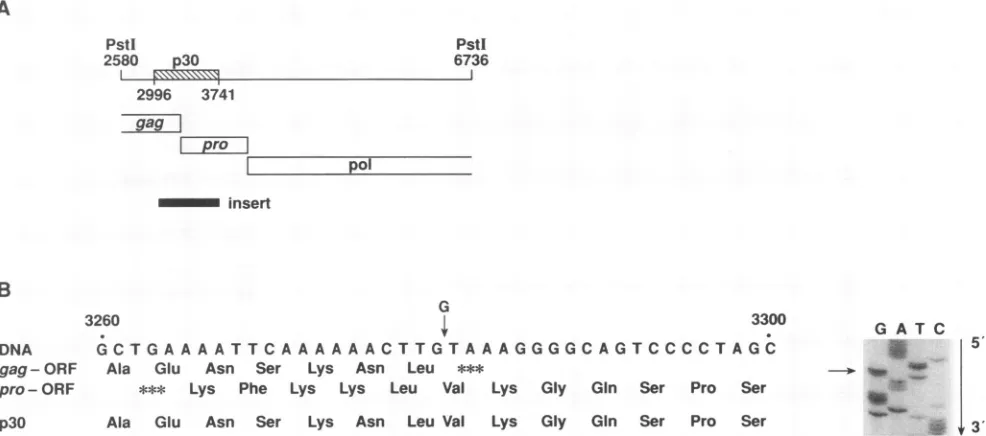
Ala Glu Asn Ser Lys ASn Leu Val Lys Gly Gin Ser Pro SerFIG. 1. Construction of clones expressing the MMTV gag-pro transframe protein p30. (A) The PstI MMTVgag-pol fragment is shown, indicating the region encodingp30. (B) Nucleotide sequence of the segment of MMTV DNA spanning the gag-pro overlap window with the corresponding amino acid sequence of the transframe protein p30.Arrows on the DNA sequence and theautoradiography indicate where a nucleotide (G) insertion has been introduced to generate a single ORF comprising the entire length ofp30.
by the corresponding nucleotide at the appropriate concentra-tion. Depending upon the experiment, 1 ,u (1 ,uCi) of
[8-3HJdATP
(17.1 Ci/mmol), [5,5'-3H]dCTP (21.5 Ci/mmol),[8,5'- H]dGTP (25.7 Ci/mmol), [methyl-3H]dTTP (19 Ci/
mmol), or [5,6-3H]UTP (14.3 Ci/mmol) was added to the incubation mixture instead of the corresponding amount of
[5-3H]dUTP. All radioactive nucleotides were obtained from DuPont-NEN Research Products, except [5-3H]dUTP, which wasfromAmersham. Assays were carried out at 37°C for 2 to 20 min. A totalof 50
RI
of the reaction mixture was spotted on aDE81 ion-exchange paper disc(Whatman) and washed three times for 5 min(eachwash) in 1mMammoniumformate-4 M formicacid and then once for 3 min in95%ethanol. The discs werethendried and counted inaBeckman LS 5801 scintilla-tion counter. The reaction products were analyzed by thin-layerchromatography aspreviously described (1).RESULTS
Bacterial expression and purification of the MMTV dUTPase (p30). In MMTV, the dUTPase encodingregion is locatedatthe 5' endof the pro gene and could beexpressedas partof the gag-pro transframeprotein (p30). Wehave
synthe-sizedby PCR theDNAencoding forp30, which includes the
nucleocapsid protein gene (derived from the gag ORF), and theputative dUTPase domain encoded in the pro ORF
(Fig.
1A). A nucleotide insertion was required to mimick the translational frameshift in the -1 direction, requiredforthe
synthesis of the entire p30. This was done by site-directed
mutagenesis and involved the insertion ofa G in the coding
strand (Fig. 1B).The nucleotide sequence of the whole insert wasfoundtobe identicalto thatreported byJacksetal. (17)
for the C3H strain, except for the nucleotide insertion indi-cated above. After mutagenesis, the insert was cloned into
pGEX-2T, a
prokaryotic expression
vectorcontaining thegst gene ofSchistosoma japonicum(35)
and used forexpression
and purification of the MMTV gag-pro transframeprotein,
p30.
One hour after induction, cells were harvested, lysed, and centrifuged. The supernatants were then passed through aglutathione-Sepharose 4B column. The chimeric protein was eluted with a buffer containing 5 mM glutathione. dUTPase assaysrevealed thatthis59-kDa chimeric protein (Fig. 2B) was
enzymatically active, was able to hydrolyze dUTP to dUMP and
PP1,
but failed to cleave other nucleotide triphosphates(data not shown). The purified GST-containing proteins ob-tained from cultures expressing either GST alone (plasmid
pGEX-2T) or the chimeric protein GST-MMTV protease
(plasmid pPR207)(24) did not have dUTPase activity. The recombinant MMTV
p30
was purified after thrombincleavage of the chimeric protein, previously adsorbed to the
glutathione-agarose support. This protein showed dUTPase activity and was further purified by chromatography on ssDNA-agarose, since its nucleocapsid protein domain was expected tobind ssDNA. As shown inFig. 2A, the dUTPase activitywaseluted with aKCl gradient,and fractionsshowing theenzymatic activitywerefoundtocontaina30-kDa polypep-tide recognized by antibodies directed towards the carboxyl-terminal end of the putative dUTPase domain of the trans-frameproteinp30. SDS-PAGEof thepurified proteinis shown in Fig. 2B (lane 2), and the overall yield of the process is
approximately30to50 ,ug ofproteinper liter of culture (2g [wetweight]ofE.colicells).Thespecific activityof thepurified
dUTPase was 6,200 nmol per min and mg of enzyme, when measured in the presence of 0.2 mM dUTP.
The amino- andcarboxyl-terminalsequences of the recom-binant MMTV dUTPase are shown in
Fig.
3. These results were consistent with the primary structurereported
for the MMTVp30
isolated frompurified
virus(13).
Theonly
differ-ences were found at the aminoterminus,
since the recombi-nant dUTPase contains two extra amino acids(Gly
and Ser)notfound in the viral
p30
butintroducedas aconsequence of the cloning scheme. Asexpected,
residues 3 to 18 of the recombinant dUTPasearealsoidenticaltoresidues 1to 16of the MMTV NCprotein
p14
(14). Together,
theresults of thei
I~~~~~~~~~~~~~~~~~~~~~~~~~on November 9, 2019 by guest
http://jvi.asm.org/
[image:3.612.74.567.83.301.2]2316 KOPPE ET AL.
A
Fraction
B
13 15 17 19 21 23 25
kDa
M
1
2
97.4-VU
A.,.
46- :
30-21.5
14.3-
1.0,-2
_
0
*_
X
4-'0.5 C
0
0
Y
lO
Fraction
FIG. 2. Purificationof recombinant MMTVp30. (A)Chromatographic purificationofp30onanssDNA-agarosecolumn(bedvolume,2ml).
Theamountofproteinloadedonthegelwas25 pLg,andaliquotsof thecorrespondingfractionwereassayedfordUTPaseactivity (35 pl)andby
Westernblotanalysis (120,ul),witharabbitpolyclonalantibody specificforthecarboxyl-terminal regionofp30.(B)Purified recombinantp30 (lane 2)andthechimericproteinGST-p30 (lane 1),whicharecomparedwiththeRainbowproteinmolecularmassmarkers from Amersham(laneM).
Markers includemyosin (200kDa), phosphorylaseb(97.4kDa),bovineserumalbumin(69kDa),ovalbumin (46kDa),carbonicanhydrase (30 kDa), trypsininhibitor(21.5 kDa),andlysozyme (14.3 kDa).
protein sequence analysis of the purified dUTPase and
the DNA sequence data demonstrate that the recombinant p30 is identical to the p30 found in MMTV (C3H strain) particles.
Enzymatic propertiesof the recombinant MMTVdUTPase. The only nucleotide triphosphate which was cleaved by the recombinantp30 was dUTP, and nosignificant cleavage was
observed whendATP, dCTP, dGTP, dTTP,orUTPwasused
as a substrate in the assay mixture (Fig. 4A). Competition experiments were performed using unlabeled deoxyribo-nucleosidetriphosphates (dNTPs) to compete forcleavageof [3H]dUTPto[3H]dUMP(Fig. 4B).The resultsindicate that of the sixdNTPsused,onlydUTPwascapableofcompetingfor
cleavage of radiolabeled dUTP by the recombinant MMTV dUTPase. Initial velocity studies were performed at a fixed
magnesium concentration (1 mM) but with various
concentra-tions(5 to60F.M)ofdUTP.The apparentKmfortheMMTV
dUTPasewas28.0 ± 7.3 FM, and its Vmaxwas6,500 + 1,100
nmol per min and mg of enzyme. Divalent cations such as Mg2+, Mn2+, orCo2+ have asignificant stimulatory effecton
theactivity of thisretroviral dUTPase, and EDTA isastrong
inhibitor of the enzyme activity (Table 1). However, the
inhibitory effect of EDTA was reversed by divalent cations, such as Mg2+ or Zn2+. Though zinc is likely to bind the nucleocapsid protein domain ofp30, its additiontothe dUT-Pase assay cocktail results in a moderate increase of the
enzymeactivity. Asimilareffect has also beenreportedforthe
FIV dUTPase (40), which lacks the NC domain.In addition,
the presence of 1,10-phenanthroline (a zinc chelator) in the
assay doesnot have a significant effecton the MMTV
dUT-Pase activity, suggesting that the nucleocapsid moiety ofp30
exertsaminor influenceonits enzymaticactivity.
MMTV-associateddUTPase.ConversionofdUTPtodUMP
was almost complete (>90%), after 5 min ofincubation at
NH2-termina
1:
GLY-SER-ALA-ALA-ALA-MET-ARG-GLY-GLN-LYS-TYR-SER-THR-
PHE-VAL-LYS-GLN-THR-COOH-terminal: -VAL-HIS
FIG. 3. Amino- andcarboxyl-terminalsequences of the recombinant MMTV dUTPase. Underlined amino acids correspond to the identical amino- andcarboxyl-terminalsequencesof the viralp30,isolated from purified MMTV (13). The first two residues of the amino-terminal sequence derive from the thrombincleavagesite,located between GST and MMTVp30inthe chimeric precursor of therecombinant dUTPase.
kDa
46-
30-
21.5-0L
3 10
0 80
I-D 60
0
0 40
._
L-> 20 0 0
J. VIROL.
on November 9, 2019 by guest
http://jvi.asm.org/
[image:4.612.104.502.82.381.2]MMTV dUTPase 2317
TABLE 1. Effects ofvarious divalent cations and chelators on the
activity of MMTV dUTPase"
Additive" Relative
activity"
None... 1.0
EDTA... 0
1,10-Phenanthroline... ... 0.9
Mg2+... 2.3
Mn2+... 1.9
o219...1.9 Z . .1...1.3
_
t;0l10]+TT
~~~~~~~~~~~~~~~~C
a 2...().7
dUTP UTP dATP dGTP dCTP dTTP Cu2+... 1.1
B
a.80
0
00
0 dATP
c
.40
- dGTP40
ALk dTTP -0-- dCTP
o 20 UTP
dUTP
0 II
0 0.1 0.2 0.3 0.4
Concentration of Unlabeled dNTP(mM)
FIG. 4. Substrate specificity of the recombinant MMTV dUTPase, p30. (A) Cleavage of different dNTPs todeoxyribonucleoside
mono-phosphate (dNMP), using recombinant p30. Incubationswerecarried outin thepresenceof5 pLM dNTP for 15minat37°C. Theamountof purified enzyme used in each assay was 75 ng. (B) Conversion of [5-3H]dUTP to [5-3H]dUMP in the presence of unlabeled dNTPs. Thesecompetition experimentsweredone inthepresenceof25to400 p.M unlabeled dNTP and 5,uM [5-3H]dUTP. Sampleswereincubated
at37°C for 5minafter addition of 75 ngofpurified dUTPase.
37°C, when dUTPase assays were performed with 15 p.g of detergent-disrupted purified MMTV in thepresence of 5 F.M
dUTP. However, when other nucleotides (dATP, dCTP, dGTP, dTTP, andUTP) were usedas substratesin the same
conditions, the cleavage was almost negligible (<4%). We
obtained similar resultswithEIAV, using dUTPand dATPas
substrates. However, the conversion of dUTP to dUMPwas
notobserved when theassays weredone in thepresenceof the
same amount of purified Moloney murine leukemia virus. EIAV and Moloney murine leukemia virus were used as
positive and negative controls, respectively, since dUTPase activity has been previously tested in purified preparations of those viruses (7).
Antibodies towards the carboxyl-terminal region of the putative dUTPase ofMMTVwereusedtodetectpolypeptides related tothisenzymeinpurifiedvirus. A 30-kDapolypeptide whichcomigrated with the purified recombinant p30wasfound
to be the only band recognized by the dUTPase-specific antibodies after Western blot detection, and smaller proteins corresponding totruncated versions ofp30werenotobserved
in these experiments (Fig. 5). Similar results were obtained with different isolates of the C3H strain, as well as other MMTV strains, such as R-III (data not shown). These data
"After thrombin cleavage, the MMTV dUTPase was extensively dialyzed
versus50 mMTris-HCI (pH 8.0). For these studies,MgCl,wasdeleted from the
standard reaction mixture and the dUTP concentration used was 0.1 mM.
Reaction mixtureswereincubatedat37°C for5to10min.
hThe chelators EDTA and 1,10-phenanthrolinewereaddedtofinal
concen-trations of 0.2mM, while 1 mMwasthe cation concentration in the incubation
assay.Divalentcation chloride saltswereused for this study.
' Relative activity referstothe values obtained in the absence of additive.The
standard deviation ofthemeasurementswasaround 10to 15CSc.
indicate that thegag-pro transframe protein p30 is the active
form of the MMTVdUTPase. In agreementwith this obser-vation, when disrupted viruswaschromatographedon
ssDNA-agarose under the conditions described for the recombinant
p30, the dUTPase remained boundtothe column unless 1 M
KCIwasaddedtothe elutionbuffer,asexpected, assuming that thenucleocapsid protein domain ispartof the active dUTPase in the virion.
DISCUSSION
Amino acid sequence comparisons showed that five
con-served motifs found in dUTPases from different sources (E.
coli, herpesvirus, vaccinia virus, etc.)werealsopresentinthe 5' region of the MMTVprogene(21). The determination of the
amino acid sequence of a 30-kDa polypeptide isolated from purifiedMMTVrevealed that thedUTPase-encoding region is expressed in fusion with the nucleocapsid protein domain derived from the3' end ofgag(13). In thispaper, we present
evidence indicating that the 30-kDa transframe protein of MMTV is a dUTPase. Our conclusion is supported by the
kDa 1 2
200
-
97.4-
69-
46-30 - _
21.5
14.3-FIG. 5. Western blot detection of dUTPase-containing
polypep-tides in MMTV. A total of100 ,ugofgradient-purifiedMMTV(C3H
strain) and 2 ,ugof recombinant p30wasapplied to lanes 1 and 2,
respectively. Blotswere developedwith a rabbitpolyclonal antibody specific for the carboxyl-terminal region of p30. Rainbow protein molecularmassmarkers from Amershamwere usedasreferences.
A
K~~~~~~~~~~~~~~~~~~~~~~~ri~~~~~~~~~~~~~~~~~~~~~~
0. 100
z
O 80 0~
Z 60
m
0
r 40
.2
> 20 0
0
:
VOL.68? 1994
on November 9, 2019 by guest
http://jvi.asm.org/
[image:5.612.66.306.82.392.2]2318 KOPPE ET AL.
following
observations:(i)
dUTPase assays showed thatgradi-ent-purified
MMTV contained theenzymatic activity;
(ii)Western blot
analysis
of the whole virus with antibodies directed towards thecarboxyl-terminal
region
ofp30,
which contains one of the five conserved motifs found in viral and bacterialdUTPases,
suggests thatp30
is theonly protein
comprising
the entire dUTPase sequence found in matureMMTV;
and(iii)
the recombinant MMTVp30
wasfound tocleave dUTPtodUMP andPP1 butwasunabletocleave other nucleotide
triphosphates.
The MMTV dUTPasewasinhibitedby
EDTA,
though
this effect could be reversedby
divalentcations,
like magnesium or zinc, a characteristic which isshared
by
other dUTPases.However,
itsapparentKm(28
,uM)
wasfoundtobe
relatively high
incomparison
tothosereported
for dUTPases isolated from
herpesviruses,
E.coli,
Drosophila
melanogaster,
and severalmammalian tissues(8, 16, 41, 43,
andreferences
therein)
whoseKm values range from 1to 12,uM.
Since the MMTV dUTPase isexpressed
in fusion with thenucleocapsid
protein
domainderived fromgag,it isexpected
tobe associated to the viral RNA.
Despite
itshigher
Ki,,
the MMTVdUTPase would be closetoreversetranscription sites,
where its
activity
would beimportant
to prevent in situ theincorporation
of dUMP into DNA.The MMTV transframe
protein
p30
constitutesanovel type of retroviraldUTPase, differing
from thepreviously
character-ized FIV enzyme, since the latter is encoded within thepol
geneand is
expressed
as a 15-kDapolypeptide
(7, 40).
Type
Band type Dretroviruses share averysimilar
genomic
organi-zation as well as ahigh degree
ofsimilarity
among theirproteins.
The order of thematureproteins
in theGag
precur-sor of MMTV is
plO(MA)-pp2l-p3-p8-n-p27(CA)-pl4(NC)
(14),
and in MPMV(a
type Dretrovirus),
the order isplO(MA)-pp24-pl2-p27(CA)-pl4(NC)-p4 (12, 36).
Thestruc-tureand
activity
of thehypothetical
gag-protransframeprotein
ofMPMVhavenotbeendetermined. This
protein
isexpected
to be a dUTPase and could be similar to MMTV
p30.
According
totheprediction
ofHatfieldet al.(11),
theframe-shift
signal
is locatedwithin the NCcoding region
of MPMV.Therefore,
the additional maturation site found betweenp14(NC)
andp4
inthe MPMVGag
precursorwouldbe absentin the
corresponding
transframeprotein.
At present, we lack an
explanation
forwhy
dUTPase isexpressed
in some retroviruses and not inothers,
such ashuman
immunodeficiency
virus. Thespecific
function of dUTPase in the retrovirus lifecycle
is still unclear. Recently,Threadgill
et al.reported
that the deletion of the dUTPasegene in EIAV had noeffecton
replication
when theviruswas grown onfetalequine kidney
cells. However,when grownon their natural host cells(macrophages),
replication
wasverylowcompared
with that ofthe wild type(37).
In certain viruses,suchas
herpes simplex
virus type1,
dUTPaseappearstohavean
important
role inpathogenesis (29),
sincedUTPase-defi-cient mutants were attenuated for neuroinvasiveness,
neuro-toxicity,
andreactivationfromlatency. Therefore,
itseemsthatdUTPase is
required
forvirusreplication in certaincells.In
addition,
the retroviraldUTPases couldplayanimportantrole in
reducing
mutation levels as previously suggested (7). dUTPaseactivity
notonly
lowers the dUTP concentration inthe
cell,
butsupplies dUMP,
thesubstrate for the thymidylatesynthetase,
increasing
cellulardTTPpools. HighdUTP levels,which may result from either the lack of dUTPase or the
inhibition ofthe
thymidylate synthetase
(9, 10), result in themisincorporation
of uracil in the DNA and could contributetohigh
mutationrates duetohyperrecombination
or accumula-tion ofpoint
mutations. The presence of dUTPase in some retroviruses could beadvantageous by
preventingmutationsintheir genome. This phenomenon might be related to the fidelity of their RTs, known to be rather lowcompared with DNApolymerases (2),since the retroviral enzymesaredevoid ofproofreading mechanisms. Most of the studies on thefidelity
of the RTs have been carriedoutwith enzymes from retrovi-ruseslacking the dUTPase gene, suchasthe avian myeloblas-tosis virus, murine leukemia virus, or human immunodefi-ciency virus type 1 (27, 30, 31). One could speculate that dUTPase serves in retroviruses to keep dUTP levels low, thereby safeguarding efficientreversetranscription by enzymes with high fidelity. Retroviruses with high mutation rates as a result of lowfidelity of their RTs may be less dependenton dUTPase activity, since their RT may be able to continue strand extension despite nucleotide misincorporations. How-ever,thedegreeandnatureofenvgenevariation in EIAV are remarkably similar to those in human immunodeficiency virus type 1 (25), and this observation correlates well with dataon thefidelityof the EIAVRT,whichwasfoundtobe similar to that of humanimmunodeficiencyvirus type 1 RT (6). On the other hand, fidelity varies also depending on the particular nucleotidetriphosphate. Thoughit is known thatprokaryotic DNApolymerases can use dUTP as a substrate withkinetics similar to those for dTTP (39), there are no reports on the ratesofmisincorporationof uracil into DNAby retroviral RTs. Further studies will be required todetermine the role ofthe dUTPaseduringthe virus lifecycleand thepossible evolution-aryadvantagesof itspresencein certain subsets ofretroviruses.
ACKNOWLEDGMENTS
We expressourgratitudetoTerryCopelandand Pat Wesdockfor
peptidesynthesisandantibodyproduction, Cathy HixsonandSuzanne
Spechtfor amino acidanalysis,Young Kim for amino acid sequencing, MarilynPowersforoligonucleotide synthesis, DougStevensforhelp withvirus production, and Deanna Gotte for assistance with PCR
cloning and DNA sequencing. We also thank Cathy Hixson for determinationofcarboxyl-terminalsequences.
This research was sponsored in part by the National Cancer
Institute, DHHS,undercontractN01-CO-74101 withABL. REFERENCES
1. Beardsley,G.P.,and H.T. Abelson.1980. A thin-layer chromato-graphic method for separation of thymidine and deoxyuridine nucleotides. Anal.Biochem.105:311-318.
2. Bebenek, K.,and T. A. Kunkel. 1993. The fidelity of retroviral
reversetranscriptases,p.85-102. In A. M. Skalka and S. P. Goff
(ed.), Reverse transcriptase. Cold Spring Harbor Laboratory Press,ColdSpring Harbor,N.Y.
3. Broyles,S. S.1993. Vaccinia virus encodes afunctional dUTPase.
Virology 195:863-865.
4. Cedergren-Zeppezauer, E. S., G. Larsson, P. 0. Nyman, Z. Dauter,and K.S. Wilson. 1992. Crystalstructureof a dUTPase. Nature (London)355:740-743.
5. Chamberlain,N.R., L. DeOgny, C. Slaughter, J. D. Radolf, and M. V.Norgard. 1989.Acylationof the47-kilodaltonmajor mem-brane immunogen ofTreponema pallidum determines its
hydro-phobicity.Infect. Immun.57:2878-2885.
6. DeVico, A.,R. C.Montelaro, R. C. Gallo, and M. G.
Sarngadha-ran. 1991. Purification and partial characterization of equine infectious anemia virus reverse transcriptase. Virology 185:387-394.
7. Elder, J. H.,D. L.Lerner, C. S. Hasselkus-Light, D. J.Fontenot, E.Hunter,P.A.Luciw,R.C. Montelaro, and T. R. Phillips. 1992. Distinct subsets of retroviruses encode dUTPase. J. Virol. 66: 1791-1794.
8. Giroir,L.E., and W.A.Deutsch.1987. Drosophila deoxyuridine
triphosphatase. Purification andcharacterization. J. Biol. Chem. 262:130-134.
9. Goulian, M., B. Bleile, and B. Y. Tseng. 1980. The effect of J. VIROL.
on November 9, 2019 by guest
http://jvi.asm.org/
methotrexate on levels of dUTP in animal cells. J. Biol. Chem. 255:10630-10637.
10. Goulian, M., B. Bleile, and B. Y. Tseng. 1980. Methotrexate-induced misincorporation of uracil into DNA. Proc. Natl. Acad. Sci. USA77:1956-1960.
11. Hatfield, D. L., J. G. Levin, A. Rein, and S. Oroszlan. 1992. Translational suppression in retroviral gene expression. Adv.
Virus Res. 41:193-239.
12. Henderson, L.E.,R.Sowder, G. Smythers,R. E.Benveniste,and
S. Oroszlan. 1985. Purification and N-terminal amino acid
se-quence comparisons of structural proteins from retrovirus-D/ Washington and Mason-Pfizer monkey virus. J. Virol. 55:778-787. 13. Hizi, A., L. E. Henderson, T. D. Copeland, R. C. Sowder, C.V.
Hixson, and S. Oroszlan. 1987. Characterization ofmouse
mam-mary tumorvirus gag-pro gene products and the ribosomal frame-shift site by protein sequencing. Proc. Natl. Acad. Sci. USA 84:7041-7045.
14. Hizi, A., L. E. Henderson, T. D. Copeland, R. C. Sowder, H. C. Krutzsch, and S. Oroszlan. 1989. Analysis of gagproteins from
mouse mammary tumorvirus. J. Virol. 63:2543-2549.
15. Hoffmann, I., J. Widstrom, M. Zeppezauer, and P. O. Nyman. 1987.Overproduction and large-scalepreparationofdeoxyuridine triphosphate nucleotidohydrolase from Escherichlia coli. Eur. J.
Biochem. 164:45-51.
16. Hokari, S.,andY.Sakagishi. 1987. Purification and characteriza-tion ofdeoxyuridine triphosphate nucleotidohydrolase from ane-micratspleen:atrimercompositionof the enzymeprotein.Arch. Biochem. Biophys. 253:350-356.
17. Jacks,T.,K. Townsley,H. E. Varmus,andJ. Majors. 1987.Two
efficient ribosomalframeshiftingevents are requiredforsynthesis of mouse mammary tumor virusgag-related polyproteins. Proc. Natl.Acad. Sci. USA 84:4298-4302.
l7a.Jahan, M., C. V. Hixson, S. Oroszlan, and T. D. Copeland. Unpublisheddata.
18. Lerner, R.A., N. Green, H.Alexander, F.-T. Liu, J. G. Sutcliffe,
and T. M. Shinnick. 1981. Chemically synthesized peptides pre-dicted from the nucleotide sequence of the hepatitis B virus genomeelicit antibodiesreactive with the nativeenvelopeprotein
ofDane particles. Proc.NatI.Acad. Sci. USA78:3403-3407. 19. Majors, J. E.,and H. E. Varmus. 1981.Nucleotide sequences at
host-proviraljunctionsformousemammarytumourvirus. Nature (London) 289:253-258.
20. McClure, M. A., M. S. Johnson, and R. F. Doolittle. 1987. Relocation ofa protease-likegene segment between two
retrovi-ruses. Proc. Natl. Acad. Sci. USA 84:2693-2697.
21. McGeoch,D.J. 1990. Protein sequencecomparisonsshowthat the 'pseudoproteases' encodedbypoxvirusesandcertain retroviruses belong to the deoxyuridine triphosphatase family. Nucleic Acids
Res. 18:4105-4110.
22. Menendez-Arias, L., D. Gotte, and S. Oroszlan. 1993. Moloney
murine leukemia virus protease: bacterialexpression and charac-terization of the purified enzyme.Virology196:557-563. 23. Menendez-Arias, L.,C.Risco,and S.Oroszlan. 1992.Isolationand
characterization of ot,-macroglobulin-protease complexes from purified mouse mammary tumorvirus and culture supernatants fromvirus-infected cell lines. J. Biol. Chem. 267:11392-11398. 24. Menendez-Arias, L., M.Young, andS. Oroszlan. 1992.
Purifica-tion and characterization of the mouse mammary tumor virus proteaseexpressedin Escherichia coli.J. Biol. Chem. 267:24134-24139.
25. Payne,S.L.,F.-D.Fang,C.-P.Liu,B. R.Dhruva,P.Rwambo,C.J. Issel, andR. C. Montelaro. 1987.Antigenicvariation and
lentivi-rus persistence: variations in envelope gene sequences during EIAVinfection resemblechangesreportedforsequential isolates
of HIV. Virology 161:321-33 1.
26. Power,M.D.,P. A.Marx,M. L.Bryant,M. B.Gardner,P.J. Barr,
and P. A. Luciw. 1986. Nucleotide sequence of SRV-1,a typeD
simian acquired immunedeficiency syndromeretrovirus. Science
231:1567-1572.
27. Preston,B.D.,B.J.Poiesz,and L. A. Loeb.1988.FidelityofHIV-1
reversetranscriptase. Science 242:1168-1171.
28. Pri-Hadash, A., D.Hareven,and E. Lifschitz. 1992.A meristem-related gene from tobacco encodesadUTPase:analysisof expres-sion invegetativeandfloral meristems.Plant Cell 4:149-159. 29. Pyles, R. B., N. M. Sawtell, and R.L. Thompson. 1992. Herpes
simplexvirus type 1 dUTPasemutants are attenuated for
neuro-virulence, neuroinvasiveness, and reactivation from latency. J. Virol.66:6706-6713.
30. Ricchetti, M., and H. Buc. 1990. Reverse transcriptases and
genomic variability: the accuracyof DNA replication is enzyme specificand sequencedependent. EMBOJ. 9:1583-1593. 31. Roberts, J. D., K.Bebenek,and T. A.Kunkel. 1988.The accuracy
ofreversetranscriptasefromHIV-1. Science 242:1171-1173.
32. Roberts, M. M., and S. Oroszlan. 1989. The preparation and biochemical characterization of intactcapsidsofequineinfectious anemia virus. Biochem.Biophys. Res.Commun. 160:486-494. 33. Sanger, F.,S.Nicklen,and A. R.Coulson.1977. DNAsequencing
with chain-terminating inhibitors. Proc. Natl. Acad. Sci. USA 74:5463-5467.
34. Slabaugh,M. B., andN. A. Roseman. 1989. Retroviral protease-like gene in thevaccinia virus genome. Proc.NatI.Acad. Sci. USA 86:4152-4155.
35. Smith,D.B.,and K. S.Johnson. 1988.Single-steppurificationof
polypeptidesexpressedinEscherichiacoliasfusions with glutathi-one S-transferase. Gene67:31-40.
36. Sonigo, P., C. Barker, E. Hunter, and S. Wain-Hobson. 1986.
Nucleotide sequence of Mason-Pfizermonkeyvirus: an immuno-suppressiveD-type retrovirus. Cell 45:375-385.
37. Threadgill,D.S.,W. K.Steagall,M. T.Flaherty,F.J.Fuller,S. T.
Perry, K. E. Rushlow, S. F.J. Le Grice,and S. L. Payne. 1993. Characterization of equine infectious anemia virus dUTPase:
growth properties of a dUTPase-deficient mutant. J. Virol. 67:
2592-2600.
38. Towbin, H., T. Staehelin, andJ. Gordon. 1979.
Electrophoretic
transfer of proteins from
polyacrylamide gels
to nitrocellulose sheets: procedure and some applications. Proc. Natl. Acad. Sci. USA76:4350-4354.39. Tye, B.-K., J. Chien, I. R. Lehman, B. K. Duncan, and H. R. Warner. 1978. Uracil incorporation: a source of
pulse-labeled
DNAfragments in thereplicationof theEscherichiacolichromo-some.Proc. Natl.Acad. Sci. USA 75:233-237.
40. Wagaman,P.C.,C. S.Hasselkus-Light,M.Henson,D.L.Lerner,
T. R. Phillips, and J. H. Elder. 1993. Molecular
cloning
and characterizationofdeoxyuridine
triphosphatase
fromfelineimmu-nodeficiencyvirus(FIV). Virology196:451-457.
41. Williams, M. V. 1984. Deoxyuridine triphosphate
nucleotidohy-drolase induced by herpes simplex virustype 1. Purification and characterization of induced enzyme. J. Biol. Chem. 259:10080-10084.
42. Williams, M. V., and Y. Cheng. 1979. Human
deoxyuridine
triphosphate nucleotidohydrolase. Purification and characteriza-tion of the deoxyuridine
triphosphate
nucleotidohydrolase
fromacute
lymphocytic
leukemia. J. Biol. Chem. 254:2897-2901.43. Williams, M. V., and D. S. Parris. 1987. Characterization of a
herpes simplex virus type 2
deoxyuridine
triphosphate
nucle-otidohydrolase andmappingofageneconferring
typespecificity
for the enzyme. Virology156:282-292.