Rochester Institute of Technology
RIT Scholar Works
Theses
Thesis/Dissertation Collections
9-1-2003
Effects of operator training method on knowledge
retention on a common CNC machine interface
Phillip Rogerson
Follow this and additional works at:
http://scholarworks.rit.edu/theses
This Thesis is brought to you for free and open access by the Thesis/Dissertation Collections at RIT Scholar Works. It has been accepted for inclusion
in Theses by an authorized administrator of RIT Scholar Works. For more information, please contact
Recommended Citation
Effects of Operator Training Method on Knowledge Retention on a Common CNC
Machine Interface
ROCHESTER INSTITUTE OF TECHNOLOGY
KATE GLEASON COLLEGE OF ENGINEERING
Department of Industrial and Systems Engineering
Master's Thesis
Effects of Operator Training Method on Knowledge Retention
on a Common CNC Machine Interface
September 2003
De2ree Candidate:
Phillip A. Rogerson
Thesis Committee:
Dr. Jacqueline Mozrall, Advisor
Mr. Madhu Nair
The following graduate thesis, completed by Phillip
A.
Rogerson, is submitted in partial
fulfillment of the requirements for the degree of Master of Science in Industrial and Systems
Engineering.
Approved by:
_
Dr. Jacqueline Mozrall, Committee Member/Advisor
Mr. Madhu Nair, Committee Member
1
Effects of Operator Training Method on Knowledge Retention on a Common CNC
Machine Interface
Graduate Project Reproduction Permission Statement
Permission Granted
Title of Graduate Project: Effects of Operator Training Method on Knowledge Retention on a
Common CNC Machine Interface
I, Phillip
A.
Rogerson, hereby grant permission to the Wallace Memorial Library of the
Rochester Institute of Technology to reproduce my thesis in whole or in part. Any reproduction
will not be for commercial use or profit.
Signature
of
Author:
_
2
Effects
of
Operator
Training
Method
on
Knowledge
Retention
on a
Common CNC
Machine
Interface
Acknowledgments
My
sincerest gratitude goes out
to
all
those
who
contributed
to
the
success
of
my
graduate
studies and
this
project.
I
would
especially
like
to thank
my
advisor, Dr. Jacqueline
Mozrall,
who guided
me
through the thesis
process and gave
me
direction,
advice
and
pep-talks
while
I
was
researching
and
writing
this
paper.
Thanks
also go
to
Mr. Madhu
Nair,
who served on
my
thesis committee,
and was
the
source
for many
valuable
suggestions.
I
thank
Dr. Jake
Shealy
for encouraging
me
to
pursue graduate
studies
at
RIT,
Marilyn
Houck for
sending
me
to the
right people at
the
right
time,
Martin Haas
who
has done
so
much
to
make
the
Brinkman
machine
tools
lab
what
it
is,
and
Josh
Quick
and
John Bonzo
for
their
assistance
during
the
pilot
study.
Of
course,
I have
to thank
my late
parents
for
their
love
and
patience,
and
for encouraging
my curiosity
and
the
love
of
learning
that
were
so vital
to
my
success.
I
wish you could
have
been here
to
see
it
completed.
Finally,
my deepest love
and
unending
thanks
go
to
my
wife
Lisa for
her
support,
patience,
humor,
understanding
and
unfaltering love
during
my
time
at
RIT. Now
we can
have
a
normal
life!
Phillip
Rogerson
September,
2003
Effects
of
Operator
Training
Method
on
Knowledge Retention
on a
Common
CNC
Machine Interface
Abstract:
The
continued growth of computer
numerically
controlled
(CNC)
machine
tool
use
in
industry
combined with
increased
competition
in
the
global market requires workers
to
quickly
attain requisite
skills
and raise
productivity
levels
to
meet production
demands.
Retention
of
knowledge
is
a
key
factor
in
an
operator's
ability
to transfer
training
into
actual machine
operation
in
a production
setting.
This
study
examines
the
difference
in
short
term
retention
of
knowledge necessary
to
perform
basic interface
operations
in
operators
trained
using
a
Effects
of
Operator
Training
Method
on
Knowledge Retention
on
a
Common
CNC
Machine Interface
Table
Of
Contents
1.
Problem
Statement
and
Definition
8
2.
Literature
Review
9
2.1 General Background
9
2.1.1
CNC
Interface
Usability
10
2.1.2
Learning
10
2.1.3
Individual Differences
12
2.1.4
Retention
12
2.2 Specific Background for
the
Experiment
14
2.2.1
Training
Duration
and
Repetitions
14
2.2.2
Training
to
Criteria
15
2.2.3
Refresher
Training
15
2.2.4
Experimental Session
Scheduling
15
2.2.5
Operator Reference Materials
16
2.2.6
Type
of
Training
16
2.2.7
Number
of
Subjects
17
2.2.8
Measures
of
Retention
17
3.
Variables
and
Hypotheses
18
3.1
Independent Variables
18
3.2 Objective Dependent Variables
18
3.3 Subjective
Dependent
Variables
19
3.4 Hypotheses Tested
19
3.5
Tableof Variables
20
4.
Methodology
21
4.1
Design
of
the
Study
21
4.1.1
Training
Design
21
4.1.2
Refresher
Training
22
4.1.3
Experimental
Session
Scheduling
Design
22
Effects
of
Operator
Training
Method
on
Knowledge Retention
on
a
Common
CNC
Machine
Interface
4.1.5
Number
of
Subjects
23
4.1.6
Study
Design
and
Data Analysis
23
4.2
Preparation
for
Experimental
Sessions
23
4.3
Experimental
Session Procedure
25
4.4 Timeline
26
4.5 Hardware
and
Software Requirements
26
4.6 Space
Requirements
26
4.7 Data Analysis Procedure
27
5. Results
28
5.1
Population
Data
28
5.2 Time
and
Usability
Data Results
29
5.2.1 Time Data
30
5.2.2
Usability
Data
34
5.3
Query
and
Error
Count Data
38
6. Conclusions
and
Discussion
of
Results
40
6.1 Evaluation
of
Results
40
6.2 Overall Conclusions
44
6.3 Strengths
and
Weaknesses
of
the
Study
46
6.4
Future Directions
47
Appendix A:
Description
of
Experimental Tasks for
CNC
Interface Retention
Study
48
Appendix
B: Informed Consent Form
49
Appendix C:
Demographic
Survey
Form
51
Appendix D:
Task Sequence for Machine Operator
53
Appendix
E:
Form
for
Subjective Assessment
of
Usability
55
Appendix
F: Objective
Data Analysis Output
Effects
of
Operator
Training
Method
on
Knowledge Retention
on a
Common CNC
Machine Interface
Appendix G:
Objective
Data Analysis
Output
Chi
Square
Results
75
Appendix H:
Objective
Data Analysis Output
ANOVA
Results
77
Appendix I:
Subjective
Data Analysis Output
Tabulation
and
Box
plot
Results
80
Appendix J:
Subjective
Data Analysis Output
ANOVA Results
109
Appendix K: Subject Population Specifics
and
Comparisons
by
T-Test
122
Effects
of
Operator
Training
Method
on
Knowledge Retention
on a
Common
CNC
Machine
Interface
1. Problem Statement
and
Definition
In
a previous
study
of
two
common
CNC
controllers,
it
was
found
that
CNC
machine
tool
user
interfaces
violate
many
principles of
usability
(Rogerson,
1998). While
improving
usability
of
the
machine
tool
interface
would
undoubtedly
reduce
learning
time
and allow machinists
to
reach
desired levels
of production more
quickly,
it is
also reasonable
to
expect
that
employing
better
training
methods
would
aid
users
in
learning
to
operate
the
machines.
The
intent
of
this
experiment
was
to
study
a
popular
CNC lathe/interface
system and
provide
specific
information
to
answer
the
following
questions
concerning
the
interface
and
machine
tool
combination:
Would
the train-to-criteria
method
be
an
improvement
over conventional
training
methods
from
the
standpoint
of
training
effectiveness
reflected
in
an
operator's
retention
of
the
knowledge necessary
to
begin using
the
CNC
interface,
and
measured
by
the
operator's
speed of
execution,
frequency
of
accessing
help,
and error rates?
Effects
of
Operator
Training
Method
on
Knowledge Retention
on a
Common
CNC
Machine
Interface
2. Literature
Review
2.1 General
Background
Although
the transition to
automation
in
general
industry
is
not
by
any
means
complete,
machinists
are
increasingly
being
called
upon
to
work with computer
controlled
equipment.
The
average machine
shop has
at
least
one
Computer
Numerically
Controlled
(CNC)
lathe,
mill,
or
grinder.
On many
production
floors,
CNC
machines
have
supplanted
manually
controlled
tools
with
the
intent
of
improving
quality
and
reducing
production
costs
by
providing
greater
flexibility
of production operations
and
allowing
a single operator
to tend
multiple
machines.
While
employment
for
manual machine
tool
operators
is
in
decline,
demand for CNC
machine
operators
is
expected
to
rise
as
the trend
toward
automation continues
(Occupational Outlook
Handbook,
1998).
The
adoption
of
Computer Aided Design
(CAD)
systems
by
engineering
and
design
groups
leads
naturally
into
more
connectivity between
the
design
office and
the
production
floor.
While
CAD
packages
(such
as
MasterCAM)
that
bridge
the
gap
by
generating
machine code are
already in
common
use,
we are
still
far from
the
futurists'vision
of
lights
out
factories,
run
by
means of program and
instruction
uploads
from
the
engineering
and management offices.
Human
operators are still
the
norm
in industry.
Machine
tool
operators
fall
into
two
general
categories:
those
who
are responsible
for
setting up
the
machines prior
to operation,
and
those
who
tend
to
machines
during
production.
The
machine operators
may
or
may
not
be
called upon
to
make minor
adjustments
in
the
course
of
an
operation.
In many
facilities,
workers
may be
required
to
perform
both
of
these tasks.
As
a
result,
they
are required
to
achieve
a
high level
of
familiarity
with
the
machines.
In
spite
of
the
technological
capabilities
already
attained,
it is
still
the
norm
to
see
production
facilities using CNC
machines programmed
by
the
keystroke
at
the
machine console.
Few
shops
have
progressed
to the
point where
human
operators are unnecessary.
Because
of
the
complex nature
of
machining
tasks,
the
cost of
scrap
and wasted
labor,
and
the
potential
for
serious
damage
to
equipment
or physical
injury,
operators must
be
trained to
a sufficient
level
of
proficiency
to
carry
out
the
desired
tasks
and meet
the
productivity
demands
of
the
production
Effects
of
Operator
Training
Method
on
Knowledge
Retention
on a
Common
CNC
Machine Interface
In
spite
of
the
increasing
complexity
of
the
machining
environment,
it is
not
uncommon
for
CNC
machine
operators
to
learn
their trade
on
the
job,
progressing
through
increasingly
greater
levels
of
task
responsibility.
Some
companies
have formalized
the
training
process while
others
rely
on
the
machine
tool
manufacturers
to
supply initial
training
(Occupational Outlook
Handbook,
1998).
Typical
CNC
operators
learn
the
basics
of
their
jobs
within several months.
Full mastery
of
machine operation can
take
years
to
achieve.
The
time
required
to
attain
a
certain
level
of
competency depends
on
the
individual
operator's
ability
and
the
complexity
of
the
machine.
2.1.1
CNC
Interface
Usability
Unfortunately,
improvements
in
the
usability
of
CNC
machine
controllers,
in
contrast
to
consumer
computer
goods,
have
not
kept
pace
with
those
of
popular
application
software
(Rogerson,
1998).
Some
of
the
most
commonly
used
CNC
controllers
are
still
laden
with
significant
usability
problems,
making
the
machines
difficult
and cumbersome
to
use.
Due
to
poorly defined
menu
structures, the
interfaces
encourage
the
user
to
operate
in
a rule-based
mode.
They
also provide
the
user
with
little
or no
feedback. Hidden
menu choices and unclear
labeling
further hinder
use of
the
interfaces
(Rogerson,
1998). It
is
reasonable
to
expect
that the
usability deficiencies found in CNC
interfaces
will
lead
to
difficulties in
learning
to
use
the
machines
and perform
machining
operations.
2.1.2
Learning
McGehee
and
Thayer
(in
McCormick
&
Tiffin,
1974)
described
learning
as
a process
wherein
behavioral
changes occur
in
response
to
experience.
Learning
can also
be
viewed
as
a
means
of
formulating
a
connection
between
a
stimulus
acting
on
an organism
and
an optimal or
appropriate response
from
the
organism.
(McCormick
&
Tiffin,
1974).
Many
factors
such as
task
complexity,
innate
ability, motivation,
training
method
and
structure
of
practice,
affect
an
individual's ability
to
leam
a
particular skill.
As
might
be
expected, the
ability
of
individuals
to
benefit from instruction
and
training
differs. Those
with greater mental capabilities
may be
able
to
assimilate
and
apply knowledge
Effects
of
Operator
Training
Method
on
Knowledge Retention
on a
Common
CNC
Machine Interface
more
quickly
than the
norm.
The
rate
of
instruction,
therefore,
should
be
adjusted
to the
individual's ability
to
learn.
(Schultz,
1978).
A
learner's
motivation can
also
have
a
profound
effect
on
the
absorption
of
training
material.
Whether
through
intrinsic
means,
such
as
a worker's
pride
for
a
job
well
done,
or
through
extrinsic
means,
such
as
praise, pay,
recognition
of
the
need
for
training,
or
job
security,
motivation
increases
the
learning
rate.
(McCormick &
Tiffin,
1974).
Knowledge
of results
may
enhance
learning by
allowing
the
operator
to
adjust
his
or
her
actions
to
obtain
the
desired
results.
Early
in
the
learning
process,
feedback
provides
a
basis for
correcting
mistakes.
Lack
of
feedback may significantly hinder
an
operator
in attaining
a
given
level
of
proficiency
in
certain
tasks,
namely
those
in
which
the
operator must
know
how
the
system
responds
in
order
to
properly
control
it
(Travers,
1977). Lack
of
feedback may
also
significantly increase
the time
required
to
gain
proficiency in
a
task
(Stockbridge & Chambers in
McCormick
&
Tiffin,
1974).
Task complexity is
yet
another
factor
that
affects
learning. Complex
tasks
are
naturally
more
difficult
to
leam
than
simple
tasks.
Increased
complexity,
as
defined
by
the
number of steps
required
in
a
task,
affects
the
rate of
learning
(O'Hara,
1990).
In
the
context of
this
definition,
more
complex
actions
could
be
viewed
as
requiring
more
steps
to
complete.
Gagne
(in
McCormick
&
Tiffin,
1974)
postulated
a
hierarchy
of
learning
sequence,
which
encompasses a
continuum
ranging from
simple
stimulus-response
connections
to the
learning
of
complex
principles
or
rules,
each
level requiring
relevant
learning
at
the
lower levels. The
strictness
of
the
hierarchy
is
under
debate. The Gagne
model
may,
however,
explain
the
increasing difficulty
of
learning
more
complex
tasks,
such
as
CNC
operation, that
involve
multiple
discriminations,
concepts,
and simple and complex principles or rules.
Another important
consideration
in
the
ability
of a
person
to
learn
is
the
frequency,
duration,
and
structure
of practice.
Although
there
are
no consistent and
generally
applicable
rules
for
optimal practice
scheduling,
it
has
been found
that
distributing
training,
particularly
in
the
case
of
difficult
or
less
meaningful
material,
is
more
effective
and
may
lead
to
longer
retention
than
training
carried
out
in
concentrated sessions.
(McCormick
&
Tiffin,
1974).
Effects
of
Operator
Training
Method
on
Knowledge Retention
on a
Common
CNC
Machine
Interface
2.1.3
Individual Differences
Van der Veer
(1989)
stated
that
individual
differences in
cognitive
function
and style
are
important
considerations
when
introducing
novices
to
computer
systems,
and affirmed
that
the
interaction
between
the
new
user
and
the
system
may
be improved if
these
differences
are
reflected
in
the
design
of
both interfaces
and
training
regimens.
Individual differences
span
a
continuum
encompassing
both
static and
dynamic dimensions (Van der Veer
and
Van
Muylwijk,
in Van der Veer 1989).
Relatively
stable
personality features
such
as
intelligence,
interpersonal
relationship
styles,
and
fear
of
failure interact
with
learned
traits
such
as
knowledge
and skills
to
influence
the
learning
process
and
the
selection
of
cognitive
styles
and
learning
strategies
employed
by
the
student.
The
learning
environment
must
be
structured
to
address
these
differences
by
adjusting
to
an
individual's
cognitive style.
Such
adaptation
may
take
the
form
of
changing
the
interface
to
more
closely
match
user
characteristics
and
limitations.
More
realistically,
adaptation
in CNC
training
would
consist
of
modifications
to the
educational
process
designed
to
address
individual
needs, wishes, abilities,
and
limitations.
Obviously,
changes
to the
training
process
require
more
effort
from
the
instructor,
and
some
means
of
determining
the
effectiveness of
the
instruction.
2.1.4 Retention
Once
a
task
is
learned,
the
knowledge
acquired
must
then
be
retained.
Retention may be
viewed
as
the
continued
capacity
to
behave
in
a
particular
way
that
has been learned. Retention
may
also
be
examined
graphically
as
the
quantity
of material recalled after some
time
interval
has
passed
(Travers,
1977).
As
with
learning,
there
are several
factors
that
affect
the
degree
to
which
an
individual
retains
knowledge
gained
through training.
Task complexity
and
the
logical
sequence of
task
elements,
both
affect
the
decay
of
learned
skills
(O'Hara,
1990).
The quantity
and
scheduling
of practice
has
a
significant
impact
on
retention.
More
practice
leads
to
more
rapid
acquisition
of skills
and
a
higher degree
of
retention.
There
is
evidence
that
carrying
on
with
practice
after
fluency
is
achieved, termed
overlearning,
may
significantly
aid
retention of
the
skill
(Travers,
1977).
Effects
of
Operator
Training
Method
on
Knowledge Retention
on
a
Common CNC
Machine Interface
The
author
participated
in
a program
intended
to train
operators
in
the
use
of
lathes
employing
a
common
CNC
controller.
The
training
regimen experienced
by
the
author relied
largely
on
a rule-based
approach.
Over
the
span of a
five-day
week,
operator
trainees
were
introduced
to the
basic
procedures
necessary
to
run
the
CNC
machine.
The
training
focused
heavily
on
developing
the
operator's
ability
to
write
and manipulate G- and
M-code
programs.
Far less
time
was spent
learning
about
the
actual operation
of
the
machine
and
manipulation
of
the
interface.
During
interface
operation
training,
there
was no
formal
evaluation of
knowledge
assimilation.
Several
times
during
the
course
(three
times
in
the
author's
class)
the
students
performed common
tasks
under
the
direct
supervision
of
company
trainers.
The
tasks
included
common
procedures such as
loading
machine
programs
from
the
library,
and
zeroing
machine
axes.
No formal
test
was
performed
to
determine
whether
trainees
were able
to
perform
the tasks
without
assistance
(Rogerson,
1998).
It
cannot
be
disputed
that
program
writing
and
editing
skills
are
necessary for
those
operating
CNC
machines
in
most
shops.
However,
effectively
training
workers
in
machine
interface
operation
is
an
area
that
could
have
a
large
impact
on
immediate
productivity
and
transfer
of
the
skills
from
the
classroom
into
the
work
environment.
As
mentioned
above,
common
CNC
interfaces
contain
numerous
significant
usability
problems
that
are
likely
to
increase
an operator's
training
requirements
and
the
amount
of
time
required
to
achieve
fluency
in
operation.
If
the
assimilation of
actual operational abilities
is
not
checked
as
part of
training, it
is
likely
that
operators
will
experience
significant
problems
early in
occupational
machine
operation.
To
determine
whether
a
training
program
could
benefit
by
changing
from
current
instructional
methods
to
a
train-to-criteria method,
it
was
necessary
to
compare operators
trained
using
the two
methods.
Proctor
and
Van Zandt
(1994)
advise
evaluating
training
programs
based
on
the
degree
of
knowledge
transfer
from
trainer
to
operator
during
training,
or
the
retention of
knowledge
training
produces
in
operators.
This
study
examined
the
training
methods
based
on
knowledge
retention.
Effects
of
Operator
Training
Method
on
Knowledge
Retention
on
a
Common CNC
Machine
Interface
2.2 Specific Background for
the
Experiment
In
the
design
of a retention
study,
a number
of
issues
must
be
examined.
A
review
of
retention
study literature
reveals considerations of particular
importance:
Training
duration
Training
methods
to
be
used
Whether
or not
to train to
criteria
Whether
refresher
training
is
provided
during
the
study
Number
of
repetitions
of
tasks
studied
Number
and
scheduling
of
experimental sessions
Whether
the
operator
is
supplied
with
reference materials
The
number of
subjects
to
examine
Retention
metrics
to
be
used
The
following
sections
examine
these
factors
as
they
are
discussed
in
recent retention
study
literature.
2.2.1
Training
Duration
and
Repetitions
A primary
question
in
retention
study design
is
that
of
training
duration for
each
experimental
subject
group.
A survey
of recent
retention
study literature
provides
no
clear
answer
to this
question.
Sauer
et al
(2000)
tested
the
effects
of
training
on short and
long
term
skill
retention,
providing
six
hours
of procedure-based
training,
the
kind currently
used
in
the
CNC
training
environment,
carried out
over
the
course of
five
sessions.
A
second,
related
question
deals
with
the
number
of
task
repetitions
during
training.
According
to
Hagman
(1980b),
task
repetitions
reduced
task
time
and
error
rates
on
both
immediate
and
delayed
retention
tests.
Time
and
error
rate
were
generally found
to
vary
inversely
with
the
number
of
repetitions
performed.
Performance
differences
present
in
immediate
testing
were also
present
in delayed
testing.
Effects
of
Operator
Training
Method
on
Knowledge
Retention
on a
Common CNC
Machine
Interface
2.2.2
Training
to
Criteria
An
alternative
to the
idea
of a standard
contact
time
or minimum number of repetitions
during
training
is
that
of
training
to
some
criterion.
In
several retention
studies,
Hagman
(1983)
did
not
employ
training
time
limits,
but
trained to the
criterion
of
one successful
(error-free)
task
completion.
The
US
Army
uses a
training
criterion of one
complete,
error-free
task
performance
carried out within a predetermined
time
period.
(Hagman,
1983).
An
obvious advantage
inherent in
the train-to-criteria
method
is
that
all
learners
are,
by
definition,
brought
to
some predetermined and consistent
level
of
performance
in
the
course of
the training.
Without
a
means
of
evaluating
the
effectiveness
of
instruction,
such
assurances
are
not possible.
The
benefits
of
evaluating
student
achievement, namely uniformity
of
training,
and
the
ability
to track the
effectiveness
of
the
training
program
and
instructors,
may be lost. Because
of
the
variables
involved in
learning
and retention of
knowledge,
and
the
diverse
abilities of
trainees,
it is
reasonable
to
expect
that the
duration
of
training
and
practice
necessary
will
vary
for
individuals.
As
a
result, there
may
be
practical
difficulties in
scheduling
training
and
predicting
the
amount of
practice and
training
necessary
for
a
given
trainee.
2.2.3 Refresher
Training
A
question
that
arises
in
the
study
of retention
is
whether
refresher
training
should
be
provided
between
the
study
trials.
In
retention
studies
conducted
to
examine
the
effects
of
training
method on
retention,
Sauer
et al
(2000)
and
Hagman
(1983)
did
not
employ
refresher
training
between
the
initial
and
follow-up
sessions.
Providing
refresher
training
after
the
initial
examination and
prior
to
subsequent
examination
may
serve
to
reinforce
initial
training
and skew
the
results
of
the
retention
study
(O'Hara,
1990).
2.2.4
Experimental Session
Scheduling
Initial
experimental sessions
in
all studies examined were carried out
immediately
after
training
to
provide
a
baseline
for
comparison.
Sauer
et
al
(2000),
for
example,
used
two
experimental
testing
sessions,
each
examining
the
main
study
effects
for
an
hour. Other
retention
studies
follow
this
pattern of
two
experimental
sessions.
Intermediate
sessions,
while
potentially
Effects
of
Operator
Training
Method
on
Knowledge Retention
on a
Common
CNC
Machine
Interface
providing information
on
the
rate of retention
decay,
might also supplement
the
initial
training
in
a manner similar
to
a refresher
session.
In
the
study
conducted
by
Sauer
et al
(2000),
subjects
were
examined
in
two sessions,
spaced
eight
months
apart, to
explore
long
term
retention.
Most
retention
studies
examined
concentrated
on
long
term retention,
usually
on
the
order
of
6
months or more.
Studies
described
by
Hagman
(1983)
examined
retention
over periods
ranging from
two
weeks
to
several months.
2.2.5
Operator Reference Materials
In
Sauer's study
(2000),
participants
learning
to
use
a
control system were provided with
a reference guide
to
use
during
both
training
and
testing
sessions.
Those receiving
rule-based
training
were
found
to
consult
the
guide more
frequently
than
those
receiving knowledge-based
training,
and as
training
progressed, the
instructor intervened only if
subjects
did
not
follow
the
prescribed procedures.
No
information
was given and no
questions were
answered
about
the
interactions between
system
parameters.
Prescribed
procedures
were
stressed
as
the
most
effective
way
to
manage
the
system.
2.2.6
Type
of
Training
In
completing
the
conventional
CNC
training
program,
Rogerson
found
interface
operation
to
be
presented
primarily
as a
procedure-based
approach,
relying
on
teaching
operators
specific
sequences
of
task
elements
rather
than
developing
a
higher level knowledge
of
the
system's
functions.
Group
or class size
is
also a
consideration
in
training
design.
A
smaller
group
size,
or
individual
instruction,
can
lead
to
more
individualized
attention
from
the
trainer,
but
this
may
be
offset
by
the
potential
for
the
enhanced
group
dynamic,
social
pressure,
and
additional
opportunities
for observing
task
performance
inherent in
the
larger group
setting.
Guetzkow
et al
(in
Travers,
1977)
found
evidence
that these
effects
may
not
be
a
significant concern.
Rogerson
noted
that,
during
the
training
sessions
he
attended,
those
waiting
to
perform
tasks
just
demonstrated did
not
necessarily follow
the
progress of
the
other
trainees
as
they
performed
the
task.
Effects
of
Operator
Training
Method
on
Knowledge
Retention
on a
Common CNC
Machine Interface
2.2.7 Number
of
Subjects
In
the
interface
training
and retention
study
conducted
by
Sauer
et al
(2000),
a
between-subjects
design,
an
initial group
of
25
participants
was
employed; 17
of
the
original participants
completed
the
study.
In Hagman's
1983 survey
of
thirteen
Army
retention
studies,
subject
population
sizes
ranged
from 6
to
523
with
a mean
of
50
and
a median of
15. The
most common
subject
population
size
in
the
retention
study literature
seems
to
be between 12
and
15.
2.2.8 Measures
of
Retention
Retention
can
be
measured
in
three
different
ways:
free
recall, recognition,
and
the
releaming
method
(Travers,
1977). Free
recall
requires
a
subject
to
retrieve
and
provide
information
stored
in memory
with
minimal
cues.
Recall
requires
detailed
information
to
be
stored.
Recognition
testing
provides
the
subject
with some
number of alternatives
from
which
he
or she must
select
the
appropriate
response.
Recognition
involves
a perceptual
analysis
and
demonstrates
that
some
characteristics
of
the
alternatives
have been
retained,
but
does
not
demonstrate
that
recall
is necessarily
possible.
The
releaming
method
measures
the
amount of
learning
that
is
necessary
to
regain
a
previously
attained
level
of
performance
after
some
retention
interval has
passed.
Rowe
et al
(1996)
identified
several methods
of
assessing
operators'
understanding
of a
system,
among
which were:
accuracy
and
time
measures
(error
rates, task
completion
times);
structured or
unstmctured
interviews;
and process
tracing
or
think-aloud
methods
(Sauer
et al
2000). Sauer
also
suggested
using
error
rate, task
performance
time,
and
time
spent
in
error
to
measure
performance.
Similarly,
studies
described
by
Hagman
(1983)
used
error rates and
task
performance
times to
measure retention
level. In
each of
these
retention
studies, the
performance
measures,
such
as
error
rate, time
spent
in
error
mode,
and
task
performance
time,
were
compared
between
the
initial
and
delayed
testing
sessions.
Effects
of
Operator
Training
Method
on
Knowledge Retention
on
a
Common
CNC
Machine Interface
3.
Variables
and
Hypotheses
The dependent
and
four
independent
variables used
in
the
present
study
are
discussed
below
as are
the
hypotheses
tested.
3.1
Independent Variables
The
independent
variables
were:
Training
method:
two
levels,
conventional and
train-to-criteria
Training
delivery:
two
levels,
subjects examined
individually,
and
in
groups of
two.
Trial
session:
two
levels,
initial
trial
and
delayed
trial
Subject
From
subject
to subject, the
training
method employed was
randomly
assigned
between
two
levels,
the
first level
being
conventional
training,
similar
to that
provided
by
the
training
facility,
and
the
second
level
being
the train-to-criteria method,
in
which
the
operator was
trained
until
a
predetermined performance standard was met.
Trial
session
time
was examined at
two
levels,
each subject
being
examined
twice.
The
initial
trial
took
place
immediately following
the
training
session.
The
second
(delayed)
trial
was
conducted
approximately
two
weeks after
the
training
session and
first
trial.
3.2
Objective Dependent Variables
The objectively
measured
dependent
variables were:
Overall
task time
Number
of
reference
consultations
and
Time in
error
help
queries
to the
analyst
The
number
of
errors committed
(total,
unrecovered,
and
undetected)
Time
spent
in
error
recovery
Overall
task
time
was measured
using
a stopwatch and
included
time
used
by
the
operator
to
accomplishthe
required
objectives
in
operating
the
machine.
Effects
of
Operator
Training
Method
on
Knowledge Retention
on a
Common
CNC
Machine Interface
The
time
spent
in
error
was measured with
a
stopwatch,
and
included
all
time
from
the
initial
errant
activity
until
the
operator
recovered
from
the
error
state
and re-entered
the
correct
task
sequence.
Time
spent
in
error
recovery,
a subset of
time
spent
in
error,
was measured with a
stopwatch
beginning
at
the
point
when
it became
apparent
that the
operator
recognized an error
had been
committed,
and
ending
when
the
error
recovery
was complete.
The
number
of
errors committed was
counted.
Errors
were considered
to
be any deviation
from
the
standard procedures or requirements of
task
performance.
The
number
of
reference
consultations and
help
queries
was
counted.
Any
use
of
the
reference
material was counted as
a
consultation,
as
was
any
question
or
help
request
directed
to
the
analyst.
3.3 Subjective Dependent Variables
Subjectively
measured
dependent
variables
were:
Usability
ratings
for
each
step
of
the
task
Overall usability
ratings
for
the
interface
At
predetermined
times
during
the
course of
the task completion,
subjects were asked
to
rate
the
usability
of
the
interface using
the
form found in Appendix
E,
on page
55. The
operator
was
also
asked at
the
conclusion
of
the
experimental session
to
assign overall
usability
ratings
for
the
interface using
the
same
form.
3.4 Hypotheses Tested:
1.
Compared
to the
conventional
method, the
train-to-criteria
method
improves
an
operator's retention of
knowledge necessary
to
use
the
CNC interface.
2.
The
train-to-criteria
method would
help
overcome some
of
the
usability
problems
inherent
in
the
CNC interface.
Effects
of
Operator
Training
Method
on
Knowledge
Retention
on a
Common CNC
Machine Interface
3.5 Table
of
Variables:
Hypothesis
Dependent
measures
_
Mfinsirreiaeif
Teciffiiques
1
Compared
to the
conventional
Number
of errors
Count
of errors
method,
training
to
criteria
committed
committed
during
task
improves
an operator's
performance
retention of
the
knowledge
necessary
to
use
the
CNC
interface.
Number
of reference
Count
of reference
consultations
consultations
Number
of
help
queries
Count
of
help
queries
Time
to
complete
Stopwatch
timing
of
task
operations
elements
and overall
task
time
Time in
error
Stopwatch
timing
of
time
in
error
Time in
error
recovery
Stopwatch
timing
of
time
in
error
recovery
2
Training
to
criteria
would
help
Usability
rating for
each
Rating
of
usability
by
overcome
some
usability
task
step
operator
problems
inherent in
the
CNC
interface.
Overall usability rating for
Rating
of
usability
by
the
interface
operator
Effects
of
Operator
Training
Method
on
Knowledge Retention
on a
Common CNC
Machine Interface
4. Methodology
4.1 Design
of
the
Study
In
this
study,
the
impact
of
two
training
methods
on
an
operators'ability
to
retain
knowledge
was
examined.
Five
tasks
commonly found in
machine operation were
used
to
provide
as
realistic
a
sampling
of
the
user's
experience
with
the
interface
as possible.
Further,
the
users were
asked
to
provide
feedback
on
the
interface
with respect
to
all
tasks
performed.
Instructions for
the tasks
were
drawn
directly
from
training
and reference materials produced
by
the
lathe
manufacturer
and used
in
the
training
facility
(Hardinge,
1996,
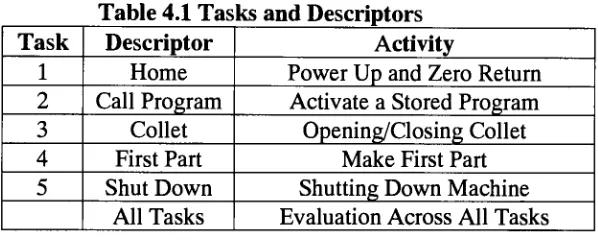
1997). The
table
below
lists
all
tasks
studied
along
with
text
descriptors
that
provide
an
easier means
of
identification
in
this
paper.
For
complete
descriptions,
see
Appendix
D,
page
53.
Table
4.1
Tasks
and
Descriptors
Task
Descriptor
Activity
1
Home
Power
Up
and
Zero Return
2
Call Program
Activate
a
Stored Program
3
Collet
Opening/Closing
Collet
4
First Part
Make First Part
5
Shut Down
Shutting
Down Machine
All Tasks
Evaluation Across All Tasks
4.1.1
Training
Design
Since
the
scope of
the
operations and
the
level
of
complexity
of
the
machining
tasks
examined
in
this
study
were not as great as
those
examined
by
Sauer
et al.
(2000),
it
was
felt
that
a shorter
training
period
was
appropriate.
To further
align
the
present
study
with actual
machine
training
and
use
environments,
exposure
to
the tasks
in
terms
of
duration
and
number
of
repetitions
was
kept
as
similar as possible
to that
experienced
by
persons
being
trained
in
the
conventional
program,
within
the
constraints
of
facilities,
time
and subject
availability.
Training
and reference materials
produced
by
the
manufacturer
were used.
Due
to
subject
scheduling
and
time constraints,
and experimental
facility
size, the
groups
used
in
the
current
study
were smaller
than
those
typically
found
in
the
model
training
facility
(one
or
two
trainees
as compared
to
eight
to ten).
In
the
design
of
the
present
study,
whose
purpose
was
to
compare
and contrast
the
conventional
training
protocol with
a
train-to-criteria
[image:22.528.136.435.315.435.2]Effects
of
Operator
Training
Method
on
Knowledge Retention
on a
Common CNC
Machine
Interface
method, there
was some question as
to
whether
the
comparatively
smaller
group
size
to
be
used
in
the
study
would
adversely
affect
the
outcome.
As
noted
in
the
literature
review,
there
seems
to
be
no
definitive
evidence
that
group
size
significantly influences
training
effectiveness.
In
keeping
with
conventional
training
practices,
and
to
maintain
a
meaningful
relationship
between
this
study
and
the
machine
use
environment,
a procedure-based approach
was
followed in
subject
training
for
both
groups.
Operators
were
trained
by
one
of
the two
methods
and
examined
immediately
to
ascertain
the
degree
of
their
mastery
of
the
processes
learned
and provide a
basis for
comparison
(Sauer
et
al,
2000).
Subjects
in
the
conventional
experimental
group
received
an
at-the-machine
demonstration
and
then
performed
three
practice
trials
under
the
guidance
of
the
analyst.
Subjects in
the
other
experimental
group
were
trained to
criteria.
Based
on
examination
of
various retention
studies, the
criterion of
one
successful error-free
task performance,
as used
by
the
US
Army
(Hagman, 1983),
was
selected as appropriate
for
this
study.
No
time
criterion was
used,
however.
4.1.2 Refresher
Training
In
keeping
with
standard
retention
study
practices,
no
practice
sessions
or
refresher
training
were
provided
between
the
experimental
sessions.
4.1.3
Experimental Session
Scheduling
Design
Because
common
machine
operations
using
the
CNC interface
were
studied,
it
was
decided
that
retention
over
a
long
time
period
was
not
a
concern
in
the
face
of real
world
application of
the
results.
For
the
purposes
of
this study,
it
was
felt
that
examining
retention after
two
weeks would
realistically
represent
the
longest
delay likely
to
be
experienced
by
trainees
before
applying
their
knowledge
to
actual machine operation.
4.1.4
Experimental
Use
of
Reference Materials
Although
the
conventional
training
protocol
does
not
limit
trainees
to
procedural
methods,
it
was
the
author's
experience
that
most
participants
did
not
seek
knowledge-
or
system-based
information. Rule
based
behavior
is
controlled
by
stored
rules
or
procedures
Effects
of
Operator
Training
Method
on
Knowledge
Retention
on a
Common
CNC
Machine
Interface
obtained
through
experience
or
instructions,
whereas
knowledge-based
behavior
involves
problem
solving
and
reasoning
that
require a much more comprehensive
and
accurate
mental
model
of
the
system
(Proctor &
Van
Zandt,
1994).
Thus,
the
conventional
training
was
rule-based
rather
than
knowledge-based. Because
such
information
sources are
common
in
real world
applications,
and are
supplied
and
used
in
the
conventional
training
protocol,
reference materials
used
at
the
training
facility
were
made
available
to
subjects
during
the
study
sessions.
The
references
included
task
sequence
listings.
4.1.5 Number
of
Subjects
Because
the
study
was conducted
using
a wi
thin-subjects
design,
fewer
subjects were
necessary
than
were employed
by
Sauer
et al.
Examination
of several retention studies
indicated
that
subject
group
size
typically
ranges
between
twelve
and
fifteen, however,
due
to supply, this
study
employed
twenty
subjects
in
each
trial group,
for
a
total
of
forty
subjects.
4.1.6
Study
Design
and
Data Analysis
The study
employed
a
two
by
two
by
two,
repeated measures
design
(training
method
x
delivery
x
subject
trial),
with
training
method
and
delivery
as
between-subjects
factors,
and
subject
trial
as a
within-subjects,
repeated measures
factor. ANOVA
was used
to
determine
the
presence
of
significant
differences
in
the
dependent
variables,
performance
times,
time
spent
in
error
mode,
and error
rates,
between
the
initial
examination and
delayed
testing
of retention.
Specifics
of
the
analysis procedure
are
discussed in
section
4.7,
on page
27.
4.2
Preparation for Experimental Sessions
Subjects for
the
usability
trials
were
drawn from
the
student
population
at
Rochester
Institute
of
Technology. A
total
of
forty
subjects
was
examined,
each
participating in
two
experimental
trials,
for
a
total
of
eighty
trials.
Subjects
were
divided randomly
into
two
subpopulations:
those
receiving
conventional
training,
and
those
being
trained
to criteria,
and
again
into
groups
receiving
training
alone or
training
in
pairs.
Subject
candidates were pre-screened
to
conform
to the
desired
subject
profile.
Since
the
study
was
focused
on
the
user
interface,
acceptable subjects
may
have had machining
experience
with
manually
operated
machine
tools,
but
must
have
had
no experience with
CNC
machine
Effects
of
Operator
Training
Method
on
Knowledge Retention
on a
Common
CNC
Machine
Interface
interfaces,
or
the
specific
CNC
machine
tools
and
controllers
being
studied.
Subjects
were
required
to
be physically
able
to
operate
a
machine
tool
and
must not
have been
under
the
influence
of
any
medications or
other
substances
that
could
adversely
affect
their
ability
to
safely
operate
a
machine
tool.
These
qualities
were
determined
by
questionnaire
and
observation.
Candidates
were
required
to
commit
to
both
of
the
experimental
sessions and were required
to
sign
an
informed
consent
form
(Appendix
B,
page
49).
Candidates
were requested
to
make appointments
for
their
sessions.
Each
candidate was
informed
of
the
general nature of
the
study
and
requirements
for
participation,
and
informed
that
he
or she
would
be
required
to
participate
in
two sessions,
over
the
period of
approximately
two
weeks, the
first requiring approximately
one
hour,
the
second
approximately fifteen
minutes,
if
he
or
she
was selected
to
participate
in
the
study.
Upon appearing for
the
initial
session,
candidates were assigned
a
numerical
code number
that
was used
to
identify
data
and records.
Information
linking
personal
information
and
code
numbers was maintained
securely
by
the
principal
investigator
and
destroyed
at
the
conclusion
of
the
study.
Each
candidate
was
informally
interviewed
about
his
or
her
machine
operating
background
to
verify
that
he
or she
met
the
criteria
for
participation.
Candidates
were given a
written
description
of
the
experiment
(see
appendix
A,
page
48). The
experiment
was explained
verbally,
and candidates were given a chance
to
ask questions.
Each
candidate was
informed
that
he
or she might choose
to
terminate
participation
at
any
time
or
for any
reason
during
the
course
of
the
study.
Candidates
that
met
the
criteria and wished
to
participate
in
the
study
were selected
as
subjects.
Upon qualifying
and