Note
. This article will be published in a forthcoming issue of the
International Journal of Sports Physiology and Performance
. The
article appears here in its accepted, peer-reviewed form, as it was
provided by the submitting author. It has not been copyedited,
proofread, or formatted by the publisher.
Section: Original Investigation
Article Title: The Effect of Different Repeated High-Intensity Effort Bouts on Subsequent Running, Skill Performance and Neuromuscular Function
Authors: Rich D. Johnstonª, Tim J. Gabbettª,b, David G. Jenkinsᵇ, and Michael J. Speranzaª
Affiliations: ªSchool of Exercise Science, Australian Catholic University, Brisbane, Queensland, Australia. ᵇSchool of Human Movement Studies, University of Queensland, Brisbane, Queensland, Australia.
Journal: International Journal of Sports Physiology and Performance
Acceptance Date: July 16, 2015
©2015 Human Kinetics, Inc.
RUNNING HEAD: Repeated efforts and subsequent performance
The effect of different repeated high-intensity effort bouts on subsequent running, skill
performance and neuromuscular function
Rich D. Johnston ª, Tim J. Gabbett ª,b, David G. Jenkins ᵇ, and Michael J. Speranza ª
ª School of Exercise Science, Australian Catholic University, Brisbane, Queensland, Australia
ᵇ School of Human Movement Studies, University of Queensland, Brisbane, Queensland, Australia
Address for correspondence:
Rich Johnston
School of Exercise Science,
Australian Catholic University,
Brisbane, Queensland, Australia, 4014
Email: [email protected]
Word Count:
Abstract
Purpose: To assess the impact of different repeated high-intensity effort (RHIE) bouts on
player activity profiles, skill involvements and neuromuscular fatigue during small-sided
games. Methods: Twenty-two semi-professional rugby league players (age 24.0 ± 1.8 years;
body mass 95.6 ± 7.4 kg) participated in this study. During 4 testing sessions, players
performed RHIE bouts that each differed in the combination of contact and running efforts,
followed by a 5 min ‘off-side’ small-sided game before performing a second bout of RHIE
activity and another 5 min small-sided game. Global positioning system microtechnology and
video recordings provided information on activity profiles and skill involvements. A
countermovement jump and a plyometric push-up assessed changes in lower- and upper-body
neuromuscular function after each session. Results: Following running dominant RHIE
bouts, players maintained running intensities during both games. In the contact dominant
RHIE bouts, reductions in moderate-speed activity were observed from game 1 to game 2
(ES = -0.71 to -1.06). There was also moderately lower disposal efficiencies across both
games following contact dominant RHIE activity compared with running dominant activity
(ES = 0.62-1.02). Greater reductions in lower-body fatigue occurred as RHIE bouts became
more running dominant (ES = -0.01 to -1.36), whereas upper-body fatigue increased as RHIE
bouts became more contact dominant (ES = -0.07 to -1.55). Conclusions: Physical contact
causes reductions in running intensities and the quality of skill involvements during
game-based activities. In addition, the neuromuscular fatigue experienced by players is specific to
the activities performed.
Key Words: Team sport; rugby league; movement demands; pacing; global positioning
Introduction
Collision based team sports such as rugby league and rugby union are characterised
by high-intensity running and contact efforts interspersed with periods of lower-intensity
activity.1,2 Whilst the majority of match-play is spent performing low-intensity activities,1
high-intensity activities typically occur at critical periods and often in close proximity to one
another.3,4 These intense bouts of activity have been termed repeated high-intensity effort
(RHIE) bouts.4 Specifically, a RHIE bout involves 3 or more contact, acceleration, or
high-speed running efforts with less than 21 seconds between each effort.5 Although 3 efforts is
the minimum number required to constitute a RHIE bout, these bouts can be much more
frequent and longer in duration.6,7 The longest RHIE bout reported in a study of elite rugby
league players included 13 efforts (4 contact and 9 acceleration) over a 120 s period with an
average recovery time of 5 s between efforts.7 Not only do these RHIE bouts occur frequently
during rugby league 3,7 and union competition,6 they also tend to occur during critical periods
of play such as when defending the try-line.3 Moreover, winning teams perform more RHIE
bouts, more efforts per bout, and maintain a higher playing intensity whilst recovering from
high-intensity efforts.8 Clearly, the frequency of RHIE bouts and the critical time points at
which they occur suggests players must have the capacity to maintain physical, technical and
decision-making performance following these efforts in order to deliver successful outcomes.
Previous research has highlighted that the addition of contact efforts to
repeated-sprints9 and small-sided games10-12 leads to greater reductions in running performance and
increases in perceived effort compared with activities involving running alone.9,10 Not only
does physical contact result in transient fatigue, residual fatigue is also apparent, with
increases in upper-body fatigue and muscle damage following contact small-sided games.13
Conversely, increased running loads result in greater increases in lower-body fatigue.13
RHIE bouts11,12, players from both rugby codes rarely perform contact in isolation during
match-play, rather they are interspersed with running efforts.6,7 Therefore, it is important to
determine whether subsequent running activity and fatigue is influenced by the type of RHIE
bout performed (i.e. contact or running dominant).
Although physical performance is important,14 skill and technical performance is
inextricably linked to game success.15 One study demonstrated that pivots showed reductions
in the frequency and quality of skill involvements following the most intense 5 min running
period during elite rugby league games.16 In addition, tackle technique appears reduced
following RHIE bouts.17 Despite this, the specific effect RHIE bouts have on skill
performance and whether this is dependent on the type of RHIE bout performed remains
unknown. Given that RHIE bouts often occur during vital passages of play,3 it is important to
investigate the impact of RHIE bouts on both physical and technical performance. This would
allow coaches to develop specific repeated effort drills that would develop players’ ability to
maintain skills under pressure and fatigue. With this in mind, the aims of this study were to
determine the impact of different RHIE bouts on (1) running intensities (2) skill involvements
and (3) neuromuscular fatigue during small-sided games. It was hypothesised that increasing
the contact demands of the RHIE bouts would result in greater reductions in running intensity
and more upper-, but less lower-body fatigue. In addition, skill performance would be
negatively impacted by performing RHIE bouts.
Methods
Design
In order to test our hypotheses, a counter-balanced, cross-over experimental design
was used. Players took part in 4 different RHIE bouts followed by small-sided games over 21
microtechnology units during the RHIE bouts and small-sided games in order to provide
information on activity profiles. Additionally, each small-sided game was filmed to assess the
quality and frequency of skill involvements.
Subjects
Thirty-eight semi-professional rugby league players (age 24.2 ± 2.3 years; body mass
96.1 ± 10.9 kg) from the same Queensland Cup club, participated in the study. Data were
collected during weeks 9-11 of the pre-season period, with players free from injury. Over the
course of the testing period, players were asked to maintain their normal diet. In accordance
with the Code of Ethics of the World Medical Association (Declaration of Helsinki), players
received an information sheet outlining experimental procedures; written informed consent
was obtained from each player. The study was approved by the University’s ethical review
board for human research. Over the course of the study, some players were unavailable for
each testing session. Only players that completed each of the 4 conditions were used within
the analysis. Therefore, 22 players (age 24.0 ± 1.8 years; body mass 95.6 ± 7.4 years) formed
the final cohort for this study.
Protocol
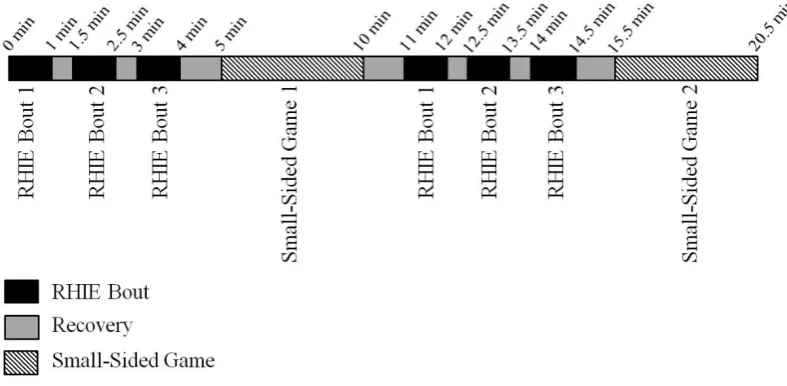
On each of the 4 testing sessions, players performed 3 RHIE bouts followed by a
standardised 5 minute ‘off-side’ small-sided game before repeating the RHIE bouts and
small-sided game (Figure 1). Within 30 min following the RHIE bouts and games,
neuromuscular function was assessed via a countermovement jump (CMJ) and plyometric
push-up (PP). Players trained in two separate squads with one squad performing the testing
first, immediately followed by the second squad of players. Prior to the first session, each
squad was divided into two teams of nine players, ensuring an even spread of playing
the 4 conditions, due to player absences (e.g. injury, separate training) some variations in the
players within each team did occur between conditions. The number of players on each team
was maintained at 9 for each condition.
RHIE Bouts
Prior to each small-sided game, players performed 3 x 6-effort RHIE bouts. Each bout
lasted for 1 minute and involved 6 efforts with 30 s recovery between each bout where
players jogged 20 m at their own pace. Following the third RHIE bout and the 20 m jog, there
was an additional 30 s of recovery prior to the start of the small-sided game. These bouts
were designed to reflect the work-to-rest ratios of the most demanding RHIE bouts observed
in competition.4,14 The 4 different RHIE bouts involved a combination of 5 s contact and/or
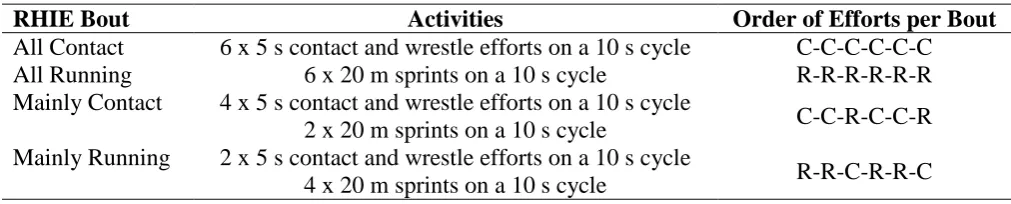
20 m sprint efforts with a 1:1 work-to-rest ratio. The 4 bouts comprised (1) ‘all contact’ (6
contact efforts), (2) ‘all running’ (6 20 m sprints), (3) ‘mainly contact’ (4 contact, 2 sprint
efforts), and (4) ‘mainly running’ (2 contact, 4 sprint efforts) (Table 1). From a standing
position, the contact efforts involved a hit on each shoulder, utilising over- and under-hook
grips, before attempting to wrestle their opponent onto their back from a standing position.
The 20 m sprint involved an all-out sprint followed by a 10 m deceleration.
Small-Sided Games
One minute following the third RHIE bout, the first small-sided game was played.
The small-sided games were 5 min in duration and involved 9 vs. 9 players on a standardised
(68 m x 40 m) floodlit grassed playing area. Unlike a regular small-sided rugby game, during
side’ games, the ball can be passed in any direction (i.e. to side’ players). The
Activity Profiles
Game and RHIE activity profiles were assessed using GPS microtechnology devices.
The GPS units sampled at 10 Hz (Optimeye S5, Catapult Sports, VIC, Australia) and
included a 100 Hz tri-axial accelerometer and gyroscope to provide information on collisions.
Data were downloaded to a laptop and subsequently analysed (Sprint, Version 5.1.1, Catapult
Sports, VIC, Australia). Data were categorised into low-speed activity (0-3.5 m·s-1),
moderate-speed running (3.6-5.0 m·s-1) and high-speed running (≥5.1 m·s-1).1 Player Load™
Slow (<2 m·s-1) was used to determine the load associated with the non-running components
(i.e. physical contact) of the RHIE bouts.18 These units offer valid and reliable estimates of
activities common in team sports.19,20 To assess internal load of each condition, within 30 min
following the session, rating of perceived exertion (RPE [CR-10]) was recorded for each
player.21
Skill Involvements
Each small-sided game was filmed using a video camera (Cannon Legria HV40,
Japan). Games were coded for number of possessions, number and quality of disposals, and
number of errors. An effective disposal was classified as a completed pass to a team-mate in
an ‘open’ position; an ineffective disposal involved a pass that went to a closely marked
team-mate or the ball was turned over.22 Disposal efficiency represented the number of
effective passes divided by the total number of possessions. An error was coded when the ball
went to ground, or was intercepted. The test re-test reliability (typical error of measurement
[TE]) was determined by the same operator coding two games on two separate occasions, 4
weeks apart for number of possessions (TE = 3.2%), number of disposals (TE = 5.7%),
Neuromuscular Fatigue
Neuromuscular fatigue was assessed within 15 min after the second game.
Lower-body neuromuscular fatigue was assessed using a CMJ; upper-Lower-body neuromuscular fatigue
was assessed using a PP as described previously.23 Both exercises were performed on a force
platform (Kistler 9290AD Force Platform, Kistler, USA) connected to a laptop running
manufacturer designed software (QuattroJump, Kistler, USA). Changes in neuromuscular
fatigue were compared against each player’s maximum value that was determined 5 days
prior to the first testing session. Maximum peak power was determined by their highest score
from 3 CMJ’s and PP’s performed in a non-fatigued state, with approximately 5 min between
efforts. The between day TE for the CMJ and PP was 3.5% and 3.8% for peak power,
respectively.
Statistical Analysis
Based on the real-world relevance of the results, magnitude based inferences were used to
determine the meaningfulness of any differences in activity profile, skill, and neuromuscular
fatigue changes during and following the different RHIE bouts and games. Firstly, the
likelihood that changes in the dependent variables were greater than the smallest worthwhile
change was calculated as a small effect size of 0.20 x the between subject standard deviation.
Thresholds used for assigning qualitative terms to chances were as follows: <1% almost
certainly not; <5% very unlikely; <25% unlikely; <50% possibly not; >50% possibly; >75%
likely; >95% very likely; ≥99% almost certain.24 The magnitude of difference was considered
practically meaningful when the likelihood was ≥75%. Secondly, magnitudes of change in
the dependent variables were assessed using Cohen’s effect size (ES) statistic.25 Effect sizes
(ES) of 0.20-0.60, 0.61-1.19, and ≥1.20 were considered small, moderate and large
Results
RHIE Bouts
Players covered an average of 43 ± 2 m·min-1 in the ‘all contact’, 49 ± 2 m·min-1 in
the ‘mainly contact’,84 ± 4 m·min-1 in the ‘mainly running’, and 105 ± 7 m·min-1 in the ‘all
running’ RHIE bouts (ES = 3.00-12.97). In addition, Player LoadTM Slow values per minute
of each bout were 7.6 ± 1.7 AU·min-1 (‘all contact’), 5.0 ± 1.0 AU·min-1 (‘mainly contact’),
4.0 ± 1.0 AU·min-1 (‘mainly running’), and 2.6 ± 0.5 AU·min-1 (‘all running’) (ES =
1.77-3.99).
Game Intensities
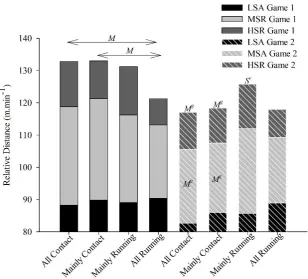
In game 1, there were similar running intensities in each condition other than the ‘all
running’ condition where the relative intensity was moderately lower than the ‘all contact’
(ES = -0.69 ± 0.22; likelihood = 93%, likely) and ‘mainly contact’ (ES = -0.69 ± 0.43;
likelihood = 89%, likely) conditions (Figure 2). There was little difference between the
relative intensities of game 2 for the different conditions. From game 1 to 2, there were only
small and trivial reductions in the ‘mainly running’ (ES = -0.36 ± 0.62; likelihood = 83%,
likely) and ‘all running’ (ES = -0.17 ± 0.23; likelihood = 87%, likely) conditions. There were
however larger, moderate reductions in relative intensity in game 2 in the ‘all contact’ (ES =
-0.96 ± 0.42; likelihood = 94%, likely) and ‘mainly contact’ (ES = -1.07 ± 0.34; likelihood =
94%, likely) conditions. These reductions were largely brought about by decreases in
moderate-speed activity in game 2 in the ‘all contact’ (ES = -0.71 ± 0.34; likelihood = 93%,
likely) and ‘mainly contact’ (ES = -1.06 ± 0.48; likelihood = 89%, likely) conditions. Albeit
small, there were greater relative distances covered in game 2 of the ‘mainly running’
Skill Involvements
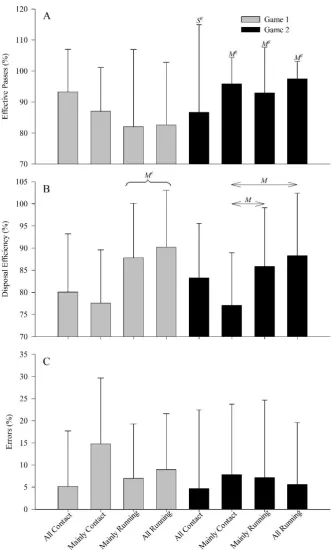
During game 1, there were a total of 67, 79, 79, and 73 passes made in the ‘all
contact’, ‘mainly contact’, ‘mainly running’, and ‘all running’ conditions. In game 2, there
were a total of 58, 81, 66, and 73 passes made in the ‘all contact’, ‘mainly contact’, ‘mainly
running’, and ‘all running’ conditions. There was no difference in the number of effective
passes between conditions in game 1. In game 2, there were moderate increases in the
number of effective passes across all conditions except in the ‘all contact’ condition where
there was a small reduction in effective passes compared with game 1 (ES = -0.30 ± 0.22;
likelihood = 77%, likely [Figure 3]). In game 1 there were moderately greater disposal
efficiencies in the ‘mainly running’ (ES = 0.77-1.02) and ‘all running’ (ES = 0.62-0.79)
conditions, compared with the games following the contact dominant conditions. There was
little difference in skill performance between game 1 and game 2 in any condition although
there was still greater disposal efficiencies observed in the game in the ‘mainly running’ (ES
= 0.73 ± 0.19; likelihood = 97%, very likely), and ‘all running’ (ES = 0.83 ± 0.22; likelihood
= 100%, almost certain) conditions compared with the ‘mainly contact’ condition. There were
no differences in the number of errors between games or conditions.
Neuromuscular Fatigue
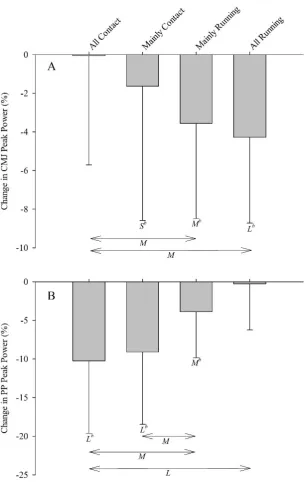
There was no change in CMJ peak power following the ‘all contact’ (ES = -0.01 ±
0.11; likelihood = 29%, possibly not), small reductions following the ‘mainly contact’ (ES =
-0.33 ± 0.18; likelihood = 64%, possibly), moderate reductions following the ‘mainly running’
(ES = -1.02 ± 0.21; likelihood = 79%, likely), and finally large reductions following the ‘all
running’ condition (ES = -1.36 ± 0.20; likelihood = 85%, likely). Furthermore, the reductions
observed following the ‘all running’ and ‘mainly running’ conditions were moderately
There were large reductions in PP peak power following the ‘all contact’ (ES = -1.55
± 0.44; likelihood = 100%, almost certain) and ‘mainly contact’ (ES = -1.37 ± 0.32;
likelihood = 100%, almost certain) conditions, moderate reductions following the ‘mainly
running’ condition (ES = -0.92 ± 0.65; likelihood = 56%, possibly), and finally trivial
reductions following the ‘all running’ condition (ES = -0.07 ± 0.09; likelihood = 36%,
possibly). Reductions observed following the ‘all contact’ and ‘mainly contact’ conditions
were moderately greater than the changes following the ‘all running’ (ES = 1.12-1.27) and
‘mainly running’ (ES = 0.66-0.88) conditions.
Perceived Exertion
The highest RPE was observed following the ‘mainly contact’ condition (RPE = 5.6 ±
1.1 AU), this reflected a large effect size difference compared with the ‘all contact’ (ES =
-1.21 ± 0.23; likelihood = 100%, almost certain; RPE = 4.2 ± 1.3 AU) and ‘mainly running’
(ES = -1.41 ± 0.28; likelihood = 100%, almost certain; RPE = 4.0 ± 1.1 AU) conditions, and
a moderate difference compared with the ‘all running’ condition (ES = -0.78 ± 0.18;
likelihood = 92%, likely; RPE = 4.6 ± 1.5).
Discussion
The aims of this study were to determine the impact of different RHIE bouts on
running intensities and skill involvements during game-based activities and to assess the
neuromuscular fatigue response to RHIE bouts comprising different amounts of contact and
sprinting. Players set a lower, but ‘even-paced’ pacing strategy in the ‘all running’ condition
compared with the other conditions. When players were required to perform contact in the
RHIE bouts, they began with higher running intensities in game 1, before showing reductions
in game 2. These reductions were greater following the contact dominant conditions. As such,
reductions in running intensities compared to following running dominant RHIE activity.
Furthermore, following contact dominant RHIE activity, players display lower quality skill
involvements than following running dominant RHIE activity. Lower-body and upper-body
fatigue appear to increase with both the running and contact demands of RHIE activity,
respectively. This study demonstrates that physical contact causes greater reductions in
running intensities and the quality of skill involvements during game-based activities
compared with running efforts.
Different running intensities were observed during the small-sided games following
the different RHIE bouts. Particularly in game 1, following the ‘all running’ condition, player
work rates were reduced compared to the other conditions. They appeared to set an
‘even-paced’ pacing strategy that they could maintain across both game 1 and game 2.27 The reason
for this reduced intensity following the ‘all running’ bouts may be due to players being
unaccustomed to exclusively performing running efforts given the high frequency of physical
collisions during match-play.1,10 In the other conditions, players employed a ‘positive’ pacing
strategy whereby the playing intensity was high to begin with (i.e. in game 1) before
decreasing in game 2; indicative of player fatigue.27 These reductions in intensity were
greater in game 2 following the contact dominant RHIE bouts, primarily through reductions
in moderate-speed activity. These results are in accordance with others that have reported
greater reductions in both high-speed,9,11 and moderate-speed running12 with increased
contact demands. These findings clearly demonstrate the large physical cost associated with
performing contact efforts. It is interesting to note that the greatest RPE was observed in the
‘mainly contact’ condition where players had to perform 4 contact and 2 running efforts per
RHIE bout. It is likely that combining the demanding nature of contact efforts with the
cardiovascular stress of running is particularly demanding for players and resulted in a
players should be regularly exposed to RHIE bouts involving contact in order to minimise
reductions in player work-rates and deliver successful performances. A combination of
running and contact efforts is more game-specific and likely to elicit greater internal loads.
Other than in the ‘all contact’ condition, where small reductions were observed,
players showed moderate increases in the percentage of effective passes from game 1 to game
2. There are a number of potential explanations that could explain these findings. Firstly,
players may be more accustomed to their team-mates, and opposition’s style of play
following game 1 allowing for improved passing performance. Secondly, a reduction in game
speed, allowing players more time to make the correct decision and therefore deliver an
effective pass could also have played a role. Whilst this may be the case in game 2 in the
‘mainly contact’ and ‘mainly running’ conditions, following the ‘all running’ RHIE bout,
from game 1 to 2, the relative intensity was unchanged yet there was a marked increase in the
percentage of effective passes. As such, an alternate explanation could be that as players were
accustomed to performing this skill under pressure and fatigue, they were able to withstand
higher levels of arousal, before arousal had detrimental effects on skill performance.28
Indeed, previous research from water polo indicates that during high levels of exertion and
fatigue, response accuracy on a sport-specific decision making test is increased, and shooting
accuracy is maintained despite reductions in shooting technique.29 Similarly, soccer players
appear to be able to maintain skill performance over the course of a game despite reductions
in physical performance and apparent fatigue.30
There was little change in the total number of passes per player between game 1 and
game 2 following any of the RHIE bouts. Collectively, these results are in contrast to
previous research from rugby league that reported reductions in the number and quality of
skill involvements following the peak 5 min period during match-play.16 A reason for this
games that were shorter in duration as opposed to the ‘on-side’ nature and longer duration of
rugby league competition. Despite this, there was reduced disposal efficiency in the games
following contact dominant RHIE bouts compared to those following the running dominant
bouts. This reduced disposal efficiency was largely brought about by players being caught in
possession more frequently in the games following the contact dominant RHIE bouts. This
could be due to higher levels of upper-body fatigue observed currently, and previously,13
resulting in players being unable to complete fast exchanges in passes and therefore being
caught in possession more frequently. Further research is required to determine the influence
of RHIE activity and fatigue on technical and decision making performance in more closely
controlled, sport specific ‘on-side’ scenarios in rugby players.
Greater increases in lower-body fatigue following the ‘all running’ RHIE bouts and
games and progressively smaller increases in lower-body fatigue as the running loads of the
RHIE bouts reduced were also observed. The opposite was observed for upper-body fatigue
which increased with the contact demands. These findings are in accordance with those
previously published13 and clearly highlight that the fatigue response to players involved in
contact sport is likely to be whole body in nature. Simply determining lower-body muscle
fatigue is likely to underestimate the fatigue response. Furthermore, this provides useful
information to coaches with players covering greater running loads during competition (i.e.
outside backs) likely to experience more lower-body fatigue. Conversely, players who
perform larger numbers of contact efforts (i.e. the forwards) are likely to suffer more
upper-body fatigue in the days following competition. Further research should aim to elucidate
specific training and recovery strategies following competition according to the activities
performed by each player, based on their in-game positional demands.
It is important to note that this study was not without its limitations. Firstly, whilst we
m sprints in the RHIE bouts, players typically completed the 20 m sprints in 3-4 seconds, and
therefore had a slightly longer rest period (6-7 seconds). Secondly, the wrestle efforts were
more eccentric/isometric in nature compared to the concentric dominant running efforts,
which is likely to impact fatigue symptoms. Thirdly, the placement of the unit between the
shoulder blades could influence the measurement of Player Load™ and might explain some
of the differences observed between the contact and running RHIE bouts.31 The placement of
the GPS unit between the shoulder blades may be more sensitive for detecting accelerations
that occur in the upper body (i.e. contact) rather than the lower body (i.e. running).
Practical Applications
Players should be exposed to a combination of contact and running RHIE bouts to
prepare them for the intense demands of rugby league and rugby union competition. These
bouts should be tailored to the specific positional demands of the game and reflect the
differing contact and running demands between positional groups. Challenging players to
maintain performance following RHIE activity may be an effective method of developing
their ability to work under pressure and fatigue. Targeting opposition playmakers whilst in
attack, making them perform more contact efforts, may lead to greater reductions in their
physical and technical performance. Given the demanding nature of RHIE bouts and
contact9,13 the prescription of any RHIE training should take this into account and be
appropriately periodised in order to maximise the adaptive response to training. Future
research should aim to determine the efficacy a period of RHIE training has on players’
ability to limit the physical and technical reductions observed following RHIE bouts. The
fatigue response to rugby league training and competition is likely to be whole-body in nature
and this, along with their match activities, should be taken into account when monitoring
Conclusions
When the activities performed in RHIE bouts are manipulated, players will set
different pacing strategies in order to complete set tasks. When players are required to
perform contact efforts, they set a positive pacing strategy where they start with an initially
high playing intensity that is reduced in the second game. These reductions in running
intensity are greater in the games following contact dominant RHIE bouts. In addition, whilst
there are increases in the effective passes from game 1 to game 2 in all conditions other than
the ‘all contact’ condition, there is reduced disposal efficiency observed in the games
following the contact dominant bouts. Increases in running loads results in greater
lower-body fatigue, whereas greater contact loads leads to increased upper-lower-body fatigue. This study
highlights the physical and functional cost of performing contact efforts from both a physical
and technical perspective.
Acknowledgements
The authors have no conflicts of interest to declare, and no sources of funding were used in
this study. Thanks to the players from Norths Devils RLFC who volunteered to take part in
References
1. Gabbett TJ, Jenkins DG, Abernethy B. Physical demands of professional rugby league training and competition using microtechnology. J Sci Med Sport. 2012;15:80-86.
2. Austin D, Gabbett T, Jenkins D. The physical demands of super 14 rugby union. J Sci Med Sport. 2011;14:259-263.
3. Gabbett TJ, Polley C, Dwyer DB, Kearney S, Corvo A. Influence of field position and phase of play on the physical demands of match-play in professional rugby league forwards. J Sci Med Sport. 2014;17:556-561.
4. Austin DJ, Gabbett TJ, Jenkins DJ. Repeated high-intensity exercise in a professional rugby league. J Strength Cond Res. 2011;25:1898-1904.
5. Gabbett TJ. Sprinting patterns of national rugby league competition. J Strength Cond Res. 2012;26:121-130.
6. Austin D, Gabbett T, Jenkins D. Repeated high-intensity exercise in professional rugby union. J Sports Sci. 2011;29:1105-1112.
7. Black GM, Gabbett TJ. Repeated high-intensity effort activity in elite and semi-elite rugby league match-play. Int J Sports Physiol Perform. 2014.
8. Gabbett TJ. Influence of the opposing team on the physical demands of elite rugby league match play. J Strength Cond Res. 2013;27:1629-1635.
9. Johnston RD, Gabbett TJ. Repeated-sprint and effort ability in rugby league players. J Strength Cond Res. 2011;25:2789-2795.
10. Johnston RD, Gabbett TJ, Seibold AJ, Jenkins DG. Influence of physical contact on pacing strategies during game-based activities. Int J Sports Physiol Perform.
2014;9:811-816.
11. Johnston RD, Gabbett TJ, Jenkins DG. Influence of number of contact efforts on running performance during game-based activities. Int J Sports Physiol Perform.
2014.
12. Johnston RD, Gabbett TJ, Walker S, Walker B, Jenkins DG. Are three contact efforts really reflective of a repeated high-intensity effort bout? J Strength Cond Res. 2014.
13. Johnston RD, Gabbett TJ, Seibold AJ, Jenkins DG. Influence of physical contact on neuromuscular fatigue and markers of muscle damage following small-sided games. J Sci Med Sport. 2014;17:535-540.
14. Johnston RD, Gabbett TJ, Jenkins DG. Applied sport science of rugby league. Sports Medicine. 2014.
16. Kempton T, Sirotic AC, Cameron M, Coutts AJ. Match-related fatigue reduces physical and technical performance during elite rugby league match-play: A case study. J Sports Sci. 2013;31:1770-1780.
17. Gabbett TJ. Influence of fatigue on tackling technique in rugby league players. J Strength Cond Res. 2008;22:625-632.
18. Boyd LJ, Ball K, Aughey RJ. Quantifying external load in australian football matches and training using accelerometers. Int J Sports Physiol Perform. 2013;8:44-51.
19. Gabbett T, Jenkins D, Abernethy B. Physical collisions and injury during professional rugby league skills training. J Sci Med Sport. 2010;13:578-583.
20. Varley MC, Fairweather IH, Aughey RJ. Validity and reliability of gps for measuring instantaneous velocity during acceleration, deceleration, and constant motion. J Sports Sci. 2012;30:121-127.
21. Gabbett TJ, Jenkins DG. Relationship between training load and injury in professional rugby league players. J Sci Med Sport. 2011;14:204-209.
22. Gabbett TJ, Walker B, Walker S. Influence of prior knowledge of exercise duration on pacing strategies during game-based activities. Int J Sports Physiol Perform. 2014.
23. Johnston RD, Gibson NV, Twist C, Gabbett TJ, Macnay SA, Macfarlane NG. Physiological responses to an intensified period of rugby league competition. J Strength Cond Res. 2013;27:643-654.
24. Batterham AM, Hopkins WG. Making meaningful inferences about magnitudes. Int J Sports Physiol Perform. 2006;1:50-57.
25. Cohen J. Statistical power analysis for the behavioral sciences (rev. Ed.). Hillsdale, NJ, England: Lawrence Erlbaum Associates, Inc; 1977, xv, 474 p.
26. Hopkins WG, Marshall SW, Batterham AM, Hanin J. Progressive statistics for studies in sports medicine and exercise science. Med Sci Sports Exerc. 2009;41:3-13.
27. Tucker R. The anticipatory regulation of performance: The physiological basis for pacing strategies and the development of a perception-based model for exercise performance. Br J Sports Med. 2009;43:392-400.
28. Landers DM. The arousal-performance relationship revisited. Res Q Exerc Sport.
1980;51:77-90.
29. Royal KA, Farrow D, Mujika I, Halson SL, Pyne D, Abernethy B. The effects of fatigue on decision making and shooting skill performance in water polo players. J Sports Sci. 2006;24:807-815.
31. Barrett S, Midgley A, Lovell R. Playerload: Reliability, convergent validity, and influence of unit position during treadmill running. Int J Sports Physiol Perform.
Figure 2. Movement demands of game 1 and game 2 following the different repeated effort bouts. LSA = low-speed activity; MSR = moderate-speed running; HSR = high-speed running. Mg refers to a moderate (0.61-1.19) effect size difference between game 1 and 2; Sc
Figure 4. Changes in (A) lower body muscle function and (B) upper body muscle function following the different repeated effort bouts and small-sided games. CMJ = countermovement jump; PP = Plyometric push-up. Sb,Mb, and Lb refers to a small
(0.20-0.60), moderate (0.61-1.19) and large (≥1.20) effect size difference from baseline; Mc and Lc
Table 1. Activities performed during each RHIE bout preceding the small-sided games. †
RHIE Bout Activities Order of Efforts per Bout
All Contact 6 x 5 s contact and wrestle efforts on a 10 s cycle C-C-C-C-C-C
All Running 6 x 20 m sprints on a 10 s cycle R-R-R-R-R-R
Mainly Contact 4 x 5 s contact and wrestle efforts on a 10 s cycle
2 x 20 m sprints on a 10 s cycle C-C-R-C-C-R
Mainly Running 2 x 5 s contact and wrestle efforts on a 10 s cycle
4 x 20 m sprints on a 10 s cycle R-R-C-R-R-C