NURBALQIS BINTI YUSOFF
This report is submitted in partial fulfilment of the requirements for the Bachelor of Computer Science (Artificial Intelligent)
FACULTY OF INFORMATION AND COMMUNICATION TECHNOLOGY UNIVERSITI TEKNIKAL MALAYSIA MELAKA
NUTRIENT FACT PROCESSING TOOL
is written by me and is my own effort and that no part has been plagiarized without citations.
STUDENT: Date:
---
-(NURBALQIS BINTI YUSOFF)
DEDICATIONS
To my beloved parents, who have been my constant source of inspiration.
ACKNOWLEDGEMENT
I would like to thank Dr. Norzihani bt. Yusoffor giving assistant to complete this
project successfully.
I would also like to thank my beloved parents who have been giving me support and
ABSTRACT
As the world shifted to the modern age, there will be more food packet delivered
within nutritional fact for the consumer's convenience. However, consumers tend to
eat whatever kind of food without taking note the nutritional fact provided within
food packet. This is because nutritional facts provided by food manufacturers was
quite complicated and hard to be understood by consumers. This can be one of the
reasons why obesity problem triggered in Malaysia as consumer having lack of
knowledge about nutritional fact served in food packet consumed.
So providing a solution to this problem, I would like to propose a 'Nutrient Fact
Processing Tool' that is very crucial for the packet food consumers. In this tool, there
will be an additional feature provided which is the body mass index calculator. This
calculator will enable food consumer to consider their body mass index within the
content of nutrients appeared on the food packet. So far, there is no effort had been
carried out to meet this main objectives which is to provide a tool which capable in
processing image of nutritional fact on food packet. By that, packet food consumer
ABSTRAK
Apabila dunia semakin menganjak ke zaman moden, akan lebih banyak makanan
berpaket yang dilengkapi fakta nutrisi dikeluarkan untuk kemudahan pengguna.
Walau bagaimanapun, kebanyakan pengguna lebih selesa menikmati makanan
berpaket tanpa mengambil kira fakta nutrisi yang disediakan tersebut. Ini berpunca
daripada struktur fakta nutrisi itu sendiri yang tidak mesra pengguna dan sukar untuk
ditafsirkan oleh pengguna. Ini merupakan salah satu sebab mengapa masalah obesiti
muncul di Malaysia yang mana berpunca daripada pengguna makanan berpaket yang
tidak mengambil berat akan jumlah nutrisi yang diambil bagi setiap hidangan.
Lantaran masalah tersebut, saya rnencadangkan satu 'Pemproses Fakta Nutrisi' yang
akan menjadi satu alat penting untuk pengguna makanan berpaket. Di dalam alat ini,
akan ada ciri-ciri tambahan iaitu 'Kalkulator Indeks Jisim Tubuh'. Kalkulator ini akan
membolehkan pengguna rnengira indeks jisim tubuh mereka. Setakat ini, tiada usaha
yang dijalankan oleh pihak lain untuk menghasilkan satu alat serupa yang mampu
memproses fakta nutrisi pada paket makanan. Diharap dengan usaha saya kali ini,
para pengguna akan lebih jelas dan prihatin terhadap fakta nutrisi yang disediakan
CHAPTER
CHAPTER I
TABLE OF CONTENTS
SUBJECTS
DECLARATION
DEDICATION
ACKNOWLEDGEMENT
ABSTRACT
TABLE OF CONTENT
INTRODUCTION
1.1 Project Background
1.2 Problem Statements
1.3 Objectives
1.4 Scope
1.5 Project Significant
1.7 Expected Output
1.8 Conclusion
CHAPTER II LITERATURE REVIEW AND PROJECT
METHODOLOGY
2. 1 Introduction
2.2 Fact and Finding
2.2.1 Domain
2.2.2 Existing System
2.2.3 Technique
2.3 Project Methodology
2.3.1 Approach 12
2.3.2 Model 13
2.4 Project Requirement 17
2.4.1 Software Requirement 18
2.4.2 Hardware Requirement 19
2.4.3 Other Requirement 19
2.5 Project Schedule and Milestone 20
2.6 Conclusion 23
CHAPTER III ANALYSIS
3.1 Introduction 24
3.2 Problem Analysis 25
3.3 Requirement Analysis 26
3.3.1 Data Requirement 27
3.3.2 Functional Requirement 28
3.3.2.1 Detection 29
3.3.2.2 Calculate 29
3.3.3 Non-Functional Requirement 30
3.3.3.1 Performance 30
3.3.3.2 Size of Data 31
3.4 Conclusion 31
CHAPTER IV
DESIGN
4.1 Introduction 32
4.2 High-Level Design 33
4.2.1 System Architecture 33
4.2.2 User-Interface Design 34
4.2.3 Navigation Design 34
4.2.4 Input Design 41
4.3 Detail Design 43
4.3.1 Software Specification 43
4.3.1.1 Load Button 45
4.3.1.2 Select Button 45
4.3.1.3 Crop Button 46
4.3.1.4 Analyze Button 47
4.3.1.5 Reset Button 49
4.3.1.6 Calculate BMI Button 49
4.3.1.7 Reset BMI Button 50
4.4 Conclusion 51
CHAPTER V IMPLEMENTATION
5.1 Introduction 52
5.2 Software Development Environment 53
5.3 Software Configuration Management 55
5.3.1 Configuration Environment Setup 55
5.3.2 Version Control Procedure 56
5.4 Implementation Status 57
5.5 Conclusion 59
CHAPTER VI TESTING
6.1 Introduction 60
6.2 Test Plan 61
6.2.1 Test Organization 61
6.2.2 Test Environment 62
6.2.3 Test Schedule 63
6.3 Test Strategy 63
6.4 Test Design
6.4.1 Test Description
6.4.2 Test Data
6.5 Test Results and Analysis
6.6 Conclusion
CHAPTER VII PROJECT CONCLUSION
67
69
70
72
7.1 Observation on Weaknesses and Strengths 73
7.2 Propositions for Improvement 75
7.3 Contribution 75
7.4 Conclusion 76
REFERENCES 77
CHAPTER I
INTRODUCTION
As the world advance to the modem age, there will be more food packet delivered within nutritional fact for the consumer's convenience. Nowadays, consumers tend to eat whatever kind of food without take note about the nutritional
fact provided within food packet. However, nutritional facts provided by food manufacturer was quite complicated and hard to be understand by consumers. This can be one of the reasons why obesity problem triggered in Malaysia as consumer having lack of knowledge about nutritional fact served in food packet consumed.
has been carried out to meet this main objectives which is to provide a tool which capable in processing image of nutritional fact on food packet. This tool will provide a detail about nutrients served within food packet.
1.1 Project Background
1.2 Problem Statements
There are few problems about nutritional fact on the current food packet which raises my awareness to design this Nutrient Fact Processing Tool. Firstly, nutritional facts display on every food packet was quite difficult to be read by food consumer. Secondly, food consumer cannot acknowledge how much nutrient taken per serving and how much nutrient need to be consumed on the next me.
1.3 Objectives
From this project, I would like to carry out the following aims which are;
l. To enable packet food consumer acknowledge how much nutrient taken by
them per serving and how much nutrient need to be served on the next meal.
2. To enable packet food consumer to acknowledge their current Body Mass
1.4 Scope
The scope of my project will be focused on the usage of this Nutrient Fact Processing Tool and its business rule, software that will be used in order to build this project.
1.5 Project Significant
1.6 Expected Output
This system should be able to process identified images and do intelligent
task in order to produce the percentage of nutrition fact by using some algorithm
implemented with digital image processing that suit this case. This system will make
decision about the input of Body Mass Index (BMI) of a person with the content of
nutrition of the food packet.
1. 7 Conclusion.
The aim of this project is to design and develop a system a system that could
count the petcentage of nutrition content to enable people to beware about the food
content when deal with fast food and tendency of unethical food intake. In future
significance, some improvement can be added to make this such system to be more
intelligently, effectively functional and can be implemented in more wide area.
I hope at the end of this project, will be able to help packet food consumer to manage
their nutrients intake efficiently. I also hope that, the existence of this tool later on,
food consumer will not experience any problem in understanding the nutrient fact in
CHAPTER II
LITERATURE REVIEW AND PROJET METHODOLOGY
2.1 Introduction
In software development, it will go through a several phases of techniques and methodology in order to achieve the goals or the objectives of the project. With different resources, there are several methodology phases that will go through. In this project, Matlab R2007b software and the tools inside the software has been chosen to
2.2 Facts and Findings
Fact and findings is references or past researches that have been found in the
internet, book and other documentation.
2.2.1 Domain
In every project, it is important to know what domain is it in. For this project,
the aim is to develop a system to read the nutrition percentage in food packet based
on Body Mass Index (BMI) . The system will be used by everybody especially who
concern about their food intake. This system will be compared the value of food
nutrition with their Body Mass Index (BMI) thus enable food consumer to limit their
food intake. By that, food consumer can manage how many packet of food need to
2.2.2 Existing System
There a lot of similar system that has been develops for text detection. Considerable of Plate Number Recognizer is based on real-time image processing. In this project, the system is developed based on digital image processing. One of them is Traffic System (Traf- Sys Inc,). It will record the traffic and counting in real time.
Their goal is to help the clients achieve higher profits by using traffic counting systems data along with the other key metrics that have always been analyzed in running a business. This way, their customers can find out how many sales they are getting in relation to the traffic, how much staff needed, how much security staff, etc. Their customers can even use the information to team with sponsors-by knowing exactly how many people go by a kiosk or display.
2.2.3 Technique
was introduced for neural networks. Since then, neural network has obtained a
widespread used in image processing. The current use of ANNs in image processing
exceeds the aforementioned traditional applications. The role of feed-forward ANNs
and SOMs has been extended to encompass also low-level image processing tasks
such as noise suppression and image enhancement. Hopleld ANNs were introduced
as a tool for fmding satisfactory solutions to complex (NP-complete) optimization
problems. This makes them an interesting alternative to traditional optimization
algorithms for image processing tasks that can be formulated as optimization
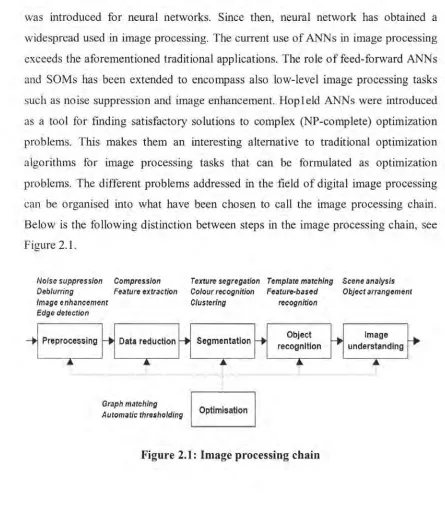
problems. The different problems addressed in the field of digital image processing
can be organised into what have been chosen to call the image processing chain.
[image:19.567.79.524.123.645.2]Below is the following distinction between steps in the image processing chain, see
Figure 2.1.
Noise suppression Compression Deblurring Feature extraction Image enhancement
Edge detection
Preprocessing Data reduction
Graph matching Automatic thresholding
Texture segregation Template miJtching Colour recognition Feature-based Clustering recognition
Optimisation
Figure 2.1: Image processing chain
Scene aniJiysis Object arrangement
I. Preprocessing/filtering
Operations that give as a result a modi I ed image with the same
dimensions as the original image (e.g., contrast enhancement and noise reduction).
2. Data reduction/feature extraction
- Any operation that extracts signilcant components from an image
(window). The number of extracted features is generally smaller than
the number of pixels in the input window.
3. Segmentation
- Any operation that partitions an image into regions those are coherent
with respect to some criterion. One example is the segregation of
different textures.
4. Object detection and recognition.
- Determining the position and, possibly, also the orientation and scale of speci I c objects in an image, and classifying these objects.
5. Image understanding.
6. Optimization.
Minimization of a criterion function which may be used for, e.g., graph matching or object delineation. Optimization techniques are not seen as a separate step in the image processing chain but as a set of auxiliary techniques, which support the other steps. Besides the actual task performed by an algorithm, its processing capabilities are partly determined by the abstraction level of the input data. It has been distinguish between the following abstraction levels:
Abstraction Level Description
The intensities of individual pixels are Pixel level
provided as input to the algorithm.
A set of derived, pixel-based features Local feature level
constitutes the input.
The relative location of one or more Structure (edge) level
perceptual features (e.g., edges, comers,
junctions, surfaces, etc.)
Properties of individual objects.
The mutual order and relative location of Object set level
detected objects.
A complete description of the scene Scene characteristic
possibly including lighting conditions,
context and etc.
2.3 Project Methodology
Methodology used for this project is Edge Detection as the project
methodology. The following topic will explain more details about the methodology.
2.3.1 Approach
Since using Edge Detection as the project methodology, a method to design
and build large programs with a long lifetime. Edge Detection is often part of the
This methodology is closer to the way problems appear in life. In terms of
object or concept and relations between concepts, it is easy to modelling simplified
with object-oriented because this system have objects and relation. This methodology
need some diagram to describe the flow of system such as use case diagram, class
diagram and sequence diagram.
Object-oriented analysis and design is an approach that models a system as a group
of interacting object. Each object represents some entity of interest in system being
modelled and is characterized by its class, state and behaviour.
2.3.2 Model
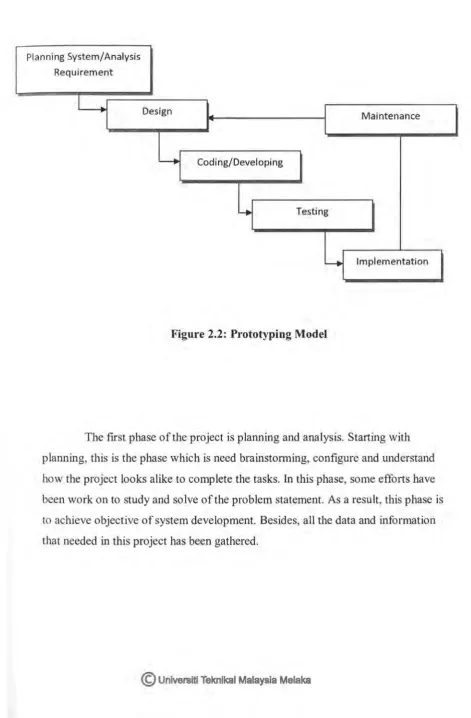
The Nutrient Fact Processing Tool project will be using prototyping model. It
is a series of process that develop an information system which gathers information
and gives the related output. This model is quite simple or easy to implement and
Planning System/Analysis
Requirement
Design Maintenance
l-....+ Coding/Developing
4 Testing
[image:24.567.57.529.97.817.2]4 Implementation
Figure 2.2: Prototyping Model
The first phase ofthe project is planning and analysis. Starting with planning, this is the phase which is need brainstorming, configure and understand how the project looks alike to complete the tasks. In this phase, some efforts have
been work on to study and solve of the problem statement. As a result, this phase is
to achieve objective of system development. Besides, all the data and information