THESES SIS/LIBRARY TELEPHONE: +61 2 6125 4631
R.G. MENZIES LIBRARY BUILDING NO:2 FACSIMILE: +61 2 6125 4063
THE AUSTRALIAN NATIONAL UNIVERSITY EMAIL: [email protected]
CANBERRA ACT 0200 AUSTRALIA
USE OF THESES
This copy is supplied for purposes
of private study and research only.
Passages from the thesis may not be
copied or closely paraphrased without the
Deliberation in the
Wilderness
Transforming Policy
Preferences Through
Discourse
by
Simon John Niemeyer
April 2002
A thesis submitted for the degree of Doctor of Philosophy of the Australian
Declaration
This thesis is the original work of the author, except where acknowledged in the text. It
has never heeu submitted for degree or diploma in any university.
Acknowledgments
Much has changed since l began my PhD, including my marital status, department, country of residence and supervisor. The one constant throughout the past four years has been Bob Goodin. Bob began as part of my supervisory panel and took over the lead role with the departure of Mick Common. As traumatic as it is to see one's supervisor leave within a couple of months of starting a PhD, I am fortunate to have someone with Bob's patience and perspicacity to guide me through the process. He was recommended to me as being the 'best in the business' and he has proven this as a supervisor.
I have been doubly lucky to have not just one of the best on my supervisory panel, but two. John Dryzek helped in the early stages through occasional meetings in Canberra and Melbourne and then took on a formal role when we both joined the Social and Political Theory Program at the ANU. It is difficult to imagine how things might have gone without Bob and Joho. Their contributions to the development of the ideas in this thesis have been considerable. However, all responsibility for omissions and errors is entirely my own.
Many others have contributed intellectually to this thesis. Russell Blarney was heavily involved in the early stages as convenor of the Citizens' Jury Project. Geoff Brennan has made important contributions. Thanks to John Parkinson and Michelle Buxton, my 'thesis buddies' for chats over breakfast and coffee at Tilley's on Thursday mornings. Thanks to Clive Spash and Claudia Carter for giving me a place to lay my laptop while in Cambridge. I have benefited much from the opportunities they have provided. Too many others have contributed to this thesis to recall here. My thanks to you all and my apologies for your omission.
Thanks also to the the twelve participants in the Far North Queensland Citizens' Jury. They showed that citizens have the 'right stufr. Thanks also to the individuals who gave up their time to present to the Jury and others in Cairns who assisted in the lead up to the Jury. Of particular note are Jill Jake! and Bruce Jennison. The organising team for the Jury were instrumental to its success. Jane Palmer displayed impeccable organisational skills and Peter McCarthy kept the process on track as facilitator. Thanks also the administrative support that was given from staff at the Research School of Social Sciences at the Australian National University. Despite some difficulties, including 'interesting' experiences organising the FNQCJ, the project wa.' ultimately a success because there was a lot of good support behind it.
This research was also blessed with good resources. On this score, although gone from the A't>.'G to Glasgow, Mick Common is far from forgotten. Without his efforts, this research would never have taken place. Nor would it have occurred without the foresight of Land and Water Australia, who funded both the CJ project and my scholarship. Land and Water is a truly progressive organisation and model for R&D on environmental issues in Australia.
Most profound thanks to my gorgeous wife, Kersty Hobson. Kersty has displayed enormous patience in the face of ever shifting dates for completion. She has also helped greatly to polish up the final draft. It is going to take some serious dedication to make it up to her. In the meantime, my love and my thanks.
Abstract
This research examines the formation of policy preferences under conditions approaching the ideal of deliberative democracy. These scenarios speeifically relate to complex and controversial environmental issues. The objective is to explore the possibilities for deliberative democracy and its implications for the policy process.
The Far North Queensland Citizens' Jury (FNQCJ) was conducted over four days in January 2000, deliberating policy options for the Bloomfield Track, a controversial road within World Heritage listed rainforest. Policy preferences of participants were surveyed before and after deliberation using rank orderings of five policy options. 'Subjectivity' (beliefa and values) was also studied at three points using Q methodology.
Analysis of the results reveals changes in subjectivity, which although comparatively small, has had a dramatic impact on policy preferences. The mechanism whereby policy preferences were transformed appears to involve the deactivation of symbolic assertions by interest groups and the activation of subjective states pertaining to common goods. Pre-deliberative policy preferences tended to reflect polarised (symbolic) discourses that dominated the issue publicly.
Deliberation dissipated the distorting influence of symbolic politics and induced convergence toward a shared policy position appreciating the complexities of the issue for which deliberators sought integrated policy solutions, rather than juggling seemingly irreconcilable symbolic claims. Although this did not lead to absolute consensus, the differences in opinion among deliberators were readily accommodated in the formulation of policies. This appears to be a possible outcome of deliberation so long as outcomes are sensitive to the underlying reasons for particular positions.
These fmdings suggest that policy preferences cannot be divorced from political context, including institutional arrangements. Under the status quo, citizens tend to be unduly influenced by the strategic arguments of interests, despite their capacity for better judgement. Without active citizen participation, policy discourses are shaped by dominant political actors, This results in a fuilure of policy preferences to reflect substantive dimensions of issues, perpetuating symbolic issues in public decision-making. By contrast, it appears that the deliberative process helps to reconstruct policy preferences according to theoretical ideals - peeling away the layers of confusion created by symbolic politics, which can result in poorly considered preferences. As such, it is concluded that deliberation serves to shape policy preferences to reflect community aspirations, which are consistent with the provision of common goods such as environmental protection, rather than individual concerns and prejudices.
-v-SYNOPTIC
TABLEOF CONTENTS
PART I: BACKGROUND
Chapter 1 Deliberation in the Wilderness! The Idea of
Deliberative Democracy-.... ,,.uu••ou•Ho•••••••H•••••u• .. u•uu••••••••••••••• ... ou•••·•··~•l Chapter 2 Deliberative Preference Transformation: Developing
Exploratory models ...•....•...•••••.••...•...•...••••....••...•••...•••.•....•... 19
PART II: DELIBERATIVE PROCESS AND BACKGROUND
Chapter 3 Simulating Deliberative Democracy: The Design of
the FNQCJ ••••H•••••nHHHH•••~• .... •••••onuoHHHH••••H••n••••uuouH•uoo•u••••••••••••uuuouu65
Chapter 4 Case Study: Policy Options for the Bloomfield
T racLuou•ooooooooooooHU•OHUHO•••••••••• . . u••••••H••hoooooooooo•+••Huo•u~•••ou•••••••••nnuuuuoo85
PART III: ANALYSIS OF DELIBERATIVE DYNAMICS
Chapter 5 The Far North Queensland Citizens' Jury:
Proceedings, Discourses and Outcomes ... 127
Chapter 6 The Deliberative Dynamics of Subjectivity:
Exploring The Discursive Sphere using Q Method ... 155
Chapter 7 Deliberative Dynamics of Preferences: Analysis of
Transformation Through Discourse ... W
Chapter 8 Activating Norms Through Discourse: Deliberation
and the Dynamics of Subjectivity and Preference ... 233
PART IV: FINDINGS AND IMPLICATIONS
Chapter 9 Deliberation and Preference Transformation:
Incorporating Findings into Theory ... 262
Chapter 10 Conclusion: Deliberation out of the Wilderness! ... 290
FIGURES
Figure 2-1 Preference Construction Model... ... 24
Figure 2-2 Preference Model Including Motivational System ... .., ... 37
Figure 2-3 The Discursive Sphere ... 50
Figure 2-4 Subjective States and Their Relationship to Policy Preferences ... 56
Figure 4-1 Location of the Bloomfield Track ... 89
Figure 4-2 The Bloomfield Track ... 89
Figure 4-3 Creek Crossing at Emmagen Creek ... 97
Figure 4-4 Cowie Range ... 97
Figure 4-5 The Zig Zag ... 97
Figure 4-6 Protests During the Construction of the Bloomfield Track ... 113
Figure 5-1 Map of the Cairns-Cooktown region showing roads aud Shires ... 132
Figure 6-1 The Application of Q methodology to the FNQCJ.. ... 161
Figure 6-2 Diagrammatic representation of factors ... 173
Figure 6-3 Factor loadings measured at three deliberative stages ... 193
Figure 8-1 Intersubjective construction of preferences using raw Q data ... 238
Figure 8-2 Scatter plot ofloadings on Preservation aud Restrictive Access ... 248
Figure 8-3 Calculation of Residual Shift on Restrictive Access ... 250
Figure 8-4 Scatter plot of Optimism & Propitiatism versus Residual Shift on RA ... 252
TABLES
Table 2-1 Modalities of Preference Formation, French Assemblee
Constituante ... 24
Table 2-2 Types of Consensus under the Preference Construction Model.. ... 26
Table 3-1 Deliberators participating in the Fl\QCL ... 82
Table 5-1 Timetable for the FNQCJ ... 130
Table 5-2 Technical Witnesses ... 133
Table 5-3 Community Witnesses ... 134
Table 5-4 Influence of Witnesses ... 141
Table 6-1 Factor Scores ... 171
Table 6-2 Statements experiencing greatest level of change in response across the deliberators ... 189
Table 7-1 Five policy options used in the preference survey ... 212
Table 7-2 Pre and post-deliberative preference ranks ... 214
Table 7-3 Pre and post-deliberative aggregate policy rank ... 215
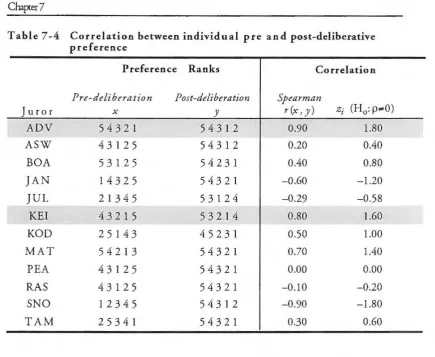
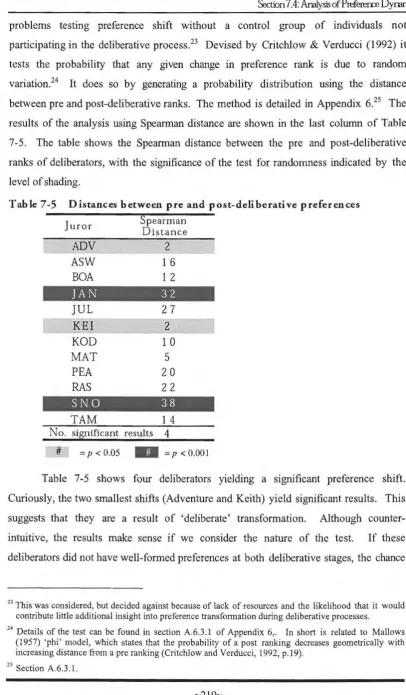
Table 7-4 Correlation between individual pre and post-deliberative preference ... 2 l 8 Table 7-5 Distances between pre and post-deliberative preferences ... 219
Table 7-6 Results oftest for trend ... 221
Table 7-7 Consensus test using distance from centre ... 222
Table 7-8 Test for change in concordance ... 223
Table 7-9 Statistical versus Substantive Findings ... 226
Table 8-1 Contribution of Subjective Factor to Aggregate Preference ... 243
Table 8-2 Relative Contribution of Factors to Aggregate Preference ... 245
Table 8-3 Pre-deliberative influences on Preference ... 257
ANALYTIC TABLE OF CONTENTS
Synoptic Table of Contents ... vii Figures ... viii Tables ... ix
PART I: BACKGROUND
Chapter l Deliberation in the Wilderness? The Idea of Deliberative
Democracy •••••••u•n••nunuo•••••••••u•• .. ou•ou•o•••n•uu•••••H••H••onu•nu••••u•••uuu•u•••l I.I Overview ... I 1.2 The Ideal of Deliberative Democracy and its Detractors ... 3
1.2.1 The Ideal of Deliberative Democracy... ... . ... 4 1.2,2 Deliberation and Democr(]L.y: Can Citizens have the 'Right
1.2.3 1.2.4 1.2.5
Stuff"'... ... .. ... . f)eliberation and Deliberative Outputs .... .
Deliberation as Transformation of Politics in esse ... ,., Summary: Synopsis of Aims... . ... ,.,, ... ,
.... 5
.9
. 12 .... 16 1.3 The Task Ahead ... 17
Chapter 2 Deliberative Preference Transformation: Developing
ExploratOl)" models U H • u u n u u H H < • H O O H < • • o . . u n u n o u u u u o n o • • • • o U O O h H O O O H H O O + • • • • • • • o o o l 9
2.1 Introduction ... 19
2.2 Preferences and Policy Choices ... 20 2J l The Problem with Preferences as Reasons: A Critique of the Thin
Model... ... ... .. ... 20
2.2.2 The Extended Model of Po&J' Preferences... 22 2.2.3 The Preference Construction J,.fodel and l...todes of Deliberative
Tran~fonnation,, ... ,.." .,. .,,.17 2.2.4 Summary ... . ... ... .. ... 28
2.3 The Preference Construction Hypothesis: Deliberation and
Changes in Beliets ... 28
2.3. l Cognition and Mechanisms for Deliberative Preference Shi{/... 29 2.3.2 Preference Constroction and Issue Complexity: Bounded
Rationality... .... .. .. ... . .. ... .. .. .. ... 29 2. 3. 3 Deliberation as Pushing Back Cognitive limits... .. ... 30 2.3,4 Limitations of Deliberative Preference Transfortnation Due to
Changing Beliefs.. . .. .. .. .. . . .. . .. . .. .. . .. .. .. . 3 2
2.4 Deliberation and Changing Values ... 33
2.4. l The Case for Admitting Multiple Motivations to the Preference
Model.... ... . .... 33
2.4.2 Multiple Motives: Including the Valuational Dimension in the
Preference Model . . . .. . .. .. .. .. .. .... 3 6 2.4.3 Deliberative Preference Shift due lo changing Values. .. ... 40 2.4.4 Activating Values Through Deliberation ... ... ".. .. 40 2.4. 5 Summary.... .. .. .. .. .. .. . .. . ... .. .. .. ... 45
2.5 An Exploratory Model of Deliberative Preference
Chlpterl 2.5.l 2.5.2 2.5.3 2.5.4 2.5.5 2.5.6 2.6
(Rejsimpiifying the Preference Model... .. .. . .. .. .. .. .. . . ... 4 6
SubjectivityandDis:course .. ... .,, ... , ,,,,,,, "., ... , .. ,.47
Generalizeable Interest.-:,,. ... .,.. ···"··· ... 51
Prt;ference Formation in the Discursive Sphere.... . ... ... 52
Three T}pes qf Policy Pre,ference Sh~ft under the Discursive Model.. ... .. ... ... 54
Summary .. "... . ... ., .. , .... .... " ... 58
Exploring Preference Shift Under the Discursive Model; Approaches and Methods ... 58
2.6.l The Nature of the Task... ... ... .. ... 58
2. 6.2 Q methodology and the Analysis of Discourse... . ... 59
2.7
Conclusion ...61
PART II:
DELIBERATIVE PROCESS AND BACKGROUND
Chapter 3 Simulating Deliberative Democracy: The Design of the FNQCJ ... 653.1 Introduction ... 65
3 .2 Principles of Design ... 65
3.3 Case Studies in Deliberation and Deliberative Faihrre ... 67
3.4 Discursive design: Leaming from Deliberative Failure ... 70
3.4.l Conforming Behaviour... .. ... d . . . . , . . . . 71
3.4,2 Deliberative Overload. . ... .,,. .. ,, .. 73
3.4.3 Strategic Talk... ... ... ... . ... .. .. 75
3.5 Recruitment of Deliberators ... 78
3.5,1 Representativeness... ... . ... " 78 3.5.2 Geographic Area for Selection ... ... . ... .. ... 80
3.5.3 Selection Process.. ... ... . ... 81
3.5.4 Compensation for Deliberators. .. ... 81
3.5.5 Final Deliberative Group... ... .. ... 82
3.6 Witnesses ... 83
3.6.1 Expert Witnesses... . .. ... 83
3.6.2 Community Witnesses ... ,. ... ".'"· .... 83
3.7 Conclusion ... 84
Chapter 4 Case Study: Policy Options for the Bloomfield Track ... 85
4 .1 Introduction ... 8 5 4.2 Background to The Bloomfield Track Issue ... 85
4.2.l Overview of the Bloomfield Track. ... ... ... 86
4.2.2 The Bloomfield Track in Ecological Context ... ..93
4.2.3 The Bloomfield Track in Social Context... 100
4. 2.4 The Bloomfield Track in Political Context. . ... .. . . .... .. . . .. ... . . . ... 102
4.2.5 Summary.. ... 106
4.3 The Genesis of a Policy Fiasco ... 107
4.3.J Events in Lead up to the Bloomfield Track Issue.... ... ... .. .... 107
4.3.2 A Very Public Battle: The Construction of the Bloomfield Track ... 112
4.3.3 The Bloomfield Track Outcome. The Politics of Power ... 120
4,4,J After the Bloomfield Track,, ,, ,, ,, ,, ,, ,, , ,,,,, 121
4.5 Conclusion ... , ... ,, .... ,,, ... ,,, ... 123
PART III:
ANALYSIS OF DELIBERATIVE DYNAMICS
Chapter5
The Far North Queenslaod Citizens' Jury: Pro<:eedings, Discourses and Outcomes ~nuuo.o•HHnu••HHHuHno••o•••····•••uu••••UH••••UUU•••••127 5, I Introduction ,,, .. ,,, .... ,, .. ,,,, ,,,, ... ,, .. ,,,,,,,,,,,,,,,, ,,,, , ... ,,,, ... 12 7 5.2 The Deliberative Process ... ,, ... ,,,,,,,, ,,,, , ... 1285,2,/ Overview,,,, .. ,,,,,,. ,,,,,,,,,,,, , ,,,,,,,,,, .... ,,,,,,,,,,,, .. 128
5.3 Discourses and Turning Points ... ,,,,,,,,,,,,,,,,,,,, ... ,,,,,,,,. 136
5.3. I Sitelnspection .... ... ,, ,, .. , .. .. .... ,, ,, .. , ,, , ,, ,, , 13 7 5.3.2 fVUness Presentations,,.. .. ... ,,.,,."'"'"'' ... ,,,, ... 139
5.3.3 Discourses on the Final Day of Deliberation, ,,,,,,,,,,,,,, l 50 5.4 Policy Recommendations of the Far North Queensland Citizens' Jury .... , ... ,, ... ,, . ,, ,, ... ,, .... ,, ,, ,, ... ,,,,,,,,.,,,,, ... 152
5.4. l Position l: Staged Bloomfield Track Closure,, ... ,, , I 53 5.4.2 Position 2: Keep Bloomfield Track Open with Strict Management ... 153
5.4.3 llnanitnous Findings,,... .. .... ".""" ... , ... 154
5 .5 Summary ... ,,,,,,, .... ,,,,,.,,,, .. ,, ... ,, ... ,,,,,,, ... ,,,,, ... 154
Chapter 6 The Deliberative Dynamks of Subjectivity: Exploring The Dis<:ursive Sphere using Q Method ... 155
6. 1 Introduction ... ,, ... ,, ... ,, ... , , ... 155
6.2
Q
methodologyand the Analysis ofDiscourse ... ,, ... ,, ... 1566.2. l Q methodology as the search for subjective species ,, ,, 156 6'2. 2 Sampling and Q Methodology,, ,, , .. ,, ,, ,, ,, , , , ... ,, ,, ,, , I 58 6.2.3 Ana{vsis o/Q sorts and its Application to the f<iVQC! Data. .. ... 160
6.2.4 Step 1: QSorting,,,, ,,,,,,,,,,,,,,,,,,,,,,,,,... .. .. ,,, ... ,, ... 161
6.2.5 Step 2: I'llctor Extractionfro111 the Subjectivity Data, ... 162
6.2.6 Step3·Judgmenta/Rotation .. ,,,,,,, .... , ... 164
6.2.7 Factor Description..,,,,,,,,,,,,,,,,,,,,,,,,,,,., .. ,,... .. ... 165
6.3
Q
Factors: Four Subjective Types in the Discursive Sphere ... 1696.3.J Overview of the Subjective Factors .. ,,,.. .. .... 169
ti3.2 Factor Descriptions,, ... ,,, ... , 175
6.4 Deliberative Dynamics of Subjectivity ... ,,, ... 186
6.4.1 Subjective Changes Across the Discursive landscape .. ... 187
6.4.2 Subjective Dynamics and Changes to Factors .. ·-· ... 191
6.4.3 Synopsis of Changes to the Discursive Landscape,, ,,,,,,,, .... ,,, ,,,,,,,., 196
65 Explaining Changes to the Discursive Landscape .... ,, ... ,, ... 196
6,5, 1 Explaining Changes to individual Factors,, ... ,,,, ... 197
6.5.2 The Acquisition of Information in l)e/iberative Context ond the Role of Pre-existing Knowledge,,.,, ... . 203
6.6 Summary and Conclusion ... ,,, ... ,, .... ,, ... 204
-xiii-Chapter 7 Deliberative Dynamics of Preferences: Analysis of
Transformation Through Discourse ... 207
7.1 Introduction ... 207
7.2 Measuring Policy Preferences for the Bloomfield Track. ... 208
7.2.l Measuring Policy Preferences... ... .. ... 208
7.2.2 Implementation of Pr~ference Survey .... ... 210
7.3 Policy Preference Results ... 213
7.3.1 Pre and Post-deliberative Policy Prejerences . ... ,,,,. . ... 213
7.3.2 Aggregat£ Preferences,.. ... . ... .. .. 214
7.3.3 Discusswn of Raw Results... .. ... 216
7.4 Analysis of Preference Dynamics ... 216
7.4.I Individual Preference Dynamics .... ,, ... _ ... , ,, 217
7.4.2 Group Preference Shifts... .. ... 220
7.4.3 Empirical Consensus .... ., ... ,., ... 222
7.4.4 l)iscussion of Statistical Analysis... . ... · ... 223
7 .5 Discussion: Deliberative Dynamics of Preferences ... 225
7.5.1 Self-Assessment of Substantive Shifts.... ... .. 225
7.5.2 Substantive changes to aggregate outcome., ... "'... . ... 228
7.5.3 Substantive Consensus .. ,,, ... ,. ... , ,,,... .. 229
7.6 Conclusion ... 230
Chapter 8 Activating Norms Through Discourse: Deliberation and the Dynamics of Subjectivity and Preference ... 233
8.1 Introduction ... 233
8.2 Review of Findings ... 234
8.2. l Review qf Findings so far... .. ... 234
8.3 Explaining Deliberative Dynamics: Exploring Tbree possible explanations ... 236
8.3. I Subjective Transformation... . ... 237
8.3.2 Preference Construction. ... . ... 237
8.3.3 The Activation Hypothesis... .. .... 239
8.4 Assessing tbe Role of the Subjective Factors in the construction of preference ... 242
8. 4, 1 The Contribution of the Subjective F'actars to Aggregate 8.4.2 Preference ... Summary .. ...242
... 245
8.5 Refining Explanations of Deliberative Dynamics ... 246
8.5. l The Activation of Preservation and Deactivation of Synibolic 8.5.2 8.5.3 Politics ... , .... , .. . .. .. ., "" ,. ... ,. ... 246
Pragmatisnt as the Counter-G'ase ... . 254
Summary and Findings.. ... ... ... .. ... 257
PARTIV:
FINDINGS AND IMPLICATIONS
Chapter 9 Deliberation and Preference Trans formation: Incorporating
Findings into Theory ... 262
9.1 Introduction ... 262
9.2 Policy Preference Formation and the Implication of Multiple ~orms ... 263
9.2, l The Preference Construction ]Y!odel and Prediction o_f Policy Preferences.. ... . ... 263
9.2.2 The Role of Multiple Subjective States in Explaining Preference f.,ormation and Transformation, ... , ... , ... ,,.,, ... 264
9.2.3 Multiple and Dominant l'{orms; Particular and Generalizable Interests... ... .. ... 269
9.3 Preference Distortion and Deliberative Remedies ... 271
9.3.l Symbolic Politics: The Crowding-out of Dominant Norms and its Deliberative Dissipation... . " .. ,. ,,.. . .. . ,. . ,., .. . . .. . ".272 9.3.2 Turning Desires into Preferences: The Activation of the Preservationist Norm, ... ... "... ... ... ... . ... ,,., . . ,.,,,,.276
9.4 Deliberative Dynamics: An Overview ... 278
9. 4.1 Two Processes of Dissipation and Activation: Same !Jeliberative Process., ... ,, .... , ... ",, . ., ... , , ... . . . .... , , . "279 9.4.2 The Importance of Deliberative Context: The Relative Role of Information and Deliberation in Dispelling Symbolic Myths? ... . ... 281
9 .5 The Stability and Legitimacy of Deliberative Outcomes ... 284
9.5.1 Stability of Deliberative Outputs Over Time... .. ... 284
9.5.2 Stability Dependence on the Content and Duration of the DeliberatilieProcess . ... ... ",, ... 285
9.5.3 9.5.4 .4 venues jOr Process Afanipulation.. .. , .. ,, ,. .. , Summary: Legitimate Conclusions Jf'om the FlVQCJ, .. ... 287
... 288
9.6 Conclusion ... 289
Chapter IO Conclusion: Deliberation out of the Wilderness? ... 290
10.1 Introduction ... 290
10.2 Politics in esse: The Disenfranchising Power of Preferences ... 291
10.2.l 'Dumb' Preferences... .. ... 29!
10.2.2 The Revised Political Sequence.· Questioning Autonon1ous Preferences.. .. ... ,, .. ,... . . ... . 295
10.2,3 Reverse Politics: Disenfranchising Citizens/Disenfranchising ;Vature .... .. . ... , , , ... , ... , , , ... , ... . . . . .... 297
10.3 Deliberative Politics in posse: Enfranchising the Wilderness ... 299
JO,J.J Enfranchising Citizens Through Reason.. .. ... 299
111.3.2 Ecological Complexity: Do Deliberating Citizens Have the Right Stuff! .. ... ... .... ... .301
10.3.3 Deliberation and the Wilderness: Against Pre-emptive 'Sustainable· Consensus. .., ... 302
l 0.4 Bringing Deliberation out of the Wilderness? ... 305
10.4. I A Citizens' Jury does not a Deliberative Democracy }.,fake .. ,, .... ,,, .... 306
I 0. 4.2 .4 Citizens' Jury may a Non-Deliberative Democracy Transform.. , . , , , 308
-xv-References ... 309
APPENDICES
Appendix 1 FNQCJ Surveys ... 327A.1.1. Pre-deliberative Survey ... 328
A.1.2. Post-Deliberative Survey ... 330
Appendix 2 Raw Survey Data ... 336
A.2.1. Adventure ... 336
A.2.1. l. Pre-Deliberative Survey Results... .. .. .... .... .. .. ... 336
A.2.1.2. J>ost-Deliberative Swvey Results,, ... ... ,,, .. ,. .... ,,.,. ... ," ... ,, .. 336
A.2.2. Aswad ... 337
A.2.2. l. Pre-Deliberative Survey Results. .. .. .. .. .... . .. .. .. .... . ... . .... 33 7 A.2.2. 2. Post-Deliberative Survey Results... .. ... 337
A.2.3. Boat ... 338
A.2.3.1. 11re-Deliberative Survey Results ... ,,,, .. A.2.3.2. [>ost-Deliberalive Survey Results,. .. . .... ... 338
. ""'"""'" ... 338
A.2.4. Janine ... 340
A.2.4. I. Pre-Deliberative Survey Results... .. .. .. . .. .. . .. ... 340
A.2.4.2. Post-Deliberative Survey Results.. ... . ... 340
A.2.5. Julie ... 341
A.2.5.1. Pre-Deliberative Survey Results ... ... ... ..341
A.2.5.2. Post~DeliberativeSurveyResults.. ... . .... "' .. ''" " ... 341
A.2.6. Keith ... 342
A.2.6. 1. Pre-Deliberative Survey Results.. .. ... 342
A.2.6.2. Post-DeliberativeSurveyResults... . ... .. 342
A.2.7. Koda ... 343
A.2. 7. 1. Pre-Deliberative Survey Results. .. .. .... .... .. . . ... 343
A.2. 7.2. Post.Deliberative Survey Results... . ... 343
A.2.8. Matilda ... 344
A.2. 8. I. Pre-Deliberative Survey Results... . ... 344
A.2.8.2. Post-Deliberative Survey Results... .. .. .. ... . . .. . . . .. 344
A.2.9. Pearl ... 346
A.2.9.J. Pre-Deliberative Survey Results. ... .. .. 346
A.2.9.2. Post-Deliberative Survey Results... ... .... ... .... ... . .. 346
A.2.1 O.Rastus ... 347
A.2. JO. I. Pre-Deliberattve Survey Re.suits ... A.2. 10.2. Post-Deliberative Survey Results ... '"' ... ... 347
" ... ... 347
A.2.11.Snoopy ... 348
A.2.11.l. Pre-DeliberativeSurveyResults. ... .... ... .348
A.2.1I.2. Post·De/iberative Survey Resullv ... 348
A.2. 12. Tamarra ... 349
A.2.12.1. Pre-Deliberative Survey Results ... ... . ... , ... 349
Appendix 3 Technical Witness Handouts ... 351
A. 3. 1. Bob Baade ... , .... 3 52 A.3 .2. Peter Hitchcock ... 3 5 6 A.3.3. Steve Turton ... 363
A.3 .4. David Haynes ... 366
A.3.5. Julie Brown ... 370
Appendix 4 FNQCJ Juror Findings ... 373
A.4. 1. Majority Position: Staged Closure of the Bloomfield Track ... 373
A.4.1.1. Mitigating Impact on Local Connnunities and C'apturing Opportunities... . .... 373
A.4.1.2. Timelinefor Closure... ... .. ... 374
A.4.2. Minority Position: Leave the Bloomfield Track Open With Strict Management ... 376
A.4.3. Findings by All Jurors ... 378
A,4.3.J, Ranger Station/Visitor Centre .. ···"···'" ... 378
A. 4. 3. 2. Consultation... ... ... .. .. .... ... .. .. . . ... 3 79 A.4.3.3. Sensitivity to Local Indigenous Issues... . ... 380
Appendix 5 Q Method: Design and Analysis ... 381
A.5. l. Selection of Q Statements ... 3 81 A.5 .2. Q-Sorting ... , ... , ... 3 85 A. 5 .3.
Q
Results ... 3 86 A.5 .4. Changes to Statement Scores ... 389A. 5. 5. Changes to Sorts ... 3 90 Appendix 6 Analysis of Policy Preferences ... 392
A.6.1. Spatial 'Distances' Between Ranks ... 392
A.6. 1. 1. Euclidean Distance... . ... 392
A .6. 1. 2. Spearman Distance... . . .... .. .. .. .. ... . . ... ... 393
A.6.1.3. Kendal/Disrance.. .... ... . ... 393
A.6.2. Measures of Aggregation ... 394
A.6.2.1. Marginals and average rank... .. ... 394
A.6.2.2. Borda Count... ... ..395
A. 6,2, 3. Paired Comparisons and consensus rank , ... 396
A.6.2.4. Hare... ... ... .. .... 397
A 6.2.5. Centre Rank. ... ... . .. 397
A.6.3. Analysis of Paired Ranks ... 398
A.6.3.1. Critchlow and Verducci test for paired ranks.. ... . ... ... 398
A.6.3. 2. Test for trend in rank data.. ... ... .. ... .. .. ... .. ... 404
A. 6.3.3. Correlation between paired ranks .. .. 404
A.6.4. Test for Change in Preference Orderings Across the Group ... 406
A,6,4.1. T-testusingDistaneefrom Centre.,'"""""" ... 406
A. 6.4.2. Marden Test for di/]erence using Paired Rankings.... .. .. . 408
A.6.5. Measures of Distribution, Concordance and Consensus ... 409
A.6.5.1. Distributionjrom Centre... ... . ... ... .409
-xvii-Concordance , . , . . .... 410
A.6.5.2. A.6.5.3. Formal Measures of Consensus. . ... 412
Appendix 7 Structuration of Preferences ... 417
A.7.l. Preference Structuration and Single Peakedness ... 417
A. 7.1.1. Case Study The Deliberative Poll on an Australian Republic ... 419
A.7.2. Analysis of Single Peakedness for the FNQCJ Data ... 420
A.7.2.J. Results.... ... ... ..421
A. 7.2.2. Symbolic Politics, Deliberation and Preference Structuration ... " ... , 424
Appendix 8 Combined Analysis of Subjectivity and Preference ... 427
A.8.1. Preference Outputs from the Four Subjective Factors and Their Transformation ... 427
A.8,1.1. Associating Preference.,'¥ with Subjective Factors: Calculation of Factor Preference Ranks,,. .. ... ,,.,,,. ... ". . ... 428
A.8. l.2. Factor Preference Ranks and Changes between Deliberative Stages... . . . .. .. . .... . . ... . A.8.1.3. Explaining Changes to Factor Preference Rank ... . A. 8. 1. 4, Calculation of Factor Preference Construction,,,, ... 430
. ... 432
.... 433
A.8.2. Preference Transformation: Detailed Analysis of Causes ... 434
A.8.2.1. Assessing Preference Shift due to Subjective Transformation ... ,,. 434
A.8.2.2. Testing The Preference Construction Hypothesis ... ,,... . ... 441
A.8.3. Analysis of the Role of Pragmatism .. ,, ... ,, ... ,, ... ,, ... 442
CHAPTER 1 DELIBERATION IN THE
WILDERNESS? THE IDEA OF
DELIBERATIVE DEMOCRACY
1.1
OVERVIEW
Do citizens have the 'right stuff to make deliberative democracy work?1 Do the
configurations of modern 'democratic' states lend themselves to political outcomes
approaching democratic ideals? If the response to either question is negative, what are the major impediments in the way? What can be done to steer a path toward a
'deliberative democracy'? Moreover, does a deliberative democracy lend itself to
political decisions that are sensitive to the enviromnental circumstances of human
societies? These questions set the broad parameters of this thesis, which aims to
address them and in doing so contribute to the integration of deliberative theory and
practice.
A good deal of literature has been dedicated to the ideal of deliberative
democracy and the potential barriers to it in practice. The deliberative literature to date bas covered a wide range of related topics - including not only the judgemental
capacities of deliberating citizens, but also problems of legitimacy and
representativeness, procedural versus epistemic merits, and achievability of theoretical
ideals. Instances of 'deliberative' practice have emerged over the past thirty years
independently of the theoretical literature. These have taken a number of forms such as
deliberative polls, Citizens' Juries and consensus conferences. In some constituencies
deliberative forums have become increasingly embraced as legitimate inputs into public
decision making.
1
Chapterl
Thus, there is considerable activity associated with the 'deliberative tum' among both theoreticians and practitioners. However, there has been little communication between these two communities beyond tacit acknowledgment.2 Each has contributed much to the body of understanding. Through the efforts of theoreticians it possible to gauge how deliberative democracy works in the abstract. From practitioners we know that interesting results arise when deliberative forums are conducted and that they may at times fail spectacularly to either produce coherent results or influence public policy processes when confronted with realpolitik. Yet, there is currently a dearth of work linking these two sttands.
More recently the need for empirical checks on theoretical possibilities through practical examples has become increasingly recognised (for example Bolrman, 1998). To integrate theory and practice properly, it is necessary to investigate the processes at play during deliberation in practice and the ways in which these relate to theory. It is also necessary to be sensitive to the political contexts of deliberative practice. Moreover, if we are to understand deliberative possibilities it is important to examine the extent to which both existing and theorised political institutions and examples of deliberative practice approach theoretical ideals. Where they do not, the gap between them needs explanation. It is this gap - between theory and practice - that I set out to bridge.
In
doing so, it is hoped that both possibilities for deliberative democracy and tangible steps that can be taken toward it can be identified.To achieve these aims I 'Will explore empirically the possibilities of deliberative democracy by probing the differences in the way that ordinary citizens respond to a complex environmental policy problem. The policy problem providing the focus for citizens' deliberations will be the Bloomfield Track, a controversial road located in a World Heritage listed rainforest wilderness area in the Far North of Queensland (FNQ), Australia.
I will investigate citizen responses to the Bloomfield Track issue under two scenarios. The first concerns 'politics as usual' under the prevailing institutional and political settings for the issue. The second is conducted under conditions of 'deliberative intervention', designed to simulate something approaching the 'deliberative
Soction 12: Thi Ideal of Deliberative Democracy arr! its Detractors
ideal'. The forum in which deliberations took place was the Far North Queensland Citizens' Jury (FNQCJ), which was conducted in Cairns in January 2000. The differences between the pre and post·deliberative scenarios and the process of transformation between them are analysed. By doing so, I hope to be able to infer something about the salient characteristics of the status quo that produce outcomes counter to deliberative ideals. I also hope to be able to formulate tentative mechanisms to address these gaps.
In the following section (1.2) I will adumbrate the major features of deliberative democracy and consider some of the criticisms levelled at it. The discussion will serve to outline the broad areas of political practice and deliberative possibilities covered by
this thesis. Section 1.3 outlines the structure of the thesis to achieve its aims.
1.2
THE IDEAL OF DELIBERATIVE DEMOCRACY AND
ITS DETRACTORS
The term 'deliberative democracy', first coined by Bessette (1980), has become the idiom of choice for exponents of the deliberative tum in democratic theory. It is not a new phenomenon. The idea of deliberative democracy has its roots as far back as Rousseau, even Aristotle, with its modern precursors lying in the works of Dewey and Arendt. In its contemporary usage, deliberative democracy has both a classical (ideal) and critical flavour. The classical ideal is well encapsulated by Fay's (1975) description of politics as citizens' 'deliberate efforts to order, direct, and control their collective affairs and activities, to establish ends for their society, and to implement and evaluate these ends'.4 The critical component stems from the tendency for deliberative, or 'discursive', democracy to be set up in contradistinction to an unsatisfactory state of affairs in politics as practised. 5
1
:\mong many others, too numerous to be considered here, For a discussion of the deHberative turn see Bohman (1998, p.400)
4
Cited in Dryzek (1990, p.10)
3
Crnpterl
Thus, on one hand we have deliberative democracy as prescription for achieving democratic ideals, or politics in posse; on the other it can be used as a counterfactual position from which to criticise the status quo, or politics in esse, In the following discussion I will sketch the ideal of deliberative democracy, before moving on to contrast it with practical considerations.
1.2.1 The Ideal of Deliberative Democracy
The classical ideal of deliberative democracy cited above resonates with Barber's (1984) 'strong democracy', which stresses broadscale participation in political decision making and the activation of 'citizenship' in determining outcomes, Following from this deliberative democracy in posse comprises two main elements: participatory and deliberative. 6 The first, participatory element concerns the legitimation of democratic decisions through the assent of the citizenry. The problem of legitimation for deliberative democracy is not trivial, not least because it may be interpreted to imply that everyone affected by a decision should have 'free and unconstrained' deliberative participation in the decision process (Benhabib, 1996, p.68). Such lofty ideals are clearly not possible. There have been a number of attempts to wrestle with the problem oflegitimacy, without full representation of all concerned with (or affected by) a policy problem.7
Here I will side-step these issues and focus on the second feature of deliberation ·~the transformation of preferences - considering the processes whereby this occurs, and how popular decisions might be affected by the application of deliberation to democratic processes. 8 To borrow from the classic conception of politics, I am
interested in how citizens might choose particular policy means to satisfy desired ends. Importantly, I am also interested in how these ends are chosen.
Preference transformation under deliberative democracy in posse tends to be contrasted with preferences under politics in esse in terms of the conditions under which they are formed. Dryzek ( 1990), for one, characterises the conditions of the deliberative
'See for example Dryzek (2000, p.l), 1
For example: (for example Goodin, 2000a; Dryzek, 200 l; O>!eill, 2001)
3
Section 12:
Trn ldeal
of DelilJeral:Ml Democracy an:l llsDetra:mrs ideal in terms of communicative rationality. Under communicative rationality, actors engage in 'intersubjective' discourse. This involves reflecting on the issue at hand from a shared perspective. This Habermasian concept, is also reflected in 'strong democracy':The participatory process of self-legislation that characterizes strong democracy attempts to balance adversary poiitics by nourishing the mutuaHstic art of listening. "I will listen'' means to the strong democrat not that I will scan my adversary's position for ··;veakne~'isess and potential trade-offs, nor even (as a minimalist might think) that I will tolerantly pennit him to say whatever he chooses. It means, rather, "I will put myself in his place, I will try to understand, I v,dli strain to hear what makes us aHke, I \Vill listen for a common rhetoric evocative of a couunon purpose or a couunon good". (Barber, 1984, p.175)
This contrasts with preference formation under conditions where individuals engage in instrumental rationality. Instrumental rationality is associated with strategic behaviour in order to bring about a desired outcome, usually associated with narrow self-interest The deliberative ideal is corrupted once individual desires take over the process and arguments are used in order to elicit specific outcomes, a situation that will be characterised in the concluding chapter (10) as 'reverse politics'.
Self-interest may be a manifest problem among individuals or groups with a particular stake in an issue. However, when it comes to much of the population a more pressing problem may not be self-interest, but misguided conceptions of the common good and/or poor judgemental capacities (for example Goodin and Roberts, 1975). I will consider some of these objections in the following discussion.
1.2.2 Deliberation and Democracy: Can Citizens have the 'Right
Stuff'?
As alluded to at the outset of this chapter, a major challenge to the deliberative ideal concerns whether or not citizens have the 'right stuff to make deliberative democracy work. In short, the concern is that popular policy decisions often turn out to be collectively bad ones, giving rise to policy fiascos (Bovens and t'Hart, I 996, p.32-34). Concern with failure of democracy due to the capacities of citizens has a long history, with Burke perhaps the best-known example in political theory.9 A more modem exponent of this scepticism is Schumpeter (1943 (1976), p.262), who presents a particularly grim view of the capacities of citizens, believing:
9
Crnpter 1
[T]he typical citizen drops down to a lower level of mental performance as soon as he enters the political field. He argues and analyses in a way which he would readily recognize as infantile within the sphere of his real interests. He becomes a primitive again.
There is a wide array of literature challenging deliberative democracy and its direct democratic counterparts.10 Most pressing for this thesis are those based on
arguments about the capacity, or lack thereof, of individuals to engage the deliberative process in a manner described by the deliberative ideal. There are two main problems relating to the limitations of human capacities in achieving deliberative ideals. The first concerns communicative (or judgemental) competence. The second is the basis of motivations upon which individuals acting autonomously arrive at collective decisions.
(a) Limits to Communicative Competence
Deliberative ideals may be undermined to the extent that individuals are incapable of communicative competence, where deliberation proceeds on the basis of good argument and intersubjective understanding (see Dryzek, 1990). One stream of argument concerning competence comes from the legal literature. It argues that the average citizen is simply not capable of grappling with complex issues in any meaningful way (Green, 1967; Edmond and Mercer, 1997). Similar arguments of a more political flavour contend that preferences of citizens are inherently manipulable and essentially 'empty', more a product of irrelevant causes, such as a desire to conform to the expectations of others.11 Another well-versed objection is that without incentive to tell
the truth, deliberators will engage in strategic uses of argument (Austen-Smith, 1992; Przeworski, 1998).
The flip side of strategic talk could be the assertion that 'all deliberators are gullible'. While there is much focus in the deliberative literature of strategic uses of argument12, another question concerns just why individuals might be persuaded against their better judgement - assuming that if acting autonomously, their motivations would
1
°
For a review of some of the major themes of criticism of deliberative democracy see Dryzek (2000). "For examples see (Janis, 1972; Wetzel and Walton, 1985; Kuran, 1997; Bliese and Halverson, 1998;
Kuran, 1998; Verlhiac, 2000). Conformity is but one irrelevant cause of preferences; others include anti-conformity, adaptive and counter-adaptive preferences, the obsession with novelty and the resistance to novelty (Eisler, 1986a, p.110).
12
Sectbn 12:
Tu
ldeat of Delfuerat:i\eDemocracy
arrl its Thmictors direct them otherwise. Rather than the propensity for strategic talk, it is the impact on'gullibility' that will be the focus of analysis here.
Are deliberators gullible? It is an important question with respect to the prospect of deliberative democracy. Here I am interested in whether deliberation leads
individuals to decide autonomously what they want, in terms of outcomes, as well as
the best way this may be achieved through the implementation of policies.
{b) Limits b,1Sed on Human Motivations
Of course, I am also interested in how deliberation affects the motivations
driving individual behaviour. An important consideration is whether basic human motivations can be compatible with deliberative ideals. The rational-self interest model
is a particularly dominant, although much challenged, model for human behaviour. The
model contrasts sharply with communicative rationality and, as I will now argue, is
particularly relevant
to
environmental issues.In view of perceived limitations of human motivations, such as self-interest,
dedicated environmentalists might baulk at principled commitments to grassroots
democracy because there is no guarantee that their desire for green outcomes cao be
reconciled with democratic principles (Goodin, 1992). Indeed, economists have
produced evidence to support such concerns whereby 'sovereign' prefurences, based on
self-interest, cannot ensure ecologically sustainable outcomes (Common aod Perrings,
1992).
That 'intrinsic' human self-interest might undermine the ability to achieve
collectively desirable outcomes has led to the proposal of a series of remedies.
Economists tend to focus on market based solutions, which supposedly harness
self-interest in order to achieve collective outcomes, such as the protection of the
environrnent.13 Another solution with a distinctly collective flavour is Goodin's (1986)
'laundering' of preferences, whereby certain kinds of preferences are 'filtered' or
'censored' from being expressed, for the sake of the common good.
13
C!BptEr 1
There is also an emerging theme similar to the laundering of preferences among ecological economists. As the proclaimed 'science of sustainability' (Costanza, 1991), ecological economics is concerned with the prospect for sustainable outcomes from collective choices. Apart from a lingering influence of neoclassical economics, many solutions developed tend to be fairly interventionist in flavour. One particular approach involves 'steering' individual preferences in 'sustainable' directions (Norton et al., 1998).14
(c) Human Capacities and Deliberative Ponibilities
Findings such as those above citing limited human capacities tend to lead some theorists to advocate democratic processes that mediate the worst excesses of popular democratic processes through the exercise of intervention hy elites. Nevertheless, are the capacities of citizens so hopeless as to render the project of deliberative democracy futile? Can it be ecologically sustainable?
In
this thesis, I make a case that citizens do have the 'right stuff' to make deliberative democracy work and deternrine sustainable policies. Rather than limited capacities of citizens, the substantive problem may be structural, where existiog democratic process create impediments to deliberative democracy. Indeed, there is a link between the two. Individual capacities are limited because of structural factors.Consequently, those who criticise the capacities of citizens may simply be projecting the processes of politics in esse into the possibilities of deliberative democracy, without recogoising that individuals may act quite differently under deliberative ideals. One problem with such criticisms is an implicit assumption that deliberative democracy is constituted by anything that involves discussion.15 Doing so lowers the deliberative benchmark considerably, making deliberative democracy an easy target. However, as I alluded above, deliberative democracy implies a particular set of
14
However; these are not the only potential solutions, ecological economics too has experienced a fonu of deliberative tum, if albeit a partial one (for example Sagoff, 1998). This thesis is consistent witl1 this deliberative tum in ecological economics so far as it seeks to understand the relationship between deliberation and jsustainable' preferences.
15
Samn 12: Tu 1:Jeatof De!iblt'ame Demoaa.:y an:! its0€1nrto!s
conditions whereby individual preferences are formed and transformed. As
will
be argued in the remaining chapters of Part I, deliberative democracy involves far more than superimposing additional discussion onto politics in esse.I have considered above that conditions of communicative rationality arc qualitatively different to strategically motivated discussion under politics in esse. It
follows that so too is the modus operandi of deliberation under theoretical ideals. In order to explore the deliberative possibilities, it is important to be mindful of these differences in discursive design. Thus, to explore the extent to which the judgemental capacities of 'ordinary' citizens might be enhanced under 'ideal' deliberative conditions, compared to those of politics as usual I will need to be sensitive to these differences.
1.2.3 Deliberation and Deliberative Outputs
I will also need to be sensitive to the role of preferences for public policies (referred to herein as policy preferences) as part of the deliberative process.
In
the following discussion I outline some of the considerations pertaining to deliberation and preferences as deliberative outputs.(a) Deliberation and Preference Aggregation
There is an important tension between deliberative possibilities and politics in esse in relation to output
In
politics in esse, preferences have become the currency of democratic process. Deliberation, by contrast, tends to emphasise the process of reasoning. Thus, on one hand, the focus of democratic procedure is on aggregation of preferences, on the other the main concern is with reasons,Conceptualising the role of policy preferences in decision making is relatively straightforward, problems posed hy social choice notwithstanding.16 There are a number of potential avenues for transforming preferences into policy decisions. The most commonly recognised include the formal mechanisms such as voting for political candidates. A more 'participatory' approach includes referenda on policy options.
Chiµ:er 1
Of course, it is not possible to hold a referendum on every policy issue, potentially breaking the nexus between policy decisions and participation. Even more problematic is that, at its foundations, the idea of deliberative democracy implies much more than reducing democratic decisions to votes. Under deliberative ideals the reasons for a preference are at least at important (for example Goodin, 2002). Yet, how do we turn reasons into decisions without recourse to preferences?17
(b) Deliberation as Consensus Building?
One solution follows the argument that voting is unnecessary under conditions of 'complete rational consensus' (for example Cohen, 1989). Indeed, such outcomes tend to be interpreted as the ideal output of deliberative processes. Take for example the following interpretation by Eisler (l986a, p.103).18 He states that:
according to the theory of Jiirgen Habermas~ the goal of politics should be rational agreement rather than compromise; and the decisive political act is that of engaging in public debate with a view to the emergence of a consensus.
He then goes on to argue that, in view of rational agreement:
The input to the social choice mechanism would then not be the raw preferences that operate in the market. but informed and other-regarding preferences. Or rather, there would not be any need for an aggregating mechanism, since a rational discussion would tend to produce 1.1nanimous preferences (Elster, l 986a, p. l 12, italics added).
This may be contrasted with the more modest concerns of social choice with the potential for stable democratic outcomes. Indeed, it is this (perceived) reliance on consensus that exposes deliberative democracy criticisms based on charges of impossibility in achieving consensus (for example Femia, 1996; Van Mill, 1996). Another concern associated with the goal of consensus is that, if it is achieved, then it is done through the use of coercion or the exclusion of potential dissenters (Sanders, 1997).
I intend to investigate the nature of consensus that might be realistically achieved under deliberative ideals to see if they echo the concerns of critics of deliberative theory. To do so, I will adopt a broader view of consensus than simply agreeing on a preferred
11
Short of 'aggregating reasons'. An example of such an approach can be found in List and Petit (200!), although it is primarily concerned with the search for escape routes from Arrow's theorem.
Section 12: Th:i Ideal of De!~ Demoo:acy arrl iffi Detra:tors policy outcome. Instead, I will break consensus dovm into to constituent parts based on
the preference model developed in Chapter 2.19
(c) Deliberation as Prelude to Voting?
If complete consensus is not possible, then we fall back onto the problem of
deliberation leading to a decision. This problem has led to a concession by deliberative
theorists that some form of preference output is required to reconcile the ideal of
deliberation with the need for a decision. Indeed, several practical examples of
deliberative processes have been designed explicitly to result in voting, or preference
aggregation procedures. Fishkin's (1991; 1995) 'deliberative opinion poll' provides
perhaps the best known example - and a much criticised one.2° More recently,
deliberative theory has also been incorporated into procedural accounts of public
decision-ma.king from within the economics community, mostly in respect to
environmental decision making (for a review see Niemeyer and Spash, 2001 ).
This trend toward procedural accounts of deliberative democracy is criticised by
Dryzek (200 l, p.657) as lending itself to the criticisms of popular conceptions of
democracy levelled by social choice theorists such as Riker (1982). However, is there
any reason for concern with the conflation of deliberation and policy preference
aggregation, such as in the case of social choice?21
If deliberation can be accurately described as the process of preference
transformation (for example Przeworski, 1998) and social choice as preference
aggregation, are the two not simply located at different ends of the same processes? As
will become evident during this thesis, indeed they are. However, here I vehemently
stress that they are at different ends. Certainly they should not be conflated.
(d) Deliberation and Public Opinion
Again, we fall back on the problem pertaining to the role of preferences in
deliberative democracy. Habermas' (1994, p.8) provides one potential solution. His
'two-track' model explicitly advocates a role for elections along liberal conceptions of
19
Section 2.2.2(b)
"For example Kuran (1998), Sanders (1999) and Merkle (1996).
Cltipter 1
democracy. Under the model infomial public opinion, formation generates 'influence'; influence is transformed into 'communicative power' through the channels of political elections. Although not necessarily agreeing with this synopsis, it is this latter form of preference that I am implicitly concerned with in this research. 22
There are a number of different conceptualisations of public opinion in the literature. These include highly specific 'scientized' public opinion polls, which Converse (1987) criticises as being unrelated to the nature of the political problem.23
The also include looser conceptions of public opinion pertaining not just to personal preferences, but also the processes whereby they are formed and interact with decision making processes. Dryzek (2001, p.656) refers to these informal processes of public opinion influencing public policy as 'extra-constitutional agents of influence'.
(e) Deliberaiion as Preference Transformation
In analysing shifting preferences, I am not primarily concerned with procedures for aggregating preferences into a decision. Rather, I am interested in the process of their formation and transformation. This thesis will perform the task by iovestigating both the deliberative process and the preference output I will come to stress that the order of the process is important: preferences should follow reasons, not reasons from preferences.24 It will emerge by the end of the thesis that what we have is a dialectical tension between deliberation aud preferences. The qualitative difference between politics in esse and in posse concerns that end of the reasons-preferences relationship the political process is focussed. Wherever a democratic process emphasises preferences over reasons, it compromises the deliberative ideal.
1.2.4 Deliberation as Transformation of Politics in esse
Let me return to one of the core themes of this thesis, which seeks to contrast deliberative ideals and political practice. It is clear that the two are not the same. Indeed, the departure deliberative ideals from politics in esse that provides one of the
n ,l\ithough I will make careful provisos in relation process of preference formation - lest deliberations become derailed by strategic rationality.
13
See also Dryzek (l 990, ch.8)
"For example, O'Neill (1995, p.202) argues that 'desires [ie. preferences] answer to goods, not goods to desires. I want objects because I believe they are good; I do not believe that are good because I want them' (citing Aristotle, !072, p.2).
-12-Soctbn 12: 1le Ideal of De.liberati:l.e Democracy an:l it' Detr<lCttl!S most damning charges against deliberative theory. The argument goes that, while theoretically promising and intuitively appealing, deliberative ideals simply ignore politics in the real world (Shapiro, 1999}. Deliberative democracy is an ideal to be sure, but to what extent can attempts to make democratic processes more deliberative serve to transform politics as practiced? To explore the possibilities, in the following discussion I identify one particular facet of real world politics which deliberation may affect.
Observations of political practice tend to reinforce the idea that politics is about power. In real world politics, power is used in manipulatory ways counter to the deliberative ideal. In other words, they are strategic, rather than communicatively rational. In earlier discussion, 25 I considered arguments that individuals tend to act stn1tegically in deliberative processes. I suggested that, rather than intrinsic self-interest, the problem with individual behaviour may finds its root~ in structural accounts of democratic processes. At the state level there are many structural reasons potentially accounting for the manipulation of citizens, particularly in respect to the environment,26 but these are not of principal concern here.
Of primary concern in this thesis are those mechanisms for manipulation of policy preferences and how this produces outcomes contrary to deliberative ideal. Finally, I am interested in how deliberation might provide a remedy to such processes.
In
short, I wish to investigate the extent to which deliberative processes may act as a practical antidote to politics in esse.(a) Symbolic Politics
There are many possible avenues for manipulation under politics in esse.
Goodin (1980) for one provides an account of these processes whereby outcomes are manipulated, ostensibly as part of the democratic process. One particularly pertinent
"Section l.2.2(b).
26
There a numerous candidates for accounting for the reasons why political actors might seek to manipulate citizens, ranging from accounts of rational political actors to more structural accounts of tensions within the role of modem states, such as those of neo-Marxists {for example ()ffe. 1984). Walker (1989) provides an account of the evolutionary trajectories of states that set them on collision course with ecological imperatives. A more specific account of the incompatibility of capitalist states with environmental imperatives can be found in Dryzek (1992). Elsewilere l have described how these t\\'o phenomena of political imperatives and deterioration ln environmental quaHty combine to produce an ever accelerating spiral where popular demands for environmental protection must he placated using manipulatory devices in vlew of the need for states to liquidate environmental resources (Niemeyer; 1997).
-13-C!Epter 1
example of manipulatory politics for the purposes here is that of 'symbolic politics'. Symbolic politics is described as follows:
[M]ass public consists largely of spectators acquiescent to the abstract and remote passing parade of political symbols but who are anxious about a threatening, complex world. Ordinary citizens ... have only unstable and inconsistent polltical preferences, not firm ideological commitments that would resist ttie blandishments of elites. Political myth and ritual provide them with symbolic reassurance. Organized interest groups, on the other han~ do use politics instrumentally to directly and methodically maneuver for tangible benefits. Elites thus can easily manipulate mass publics by providing tension-reducing symbol'i (such as a political enemy, identification with a group, or attachment to a ]eader), which divert the public~s energies into fruitless mass violence or political quiescence, such actions facilitating the interests of the elites, Though politics is apparently centered on tangible outcomes: then, it 'reaUy' only provides symbolic reassurance to the ordinary mass publics, (Sears1 19931 p. 117)
27
To summarise Sears (1993), in general terms the construction of a symbolic preference is most likely to occur under the following conditions
•
•
complexity:
anxiety:
where the issue is complex;
where there is a high level of anxiety concerning the issue; and
• politicisation: where there are active interests operative in the political sphere.
Where the issue is complex, individuals will tend to develop broad predispositions towards it, rather than informed preferences with respect to policies.28 Where there is aindety concerning the issue and symbolic attitudes relevant to it, individuals will tend to place 'attachment to reassuring abstract symbols rather than to one's own efforts' (Edelman, 1964, p.76).29 This tendency to seek reassurance provides scope for the manipulation of policy preferences where interests wishing to achieve a particular policy outcome "~11 invoke particular symbols in order to elicit a desired response.
(b) Symbolic Politics and Political Socialisation
This characterisation of symbolic politics tends to suggest that the public behaves in a less than consistent, or 'rational' manner, simply following the parade of passing symbols, hence the tendency to contrast symbolic politics with self-interest.30 Following Edelman's (1964) initial idea, symbolic politics has been developed further to
" Citing Edelman (1964).
"As in the 'non-attitudes' as described by Converse (1970). "Cited in Sears (1993, p.117)