_____________________________________________________________________________________________________
Simulation of Convection Flow and Sensitivity
Analysis of Model Parameters of Evacuated Glass
Tube Solar Water Heater
K. D. N. Kumari
1*and J. K. Wijerathna
21
Open University of Sri Lanka, Nawala, Sri Lanka. 2
University of Colombo, Colombo 03, Sri Lanka.
Authors’ contributions
This work was carried out in collaboration between both authors. Author JKW designed the study, performed the analysis and wrote the protocol. Author KDNK managed the analyses of the study, the literature searches wrote the first draft of the manuscript. Both authors read and approved the final manuscript.
Article Information
DOI: 10.9734/JENRR/2018/v1i39826 Editor(s): (1)Doaa Mohamed Atia, Electronics Research Institute, Cairo, Egypt. Reviewers: (1) S. S. Chandel, National Institute of Technology, India. (2)Ahmed N. Abdalla, Huaiyin Institute of Technology, China. (3)Romdhane Ben Slama, ISSAT University of Gabes, Tunisia. Complete Peer review History:http://prh.sdiarticle3.com/review-history/25758
Received 17th May 2018 Accepted 25th July 2018 Published 1st August 2018
ABSTRACT
The water-in-glass evacuated collectors are made up of parallel circular tubes. They are installed with some inclination angle to the horizontal. The thermal performance of water-in-glass evacuated tube solar water heater heavily depends on weather conditions. The analysis of the sensitivity of the model parameter and weather conditions on heat transfer process is extremely important to install a solar water heater system in order to achieve its maximum efficiency. The evaluation of the sensitivity of the system parameters is done by considering one parameter after another while keeping the remaining fixed. Further to the analysis of the heat transfer process, the average heat transfer coefficient and the average natural circulation flow rate are calculated.
The fluid flow is assumed to be unsteady, two-dimensional, laminar and incompressible. The heat and fluid flow are analyzed using the Navier-Stokes equations and temperature equation for an incompressible fluid, subject to density variation with temperature. The discretization of the
governing equations is done by Finite Volume Method (FVM). The Open FOAM computational fluid dynamic software with PISO-SIMPLE algorithm is used for the simulation.
The results show that the heat transfer process is improved when there is a moderate level inclination angle. Further, it is found that when the ratio of tube length to diameter L Dis high, the heat transfer process is improved. The solar radiation input highly affects the performance of a solar water heater. The cold-water inlet temperature does not directly affect the buoyancy induced flow, but it influences the temperature gain.
The angle of the solar rays vary within the daytime, however it does not affect the performance of the solar water heater since an evacuated-tube has a circular absorbing surface, it passively tracks the sun throughout the day.
These results recommend using moderate level tube inclination angle and high L D ratio to improve the performance of a solar water heater.
Keywords: Evacuated tube; heat transfer; numerical simulation; solar water heater; sensitivity of parameters.
1. INTRODUCTION
In Sri Lanka, the modern human civilization highly depends on fossil fuels such as oil, coal and natural gases, even though the indigenous traditional sources such as Biomass, hydropower, solar power and wind power are frequently available. The shortages of non-renewable fuels result in a rapid increase in the
global prices of fossil fuels. The emissions from burning fossil fuels increase the carbon
dioxide concentration in the Earth's atmosphere which leads to the global warming.
In long-term consequences, this can lead to raise the sea levels and create instability in climate [1]. Also, due to the combustion byproducts when
burning fuels, the ozone layer is damaged badly [2].
The massive increase in fossil fuel prices and their negative impact on the environment has demanded a growing interest in solar energy and other renewable energy matrices. Sri Lanka is an island located in the equatorial belt, within the tropics between 5° 55' to 9° 51' North
latitude and between 79° 42' to 81° 53' East longitude, it receives solar radiation throughout the year. According to the department of meteorology - Sri Lanka in the lowlands, up to an altitude of 100 m to 150 m, the mean annual temperature varies between 26.5°C .to 28.5°C., with an annual temperature of 27.5°C. [3]. However, the actual use of this source is limited due to technological, socio-economic and political reasons [4].
This study mainly focuses on solar power, which has a great potential in Sri Lanka for commercial and domestic use. The most common usages of
solar energy are electricity generation, drying, and water heating [5].
In urban areas, the most popular energy source for heating water has been liquefied petroleum gas. However, this energy source badly effects on the environment. Since petroleum gas is purchased from outside, the national economy spends a large amount of money, this has been an economic burden too. The domestic hot water is generally heated around 60°C., therefore solar power can be used to heat water instead of fossil fuels. Hotel industry and most health institution in the private sector have started to use solar water heater systems as they require hot water for their daily operations. It is a good option to reduce their cost of electricity in long run. However, the installation standard of the solar water heaters in these industries has not been in a satisfactory level. Further, any specific product standards are not yet available for solar water heater systems in Sri Lanka. Thus, the efforts are being tested to develop a standard and may come out in near future [6].
Several types of solar water heaters are
available in Sri Lanka at present. They are either active or passive. An active system uses an electric pump to circulate the
Solar water heating systems consist of two main components, a storage tank and solar collectors. When the solar collector is exposed to the sun, the solar radiation is absorbed and part of it is transferred to the fluid flowing through the collector. There are
two types of solar collectors available in Sri Lanka. They are a flat-plate collector and evacuated-tube solar collector. According to the expertise in the solar water heater industry in Sri Lanka, the flat-plate collectors are the most popular, since they are cost-effective and easy to maintain.
The average temperature gained by flat-plate collectors is between 50°C to 60°C. A flat-plate collector consists of the black surface which enhances absorption of radiation. There is a glass cover which allows the solar radiation to reach the absorber surface. The circular tubes are used to transfer heat to the fluid in a flat-plate
collector. There is back insulation which reduces the conduction and diffusion
losses [8].
The evacuated-tube solar collectors are costlier than the flat-plate collectors; however, their temperature gained is higher than the flat-plate collectors. Evacuated-tube collectors are made up of rows of parallel, transparent glass tubes. Each tube consists of a glass outer tube and an inner tube, or absorber, covered with a selective coating that absorbs solar energy well but inhibits radiative heat loss. The air is withdrawn (evacuated.) from the space between the tubes to form a vacuum, which eliminates conductive and convective heat loss [8].
This study is especially focused on the passive direct solar water heater system. The thermosiphon effect is used in this type of solar water heaters for heat transferring process. A thermosiphon effect relies on warm water rising, a phenomenon known as natural convection, to circulate water through the collector and in the storage tank.
In Sri Lanka, most of the solar waters heaters have been assembled within the country by importing the parts from other countries such as China and India. Thus, these parts are made according to their climate factors. Since the weather conditions in Sri Lanka, are different from the other parts of the world, most of the solar water heaters have failed prior to their expected lifetime. Further, the experts in the solar water heaters industry use the knowledge
of their ancestors. The experimental data regarding the effectiveness of the solar water heater systems in Sri Lanka is also not available.
Due to the complexity of the solar water heater, the mathematical model consists of several parameters. Typically, these
parameters are hard to measure. Identification based on comparing available data and simulation is a one way to determine the sensitivity of these parameters. Additionally, the heat transfer process in a solar water heater
depends heavily on weather conditions (initial and boundary conditions). Thus, this
research is mainly focused on the numerical investigation of the sensitivity of system parameters and weather conditions on the heat transfer process.
The computational cost of studying the sensitivity of parameters on the heat transfer process is very high. Therefore, the sensitivity of the system parameters of a solar collector is studied by considering only one parameter at a time while keeping the rest of them fixed. Further to evaluate the sensitivity on parameters on the heat transfer process of an evacuated tube, we calculate the heat transfer coefficient [9] and the natural circulation flow rate [10].
The flow of water through an evacuated tube was studied, and it has been observed a natural convection flow in the tube [11]. The sensitivity of the inclination angle of the tube was also studied [12].
2. Related Works
This study is focused to investigate the unsteady performance of solar energy gain in an evacuated tube which is a circular tube that
has a hemispherical cup at the bottom of the tube.
For this study, it has been considered a circular tube having length
L
and inside diameterD
. Generally, solar collectors are made by attaching a number of circular tubes to the storage tank and collector is installed with an acute angle to horizontal; thus, the tube is placed with angle
to horizontal. Since the solar rays are absorbed in the top surface of the collector, the heat transfer by radiation is modeled by applying a constant heat flux
Q
incident on the top lateralFig. 1. The physical model
According to the National Renewable Energy Laboratory (NREL) of the USA, over most part of the flat dry zone of Sri Lanka, which accounts for two-thirds of the land area, the solar radiation
varies from
4
.
0
4
.
5
kWh
/
m
2/
day
.[12] The corresponding heat fluxes for these data are chosen for this simulation.Here we assume sunrays are coming from the vertical direction. The optimal heat flux (
Q
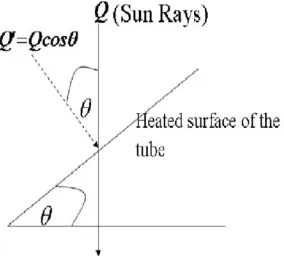
) absorbed by the water in an evacuated tube is calculated as shown in Fig. 2a.However, we consider a circular tube; accordingly, the heat flux absorbed by tube is varying with the position of the surface. Thus we have got the average heat flux (
Q
) according to surface position (Fig. 2b)[13]. The mathematical formulation of the present problem is based on the following assumptions, The flow is unsteady, two- dimensional, laminar and incompressible.
The properties of water such as viscosity, thermal conductivity, thermal diffusivity, etc. are constant, except for the density
changes with temperature, which causes to buoyancy forces. (Table 1)
Heat loss can be neglected.
Table 1. The Physical properties of water
Property Value
Kinematic viscosity (ν) 5 1
10
ms
Thermal conductivity(κ) 0.6154W/mK Thermal diffusivity (α) 6 2 110 147 .
0
ms
Gravitational acceleration (g) 2
98
.
0
ms
The coefficient of volumetrictemperature
Expansion of the water ()
1
0385 .
0
K
Based on the assumptions described above, two-dimensional models are developed.
2.1 Governing Equations
The simulation consists of solving the combined equations of Navier-Stokes and energy equation for an incompressible fluid, subject to density variation with
temperature. The buoyancy problem is approached by using a source term (S), expressed in the equation (1), added to the momentum equations by applying the Boussinesq Approximation, shown in the equation (2), which considers the independence of the fluid density with respect to temperature and pressure.
) ( ) (
cos ) (
or
sin ) (
0 0 0
0 0
T T T T g S
T T g S
(2)
Fig. 2a. The optimal heat flux Fig. 2b. The average heat flux
Mass conservation equation:(Continuity equation) 0 y v x
u (3)
Momentum conservation equations:
T T0
sinθ gβ y v x u x p ρ 1 y u v x u u t u 2 2 2 2 (4)
T T0
cosθgβ y v x u y p ρ 1 y v v x v u t v 2 2 2 2
(5) Energy conservation equation: y T x T y T v x T u t T 2 2 2 2
(6)
where u and vare velocity components in xand y directions respectively,
0 is the referencedensity and
T
0 is the reference temperature, T istemperature, p is the pressure, t is time,g is the acceleration due to gravity,
,
and
are density, kinematic viscosity and thermal diffusivity of the water respectively.2.2 Initial and Boundary Conditions
The initial and boundary conditions for the study of the sensitivity of model parameters heat transfer process in a solar collector are described as follows.
At the time
t
0
, the temperature of the stagnant water is at uniform 300k, and there is no any velocity in the system.For
t
0
, Hemispherical cup at
x
0
No slip boundary condition for velocity and adiabatic boundary condition for temperature.
0
x
T
0,
t
y,
x,
u
t
y,
x,
v
0 x at cup cal hemispheri
x
1
: No-slip boundary condition for velocity and adiabatic boundary condition for temperature
0 x T 0, t y, 1, u t y, 1, v 1 x y = 0: No-slip boundary condition for
velocity and adiabatic boundary condition for temperature
0 y T 0, t x,0, u t x,0, v 0 y y = 0.05: No-slip boundary condition for
velocity and adiabatic boundary condition for temperature
Q x T 0, t x,0.05, u t x,0.05, v 05 0. y When studying the sensitivity of weather conditions on heat transfer process in the solar collector, the initial and boundary conditions have been varied. The sensitivity of the cold-water inlet temperature is studied by varying the initial condition of the temperature for several times. To evaluate the effect of the solar radiation on the heat transfer process of a solar collector, we have considered the data of the hourly variation of solar radiation around the year. Accordingly, the boundary condition at y = 0.05, the heat flux is varied.
3. Numerical Methods
The Finite Volume Method (FVM) is used for the discretization of the governing equations. When we choose this method as the discretization method we have considered the following advantages. As a discretization method the Finite Volume Method offers high Flexibility. With this method, the discretization is carried out directly in the physical domain without use of any transformation of physical and computation domain [14].
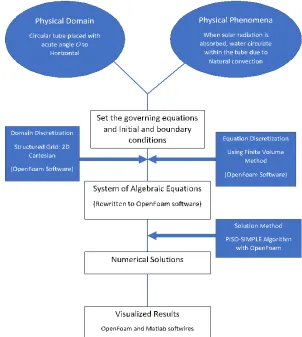
Fig. 3. The process of numerical simulation
which is developed by Henry Wella [15]. It is a free software and it allows to access the source files in order to directly modify if required. Further, it has an optimal linkage between theoretical study and numerical implementation of fluid dynamic concepts. The equation writing in the software is similar to the mathematical language. Because of these advantages, make it preferable to use this software for present study.
The merged piso-simple (pimple) algorithm is used for the simulation because this algorithm can handle the pressure velocity coupling. In openfoam software, with its inbuilt toolbox: Bupyant Bossinesq Pimple Form is available for heat transfer problems in turbulence, transient state which apply Bossinesq approximation. However, present study has a laminar flow. Thus, the model parameter values have been changed in the inbuilt toolbox: Bupyant Bossinesq Pimple Form to simulate laminar flow.
The process of numerical simulation is given in Fig. 3.
4. RESULTS AND DISCUSSION
Here the numerical results of the problems described above is presented with two parts.
4.1 Sensitivity of the Model Parameters on the Heat Transfer Process in the Solar Water Heater
4.1.1 Sensitivity of the tube inclination angle on heat transfer process
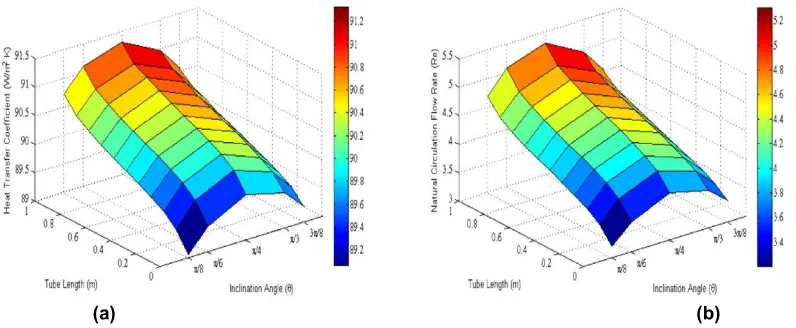
(a) (b)
Fig. 4. (a) Effect of tube inclination on heat transfer coefficient (b) Effect of tube inclination on natural circulation flow rate
beyond that it is decreasing. Further, the heat transfer coefficient increases along the tube length. Also, it is interesting to note from Fig. 4 (b), the corresponding natural circulation flow rate is also having a similar behaviour. This is due to the optimal acute angle creates a trade-off situation between solar energy absorption and buoyancy forces. Thus, it can be concluded, the buoyancy induced flow in the evacuated tube is improved with a moderate level of an acute angle.
One may see from Fig. 4 (a), till (
4
) the heat transfer coefficient increases, beyond that it is decreasing. Further, the heat transfer coefficient increases along the tube length. Also, it is interesting to note from Fig. 4 (b), the corresponding natural circulation flow rate is also having a similar behaviour. This is due to the optimal acute angle creates a trade-off situation between solar energy absorption and buoyancy forces. Thus, it can be concluded, the buoyancy induced flow in the evacuated tube is improved with a moderate level of an acute angle.Variation of total velocity with respect to inclination angle is visualized in Fig. 5. One can observe that the maximum velocity in the tube is
high when the acute angle is
4
. The range of the velocity is from 0 to 0.0197, for an acute angle
4
which is in a considerably high level. Thus, in Fig. 5, verifies that, when the inclination angle is in the moderate level, the buoyancy induced flow tends to increase.Fig. 6 exhibits the total temperature profile of water within the tube after 15 minutes of the heating period. The final temperature varies from 309K to 329K for the inclination angle
8
andthe inclination angle
3
8
, it varies from 304K to 311K. It can be seen, when the inclination angle is small, the maximum temperature gain is high, but the portion of water particles that are in the maximum temperature is low. On the other hand, when the acute angle is large, the maximum temperature gain is low; however, the portion of water particles which are at maximum temperature is high.Then consider the middle value of the acute angle, there we have considered
4
, and the temperature varies from 308K to 321K. When the inclination angle is
4
, the maximum temperature gain is at a moderate level, and a large amount of water particles are also in the maximum level of temperature. [12].4.1.2 Sensitivity of the tube dimensions angle on heat transfer process
(a) (b)
(c) (d)
(e)
Fig. 5. Total velocity profile for the inclination angle (a)
8
(b) 6
(c)
4
(d)
3
(e)
8
3
.
(a) (b)
(c ) (d)
(e)
Fig. 6. Total temperature profile of water within the tube for the inclination (a)
8
(b)6
(c)4
(d)3
(e)(a) (b)
Fig. 7. Effect of tube parameters (L, D) on (a) heat transfer coefficient (b) natural circulation flow rate
Fig. 8 exhibits the average temperature of water along the tube diameter in the tube after 15 minutes of the heating period. The average temperature increases along the tube length, according to the LD ratio.
Variation of velocity in the tube with respect to D
L ratio is visualized in Fig. 9. From this, one can see the maximum velocity in the tube decreases with the L D ratio. However, when we have the highest L Dratio, a large amount of water particles moves at a moderate level of velocity (From 0.005 to 0.0119 m/s). On the other hand, when L Dratio is low, a large amount of water particles moves at lower level of velocity which is less than to 0.005 m/s, where the water particles at heated wall have high velocity (From 0.01 to 0.0266 m/s). Thus, the buoyancy induced flow in the evacuated-tube significantly increases with respect to L Dratio.
It is expected this flow pattern in the tube
because the tube is subject to uniform heat
flux boundary at the top lateral surface of the tube. With the increase in length, the heat
that is transferred into water in the tube also increases causing thereby a rise in the temperature of the fluid. This increases the buoyancy forces.
4.2 Sensitivity of the Weather Conditions on Heat Transfer Process in a Solar Water Heater
4.2.1 Sensitivity of the solar radiation on heat transfer process in a solar water heater.
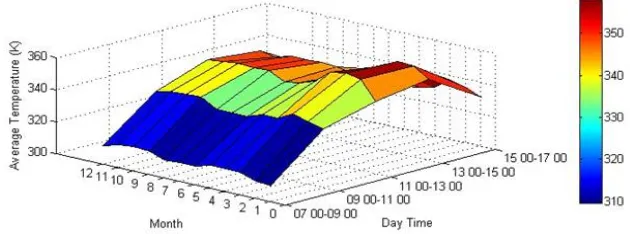
During the daytime the solar radiation gain is varied. Thus, the effect of the solar radiation
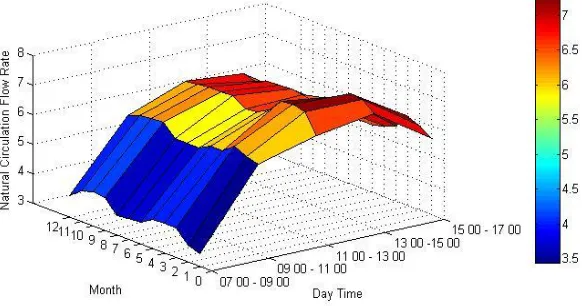
input to average temperature gain of the water in a solar collector is depicted in Fig. 9 within a day for every month. Variation of heat transfer coefficient of the system
according to hourly values of solar radiation is given in Fig. 11 and the corresponding natural circulation flow rate of the system is shown in Fig. 12.
(a) (b)
(c ) (d)
(e)
Fig. 9. Total velocity when
L
D
ratio is (a) 10 (b) 16.67 (c) 20 (d) 25 and (e) 40Fig. 10. Annual variation of average temperature gain of water in an evacuated tube.
Fig. 12. Variation of natural circulation flow rate with respect to hourly solar radiation level
.
It can be easily seen that the average temperature gain of water in the tube is high from 11.00 am to 3.00 pm every month. The corresponding heat transfer coefficient and the natural circulation flow rate also show the same behavior. This is due to the fact that, the solar radiation (heat flux) supplied to the evacuated-tube is high during this time period. It is also observed that the average temperature gain is high in the months of February, March and April. The heat transfer coefficient and the natural circulation flow rate also have high values in these months compare to the rest of the months. This is obvious because in these months the solar radiation level is high. Thus, it is clear that the buoyancy induced flow tends to increase with the increase in heat flux supply at the top lateral surface of the tube.
4.2.2 Sensitivity of the cold-water inlet on heat transfer process in a solar water heater
Fig. 13 exhibits the effect of cold water inlet temperature on the heat transfer process of
water in an evacuated tube. Variation of velocity profile after 15 minutes of heating is
given in Figs14, 15 depicts the temperature variation with respect to the cold-water inlet temperature.
It is seen that the heat transfer coefficient with respect to the cold-water inlet temperature is almost the same and it increases along the tube length. The natural circulation flow rate also has the similar behavior with respect to the cold-water inlet temperature. The cold-cold-water inlet
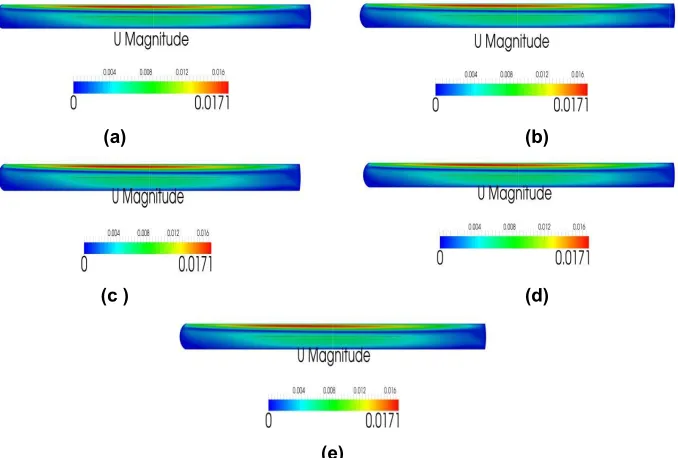
temperature does not affect the velocity profile of the system. Thus, the cold-water inlet temperature has no significant effect on heat transfer process of water in an evacuated-tube. However, the temperature linearly increases with respect to the cold-water inlet temperature. This result is realistic since the tube is subjected to uniform heat flux boundary condition at the top lateral surface of the tube and the absorption of heat to high temperature water particles causing thereby a rise in temperature. Thus, this result suggests that the cold-water inlet temperature does not affect directly to buoyancy-induced flow in the tube, but it causes a high-temperature gain in the system.
4.2.3 Effect of the angle of the solar rays on heat transfer process in a solar water heater
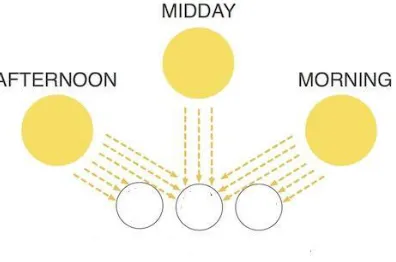
Depending on the time of the day, the direction of solar radiation differs. We have observed that when supplied heat flux is large, the heat transfer process is improved. It is well known that if the angle of the sunrays is perpendicular to the tube surface, the optimal heat flux that absorbs by the water in the tube is high. Thus, when the angle of sunrays is perpendicular to the tube surface, the heat transfer process in an evacuated-tube is improved.
(a) (b)
Fig. 13. Effect of cold water inlet temperature on (a) heat transfer coefficient (b) natural circulation flow rate
(a) (b)
(c ) (d)
(e)
Fig. 14. Variation of velocity with respect to cold water inlet temperature (a) 293 K (b) 295 K (c) 300 K (d) 305 K (e) 310 K
Fig.16. The schematic diagram of the direction of sun rays on an evacuated-tube collector
Fig. 16 shows the direction of solar radiation on an evacuated-tube collector. Thus, there is no significant effect of the direction of sun rays on the heat transfer process of an evacuated tube-collector.
5. CONCLUSION
The computational cost of the sensitivity of the model parameters and weather conditions on heat transfer process of a solar water heater is very high. Thus, the sensitivity of the system parameters of solar collector was studied by considering only one evacuated tube.
The heat transfer parameters were studied by varying one parameter at a time while keeping the rest of them fixed. Some of the results were analyzed qualitatively. It has been observed that, with moderated level of inclination angle
4
, the buoyancy induced flow is high and the maximum temperature gain is also considerably high where the portion of water particles which have maximum temperature is also considerably high. Thus, it can be concluded that with a moderate level inclination angle, the system is optimized. However, the experts in the solar water heater industry use low level of inclination angle ( 12 6 ). This result suggests a moderate level of inclination angle to improve the performance of a solar water heater.
The variation of tube dimensions (L D ratio) influences the heat transfer process of water in an evacuated-tube; where the buoyancy induced flow significantly increase with the increases of
D
L ratio. Thus, it is suggested that use of high length tube compare to the tube diameter improves the performance of a solar water heater.
It has been observed, that the variation of solar radiation (heat flux supplied) is significantly affected to the heat transfer process of an evacuated-tube. The performance of heat transfer process is high within the time from 11.00 am to 3.00 pm around the year. Moreover, from February to April the performance of the heat transfer process is high in comparison to the rest of the year. This is because within this time period the solar radiation level is high. Although the angle of the sunrays is varying in daytime, it is not effect to the performance of the solar water heater, because the evacuated tube having a circular absorbing surface, it passively tracks the sunrays throughout the day.
The results suggest that the cold-water inlet temperature does not directly effect to the
buoyancy induced flow within the tube, however it causes a high-temperature gain in the
system.
For this study, we considered only two-dimensional mathematical model. One of the possible further directions of this study is to investigate the heat flow of water in a solar water heater using three-dimensional mathematical model. It will be enabling to release some of the assumptions we have done. Another point is to investigate performance of a solar water heater by considering the glass and other component of the system. This will be enabling to understand the e effect of the heat transfer parameters of the materials on the performance of a solar water heater.
ACKNOWLEDGEMENTS
COMPETING INTERESTS
Authors have declared that no competing interests exist.
REFERENCES
1. Cohen BL. The nuclear energy option: environmental problems with coal, oil, and gas, University of Pittsburgh; 1990.
Available:http://www.phyast.pitt.edu/~blc/bo ok/chapter3.html
(Accessed 29 November 2017)
2. Department of Meteorology Sri Lanka. Climate of Sri Lanka.
Available:http://www.meteo.gov.lk/index.ph p?option=com_content&view=article&id=9 4&Itemid=310&lang=e
(Accessed 20 August 2016)
3. Sri Lanka Sustainable Energy Authority. Sri Lanka Energy Balance. 2012;2013;4. 4. UNDP. Sustainable energy for all-Sri
Lanka Rapid Assessment and Gap Analysis, Revised and expanded edition. 2012;15.
5. Miththapala S, Karavita S, Jayasekera C, Elvitigala S. Factors to be taken into account in the use of solar water heaters as a sustainable energy option, Proceedings of International Forestry and Environment Symposium, Sri Lanka. 2011; 16.
6. North Carolina Solar Center. Passive and Active Solar Domestic Hot Water Systems Revised edition, Printed in North Carolina; 2002.
7. National Renewable Energy Laboratory. Solar Water Heating, U. S. Department of Energy; 1996.
8. GAD-EL-HAK M. Fluid mechanics from the beginning to the third millennium*. International Journal of Engineering Ed. 1998;14(3):77-185.
9. Bengtson H, Stonecypher L. Natural convection heat transfer coefficient estimation calculation.
Available:http://www.brighthubengineering. com/hvac/92660-natural-convection-heat-transfer-coefficient-estimation-calculations (Accessed 15 September 2017)
10. Budihardjo I, Morrison GL. Performance of water-in-glass evacuated tube solar water heaters. Solar Energy. 2009;83:49-56. 11. Kumari KDN, Wijerathna JK. Numerical
simulation of heat flow of a circular tube with a hemispherical cup at the bottom in an evacuated solar collector. Annual Research Symposium, University of Colombo, Sri Lanka; 2016.
12. NREL. The energy efficiency and renewable energy clearinghouse; 2015. Available:http://www.nrel.gov/
docs/legosti/fy96/17459.pdf (Accessed 05 June 2015)
13. Kumari KDN, Wijerathna JK. Sensitivity of tube inclination angle on thermal performance of water-in-glass evacuated tube solar water heater. International Conference on Computational Modeling and Simulation; 2017.
14. Moukalled F, Mangani L, Darwish M. Fluid mechanics and its applications. Springer. 2015;113:103.
15. Wthrich B. Simulation and validation of compressible flow in nozzle geometries and validation of Open FOAM for this application. Master Thesis, Institute of Fluid Dynamics; 2017.
_________________________________________________________________________________ © 2018 Kumari and Wijerathne; This is an Open Access article distributed under the terms of the Creative Commons Attribution License (http://creativecommons.org/licenses/by/4.0), which permits unrestricted use, distribution, and reproduction in any medium, provided the original work is properly cited.
Peer-review history: