White Rose Research Online URL for this paper: http://eprints.whiterose.ac.uk/95421/
Version: Accepted Version
Article:
Harcup, T. (2014) 'News with a kick': a model of oppositional reporting. Communication, Culture and Critique, 7 (4). pp. 559-577. ISSN 1753-9129
https://doi.org/10.1111/cccr.12059
This is the peer reviewed version of the following article: Harcup, T. (2014), “News With a Kick”: A Model of Oppositional Reporting. Communication, Culture & Critique, 7: 559–577, which has been published in final form at http://dx.doi.org/10.1111/cccr.12059. This article may be used for non-commercial purposes in accordance with Wiley Terms and
Conditions for Self-Archiving (http://olabout.wiley.com/WileyCDA/Section/id-820227.html)
[email protected] https://eprints.whiterose.ac.uk/ Reuse
Unless indicated otherwise, fulltext items are protected by copyright with all rights reserved. The copyright exception in section 29 of the Copyright, Designs and Patents Act 1988 allows the making of a single copy solely for the purpose of non-commercial research or private study within the limits of fair dealing. The publisher or other rights-holder may allow further reproduction and re-use of this version - refer to the White Rose Research Online record for this item. Where records identify the publisher as the copyright holder, users can verify any specific terms of use on the publisher’s website.
Takedown
If you consider content in White Rose Research Online to be in breach of UK law, please notify us by
“News With a Kick”:
A Model of Oppositional Reporting
Tony Harcup
Abstract
This article explores uses of reporting techniques by de facto journalists operating within alternative media, paying particular attention to the extent to which people who tend to be marginalised by mainstream journalism may be heard via alternative journalism. The article is based on an empirical study of an online provider of alternative local news operating in one UK city. Drawing on broader conceptualisations of alternative journalism (Forde, 2011; Atton, 2002), this article proposes a more specific model of “oppositional reporting,”
combining pragmatic use of journalistic skills with an ideological critique of the hegemonic discourses of powerful social groupings and mainstream media alike. Oppositional reporting speaks up for the powerless and, at times, allows the powerless to speak directly for
themselves.
This article considers “oppositional reporting” as a form of alternative journalism that is produced by, and/or on behalf of, those who tend to be excluded or marginalised by mainstream media. Journalism involves the provision of sourced information on topical events and reporting is its heartbeat. This article will examine a form of reporting that can be found within some examples of alternative media: “oppositional reporting” that sets out to speak up for the powerless in society, that facilitates the powerless to speak for themselves, and that seeks to inspire action for change. Such reporting provides citizens with alternative news as well as additional contextual information to help explain (and sometimes debunk) mainstream news. It does this as part of a project aimed at encouraging audiences “to take part in democracy, in civic society – to participate, to do something” (Forde, 2011, p. 165; emphasis in original). In this sense, alternative journalism in the form of oppositional reporting can act as a means of “democratic communication” (Atton, 2002, p. 4), providing “information for action” (Atton, 2002, p. 85), in the phrase adopted as a motto by both
SchNews (2013) and Corporate Watch (2013).
This study will explore how oppositional reporting provides such information for action in Manchester, a city in the north-west of England in the UK. From 2007 to date the city has been home to Mule, which describes itself as “a Manchester based non-profit independent media project, looking to promote social justice by getting out the news and views you won’t find elsewhere, from the rainy city and beyond,” aiming to “cover the
style and format are relatively conventional but its ethos and content are far from conservative.
Mule’s journalism goes beyond providing information and entertainment to become a form of oppositional reporting that is underpinned by scepticism. Mule’s journalism is
designed to speak up for the powerless and to inspire and inform social and political action. It does this, in part, by rejecting objectivity in favour of articulating what it sees as the interests of the relatively powerless in society against those of the relatively powerful. Mule engages in oppositional reporting to speak up for the powerless, allow the powerless to speak for themselves, and provide information for action in the pursuit of social change. In doing this it declares itself as, broadly, on the side of labour against capital; women against sexism; communities against corporations; need against greed; and minorities against discrimination.
This article will use quantitative and qualitative methods to explore how it does this, paying particular attention to its sourcing practices. It will feature a detailed content analysis of one month’s output as well as a consideration of examples put forward as case studies by
Mule itself. This material will be contextualised with explanatory material obtained via face-to-face discussions and e-mail exchanges. The article will then analyse the resulting evidence in the light of recent scholarship on alternative media and alternative journalism. Finally, the article will propose a model of oppositional reporting that combines pragmatic use of
journalistic skills with an ideological critique of mainstream discourse. But before we turn to the case study, we must acknowledge that Mule and other contemporary examples did not simply emerge one day to change the world; they have history.
Alternative Journalism and Oppositional Reporting
antiracism, anti-imperialism, and antimaterialism, elements of what has been termed the “1968 generation” created an alternative local press that frequently used, and on occasion
subverted, many of the established techniques of mainstream journalism and reporting
(Harcup, 2013). Many of the 1968 generation’s alternative media activists were aware of, and inspired by, oppositional movements and media from earlier decades, even earlier centuries (Forde, 2011; Harcup, 2013). In this spirit they created media projects that had relatively open and nonprofessionalised structures, “available to ordinary people without the necessity of professional training” (Atton, 2002, p. 25). Despite most participants’ lack of formal journalistic training – some might argue it was because of their distance from the industry’s norms – this post-1968 alternative press produced some in-depth reporting, not just
commentary (Whitaker, 1981).
Amongst many other things, this press produced something that I label oppositional reporting: reporting that provided new information at the same time as critiquing mainstream narratives. For example, one comparative study of coverage of the 1981 riots in the UK found marked differences between mainstream and alternative media. Whereas mainstream media tended to frame events within a story of criminality, and to quote only senior police personnel and politicians in the role of primary definers, the alternative press of the time pointed to complex social and economic reasons behind the disturbances and relied more on sources found on the streets than on any official version of events (Harcup, 2003). Another case study found reporters from alternative media conducting extensive ground-level, “grassroots” reporting during the 1984-1985 mineworkers’ strike in the UK. This contrasted with the narrow range of overwhelmingly antistrike perspectives that tended to frame coverage within contemporary mainstream journalism. One weekly alternative local newspaper published 51 issues during the strike, in which there were 265 articles about the dispute, using 281
left “voiceless” in much of the mainstream media for the duration of the dispute: that is, the “ordinary” men and women involved in the strike in villages, on picket lines, in kitchens,
and in support groups. Such reportage depended upon alternative journalists physically going out and about, talking to people face to face, seeking out and recording their stories for wider circulation, not simply for the sake of spreading information but also in the hope of inspiring action (Harcup, 2011). This was oppositional reporting in practice and, in the Mule case study (below), we will now explore how it works three decades on, in the digital era.
Mule: “A Tool for Social Change”
The people who founded the media project known as Mule saw it, essentially, as a political act. They created Mule as “a tool for social change,” as the collective made clear in its online “About” statement:
At its best independent media supports progressive social movements by raising public awareness and providing information that is a tool in the hands of campaigners. This starts at home. The place we can be most effective is in our backyard, holding power to account in Manchester. (Mule, 2012)
Mule’s founders despaired of much mainstream media, which they saw as far too docile to be an effective watchdog, but they were also critical of what they saw as the dogmatism of much alternative and radical media. So they decided to produce their own version of information for action to fill the gap left by deficiencies of existing alternative media as well the mainstream. Mule described itself as “an old form of left journalism not seen since the radical papers of the past”; namely, “well-researched articles about things people care about, such as schools, cuts, racism, local councils and housing, not just counter-culture stuff that’s only read by people already interested” (Mule Collective, 2011). Although
they were young enough to fit the label “digital natives,”the collective’s initial plan was for a newspaper with an added website. They later dropped the print edition due to the physical and financial strains involved in producing and distributing it. The content and reporting style of the newspaper and website were virtually identical, but members of the collective still have misgivings that some of the most deprived communities in the city may now effectively be denied access to the online-only Mule. They have not ruled out an occasional return to print at some point in the future, to provide a physical product that could be distributed to community centres and other locations to reach potential readers and sources on the wrong side of the “digital divide.”
Mule’s journalism is consciously informed by its activists’ knowledge of the “propaganda model,” the explanation offered by Edward Herman and Noam Chomsky of
We wanted it to be openly biased about the things we felt were important. It was meant to be connected to social movements as a resource for the activist community in Manchester, to use the paper as a tool for social change, trying to get a message out there that wasn’t ranty, that was well-informed, well-researched. (Interview)
Mule shows its bias in its selection of stories (there is no celebrity news and little or no standard crime reporting, for example), in a commitment to researching how the decisions of the powerful impact on those lower down the social order, and in privileging the voices of activists, campaigners and ‘ordinary people’ over the more powerful voices that tend to
dominate so much mainstream coverage. Readers can take bias into consideration only if it is out in the open, so Mule’s argument goes.
Mule’s reporting therefore begins from a stance that views events from an
oppositional, primarily class-based, perspective. That is both its purpose and an essential part of its methodology. Mule’s politics and journalism are inseparable, and we can see this most clearly at the local level where its journalism is not merely an observation on the life of the city: it is an intervention. As one member of the collective explains:
We found that a lot of activists could tell you what the International Monetary Fund was but they couldn’t really tell you what a “local enterprise partnership” was, even
though they make major decisions - especially with housing, which is a really key driver of socio-economic pressures - which we thought deserved a look in our area. (Interview)
Rather than relying on oppositional rhetoric, then, Mule’s activists-cum-journalists explore empirical evidence. They pay particular attention to official documents produced by local authorities, government departments, nongovernment organisations (NGOs), regional development organisations, university research projects, business forums, and assorted “thinktanks.” Mule journalists search through economic reviews and strategies, company
annual reports, and transcripts of parliamentary debates and questions to be found in Hansard, the official record of proceedings in the House of Commons and the House of Lords. Mule synthesises yet at the same time delves beneath the surface of such material to analyse and contextualise what it might mean for everyday citizens. It records the views of those on the receiving end of, as well as those campaigning against, such policies. And Mule journalists then report the results in what they intend to be a measured and accurate manner, adopting a readable and accessible style, without distorting or oversimplifying the often complex issues involved.
Underpinning Mule’s exploration of such evidence is a default position of scepticism. This scepticism informs Mule’s reading of what appears in other media, and in public
relations, just as it informs Mule’s original reporting. It is journalism with attitude. A member of the collective describes that attitude in the following terms:
When you see a council press release about regeneration we look very carefully through it and think, “What assumption is being made here, what assumption is being made there?”, and then going to people in those areas and saying, “What do you think about this, what’s your experience been?”…We basically look through every local
story every day…and we think, “What are they up to?”. (Interview)
will be followed by analysis of a whole month of Mule output (that was not suggested by the collective).
Example one: the workers speak. Story one covers an industrial dispute and this
example of oppositional reporting is notable for the way in which it is entirely framed from the perspective of the workers involved. It describes a long-running series of conflicts at a further education college in Manchester (Mule, 2010). Looking back on “a year of struggle” between management and staff, Mule frames the story explicitly from the perspectives of workers’ detailed allegations and grievances about the way their workplace is run. It directly
quotes seven members of staff, all anonymously, and makes it clear that many other workers have also been spoken to. A worker describes one encounter with their employer:
My line manager said to me, “I don’t like to call this or see it as a demotion, it’s more of a revision of your role and regarding.” 20 per cent less pay and three weeks holiday removed, which we will not be compensated for, seems like a demotion to me, but we are scared to rock the boat as we have been made to feel lucky we have kept our jobs. (Mule, 2010)
Another worker is quoted explaining that some changes amount to discrimination against parents, particularly mothers:
By changing holidays and increasing working hours the college has not taken childcare needs into account. When confronted by someone who says it looks like they cannot continue in their job due to the changes, the college just says there is “no negotiation.” (Mule, 2010)
Management declined to comment to Mule but the story quotes from a number of e-mails senior managers had sent to staff, which provide some evidential backup to the workers’
eliciting direct comment from the local authority and local politicians. This story has attracted 10 online comments from readers, including several from workers directly involved in the dispute adding further information. Overall, not only does the workers’ perspective frame Mule’s coverage of the dispute, but many of the workers involved are given the opportunity to speak for themselves directly.
The way in which Mule has reported this story contrasts with mainstream coverage, where the words of ‘ordinary’ workers directly involved are rarely heard. The mainstream
Manchester Evening News has devoted little space to the disputes at the college and its stories from this period do not quote a single worker, allowing only a college spokesman and the general secretary of a trade union to speak on the issue (MEN 2010a, 2010b). Alternative and mainstream reporting, therefore, can be said to differ markedly in the quantity of coverage, in whose perspectives are reported most prominently, and in whose perspectives are actively sought (or not).
Example two: utmost scepticism. Story two covers the way in which a claim about
new jobs collapses under scrutiny from Mule’s critical perspective. The story examines an airline’s announcement of an £175 million investment at a local airport, tests the company’s
account of the numbers of jobs involved against available evidence from other sources, and highlights discrepancies (Mule, 2011a). Mule’s version includes 20 links to 15 different sites or documents, ranging from the airline’s original news release to reports and analysis
This is an example of how healthy scepticism, when combined with oppositional reporting’s exhaustive approach to multiple sourcing, can debunk a powerful industry’s
public relations spin. It contrasts with how the airline’s announcement is treated by the
Manchester Evening News. The city’s major newspaper trumpets the £175m announcement and the supposed creation of 2,000 jobs in its headline; all it adds to the original press release is a positive quote from the managing director of the airport (MEN, 2011a). As a result, Mule accuses the mainstream media of, in effect, exaggerating the number of new jobs likely to be created. The Mule story concludes that all such claims made by the aviation industry,
politicians and media alike should be scrutinised and approached with “the utmost scepticism.”
Example three: the riot in context. Story three concerns reaction to an outbreak of
rioting in Manchester city centre, and was published online shortly after a night of
disturbances. It is Mule’s attempt to make sense of what took place on the streets that night, and why it happened (Mule, 2011b). Mule places events within the context of evidence of “structural inequality, deprivation and exclusion,” including reporting figures for poverty,
social deprivation, unemployment and life expectancy taken from a range of sources
including the council and the charity Save The Children, all with links to take readers to see the original evidence for themselves. The article also points readers back to some of Mule’s own earlier coverage of relevant issues, including a piece that cited a letter from community activists warning the council that cuts to the city’s youth services could result in street
story has generated further discussion among those posting comments online, who contribute a range of different perspectives and opinions on the events of that August night.
In contrast, the Manchester Evening News’s extensive coverage of the same events echo that found in mainstream coverage of riots 30 years earlier (Harcup, 2003). That is, it focuses on criminality, law and order, and details of specific incidents rather than
consideration of what might lie behind them. For example, the headline of the MEN’s major story on the August 2011 riots describes them as one of the worst events in the city’s history,
and the following words and phrases all appear in the scene-setting intro: “rampaged…trail of devastation…targeted by yobs…smashed…looted…” (MEN, 2011b). Such mainstream
coverage tends to downplay possible underlying social issues (Wadsworth, 2012), and seems to leave little room for the kind of reflective discussion offered by Mule.
From Specific Examples to One Month’s Entire Output
the findings. The next section will examine Mule’s range of stories, sources and links, to explore the extent to which it speaks up for the voiceless and promotes action for social change.
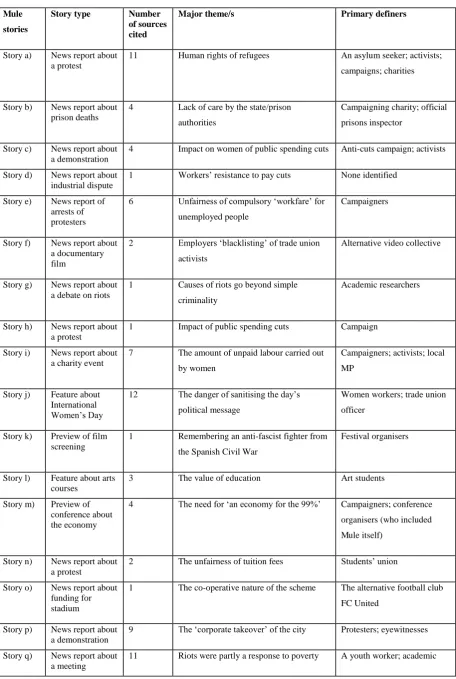
The range of stories. Table 1 records in detail the number of items published during
the sample period, along with the number of sources referred to, the major theme of each item, and any source/s used in the role of primary definer. During the month Mule published 25 items of editorial matter on its website, comprising 17 news stories, four previews, three feature articles, and one review. This is overwhelmingly political material about the impact of spending cuts, tuition fees and climate change, and campaigns around human rights issues. Even the one review is of a series of political films from a Spanish and Latin American festival. The number of sources cited for each story ranges from just one in some cases up to double figures in four of the stories, and these will be broken down in Table 2.
[INSERT TABLE 1 HERE]
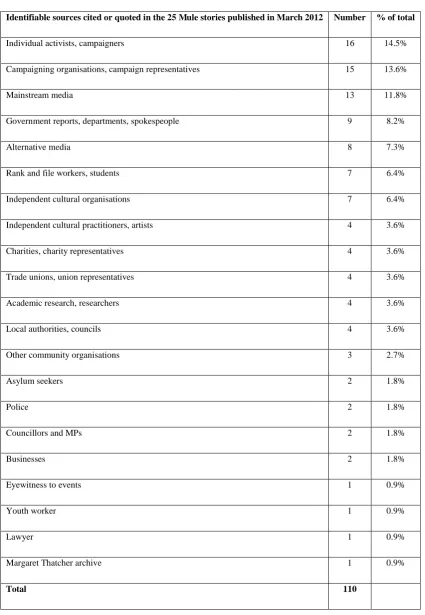
The range of sources. Table 2 takes the 110 identifiable sources used by Mule during
the sample period and places them into categories, as far as it is possible to do so from the published material. The data presented in Tables 1 and 2 suggest that, despite having few financial resources and no team of paid reporters, Mule manages to use multiple sources for approximately three-quarters of its stories. The tables also point to there being no
activists do not appear to have their voices recorded and amplified quite as often as might be expected from Mule’s stated intentions.
[INSERT TABLE 2 HERE]
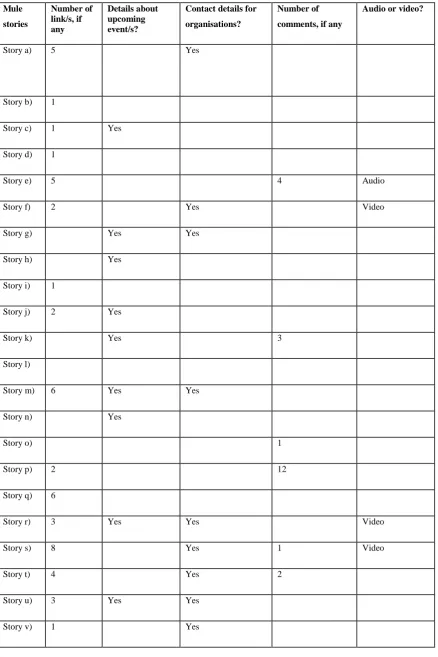
An interactive tool for social change. Table 3 records how Mule uses interactive
and multimedia techniques and goes beyond observation to encourage active participation in events. Mule uses technology that would have been impossible for earlier generations of alternative journalists to imagine, even though it is nowhere near the cutting edge of
interactivity or multiplatform storytelling. The 25 published items contain more than 50 links to evidence or relevant organisations, have attracted 25 readers’ comments directly to the
website, and use four pieces of audio-visual material. More noteworthy when it comes to inspiring action is the fact that almost half the published output contains details of a forthcoming event, with many of the stories also including contact details for events or organisations. This suggests that Mule’s reporting and sourcing practices are not ends in themselves but are means to an end: that end being social change.
[INSERT TABLE 3 HERE]
Contrast With the Mainstream
Mule’s choice of stories during the sample month contrasts with the prevailing news values of most mainstream media, in which entertainment, celebrities and elites tend to dominate (Harcup & O’Neill, 2001). Similarly, Mule’s range of sources, as indicated in the above tables, differs markedly from the way in which even some “quality” mainstream newspapers rely on the content-subsidy provided by the public relations industry (Lewis et al., 2008). Mule’s sourcing appears to be far more diverse than that found in much local and regional media, in particular, where overworked journalists are “becoming more passive” and
by O’Neill and O’Connor (2008, p. 498). Such reporting contrasts with the sourcing practices
of Mule that can be seen in Tables 1 and 2.
The following section will discuss the extent to which the above evidence
demonstrates a form of reporting that sets out to speak up for some of the least powerful in society and enable the voices of the powerless themselves to be heard, all driven by a desire to inspire social action and political activity. After considering the record of Mule in relation to further scholarship about alternative journalism, this article will conclude by proposing a model of such oppositional reporting.
Oppositional Reporting: Discussion
The foregoing exemplars and content analysis suggest that Mule engages in recognisably journalistic techniques and that it does so for alternative and oppositional purposes. The depth and breadth of much of Mule’s information, analysis and sourcing of stories appear to go well beyond the norm found in mainstream media, particularly at a local or regional level. This journalistic material is written in a relatively plain and easy-to-read style, making some use of interactive technology to allow readers to see much of the original evidence for themselves, by way of links, and to have their own say, via the online comments facility and social media.
Mule permits some of the people formerly known as the “voiceless” to speak on their own behalf about issues that concern them. Mule does not just permit the voiceless to speak, it facilitates and encourages it. The evidence suggests that, on some occasions, such views and experiences are actively sought out for publication by Mule, which may then use such sources as primary definers whose perspectives can frame its coverage of issues. However, the evidence also suggests Mule does not do this as often as it might. As one member of the collective acknowledges: “I don’t think you can ever do as much as you should.” (Interview.)
journalism that have been suggested by Susan Forde (2011). These include: a commitment to encouraging political, social and civic participation among citizens; the prioritising of news that is of most relevance to what are deemed to be the interests of such citizens; the blurring of boundaries between audience and journalist; and the critiquing of dominant discourse, including that of mainstream media (Forde, 2011, pp. 174-175).
Going further, I suggest that Mule engages in a set of practices that we might call not just alternative journalism in general, but oppositional reporting in particular. Such reporting involves discovering, verifying, analysing, and communicating fresh information on topical events (the reporting element) and doing so overtly in the service of a form of ideological critique of the hegemonic consensus (the opposition element). Typically, those engaging in such reporting are not striving for a form of binding ideological party line associated with the Leninist model of radical media (Downing, 2011, p. 302). Rather, their ideological critique of mainstream discourse tends to be informed by an arguably more open-minded and more inchoate set of beliefs that are concerned with providing a voice for the voiceless and the downtrodden and to support and provoke social action for change. This is perhaps best summed up in the statement contained in the first issue of Leeds Other Paper, back in 1974: “It is our intention to support all groups active in struggle in industry and elsewhere for
greater control of their own lives” (quoted in Harcup, 2013, p. 169). That is, such reporting is not content to quote the otherwise voiceless as ‘victims’ but as active participants in social change; or, at least, as potentially active participants.
To this end, oppositional reporting combines practical reporting with ideological critique and incorporates within its journalistic methodology a broad critique, not just of the actions of a society’s ruling elements, but also of how their actions are portrayed in most
sources. It does this to dig out new facts and provide, question, verify, evaluate, and analyse evidence. The oppositional element of such reporting comes when it is deployed openly on the side of, roughly speaking, labour as opposed to capital, working class communities as opposed to corporations, social need as opposed to individual greed, and freedom and human rights as opposed to oppression and repression. At heart, such reporting is produced more to inspire social participation and political activity than it is to entertain a passive audience (Forde, 2011). One form of participation it can inspire is the creation of further examples of alternative media, as more of the formerly voiceless find their own voices and, in turn, create their own outlets for democratic communication (Harcup, 2013). In this sense, providing a voice for the voiceless and seeking to inspire social action can be one and the same thing.
By working within such democratised spaces, alternative journalists and oppositional reporters ask some fundamental questions about journalism itself. For Chris Atton,
oppositional reporting “is able to challenge dominant official narratives,” to encourage citizens “to consider sources of information beyond those routinely presented in mainstream news,” and attests “to the multiple realities that may be derived from the world and how journalists position themselves as active participants in constructing those realities” (Atton, 2013, p. xiii). By allowing media audiences to speak and the otherwise marginalised to be heard, the production of such journalism entails performing “radical critiques on what it means to be ‘in the news,’ what it means to be an audience and what it means to be a journalist” (Atton, 2013, p. xi).
Taking such questioning a stage further, we might ask if this form of journalism is limited to media projects informed by the open, leftish spirit of 1968 or could something akin to oppositional reporting also characterise other forms of nonmainstream media production? What of the party newspapers of Marxist political organisations, for example, or the
(2004: p. 88-90) suggests that far-right media display few signs of the sort of democratised spaces found “in other alternative media formulations, little space for the sharing or
exploration of ideas and arguments,” being “replete with closure: organisationally,
dialogically, discursively.” Even liberal or leftist alternative journalism is not necessarily as alternative, or as radical, as it appears at first sight, according to Tamar Ashuri (2012). Her study of an online project that monitors the human rights of Palestinians at Israeli military checkpoints concluded that, by embracing elements of a journalistic approach that
emphasises evidence-gathering and facts, the activists behind the site are in effect adopting a conservative approach to recording reality. For Ashuri, this means that, although “members of this organisation, through the very act of reporting, expose a marginalised social
reality…which in turn makes it possible to change realities,” there is also a downside. Their
privileging of journalistic techniques over direct personal testimony has the unintended consequence of “legitimising the conventional practices of mainstream news organisations,” she argues (Ashuri, 2012, p. 54).
But, rather than legitimising the methods of mainstream media, is it not possible that alternative media’s use of such journalistic practices is actually a process of reclaiming them? As Forde (2011, p. xi) reminds us, “the practices of alternative journalism are older than the practices of professional commercial journalism.” Old or new, alternative journalism
continues to be produced in a variety of forms today, one of which is the type of oppositional reporting discussed in this article. The final section will seek to outline precisely what it entails.
Conclusion
oppositional reporting in practice at Mule, we may now more clearly identify the factors that comprise it, which are:
Speaking up for labour against capital; for working class communities against
corporations and bureaucrats; for the concept of social need as opposed to individual greed; for human rights and freedom from oppression, repression, discrimination, sexism and racism.
The use of routine journalistic practice to achieve the discovery, verification, analysis,
and communication of new information about topical events of importance to citizens and of relevance to the above.
The use of multiple primary and secondary sources to uncover, check, question, and
evaluate evidence in connection with the above.
The production of multiple-sourced and evidence-based journalism that makes no claim
to be free of bias and which declares its bias openly.
The seeking out and privileging of the voices of those directly involved in events,
allowing them to speak for themselves as active agents rather than passive victims.
The production of counterhegemonic journalism that incorporates not simply a critique of
how a society is ruled but of how issues tend to be reported in mainstream media.
The use of all of the above to encourage “ordinary people” to become active participants
in the public, social, civic, cultural, political, and, not least, media spheres.
Alternative journalists produce such oppositional reporting not primarily because it might be interesting, entertaining, fun, or a way of building a journalistic profile or “brand,” although it can be all of those things. Rather, alternative journalists practise oppositional reporting
receiving end of others’ actions. It does this in the hope of recording, supporting and
encouraging action for social change.
Mule shows that it is possible to produce journalism that can inform and inspire, speak up for the powerless, and facilitate the voiceless to speak for themselves. It may not always manage to carry out oppositional reporting of the depth to which members of the collective aspire or to give voice to as many of the voiceless as it would like; but its record stands out in illuminating contrast to the passive and uncritical nature of too much
mainstream journalism. Furthermore, Mule’s oppositional reporting in the digital age demonstrates that online journalism can be so much more than what it so often is: celebrity gossip, shouty propaganda, or mere aggregation of the work of others.
Acknowledgement
Thanks to members of the Mule collective for their cooperation with this research project; to CCC editors for their encouragement; and to participants in two events during which some of the ideas contained within this article were discussed: a research symposium at the University of Central Lancashire in June 2012 and a public meeting at the Mechanics Institute in
References
Ashuri, T. (2012). Activist journalism: Using digital technologies and undermining structures. Communication, Culture, and Critique, 5, 38-56.
Atton, C. (2002). Alternative media. London, England: Sage.
Atton, C. (2004). An alternative internet: Radical media, politics and creativity. Edinburgh, Scotland: Edinburgh University Press.
Atton, C. (2013). Foreword: Local journalism, radical reporting and the everyday. In T. Harcup, Alternative journalism, alternative voices (pp. xi-xvi). London, England: Routledge.
Atton, C., & Couldry, N. (2003). Introduction to special issue on alternative media. Media, Culture and Society, 25(5), 579-586.
Corporate Watch. (2013). About us. Corporate Watch. Retrieved January, 22, 2013 from: http://www.corporatewatch.org/?lid=58
Downing, J. (2011). Leninist underground media model. In J. Downing (Ed.). Encyclopedia of social movement media (pp.301-302). Los Angeles, CA: Sage.
Forde, S. (2011). Challenging the news: The journalism of alternative and community media. Basingstoke, England: Palgrave Macmillan.
Harcup, T. (2003). The unspoken – said: The journalism of alternative media. Journalism: Theory, Practice and Criticism, 4(3), 356-376.
Harcup, T. (2011). Reporting the voices of the voiceless during the miners’ strike: An early form of “citizen journalism”. Journal of Media Practice, 12(1), 27-39.
Harcup, T. (2013). Alternative journalism, alternative voices. London, England: Routledge. Harcup, T., & O’Neill, D. (2001). What is news? Galtung and Ruge revisited. Journalism
Herman, E., & Chomsky, N. (1988). Manufacturing consent: The political economy of the mass media. London, England: Vintage.
Lewis, J., Williams, A., & Franklin, B. (2008). Four rumours and an explanation: A political economic account of journalists’ changing newsgathering and reporting practices.
Journalism Practice, 2(1), 27-45.
MEN. (2010a). Manchester college to axe 300 workers. Manchester Evening News, January 22. Retrieved November 17, 2012, from
http://menmedia.co.uk/manchestereveningnews/news/s/1189997_manchester_college
_to_axe_300_workers
MEN. (2010b). Lecturers vote for strike over contracts. Manchester Evening News, June 11. Retrieved November 17, 2012, from
http://menmedia.co.uk/manchestereveningnews/news/s/1242836_lecturers_vote_for_s
trike_over_contracts
MEN. (2011a). Ryanair to invest £175m and create 2000 jobs at Manchester Airport. Manchester Evening News, July 13. Retrieved January 18, 2013, from
http://menmedia.co.uk/manchestereveningnews/news/business/s/1426509_ryanair-to-invest-175m-and-create-2000-jobs-at-manchester-airport
MEN. (2011b). More than 100 arrested as rioting youths go on rampage - one of the worst days in Manchester’s history. Manchester Evening News, August 10. Retrieved
January 18, 2013, from
http://menmedia.co.uk/manchestereveningnews/news/s/1455173_live-more-than-100-
Mule. (2010). Twelve months of strife at Manchester college. Mule, September 12. Retrieved November 17, 2012, from
http://manchestermule.com/article/objections-force-council-to-reconsider-school-closures
Mule. (2011a). Welcoming Ryanair back to Manchester? Mule, July 17. Retrieved January 27, 2012, from http://manchestermule.com/article/welcoming-ryanair-back-to-manchester
Mule. (2011b). After the riots: the council must face the “real Manchester”. Mule, August 11. Retrieved January 27, 2012, from http://manchestermule.com/article/its-time-the-council-faced-up-to-the-real-manchester
Mule Collective. (2011). Manchester’s alternative press. Red Pepper, October/November, 14-15.
Mule. (2012). About. Mule. Retrieved August 17, 2012, from http://manchestermule.com/about-mule
O’Neill, D., & O’Connor, C. (2008). The passive journalist: How sources dominate local
news. Journalism Practice, 2(3), 487-500.
Rodriguez, C. (2001). Fissures in the mediascape: An international study of citizens’ media. Cresskill, NJ: Hampton Press.
SchNews. (2013). DIY guide. SchNews Retrieved January 21, 2013, from http://www.schnews.org.uk/diyguide/index.htm
Wadsworth, M. (2012). Media coverage of 2011 riots “was disgraceful”. The Voice Online, June 10. Retrieved November 17, 2012, from
http://www.voice-online.co.uk/article/media-coverage-2011-riots-was-disgraceful
TABLE 1: Major themes and primary sources of Mule output in March 2012
Mule
stories
Story type Number
of sources cited
Major theme/s Primary definers
Story a) News report about a protest
11 Human rights of refugees An asylum seeker; activists;
campaigns; charities
Story b) News report about prison deaths
4 Lack of care by the state/prison
authorities
Campaigning charity; official
prisons inspector
Story c) News report about a demonstration
4 Impact on women of public spending cuts Anti-cuts campaign; activists
Story d) News report about industrial dispute
1 Workers’ resistance to pay cuts None identified
Story e) News report of arrests of protesters
6 Unfairness of compulsory ‘workfare’ for
unemployed people
Campaigners
Story f) News report about a documentary film
2 Employers ‘blacklisting’ of trade union
activists
Alternative video collective
Story g) News report about a debate on riots
1 Causes of riots go beyond simple
criminality
Academic researchers
Story h) News report about a protest
1 Impact of public spending cuts Campaign
Story i) News report about a charity event
7 The amount of unpaid labour carried out
by women
Campaigners; activists; local
MP
Story j) Feature about International
Women’s Day
12 The danger of sanitising the day’s
political message
Women workers; trade union
officer
Story k) Preview of film screening
1 Remembering an anti-fascist fighter from
the Spanish Civil War
Festival organisers
Story l) Feature about arts courses
3 The value of education Art students
Story m) Preview of conference about the economy
4 The need for ‘an economy for the 99%’ Campaigners; conference
organisers (who included
Mule itself)
Story n) News report about a protest
2 The unfairness of tuition fees Students’ union
Story o) News report about funding for stadium
1 The co-operative nature of the scheme The alternative football club
FC United
Story p) News report about a demonstration
9 The ‘corporate takeover’ of the city Protesters; eyewitnesses
Story q) News report about a meeting
and inequality researchers; charities; police;
council
Story r) Interview with a local musician
4 Independent cultural practice The musician
Story s) News report about proposed anti-squatting law
10 The contrast between the numbers of
empty homes and homeless people
Squatting campaign; squatters
Story t) News report about a conference on climate change
4 The lack of action and transparency on
climate change locally
Two activists wrote the story
themselves
Story u) Preview of local arts festival
3 Independent cultural practice Festival organisers
Story v) News report announcing new cultural section for Mule
1 Giving a voice to local events and
organisations usually ignored by
mainstream media
Mule itself
Story w) Film review 1 Review of political films from Spanish
and Latin American film festival
N/A
Story x) Preview of exhibition
3 Independent cultural practice Arts collective; the artist
Story y) News report about campaign against deportation of local woman
4 Human rights of victims of trafficking The woman herself; human
TABLE 2: Identifiable sources cited in Mule output in March 2012.
Identifiable sources cited or quoted in the 25 Mule stories published in March 2012 Number % of total
Individual activists, campaigners 16 14.5%
Campaigning organisations, campaign representatives 15 13.6%
Mainstream media 13 11.8%
Government reports, departments, spokespeople 9 8.2%
Alternative media 8 7.3%
Rank and file workers, students 7 6.4%
Independent cultural organisations 7 6.4%
Independent cultural practitioners, artists 4 3.6%
Charities, charity representatives 4 3.6%
Trade unions, union representatives 4 3.6%
Academic research, researchers 4 3.6%
Local authorities, councils 4 3.6%
Other community organisations 3 2.7%
Asylum seekers 2 1.8%
Police 2 1.8%
Councillors and MPs 2 1.8%
Businesses 2 1.8%
Eyewitness to events 1 0.9%
Youth worker 1 0.9%
Lawyer 1 0.9%
Margaret Thatcher archive 1 0.9%
TABLE 3: Interactive and multimedia elements incorporated into Mule output in March 2012
Mule
stories
Number of link/s, if any
Details about upcoming event/s?
Contact details for
organisations?
Number of
comments, if any
Audio or video?
Story a) 5 Yes
Story b) 1
Story c) 1 Yes
Story d) 1
Story e) 5 4 Audio
Story f) 2 Yes Video
Story g) Yes Yes
Story h) Yes
Story i) 1
Story j) 2 Yes
Story k) Yes 3
Story l)
Story m) 6 Yes Yes
Story n) Yes
Story o) 1
Story p) 2 12
Story q) 6
Story r) 3 Yes Yes Video
Story s) 8 Yes 1 Video
Story t) 4 Yes 2
Story u) 3 Yes Yes
Story w) Yes
Story x) 1 Yes Yes
Story y) 1 Yes 2
Total: 25
stories
53 links 12 upcoming
events
10 contact details 25 comments on
website
4 stories with