Optimization of Image Registration for Medical
Image Analysis
PN Maddaiah , PN Pournami , VK Govindan
Department of Computer science and Engineering, National Institute of Technology Calicut, Kerala, India
Abstract— Image registration has vital applications in medical image analysis. It is a fundamental preprocessing step where two or more images are aligned into a common coordinate system. Out of various types of registration methods, a popular category is the one, which uses the whole image content to derive a suitable transformation for overlaying the input images. Image registration itself is composed of a number of phases like transformation, interpolation, computing similarity metric and optimization of the transformation parameters (translation, rotation, shearing etc). A major factor that determines the success and effectiveness of any registration method is the optimization strategy we employ for achieving the optimal set of transformation vectors. Hence, it can be viewed as an optimization problem, which computes the geometric as well as intensity transformations at which the input images are having maximal similarity with one another. In this paper, we present a mono modal image registration algorithm for the alignment of T1-weighted MR images of human brain using modified Particle Swarm Optimization (PSO) method for getting the optimum spatial coordinates of the moving image. The experimental results clearly show that the proposed algorithm guarantees better results than the traditional PSO algorithm.
Keywords Image registration, Interpolation, Optimization
method, Transformations, Mutual information, Particle swarm optimization.
I. INTRODUCTION
Image registration is the process of transforming different sets of data into one coordinate system [1], [2], [3], [4]. Data may be multiple photographs, data from different sensors, times, depths, or viewpoints. This Registration is used in medical imaging, computer vision, in military, comparing images, analyzing satellites images. In image registration two images are involved- the reference image and test image. The reference image is denoted by f1(x) and test image is denoted by f2(x), where x
is the coordinates of images. If T is a transformation of coordinates then f2(T(x)) is associated to reference image
f1(x). We need to find the transformation T such that it
gives maximum similarities between reference image and test image with the help of an optimization method.
(1) T = ArgmaxMetric [f1(x), f2(T(x)) ]
The organization of the paper is as follows. Section II presents a general outline to the image registration process. A comprehensive literature survey on image registration
methods applied in the medical image analysis is given in Section III. Conventional PSO algorithm is presented in Section IV. Section V deals with the proposed algorithm and the results are presented in section VI. Finally, the work is concluded in Section VII
II. IMAGE REGISTRATION
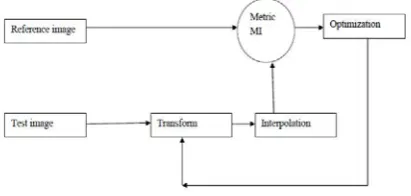
Frame work of medical image registration is shown in figure 1, and the components involved are presented in the following subsections.
Figure 1: Frame work of image registration
A. Transformation
Rigid transformation is used to transform the moving image. Rigid transform is done by rotation and translation operations. This registration gives global transformation of images. The transformation operations are as given below:
(2) TGlobal(x) = Rx + t
R= cos − sin
sin cos
x=
t=
Where is rotation angle and tx, ty are translation
values over x, y axis.
B. Metric function (Mutual information)
(3) H(A,B)=-∑a,bpA,B(a,b)logpA,B(a,b)
Where PA,Bis the joint probability distribution function
of pixels associated with image A and B. Mutual information is represented in terms of entropy as shown below
(4) MI (A,B) = H(A) + H(B) - H(A,B)
Where H (A), and H (B) are individual entropies of A and B images respectively. Individually, entropies of images are found from the following formula:
(5) H(x) = ∑x px(x)logpx(x)
Where p(x) is the probability distribution function; the mutual information is maximized when over lapping areas are high in both images.
C. Optimization
Optimization is an iterative procedure in which iteration refines the parameter value based on the fitness computation [5]. Optimization always provides best parameters for proper alignment of moving image.Some of the optimization algorithms that are used in image registration are gradient descent, quasi-Newton, nonlinear conjugate gradient, stochastic gradient descent methods, Kiefer-Wolfowitz, Robbins-Monro, simultaneous perturbation, adaptive stochastic gradient descent, preconditioned stochastic gradient descent, Genetic algorithm, and Particle swarm optimization.
III.LITERATURE SURVEY
Chen-Lun Lin et al. [1] proposed particle swarm optimization for medical image registration. Rigid transformation is used for global transformation of image and non-rigid is used for local transformation of images by cubic B-spline.
Yen-Wei Chen and Aya Mimori [6] proposed hybrid particle swarm optimization for multi modal medical image registration, by including subpopulation and crossover from GA techniques in to traditional PSO. It is applied for 3D medical images.
Hennessy and Patterson [7] presented a full introduction about particle swarm optimization, with the help of the flowcharts and algorithm.
Qiu Yina et al. [8] proposed a gravity based optimization which is used for 2D brain medical images in rigid registration. A performance comparison with Powell and PSO algorithms are also given to demonstrate the superiority of the proposed work.
Yutaro Yamamural et al. [9] developed a new method for automatic registration by using mutual information. It is applied to CT and MRI images of head. It was done with increasing accuracy of registration and reducing the time to finish registration.
Y.Bentoutou et al. [10] described new feature based technique with involving the edge based selection by using control points for satellite images. Thin-plate spline
Yongming Li et al. [11] proposed one dynamic brain MR image registration algorithm by combining two techniques inheritance idea and Particle Swarm Optimization. The algorithm can inherit the information of the reference image and use it to guide the register image. The time complexity of the proposed approach is g (t) = O (t × m × n), where t is the time to calculate the fitness value of one particle, m is the size of the population, n is the number of iterations.
Maruturi Haribabu1 et al. [12] proposed multimodal medical image fusion of MRI-PET using wavelet transform. It is an integrative display method of two images. The PET image shows the brain function with a low spatial resolution and MRI image shows the brain tissue anatomy and contains no functional information if integrated these two images it has more information and it is useful for the doctors to easily analyse and give treatment to patients. Based on the average and spatial frequency methods, the discrete wavelet transform coefficients of MRI-PET intensity values are fused.
Ramesh et al. [13] attempted to develop a package for mosaicing multiple image this work is done in three modules each module is run independently. Modules are Images displayed in overview with full resolution zoomed modes and registration and layout file generation, polygon filling. By composing these three modules forms a full-fledged system.
IV.PARTICLE SWARM OPTIMIZATION
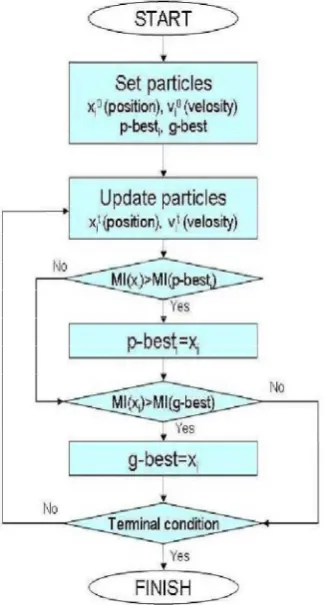
In this algorithm, the population of particles is called swarm each particle is a point [6]. Each particle is initialized with uniform random values in the space. The algorithm updates the values of particles according to the similarity measure. P-best (personal best value) and g-best (global best value) values are kept maintained along execution particles. P-best is the best value of each particle and g-best value is the best value among the all p-best of particles.
Particles motions are based on its velocities and current positions; these values are updated at iterations. The equations for velocity and position of each particle are given below [7].
(6) vi(t) = w(t)+vi(t -1) + φ1u1[pi - xi(t - 1)] + φ2u2[gi -
xi(t - 1)]
(7) xi (t + 1) = xi(t) + vi(t)
Where t is iteration number, xi is the ith particle
position, vi is the velocity vector, pi is the personal best
value of xi and gi is the global best among all particles; w
(t) is the inertial weight, φ is the acceleration constant, and u is the uniformly distributed random numbers, in the range of 0 to 1.
(8) w(t +1) = w(t) + dw (9) dw = (wmin-wmax)/T
Where T is the maximum of iterations, wmax and wmin
Algorithm:
1. Create a population of agents (called particles) uniformly distributed over the space X.
2. Evaluate each particles position according to the objective function.
3. If a particle’s current position is better than its previous best position, update it.
4. Determine the best particle (according to the particle’s previous best positions).
5. Update particles’ velocities
6. Move particles to their new positions
7. Go to step 2 until stopping criteria are satisfied. 8. Stop.
The flow chart of PSO is as given in Fig. 2.
Figure 2: Flow chart of PSO
V. PROPOSED ALGORITHM
Removing Worst particle: While PSO is running, after
half of the iterations, finds the particle which is in worst position in space, then replace that particle position by mean value of current position of particle and global solution. This may help that particle to reach global solution.
Run PSO iteratively: In iterations, consider PSO as a
group of particles. Among the iteration (among sub groups) find the solution that gives maximum similarity between test image and reference image. The modified PSO algorithm flow charts are given in Figures 3 and 4.
Figure 3:Removing Worst particle while PSO running.
VI.RESULTS AND DISCUSSION
The proposed technique is implemented using Matlab. In this image registration, we used mutual information for metric function and modified PSO is used for optimization of transform parameters; this case of rigid registration for 2D medical images.
For registration, a brain image of 354x353 pixels is taken as a reference image and the transposed 353x354 pixels image is taken as a test image and done registration with traditional PSO and proposed PSO. In traditional PSO, the number of particles are 5 and number of iterations are 10. In the proposed PSO, each subpopulation has 3 particles and 6 iterations. We have taken 2 subpopulations; the increase in number of subpopulations provides better registration accuracy.
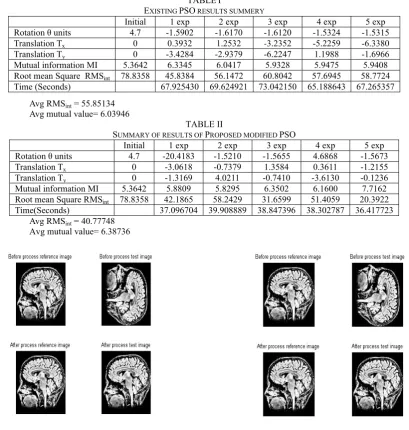
Tables 1 and 2 depict results for existing PSO and the proposed PSO respectively. Image registration accuracy is calculated by RMSint between reference image and the
registration generated moving image. RMSint formula
representation is
(10) RMSint = 1/ ∑ ( ( ) − ( ) )
Where RMSint is the Root mean square of difference in
intensities between IF(x) and IM(x); N is the total number of
pixels.
We have done registration 5 times among these calculated average RMSint value and average mutual
information for traditional PSO and proposed modified PSO. The modified PSO gave better result than traditional PSO.
Though the number of iterations (12 iterations) in the proposed PSO is larger than the existing (10 iterations) PSO, the completion time of propose technique is only approximately half of the time of existing PSO approach. The introduction of the randomness in the PSO helped to reduce the convergence time. Also, the proposed PSO got better average RMS value than traditional PSO, and proposed PSO acquired good mutual information. The results of registration are given in Figures 5 and 6.
TABLE I
EXISTING PSO RESULTS SUMMERY
Avg RMSint = 55.85134
Avg mutual value= 6.03946
TABLE II
SUMMARY OF RESULTS OF PROPOSED MODIFIED PSO
Initial 1 exp 2 exp 3 exp 4 exp 5 exp
Rotation θ units 4.7 -20.4183 -1.5210 -1.5655 4.6868 -1.5673
Translation Tx 0 -3.0618 -0.7379 1.3584 0.3611 -1.2155
Translation Ty 0 -1.3169 4.0211 -0.7410 -3.6130 -0.1236
Mutual information MI 5.3642 5.8809 5.8295 6.3502 6.1600 7.7162 Root mean Square RMSint 78.8358 42.1865 58.2429 31.6599 51.4059 20.3922
Time(Seconds) 37.096704 39.908889 38.847396 38.302787 36.417723 Avg RMSint = 40.77748
Avg mutual value= 6.38736
Figure 5: image registration output with PSO
Initial 1 exp 2 exp 3 exp 4 exp 5 exp
Rotation θ units 4.7 -1.5902 -1.6170 -1.6120 -1.5324 -1.5315
Translation Tx 0 0.3932 1.2532 -3.2352 -5.2259 -6.3380
Translation Ty 0 -3.4284 -2.9379 -6.2247 1.1988 -1.6966
Mutual information MI 5.3642 6.3345 6.0417 5.9328 5.9475 5.9408 Root mean Square RMSint 78.8358 45.8384 56.1472 60.8042 57.6945 58.7724
VII. CONCLUSION AND FUTURE WORK
It is observed that replacing worst particle by the mean of particle position and g-best value, and iteratively running PSO as a sub group lead to better results. The proposed technique provided better performances than traditional PSO; it also works with multi modal medical images.
Attempt is in progress to apply the approach to 3D images and for employing parallel computation of PSO in inside for loop to further reduce run time with non-rigid registration.
REFERENCES
[1] Chen, Yen-Wei, Chen-Lun Lin, and Aya Mimori. "Multimodal medical image registration using particle swarm optimization." Intelligent Systems Design and Applications, 2008. ISDA'08. Eighth International Conference on. Vol. 3. IEEE, 2008.
[2] Sithara Kanakaraj, Govindan V K and Pournami P N, A fast brain image registration using axial transform; Communications in Computer and Information science, 2012, vol. 292, part 2, pp. 206-212, DOI: 10.1007/978-3-642-31686-9_24.
[3] Pournami P.N, Sithara Kanakaraj & V.K. Govindan; Registration using multi-resolution optimization for the early diagnosis of alzheimer’s disease; International Journal of Computer Science and Electrical Engineering (IJCSEE) ISSN No. 2315-4209, Vol-1, Iss-2, 2012.
[4] Pournami P N, Shaj G S, and V K Govindan, Threshold Accepting Approach for Image Registration, International Journal of
Computer Science and its Applications, Vol.2, Issue 2, pp 88-92, 2012, ISSN 2250-3765.
[5] Klein, Stefan. Optimisation methods for medical image registration. PhD thesis, Image Sciences Institute, UMC Utrecht, 2008. [6] Lin, Chen-Lun, Aya Mimori, and Yen-Wei Chen. "Hybrid particle
swarm optimization and its application to multimodal 3d medical image registration." Computational intelligence and neuroscience 2012 (2012): 6.
[7] J. L. Hennessy and D. A. Patterson. Particle Swarm Optimization Introduction. Marco A. Montes de Oca, May 7 2007.
[8] Yina, Qiu, et al. "A Medical Image Registration Method Based on Gravity Optimization." Bioinformatics and Biomedical Engineering, 2009. ICBBE 2009. 3rd International Conference on. IEEE, 2009. [9] Yutaro Yamamural, Hyoungseop Kim2, and Akiyoshi Yamamoto3,
''A Method for Image Registration by Maximization of Mutual Information”,SICE-ICASE International Joint Conference 2006 Oct. 18-21, 2006 in Bexco, Busan, Korea.
[10] Y. Bentoutou a, N. Taleb b, A. Bounoua b, K. Kpalma c, and J. Ronsin c, '' Feature Based Registration of Satellite Images '', Proc. of the 2007 15th Intl. Conf. on Digital Signal Processing (DSP 2007).
[11] Yongming Li*, Han Lai, Liuyi Lu, Yiwen Gao, and Pin Wang, '' Dynamic Brain Magnetic Resonance Image Registration based on Inheritance Idea and PSO '', 2011 4th International Conference on Biomedical Engineering and Informatics (BMEI).
[12] Maruturi Haribabu1, CH.Hima Bindu2, and Dr.K.Satya Prasad3, '' Multimodal Medical Image Fusion of MRI – PET Using Wavelet Transform '', 2012 International Conference on Advances in Mobile Network, Communication and Its Applications.