MAPPING VALUES AT RISK FROM
NATURAL HAZARDS AT GEOGRAPHIC
AND INSTITUTIONAL SCALES:
FRAMEWORK DEVELOPMENT
Roger Jones, Celeste Young and John Symons
Version Release history Date
1.0 Initial release of document 15/08/2015
This work is licensed under a Creative Commons Attribution-Non Commercial 4.0 International Licence.
Disclaimer:
The Victoria Institute of Strategic Economic Studies (VISES), Victoria University and the Bushfire and Natural Hazards CRC advise that the information contained in this publication comprises general statements based on scientific research. The reader is advised and needs to be aware that such information may be incomplete or unable to be used in any specific situation. No reliance or actions must therefore be made on that information without seeking prior expert professional, scientific and technical advice. To the extent permitted by law, the Victoria Institute of Strategic Economic Studies (VISES), Victoria University and the Bushfire and Natural Hazards CRC (including its employees and consultants) exclude all liability to any person for any consequences, including but not limited to all losses, damages, costs, expenses and any other compensation, arising directly or indirectly from using this publication (in part or in whole) and any information or material contained in it.
Publisher:
Victoria Institute of Strategic Economic Studies (VISES), Victoria University and Bushfire and Natural Hazards CRC
ISBN: 978-1-86272-714-4
August 2015
Citation: Jones, R.N., Young, C.K. and Symons, J. (2015) Mapping Values at Risk from Natural Hazards at Geographic and Institutional Scales: Framework Development, Victoria Institute of Strategic Economic Studies (VISES), Victoria University and Bushfire and Natural Hazards Cooperative Research Centre, Melbourne.
VISES Climate Change Working Paper No. 28
Cover: Northern Grampians, Landsat before and after fire January 2013, NASA
TABLE OF CONTENTS
ABSTRACT 3
INTRODUCTION 4
BACKGROUND 6
FRAMEWORK 8
Risk framework 8
Institutional Analysis and Development Framework 10
Institutions 12
Action situations 13
External variables 15
Interactions 16
Evaluation and outcome criteria 17
Updated framework 19
KEY FRAMEWORK ELEMENTS 21
Assessing values at risk 21
Risk ownership 24
Risk propagation across domains 28
CONCLUSIONS AND NEXT STEPS 31
ABSTRACT
This paper describes the framework development for the project “Mapping and understanding bushfire and natural hazard vulnerability and risks at the institutional scale” being undertaken for the Bushfire and Natural Hazards Co-operative Research Centre (BNHCRC). The project is taking a values at risk approach to natural hazard vulnerability by mapping a wide variety of values within an economic geography. Risk ownership of assets at risk and delegated strategic risk management will then be allocated at the institutional scale, providing an insight into existing levels of risk governance for the broad range of values at risk. Aspects of strategic risk management within the project scope concerns natural hazard risk reduction before and after events, taking into account resilience, preparedness, mitigation and recovery.
The systemic nature of natural hazard risk requires building the standard risk assessment process into a broader framework that assess interactions at the institutional scale. This role is filled by the Institutional Analysis and Development Framework (IAD). The framework operates at a polycentric (multiple scale) and heterodox (multiple economic methodology) scale, and is suited to the analysis of common pool resources, which are subtractable, and where limiting access is non-trivial. The capacity to manage natural disaster risk arguably qualifies as a common pool resource, notwithstanding the open-ended nature of current government financing arrangement for disaster recovery. Key features of the framework include:
• The major institutions affected by natural hazard risk, including local, state and federal government, the community and business and industry, along with specialised institutions such as the emergency management sector.
• Multiple values covering monetary, social and environmental values ranging from tangible to intangible values, and covering five value clusters: built, social and environmental assets, and the goods and services produced from those assets.
• The understanding of risk ownership through the owner of the resource (assets, goods or services) at risk and the delegated risk manager, at the institutional scale.
• The crossing of institutional domains, as risks propagate from where the event occurs to where the risk needs to be responded and managed, using risk ownership as a vehicle.
INTRODUCTION
Natural disasters are triggered by one or more hazard events that result in a serious disruption to people or a place (UNISDR, 2009; IPCC, 2012). A rapid-onset event that shocks a social-ecological system will transmit a set of impacts through that system, variously amplified and dampened by different feedbacks. Its severity is influenced by the direct response from time of first warning to the immediate aftermath, but also depends on the condition of the system and level of preparedness at the time of the event. These factors will also influence the level of residual losses.
Disaster risks are complex. The systemic nature of disasters requires the characterisation of risk and its analytic process to also be systemic (Renn and Klinke, 2004). A systemic risk is one where a shock or failure causes a chain of consequences (Schwarcz, 2008). Complexity arises out of the interaction between internally-generated risks (called idiosyncratic risk in the financial literature and endogenous risk in the scientific literature) and external or systemic risk (also known as exogenous risk)(Miranda and Glauber, 1997; OECD, 2003; Schwarcz, 2008; Acharya et al., 2010). Instead of following the standard linear risk assessment, a framework of interacting risks needs to be constructed and explored using iterative methods (Jones et al., 2014).
Disaster risk management and risk reduction can be considered as having two major parts: the immediate response to natural hazard event(s) from warning to response and containment, and the strategic planning focusing on before and after a disaster event (Guha-Sapir et al., 2004; Jaques, 2010). These occupy two very different worlds:
1. Emergency response is adrenaline-fuelled and action-based using motor memory and drills to carry out a series of actions as effectively as possible. 2. Strategic planning is pre-thought, considering both theory and practice, links,
networks and feedbacks to consider what needs to be done before and after disasters to minimise damage and loss while speeding recovery.
Addressing the second point is difficult and less attractive to funding bodies (Guha-Sapir et al., 2004), especially as many of the benefits are intangible (Annan, 1999). Getting political buy-in where the reward may not occur for decades is difficult whereas the reward for responding to a current disaster is immediate (Blaikie et al., 2014). The evidence is that voters reward politicians for providing disaster relief but not for mitigation, a fact that politicians recognise (Healy and Malhotra 2009). This situation is unlikely to be rectified unless the range of values at risk are clearly articulated, potential solutions outlined and the institutional context in which they can be applied is better defined. In Australia, the current scientific and institutional understanding of the systemic nature of disasters is patchy, with the clearest understanding surrounding disaster response (COAG, 2004). Less well understood are the processes and feedbacks that amplify or dampen risks, especially with regard to land-use and changing exposure, how the broad range of values affected can be managed in a holistic manner, and how a stream of investment into risk mitigation can be created with the complex networks of risk ownership in play.
(NERAG)(National Emergency Management Committee, 2010), which is widely being applied by governments across Australia. To date, most assessments look at single hazards, calculating risk-response relationships or exploring event-based scenarios, but changing baselines and the potential for different types of events to present in succession means that almost any combination of events can be anticipated. This type of challenge limits the effectiveness of linear systems and prescriptive solutions, and anticipates the need for foresighting and robust institutional arrangements.
Impacts from severe to catastrophic events can also propagate from one domain to another; for example, from local to state to national, changing ownership along the way (Jones et al., 2013). This degree of complexity requires strong risk governance at the institutional scale (Djalante et al., 2011; Tierney, 2012). The theme of risk governance for large, systemic risks is growing in prominence; and having strong and aware institutions is considered to be central (OECD, 2003; Renn, 2008; Aven and Renn, 2010; Renn et al., 2011; Wachinger et al., 2013).
This paper addresses the strategic aspects of natural disaster management in Australia by moving beyond the monetary aspect to take an all-values approach. This requires a framework that links public and private values with the commons – resources shared by everyone (Hardin, 1968). Rather than using conventional economic models that analyse the costs and benefits of taking such an approach, the proposal is to build an economic geography of values at risk as a first step. Values at risk will be assessed using a combination of hazard, exposure and vulnerability consistent with Cardona et al. (2012). The first goal is to use that geography to understand how vulnerability is currently being perceived across a wide range of values. This will then move onto the assessment of current patterns of risk ownership at the institutional scale, which will provide insight to the effectiveness of risk governance. Further work will investigate how risk ownership can be addressed to improve the strategic management of natural hazard risk, thus improving risk governance. The areas of risk management this covers are risk mitigation, post-event response, and recovery and resilience (Young et al., 2015), which can collectively be thought of as strategic aspects of natural disaster risk reduction.
This is a difficult undertaking with many unknowns, so the intention is to do this in a series of steps, learning along the way. A companion paper looks at existing arrangements for risk ownership natural hazards within the Australian context using publicly available sources (Young et al., 2015). It provides a framework for assessing ownership of strategic risk management, focusing on strategic planning in the lead up to and following natural hazard events.
BACKGROUND
This paper is part of a project “Mapping and understanding bushfire and natural hazard vulnerability and risks at the institutional scale” being undertaken for the Bushfire and Natural Hazards Co-operative Research Centre (BNHCRC). The project objective is to develop a framework for understanding the ownership of risks from bushfires and natural hazards at the institutional level in order to improve risk governance through a range of measures, including investment strategies, resilience and risk mitigation.
Natural hazards being addressed are selected from those being dealt with as part of the Bushfire and Natural Hazards CRC and include bushfire, flash and riverine flood, heat extremes, earthquake and landslide. Natural hazards not considered here include coastal inundation, tsunamis, volcanic eruptions, solar storms and meteor strikes.
The recent Productivity Commission (2014) inquiry into government funding arrangements for natural disasters acknowledges the wide range of values affected, but restricts itself to assessing the fiscal arrangements for government surrounding disaster relief and recovery payments, and investments in resilience and disaster risk mitigation. The recent imbalance between these two is marked. The past decade has seen $13.6 billion spent on post-disaster relief and recovery by all governments, with the federal government allocating another $5.7 billion for past events (Productivity Commission, 2014). The Productivity Commission (2014) estimates that government funding for mitigation is 3% of post disaster relief and recovery, but caution that local and state mitigation expenditure is missing from this estimate as is private expenditure. Other activities that also serve to mitigate natural hazard risk (e.g., climate change adaptation funding) are also excluded from this estimate. The national balance between mitigation and recovery expenditure therefore, is highly uncertain, but is likely to be heavily negative.
A working hypothesis for the project is that the current imbalance between pre and post disaster spending at the federal government level extends to the rest of the public and private sectors and includes a broad range of economic, social and environmental values. Losses may cross domains (geographic, political, statutory), changing ownership of the associated risks as they do so (Jones et al., 2013). Domains include levels of government, public and private domains, regions and economic sectors. These unowned risks are currently not well identified at the institutional level (Young et al., 2015), and hence are likely to remain unowned if current arrangements continue. The potential for climate-related hazards to become more severe and for exposure to increase, also suggests that any current imbalance could blow out further. This theme is explored in Box 1.
If this is the case, then obtaining a more systemic understanding of who has a stake in these values is an important task for strategic risk management.
The underlying cause for the recent increase in post-disaster payouts is heavily debated – whether it is due to increasing disasters, exposure or a combination of both (Crompton and McAneney, 2008; Bouwer, 2010; Crompton et al., 2010, 2011; Nicholls, 2011). Increases in exposure due to population growth and greater investment in hazardous places (e.g., Crompton and McAneney, 2008; Crompton et al., 2010) are uncontroversial. However, some climate-related natural hazard risks are being affected by changing climate extremes. Climate-related indices, such as Forest Fire Danger Index and extreme daily temperatures in south-eastern Australia have increased (Braganza et al., 2013), especially since 1998, to levels equivalent to those projected for 2030–2050 (Jones et al., 2013). Rainfall intensity is increasing in a manner consistent with a warming climate (Coumou and Rahmstorf, 2012; Evans and Boyer‐Souchet, 2012; Yilmaz and Perera, 2013). The floods of 2010–11 were associated with a record La Niña and sea surface temperatures in northern Australia, the latter attributable to climate change (Braganza et al., 2013). Increased storm intensity associated with the Queensland floods has been linked to teleconnections between the jet stream and planetary waves; these links increase in climate models forced by greenhouse gases, suggesting climate change has influenced the flood severity (Wang et al., 2013).
Using statistical methods to normalise damages over time, Crompton and McAneney (2008) and Crompton et al. (2010) argue that increasing damages from natural hazards in Australia can be explained solely by increasing exposure. A counter argument is that improved planning, design and response could be reducing the exposure of individual properties and buildings, which potentially could mask any increases in hazards (Nicholls, 2011). This is the case for extreme heat, where adaptations in response to heat waves in 2009 have been effective in later heat waves (Queensland University of Technology, 2010; Washington, 2013). Adaptation is also likely to be contributing to lower levels of fire and flood damage.
The normalisation argument therefore does not hold, because although damage data cannot be used to prove that climate-related risks are increasing (there are other ways to do that), it also cannot be used to prove that climate change is not contributing to the current high levels of damage being experienced. Furthermore, the long-run statistics being used to argue this case may require decades more data to confirm that climate-change related risks are increasing with 95% confidence, which is the convention for scientific proof but not for addressing risk (Barratt et al., 2010; Bohensky and Leitch, 2014). This is counter to risk management principles, where the prospect of a risk is sufficient to warrant attention, not its realisation.
FRAMEWORK
The framework supporting the project needs to accommodate three sub-systems: 1. The cause and effect process of natural hazards;
2. The social-ecological system affected by those hazards; and
3. The institutional structure that governs how hazard risks are managed.
The first two sub-systems describe the setting in which hazards occur. If one or more hazard events shock a system, the nature of the response depends on that system’s initial state. This is consistent with conventional hazard-impact or state-impact-response models. Within a standard risk assessment framework, the risk management process will focus on event risk, identifying specific controls and evaluating options for risk treatment. However, to investigate the institutional arrangements within which risks are governed, a more over-arching approach is needed.
The IAD is being used to organise these three sub-systems within an overall framework. This will link pre-event status, post-event damage and loss, mitigation and response through the values and trade-offs that connect these elements. These links are being made through the concept of risk ownership, discussed in more detail later. Initially, a wide range of values at risk are being gathered and assessed before addressing ownership of these values at the institutional scale.
Applied to natural hazards, risk ownership becomes a tool for identifying responsibilities amongst a wide range of potential owners, ranging from those who control an asset, good or services, to those responsible for managing the risk (Jones et al., 2013; Young et al., 2015). Because the responsibility for managing natural hazards before and after an event is highly distributed, the concept of risk ownership is a useful way to assess the effectiveness of governance measures, and to identify potential gaps in ownership that may lead to unresolved damage and loss.
RISK FRAMEWORK
The main guidance for managing natural hazard risk in Australia is provided by the National Emergency Risk Assessment Guidelines (National Emergency Management Committee, 2010). These guidelines apply the cause and effect process of natural hazards and the social-ecological system affected by those hazards to the standard risk process. This section outlines the basic risk framework we are building on.
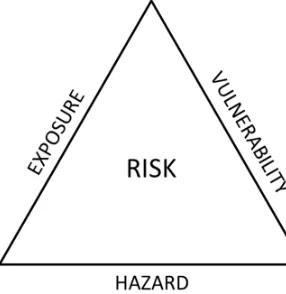
The three basic elements of risk form the risk triangle of hazard, exposure and vulnerability (Figure 1). This model is used by Geoscience Australia in their analysis and communication of natural hazards (Geoscience Australia, ND) and the National Emergency Management Committee (2010) in their risk guidance. However, these concepts are not simple to apply in a multi-hazard multi-value framework.
FIGURE 1. RISK TRIANGLE OF HAZARD, EXPOSURE AND VULNERABILITY (CRICHTON, 1999).
Füssel (2007) identifies eight different vulnerability concepts and six dimensions. These six dimensions and how we are applying them are:
• Temporal reference: current vs. future or dynamic (both) – the project is beginning with current vulnerability but will develop dynamic vulnerability over time.
• Sphere: internal vs. external or cross-scale (both) – cross-scale.
• Knowledge domain: socioeconomic vs. biophysical or integrated – integrated.
• Vulnerable system – Victoria, expanding nationally over time.
• Attribute of concern – values at risk, risk ownership
• Hazard – natural hazards including flood, fire, heat wave, earthquake and coastal flooding.
Within the NERAG, vulnerability is not clearly defined except to refer to it as vulnerability to hazard (National Emergency Management Committee, 2010, p. 11), leaving it up to users to define their specific usage. Based on an informal survey of the guidance material and published literature, the two main uses of vulnerability for natural hazard management in Australia are:
1. Socio-economic vulnerability as a precursor to risk, and
2. Impact-related vulnerability as an outcome (e.g., vulnerability to a hazard). We are applying both uses within the geography, but begin with the first. This applies cross-scale socio-economic vulnerability using measures such as income, demographics and health status, independently of the type and level of hazard, providing a generic view of socio-economic susceptibility to hazard-related damage. In this sense, vulnerability is a measure of response-capacity and becomes an aspect of political economy (Füssel, 2007). Governments and societies decide, by default or design, what degree of generic vulnerability should be shouldered by the state and what degree by the individual.
Some authors divide hazard-related vulnerability and general socio-economic vulnerability according to susceptibility to primary and secondary hazard impacts (Birkmann, 2006). However, other input measures such as exposure, also contribute to total risk, so can contribute to some framings of vulnerability. The complex nature of vulnerability requires us to be clear about the context in which it is being applied (Cardona et al., 2012). Initially, vulnerability will be communicated as values at risk from natural hazards. Some data will represent such values directly (e.g., assets, goods and services), whereas others will represent indicators of vulnerability that lead to such values being compromised. This work and the experience of end-user agencies can help identify which values are important and need to be represented in a geography. The initial values at risk comprise a wide range of values covering five value clusters, which are discussed later in the paper.
These values can be superimposed onto available hazard data to summarise broad patterns of values at risk across given geographic domains, initially the State of Victoria. Values at risk exposed to the existing pattern of natural hazards also provides a baseline for understanding the existing state of a specific system, place or activity. Values are affected by disasters in two ways: one is through the damage experienced as a result of the shock and the other is as ongoing losses/gains during recovery (Cavallo and Noy, 2010). Losses in some areas of value may never be recovered, while other values may actually be stimulated by the shock or by other measures taken to aid recovery (Case Study 2). For example, rebuilding often stimulates the construction and materials sectors, as occurred following the 2011 Queensland floods (Hartley et al., 2011).
By combining very different values spanning the monetary economy, human society and the natural environment, we aim to tease out some of the differences between different kinds of value in terms of their relative vulnerabilities and how these vulnerabilities are currently perceived. For example, the trade-offs between environmental, social and monetary values are much richer than the relationships implied by economic models that focus on price, supply and demand. This requires selecting criteria for representative values that can be represented within a geography and can be overlain with natural hazards to illustrate risk and vulnerability. As such, data needs to be available and relevant.
The next part of the project, where risks and risk ownership cross domains, moves into the institutional realm, which is where the IAD becomes important.
INSTITUTIONAL ANALYSIS AND DEVELOPMENT FRAMEWORK
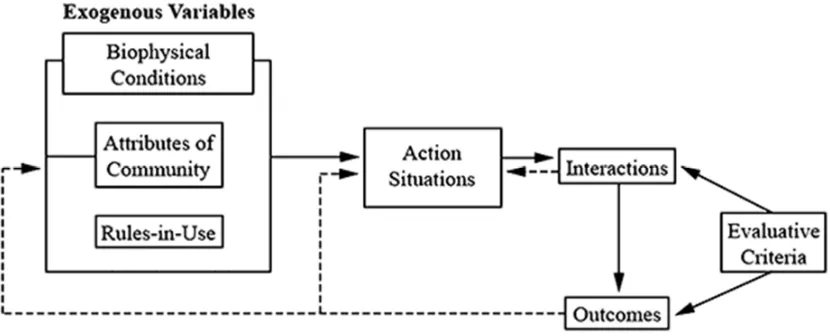
The IAD framework is described in Figure 2. External influences on a social-ecological system with specific attributes lead to an action situation. Here, external influences include bushfire and natural hazard events, but community attributes and the external influences that affect these can also be important. The action situation and interactions describe the resulting disaster events and potential emergency responses, in addition to strategic risk management activities that include risk mitigation, post-event response and recovery.
FIGURE 2. A FRAMEWORK FOR INSTITUTIONAL ANALYSIS (OSTROM, 2011)
System interactions are measured using defined evaluation criteria. These criteria include key values at risk, but also criteria that provide measures of success in addressing institutional arrangements concerning disaster risk management and disaster risk reduction. Values are linked to vulnerability as the propensity to be harmed, influenced by sensitivity and exposure following the Intergovernmental Panel on Climate Change (IPCC, 2007, 2014). The scale is institutional because of the unpredictability of future hazard events, the systemic nature of risks and potential for market failure and the interpersonal or relational nature of institutional rules (Budzinski, 2003; Lebel et al., 2006; Ostrom, 2011).
The IAD framework organises the elements and general relationships for institutional analysis, which can be pursued with either diagnostic or prescriptive enquiry. Prescriptive inquiry follows the stated aims and rules of the game, and diagnostic enquiry tries to understand what institutions and their constituents actually do. Both deliver valuable perspectives. The framework needs to encompass all the information available to actors, the flow of activities, and the identification and ownership of risks.
The external drivers set in train a series of interactions, which invite some form of further response if current arrangements are likely to lead to unacceptable outcomes. The framework involves at least two iterations. The first iteration addresses the current state of affairs by asking questions such as:
1. Who and what is at risk from natural hazards?
2. What factors increase vulnerability and exposure to natural hazard risks? 3. What are the main values at risk?
The economic geography is being used to investigate these questions by displaying hazard type and intensity, key values, measures of vulnerability and broad levels of exposure. This will be carried out with end-users who are involved in strategic aspects of natural hazard risk management. The second iteration will investigate how risk governance arrangements can be modified to account for important gaps or short-comings in risk ownership.
The main elements of the framework and how we will apply them are described in more detail in the following sections on institutions, action situations, external variables, interactions, and outcomes and evaluation.
INSTITUTIONS
Institutions are rules and norms held in common by social actors that guide, constrain, and shape human interaction (North, 1990). Such rules can be formal, such as laws and policies; or informal, such as norms and conventions. Organizations such as parliaments, regulatory agencies, firms and community bodies act in response to institutional frameworks and the incentives they frame (Young et al., 2008).
Institutions involved in natural hazard planning and management include different levels of government, the legal system, the community, business and industry, and the emergency management sector. Individually and collectively they can be said to ‘own’ and ‘share’ risks. Institutional rules can be separated into stated and realised rules or norms, with stated rules being the official rules and realised rules being the way the actors within an institution behave (Ostrom et al., 1994). Risk ownership can be investigated by analysing the institutional values exercised by an actor or group of actors as outlined in Young et al. (2015).
For institutions and/or organisations directly involved in natural hazard and emergency management, risk management is their core business. A resource owner at risk also needs to address this as part of their core activities or face severe losses. However, as natural hazards become less of a direct threat, or seem remote, institutional links weaken, increasing the possibility that risks may be unowned. In many cases, institutional values may not be well aligned with those required for effective risk management. For example, if housing is allowed in poorly-sited developments, both the developer profits and local government increases its rate base. Future risk is transferred to individual property owners, but can also refer back to local government who take on the legacies of increased risk to its community, and pressure to mitigate if impacts become too great. Each institution is following its values in terms of realising profit, sustaining local government income, and acquiring affordable housing, but the risks are inadequately owned.
The role of aligning institutional values with risk ownership can be approached by applying the IAD framework to ensure that values and outcomes are appropriately aligned. Ensuring that risk ownership is aligned with the capacity to exercise the responsibilities of being a risk owner is a core task of risk governance. Many uncompensated losses will stem from unowned risks. The need to address this particular issue provided much of the motivation for developing the IAD in the first place (Ostrom, 2011).
be exploited by free riding, creating a disjunct between values, motives and behaviour (Ostrom et al., 1994; McCay and Jentoft, 2010; Renn, 2011). It is widely available to all, can be depleted by over-use, and limiting access to is non-trivial and requires some form of rules (internal and external) to be properly managed (Ostrom et al., 1994; Renn, 2011). For example, the slogan “Disaster resilience is everyone’s business” (p. vii, Committee on Increasing National Resilience to Hazards Disasters et al., 2012) cannot become everyone’s business until the institutional arrangements are in place for making it so.
ACTION SITUATIONS
Problems or situations are identified through an action situation used to describe, analyse, predict and explain behaviour according to institutional arrangements (Ostrom, 2005, 2011). An action situation involves a set of actors, their institutional positions and a set of actions they are able to undertake.
The action situation is influenced by a set of external drivers and takes place within a specific social-ecological system, which is a linked system of people and nature (Berkes and Folke, 1998; Berkes et al., 2002). By defining a particular scale and scope of a problem, in this case natural hazard risk, social-ecological systems comprise the physical environment, actors and institutions that need to be assessed (Berkes et al., 2002). Valued attributes include assets, goods, services and things valued for their own sake. Values at risk range from market values measured in monetary terms through to strong cultural, religious or emotional connections. Most assessments calculate the direct monetary costs only. Flow-on or secondary losses are less often estimated and the non-monetary losses are rarely assessed in any formalised way (Pelling et al., 2002; ECLAC, 2003; Productivity Commission, 2014).
Assessing how actors behave in a specific action situation includes assumptions about four types of variable (Ostrom, 2011):
1. The resources that an actor brings to a situation;
2. The values that actors assign to states of the world and to actions;
3. The way actors acquire, process, retain, and use knowledge and information; and 4. The processes actors use to select particular courses of action.
Types of actors relevant to the strategic management of natural hazards include individuals, organisations, communities and institutions. Organisations can sometimes be considered institutions in their own right, but more often a number of organisations form an institution; for example, businesses competing in a market. An actor’s resources can be closely linked to capacity, in that their ability to resist, cope with or recover from an event is an important measure of successful risk management. Exceeding this capacity signals the need for the transfer of risk ownership if a domain boundary is crossed or long-term loss if this is unsuccessful.
pathways to those solutions (Rittel and Webber, 1973; Australian Public Service Commission, 2007). Agreement between actors on a common set of core values may require applied negotiations, or if agreement is not possible, further negotiations may reach a degree of accommodation acceptable to all stakeholders; e.g., we agree to disagree but respect each other’s views (Ison, 2010).
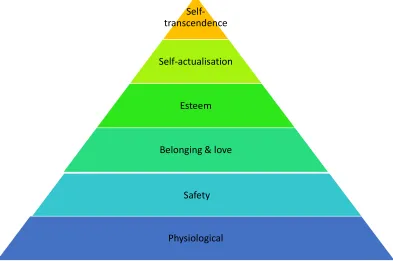
Human needs also define the action situation. Donahue et al. (2012) propose the use of Maslow’s hierarchy of needs (Maslow, 1943; Koltko-Rivera, 2006) in disaster management (Figure 3). This is a logical extension of the all-hazards approach, where rather than addressing individual situations, a broad set of needs suitable for application across multiple situations is identified (Donahue et al., 2012). Maslow’s list of needs contains multiple independent motivational systems that can re-order priorities based on internal and external cues (Kenrick et al., 2010), therefore Donahue et al. (2012) suggest using a taxonomy rather than a strict hierarchy. Motivation beyond self is also important, taking in not only self-actualisation and transcendence, but motivation for family and community in safety and belonging/love. It is important to view such values as not just addressing the individual, but also the needs of a person embedded within a social setting (Hobfoll, 2001).
FIGURE 3. MASLOW’S HIERARCHY OF NEEDS WITH AN ADDED LAYER OF SELF-TRANSCENDENCE (MASLOW, 1943; KOLTKO-RIVERA, 2006).
A disaster situation can potentially radically alter motivations and needs, as widely recognised in the literature (Donahue et al., 2012), potentially requiring some form of normalisation and recovery afterwards. A list of needs will therefore not remain static throughout the disaster cycle. In terms of recovery, governments have traditionally addressed physiological and safety needs, but the evidence for addressing a broader set of needs is mounting (Morrissey and Reser, 2007; Norris et al., 2008; Donahue et al., 2012).
Kenrick et al. (2010) describe a motivational system as including:
Self-transcendence
Self-actualisation
Esteem
Belonging & love
Safety
a) a template for recognizing a particular class of relevant environmental threats or opportunities,
b) inner motivational/physiological states designed to mobilize relevant resources, c) cognitive decision rules designed to analyze trade-offs inherent in various prepotent
responses, and
d) a set of responses designed to respond to threats or opportunities represented by the environmental inputs (i.e., to achieve adaptive goals).
These are congruent with the four types of variable listed above, showing the suitability of the IAD for addressing a spectrum of human values. Scaling these components up to the institutional scale allows individual and institutional goals with respect to an action situation to be contrasted. If personal decision rules and responses accord with institutional rules and response designed to manage risk, then they are in alignment; if not, then the reasons why need to be understood better to identify potential solutions. Considering needs and underpinning values as actors perceive them is an important part of addressing systemic risk. For example, if there is a large gap between perceived and calculated risk, this will often be driven by values and motivations different to those based on calculated risk and measures to manage it (Renn, 2011). Perceived risk, the values that inform it and observed behaviour can be contrasted with idealised values based on ‘rational choice’, the latter being based on an objective summation of risk and values at stake (Eiser et al., 2012). Rational choice is often based on idealised behaviour around price or calculated rates of risk and return, so it is important to determine what values actors are working to, especially their core values. Often rational choice is framed around what can be measured (tangible), overlooking what is treasured (intangible), whereas the sensible course is to represent both. Budzinski (2003) distinguishes between institutional and personal rules, arguing that they have important differences that have not been well explored.
Improved insight into these different relationships will inform action-based research. By making these insights available to decision makers, potential responses to that information can form a feedback loop that can inform further action. Action situations can therefore be informed by improved knowledge of internal and external variables, feeding back into how a situation is perceived and managed (Argyris and Schön, 1978).
EXTERNAL VARIABLES
External variables (Figure 2) include the combined biophysical system, existing community attributes (and their drivers) and rules in use described as follows:
• The biophysical system consistent of natural hazards and the social-ecological system exposed to those hazards. It incorporates the values at risk considered to be vulnerable. This is discussed in the section on the risk framework earlier in the paper.
• Community attributes include the actors involved and their institutional context.
• The rules in use are shared understandings amongst the actors that refer to what actions or states are permitted, required or prohibited, which may be explicit or implicit (Ostrom, 2011).
1. The methodologies, methods and toolkits that guide institutions in conducting assessments and managing natural hazard risk. These are being interpreted through risk ownership.
2. The formal and informal rules used by actors and institutions that influence what institutions recognise as significant values. These are to be analysed through how risk ownership is exercised and its level of coverage of natural hazard risk.
The first set can be considered as the formal set of rules in place to manage natural disasters. As has been well documented for Australia, these rules are generally effective for managing natural hazard response; however, the recent demand for large and sustained recovery funding, suggest significant shortcomings (Productivity Commission, 2014). The second set of rules provides the basis of further exploration and thus, the opportunity to address identified shortcomings.
INTERACTIONS
As described in the section on the risk framework, interactions are informed by the threat of natural hazard risks, externally-driven changes in the social-ecological system affecting exposure and the rules in use that influence the balance between disaster risk reduction and recovery. The first two elements are represented in the initial version of the economic geography.
The systemic nature of these interactions arises from the potential of hazard events to propagate through a social-ecological system, crossing domain boundaries as they do so. These are impacts whose effects cross geographical and/or institutional domains. After crossing a domain boundary, impacts may be absorbed by existing institutional capacity at that level or, if large enough, may require an ongoing response. An example is where a series of large floods overwhelm local capacity, requiring intervention in the form of flood relief and recovery at the state and sometimes federal scale. The repercussions can be quite long-term. A severe enough event will often precipitate an inquiry which, based on historical experience, will make a predictable set of recommendations that fail to address the root causes of disaster (Eburn and Dovers, 2015).
Impacts can propagate across geographic scales (e.g., one large event or multiple small events combining to affect a region or state, Figure 4), across sectors (e.g., from production to finance) and across institutions (e.g., from local government to state and federal governments); with the largest disasters affecting all types of domain. Regions in Figure 4 include catchment management authorities and similar organisations responsible for aspects of asset or hazard management in areas larger than local government areas. The crossing of a domain is almost invariability associated with the propagation of that risk across institutional boundaries, and with it, some responsibility for management. This forms the basis of changing risk ownership as outlined in Jones et al. (2013). Risk ownership can become quite complex because of shared responsibilities for specific assets or values, and because the different aspects of risk management are shared widely across different organisations.
enough. More efficient markets by themselves are not sufficient to manage such risks. Actions to build resilience in one place may also propagate risks across domains; when those risks outweigh the net benefits they qualify as maladaptation (Barnett and O'Neill, 2010; O’Brien et al., 2012). Rather than relying on the traditional options of building hard infrastructure that may amplify risks or increase the cost of failure (O’Brien et al., 2012), the examination of institutional goals and values can potentially open up the decision space for a range of other options. The analysis of risk ownership and how it changes under current institutional arrangements will provide a better idea of the strengths and weaknesses in current governance arrangements.
FIGURE 4. DOMAIN CROSSING OVER SPATIAL SCALES OF FIVE SELECTED NATURAL HAZARDS.
EVALUATION AND OUTCOME CRITERIA
Complex risks are difficult to set evaluation and outcome criteria for. Criteria based on degrees of vulnerability, or levels of risk severity are insufficient by themselves, but are an important step on the way to determining relevant institutional outcomes. The process of making the transition from values at risk to institutional outcomes will be carried out using risk ownership as a vehicle, as discussed in detail further on.
Risk ownership itself is complex, involving a variety of actors who often have different individual goals. For example, a broad framework of disaster risk reduction may aim to make society, the economy and the environment less vulnerable to natural hazards, but not all of the outcomes sought by individual actors will be consistent with this aim. Setting the initial context is very important. When developing a systems approach, a key task is to identify the existing criteria in place, the specific outcomes sought by individual actors
Local
Regional
State
and to identify the institutional settings these take place in (Young et al., 2015). This provides the baseline for further investigation.
Added difficulties in setting specific criteria arise because of internal system feedbacks, long-term timescales and uncertainty with cause and effect relationships (Jones et al., 2014). For example, both the uncertainty of extreme event statistics for extreme temperature, rainfall or flooding, and the evolving building and planning standards over time, can make it very difficult to separate out the influences of hazard and exposure on damages, as discussed earlier. This is particularly difficult to diagnose when data for historical, stationary baseline periods is unavailable.
In such cases, it may take decades to show with statistics whether strategic planning is reducing losses due to investments in resilience or risk mitigation. If both exposure and the hazard are non-stationary, untangling the effect of improved risk management on outcomes requires ongoing monitoring and review to ensure that interventions are effective. On the other hand, for vulnerable hot-spots, recent examples for flooding in Queensland show that mitigation has provided substantial short-term savings where it has been implemented and substantial losses where it hasn’t (Case Study 1). This shows that both specific and systemic solutions can yield benefits. This combination will be most effective where targeted programs commission individual projects within a broader institutional framework, as recommended by the recent Productivity Commission report (2014).
Ongoing evaluation needs to factor in both accountability and responsibility. The responsibility for undertaking specific risk management actions is allocated to those who physically carry them out; accountability is needed to ensure that these have been implemented correctly and that outcomes are as intended (Young et al., 2015). Process measures, such as having policies or resilience programs in place, are often used as proxies, but cannot in themselves guarantee that outcomes may be met without specific evidence to back them up (Jones et al., 2014). Evidence supporting the effectiveness of policy and programs is hard to obtain and verify, but can become part of an ongoing monitoring and review process (Young, 2014).
Case Study 1: Damage, preparedness and mitigation flooding examples for Queensland
Following serious flooding and loss of life in January 2011, an investment in Lockyer Valley of $18 million in 2011–2012 in a land swap for flood-prone housing saved an estimated $30 million in 2013 (AGD, 2014). A levee in Charleville built following floods in 2005, and costing $28 million returned a savings ratio of 3.8 from a flood in 2012 even though not completed (AGD, 2014). Suncorp was the only insurer who offered full flood coverage when the 2010–2011 floods affected much of Queensland. Suncorp paid out $150 million between 2010 and 2012 in Roma and Emerald on the basis of $4 million in premiums. In 2012, they declined to take any further customers from those towns, the CEO of personal insurance pointing out that helicopter rescues in Roma ($11 million) cost about the same as a levee (Fanning, 2012). In mid-2012, flood premiums in Roma were an average of $3,367 compared to $1,277 in the more protected Charleville (Fanning, 2012). A levee built in Roma in 2013 for $16 million is expected to reduce premiums by an estimated 60%. Under current exposure to flood risk, that investment has an estimated present value return of 4.9 over 50 years using a 7% discount rate (Urbis, 2014).
• levels of damage benchmarked against hazard magnitude,
• response and recovery costs remaining within projected allocation limits, • evidence of risk spreading, such as insurance payouts as a proportion of total loss,
• damages avoided via specific measures,
• avoided injury or loss of life or injury,
• specific levels of preparedness,
• evidence of post-event rapid recovery,
• policies providing clear lines of sight across risk ownership of core values,
• clearly allocated ownership for core values, and
• specific budget allocations and/or finance for intangible values at high risk. These criteria can potentially all contribute to disaster risk reduction. However, the past assessment of risk reduction benefits has usually been limited to hard infrastructure such as levees and sea walls because they are single-purpose and have readily available information on costs and benefits (Hallegatte, 2008). Estimating damages avoided by mitigation that utilises soft infrastructure that provides multiple benefits (e.g., green infrastructure, social resilience) is much more difficult. Because they lack adequate criteria and yield uncertain benefits, they take a back seat to more ‘rational’ but perhaps limited, methods.
To develop a comprehensive institutional approach, outcomes need to embrace the whole process of risk management, which includes such tasks as understanding the risk, building the evidence base for evaluating management options, formulating policy, developing plans, implementing action plans, and monitoring and review. If this is incomplete or contains unfamiliar roles and tasks, then the process seems daunting. However the goal would be to institutionalise such an approach and build familiarity over time. Closing the loop between outcomes and risk governance is very important. Mapping outcomes onto institutional performance ensures that risk management decisions are consistent with stated institutional aims, can be implemented as intended and adjusted if new information becomes available.
UPDATED FRAMEWORK
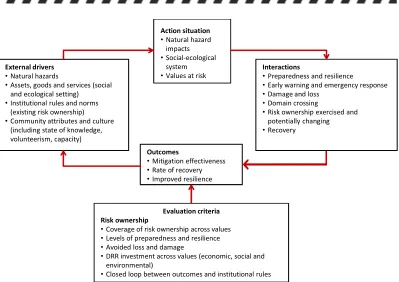
FIGURE 5. THE INSTITUTIONAL ANALYSIS AND DEVELOPMENT FRAMEWORK UPDATED FOR NATURAL HAZARD INTERACTIONS.
External drivers
•Natural hazards
•Assets, goods and services (social and ecological setting)
•Institutional rules and norms (existing risk ownership)
•Community attributes and culture
(including state of knowledge, volunteerism, capacity)
Action situation
•Natural hazard impacts
•Social-ecological system
•Values at risk
Interactions
•Preparedness and resilience
•Early warning and emergency response
•Damage and loss
•Domain crossing
•Risk ownership exercised and
potentially changing
•Recovery
Outcomes
•Mitigation effectiveness
•Rate of recovery
•Improved resilience
Evaluation criteria Risk ownership
•Coverage of risk ownership across values
•Levels of preparedness and resilience
•Avoided loss and damage
•DRR investment across values (economic, social and
environmental)
KEY FRAMEWORK ELEMENTS
Several aspects of the framework are outlined further in the following sections. They cover aspects of risk management, how values at risk are being considered and how institutional economics are being applied. Topics include assessing values at risk, risk ownership, risk propagation and institutional values.
ASSESSING VALUES AT RISK
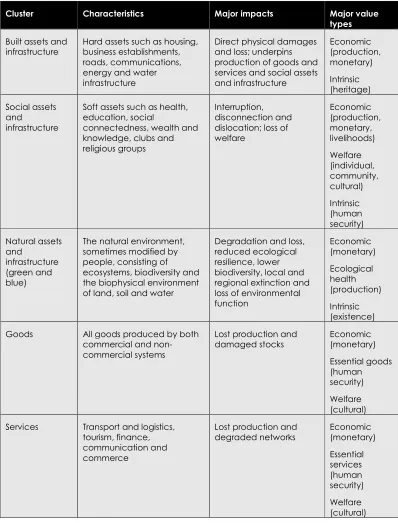
Values at risk from natural hazards are grouped into three clusters: asset-based stocks (built, social and natural assets and infrastructure) and two production-based flows (goods and services) (Jones et al., 2013). The five clusters are summarised with their major impacts and values in Table 1. These clusters are divided in such a way that they can be assessed with related economic methods. The asset-based stocks will populate many of the values at risk in the geography, whereas the flows will be used to assess vulnerability to hazards as the geography is developed. Many goods and services are produced from a combination of assets.
Here, the built and social value clusters are divided along hard (built) and soft (social) lines, respectively. This separation is along engineering rather than sociological or economic lines because buildings that are often classified as social assets, such as schools, hospitals and community centres, experience similar types of natural hazard damage to other buildings. This classification also matches data types better, which is important for constructing a geography.
The complex nature of risk ownership and of the risks themselves does not allow value clusters to be classified easily. For example, using measured vulnerability to hazards will see the hard and soft elements being dealt with separately, whereas dividing them according to ‘who pays?’ might separate public from private assets and interests. There is also great deal of cross-over between these clusters. Contributions to key production sectors, such as agriculture and tourism, come from all three asset groups. Local economies also depend on all three asset clusters. Many goods and services depend on both direct and indirect inputs. Publicly-owned built infrastructure contributes to individual and community welfare, as do natural assets and ecosystem services. Natural assets contribute to agriculture and tourism. Community welfare contributes to productivity and the economy.
Cluster Characteristics Major impacts Major value types
Built assets and infrastructure
Hard assets such as housing, business establishments, roads, communications, energy and water infrastructure
Direct physical damages and loss; underpins production of goods and services and social assets and infrastructure Economic (production, monetary) Intrinsic (heritage) Social assets and infrastructure
Soft assets such as health, education, social
connectedness, wealth and knowledge, clubs and religious groups
Interruption, disconnection and dislocation; loss of welfare Economic (production, monetary, livelihoods) Welfare (individual, community, cultural) Intrinsic (human security) Natural assets and infrastructure (green and blue)
The natural environment, sometimes modified by people, consisting of ecosystems, biodiversity and the biophysical environment of land, soil and water
Degradation and loss, reduced ecological resilience, lower biodiversity, local and regional extinction and loss of environmental function Economic (monetary) Ecological health (production) Intrinsic (existence)
Goods All goods produced by both commercial and non-commercial systems
Lost production and damaged stocks Economic (monetary) Essential goods (human security) Welfare (cultural)
Services Transport and logistics, tourism, finance, communication and commerce
Lost production and degraded networks Economic (monetary) Essential services (human security) Welfare (cultural)
TABLE 1. BROAD VALUE CLUSTERS USED FOR ASSESSING VALUES AT RISK FROM NATURAL HAZARDS.
Four important sets of characteristics relating to how goods, services and assets are utilised are:
• Consumptive/non-consumptive – good or service consumed by use/unaltered by use (synonyms: subtractible, rivalrous).
• Renewable/non-renewable – asset that can regenerate after consumptive use/cannot regenerate.
• Substitutability/non-substitutability – Asset, good or service that can/cannot be readily substituted by another.
Table 2 provides selected examples of excludable/non-excludable and consumptive/ non-consumptive goods and services. Appropriate risk management needs to account for the role of an asset and nature of use of goods and services thus produced. As implied by the final column in Table 1, a variety of economic methods can be used in assessing these five clusters and these need to account for the categories in Table 2.
Consumptive Non-consumptive
Excludable Most privately-owned goods
Combustion energy Harvested water
Water for power Private open spaces Housing
Business
Non-excludable
Wild foods, some marine resources
Fuel wood Rainfall
Air
Public space
Amenity landscape views Solar and wind energy
Public infrastructure services such as footpaths, roads, bicycle tracks
TABLE 2. EXAMPLES OF EXCLUDABLE/NON-EXCLUDABLE AND CONSUMPTIVE/NON-CONSUMPTIVE GOODS AND SERVICES. A FURTHER IMPORTANT CATEGORY IS RENEWABILITY.
Methods for assessing the economic impact of natural hazards on these value clusters can be divided into three major groups:
1. Market-dominated methods assess the dollar value of built assets and markets-based goods and services produced from those assets. These constitute the best understood methodology.
2. Welfare-based methods assess individual and community welfare. Direct health benefits and recreation can be given a dollar value but many aspects of welfare are calculated using indirect monetary methods. Ethically-based values, such as the sanctity of human life and human rights, are generally applied through institutional rules.
3. Ecological economic methods value natural assets and ecosystem goods and services, mainly using indirect monetary methods, ranking, scientific assessment (e.g., ecological health) and qualitative methods.
Not all impacts are associated with straightforward damage and loss. For example, loss of production comes at a direct cost to the economy, which may not be recovered. Rebuilding damaged assets can benefit some sectors, such as construction, and lift employment rates (Hartley et al., 2011). The net economic impacts of rebuilding existing assets and building new fit for purpose assets are opportunity and transaction costs that will be returned as avoided damages at a later date. Links between social assets and the economy may not be direct, but are notable if they degrade or become absent (e.g., through productivity loss due to a loss in human welfare). The direct cost to the economy through damage and loss to natural assets is extremely difficult to calculate. At the global scale, ecosystem collapse can lead to catastrophic economic impacts. At the national scale, long-term economic and social returns could be substantially reduced by a failure to invest in maintenance and ecological resilience.
reduction, especially when renewability and substitutability are factored in. These attributes can add or subtract value. Value is added especially for limited or non-renewable intangible resources, especially if they are non-substitutable.
Accordingly, given the different types of value clusters in Table 1 and goods and services in Table 2, setting out the core values for each of these clusters for the purpose of an economic geography requires different types of criteria to determine a comprehensive set of values at risk. Summarised, they cover:
1. Built assets and infrastructure: descriptors cover major sectors, networks and public/private. Production from business and industry covers major sectors in terms of income and employment.
2. Social assets and infrastructure: applying Maslow’s hierarchy of needs (Koltko-Rivera, 2006; Donahue et al., 2012) as a typology rather than a hierarchy, is consistent with the all needs approach advocated by Donahue et al. (2012). Needs are covered under the headings of physiological, safety and security, love and belonging, esteem, self-actualisation and self-transcendence.
3. Natural assets and infrastructure: covers land cover and land-use, land tenure, ecosystem health, conservation and management status.
We consider risk ownership to be an institutional capacity, one aspect of which designates roles and responsibilities for risk management. Natural hazard risk management is proposed as a common pool resource that will require specific forms of governance. Risk is managed within a variety of institutional structures (e.g., markets, public funding, public stewardship and volunteerism), so the task is to translate values at risk using risk ownership applied to various stages of the risk process, concentrating here on the strategic management aspects. This requires a transition from an economic geography of values at risk to an institutional geography of risk ownership. Aspects of this are discussed in the following sections.
RISK OWNERSHIP
Risk ownership designated at the institutional scale can be used to allocate a large part of the governance arrangements designed to address systemic risk. The concept of risk ownership in managing natural hazard risk was discussed in Jones et al. (2013) and is further developed here and in Young et al. (2015). A risk owner is defined by the international risk standard ISO 31000 as a “person or entity with the accountability and authority to manage a risk” (ISO, 2009). At the institutional scale, risk ownership describes sets of actors with common goals and responsibilities, such as home owners, local government, the insurance industry and so on.
Risk ownership is widely used within the corporate sector as an operational tool (Buehler et al., 2008; Gerken et al., 2010), and is increasingly being applied in the operational aspects of natural hazard risk management. The identification of risk owners is part of training being undertaken by the World Bank1 and UNISDR2. However, risk ownership is
1http://worldbank.mrooms.net/course/view.php?id=465
http://web.worldbank.org/WBSITE/EXTERNAL/WBI/WBIPROGRAMS/CMUDLP/0,,contentMDK:21713610~pagePK:64156158~piPK:
64152884~theSitePK:461754,00.html
rarely discussed in the research literature, especially in natural hazard research. Recent examples include: the identification of risk owners as part of natural hazard mapping (Noson, 2002); in assessing building ownership as part of post-earthquake urban development (Erten, 2004); in understanding infrastructure resilience to natural hazards (Hudson et al., 2012); and in applying coastal zone management (Kittinger and Ayers, 2010). In Australia, Hussey and Dovers (2015) are applying the concept of risk ownership to critical infrastructure management using a similar set of questions to those articulated in Jones et al. (2013).
Risk ownership identifies two main roles via:
1. Ownership of the resource (asset, good or service) at risk, and 2. The delegated risk manager.
The first role originates within economics and the second is part of the risk management process. Risk management can be divided further into responsibility for carrying out a management process or action, and accountability for ensuring that it has been carried out (Young et al., 2015).
The original concept of risk ownership traces back to the economist Robertson (1923), who stated “where the risk lies, there the control lies also”. The term risk ownership was coined by Hewett (1939) from this statement and was understood to be a necessary part of economic institutions in a capitalist economy. Robertson (1923) argued that ownership needed to consider the potential for catastrophic loss in addition to profit. He made two points: “the power of making decisions is most wisely exercised in the hands of those who stand to lose most heavily if the decision turns out badly” and “the risks of industry will be most bravely shouldered if those who shoulder them are not obliged to hand over to others the power of making decisions about the resources which they put to hazard”. This addresses both roles listed above and places them squarely in the hands of those who control the resources at risk.
This role of risk ownership being exercised through the asset owner was emphasised by the Productivity Commission (2014) in their recent inquiry into natural disasters in Australia:
The natural disaster funding arrangements should allocate roles and responsibilities in ways that strengthen incentives for people and organisations to manage the natural disaster risks they face. A starting point is that asset owners, including households, businesses and governments, should be responsible for managing natural disaster risks to their assets. (Productivity Commission, 2014, p. 58)
Added points given in support of this stance are that the asset owner has legal authority, incentive to manage risk to prevent loss and fairness in the distribution of cost and benefit (Productivity Commission, 2014). While this is suitable as a starting point (as the Commission acknowledges), the systemic nature of natural disasters suggests the focus on asset ownership is necessary, but insufficient.
Unclear ownership will lead to risks being less well-managed. One goal of building the economic geography is to give intangible values greater visibility. This will help to better identify risk ownership and potential gaps in ownership. This lack of visibility is due to a number of reasons (Jones et al., 2013):
• Unclear, partial or disputed ownership of risks as they cross domains.
• Unclear and partial costs associated with current risk exposure.
• Un-owned risks are undervalued, therefore are considered psychologically remote.
• When the commons are valued, they become everyone’s care and no-ones responsibility.
• Severe risks tend to be discounted by individuals.
• There is a lack of clarity as to what the values at stake are worth, who is affected if they are damaged, and what the potential costs will be if they are left unmanaged.
The risk management role of risk ownership concerns the accountability and authority to deal with the strategic planning and management of natural hazard risks (Young et al., 2015). Strategic management has been divided into two parts: the first precedes an event and includes building resilience and mitigation actions; the second part occurs after the event and includes recovery and further investment in resilience and mitigation using the experience gained during the event and from subsequent review (Young et al., 2015).
Case Study 2: The 2011 Grampians Landslides (Ollerenshaw et al., 2014)
Over 12–14 January 2011, 282 mm of rainfall measured at Hall’s Gap fell on the Grampians, the heaviest 72-hour event within a 135-year record. Assuming stationary data, two 1:100 year events occurred over three days and the 3-day event is estimated to have been a 1:500 event (Ollerenshaw et al., 2014). This event occurred at the tail-end of a combined La Niña–Indian Ocean Dipole event, which historically is associated with moderate to severe flooding in north and western Victoria (Wilby and Jones, 2011). This downpour resulted in severe flash-flooding and many landslides, 192 of which have been mapped. The landslides cut three arterial roads, damaged many more roads and walking tracks, and 11 vehicle and 21 pedestrian bridges (Ollerenshaw et al., 2014). The Grampians National Park was almost totally closed, halting local tourism, a major local industry. Relief and recovery was estimated to cost $140 million, while estimated tourism losses of $25.5 to $30.5 million affected the broader Grampians area.
Response and recovery (summarised from Ollerenshaw et al. 2014):
• Impacts on individuals were short-term, but businesses were negatively to very negatively impacted, although responses two years later suggests a high degree of resilience.
• An estimated $140 million spent on rebuilding road, path and bridge infrastructure translated into modelled flow-on economic benefits of $340 million, ten times tourism losses, but the beneficiaries were largely a different cohort to those experiencing tourism losses.
• Significant impacts on local water supply have not been assessed for their economic effects, nor have environmental damages to areas affected by landslides, but monitoring is ongoing. Lake Bellfield, having been affected by fires in 2006 and floods/landslides in 2011, is still unfit for drinking.
• There was some personal stress and loss, but there was no injury or death for which people were thankful.
Ownership issues
• There was no dedicated state agency for landslides meaning that responsibility for landslide management needed to be adopted in hindsight.
• Australian Government-State Natural Disaster Relief and Recovery Arrangements (NDRRA) funding was utilised. This means that the disaster event crossed domains from local to state to federal government, even though the locus for recovery remained in local and state control.
• There was no local memory of landslides, so they were completely unexpected.
• Local government and authorities put in place response and recovery plans afterwards to co-ordinate responsibilities, manage staffing issues and co-ordinate information, thus took on ownership for future events.
• Recovery was not fully integrated into the local need to encourage visitors into safe and reclaimed areas. There was continuing lack of connection between tourism, parks and operators during recovery, but response was judged to be better coordinated. Visitor numbers recovered in the second year.
• Significant local ownership was exercised through people who went “above and beyond” their designated roles during response and recovery.
• After experiencing three disasters (fires 2006 and 2009, floods/landslides 2010–2011) local government, Parks Victoria, VicRoads and GWM Water all improved infrastructure in the recovery process to mitigate future damage.
• The role of story-telling and celebration were recognised as important for closure and reinforcing community resilience.