Copyright to IJIRSET www.ijirset.com 9664
Characterization of Essential Nutrients and
Heavy Metals during Municipal Solid Waste
Composting
Manohara B. 1, Belagali S.L.2Research Scholar, DOS in Environmental Science, University of Mysore, Mysore, Karnataka, India1
Professor, DOS in Environmental Science, University of Mysore, Mysore, Karnataka India2
Abstract: In this paper the composting process was studied for Municipal Solid Wastes in order to characterize the essential plant nutrients and heavy metals during the degradation process. The process was studied in pre-monsoon, monsoon and post-monsoon seasons and samples were collected during 10th to 60th days of composting process. Primary macronutrients like nitrogen, phosphorus, potassium, secondary macronutrients calcium, magnesium and micronutrients/trace minerals like chlorine, manganese, iron, zinc, copper, molybdenum, nickel were analyzed. Heavy metals like lead, cadmium, chromium, were analyzed by atomic absorption spectrophotometer. From the study, the concentrations of essential plant nutrients were found to be under the limits of Ohai- EPA standards and Canadian Council of Ministers of the Environment (CCME) standards. Heavy metals were also found in trace quantities and humification process caused decrease in heavy metal concentration. From the present study, it was observed that composting process was faster during monsoon season and compost produced was better source of plant nutrients.
Keywords: Solid waste, Essential nutrients, Heavy metals, Composting, Ohai- EPA and CCME standards.
I. INTRODUCTION
Management of solid wastes is one of the critical issues for the urban areas of developed and developing countries, since rapid growth of population in urban area is taking place due to migration of rural population in search of better livelihood. Advancement of civilization enhanced the usage of consumer products and manufacturing processes. Usage of vast range of products leads to generation of large quantity of wastes in cities. The lack of proper management of solid wastes leads to air and water pollution which leads to health and environmental impacts. The overall goal of urban solid wastes management is to collect, treat and dispose off solid wastes generated by urban population in an environmentally and socially satisfactory manner using the most economical available means.
Municipal solid waste, commonly known as trash or garbage, refuse or rubbish is a waste consisting of everyday items that are discarded by the public. It is classified into Domestic wastes, Commercial wastes, Institutional wastes and Municipal wastes depending upon the sources. Waste Processing/treatment is chief stage of solid waste management. Several traditional and modern methods are adopted for the treatment depending upon the type of wastes collected. Composting is one of the traditional and common methods of processing of Municipal solid wastes in most of the countries. It is the process of converting the active organic portion in the solid waste into a stabilized product, which can be used as a nutrient source for plant growth and/or conditioner to improve soil physical character (Wong et al.2005). But the stability of final product is more important since chemically unstable compost is phytotoxic due to the production of ammonia, ethylene oxide and organic acids (Khan et al. 2008).
Copyright to IJIRSET www.ijirset.com 9665 (lime/sulfur addition). Compost not only provides some nutrition, but often makes current fertilizer programs more effective. Hence the fate of essential nutrient metals and the heavy metals during composting is very important in order to characterize the quality of compost produced. Deficiency of nutrients like nitrogen, potassium, phosphorous or presence of excess toxic metals will affect the quality of the compost. Plants require seventeen essential elements for growth. If any one of these elements is missing, a plant will not grow, even if all the other elements are present in their required concentrations.
The elements which plants require in relatively large amounts are called macronutrients. The primary macronutrients are nitrogen, phosphorus, and potassium. Nitrogen promotes are green leaves and foliage growth. Phosphorous stimulates healthy root growth and helps in the formation of flowers, seeds, and fruits. Potassium is required for proper development of flowers and fruit, ensuring good size, colour and quantity. The secondary macronutrients are calcium, magnesium, and sulfur. Calcium is essential part of cell wall structure, must be present for formation of new cells. Magnesium is essential for photosynthesis. Sulfur is responsible for characteristic odours of plants such as garlic and onion (Master Gardener Association of San Diego Country).
Essential elements which plants need in relatively small amounts are called micronutrients, like Boron, Chlorine, Copper, Iron, Manganese, Molybdenum, Zinc, and Nickel. Composting organic matter such as grass clippings and tree leaves is an excellent way to provide micronutrients.
Bernai et al (1998) were studied maturity and stability parameters of composts prepared with a wide range of organic wastes and concluded that, these parameters for mature compost depended on the wastes from which the composts were made. Number of studies also has been done for the organic matter evalution during the different types of composting processes, through the chemical and spectroscopic methods, i.e., Castaldi et al (2005), Farid Barjea et al (2012), Huang et al, etc. Elango et al (2009) states that the final compost material from the thermophilic reactor provides good humus to build up soil characteristics and some basic plant nutrients. Kanmani et al (2013) investigated the heavy metal contamination in soil due to leachate migration from an open dumping site.
Study area: The study area chosen is Mysore city which is one of the major cities in Karnataka State (India). Mysore is spread over an area of about 128 sq. km with the growing population (0.76 millions in 2001 to 0.92 millions in 2011) at faster rate due to influx of many industrial activities. The city is situated in south of Karnataka state at a latitude of 12° 18´ N and longitude 76° 39´ E. The average annual rainfall of the district is 782 mm. The temperature ranges from 11°C to 38°C.The town is having a municipal area of 128.42 sq. km with 1, 74,956 households. In Mysore City, for all the 65 wards, door to door garbage collection is in progress. 60 wards are handled by outsourced labors and 5 wards are by federation of Mysore City wards parliament. 72 autotippers, 396 pushcarts are deployed for the waste collection. Chicken and mutton market wastes are collected separately. In addition to this, 168 numbers of 2 compartments auto tippers are procured under JnNURM to collect the dry and wet wastes from households.
II. MATERIALS AND METHODS
Composting of municipal solid wastes:
Copyright to IJIRSET www.ijirset.com 9666
Physico-chemical characteristics & heavy metals:
The quality of the compost will be characterized by characteristics like temperature, pH, electrical conductivity, alkalinity, etc., along with elemental analysis. Samples were collected at 10 days intervals, randomly in 5 different places of the pile, at 1ft depth. Collected samples were mixed together and dried by exposing to sunlight followed by hot air oven at 105º C. Dried samples were crushed well and sieved through 0.2 mm mesh. The powdered samples were then used for further physico-chemical and spectral characterization
Temperature (°C) was noted during the collection of compost samples at each 10 days interval. Moisture content (%) was estimated by gravimetric method. pH and Electric conductivity were measured for the 1:5 compost:water suspensions. Organic carbon (%) and Organic matter (%) were estimated using Walkey and Black method. Water holding capacity (%) was measured using filtration method. Phosphorus (ppm) was determined through Vanadomolybdate method. Carbonates, bicarbonates and alkalinity (mg CaCO3/L) were estimated by titration of compost: water (1:5) extract with standard H2SO4 solution using Methyl orange and Phenolphthalein as indicators. Calcium and Magnesium were estimated by titration of compost: ammonium acetate (1:5) extract with standard EDTA solution using Eriochrome Black-T and Patton-Reeder’s indicators. Brucine method was used for the estimation of nitrate-nitrogen, sodium and potassium concentrations were determined using Flame photometer. Humification Index was estimated through UV-Visible spectrophotometry.
For estimation of heavy metals like lead, manganese, zinc, copper and iron etc, triacid (nitric acid: sulphuric acid: perchloric acid in 9:2:1 ratio) extract of the compost sample were used for Atomic Absorption Spectrophotometry.
III.RESULTS AND DISCUSSIONS
Physico-chemical characteristics:
Physico-chemical characteristics and essential nutrients estimation for samples collected from different stages of composting during the pre-monsoon, monsoon and post-monsoon seasons are listed in Tables 1, 2 and 3 respectively.
TABLEI
PHYSICO-CHEMICAL CHARACTERISTICS DURING DIFFERENT MATURITY STAGES OF COMPOSTING (PRE-MONSOON SEASON)
No. Sample days 10 20 30 40 50 60 Recommended
standards
1 Temp (oC) 54 60 68 62 56 53 NA
2 Moisture (%) 51 59 64 62 44 48 45-65%
3 pH 9.2 9.16 8.75 8.82 7.68 7.65 6.9-8.3
4 EC (dS/m) 8.8 8.6 6.4 5.6 5.8 5 2-6
5 OC (%) 19.87 16.95 16.36 15.19 13.83 12.27 >30 6 Organic matter (%) 34.26 29.22 28.20 26.19 23.84 21.16 35-45% 7 Alkalinity (mgCaCO3/L) 4.609 3.822 2.82 2.529 2.068 1.724 NA 8 Water holding capacity (%) 60 45.43 45.04 44.64 55.15 67.19 NA 9 Humification Index 8.35 8.43 8.62 8.88 8.94 9.08 NA 10 Available Nitrogen (g/Kg) 1.624 1.638 1.694 1.684 1.750 1.750 NA 11 P5+ (%) 1.35 1.65 1.7 1.85 1.35 1.3 0.4-1.1% 12 K+ (%) 0.57 0.51 0.45 0.33 0.29 0.27 0.6-1.7 13 Na+ (%) 0.48 0.32 0.22 0.17 0.16 0.13 NA 14 Ca2+ (%) 0.92 0.78 0.76 0.77 0.73 0.72 1.0-4.0% 15 Mg2+ (%) 0.5 0.39 0.29 0.37 0.2 0.21 0.2-0.4 %
NOTE:NA- NOT AVAILABLE
Copyright to IJIRSET www.ijirset.com 9667 at later stages of composting indicates the stablization of decomposed organic fraction into compost. After reaching certain temperature it remains constant even after additon of water, which indicates that compost had become stabilized. The pH of the compost was found to be basic in both pre-monsoon and post-monsoon seasons but acidic pH was observed in monsoon season. It is also observed that, pH was tending to neutral value towards the end of composting process indicating that the matured compost will have neutral pH and hence it will not affect the soil pH during its use. Electrical conductivity was higher for the samples collected during monsoon season, showing decreasing trend in all the three seasons which indicate that, the concentration of ions is reduced during the composting process. Percentage of organic carbon was due to liberation of carbon dioxide and methane as organic gases during the degradation of organic matter. Lowering of carbonates and bicarbonates and hence alkalinity is also observed during composting process. Water holding capacity was in the range of 40-60%, decreased trend at the beginning and then increased trend towards the later stages of composting process.
TABLE2
PHYSICO-CHEMICAL CHARACTERISTICS DURING DIFFERENT MATURITY STAGES OF COMPOSTING (MONSOON SEASON)
No. Sample days 10 20 30 40 50 60 Recommende
d standards
1 Temp (oC) 40 53 62 60 51 45 NA
2 Moisture (%) 68 55 62 57 47 53 45-65
3 pH 6.74 7.11 7.73 7.28 6.04 6.88 6.9-8.3
4 EC (dS/m) 14.3 15.2 14.6 15.6 11.3 11 2-6 5 OC (%) 21.62 10.13 16.95 15.19 15 13.64 >30 6 Organic matter (%) 37.27 17.46 29.22 26.19 25.86 23.51 35-45% 7 Alkalinity (mgCaCO3/L) 5.234 4.652 3.140 4.419 2.559 3.373 NA 8 Water holding capacity (%) 54.49 39.08 42.01 43.92 42.84 45.89 NA 9 Humification Index 9.36 9.63 9.73 9.92 9.99 9.72 NA 10 Available Nitrogen (g/kg) 0.711 0.778 0.736 0.814 0.829 0.832 NA 11 P5+ (%)
3.9 4.1 3.8 3.7 3.7 3.4 0.4-1.1% 12 K+ (%) 0.81 0.85 0.77 0.93 0.59 0.57 0.6-1.7 % 13 Na+ (%) 1.3 0.78 1.22 1.05 1.26 0.97 NA 14 Ca2+ 0.99 0.91 1.2 0.83 1.4 0.48 1.0-4.0% 15 Mg2+
0.409 0.219 0.398 0.560 0.323 0.523 0.2-0.4
Essential nutrients:
The primary macronutrients available are nitrogen, phosphorus; potassium and micro-nutrients like calcium, magnesium, sodium present in the composting samples at pre-monsoon, monsoon and post-monsoon seasons are also listed in Tables 1, 2 and 3 respectively.
In macronutrients, available nitrogen was found in lesser concentrations (0.2-0.7g/kg) during post-monsoon season and it was higher during pre-monsoon season. Organic carbon concentration was high (10-21 %) during monsoon season. Hence, the carbon to nitrogen ratio was higher during the monsoon season. Percentages of organic carbon and available nitrogen decreased dramatically during the composting process. According to US Environmental Protection Agency, composting may result in i) CH4 emissions from anaerobic decomposition; (ii) long-term carbon storage in the form of
undecomposed carbon compounds and (iii) nonbiogenic CO2 emissions from collection and transportation of the
organic materials to the central composting site and from mechanical turning of the compost pile. Under anaerobic conditions there is large amount of ammonia that is produced from ammonification of organic compounds which cannot be oxidized by nitrification processes to form nitrates. Therefore, to conserve nitrogen in composts, it is crucial to maintain aerobic conditions. Apart from ammonia, nitrogen in compost is also lost as nitrogen gas (N2) and Nitrous
oxides (NO and N2O).
Copyright to IJIRSET www.ijirset.com 9668 the transformation of organic phosphorus into mineral forms and also to keep the magnitude of fixation of released phosphorus into insoluble inorganic forms at low concentration, thus increasing the availability of phosphorus in these compounds (Chattopadhyay et al. 1988). The sodium and potassium concentrations were fluctuating for the samples analyzed for composting process, whereas the concentrations on 60th day was lower than that of 10th day. This is due to run-off and leaching of the metal ions with the water content present in the solid waste during the process.
TABLE3
PHYSICO-CHEMICAL CHARACTERISTICS DURING DIFFERENT MATURITY STAGES OF COMPOSTING (POST-MONSOON SEASON)
On 60th day of composting process, calcium and magnesium concentrations were higher during post monsoon season (1.804 & 0.679 %) but calcium concentration was lower (0.48 %) during monsoon season, whereas magnesium was lower (0.21 %) during pre-monsoon season. Calcium is one of the most important nutrients required by the organisms and can also aid in maintaining the structure of plant cells and soil condition. Magnesium has an important role in photosynthesis, because, it forms the central atom of chlorophyll. From the results, it is observed that percentage of calcium and magnesium concentrations were below the permissible limits of Ohai EPA standards.
No. Sample days 10 20 30 40 50 60 Recommended
standards
1 Temp (oC) 40 61 66 43 37 33 NA
2 Moisture (%) 57 65 54 63 55 48 45-65
3 pH 7.47 7.80 7.92 7.80 7.72 7.67 6.9-8.3
4 EC (dS/m) 8.3 8.2 6.7 5.0 3.0 3.1 2-6
5 OC (%) 12.86 17.14 10.52 9.944 9.93 8.76 >30 6 Organic matter (%) 22.17 29.55 18.14 17.14 17.12 15.10 35-45% 7 Alkalinity (mgCaCO3/L) 0.951 1.664 1.426 0.57 0.57 0.429 NA 8 Water holding capacity (%) 55.63 55.99 46.60 51.31 54.23 56.49 NA 9 Humification Index 8.02 8.24 8.35 8.41 8.44 8.78 NA 10 Available N (g/kg) 0.683 0.735 0.554 0.427 0.396 0.272 NA 11 P5+ (%) 1.05 1.03 1.03 1.0 0.9 0.9 0.4-1.1% 12 K+ (%)
1.28 1.83 1.30 0.81 0.59 0.58 0.6-1.7 % 13 Na+ (%)
0.65 0.73 0.67 0.29 0.15 0.13 NA 14 Ca2+ (%) 1.56 1.445 1.387 1.610 1.455 1.804 1.0-4.0% 15 Mg2+ (%)
Copyright to IJIRSET www.ijirset.com 9669 Fig. 1 represents the seasonal variations in essential plant nutrients during 60 days old composting samples. The seasonal variation pattern for different plant nutrients was different in composting samples. Except calcium and available nitrogen, all other nutrient concentrations were found to be maximum during monsoon season. This may be due to presence of higher amounts of organic wastes and faster decomposition of organic matter. Since the moisture content was higher during the monsoon season, the decomposition of organic matter by microbial activity got increased.
Heavy metals analysis:
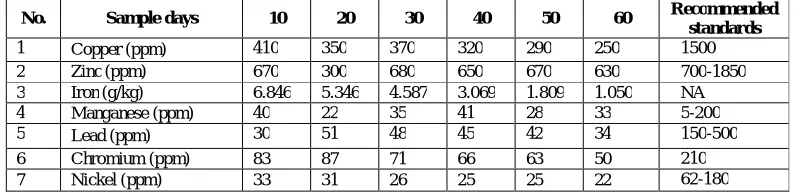
Heavy metals uptake by plants from the soil and successive accumulation in human tissues and biomagnifications through the food chain causes both human health and environment concerns. The heavy metal concentrations at different maturity stages of composting process during pre-monsoon, monsoon and post-monsoon seasons are listed in Table 4, 5 and 6 respectively.
TABLE4
THE HEAVY METAL CONCENTRATIONS DURING DIFFERENT MATURITY STAGES OF COMPOSTING PROCESS (PRE-MONSOON SEASON)
No. Sample days 10 20 30 40 50 60 Recommended
standards 1 Copper (ppm) 410 350 370 320 290 250 1500 2 Zinc(ppm) 670 300 680 650 670 630 700-1850 3 Iron(g/kg) 6.846 5.346 4.587 3.069 1.809 1.050 NA 4 Manganese (ppm) 40 22 35 41 28 33 5-200
5 Lead (ppm) 30 51 48 45 42 34 150-500
6 Chromium (ppm) 83 87 71 66 63 50 210
7 Nickel (ppm) 33 31 26 25 25 22 62-180
From the obtained data, for composting samples, from the municipal solid waste composting site, Mysore, heavy metal concentrations were under permissible limits. Reduction of heavy metal concentrations resulted at the later stages of composting. Based on the average concentration, the heavy metal concentrations in the composting samples were found in the following order: Iron > Copper > Zinc > Manganese > Chromium > Nickel > Lead.
TABLE5
THE HEAVY METAL CONCENTRATIONS DURING DIFFERENT MATURITY STAGES OF COMPOSTING PROCESS (MONSOON SEASON)
No. Sample days 10 20 30 40 50 60 Recommended
standards 1 Copper (ppm) 270 330 370 124 700 700 1500 2 Zinc(ppm) 410 470 480 550 540 510 700-1850 3 Iron(g/kg) 5.819 1.893 5.412 4.532 4.087 3.592 NA 4 Manganese (ppm) 38.1 40 37.3 40 29.4 27.4 5-200 5 Lead (ppm) 1.0 1.8 6.5 14.0 12.9 9.8 150-500 6 Chromium (ppm) 42 43 37 34 30 29 210 7 Nickel (ppm) 20 18 17 17 16 11 62-180
Copyright to IJIRSET www.ijirset.com 9670
TABLE6
THE HEAVY METAL CONCENTRATIONS DURING DIFFERENT MATURITY STAGES OF COMPOSTING PROCESS (POST-MONSOON SEASON)
No. Sample days 10 20 30 40 50 60 Recommended
standards 1 Copper (ppm) 203 204 216 186 170 170 1500
2 Zinc(ppm) 197 198 205 90 187 175 700-1850 3 Iron(g/kg) 4.81 5.17 5.19 8.48 7.95 6.92 NA 4 Manganese (ppm) 24.4 25.4 23.8 25.0 23.0 23.0 5-200
5 Lead (ppm) 51 35 40 50 23 21 150-500
6 Chromium (ppm) 78 67 65 79 73 69 210 7 Nickel (ppm) 29 27 28 29 28 23 62-180
The seasonal variations of some trace elements present in 60th day composting sample are shown in Fig.2. Iron content was higher in post-monsoon season and least in pre-monsoon season. Lead, chromium and nickel were lower in monsoon season. Manganese, lead and nickel concentrations were high during pre-monsoon, whereas iron and manganese concentrations were high during post monsoon season.
IV.CONCLUSION
Compost quality is difficult to assess from a single character, thus more characteristics should be taken into account for the said purpose. The compost prepared from the municipal solid wastes is a good source of nutrients for plants. From the present study, it is observed that, essential plant nutrients and heavy metal concentrations were found under the permissible limits of Ohai EPA standards and Canadian Council of Ministers of the Environment (CCME) standards. The total concentrations of trace elements like chromium, zinc, copper, lead, manganese and nickel were very low rendering final compost acceptable for agricultural use.
The composting samples of monsoon season were rich in essential plant nutrients, contain lesser amount of heavy metals and hence it can be considered as good fertilizer. Excess of heavy metals in compost enhances the toxicity of soil. Since, nutrient and heavy metal concentrations in Municipal solid wastes were below the permissible limits, it is advisable to limit severe loss of nutrients during processing of municipal solid waste into compost.
ACKNOWLEDGMENT
Copyright to IJIRSET www.ijirset.com 9671
REFERENCES
[1] Barker, A.V., “Composition and uses of compost, agricultural uses of by- products and wastes”, ASC Symposium series. American Chemical Society, vol. 668 (10), pp.140-162, 1997.
[2] Bernai, M.P., Paredes, C., Sánchez-Monedero, M.A., and Cegarra, J., “Maturity and stability parameters of composts prepared with a wide range of organic wastes”,Bioresource Technology, vol. 63(1), pp.91-99, 1998.
[3] Boni M.R. and Musmeci, L., “Organic fraction of municipal solid waste (OFMSW): extent of biodegradation”,Waste management and research, vol. 16 (2), pp.103-107, 1998,
[4] Brinton, W.F., “Interpretation of Waste and Compost Tests”, Journal of the Woods End Research Laboratory, vol. 1(4), pp.1-6, 2003. [5] Castaldi P, Alberti G, Merella R, Melis P, “Study of the organic matter evolution during municipal solid waste composting aimed at
identifying suitable parameters for the evaluation of compost maturity”, International Workshop « Hydro-Physico-Mechanics of Landfills” LIRIGM, Grenoble 1 University, France, vol. 25(2), pp.209, 2005.
[6] Chen, T.Q., Huang, D., Gao, Z., Huang, Y., Zheng, and Li, Y., “Temperature dynamic during the sewage sludge composting process”, Acta Ecol. Sin , vol. 22(1), pp. 736-741,2002.
[7] Dirk Bruns-Nagel, Heike Knicker, Oliver Drzyzga, Ulf Bu ̈ Tehorn, Klaus Steinbach, Diethard Gemsa and Eberhard Von Low, “Characterization of 15N-TNT Residues After an Anaerobic/Aerobic Treatment of Soil/Molasses Mixtures by Solid-State 15N NMR Spectroscopy. 2. Systematic Investigation of Whole Soil and Different Humic Fractions”, Environmental Science & Technology, vol. 34, pp.18, 2000.
[8] Elango, D., Thinakaran, N., Panneerselvam, P., and Sivanesan, S., “Thermophilic composting of municipal solid waste”, Applied Energy, vol. 86(5), pp. 663-668, 2009.
[9] Farid Barjea, Loubna. El Felsa, Houda. El Hajjoujia, Soumia. Amirb, Peter Wintertonc, Mohamed Hafidia: “Molecular behaviour of humic acid-like substances during co-composting of olive mill waste and the organic part of municipal solid waste”, International Biodeterioration & Biodegradation, vol. 74, pp. 17, 2012.
[10] Fares, F., Albalkhi, A., Dec. J., Bruns, M.A., and Bollag, J.M., “Physico-chemical characteristics of animal and municipal wastes decomposed in arid soils”, Journal of Environmental Quality, vol. 34, pp. 1392-1403, 2005.
[11] Giovanni Gigliotti, Klaus Kaiser, Georg Guggenberger, Ludwig Haumaie: “Differences in the chemical composition of dissolved organic matter from waste material of different sources”, Biology and Fertility of Soils, vol. 36, pp. 321, 2002.
[12] Gray K.R., Sherman K., and Biddlestone A.J., “A review of composting. Part 1 Microbiology and bio-chemistry”, Process Biochemistry, vol. 6(6), pp. 32-36, 1971.
[13] Hingston, J.A., Collins C.D., Murphy, R.J., and Lester, J.N., “Leaching of chromate copper, arsenate wood preservatives, a review”, Environmental Pollution, vol. 111 (1), pp.53-66, 2001.
[14] Huang G.F., Wu Q.T., Wong J.W.C., Nagar B.B.: “Transformation of organic matter during co-composting of pig manure with sawdust”, Bioresource Technology, vol. 97, pp.1834, 2006.
[15] Hogarh J.N., Fobil J.N., Ofosu-Budu G.K., Carboo D., Ankrah N.A., Nyarko A.: “Assessment of Heavy Metal Contamination and Macro-Nutrient content of Composts for Environmental Pollution Control in Ghana”, Global Journal of Environmental Research, vol. 2(3), pp.133, 2008.
[16] Jackson, M.L., (1973), “Soil chemical analysis”, Prentice Hall of India, New Delhi publication.
[17] Janakiram T, Sridevi K: Conversion of waste into wealth: A study in solid waste management”, Advances in Management, vol. 7(4), pp.1340, 2010.
[18] Jayarama Reddy P: “Municipal solid waste management: Processing - Energy Recovery - Global Examples”, vol. 1, pp.27, 2011.
[19] Jiwan Singh, Ajay S. Kalamdhad: “Reduction of Heavy Metals during Composting- A Review”, International Journal of Environmental Protection (IJEP), vol. 2(9), pp.36-43, 2012.
[20] Jenn-Hung Hsu, Shang-Lien Lo: “Chemical and spectroscopic analysis of organic matter transformations during composting of pig manure”, Environmental Pollution, vol.104, pp.189, 1999.
[21] Kanmani S., Gandhimathi R., “Assessment of heavy metal contamination in soil due to leachate migration from an open dumping site”, Applied Water Science, vol. 3, pp. 193–205, 2013.
[22] Lucimar Lopes Fialhoa, Wilson Tadeu Lopes da Silvaa, Débora MBP Miloria, Marcelo Luiz Simõesa, Ladislau Martin-Neto: “Characterization of organic matter from composting of different residues by physico-chemical and spectroscopic methods”, Bioresource Technology, vol. 101(6), pp.1927, 2010,
[23] Mahdi Ahmed, Azni Idris, Syed Omar S.R.: “Physicochemical characterization of compost of the industrial tannery sludge”, Journal of Engineering Science and Technology, vol. 2(1), pp.81, 2007.
[24] Mani A.K., Santhi R., and Sellamuthu K.M., “A handbook of laboratory analysis”, 1st edition, A.E. Publications No.10. Sundaram, P.N. Pudur, Coimbatore, vol. 8(2), pp. 156-167, 2007.
[25] Marugg, C., Gerbus, M., Hansen, R.C., Keener, H.M., and Hoitink, H.A.J., A kinetic model of the yard waste composting process”, Compost Science Utilization, vol. 10, pp 38-51, 1993.
[26] Mondini, C., Dell’Abate M.T., Leita, L., and Beneditti, A., “An integrated chemical, thermal and microbiological approach to compost stability evaluation, Journal of Environmental Quality, vol. 32, pp. 2379-2386, 2003.
[27] Mohammad Ashik Iqbal Khan, Kihachi Ucno, Sakae Horimoto, Fuminori Komai, Kinji Tanaka, Yoshitaka Ono: “Physico-chemical, including spectroscopic and biological analyses during composting of green tea waste and rice bran”, Biol Fertil Soils, vol. 45, pp.305-33, 2009. [28] Ranalli, G., Botturea, G., Taddei, P., Garavni, M., Marchetti, R., and Sorlini, G., “Composting of solid and sludge residues from agricultural
and food industries, Bio-indicators monitoring and compost maturing”, Journal of Environmental Science and Health, vol. 36 (4), pp. 415–436, 2001.
Copyright to IJIRSET www.ijirset.com 9672
[30] Sharma A.K., Gupta D.P.: “Physico-chemical characteristics of municipal solid waste of Bhopal city”. Enviromedia, vol. 25(4), pp. 871, 2006. [31] Slomczynska B, Slomczynski T: “Physico-chemical and toxicological characteristics of leachates from MSW Landfills, Polish Journal of
Environmental Studies, vol. 13(6), pp. 627, 2004.