Article
1
The influence of composite laminate stacking
2
sequence on failure load of bonding joints using
3
experimental and artificial neural networks methods
4
Bahadir BIRECIKLI 1,*, Omer Ali KARAMAN 1, Selahattin Baris CELEBI 1, Aydin TURGUT2
5
1 Vocational High School, Batman University, 72060 Batman, TR 1; [email protected];
6
[email protected]; [email protected]
7
2 Department of Mechanical Engineering, Bingol University, 12000 Bingol, TR 2; [email protected]
8
* Correspondence: [email protected]; Tel.: (00905555150444)
9
10
Abstract: The objective of this article was to forecast the ultimate failure load laminate stacking
11
sequence combination on bonding joints which are exposed to tensile strength by using artificial
12
neural networks. We have glass fiber composite materials with three different sequence
13
combinations ([0°/90°], [±45°], [0°/90°/±45°]). Various adherend thicknesses and also ductile type
14
adhesive was used in the experiment. The bonding geometry is a single lap and has four types of
15
overlap angles 30°, 45°, 60°, 75° respectively. The experimental results demonstrate that composite
16
laminate stacking sequence profoundly affects the bonding joints of failure load. Taking
17
experimental results into account, Levenberg–Marquardt learning algorithm model was used by
18
preferring a three layer forward on ANN so as to discipline network. In order to procure a precise
19
ANN tool, an integrate methodology of experimental method has been used. The outcomes are
20
used to ensure the experimental data’s to the ANN. The method of ANN permits surveying much
21
adequately the probabilities of composite laminate stacking sequence combination using the
22
prevalent ones which are [0°/90°], [±45°] and [0°/90°/±45°]. Testing data and training results were
23
quite well 0.998, 0.997 and 0.998 in turn. Consequences acquired can be used by engineers who are
24
interested in the composite material design to enhance failure load.
25
Keywords: experimental tests; composite laminates; tensile strength; artificial neural networks
26
27
1. Introduction
28
Usage of adhesively bonded lap joints with composite materials used in aviation, aerospace and
29
automotive industry is on the rise day by day [1]. Different bonded geometry for adhesive joints
30
have been used by most of researchers. Accordingly the strength of joint performance by varying the
31
input parameters is of vital importance [2]. Bonded geometry, adhesive area and sample thickness
32
have shown remarkable influence on this improvement for joint strength. By designing extreme
33
interface geometry which is overlap angle has contributed to cut down on stress concentrations [2].
34
Processes of artificial neural networks (ANNs) arouse curiosity for anticipating brings about
35
profound develop for concerning about research areas lately [3]. As a popular technique, the ANNs
36
are broadly used by many researchers as an alternative method to get over some troubles in
37
experimental studies.
38
L. Filippis and et al. [4] a model was improved for optimization of the Friction Stir Welding
39
(FSW) process. This process, via FSW method, shows the correlation both input variable of process
40
and mechanical properties of welded aluminum plates. Joint quality was estimated tensile tests.
41
Artificial Neural Networks (ANNs) identified by various algorithm, ability to provide for great
42
reliability the FSW process for welding plates in Butt-Joint. S. Her and C. Huang [5] is experimental
43
tests were applied to verify the theoretical guess among the fiber sensor and test sample. Sample of
44
strain truly transmitted to fiber is based on adhesive length. The strain goes up from 56% to 82%
45
when the bonding distance rises from 5 cm to 12 cm. Theoretical and experimental data’s indicate
46
that harder the adhesive and greater the bonding distance. H. Majidi and et al. [6] steel/carbon fiber
47
reinforced polymer was investigated both theoretically and experimentally on double lap bonding
48
joints with various lengths expose to axial tensile load to find out failure. The novel method which is
49
called point stress is developed fast and reliable to estimate the failure loads of the specimens.
50
Ultimately, a great conformity obtains among both theoretical and experimental results depend on
51
the novel method. J. Hwang and et al. [7] the bonding strength of carbon fiber reinforced polymer
52
was used. The adhesion strength of mixed composite started to increase with the rises of surface
53
roughness. I. Konovalenko and et al. [8] proposed a method for fracto-graphic image, which is relied
54
on via artificial neural network. ANN considerably decreases the amount of parameters for accurate
55
results. The results are quite similar and ANN bring out properties correctly compare to other
56
methods. M. Rucka and et al. [9] the experimental test of single lap adhesive nine joints with various
57
faults were conceived. The outcomes indicated that 2-D weighted root mean square values enabled
58
for real faults in adhesive layer film and identified model of geometry. K. Luwei and et al. [10] sorted
59
out a fusion process in condition monitoring (CM) of rotation machines. Artificial neural network
60
(ANN) method is able to capability for automatic denotation of rotating machine errors. ANN
61
algorithm offered great results as well as shows potential for enhanced these machines. Tosun and
62
Çalık [11] figure out that failure load via ANN in single lap bonding joints exposed to axial tensile
63
load. They demonstrated that ANN has perfect prediction capability and convenient with
64
experimental data. Tiryaki and Aydın [12] designed an ANN pattern to predict compression
65
strength for heat treated woods. In ANN model, extensive experiments will not be required. They
66
showed that via ANN many satisfactory data’s could be acquired which would minimize cost and
67
time. Zghoul [13] utilized an ANN in single lap adhesive joints for rating dependent output of
68
adhesives in order to extend the method installed to model the output of adhesive structures.
69
Tiryaki et al. [14] examined the bonding strength of the beech, relied on the pressing time and
70
pressure. They brought a different approach via ANN for adhesion strength on wood then
71
accomplished the approach is a useful purpose for characterizing impacts of the quantity of pressing
72
time and pressure on bonding strength of the beech. Kovan and Sekercioglu [15] fostered a method
73
via ANN to predict fatigue life and shear force of bonded cylindrical joints. The outcome indicated
74
that related model was quite powerful and viable tool for fatigue life and shear force of bonded
75
joints. Apalak and Ekici [16] examined 3-D stresses in tension for bonding double cantilever joint.
76
Moreover, the impacts of joint dimensions were detected via ANN model also detected composite
77
gradient. The rules of layout were submitted for joint design. Balcıoğlu et al. [17] analyzed that via
78
ANN the effects of single-sided and double-sided of bonding angle, patch structure and patch type
79
for composite materials of bonded joints on failure load. Dominczuka and Kaczmarzewski [18]
80
analyzed that via ANN for the processing of experimental data’s associated to strength of bonding
81
joints. They contrasted the ability of ANN with the capacity of typical statistical analysis methods
82
like polynomial and linear regression. Tiryaki et al. [19] researched an ANN model which takes in
83
multiple linear regressions for heat treated wood material to estimate ideal bonding joint strength.
84
Guneyisi et al. [20] presented an ANN formulation relied on explicit formulation to estimate the
85
shear capacity of single lap adhesive joint mounted on reinforced concrete elements. Gunes et al. [21]
86
using the finite element analysis, performed a 3-D vibration analysis of bonding joint, helpfully
87
graded circular bonding joint. Using both genetic algorithms and ANN method, he investigated the
88
optimum parameters of bonding joints. Naderpour et al. [22] called for the compression stress of
89
FRP concrete in via ANN method. Kalhor et al. [23] studied the effects of FRP thickness and laminate
90
stacking order and estimated the response of FRP square pipes exposed to axial load. The ANN
91
model is also used to see the effect of velocity impact over composite plates. Malik et al. [24]
92
projected the energy absorbed in effects by via ANN model which was gotten data obtained by finite
93
element method. It should be noted that the former articles supply to the velocity impacts or static
94
exposed to the composite laminates. Nevertheless it has been determine that the estimation of
95
composites exposed to velocity impacts is rather low. D. Fernández et al. [25] ANN is used to
96
way for estimating the effect of laminates as exposed to low velocity impact load. Dilik and
98
Hiziroglu [26] carried out research about heat treated wood underneath bond strength. Wood
99
specimen indicates only 23.6 % decreases in shear forces when exposed to 120 °C temperature. Loss
100
of strength in the specimens subjected to temperatures of 160 °C and 190 ° C were found out to be
101
44.4% and 64.1%, in turn. Kasemsiri et al. [27] stated that the bond strength of the heat treated wood
102
decreased from 25.12 % to 52.67 % compare with the untreated species. Bakaretal et al. [28]
103
introduced a decline in bond strength rates from 52.7 % to 69.4 % based on the treatment cases in the
104
heat treatment applied to various wood species. Cook and Chui [29] estimated the adhesive joint of
105
the particle plate use radial based ANN method at precision of 87.5%. Estebanetal [30] estimated the
106
bond quality of wood samples via ANN method with 93 % precisely. Demirkir et al. [31] worked on
107
optimization about fabrication parameters in order to estimate the most viable bonding joint of
108
wood. They estimated bonding joint of wood via ANN of 98.0 % precisely.
109
In this study, the effect of laminate stacking sequence for adhesive joints on failure load
110
exposed to axial tensile strength via ANN method. The results revealed that the ANN method had a
111
reliable predictive ability that the results were in great agreement with finite elements and
112
experimental data.
113
2. Materials and Methods
114
2.1. Experimental Detail
115
We have glass fiber composite materials with three different laminate stacking sequence
116
([0°/90°], [±45°], [0°/90°/±45°]) in Figure 1 and various adherend thicknesses (3 mm, 5 mm, 7 mm)
117
also ductile type adhesive DP460 made by 3M firm was used in the experiment Table 1. Adhesive
118
thickness was held constant to be 0.20 mm. The bonding geometry has four types of overlap angles
119
30°, 45°, 60°, 75° respectively. The model and parameters are shown in Figure 2 and Table 2. Failure
120
load on the mechanical behaviors exposed to tensile strength was investigated then results used for
121
artificial neural network. The mechanical properties of the composite material were determined by
122
Dokuz Eylul University Composite Research and Testing Laboratory with Shimadzu AG-X models
123
tensile test machine Table 1. The machine has a capacity of 100 kN is equipped with integrated video
124
extensometer for more accurate results are obtained Figure 3. 0,10 MPa is given for pre-load and also
125
1 mm/min. is set for pulling speed during tensile tests. Experimental values were taken from PhD
126
thesis of Birecikli [32].
127
128
129
Figure 1. Composite laminate stacking sequence [32]
130
Table 1. Material properties of the adherend and adhesive [33].
131
Composite Material Adhesive DP460
E (Mpa) 28,250 2077.10
ʋ (-) 0.13 0.38
σt (Mpa) 379.232 44.615
133
134
Figure 2. Geometry of model [33]
135
Table 2. Geometric parameters for adhesively-bonded joints [33].
136
Overlap angle
(°)
Width {w}
(mm)
Thickness {t}
(mm)
Overlap length
(a), (b) (mm)
L1
(mm)
L2
(mm)
30 27.46 3 20 118.68 131.32
45 35.12 3 20 122.27 127.73
60 40.64 3 20 126.73 123.27
75 43.66 3 20 131.75 118.25
137
138
139
140
Figure 3. Test machine [33]
141
2.2. Artificial Neural Network
142
Artificial neural networks (ANN) are inspired from biological neural networks in our brain.
143
Brain of human is consisting of about 100 billion neurons which have about 100 trillion
144
interconnections among them. Every neuron for input is given either closed or open on state.
145
Interconnections work on the notion of positive empowerment, a number of inputs pave the way for
146
an exact output and the "brain" remembers this way accurately and "learns" that way to relate. [34].
147
Many engineering problems can be solved easily by using ANN instead of complex
148
mathematical rules [35]. The simplest ANN come out of three layers that input, output and hidden.
149
The link between all layers is provided by weights, determining how strong the link is between the
150
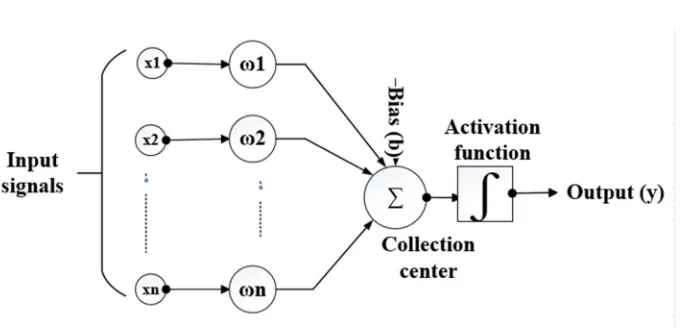
other layers. As can be seen in Figure 4, all inputs are multiplied by these weights and collected in a
151
center.
152
154
Figure 4. Block diagram model of a neuron
155
156
The first step of learning can be described as activation. The sum of the signals entering the
157
nerve cell does it have a value that can activate the cell or not? The answer is as follows: if the total
158
signal is high enough to ignite the cell and exceed the threshold value then it is the cell active (y = 1)
159
otherwise in that case the cell is passive (y = 0). ANN has several activation functions. The most
160
widely used "multi-layer perceptron” model in the present day generally uses the "Sigmoid
161
function" as the activation function. The sigmoid activation function is a continuous and derivable
162
function. This function generates a value between 0 and 1 for each of the input values. Sigmoid
163
function is defined by the formula:
164
( ) = (1)
165
166
In biological systems, learning occurs through synaptic connections between neurons. In other
167
words, people start to learning process by living from their birth. In this process, the brain is
168
continuously developing. As experience increases, synaptic connections are established and even
169
new connections occur. In this way, learning occurs and this also applies to ANN. Learning happens
170
by using examples through training. In other words, by processing the input / output data, that is, by
171
using these data’s, the training algorithm repeatedly adjusts the weights of the synapses until a
172
convergence is achieved. The selected training algorithm is important to get a good result. A large
173
number of training algorithms exist in the literature. With regard to the training algorithm put
174
accounted, the error among the network output and the wanted output is propagated backwards to
175
alter the weights of the network until the error is decreased. It can be defined a neuron by the
176
following equations:
177
= ( + ) (2)
178
179
where w and x defines weights and inputs. Where b is bias. The intention of bias entries is to balance
180
the origin of the activation function to provide better learning [36]. Transfer function can have
181
described by the following equation:
182
= ∑ . + (3)
183
184
In this study, proposed ANN model was designed as an input layer with 4 neurons, an output
185
layer with one neuron and a hidden layer with 10 neurons. Overlap angle (°), thickness (mm),
186
laminate stacking sequence angle (°) and adhesion area (mm2) were used as the input variables while
187
failure load (N) was used as the output variable in this ANN model. The Levenberg - Marquardt
188
algorithm, which is a kind of backpropagation algorithm, is used to train the modeled network. Data
189
obtained from experiment were divided into three parts: training, validation and testing. Matlab –
190
Neural Network Toolbox was used for design, train and simulate. A neural network model was
191
established, trained and tested using the present test data from 48 different samples collected from
192
The data used in neural network model are composed in a format of four input parameters that
194
include lap angle, thickness, and laminate stacking sequence angle and adhesion area. A neural
195
model where consist of 4 inputs and an output used in this study as shown in Figure 5.
196
197
Figure 5. Structure of ANN model
198
3. Results and Discussion
199
In this study, 34 of the 48 values were used for training. 7 values are used for validation and
200
testing respectively. The mean square error (MSE) was put accounted to evaluate the productivity of
201
ANN estimation model. MSE is defined as the average of squares of "Errors”. The mean square error
202
was calculated by following equation:
203
204
= ( − )
(4)
205
206
where ti is the measured value of the experiment, tdi is the estimated value, and N is the total number
207
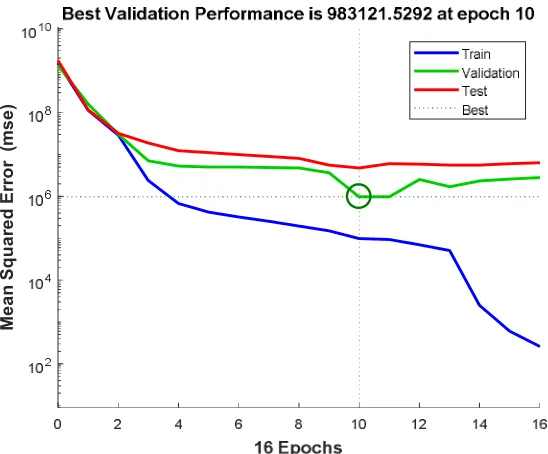
of samples. The mean square error (MSE) depending on iteration of the ANN is shown in Figure 6.
208
The training of the ANN was turned off after 10 epochs due to the targeted MSE value was achieve.
209
210
211
Figure 6. The graphic of the mean square error (MSE) depending on iteration of the ANN.
212
M
e
a
n
S
q
u
a
re
d
E
rr
o
r
(
m
s
e
Artificial neural networks using the Levenberg-Marquardt algorithm are estimated the failure
213
load. The values estimated by using the ANN model for the testing, validation and training data,
214
percentage error ratios and the measured values are shown in Table 3. When Table 3 is shown, it is
215
seen that the estimated values obtained by ANN are found with very low percentage errors. These
216
ratios of errors are very satisfactory for estimating failure load values. These values show that the
217
ANN efficaciously produces sensible results and has a reasonable reliability and accuracy ratio in
218
the model of failure load [19].
219
220
Table 3. The relationship between the estimated values obtained by using the ANN model and the
221
experimental results is shown in Figure 6 [32].
222
Overlap Angle
(°)
Adherend Thickness
(mm)
Composite Laminate
Angle (°)
Adhesion Area (mm2)
Failure Load (N)
Estimated Failure Load
(N)
(%) Error
30 3 [0/90] 180 8136 7972,5 2,01
45 3 [0/90] 180 7531,2 7289,87 3,20
60 3 [0/90] 180 9091,8 9428,88 -3,71
75 3 [0/90] 180 14900,4 15399,99 -3,35
30 3 [±45] 180 9811,8 10259,35 -4,56
45 3 [±45] 180 8593,2 8854,74 -3,04
60 3 [±45] 180 10292,4 10384,22 -0,89
75 3 [±45] 180 15390 15271,52 0,77
30 3 [0/90/±45] 180 10472,4 10599,79 -1,22
45 3 [0/90/±45] 180 9433,8 9381,31 0,56
60 3 [0/90/±45] 180 10645,2 10576,01 0,65
75 3 [0/90/±45] 180 15885 15775,31 0,69
30 5 [0/90] 300 13560 13697,65 -1,02
45 5 [0/90] 300 12552 13071,58 -4,14
60 5 [0/90] 300 15153 15475,20 -2,13
75 5 [0/90] 300 24834 24977,38 -0,58
30 5 [±45] 300 18330 18544,52 -1,17
45 5 [±45] 300 14853 15019,08 -1,12
60 5 [±45] 300 17154 17220,69 -0,39
75 5 [±45] 300 25650 25607,17 0,17
30 5 [0/90/±45] 300 17454 17520,01 -0,38
45 5 [0/90/±45] 300 15900 15905,74 -0,04
60 5 [0/90/±45] 300 18000 17884,51 0,64
75 5 [0/90/±45] 300 26475 26930,73 -1,72
30 7 [0/90] 420 18984 19177,89 -1,02
45 7 [0/90] 420 17572 18000,39 -2,44
60 7 [0/90] 420 21214 20907,30 1,45
75 7 [0/90] 420 34767 34853,51 -0,25
30 7 [±45] 420 26964 26964,01 0,00
45 7 [±45] 420 21592,2 21658,05 -0,30
75 7 [±45] 420 35910 37243,21 -3,71
30 7 [0/90/±45] 420 24435,6 24546,26 -0,45
45 7 [0/90/±45] 420 22012,2 22019,05 -0,03
60 7 [0/90/±45] 420 24838,8 24727,82 0,45
75 7 [0/90/±45] 420 37065 36764,81 0,81
30 10 [0/90] 600 27120 26922,72 0,73
45 10 [0/90] 600 25104 27000,31 -7,55
60 10 [0/90] 600 30306 30339,61 -0,11
75 10 [0/90] 600 49668 49351,75 0,64
30 10 [±45] 600 38520 38473,11 0,12
45 10 [±45] 600 30846 30866,89 -0,07
60 10 [±45] 600 34308 34308,09 0,00
75 10 [±45] 600 51600 51488,09 0,22
30 10 [0/90/±45] 600 34908 34895,56 0,04
45 10 [0/90/±45] 600 31446 31422,59 0,07
60 10 [0/90/±45] 600 35484 36236,69 -2,12
75 10 [0/90/±45] 600 52950 52728,77 0,42
223
224
225
226
Figure 7. Relationship between the experimental values and estimated values
227
4. Conclusion
228
The experimental results in Table 3 tried to explain that, failure load value increases when
229
overlap angle from 30° to 75° in geometry. Composites laminate stacking sequence can be said to
230
affect tensile strength remarkably. [±45°] instead of [0°/90°] showed an average 10% increase in
231
P
re
d
ic
te
d
P
re
d
ic
te
d
P
re
d
ic
te
d
P
re
d
ic
te
failure load. When using multi-directional fabric [0°/90°/±45°], the value increased by an average of
232
15%.
233
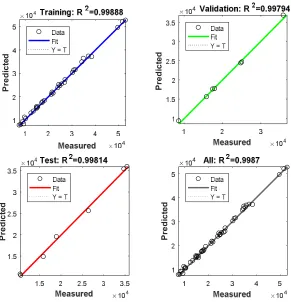
In a similar manner as shown in Figure 7, R2 values for training data set, validation data set and
234
testing data set in the prediction of failure load by ANN are 0.998, 0.997 and 0.998, respectively.
235
These results mean that the designed model is ability of explaining at least 0.99 % for the training
236
and 0.98% for the testing of obtained data by experiment. The estimated values show that the error is
237
in acceptable limits. The actual experimental results were compared with the estimated values, ANN
238
estimation is quite good and can strongly be suggested to decrease time wastage and support
239
laboratory experiment.
240
References
241
1. Kinloch, A.J. Adhesives in Engineering. Proc. Instn. Mech. Engrs., 1997, s307-335,
242
https://doi.org/10.1243/0954410971532703.
243
2. M.R. Ayatollahi, A. Akhavan-Safar, Failure load prediction of single lap adhesive joints based on a new
244
linear elastic criterion, Theor. Appl. Fract. Mech., 2015, 80 210–217, http://dx.doi.org/ 10.1016/j.tafmec.
245
2015.07.013.
246
3. G. Zhang, B.Y. Eddy Patuwo, M. Hu, Forecasting with artificial neural networks, Int. J. Forecast., 1998, 14
247
(1) 35–62, http://dx. doi.org/10.1016/s0169-2070(97) 00044-7.
248
4. Luigi Alberto Ciro De Filippis, Livia Maria Serio, Francesco Facchini, Giovanni Mummolo, Antonio
249
Domenico Ludovico, Prediction of the Vickers Microhardness and Ultimate Tensile Strength of AA5754
250
H111 Friction Stir Welding Butt Joints Using Artificial Neural Network, MDPI Materials, 2016, 9(11), 915,
251
https://doi.org/10.3390/ma9110915.
252
5. Shiuh-Chuan Her and Chih-Ying Huang, The Effects of Adhesive and Bonding Length on the Strain
253
Transfer of Optical Fiber Sensors, MDPI Appl. Sci., 2016, 6, 13; doi:10.3390/app6010013.
254
6. Hamid Reza Majidi, Seyed Mohammad Javad Razavi and Filippo Berto, Failure Assessment of Steel/CFRP
255
Double Strap Joints, MDPI Metals, 2017, 7, 255; doi:10.3390/met7070255.
256
7. Ji Hoon Hwang, Chul Kyu Jin, Min Sik Lee, Su Won Choi and Chung Gil Kang, Effect of Surface
257
Roughness on the Bonding Strength and Spring-Back of a CFRP/CR980 Hybrid Composite, MDPI Metals,
258
2018, 8, 716; doi:10.3390/met8090716.
259
8. Ihor Konovalenko, Pavlo Maruschak, Olegas Prentkovskis, Raimundas Junevičius, Investigation of the
260
Rupture Surface of the Titanium Alloy Using Convolutional Neural Networks, MDPI Materials, 2018,
261
11(12), 2467; https://doi.org/10.3390/ma11122467.
262
9. Magdalena Rucka, Erwin Wojtczak and Jacek Lachowicz, Damage Imaging in Lamb Wave-Based
263
Inspection of Adhesive Joints, MDPI Appl. Sci., 2018, 8, 522; doi:10.3390/app8040522.
264
10. Kenisuomo C. Luwei, Akilu Yunusa-Kaltungo and Yusuf A. Sha’aban, Integrated Fault Detection
265
Framework for Classifying Rotating Machine Faults Using Frequency Domain Data Fusion and Artificial
266
Neural Networks, MDPI Machines, 2018, 6(4), 59; https://doi.org/10.3390/machines6040059.
267
11. Tosun, E.; Çalık, A. Failure load prediction of single lap adhesive joints using artificial neural networks.
268
Alexandria Engineering Journal, 2016, 55, 1341-1346; doi: 10.1016/j.aej.2016.04.029.
269
12. S. Tiryaki, A. Aydın, An artificial neural network model for predicting compression strength of heat
270
treated woods and comparison with a multiple linear regression model, Constr. Build. Mater., 2014, 62 102–
271
108, http://dx.doi.org/10.1016/ j.conbuildmat. 2014.03.041.
272
13. M.H. Zgoul, Use of artificial neural networks for modelling rate dependent behavior of adhesive
273
materials, Int. J. Adhes. Adhes., 2012, 36 1–7, http://dx.doi.org/10.1016/j. ijadhadh.2012.03.003.
274
14. S. Tiryaki, S. Bardak, T. Bardak, Experimental investigation and prediction of bonding strength of oriental
275
beech (Fagus orientalis Lipsky) bonded with polyvinyl acetate adhesive, J. Adhes. Sci. Technol., 2015, 29 (23)
276
2521–2536, http://dx.doi. org/ 10.1080 / 01694243.2015.1072989.
277
15. T. Sekercioglu, V. Kovan, Prediction of static shear force and fatigue life of adhesive joints by artificial
278
neural network, Metallic Mater., 2008, 46 (1) 51.
279
16. Z. Gul Apalak, R. Ekici, Elastic stresses in an adhesively bonded functionally graded double containment
280
cantilever joint in tension, J. Reinf. Plast. Compos., 2007, 26 (13) 1291–1318, http://dx.doi.org/
281
10.1177/0731684407079370.
282
17. H.E. Balcıoglu, A.C. Seckin, M. Aktas, Failure load prediction of adhesively bonded pultruded composites
283
18. J. Dominczuk, J. Kuczmaszewski, Modelling of adhesive joints and predicting their strength with the use
285
of neural networks, Comput. Mater. Sci., 2008, 43 (1) 165–170, http://dx.doi.org/ 10.1016/
286
j.commatsci.2007.07.052.
287
19. S. Tiryaki, S. Ozsahin, I. Yıldırım, Comparison of artificial neural network and multiple linear regression
288
models to predict optimum bonding strength of heat treated woods, Int. J. Adhes. Adhes., 2014, 55 29–36,
289
http://dx.doi.org/10.1016/j. ijadhadh.2014.07.005.
290
20. E.M. Guneyisi, M. Gesoglu, E. Guneyisi, K. Mermerdas, Assessment of shear capacity of adhesive anchors
291
for structures using neural network based model, Mater. Struct. 49 (3) (2015) 1065–1077,
292
http://dx.doi.org/10.1617/s11527-015- 0558-x.
293
21. R. Gunes, M.K. Apalak, M. Yildirim, Free vibration analysis of an adhesively bonded functionally graded
294
tubular single lap joint, J. Adhes., 2011, 87 (9) 902–925, http://dx.doi.org/10.1080/ 00218464.2011.600672.
295
22. Naderpour H, Kheyroddin A, Amiri GG. Prediction of frp-confined compressive strength of concrete
296
using artificial neural networks. Compos Struct., 2010, 92 (12): 2817–2829,
297
doi:10.1016/j.compstruct.2010.04.008.
298
23. Kalhor R, Akbarshahi H, Case SW. Numerical modeling of the effects of frp thickness and stacking
299
sequence on energy absorption of metal–frp square tubes. Compos Struct., 2016; 147:231–246,
300
https://doi.org/10.1016/j.compstruct.2016.03.038.
301
24. Malik M, Arif A. Ann prediction model for composite plates against low velocity impact loads using finite
302
element analysis. Composite Structure, 2013, 101:290–300, doi: 10.1016/j.compstruct.2013.02.020.
303
25. Fernández-Fdz D, López-Puente J, Zaera R. Prediction of the behavior of cfrps against high-velocity
304
impact of solids employing an artificial neural network methodology. Compos Part A: Appl Sci Manuf., 2008,
305
39(6):989–996, doi: 10.1016/j.compositesa.2008.03.002.
306
26. Dilik T,Hiziroglu S. Bonding strength of heat treated compressed Eastern redcedar wood. Mater Des., 2012,
307
42:317–320, https://doi.org/10.1016/j.matdes.2012.05.050.
308
27. Kasemsiri P, Hiziroglu S, Rimdusit S. Characterization of heat treated eastern red cedar (Juniperus
309
virginiana L.). J Mater Process Technol., 2012, 212 (6):1324–1330, doi:10.1016/j.jmatprotec.2011.12.019.
310
28. Bakar BFA, Hiziroglu S, Tahir PM. Properties of some thermally modified wood species. Mater Des., 2013,
311
43:348–355, https://doi.org/10.1016/j.matdes.2012.06.054.
312
29. Cook DF, Chiu CC. Predicting the internal bond strength of particle board, utilizing a radial basis function
313
neural network. Eng Appl Artif Intell., 1997, 10 (2):171–177, https://doi.org/10.1016/S0952-1976(96)00068-1.
314
30. Esteban LG, Fernandez FG, de Palacios P. Prediction of plywood bonding quality using an artificial neural
315
network. Holzforschung, 2010, 65(2):209–214, doi: 10.1515/hf.2011.003.
316
31. Demirkir C, Ozsahin S,Aydin I,Colakoglu G. Optimization of some panel manufacturing parameters for
317
the best bonding strength of plywood. Int J Adhes Adhes., 2013, 46:14–20, doi:
318
10.1016/j.ijadhadh.2013.05.007.
319
32. Birecikli, B., Mechanical Analysis of Double Zigzag Type Adhesive Joints. Phd Thesis, Fırat University
320
Institute of Natural and Applied Sciences, 2016, Number: 446492, pg.237, Elazig.
321
33. B. Birecikli and A. Turgut, “The design and mechanical analysis of double zigzag type of adhesive joints”,
322
International Journal of Technology and Engineering Studies, 2017, vol. 3, no. 5, pp. 177-183, 2017, doi:
323
10.20469/ijtes.3.40001-5.
324
34. L. Amayreh, M. Saka, Failure load prediction of castellated beams using artificial neural networks, ASIAN
325
J. Civ. Eng. (Build. Hous.), 2005, 6 (1–2) 35–54.
326
35. I. Uçkan, T. Yılmaz, E. Hürdoğan, O. Büyükalaca, Development of an artificial neural network model for
327
the prediction of the performance of a silica-gel desiccant wheel, Int. J. Green Energy, 2014, 12 (11) 1159–
328
1168, http://dx.doi.org/ 10.1080/15435075.2014.895733.
329
36. D.Sevim, Ş. Fidan, S.Polat , H. Oktay “Experimental And Artificial Neural Network Based Studies On
330
Thermal Conductivity Of Lightweight Building Materials”, European Journal of Technic, 2017, vol 7,
331
Number 1, Pp. 33-41.
332
333
![Figure 1. Composite laminate stacking sequence [32]](https://thumb-us.123doks.com/thumbv2/123dok_us/7975250.1322480/3.595.160.435.668.727/figure-composite-laminate-stacking-sequence.webp)
![Table 2. Geometric parameters for adhesively-bonded joints [33].](https://thumb-us.123doks.com/thumbv2/123dok_us/7975250.1322480/4.595.43.506.102.596/table-geometric-parameters-adhesively-bonded-joints.webp)
![Table 3. The relationship between the estimated values obtained by using the ANN model and the experimental results is shown in Figure 6 [32]](https://thumb-us.123doks.com/thumbv2/123dok_us/7975250.1322480/7.595.69.527.231.775/table-relationship-estimated-values-obtained-experimental-results-figure.webp)