Encrypted Databases for Differential Privacy
Archita Agarwal∗ Brown University
Maurice Herlihy† Brown University
Seny Kamara‡ Brown University
Tarik Moataz§ Brown University
Abstract
The problem of privatizing statistical databases is a well-studied topic that has culminated with the notion of differential privacy. The complementary problem ofsecuringthese databases, however, has—as far as we know—not been considered in the past. While the security of private databases is in theory orthogonal to the problem of private statistical analysis (e.g., in the central model of differential privacy the curator is trusted) the recent real-world deployments of differentially-private systems suggest that it will become a problem of increasing importance. In this work, we consider the problem of designing encrypted databases (EDB) that support differentially-private statistical queries. More precisely, these EDBs should support a set of encrypted operations with which a curator can securely query and manage its data, and a set of private operations with which an analyst can privately analyze the data. Using such an EDB, a curator can securely outsource its database to an untrusted server (e.g., on-premise or in the cloud) while still allowing an analyst to privately query it.
We show how to design an EDB that supports private histogram queries. As a building block, we introduce a differentially-private encrypted counter based on the binary mechanism of Chan et al. (ICALP, 2010). We then carefully combine multiple instances of this counter with a standard encrypted database scheme to support differentially-private histogram queries.
∗
†
‡
Contents
1 Introduction 3
1.1 Our Contributions . . . 4
2 Related Work 5 3 Preliminaries 6 3.1 Structured Encryption . . . 7
4 Private Structured Encryption 9 4.1 Correctness and Utility . . . 10
4.2 Security and Privacy . . . 11
5 CPX: A Private Encrypted Counter 15 5.1 Efficiency and Utility. . . 16
5.2 Security . . . 17
6 HPX: An Encrypted Database for Private Histograms Queries 17 6.1 Efficiency and Utility. . . 20
6.2 Security . . . 21
7 Handling Collusions 23 8 Efficiency Estimates 24 A CPX Proofs 29 A.1 Proof of Theorem 5.1. . . 29
A.2 Proof of Theorem 5.2. . . 30
A.3 Proof of Theorem 5.3. . . 30
B HPX Proofs 31 B.1 Proof of Theorem 6.2. . . 31
B.2 Proof of Theorem 6.3. . . 33
B.3 Proof of Lemma 6.4 . . . 33
1
Introduction
A statistical database system is database management system designed to support statistical anal-ysis on the data it stores. Statistical database systems are ubiquitous and support decision making in almost every domain, including, technology, finance, education, Government, sports and national security; just to name a few. In fact, the proliferation and significance of statistical databases has motivated the important and active field ofprivate statistical analysis which includes work on pri-vacy attacks [61,23,52] and on the design of statistical mechanisms that achieve various notions of privacy like k-anonymity, `-diversity and, ultimately, differential privacy as introduced by Dwork, McSherry, Nissim and Smith [25].
In this setting, a trusted curator stores the database and responds to statistical queries made by an untrusted analyst. By answering these queries with a differentially-private mechanism, the curator can guarantee that the analyst gets responses within some bound of the correct answer in such a way that the presence or absence of an individual person/entity does not affect the output of the mechanism by much. Over the last fifteen years, research in differential privacy has produced a multitude of mechanisms to support a wide array of statistical analyses. In turn, these advances have lead to real-world deployments of differentially-private statistical databases in various domains. Some of the most high-profile examples include the Census Bureau’s deployment of differential privacy in their OnTheMap project which supports analysis on the travel patterns of commuters [48], Apple’s deployment of local differential privacy to study emoji usage, health data and media preferences [22], and Google’s deployment of local differential privacy to analyze Chrome settings [30].
While it is clear that the problem of “privatizing” statistical databases has received significant attention, as far as we know, the complimentary problem ofsecuring statistical databases has not been considered. While the security of statistical databases is in theory orthogonal to the problem of private statistical analysis—indeed in this setting the curator is trusted—we believe that the growing number of real-world deployments of differential privacy will increasingly highlight the problem of how exactly curators should protect their data. This question is even more pertinent given the highly sensitive nature of the data—which is why differentially-private mechanisms are used in the first place—and the constant occurrences of data breaches.
Security via encrypted databases. Over the last fifteen years, the area of encrypted search has emerged as a promising solution to the problem of database security and data breaches. Using an encrypted database, a client/application can store and query its data on an untrusted server without exposing itself to the risk of insider and outsider threats, data breaches and even unintentional data disclosures (e.g., due to mis-configured access control lists). Solutions for various kinds of databases and with varying levels of security have been considered in the past, including for simple key-value stores (i.e., dictionaries) [20, 17], multi-maps [21,41,40, 18,53,39], graph databases [20,50] and relational databases [56,37]. The availability of such a diverse set of encrypted database solutions, motivates the following natural question:
Can we design private encrypted databases; that is, encrypted databases that support differentially-private statistical queries?
With such a solution, a curator could store its database on any untrusted server while still allow-ing analysts to conduct private statistical analysis on the data. As a concrete example, the Census Bureau could outsource the storage and management of its OnTheMap data to a server in Amazon’s cloud without losing any of the properties provided by its differentially-private mechanism.
At a high-level, our goal is to design encrypted databases that support both encrypted and private operations. The encrypted operations include query and update operations and are used by the curator to query and maintain the database. The private operations include statistical query operations used by the analyst to analyze the data. Roughly speaking, a private encrypted database should provide security against an untrusted server and differential-privacy against an untrusted analyst.
1.1 Our Contributions
In this work we introduce and address the problem of securing private statistical databases. We make the following contributions.
Private encrypted databases. One of the contributions of this work is to delineate the scope of the problem and to propose a set of reasonable properties that any encrypted and private statistical database should achieve. We do this formally by extending the notion of structured encryption [20] to support, in addition to a set of encrypted queries, a set of differentially-private queries. The encrypted queries are used by the curator to query and modify the database while the private queries are used by the analyst to analyze the data.
New adversarial models. In our setting, there are multiple adversaries to consider, including the server that stores the database, the analyst that analyzes the data and, possibly, an adversary that compromises the server at a point in time and gets a snapshot of the database.
More formally, the first corresponds to a persistent adversary that compromises the server perpetually and can monitor the transcripts of the interactions between the curator, the analyst and the server. The second corresponds to astatistical adversary that has access to theresults of the private queries but not necessarily to the transcript of the entire interaction. This captures the standard untrusted analyst in differential privacy that tries to infer information about the data from the responses of its queries. The third is a snapshot adversary that gets multiple accesses to the database stored on the server but does not have access to the transcripts of any interactions. This captures scenarios such as data breaches, devices thefts, and subpoenas.
consider any security/privacy guarantees for the analyst. In our setting, however, the database is stored on an untrusted server so the analyst’s queries must also be protected. Another subtlety is that, in our setting, the data stored in the database is continually modified which requires differential privacy to hold undercontinual observations.
An encrypted database for private histogram queries. As a concrete goal, we focus on designing private encrypted databases that support differentially-private histogram queries. His-tograms are one of the most common and central queries in statistical analysis and many other important queries can be formulated as histograms (e.g., contingency tables, marginals).
A naive approach to solving our problem would be for the curator to use a structured encryption scheme to produce an EDB and then use a private histogram mechanism to produce a pan-private state. The curator would then use the EDB to query and manage its data and the server would use the pan-private state to answer analyst queries. The main limitation of this approach, however, is that it only guarantees differential privacy against persistent and snapshot adversaries whereas we would like a stronger guarantee.
To achieve this, we have to combine techniques from structured encryption and differential privacy in a more careful manner. Our first step, is to design an encrypted counter that supports an encrypted add operation and a differentially-private read operation. We build such a counter using additively homomorphic encryption and a differentially-private counter of Chan, Shi and Song [19]. We refer to the resulting construction as CPX. We then combine a standard encrypted data structure with several instantiations of our encrypted counter to build a private encrypted database that supports private histogram queries. There are several subtleties that come up—not only due to our new adversarial models—but also due to subtle and potentially dangerous interactions between the operations on the encrypted database and the contents of the private counter. To avoid these pitfalls, we have to carefully consider how the queries of the curator are executed so that they do not affect the security of the CPX counters. This results in a scheme we call HPX that has the same (encrypted) query complexity as its underlying encrypted database and (encrypted) update complexity that is linear in the underlying encrypted database’s update complexity and in the number of histogram bins. When HPX’s encrypted counters are instantiated with CPX, it has private query complexity that is logarithmic in the number of updates.
2
Related Work
Differential privacy. In their seminal work [25], Dwork, McSherry, Nissim and Smith introduced the notion of differential privacy that guarantees privacy of individuals by ensuring similar outputs of queries on data irrespective of whether an individual’s information is present or absent in the data. Since its conception, differential privacy has been an active research area [49,7,43,6,9,8,29], we refer the readers to [28,24] for a comprehensive survey.
Differential privacy has also been deployed in practice, see for example the systems used at Google [30,31], Apple [22], the US Census Bureau [48,2] and Uber [62,35].
authors construct an-differentially-privatecontinual counter with a small error. Specifically, they show that with probability 1−δ, the error at time step t is at mostO(1log1.5tlog1δ). They also show that with probability at leastδ, any -differentially-private mechanism forλtime steps must incur an additive error of at least Ω(1(logλ+ log1δ)). Chan, Shi and Song, in an independent work, also constructed a similar counter with same privacy and error guarantees [19]. The contin-ual observation model has been widely adopted and several problems have been considered in the literature [3,46,64,14,15,44,13,58,63,16].
Structured encryption. Structured encryption (STE) was introduced by Chase and Kamara in [20] as a generalization of searchable symmetric encryption (SSE) [59, 21]. There are STE constructions for various data structures including multi-maps [32, 21, 20, 41, 40, 18, 17, 53, 38,
39,10,11], graphs [20,36,50,66] and two-dimensional arrays [20,42].
Snapshot security. Snapshot security was discussed informally in several works [55,34] but first formalized in the context of property-preserving encryption (PPE) by Lewi and Wu [45] and in the context of STE by Amjad, Kamara and Moataz in [5].
3
Preliminaries
Notation. The set of all binary strings of lengthn is denoted as{0,1}n, and the set of all finite binary strings as{0,1}∗. [n] is the set of integers{1, . . . , n}, and 2[n]is the corresponding power set.
We write x←χ to represent an element x being sampled from a distribution χ. The output x of an algorithmAis denoted byx← A. Given a sequencevofnelements, we refer to itsith element asvi orv[i]. If S is a set then |S|refers to its cardinality. Ifx and y are two integer sequences of lengthn, then|| · || denotes the Hamming distance. We denote byLap(b) the Laplace distribution with parameter bthat has probability density function 21be−|xb| with mean 0 and variance 2b2. Abstract data types. Anabstract data type specifies the functionality of a data structure. It is a collection of data objects together with a set of operations defined on those objects. Examples include sets, dictionaries (also known as key-value stores or associative arrays) and graphs. The op-erations associated with an abstract data type fall into one of the two categories: query opop-erations, which return information about the objects; and update operations, which modify the objects. If the abstract data type supports only query operations it is static, otherwise it is dynamic. We denote byQ,R, and Uthe query, response and update spaces of the data object, respectively.
Data structures. A data structure for a given data type is a representation in some computa-tional model of an object of the given type.1 Typically, the representation is optimized to support the type’s query operation as efficiently as possible. For data types that support multiple queries, the representation is often optimized to efficiently support as many queries as possible. As a con-crete example, the dictionary type can be represented using various data structures depending on which queries one wants to support efficiently. Hash tables support Getand Put in expectedO(1) time whereas balanced binary search trees support both operations in worst-case log(n) time. For ease of understanding and to match colloquial usage, we will sometimes blur the distinction between data types and structures.
Public-key encryption. A public key encryption scheme is a set of three polynomitime al-gorithms AHE = (Gen,Enc,Dec) such that Gen is a probabilistic algorithm that takes a security parameterkand returns a pair of private and public keys (sk,pk);Enc is a probabilistic algorithm that takes a public key pk and a message m and returns a ciphertext ct;Dec is a deterministic al-gorithm that takes a private key sk and a ciphertextcand returnsmif pk was the public key under which ct was produced. A public key encryption scheme is an additive homomorphic encryption scheme if for any two messagesm1 andm2, and any (sk,pk)←Gen(1k) for all k∈N, we have that
Dec sk,Enc(pk, m1)·Enc(pk, m2)
=m1+m2.
Informally, a public key encryption scheme is secure against chosen-plaintext attacks if the ciphertexts it outputs do not reveal any partial information about the plaintext even to an adversary that can adaptively query an encryption oracle.
3.1 Structured Encryption
Structured encryption (STE) schemes [20] encrypt data structures in such a way that they can be queried. STE schemes can be distinguished depending on the type of operations they support. This includes non-interactive and interactive schemes where the former require only a single message while the latter require several rounds for queries and updates. STE schemes can also be static or dynamic where the former do not support update operations whereas the latter do. We can also distinguish between response-revealing and response-hiding schemes where the former reveal the response to queries whereas the latter do not.
Interactive response-revealing STE schemes are used as follows. During the setup phase, the client constructs an encrypted data structure EDS under a key K. If the scheme is stateful, the setup also outputs a state st. The server then receives EDS from the client. During the query phase, the client and server execute a two-party protocol where client inputs its queryq, keyK and statestwhile the server inputs the encrypted structure EDS. The client receives a responser and an updated state st0 while the server receives nothing. Similarly, during the update phase, either an add or remove, the client and server execute a two-party protocol where the client inputs its updateu+/u−, keyK and statestwhile the server inputs the encrypted structureEDS. The client receives an updated state st0 while the server receives an updated structure EDS0. We formally define an interactive response-revealing STE as follows:
Definition 3.1 (Structured encryption). An interactive structured encryption scheme ΣSTE = (Setup,Query,Add,Remove) consists of one polynomial-time algorithm and three interactive proto-cols that work as follows:
• (st, K,EDS) ← Setup(1k,DS): is a probabilistic algorithm that takes as inputs the security parameterk and a data structure DSand receives a state st, a key K, and an encrypted data structure EDS.
• (st0, r;⊥)←QueryC,S(st, K, q;EDS) is a (probabilistic) protocol between the client Cand the server S. The client inputs its state st, the key K and the query q, while the server inputs the encrypted data structure EDS. The client receives a response r and the server receives nothing.
• (st0;EDS0) ← AddC,S(st, K, u+;EDS): is a (probabilistic) protocol between the client C and
the serverS. The client inputs its statest, the keyK and the updateu+∈U, while the server inputs the encrypted data structure EDB0. As output, the client receives an updated state st0
• (st0;EDS0) ← RemoveC,S(st, K, u−;EDS): is a (probabilistic) protocol between the client C
and the server S. The client inputs its state st, the key K and the update u− ∈ U, while the server inputs the encrypted data structureEDS. As output, the client receives an updated state st0 and the server receives an updated stateEDS0.
We say that a dynamic STE scheme ΣSTE is correct if for all k∈N, for all poly(k)-size structures DS0, for all (st0, K,EDS0) output by Setup(1k,DS0), for all sequences of m = poly(k) operations
op1, . . . ,opm such that opi∈ {qi, ui}, for alli∈[m], ifopi =qi, Query(sti−1, K, qi;EDSi−1)returns
the correct response with all but negligible probability; wheresti−1 is the output of theAdd,Remove
or Query protocols, while EDSi−1 is either the output of the last update ρ < i if it exists, or the
output of the setup algorithm otherwise.
Security. The standard notion of security for STE guarantees that: (1) an encrypted structure reveals no information about its underlying structure beyond the setup leakage LS; (2) that the query protocol reveals no information about the structure and the queries beyond the query leakage
LQ; and that (3) the add/remove protocols reveal no information about the structure and the updatesu+/u− beyond the add/remove leakages LA/LR.
If this holds for non-adaptively chosen operations then the scheme is said to be non-adaptively secure. If, on the other hand, the operations can be chosen adaptively, the scheme is said to be adaptively-secure.
Definition 3.2 (Adaptive security of interactive STE). Let Σ = (Setup,Query,Add,Remove) be an interactive dynamic STE scheme and consider the following probabilistic experiments where Ais a stateful adversary,S is a stateful simulator,LS, LQ,LAandLR are leakage profiles andz∈ {0,1}∗: RealΣ,A(k): givenzthe adversaryAoutputs a structureDSand receivesEDSfrom the challenger, where (st, K,EDS) ← Setup(1k,DS). The adversary then adaptively chooses a polynomial number of operations op1, . . . ,opm such that opi is either a queryqi or an update u+i or u
− i . For all i∈[m], if opi =qi, the adversary and the challenger execute the protocol Query, and the challenger receives an updated statest0 and a responser while the adversary receives noth-ing, where (st0, r;⊥) ←Query(st, K, qi;EDS). If, opi =u+i , the adversary and the challenger execute the protocolAdd, and the challenger receives an updated statest0, while the adversary receives an updated encrypted structureEDS0, where (st0;EDS0)←Add(st, K, u+i ;EDS). If, on the other hand,opi=u−i , the adversary and the challenger execute the protocol Remove, and the challenger receives an updated statest0, while the adversary receives an updated encrypted structure EDS0, where (st0;EDS0) ← Remove(st, K, u−i ;EDS). Finally, A outputs a bit b that is output by the experiment.
IdealΣ,A,S(k): given z the adversary A generates a structure DS which it sends to the chal-lenger. Given z and leakage LS(DS) from the challenger, the simulator S returns an en-crypted structure EDS to A. The adversary then adaptively chooses a polynomial number of operations op1, . . . ,opm such that opi is either a query qi or an update u+i or u
− i . For all i ∈ [m], if opi = qi, the simulator receives the query leakage LQ(DS, qi) and executes Query(LQ(DS, qi);EDS) with the adversary. The adversary receives nothing as output. If,
opi = u+i , the adversary the simulator receives the add leakage LA(DS, u+i ) and executes
Add(LA(DS, u+i );EDS) with the adversary. The adversary receives an updated structure EDS0
We say thatΣ is adaptively(LS,LQ,LA,LR)-secure if there exists a pptsimulator S such that for
all ppt adversaries A, for allz∈ {0,1}∗,
|Pr [RealΣ,A(k) = 1 ]−Pr [IdealΣ,A,S(k) = 1 ]| ≤negl(k).
A note on operation failures. Similarly to plaintext data structures, operations over encrypted structures may fail. For queries, failures are in general the result of an empty response or the nonexistence of the query in the structure. We typically capture a query failure by a null ⊥
element added to the data type response space. However, update failures are in general more complex. For example, in set data structures, an add update might fail if the element already exists in the structure. An update also might fail if it intends to remove an element that does not exist or simply because the structure is empty. At a high level, we say that an update fails if the update does not modify the encrypted structure. Formally, an updateu+∈
Ufails ifEDS=EDS0 where (st0;EDS0) ← AddC,S(st, K, u;EDS) for all k ∈ N, for allpoly(k)-size structuresDS, for all
(st, K,EDS) output by Setup(1k,DS) (similary for Remove).2
A note on data structures and databases. Our main construction, HPX, can be used to support histogram queries on any encrypted data structure. Unfortunately, most of the differential privacy and cryptography literature does not distinguish between data structures (e.g., arrays, two-dimensional arrays, dictionaries, multi-maps, trees etc.) and databases (e.g., relational databases, NoSQL databases). So to remain consistent with the literature, in the remainder of this paper we will refer to arbitrary data structures as databases. So anytime we refer to a database DBor an encrypted database EDB what we mean is some arbitrary data structure and some arbitrary encrypted data structure, respectively.
4
Private Structured Encryption
In this Section, we extend the notion of STE to support private queries. We refer to the resulting primitive as a private structured encryption (PSTE) scheme. With a PSTE scheme, a curator can encrypt its database in such a way that it can query and manage its database through a set of encrypted queries and such that an analyst can query the database through a set of private queries. In Definition4.1below, we describe the syntax of a PSTE scheme. Here, we only describe schemes that support one encrypted and one private query operations but the syntax can be extended to support schemes with multiple encrypted and private queries in the natural way.
Definition 4.1(Private structured encryption). An interactive private structured encryption scheme ∆ = Setup,EAdd,ERemove,EQuery,PQuery consists of five polynomial-time protocols that work as follows:
• (st, KC);PEDB;KA
← SetupC,S,A (1k, ,DB);⊥;⊥
: is a three-party protocol between the curator C, the server S and the analystA. The curator inputs the security parameter1k, the privacy parameter and a database DB, while the server and the analyst input nothing. The curator receives a statestand a keyKC, the server receives an encrypted databasePEDBand
the analyst receives a key KA.
2
• (st0;PEDB0) ←EAddC,S (st, KC, u+);PEDB
: is a two-party protocol between the curator C and the serverS. The curator inputs its statest, a keyKC and an update u+∈U, while the server inputs the encrypted databasePEDB. As output, the curator receives the updated state st0 and the server receives an updated encrypted databasePEDB0.
• (st0;PEDB0) ←ERemoveC,S (st, KC, u−);PEDB
is a two-party protocol between the curator C and the server S. The curator inputs its state st, a key KC and an update u−∈U, while the server inputs the encrypted database PEDB. As output, the curator receives the updated state st0 and the server receives an updated encrypted database PEDB0.
• (st0, r);⊥
← EQueryC,S (st, KC, q);PEDB
is a two-party protocol between the curator C and the server S. The curator inputs its state st, a key KC and a query q, while the server
inputs the encrypted databasePEDB. The curator receives a response r and an updated state st0, and the server receives nothing.
• (rp;⊥)←PQueryA,S (KA, qp);PEDB
: is a two-party protocol between the analystA and the server S. The analyst inputs its key KA and its private queryqp∈P, while the server inputs the encrypted databasePEDB. As output, the analyst receives a private responserp ∈Owhile the server receives nothing.
For visual clarity, we sometimes omit the subscripts of the protocols when the parties involved is clear from the context.
A PSTE scheme is used as follows. During a setup phase, the curator, server and analyst execute theSetupprotocol on the curator’s databaseDB. This results in a secret keyKCand state
stfor the curator, an encrypted databasePEDBfor the server and a secret keyKA for the analyst.
To query the database, the curator executes the EQuery protocol with the server. To manage the database (i.e., to add or remove items), it executes the EAdd and ERemove protocols with the server. To perform a statistical query on the data, the analyst executes the PQuery protocol with the server.
4.1 Correctness and Utility
We say that a PSTE scheme is correct if the encrypted query protocol always returns the correct response with high probability (possibly) on an updated encrypted database output by an update operation (addition or removal operation) that has previously occurred. Moreover, correctness also should hold independently of the private queries made by the analyst. We formally define correctness as follows.
Definition 4.2(Correctness). Let∆ = (Setup,EAdd,ERemove,EQuery,PQuery)be a PSTE scheme. We say that ∆ is correct if for all k ∈N, for all > 0, for all poly(k)-size databases DB, for all (st, KC;PEDB;KA) output bySetup (1k, ,DB);⊥;⊥
and all poly(k)-size sequences of operations σ = (σ1,· · · , σλ), for all i∈ [λ], if σi = qi, then EQuery(sti−1, KC, qi;PEDBi−1) returns the
cor-rect response with all but negligible probability; where PEDBi−1 results from applying all the update
operations in(σ1, . . . , σi−1) to the encrypted database PEDB0 generated with Setup.
encrypted database’sPQuery operation. More precisely, we say thatPQuery is (α, δ)-useful if, with probability at least 1−δ, it produces responses within an additive factor ofαto the true response. We formally define this below.
Definition 4.3 (Utility). Let ∆ = (Setup,EAdd,ERemove,EQuery,PQuery) be a PSTE scheme. We say that ∆ is (α, δ)-useful if for all poly(k)-size sequences of operations σ = (σ1, . . . , σλ), for alli∈[λ], ifσi=qip,
Pr [|rpi −ri| ≤α]≥1−δ
where (rip;⊥)← PQuery (KA, qpi);PEDBi−1
, ri is the correct response and PEDBi−1 results from
applying all the updates in (σ1, . . . , σi−1) to the encrypted database PEDB0 generated with Setup.
4.2 Security and Privacy
As discussed in Section 1, our adversarial setting is more complex than that of STE and of dif-ferential privacy. In particular, in our context we have to consider two adversaries: namely, the server and the analyst. In addition, the server can be corrupted in two possible ways: a persistent corruption and a snapshot corruption. We summarize these models as follows:
• apersistent adversary corrupts the server perpetually. It has access to the encrypted database and can monitor both the encrypted and private query operations. This captures a corrupted server (e.g., an untrusted cloud service or a possibly corrupted on-premise server).
• a snapshot adversary is an adversary that corrupts the server only at fixed points in time. It can access a copy of the encrypted database at the time of corruption, but cannot see the encrypted or private query operations. This models certain kinds of data-breaches, subpoenas and thefts.
• a statistical adversary is an adversary that corrupts the analyst. It can see the responses to the private queries but cannot see encrypted private database or the encrypted query/update operations. This captures an untrusted analyst.
Collusions. While providing security against each of these adversaries is non-trivial, we will discuss in Section7 how to maintain the same security guarantees when some of these adversaries collude. Specifically, we will consider the cases when: (1) a snapshot adversary colludes with a statistical adversary; and (2) a persistent adversary colludes with a statistical adversary. Note that the case of a snapshot adversary colluding with a persistent adversary reduces to the case of a persistent adversary.
Security against a persistent adversary. The security of PSTE schemes is a natural extension of the security of standard STE schemes. Intuitively, we require that a PSTE scheme guarantees that the encrypted database reveals no information about its underlying database beyond the setup leakage LS; that the encrypted query protocol reveals no information about the database and the query beyond the query leakageLQ; that the add and remove protocols reveal no information about the database and the updates u+ and u−, respectively, than the add and remove leakages LA and
LR; and that the private query protocol reveals no information about the database and the private query qp beyond the private query leakage L
Definition 4.4 (Adaptive persistent security). Let ∆ = (Setup,EAdd,ERemove,EQuery,PQuery) be a private structured encryption scheme. Consider the following probabilistic experiments where
A is stateful adversary,S1 and S2 are stateful simulators, C is a challenger, LS, LQ,LA, LR, and
LP are leakage profiles, and z∈ {0,1}∗:
Real∆,A(k, ): givenz, the adversaryAoutputs a databaseDBand receives an encrypted database
PEDB, where (st, K;PEDB;KA) ← Setup (1k, ,DB);⊥;⊥
. The adversary then adaptively chooses a poly(k)-size sequence of operations σ= (σ1,· · ·, σλ). For all i∈[λ], if
• (add operations) if σi is an add operation u+i , then the challenger C and the adversary
A execute
(st0;PEDB0)←EAdd (st, K, u+i );PEDB
,
withC playing the curator and A playing the server.
• (remove operations) if σi is a remove operation u−, then the challenger C and the ad-versary A execute
(st0;PEDB0)←ERemove (st, K, u−i );PEDB
,
withC playing the curator and A playing the server.
• (encrypted query) if σi is an encrypted query qi, then the challengerC and the adversary
A execute
(st0, r;⊥)←EQuery (st, K, qi);PEDB, withC playing the curator and A playing the server.
• (private query) if σi is a private query qip, then the challenger C and the adversary A execute
(rp;⊥)←PQuery (KA, qpi);PEDB
,
withC playing the analyst and the adversary playing the server.
Finally, A outputs a bit b that is output by the experiment.
Ideal∆,A,S1,S2(k, ): given z, the adversary A generates a database DB. The simulatorS1 is then
givenz and setup leakageLS(DB) from which it outputs an encrypted database PEDB. Given
PEDB, A adaptively chooses a poly(k)-size sequence of operations σ = (σ1,· · · , σλ). For all i∈[λ],
• (add operation) ifσi is an add operation u+i , thenS1(LA(DB, u+i ))and AexecuteEAdd, with the simulator playing the curator and the adversary playing the server.
• (remove operation) if σi is a remove operation u−, then S1(LR(DB, u−i ))and A execute
ERemove, with the simulator playing the curator and the adversary playing the server.
• (encrypted query) if σi is an encrypted query qi, then S1(LQ(DB, qi)) and A execute
EQuery, with the simulator playing the curator and the adversary playing the server.
• (private query) if σi is a private query qip, then S2(LP(DB, qip)) and A execute PQuery, with the simulator playing the analyst and the adversary playing the server.
Finally, A outputs a bit b that is output by the experiment.
We say that ∆ is adaptively (LS,LQ,LA,LR,LP)-secure if there exists ppt simulators S1 and
S2 such that for all ppt adversaries A, for all >0 and all z∈ {0,1}∗, the following holds:
Security against a snapshot adversary. Security against a persistent adversary is a strong notion of security in that it guarantees security against an adversary that not only has access to the encrypted database but also to transcripts of the operations. In many real-world scenarios, however, we are concerned with a weaker adversary that can periodically access the encrypted database but, in particular, cannot access any of the query transcripts. This captures, for example, certain kinds of data breaches, malicious employees, thefts and subpoenas. This kind of adversary is referred to as a snapshot adversary and it was recently formalized in the context of structured encryption by Amjad, Kamara and Moataz [5].
In the following Definition, we adapt the formalization of [5] to our context. Intuitively, the adversary is given access to multiple snapshots of the encrypted database each of which is in-terspersed with a batch of encrypted and private queries (and updates). We then require that encrypted database reveals no information about the underlying database and the sequence of op-erations executed prior to the snapshot, beyond some snapshot leakageLSN. In the worst case, the adversary can have a snapshot after every operation.
Definition 4.5(Snapshot security). Let ∆ = (Setup,EAdd,ERemove,EQuery,PQuery) be a private structured encryption scheme and consider the following probabilistic experiments where A is a stateful adversary, S is a stateful simulator, C is a stateful challenger, LSN is a stateful leakage function,z∈ {0,1}∗, and m≥1:
Real∆,A(k, , m): given z, the adversary A outputs an initial database DB0. The challenger
then computes(st, KC;PEDB0;KA)←Setup (1k, ,DB0;⊥;⊥
. Given PEDB0,Aoutputs an
adaptively chosenpoly(k)-size sequence σ1 = (σ1,1, . . . , σ1,m). For all i∈[n],
• the challenger applies the operations in σi to PEDBi−1 which results in PEDBi;
• givenPEDBi, the adversary outputs a sequence of operationsσi+1 = (σi+1,1,· · · , σi+1,m)
Finally, A outputs a bit b that is returned by the experiment.
Ideal∆,A,S(k, , m): givenz, the adversaryAoutputs a databaseDB0. The simulatorS(z,LSN(DB0,⊥))
simulates PEDB0. The adversary A(PEDB0) outputs an adaptively chosen poly(k)-size
se-quence σ1= (σ1,1,· · ·, σ1,m). For all i∈[n],
• the challenger applies the operations in σi to DBi−1 which results in DBi;
• the simulator S(LSN(DBi,σi)) simulatesPEDBi;
• givenPEDBi, the adversaryAoutputs a sequence of operationsσi+1= (σi+1,1,· · ·, σi+1,m);
Finally, A outputs a bit b that is output by the experiment.
We say that ∆ is (n,LSN)-snapshot secure if there exists a ppt simulator S such that for all ppt adversaries A, for all >0 and all z∈ {0,1}∗, the following holds:
|Pr [Real∆,A(k, , m) = 1 ]−Pr [Ideal∆,A,S(k, , m) = 1 ]| ≤negl(k).
Definition 4.6(Breach resistance). Let∆ = (Setup,EAdd,ERemove,EQuery,PQuery)be an(m,LSN) -snapshot secure private structured encryption scheme. We say that ∆is breach-resistant if for all m=poly(k),
LSN(DB,σi) =
|DBi|,|P|
where DBi is the structure that results from applying σ1, . . . ,σi to DB0 and Pis the private query space.
Security against a statistical adversary. We now turn to our notion of privacy against a statistical adversary which captures privacy against an untrusted analyst. Specifically, we wish to guarantee differential privacy against the analyst. Informally, differential privacy formalizes privacy by requiring that the probability of the output of a mechanism is roughly the same for any two “neighboring” databases.
Continual observations. In our setting, we do not have a fixed database so we cannot use the standard definition of differential privacy. Because our database is dynamic we need a variant referred to as differential privacy under continual observations [26]. This definition is formalized as follows. Let M be a privacy mechanism, let S ⊆ Im(M)λ and let DB0 be a database. The
definition says that M is -differentially-private over continual observations if for all neighboring sequences of curator operationsσ= (σ1, . . . , σλ) and σ0= (σ10, . . . , σλ0),
Pr M(DB1), . . . ,M(DBλ)
∈S
≤e·Pr M(DB01), . . . ,M(DB0λ)
∈S
,
where DBi results from applying σi toDBi−1 and DB0i results from applying σ0i toDB 0
i−1. In our
context, the PQuery protocol is effectively a private mechanism so it would be tempting to just apply the definition above.
Variable queries. The difficulty with this is that in the definition above, the mechanism Mis a fixed operation that has no operand whereasPQuery allows the analyst to choose an operandqp. There are several possible ways to handle this but here we take the worst-case which is to assume that, after each curator operation, the analyst makes every possible private query qp ∈ P. If we can quantify the privacy against such an analyst, it will provide an upper bound on the privacy we achieve against all possible analysts.
Before we formalize this intuition, we describe our notion of neighboring sequences. Let an operationσbe composed of an operator/operand pair (op, o). We consider two sequences of curator update operations σ = (σ1, . . . , σλ) and σ0 = (σ10, . . . , σλ0) neighbors if they differ by at most a single update operation and operand; that is, there exists at most a single i ∈ [λ] such that (opi, oi)6= (op0i, o0i).
Definition 4.7 (Differential privacy). Let ∆ = (Setup,EAdd,ERemove,EQuery,PQuery) be a pri-vate structured encryption scheme. We say that ∆ is -differentially-private (under continual observations) if for all neighboring sequences of curator operations σ = (σ1, . . . , σλ) and σ0 = (σ01, . . . , σ0λ),
Pr r1,qp
qp∈
P, . . . , rλ,qp
qp∈
P
∈S
≤ e·Pr r01,qp
qp∈
P, . . . , r
0 λ,qp
qp∈
P
∈S
,
5
CPX: A Private Encrypted Counter
A counter is a data structure that stores an integer and supports Addand Read operations. Add takes as input a counter ctr and an integer a ∈ {−1,0,1} and returns an updated counter ctr0 that stores c+a, wherec is the current value of the counter. The Read operation takes as input a counter ctr and returns its current value. Counters are a basic data structure that are heavily used throughout all of computer science. A private counter [26, 19] is a counter that supports a differentially-private read operation. This is typically achieved by adding noise to the counter value. In this section, we are concerned with designing anencrypted private counter which supports encrypted add operations and private read operations.
The binary mechanism. The binary mechanism is a differentially-private (under continual observations) counter introduced by Chan, Shi and Song [19] which offers reasonable privacy and utility tradeoffs. The counter supports increment, decrement and no-op operations represented as additions of values in {−1,0,1}. When read, it returns a value that is the true counter with some noise added to it.
The counter is represented as arange tree with a local register. The local register just stores the total number of addition operations performed until now. A range tree is a complete binary tree T that stores values in such a way that all the values within a range can be computed efficiently. More precisely, range trees maintain a tree withλleaves associated toλvalues. Each node in the tree represents a unique range: thetth leaf represents the range [t, t] whereas an internal node that is the root of a subtree with leaves ranging from t1 to t2 represents the range [t1, t2]. The cover
of a range [t1, t2] is defined as the set of nodes such that the union of the ranges of the nodes is
equal to [t1, t2]. Theminimum cover is the cover with minimum cardinality. Range trees have the
property that the size of the minimum cover of a range [1, t], for anyt, is at most 2 logt. We abuse the notation and refer to the minimum cover of [1, t] as the minimum cover oft.
During setup, the binary mechanism takes as input a parameter λ denoting the maximum number of addition operations to be performed on the counter, and it initializes a range tree with λ leaves. Each node stores a value of 0. For the tth add operation, it takes as input a value a∈ {−1,0,1}, and adds a to all the nodes on the path from [t, t] to the root. It also adds noise γt ←Lap(2 logλ/) to all the nodes of the form [·, t] on this path. To answer read operations, the mechanism outputs the sum of the nodes in the minimum cover oft, wheretis the current register value which denotes the number of add operations performed until this point.
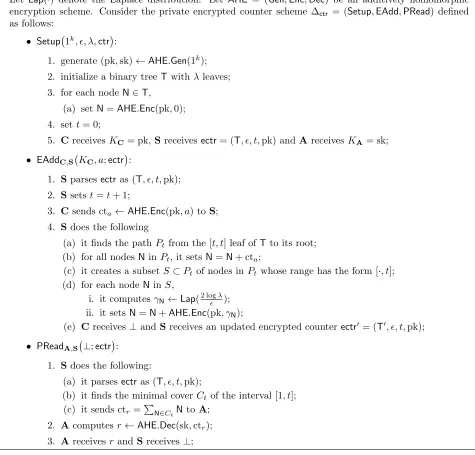
We now describe an encrypted private counter based on the binary mechanism called CPX. Our construction is described in Fig. (1) and works as follows.
Setup. The Setup algorithm takes as input the security parameter 1k, the privacy parameter and the number of update operations to be made λ. The curator initializes a binary tree T with λ leaves where every node consists of an additively-homomorphic encryption of 0. The private encrypted counter ectr is a tuple composed of the tree T, the privacy parameter , a time step t initialized to 0 and the public key of the homomorphic encryption.
which it adds the encryption of a freshly sampled noise. The server also increments the internal time step t.
Private read. To read the value of the counter after the ith operation, the server simply sends to the analyst the sum of all nodes belonging to the minimum cover of [1, i] which the analyst later decrypts.
Let Lap(·) denote the Laplace distribution. Let AHE = (Gen,Enc,Dec) be an additively homomorphic encryption scheme. Consider the private encrypted counter scheme ∆ctr = (Setup,EAdd,PRead) defined as follows:
• Setup 1k, , λ,ctr:
1. generate (pk,sk)←AHE.Gen(1k);
2. initialize a binary treeT withλleaves;
3. for each nodeN∈T,
(a) setN=AHE.Enc(pk,0);
4. sett= 0;
5. C receivesKC= pk,Sreceivesectr= (T, , t,pk) andAreceivesKA= sk; • EAddC,S KC, a;ectr
:
1. Sparsesectras (T, , t,pk);
2. Ssetst=t+ 1;
3. C sends cta ←AHE.Enc(pk, a) toS;
4. Sdoes the following
(a) it finds the pathPtfrom the [t, t] leaf ofTto its root;
(b) for all nodesNin Pt, it setsN=N+ cta;
(c) it creates a subsetS⊂Ptof nodes inPtwhose range has the form [·, t];
(d) for each nodeNin S,
i. it computesγN←Lap(2 log λ); ii. it setsN=N+AHE.Enc(pk, γN);
(e) Creceives⊥andSreceives an updated encrypted counterectr0= (T0, , t,pk);
• PReadA,S ⊥;ectr:
1. Sdoes the following:
(a) it parsesectras (T, , t,pk);
(b) it finds the minimal coverCtof the interval [1, t];
(c) it sends ctr=PN∈CtNtoA;
2. Acomputesr←AHE.Dec(sk,ctr);
3. Areceivesrand Sreceives⊥;
Figure 1: CPX: Range tree based Encrypted private counter.
5.1 Efficiency and Utility
The complexity of both the encrypted add and private query are
where λ is the upper bound on the number of updates while timeAHE is the time complexity of a homomorphic operation. This stems from the fact that the size of the minimum cover in a range tree is upper bounded by 2 logλ. Moreover, the round complexity of both protocols is equal to 1.
Theorem 5.1. For each t∈[λ], CPX is (α, δ)-useful, where α =O(1 ·(logλ)√logλ·log1δ), and , δ >0.
The proof of Theorem 5.1is in Appendix.A.1.
5.2 Security
In the following, we detail the security guarantees of CPX against persistent, snapshot and statis-tical adversaries, respectively.
Against a persistent adversary. The setup leakage of CPX consists of the size of the tree which is equal to the upper bound on the number of updates λsuch that
LctrS (ctr) =λ.
Both the add leakage and the private query leakage of CPX are equal to⊥as they do not depend of the curator’s input such that
LctrA (ctr, a) =⊥ and LctrP (ctr,⊥) =⊥.
Theorem 5.2. If AHE is CPA-secure, then CPX is (Lctr
S ,LctrA ,LctrP )-secure. The proof of Theorem 5.2is in Appendix.A.2.
Leakage against a snapshot adversary. The snapshot leakage Lctr
SN of CPX is equal, for all i∈[m], to
Lctr
SN(ctr,σi) =λ.
Theorem 5.3. If AHE is CPA-secure, then CPX is (m,Lctr
SN)-snapshot secure.
The proof of Theorem 5.3 is in Appendix A.3. Note that CPX is breach-resistant based on Definition4.6 whenm=poly(k).
Against a statistical adversary. As detailed above, CPX is an encrypted variant of the binary mechanism. In particular, the private responses of CPX have the same exact distribution (on the same sequences of operations) as the binary mechanism and, therefore inherits the same differential privacy parameters. In particular we have the following Theorem.
Theorem 5.4. ThePRead protocol in CPX is -differentially private as per Definition 4.7.
The proof of this theorem is similar to the one of the binary mechanism in [19] and we defer it to the full version of this work.
6
HPX: An Encrypted Database for Private Histograms Queries
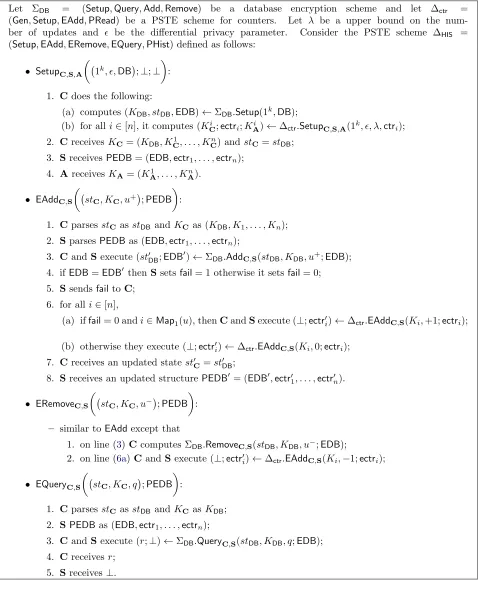
Overview. At a high-level, HPX works as follows. We are given a database DB and a his-togramH={ctr1, . . . ,ctrn} initialized to 0. We also assume the existence of a functionMap1 that
maps database updates uto multiple counters in H. Our construction produces (n+ 1) encrypted structures: EDB and ectr1, . . . ,ectrn. The first results from encrypting the database DB with an appropriate structured encryption scheme. The curator interacts with EDB to query and update its database. The structures (ectr1, . . . ,ectrn) are private encryptions of the histogram counters
(ctr1, . . . ,ctrn) and are used by the server to answer the analyst’s queries. Whenever the curator successfully updates its EDB with an updateu+, it also increments theith counterctri by 1, where i∈Map1(u+). To hide which counter was updated, however, it also increments all the remaining counters by 0.
The efficiency of our scheme depends on the efficiency of the underlying encrypted database EDBand is linear inn. In terms of security, we provide a black-box leakage analysis of HPX’s leak-age. We then show that if its underlying encrypted structures are instantiated with zero leakage or almost zero-leakage constructions then HPX’s leakage profile is minimal.
HPX makes use of a dynamic response-hiding structured encryption scheme ΣDB= (Setup,Query,
Add,Remove) and a private encrypted counter scheme ∆ctr= (Setup,EAdd,PRead) (e.g., the con-struction described in Section 5). Our construction is described in detail in Figs. (2) and (3) and works as follows.
Setup. The Setup algorithm takes as input a database DB and the size of the histogram n. It initializes n counters (ctr1, . . . ,ctrn). It then encrypts DB with ΣDB which results in EDB, and encrypts each ctri with ∆ctr which results in (ectr1, . . . ,ectrn). The private EDB is PEDB =
(EDB,ectr1, . . . ,ectrn).
Encrypted queries. To query the EDB, the curator and server execute the ∆.Query protocol where the curator inputs its query q and the server inputs PEDB. This protocol in turn executes EDB’s query protocol on the same inputs and returns the response to the curator.
Database updates. To add or remove an item u to/from the database, the curator first up-dates EDB using the appropriate update protocol (either ΣDB.Add or ΣDB.Remove). The server then returns a message to the curator indicating whether the operation succeeded or failed. The curator and server then update all the private encrypted counters (ectr1, . . . ,ectrn) as follows. If the operation succeeded and i ∈ Map1(u) (i.e., the update is associated to the ith counter) then ectri is incremented by 1 (in case of addition, otherwise it is decremented by 1), otherwise ectri is incremented by 0. Incrementing all the counters—even the ones that are not relevant to the update—hides which counter is updated from the server. This is crucial to hide the values of the histogram from the server. To see why, suppose we did not hide which counter is updated after an EDB operation (i.e., an EAdd or ERemove). Note that the server knows whether the EDB op-eration was an add or a remove and whether the opop-eration succeeded or failed. It can determine the success or failure simply by comparing EDB to EDB0. If, in addition to this, it also knew which counter got updated after the EDB operation, it would know whether that counter was in-cremented, decremented or kept constant. And from this information the server effectively knows the histogram.
Let ΣDB = (Setup,Query,Add,Remove) be a database encryption scheme and let ∆ctr = (Gen,Setup,EAdd,PRead) be a PSTE scheme for counters. Let λ be a upper bound on the num-ber of updates and be the differential privacy parameter. Consider the PSTE scheme ∆HIS = (Setup,EAdd,ERemove,EQuery,PHist) defined as follows:
• SetupC,S,A
1k, ,DB
;⊥;⊥
:
1. C does the following:
(a) computes (KDB, stDB,EDB)←ΣDB.Setup(1k,DB); (b) for alli∈[n], it computes (Ki
C;ectri;KAi )←∆ctr.SetupC,S,A(1k, , λ,ctri);
2. C receivesKC= (KDB, KC1, . . . , KCn) andstC=stDB; 3. SreceivesPEDB= (EDB,ectr1, . . . ,ectrn);
4. AreceivesKA= (KA1, . . . , KAn).
• EAddC,S
stC, KC, u+
;PEDB
:
1. C parsesstC asstDB andKC as (KDB, K1, . . . , Kn);
2. SparsesPEDBas (EDB,ectr1, . . . ,ectrn);
3. C andSexecute (st0DB;EDB0)←ΣDB.AddC,S(stDB, KDB, u+;EDB); 4. ifEDB=EDB0 thenSsetsfail= 1 otherwise it setsfail= 0;
5. SsendsfailtoC;
6. for alli∈[n],
(a) iffail= 0 andi∈Map1(u), thenCandSexecute (⊥;ectri0)←∆ctr.EAddC,S(Ki,+1;ectri);
(b) otherwise they execute (⊥;ectr0i)←∆ctr.EAddC,S(Ki,0;ectri);
7. C receives an updated statest0C=st0DB;
8. Sreceives an updated structurePEDB0 = (EDB0,ectr01, . . . ,ectr0n).
• ERemoveC,S
stC, KC, u−
;PEDB
:
– similar to EAddexcept that
1. on line (3)Ccomputes ΣDB.RemoveC,S(stDB, KDB, u−;EDB);
2. on line (6a)CandSexecute (⊥;ectr0i)←∆ctr.EAddC,S(Ki,−1;ectri);
• EQueryC,S
stC, KC, q
;PEDB
:
1. C parsesstC asstDB andKC asKDB; 2. SPEDBas (EDB,ectr1, . . . ,ectrn);
3. C andSexecute (r;⊥)←ΣDB.QueryC,S(stDB, KDB, q;EDB); 4. C receivesr;
5. Sreceives⊥.
• PHistA,S
KA, qp
;PEDB
:
1. AparsesKA as (K1, . . . , Kn);
2. SparsesPEDBas (EDB,ectr1, . . . ,ectrn);
3. AandSexecute (rp;⊥)←∆
ctr.PReadA,S
Kqp;ectrqp
;
4. Aoutputsrp andSoutputs⊥.
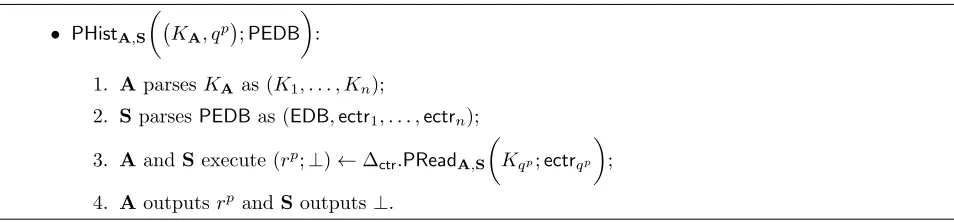
Figure 3: HPX: our PSTE construction for histograms (Part 2).
6.1 Efficiency and Utility
The query complexity of HPX is equal to the query complexity of the underlying database encryp-tion scheme ΣDB. In other words, its query complexity is
O
timeqDB(q)
,
wheretimeqDB is the query complexity ΣDB. Similarly, the round complexity of the query protocol is equal to the round complexity of the query protocol of ΣDB. The update complexity (whether it is anEAddor a ERemove) of HPX is
O
timeuDB(v) +n·timectr(λ)
,
where timeuDB is the update complexity of the database encryption scheme ΣDB,timectr is the add complexity of the private counter encryption scheme ∆ctr,nis the number of bins in the histogram, and λ is the upper bound on the number of updates. We stress that even though the update complexity is linear inn, the latter is usually a small constant. In fact, in practice, the number of bins is often decided a-priori by the analyst and is usually a small constant [4,57,47,65]. In this case, the update complexity of HPX is
O
timeuDB(v) +timectr(λ)
.
The round complexity of bothEAddand a ERemoveis
O
roundsuDB(v) +roundsactr(λ)
,
where roundsuDB and roundsactr are the round complexities of the update and the add protocols of ΣDB and ∆ctr, respectively. The private query complexity of HPX is
O
timepctr(λ)
,
Additional remarks about update complexity. As discussed above, in practice, the number of bins is a small constant but there are applications where the number of bins might be ω(1). In particular, Sturges [60] shows that, when the data is approximately normally distributed, then setting nto
n= 1 +dlog|U|e
is sufficient for data analytics, whereUis the update space of the database. In this case, the update complexity is equal to
O
timeuDB(v) + log|U| ·timectr(λ)
.
Note also that there is a variant of our construction that reduces the update complexity to
O
timeuDB(v) +n
.
at the cost of increasing the private query complexity to
O
timepctr(λ) + logλ·timectr(λ)
Due to space limitation, we defer the details of this variant to the full version of this work.
Theorem 6.1. For each t∈[λ], HPX is (α, δ)-useful, where α =O(1 ·(logλ)√logλ·log1δ), and , δ >0.
The utility of HPX is equal to the utility of CPX. This is because for each private query, one of the counters is read and returned.
6.2 Security
In the following, we detail the security guarantees of HPX against standard, snapshot and statistical adversaries, respectively.
Security against a persistent adversary. The setup leakage of HPX consists of the setup leakage of its underlying building blocks. In particular, this includes the setup leakage of the database encryption scheme and the setup leakage of the encrypted private counter, for all n counters. The query leakage is equal to the query leakage of the underlying database encryption scheme. The update leakage, whether it is an add or remove leakage, includes the update leakage of the underlying database encryption scheme and, for alli∈[n], the add leakage of the underlying encrypted private counter scheme. The private query leakage of a query consists of, the private query leakage of the underlying private counter scheme along with the counter identifier. We now give a precise description of HPX’s leakage profile and show that it is adaptively-secure with respect to it. Its setup leakage is
LS(DB) =
LdbS (DB),
LctrS (ctri)
i∈[n]
.
Its query leakage is equal to
Its respective add and remove leakages LA and LR on the respective add and remove updates u+ and u− are equal to for all a∈ {−1,0,1}
LA(DB, u+) =
LdbA(DB, u+), LActr(ctri, a)i∈[n]
,
LR(DB, u−) =
Ldb R (DB, u
−)), Lctr
A (ctri, a)
i∈[n]
.
Its private query leakage is equal to
LP(DB, qp) =
qp,LctrP (ctrqp,⊥)
.
Theorem 6.2. If ΣDB is(LdbS ,LdbQ,LdbA ,LRdb)-secure, and∆ctr is(LctrS ,LctrA ,LctrP )-secure, then HPX is (LS,LQ,LA,LR,LP)-secure.
The proof of Theorem 6.2is in AppendixB.1.
Security against a snapshot adversary. The snapshot leakage LSN of HPX is equal to the snapshot leakage of its underlying primitives such that
LSN(DB,σi) =
LdbSN(DB,σi),
LctrSN(ctrj,σi)
j∈[n]
.
Theorem 6.3. If ΣDB is (m,LdbSN)-snapshot secure, and ∆ctr is (m,LctrSN)-snapshot secure, then HPX is (m,LSN)-snapshot secure.
The proof of Theorem6.3is in AppendixB.2. Clearly, if both ΣDBand ∆ctrare breach-resistant then HPX is breach-resistant as well based on Definition4.6.
Leakage vs. update complexity and utility. Recall that the update complexity is linear in n because all the counters are updated during an HPX update. More precisely, the counters in Map1(v) are incremented with +1/−1 and the rest are incremented with 0. This is to hide the identity of the counters in Map1(v) from the adversaries. If one is willing to leak this, the update complexity improves to
O
timeuDB(v) +|Map1(v)| ·timectr(λ)
,
while the add/remove leakage and the snapshot leakage will now include, in addition, the identities of the updated countersMap1(v). This will also improve the utility of the counters because, roughly speaking, they will be incremented less often so less noise will be added.
Security against a statistical adversary. To show that our HPX construction is differentially-private, we need to show thatPHist is differentially private as per Definition4.7. For this, we first show that any two neighboring update operation sequences induce operation sequences on the counters that differ in at most two time places. As the next step of the proof, we show that, given that ∆ctr is differentially private,PHist is differentially private.
to the rest of the counters. Similarly, a successfulEAddof operandoleads to a 1 being added to all counters in Map1(o), while 0 to the rest of the counters. Therefore, the operation that is induced on the counters isalways EAddbut the operands come from{−1,0,1}. We therefore slightly abuse the notation and say that a curator’s update operation induces an operation in {−1,0,1} on the counters.
Before introducing our lemma and our main theorem, we set up some notations. Let σ = (op1, o1), . . . ,(opλ, oλ)
be an update operation sequence, where opi ∈ {EAdd,ERemove} and oi ∈ U. For alli∈[n], we define a new mappingMapi2 that, intuitively, creates the operation sequences
in{−1,0,1}λfor theith counter. We call these sequences thecounter mapped sequences. Formally, for each j∈[λ], we have,
Mapi2[σj] =
1 ifopj =EAddand j∈Map1(oj)
−1 ifopj =ERemoveand j∈Map1(oj) 0 otherwise.
Also, for every i ∈ [n], we define a another mapping Mapi3, that captures whether the jth operation in the update operation sequence is successful or not. We call these sequences the operation mapped sequences. Formally,
Mapi3
Mapi2[σj]
=
Mapi2[σj] ifoj succeeds
0 otherwise.
We abuse the notation and we set
Mapi2[σ] = Mapi2[σj])j∈[λ]
and similarly
Mapi3
Mapi2[σ]
=
Mapi3
Mapi2[σj]
j∈[λ]
.
In the following, we show that any update operation sequences that differ in at most one operation, lead to two operation mapped sequences that differ in at most two operations.
Lemma 6.4. Given any two update operation sequences σ and σ0 such that ||σ−σ0|| ≤1, and for anyi∈[n], we have
Mapi3
Mapi2[σ]
−Mapi3
Mapi2[σ0] ≤2
We provide the proof of Lemma 6.4 in Appendix B.3. Since an updateu ∈U can be mapped to|Map1(u)|counters, the overall privacy is degraded by a multiplicative maxu∈U|Map1(u)|factor.
Given the results of the lemma above, we now state our main theorem.
Theorem 6.5. If ∆ctr is-differentially-private, then HPX is 2·maxu∈U(|Map1(u)|)-differentially
private as per Definition 4.7.
We provide the proof of Theorem 6.5in AppendixB.4.
7
Handling Collusions
Snapshot and statistical adversary. First, note that collusion between a snapshot and statis-tical adversary is equivalent to the adversary considered in the pan-privacy literature. In [19], Chan et al. construct a pan-private counter for a single unannounced intrusion and multiple announced intrusions based on the same binary mechanism described in Section 5. In the former, additional noise is added to all the nodes of the binary tree during setup to prevent the adversary from getting the real node values at the time of intrusion. This added noise protects against the intrusion but degrades the utility by a factor of 2. They then extend this method to support multiple announced intrusions by adding increasing amounts of noise and further degrading the utility. In particular, kintrusions reduce the utility by O(√k+ 1).
To handle this kind of collusion, it suffices to replace all the counters in CPX with the pan-private counters of [19]. To encrypt the database, we then use snapshot-secure STE scheme with zero-leakage; that is, with leakage that reveals at most some public parameter (e.g., the security parameter or any parameter that is chosen independently of the database). Note that this is simple to achieve by padding the database and encrypting it with a breach-resistant STE scheme [5].
Persistent and statistical adversary. This is a stronger setting than above because achieving differential privacy requires us to hide whether an add or a remove operation occurred. This is particularly difficult to do against an adversary that holds the encrypted database EDB because the size of EDB before and after an operation reveals which operation occured. This essentially requires us to use anEDBwith zero-leakage updates. Another challenge is that many STE schemes leak the sizes of query responses which could be correlated with the size ofEDB. To handle this, we need to use an STE scheme with zero-leakage queries. One possible instantiation is to make use of ORAM simulation [33] where all query responses in the database have to be padded to be equal to the same length– a function of some public parameter. This instantiation, however, will induce a polylogarithmic multiplicative overhead on both the query and update complexities.
Notice that when the persistant and statistical adversaries collude, there is no need to encrypt the counters since the analyst holds the decryption key. In addition, since the server samples the noise for the counters, it can easily infer the increments made. We can therefore use plaintext counters maintained in a simple register (i.e., there is no need to use the binary tree mechanism of Chan et al.) and use the following approach to maintain them. To increment the counters, the curator sends to the server an increment of +1/−1/0 with noise for each counter. Upon receiving the noisy increment, it adds it to the current value in the register. The PRead protocol returns the current register value. We note that this approach is similar to the second simple counting mechanism of [19]. In fact, using a proof very similar to that of Theorem 1.3 of [19], this approach can be shown to be-differentially private and (α, δ)-useful, where α=O
√ λ ·log
1
δ
and , δ >0. Note that this approach meets Dwork et al.’s lower bound of √k on utility for k intrusions [26], proving that this construction is almost tight.
8
Efficiency Estimates
In this Sectoin, we estimate the efficiency of our construction. To do this we conducted micro-benchmarks of all the building blocks and then estimated the cost of the various operations.
respectively. Our test environment was a MacBook Pro 3.1 GHz Intel Core i7 with 16 GB of memory.
Micro-benchmarks. We instantiated Paillier with a 2048-bit key. Encryption, decryption and addition took on average 18, 70 and 513 ms, respectively. With a multi-map holding 10 millions pairs, DLS.Setup, DLS.Getand DLS.Put took 10 minutes, 33 ms and 1 microsecond, respectively. We used Sturges’ formula on our datast to determine the bins. This resulted in 25 bins.
Estimates. Based on the micro-benchmarks above, we estimate that for a multi-map holding 10 million pairs, HPX.Setupwill take about 10 minutes, HPX.EAddand HPX.ERemovewill take 0.96 minutes, HPX.EQuery will take 1 microsecond.
Acknowledgements
The authors would like to thank DIMACS and the organizers of the Workshop on Overcoming Barriers to Data Sharing including Privacy and Fairness where the ideas for this work were first generated.
References
[1] Javallier. https://github.com/snipsco/paillier-libraries-benchmarks/tree/master/ java-javallier.
[2] J. Abowd. The challenge of scientific reproducibility and privacy protection for statisti-cal agencies., 15 September 2016. https://www2.census.gov/cac/sac/meetings/2016-09/ 2016-abowd.pdf.
[3] G. Acs and C. Castelluccia. A case study: privacy preserving release of spatio-temporal density in paris. In Proceedings of the 20th ACM SIGKDD international conference on Knowledge discovery and data mining, pages 1679–1688. ACM, 2014.
[4] G. Acs, C. Castelluccia, and R. Chen. Differentially private histogram publishing through lossy compression. In2012 IEEE 12th International Conference on Data Mining, pages 1–10. IEEE, 2012.
[5] G. Amjad, S. Kamara, and T. Moataz. Breach-resistant structured encryption. IACR Cryp-tology ePrint Archive, 2018:195, 2018.
[6] M. E. Andr´es, N. E. Bordenabe, K. Chatzikokolakis, and C. Palamidessi. Geo-indistinguishability: Differential privacy for location-based systems. InProceedings of the 2013 ACM SIGSAC conference on Computer & communications security, pages 901–914. ACM, 2013.
[8] G. Barthe, M. Gaboardi, E. J. Gallego Arias, J. Hsu, A. Roth, and P.-Y. Strub. Higher-order approximate relational refinement types for mechanism design and differential privacy. ACM SIGPLAN Notices, 50(1):55–68, 2015.
[9] A. Blum, K. Ligett, and A. Roth. A learning theory approach to noninteractive database privacy. Journal of the ACM (JACM), 60(2):12, 2013.
[10] R. Bost. Sophos - forward secure searchable encryption. In ACM Conference on Computer and Communications Security (CCS ’16), 20016.
[11] R. Bost, B. Minaud, and O. Ohrimenko. Forward and backward private searchable encryption from constrained cryptographic primitives. InACM Conference on Computer and Communi-cations Security (CCS ’17), 2017.
[12] J. A. Calandrino, A. Kilzer, A. Narayanan, E. W. Felten, and V. Shmatikov. ” you might also like:” privacy risks of collaborative filtering. In Security and Privacy (SP), 2011 IEEE Symposium on, pages 231–246. IEEE, 2011.
[13] J. Cao, Q. Xiao, G. Ghinita, N. Li, E. Bertino, and K.-L. Tan. Efficient and accurate strate-gies for differentially-private sliding window queries. InProceedings of the 16th International Conference on Extending Database Technology, pages 191–202. ACM, 2013.
[14] Y. Cao and M. Yoshikawa. Differentially private real-time data release over infinite trajectory streams. InMobile Data Management (MDM), 2015 16th IEEE International Conference on, volume 2, pages 68–73. IEEE, 2015.
[15] Y. Cao and M. Yoshikawa. Differentially private real-time data publishing over infinite trajec-tory streams. IEICE TRANSACTIONS on Information and Systems, 99(1):163–175, 2016.
[16] Y. Cao, M. Yoshikawa, Y. Xiao, and L. Xiong. Quantifying differential privacy under temporal correlations. InData Engineering (ICDE), 2017 IEEE 33rd International Conference on, pages 821–832. IEEE, 2017.
[17] D. Cash, J. Jaeger, S. Jarecki, C. S. Jutla, H. Krawczyk, M.-C. Rosu, and M. Steiner. Dynamic searchable encryption in very-large databases: Data structures and implementation. InNDSS, volume 14, pages 23–26. Citeseer, 2014.
[18] D. Cash, S. Jarecki, C. Jutla, H. Krawczyk, M. Rosu, and M. Steiner. Highly-scalable search-able symmetric encryption with support for boolean queries. In Advances in Cryptology -CRYPTO ’13. Springer, 2013.
[19] T. H. Chan, E. Shi, and D. Song. Private and continual release of statistics. In Automata, Languages and Programming, 37th International Colloquium, ICALP 2010, Bordeaux, France, July 6-10, 2010, Proceedings, Part II, pages 405–417, 2010.
[20] M. Chase and S. Kamara. Structured encryption and controlled disclosure. In Advances in Cryptology - ASIACRYPT ’10, volume 6477 of Lecture Notes in Computer Science, pages 577–594. Springer, 2010.