A Steganographic Method Based On Optimal
Pixel Adjustment Process and Integer Wavelet
Transform
E. Suresh
1,
S. Philomina*
2Assistant Professor, Dept. of ECE, Jerusalem College of Engineering,Chennai, Tamil Nadu, India1 Assistant Professor, Dept. of ECE, Bharath University, Chennai, Tamil Nadu, India2
*
Corresponding Author
ABSTRACT: This paper proposes a novel steganography scheme based on Integer Wavelet Transform and Optimal Pixel Adjustment Process. The novel scheme embeds data in integer wavelet transform coefficients in an 8x8 block on the cover image. The Optimal Pixel Adjustment Process is applied after embedding the message. We employed frequency domain to increase the robustness of our steganography method. Integer wavelet transform avoids the floating point precision problems of the wavelet filter. We use Integer Wavelet Transform and Optimal Pixel Adjustment Process to obtain an optimal mapping function to reduce the difference error between the cover and the stego-image and to increase the hiding capacity with low distortions respectively, Peak Signal to Noise Ratio.
KEYWORDS: Steganography, Integer Wavelet Transform, Optimal Pixel Adjustment Process, Peak Signal to Noise Ratio
I. INTRODUCTION
JPEG, a standard image compression technique, employs Discrete Cosine Transfonn (DCT). Several steganography techniques for data hiding in JPEG have been proposed; such as JSteg, JP Hide & Seek and Outguess. Most recent researches utilize Discrete Wavelet Transform (DWT) because of its wide application in the new image compression standard, JPEG 2000. An example is the employment of an adaptive data embedding technique with the use of OPAP to hide data in Integer Wavelet coefficients of the cover image.The application of Optimal Pixel Adjustment Process in steganography can increase the capacity or imperceptibility. Fard, Akbarzadeh and Varasteh proposed a GA evolutionary process to make secure steganography encoding on the JPEG images. Rongrong et al introduced an optimal block mapping LSB method based on Genetic Algorithm.
Steganography is the art and science of hiding data in a cover. The cover can be text, audio, image, video, etc .We can divide the data hiding techniques into two groups: spatial and frequency domain. The first group is based on embedding message in the Least Significant Bits (LSB) of image pixels. The basic LSB method has a simple implementation and high capacity. However, it has low robustness versus some attacks such as low-pass filtering and compression .A variant of LSB method can be found in that proposes an Optimal Pixel Adjustment Process (OPAP) in which image quality of the stego-image can be improved with low computational complexity. The group finds the frequency coefficients of images and then embeds the messages with them. These hiding methods overcome the robustness and imperceptibility problem found in spatial domain.
This paper is organized as follows: Section II Introduces the proposed algorithm in detail. Section III discusses the achieved results and compares the proposed scheme with the state of the art. Section IV concludes the paper.
II. THE STEGANOGRAPHY METHOD
In the proposed method, the message is embedded on Integer Wavelet Transfonn coefficients based on Optimal Pixel Adjustment Process (OPAP).This section describes this method, and the embedding and extracting algorithms in detail [1].
A. Integer Wavelet Transform
The proposed algorithm employs the wavelet transform coefficients to embed messages into four sub bands of two dimensional wavelet transform. To avoid problems with floating point precision of the wavelet filters, we used Integer Wavelet Transform [2-3]. The LL sub band in the case of IWT appears to be a close copy with smaller scale of the original image while in the case of DWT the resulting LL sub band is distorted as shown in "Fig.1”.
+ /2
Then the inverse transform can be calculated by: These equations should be in 2D in order to be applied on images [5], [12]. Simple 2D transform has employed in this paper and it can be computed for an image.
=
= (3)
B. Genetic Algorithm
This paper embeds the message inside the cover with the least distortion therefore we have to use a mapping function to LSBs of the cover image according to the content of the message [4]. We use Genetic Algorithm to find a mapping function for all the image blocks. Block based strategy can preserve local image property and reduce the algorithm complexity compared to single pixel substitution.
1.)GA Operations
Mating and mutation functions are applied on each chromosome. The mutation process causes the inversion of some bits and produces some new chromosomes, then, we select elitism which means the best chromosome will survive and be passed to the next generation [6].
2.)Fitness function
Selecting the fitness function is one of the most important steps in designing a GA-based method [10-11]. Whereas our GA aims to improve the image quality, Pick Signal to Noise Ratio (PSNR) can be an appropriate evaluation test. Thus the definition of fitness function will be:
(4)
Where M and N are the image sizes and, x and y are the image intensity values before and after embedding [7].
C. OPAP algorithm
The main idea of applying OPAP is to minimize the error between the cover and the stego image. For example if the pixel number of the cover is 10000 (decimal number16) and the message vector for 4 bits is 1111, then the pixel number will change to 11111 (decimal number 31) and the embedding error will be IS, while after applying OPAP algorithm the fifth bit will be changed from 1 to 0, and the embedding error is reduced to 1 [8].
The OPAP algorithm can be described as follows:
Case 1 (2k-I < &i < 2k): if pi'2: 2k, then pi " = pi'-2k otherwise pi" = pi'; Case 2 (-2k-I < &i < 2k-I): pi " = pi';
D. Embedding Algorithm
The following steps explain the embedding process:
Step 1. Divide the cover image into 8x8 blocks.
Step2. Find the frequency domain representation of blocks by 2D Integer Wavelet Transform and get four sub bands LLl, HLl, LHI, and HHI.
Step3. Image containing the pixels numbers of each 8x8 blocks as the mapping function.
Step3. Embed the message bits in 4-LSBs IWT coefficients each pixel according to mapping function. Step 4. Fitness evaluation is performed to select the best mapping function.
Step5. Apply Optimal Pixel Adjustment Process on the image. Step 6. Calculate inverse 2D-IWT on each 8x8 block.
1.) Extraction Algorithm
The extraction algorithm consists of four steps as follows: Step 1. Divide the cover image into 8x8 blocks.
Step2. Extract the transform domain coefficient by 2D-IWT of each 8x8 block.
Step3. Employ the obtained mapping function in the embedding phase and find the pixel sequences for extracting. Step4. Extract 4-LSBs in each pixel.
III. EXPERIMENTAL RESULTS
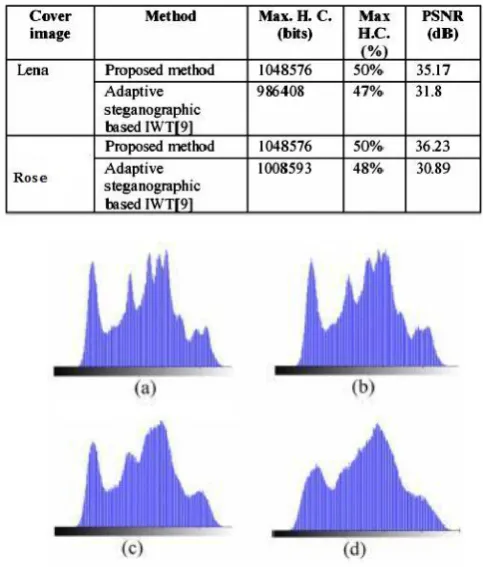
The proposed method is applied on SI2xSI2 8-bit gray scale images "Rose" and "Lena". The simulation is implemented on 2.SGHZ Core 2 Duo processor, 4GB RAM and Windows Vista OS and Matlab7.6. The messages are generated randomly with the same length as the maximum hiding capacity [9]. Table I shows the stego image quality by PSNR.Human visual system is unable to distinguish the gray scale images with PSNR more than 3S dB. This paper embedded the messages in the 4-LSBs and received a reasonable PSNR. "Fig. 3" shows the images after and before embedding.
(a) (b)
(c) (d)
TABLE I.CAPACITY AND PSNR OBTAINED
FOR 4-LSBs AND 5-LSBS
Cover Hiding PSNR(Db)
Image Capacity(Bits)
1048576 (4LSBs) 35.17
Lena
l3l0720 (5-LSBs) 29.08
1048576(4-LSBs) 36.23
Rose
1310720(5-LSBs) 29.49
TABLE II. COMPARISON OF CAPACITY AND PSNR OBTAINED FROM OUR METHOD AND THE PROPOSED METHOD
IV. CONCLUSIONS
This paper presented a novel technique to increase the capacity and the imperceptibility of the image after embedding , and then applied the Optimal Pixel Adjustment Process to increase the hiding capacity of the algorithm in comparison to other systems. The drawback of this method is the execution time that can be the subject of our future studies to GA is employed to obtain an optimal mapping function to reduce the error difference between the cover and the stego image and and to reduce the algorithm complexity to increase the PSNR using optimization algorithms such as genetic algorithm.
REFERENCES
1. Dr. H. B. Kekre, Ms. Archana A. Athawale, “Information Hiding using LSB Technique with Increased Capacity”, International Journal of Cryptography and Security, Special issue on Steganography, 2008.
2. Sengottuvel P., Satishkumar S., Dinakaran D., "Optimization of multiple characteristics of EDM parameters based on desirability approach and fuzzy modeling", Procedia Engineering, ISSN : 1877-7058, 64() (2013) pp.1069-1078.
3. N. Wu and M. Hwang, "Data hiding: current status and key issues," International Journal of Network Security, vol4, No.1, pp. 1-9, Jan. 2007. 4. W. Chen, "A comparative study of information hiding schemes using amplitude, frequency and phase embedding," PhD thesis, National Cheng
Kung University, Taiwan, May 2003.
5. Muruganantham S., Srivastha P.K., Khanaa, "Object based middleware for grid computing", Journal of Computer Science, ISSN : 1552-6607, 6(3) (2010) pp.336-340.
6. K. B. Raja, Kiran Kumar. K, Satish Kumar. N, Lashmi. M. S, Preeti. H, Venugopal. K. R. and Lalit. M. Patnaik "Genetic algorithm based steganography using wavelets," International Conference on Information System Security Vol. 4812, pp, 51-63. 2007.
7. Anbazhagan R., Satheesh B., Gopalakrishnan K., 'Mathematical modeling and simulation of modern cars in the role of stability analysis", Indian Journal of Science and Technology, ISSN : 0974-6846, 6(S5) (2013) pp.4633-4641.
8. A.M. Fard, M.R Akbarzadeh and A. F Varasteh. "A new genetic algorithm approach for secure JPEG steganography," International Conference on Engineering of intelligence Systems, pp 1 6,2006.
9. Rajendran S., Muthupalani R.S., Ramanathan A., "Lack of RING finger domain (RFD) mutations of the c-Cbl gene in oral squamous cell carcinomas in Chennai, India", Asian Pacific Journal of Cancer Prevention, ISSN : 1513-7368, 14(2) (2013) pp.1073-1075.
10. N. Wu and M. Hwang, "Data hiding: current status and key issues," International Journal of Network Security, vol4, No.1, pp.1-9, Jan. 2007. 11. C. K. Chan and L. M. Chang, "Hiding data in images by simple LSB substitution," Pattern Recognition, pp. 469-474, Mar. 2004.
12. Langeswaran K., Revathy R., Kumar S.G., Vijayaprakash S., Balasubramanian M.P., "Kaempferol ameliorates aflatoxin B1 (AFB1) induced hepatocellular carcinoma through modifying metabolizing enzymes, membrane bound ATPases and mitochondrial TCA cycle enzymes", Asian Pacific Journal of Tropical Biomedicine, ISSN : 2221-1691, 2(S3)(2012) pp.S1653-S1659.
13. B Karthik, TVUK Kumar, MA Dorairangaswamy, E Logashanmugam, Removal of High Density Salt and Pepper Noise Through Modified Cascaded Filter, Middle East Journal of Scientific Research, 20(10),pp 1222-1228, 2014.
14. Daimiwal, Nivedita; Sundhararajan, M; Shriram, Revati; , Applications of fMRI for Brain MappingarXiv preprint arXiv:1301.0001, 2012. 15. Daimiwal, Nivedita; Sundhararajan, M; Shriram, Revati; , Respiratory rate, heart rate and continuous measurement of BP using PPGIEEE
Communications and Signal Processing (ICCSP), 2014 International Conference on, PP 999-10022014.
16. Kamatchi, S; Sundhararajan, M; , Optimal Spectral Analysis for detection of sinusitis using Near-Infrared Spectroscopy (NIRS) .
17. Shriram, Revati; Sundhararajan, M; Daimiwal, Nivedita; , Human Brain Mapping based on COLD Signal Hemodynamic Response and Electrical NeuroimagingarXiv preprint arXiv:1307.4171, 2013