Image Denoising Using Framelet Transform
Swati D. Khandare
1, Vandana Shah
2PG Student, Dept. of ECE, , Sarvajanik College of Engineering, Surat, Gujarat, India1 Assistant Professor, Dept. of ECE, Sarvajanik College of Engineering, Surat, Gujarat, India2
ABSTRACT: Images are produced to record or display useful information or details .Due to flaws in the imaging and capturing process or transmission and compression process, the recorded image always represents noisy version of the original one. The undoing of these imperfections is critical to many of the successive image processing tasks. The visual quality of images plays an important role in accuracy of diagnosis which can be seriously degraded by existing noise. The noise affects both the diagnostic tasks and the ability of automatic computerized analysis, like segmentation, classification, image reconstructions and registration. There are two typical ways for noise reduction in the image processing. One way is that acquiring the data several times and averages them. However this processes is time consuming. Another way for denoise the images by post processing methods. For this purpose construction of efficient, less time consuming and high Quality technique need to be introduce. There are many techniques exist for denoising using wavelet transform but having drawbacks of losing high frequency component containing fine details. Wavelet transform has proved to be effective noise removal technique and also reduce computational complexity with better noise reduction performance. This paper describe the difference between image denoising using DWT and Framelet transform. Framelet transform provide shift invariance property. So using Framelet transform which is nearly similar to wavelet transform only with the difference is that framelet transform contains two or more high frequency filter bank which is used to produce more subband in decomposition.
KEYWORDS: DWT, Framelet Transform,
AWGN
Noise, Image denoisingI. INTRODUCTION
Image denoising is preprocessing step in image processing. In day to day life too many images are captured in so many fields. Those images are transferred to many different locations. Like in MRI centre and also Astronomical application, images are taken and transferred to different locations for analysis but during acquisition or transmission images are corrupted by some noise. Noise modelling in images which are greatly affects images because of instruments used in capturing, data transmission media, image quantization. Depending on noise models different algorithms are used. Most of the natural images are assumed to have additive random noise which is modelled as a Gaussian. In ultrasound images Speckle noise is observed whereas Rician noise affects MRI images[2]. Due to the presence of noise, the information which needs to analyse should be hidden. So that proper prediction is not possible in that case. Some of the standard algorithms use to remove noise from images and perform filtering process but the image is either over smoothen or blur due to loss of edges. Algorithm which remove noise from the image without loss of edges and reconstruct the Image nearer to original is needed. The common assumption during image denoising is that the image is contaminated with Additive White Gaussian noise with zero mean and known variance. It is also assume that the noise in image is stationary and uncorrelated among pixels.
An ideal image x is measured when additive white Gaussian noise with zero mean and constant variance is present in the image. We can formulate the observed image as:
y= x + n (1)
high frequency component then there is possibility for losing fine details of the image. Transforms like wavelet transforms are used for image denoising using sub-band decomposition. Wavelet transform [6] is effective technique in noise removal and also reduce computational complexity, better noise reduction performance. But shift invariance property is absent in DWT. Shift variance exist due to critical sub sampling in DWT. Due to this property every second wavelet at each decomposition level is discarded automatically. So there is a need for enhancement of image quality.
Based on the space field and the transformation field, filtering techniques can be classified. Image denoising can be done in three ways that is using filtering techniques, transform domain and using statistical approach[2]. Filtering techniques can be classified into linear as well as non linear filtering. Good image denoising is that it will remove noise while preserving edges as much as possible. For noise removal linear filters have been used like Gaussian filter. Big advantage of linear noise removal model is speed but they are not able to preserve edges in good manner. Non-linear filter overcome this difficulty. Non-linear filter is very good in preserving edges but smoothly varying region in input image are transformed into piecewise constant region in output image. Image denoising using Transform domain is discussed in below section. In statistical / estimation methods, estimation of the noise variance is a essential step in removal of noise for several reasons. First of all it gives a measure of data quality and used to measure the SNR. Knowledge of this noise variance [2] is useful in the analysis. It is very much effective for removal of heavy tail noise and perform effectively for the noise which is depend on signal [7]. It requires prior information of the signal and noise for error estimation and noise removal.
In this paper, we discuss about Framelet Transform for noise reduction from noisy image. The organization of this paper is as follows: section II contains the types of noise and Methods of Eliminating noise, Section III contains Framelet Transform and requirements, Section IV contains Image denoising using Framelet Transform and Section V contains the Results and Discussion. Last section contains the conclusion and references
II.NOISE MODELS AND ASSUMPTION
Additive Noise[1]: Additive white Gaussian noise is evenly distributed over the signal which is added in each pixel evenly and it is also called as Gaussian noise. Each pixel in the noisy image is equal to the sum of the original pixel value and randomly distributed Gaussian noise value.
Substitutive Noise[1]: Substitutive noise like salt and pepper noise. Due to data transmission error, white and black dots are added in the output image.
Multiplicative Noise: This type of noise is occurred in all coherent imaging systems like laser and synthetic aperture radar imagery [1]. Speckle noise is multiplicative noise. In MRI images, noise like speckle noise is observed due to thermal effect[2].
Methods of Eliminating Noise:
Two areas of operations are available for removal of noise i.e. Space field and Transformation field. In space field [3], the data operation is carried on the original image, and processes the image grey value, like neighborhood average method, wiener filter, center value filter and so on. Transformation field has the operational area in the transformation domain of images, and the coefficients after transformation are processed for denoising.
III. FRAMELET TRANSFORM AND REQUIREMENT
most current solution to overcome the shortcoming of the Short time Fourier transform. The use of fully scalable modulated window resolves the signal cutting problem. The window is shifted next to the signal and for every spot spectrum is calculated. Then this process is repeated numerous times with slightly shorter or longer window for each new cycle then the result is time frequency collection of the signal all with different resolution. By using varying window, one can deal resolution in time for resolution in frequency. In order to separate discontinuity in signal requires short basis function and for fine frequency analysis requires long low frequency basis function. This is realize by wavelet transforms where the basis functions are obtained from a single model wavelet by shift and extraction/ contraction [8]
Discrete wavelet transform which transforms the discrete data from time field into frequency field. The value of the transformed data in time frequency field are called the coefficients where large coefficients correspond to the signal and small one corresponds to usually noise [1]. The noise free data is obtained by inverse transforming the proper threshold coefficients.
Orthonormal wavelets have many applications such as in image processing and image denoising. We are interested in tight wavelet frames that are derived from refinable function through a multiresolution analysis. A tight wavelet frame is an overview of an orthonormal wavelet basis by introducing redundancy into a wavelet system. Tight wavelet frames also called as framelet have advantageous features like shift invariant wavelet frame transforms and it may be helpful in recognize patterns in a redundant/repeative transforms. In order to get fast wavelet frame transform also called framelet transform, tight wavelet frames are generally derived from refinable function through MRA[9].
IV. IMAGE DENOISING USING FRAMELET TRANSFORM
Tight frame is generated by B-spline scaling function and two framelets with vanishing moment of order 2 and 1 respectively. It means that the unvarying signal cannot pass through the high pass filter h2 and neither unvarying nor linear signal can pass thought the h1. For large numbers of images these two framelets are capable of capturing the crucial texture information since the natural images are often piecewise smooth and locally uncorrelated. Lifting factorization of this tight frame provides the sparse approximation. If we are combining the lifting factorization of tight frame that is polyphase matrix with the directional lifting structure then we are getting specific translation invariant directional framelet transform. TIDFT is considered as one of the effective sparse approximation tools with edge preserving property for analysis of images.
TIDFT will be used for noise reduction which is based on the MAP estimator. First of all images are transfer into transform domain, and then the denoising algorithm is applied on the framelet coefficient. Since distribution of framelet coefficients take over the behavior like peaked long tail Gaussian like distribution, SCE and ECE distributions[4] are used. Algorithm for noise reduction using TIDFT is as follows:
After applying Translation invariant directional framelet transform on the noisy signal, at the output noisy framelet coefficients are obtained.
Maximum A Posteriori estimation criteria based shrinkage rules like SCE and ECE distribution will be applied on the framelet coefficient.
Calculation of variance of noise and signal is necessary to estimate standard deviation of signal
For checking sparse representation potential of TIDFT, Spherically contour exponential distribution is used and for checking noise suppression capability, elliptically contour exponential distribution is used. This will gives us denoised output image.
V. RESULT AND DISCUSSION
pepper noise and Speckle noise cannot be removed totally by the Framelet because Framelet is additive which can not remove multiplicative noise and the salt and pepper noises which are shown below:
a.
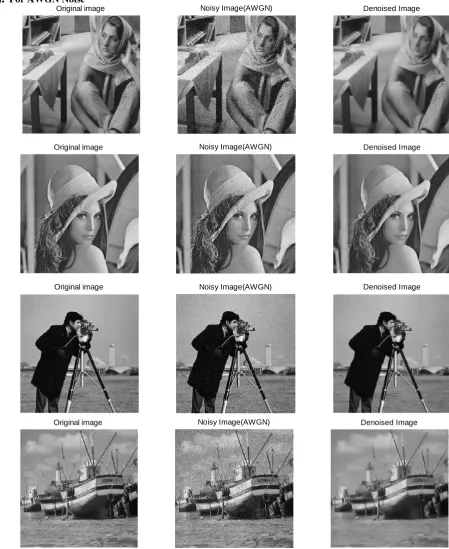
For AWGN NoiseFigure 1 Image Denoising usings Framelet (AWGN Noise)
Original image Noisy Image(AWGN) Denoised Image
Original image Noisy Image(AWGN) Denoised Image
Original image Noisy Image(AWGN) Denoised Image
Figure 1 shows image denoising using framelet transform for AWGN noise, left hand side figure shows original image, figure in middle shows noisy image and right side figure shows denoised image. In the above, original image is contaminated with Additive White Gaussian noise. Framelet based algorithm is applied on the noisy image and get back the denoised original image.
b.
For Salt and Pepper NoiseOriginal image Noisy Image by salt&pepper Denoised Image
Original image Noisy Image by salt&pepper Denoised Image
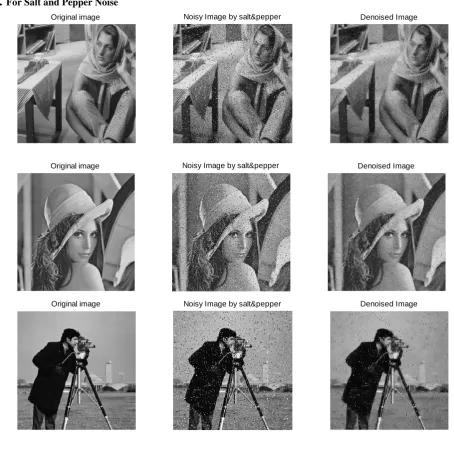
Figure 2 Image Denoising using Framelet (Salt and Pepper)
Figure 2 shows image denoising using framelet transform for Salt and pepper noise, left hand side figure shows original image, figure in middle shows noisy image and right side figure shows denoised image. In the above figure, original image is contaminated with Salt and pepper noise. After applied framelet based algorithm, getting somewhat denoised image in the output. Because Framelet Transform is additive and salt and pepper type of noise consist of random pixel being set to white and black which can be removed by simple Median Filtering.
c.
For Speckle NoiseOriginal image Noisy Image by salt&pepper Denoised Image
Original image Image affected by Speckle noise Denoised image by framelet
Figure 3 Image Denoising using Framelet (Speckle Noise)
Figure 3 shows image denoising using framelet transform for Speckle noise, left hand side figure shows original image, figure in middle shows noisy image and right side figure shows denoised image. In the above figure, original image is corrupted by Speckle Noise and framelet based algorithm is applied to the corrupted image to get the denoied image. But as mentioned earlier framelet transform is additive and cannot remove the multiplicative noise properly.
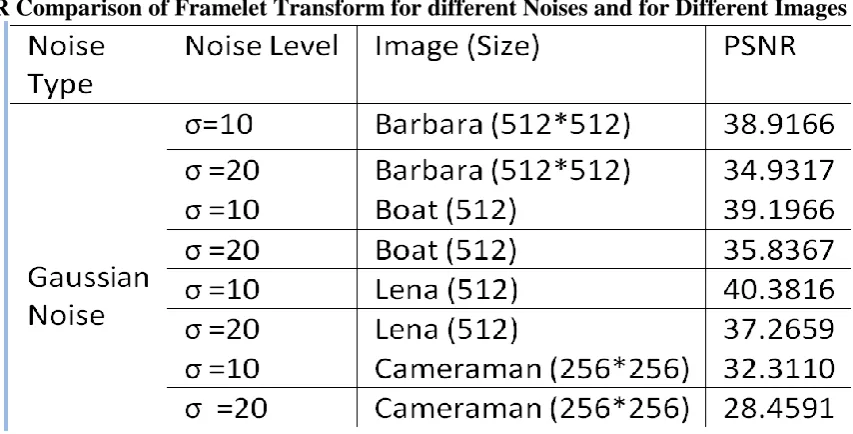
PSNR Comparison of Framelet Transform for different Noises and for Different Images
Original image Image affected by Speckle noise Denoised image by framelet
Above table is the comparision of PSNR value for the images recovered using framelet transform for Gaussian noise, Salt and Pepper Noise and Speckle noise.It can be seen that Framelet Tansform proves better for Gaussian noise and achieved good PSNR value.
IV. CONCLUSION
Image Denoising Using Framelet Transform is implemented and improved PSNR value and recover the corrupted image with high visual quality. Compared PSNR value using Framelet transform for different types of noise such as AWGN, Salt and pepper noise and speckle noise. Framelet Transform have the capability of Noise reduction with edge preserving. Framalet Transform removes the AWGN noise and achieved good PSNR value but can not remove salt and pepper noise and speckle noise completely because Framelet transform is additive and can not remove multiplicative noise.
REFERENCES
[1] S. Sulochana , R.Vidhya , “ Image Denoising using Adaptive Thresholding in Framelet Transform Domain ”,(IJACSA) International Journal of Advanced Computer Science and Applications, Vol. 3, 2012
[2] J. Mohan, V. Krishnaveni, Yanhui Guo, “A survey on the magnetic resonance image denoising methods”, Biomedical Signal Processing and Control, Vol. 9, pp. 56-69, Elsevier, 2014
[3] Sachin D Ruikar, Dharmpal D Doye, “Wavelet Based Image Denoising Technique”, (IJACSA) International Journal of Advanced Computer Science and Applications, Vol. 2, pp. 49-53,March 2011
[4] Yan Shi, Xiaoyuan Yang, and Yuhua Guo, “Translation Invariant Directional Framelet Transform Combined With Gabor Filters for Image Denoising”, IEEE Transactions On Image Processing, Vol. 23, pp. 44-55, January 2014
[5] Kostadin Dabov, Alessandro Foi, Vladimir Katkovnik, and Karen Egiazarian, “Image denoising by sparse 3-D transform-domain collaborative filtering,” IEEE Transactions On Image Processing, vol. 16, no. 8, pp. 2080–2095, Aug. 2007.
IEEE Transactions On Image Processing, Vol. 19, pp. 612 -624,March 2010
[7] A. Ben Hamza and Hamid Krim, “Image Denoising: A Nonlinear Robust Statistical Approach”, IEEE Transactions on Signal Processing, Vol. 49, No. 12, pp.3045-3054, December 2001
[8] Martin Vetterliand Cormac Herley, “Wavelets and Filter Banks: Theory and Design”, IEEE Transactions On Signal Processing, Vol. 40, No 9, pp. 2207-2232, September 1992
[9] Bin Han, QunMo, “Symmetric MRA tight wavelet frames with three generators and high vanishing moments”, Applied and computational
Harmonic analysis, Vol. 18, pp. 67–93, Elsevier, December 2005
[10] Pengliang Yang; Jinghuai Gao; Wenchao Chen, "Noise attenuation of the geophysical data using the framelet transform," IEEE
InternationalGeoscience and Remote Sensing Symposium (IGARSS), pp.2300-2303,July 2012
[11] Lixin Shen, Papadakis, M. Kakadiaris, I.A. Konstantinidis, I. Kouri, D. Hoffman, "Image denoising using a tight frame," IEEE Transactions on
Image Processing, vol.15, no.5, pp.1254-1263, May 2006
[12] X. Wang, G. Shi, and L. Liang, “Image denoising based on translation invariant directional lifting”, IEEE conference on ICASSP, pp. 1446– 1449, July 2010.
[13] Zhou Dengwen, “An Image Denoising Algorithm With An Adaptive Window”, IEEE conference on ICIP , pp. 333-336, 2007.
[14] Claude Knaus, Matthias Zwicker, “Progressive Image Denoising”, IEEE Transactions On Image Processing, Vol. 23, No. 7,pp. 3114-3125, July 2014
[15] K.P. Soman, K.I. Ramachandran, N.G.Resmi, “Insight into Wavelets”, 3rd Edition, Asoke K. Ghosh, PHI Learning Private Limited, New Delhi,