International Journal of Research (IJR)
e-ISSN: 2348-6848, p- ISSN: 2348-795X Volume 2, Issue 08, August 2015Available at http://internationaljournalofresearch.org
Effective Assessment of Software Reliability by Using
Neuro-Fuzzy System
Bonthu Kotaiah
1& R.A. Khan
21 Assistant Professor, Maulana Azad National Urdu University, Hyderabad, India 2 Professor, Babasaheb Bhimrao Ambedkar University, Lucknow, India
1[email protected], 2[email protected] ABSTRACT
Software reliability is defined as the probability of software to deliver correct service over a period of time under a specified environment. This is becoming more and more important in various software organizations to discover the faults that occur commonly during development process. As the demand of the software application programs increases the quality becomes higher and higher and the reliability of these software becomes more essential. Hence Software reliability is mentioned to be as the one of the important factor during development. Many analytical models were being proposed over the years for assessing the reliability of a software system and for modeling the growth trends of software reliability with different capabilities of prediction at different testing phases. A Neuro Fuzzy based software reliability (SR) model is presented to estimate and assess the quality. Multiple datasets containing software failures are applied to the proposed model. These datasets are obtained from several software projects. Then it is observed that the results obtained indicate a significant improvement in performance by using neural fuzzy model over conventional statistical models (Fuzzy Model) based on non homogeneous Poisson process.
1. INTRODUCTION 1.1. BACKGROUND
Dependency on computer aided systems is increasing rapidly day by day and the software systems operating in it .However this quality of service by the system is degraded by some software failures or fails to meet the required level of performance this make many of the people to strike off these Softwares. This model attempt to match product properties with the software quality attributes. Hence if a company is to develop high quality software, it is important to employ some efforts on software reliability and usability. However, this thesis focuses only on software reliability based models.
1.2 Software Reliability
The American Institute of Aeronautics and Astronautics (AIAA) defines SRE as "the application of statistical techniques to data collected during system development and operation to specify, predict, estimate, and assess the reliability of software-based systems"[8].
Three kinds of identifiers for Software Reliability. They are a) Probability of failure free operation over a specified time interval. b) Mean time to failure (MTTF) the predicted elapsed time between inherent failures of a system during operation. c) Expected number of failures per unit time interval termed failure intensity.
International Journal of Research (IJR)
e-ISSN: 2348-6848, p- ISSN: 2348-795X Volume 2, Issue 08, August 2015Available at http://internationaljournalofresearch.org
No
Yes
Figure 1: Software reliability engineering Process Overview [9]
Here in our work, a Neuro Fuzzy based SRGM is proposed. In order to test the accuracy of proposed model, real failure data of a software project is required. However, it is a very time consuming process to carryout software testing for a real project and could even take years. This is not feasible within the available time and thus secondary data which have already been collected and published.
1.3 Neuro Fuzzy Models
The idea of a Neuro Fuzzy system is to find the parameters of a fuzzy system by means of learning methods obtained from neural networks. In this chapter the basic properties of Neuro Fuzzy systems are discussed. The learning techniques that can be used to create fuzzy systems for data; a common way to apply a learning algorithm to a fuzzy system is to represent it in a special neural-network-like
Determine reliability objective
Develop Operational Profile
Perform System testing
Collect Failure data
Apply Software Reliability tools
Select appropriate software Reliability models
Use soft ware reliability models to calculate current reliability
Continue Testing
Reliability objective
met?
Start to deploy
Validate Reliability in the Field Feedback to the next
International Journal of Research (IJR)
e-ISSN: 2348-6848, p- ISSN: 2348-795X Volume 2, Issue 08, August 2015Available at http://internationaljournalofresearch.org
architecture. Then a learning algorithm – such as back propagation – is used to train the system. They cannot be applied directly to a fuzzy system, because the functions used in the inference process are usually not differentiable. There are two solutions to this problem:
a) Replace the functions used in the fuzzy system (like min and max) by differentiable functions, or b) Do not use a gradient-based neural learning algorithm but a better-suited procedure.
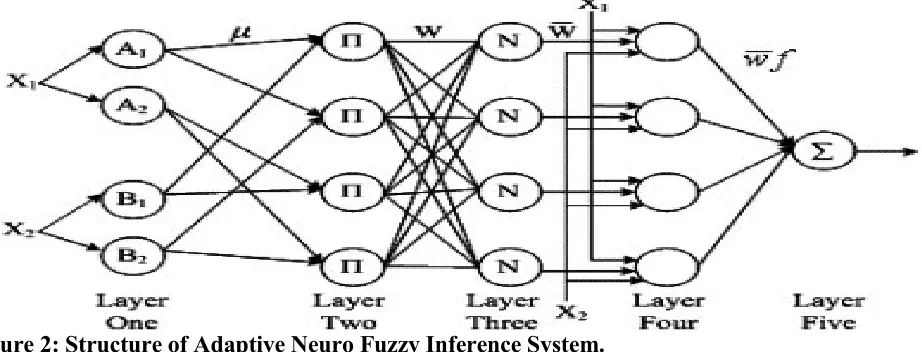
The Structure of Adaptive Neuro Fuzzy Inference System is shown in fig. 4.
Figure 2: Structure of Adaptive Neuro Fuzzy Inference System.
1.4 OBJECTIVES
The following objectives are set in our research:
To collect the set of dataset program from running software with the appropriate runtime errors that is useful for the assessment.
To formulate a theoretical analysis for the evaluation of the metrics those are used for assessment and develop model.
To identify how availability and MTBF relates with the software reliability
Calculate the metrics with the given dataset both analytically and programmatically.
To train the neural network with some collected software reliability parameters (at design phase of SDLC) mapped to numerical data and are loaded into neural network at input layer.
Assess and evaluate the performance of the trained network for software reliability at the design level with some numerically approximated values by using fuzzy membership function (sigmoid).
The approximated Software Reliability is compared against the expected reliability approximation.
The Neuro Fuzzy model was to adjust at the input layer has to minimize the difference between actual and expected values of reliability.
Our proposed model performance compared against conventional FIS (Fuzzy Inference system) models based on evaluation and validation metrics to prove that our proposed model is the promising one than the others.
International Journal of Research (IJR)
e-ISSN: 2348-6848, p- ISSN: 2348-795X Volume 2, Issue 08, August 2015Available at http://internationaljournalofresearch.org
2.1 Proposed Model
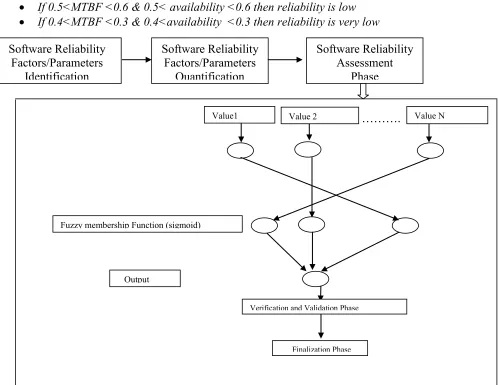
Figure below shows the proposed model of the research analysis, where the parameters concerned with the reliability assessment were given as the inputs for network. Based upon the outcome of validation the assessment will be finalized. A generalized block diagram is shown in the below figure, the parameters used were discussed in the next chapter. In this research work a Neuro Fuzzy interference model is designed for the assessment of reliability of a software growth model, the algorithm mainly focuses on MTBF and Availability which is analyzed and calculated theoretically and practically. Fuzzy rules employed for the proposed model
If MTBF (Mean time Between Failure) >0.8 & availability >0.8 then reliability is very high
If 0.7<MTBF <0.8 & 0.7< availability <0.8 then reliability is high
If 0.6<MTBF <0.7 & 0.6<availability <0.7 then reliability is moderate
If 0.5<MTBF <0.6 & 0.5< availability <0.6 then reliability is low
If 0.4<MTBF <0.3 & 0.4<availability <0.3 then reliability is very low
……..
……….
Figure 3: Proposed Model of software reliability estimation 2.2 Mathematical approximation of proposal model metrics
Formula: Ca ( xi ) = C (a) - h f(a)
Where, C (a) = Set of Measured values. „h‟ can be derived by, x1 + x0 n h
Software Reliability Factors/Parameters
Identification Phase
Software Reliability Factors/Parameters
Quantification Phase
Verification and Validation Phase
Finalization Phase
Software Reliability Assessment
Phase
Value1 Value 2 Value N
Fuzzy membership Function (sigmoid)
International Journal of Research (IJR)
e-ISSN: 2348-6848, p- ISSN: 2348-795X Volume 2, Issue 08, August 2015Available at http://internationaljournalofresearch.org
Where, n= no. of values in the dataset. x0 = 0 and x1 = 1 (since the probability ranges from 0 to 1).
Here „x‟ is MTBF. f(a) can be function, denoted as f(a)=MTBF/(1+MTBF)
Ca (xi ) is the set of values to be approximated.
Procedure for ‘h’ Calculation:
Let us take, x0 = 0 and x1 = 1 then, 1= 0 + 17 * h
h= 1/17 = 0.058
Iterations: Perform at least 5 to 10 iterations to arrive at good approximated software reliability value. At every iteration, to calculate % of Reliability, use the following formula
% of Reliability = (Average of Approximated values)/ (Average of Measured values) * 100
At final iteration, if we got 99.99% or 99.8% or 99.7%, then we can say that it is good approximation.
2.3 REVIEW & REVISIONS
Figure 4: Process flow of the proposed approach Recognition:
At this stage the objectives are 1. To identify the reliability factors.
2. To evaluate a mathematical analysis for the approximation constraints
International Journal of Research (IJR)
e-ISSN: 2348-6848, p- ISSN: 2348-795X Volume 2, Issue 08, August 2015Available at http://internationaljournalofresearch.org
At this stage the objectives are
1. To identify the reliability factors with availability and MTBF 2. To evaluate a mathematical analysis for the relationship
Measurement:
At this stage the objectives are
1. To assess the metrics for the estimation of reliability 2. To validate the metrics
Reliability:
At this stage the objectives are 1. To estimate reliability 2. To validate the reliability
Finalization:
At this stage the objectives are
1. To incorporate the changes and suggestions 2. To finalize the metrics for evaluation
3. EMPIRICAL VALIDATION
3.1 INTRODUCTION
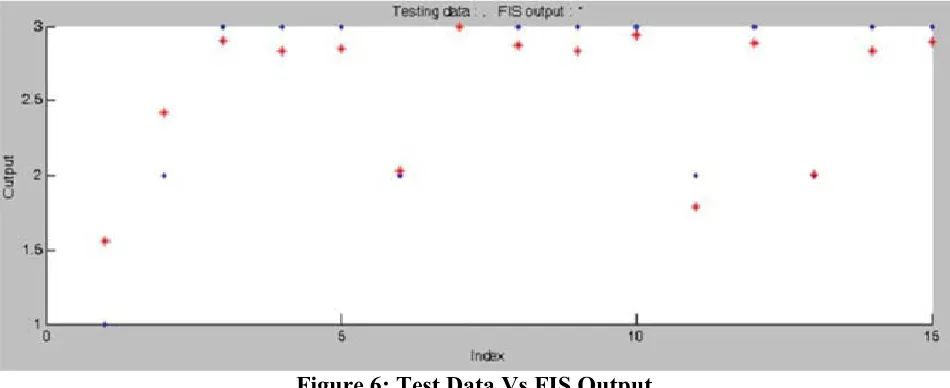
Below figure the practical implementation of the FIS model in MATLAB software tool using FIS. The NF system is trained using a hybrid learning algorithm using both least squares method and back propagation algorithm. In the forward pass the consequent parameters are identified using least squares and in the backward pass the premise parameters are identified using back propagation [12]. The trained NF system is then tested for the fifteen inputs
International Journal of Research (IJR)
e-ISSN: 2348-6848, p- ISSN: 2348-795X Volume 2, Issue 08, August 2015Available at http://internationaljournalofresearch.org
Figure 6: Test Data Vs FIS Output
And it shows 0.1571, 0.2140 as NRMSE, RMSE (equations can be found in parameters to be evaluated section) values respectively. The plot of the expected and the output of the NF system for the different inputs are shown.
3.2 DATASET
To validate our model, we had taken 17 programs of Glace EMR Medical Billing Software (on which I had worked previously as a Software Engineer at L Cube Innovative Solutions Pvt. Ltd.,) and find out the MTTF (Mean Time to Failure), MTTR (Mean Time to Repair) and MTBR (Mean Time Between Repair) and Software Reliability Approximated value based on the program execution observations. We input these 3 values as input to input layer of Neural Network and apply sigmoid fuzzy membership function at the hidden layer of neural network and try to find out the software reliability approximated value. The previous values assessed using conventional traditional software reliability growth models and our Neuro Fuzzy systems based model are compared and we found to be our model is the promising one. Software reliability is measured in terms of mean time between failures(MTBF).MTBF consists of mean time to failure (MTTF) and mean time to repair(MTTR). MTTF is the difference of time between two consecutive failures and MTTR is the time required to fix the failure.
Let us take Software Reliability for good software is a number between 0 and 1. Reliability increases when errors or bugs from the program
are removed or minimized. For example, if MTBF = 1000 hours for average software, then the software should work for 1000 hours for continuous operations. The dataset contains failure observations of 17 programs in Glace EMR Billing Software, in time series (i, Xi) and is used to predict the performance of the proposed model. Where, i = Program serial number.
3.3 Parameters used for Validation
Software Reliability: Software reliability is measured in terms of mean time between failures(MTBF).MTBF consists of mean time to failure (MTTF) and mean time to repair(MTTR). MTTF is the difference of time between two consecutive failures and MTTR is the time required to fix the failure.
Let us take Software Reliability for good software is a number between 0 and 1. Reliability increases when errors or bugs from the program are removed or minimized.
For example, if MTBF = 1000 hours for average software, then the software should work for 1000 hours for continuous operations.
International Journal of Research (IJR)
e-ISSN: 2348-6848, p- ISSN: 2348-795X Volume 2, Issue 08, August 2015Available at http://internationaljournalofresearch.org
MTTR = Average time taken to repair the system after the occurrence of failure.
Software Reliability = MTBF / (1+MTBF)
Availability = MTBF/(MTBF+MTTR) , is the likelihood that a software system will work at a
given time.
3.4 Experimental results
Table 1: Production time analysis for the program dataset S.N o Progra m # Prod. time(H rs.) Uptime at x1(Hrs.) Uptime at x2(Hrs.) Downtim e at x1(Hrs.) Downti me at x2(Hrs.) No. of breaks at x1(Hrs.) No. of breaks at x2(Hrs.)
1 GE01 256 216 202 40 54 3 11
2 GE02 324 260 203 64 121 9 16
3 GE03 236 168 154 68 82 2 19
4 GE04 600 450 435 150 165 16 23 5 GE05 371 300 265 71 106 13 35 6 GE06 447 430 410 17 37 15 21 7 GE07 865 560 525 305 340 10 25 8 GE08 843 615 575 228 268 4 31 9 GE09 943 720 706 223 237 17 28
10 GE10 135 85 78 50 57 4 6
11 GE11 242 130 132 112 110 36 22 12 GE12 369 240 206 129 163 24 30
13 GE13 122 68 64 54 58 23 9
14 GE14 107 72 74 35 33 6 15
15 GE15 371 265 253 106 118 18 34 16 GE16 453 370 398 83 55 21 37 17 GE17 325 285 256 40 69 27 29
3.4.1. Calculations
Total Production time= Uptime+ down time
MTBF= Total uptime (total time- total downtime) Number of Breakdowns
International Journal of Research (IJR)
e-ISSN: 2348-6848, p- ISSN: 2348-795X Volume 2, Issue 08, August 2015Available at http://internationaljournalofresearch.org
MTTF= Mean Time to Failure (in hours/minutes/seconds). MTTR= Mean Time to Repair (in hours/minutes/seconds).
MTBF= Mean Time between Failures (in hours/minutes/seconds). MTTR= Total downtime
Number of breakdowns
MTTF= (Failure at obs.1+ Failure at obs.2+…+ Failure at obs.N) Number of software programs under test Availability (For Repairable software systems) = MTBF (MTBF+ MTTR)
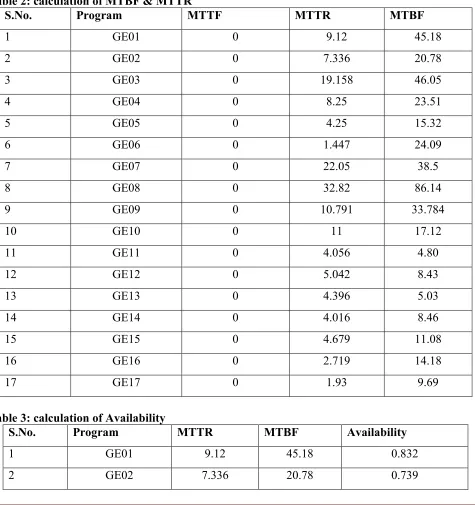
Table 2: calculation of MTBF & MTTR
S.No. Program MTTF MTTR MTBF
1 GE01 0 9.12 45.18
2 GE02 0 7.336 20.78
3 GE03 0 19.158 46.05
4 GE04 0 8.25 23.51
5 GE05 0 4.25 15.32
6 GE06 0 1.447 24.09
7 GE07 0 22.05 38.5
8 GE08 0 32.82 86.14
9 GE09 0 10.791 33.784
10 GE10 0 11 17.12
11 GE11 0 4.056 4.80
12 GE12 0 5.042 8.43
13 GE13 0 4.396 5.03
14 GE14 0 4.016 8.46
15 GE15 0 4.679 11.08
16 GE16 0 2.719 14.18
17 GE17 0 1.93 9.69
Table 3: calculation of Availability
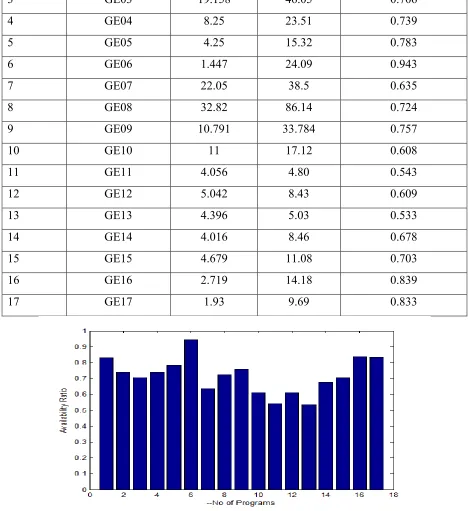
S.No. Program MTTR MTBF Availability
1 GE01 9.12 45.18 0.832
International Journal of Research (IJR)
e-ISSN: 2348-6848, p- ISSN: 2348-795X Volume 2, Issue 08, August 2015Available at http://internationaljournalofresearch.org
3 GE03 19.158 46.05 0.706
4 GE04 8.25 23.51 0.739
5 GE05 4.25 15.32 0.783
6 GE06 1.447 24.09 0.943
7 GE07 22.05 38.5 0.635
8 GE08 32.82 86.14 0.724
9 GE09 10.791 33.784 0.757
10 GE10 11 17.12 0.608
11 GE11 4.056 4.80 0.543
12 GE12 5.042 8.43 0.609
13 GE13 4.396 5.03 0.533
14 GE14 4.016 8.46 0.678
15 GE15 4.679 11.08 0.703
16 GE16 2.719 14.18 0.839
17 GE17 1.93 9.69 0.833
International Journal of Research (IJR)
e-ISSN: 2348-6848, p- ISSN: 2348-795X Volume 2, Issue 08, August 2015Available at http://internationaljournalofresearch.org
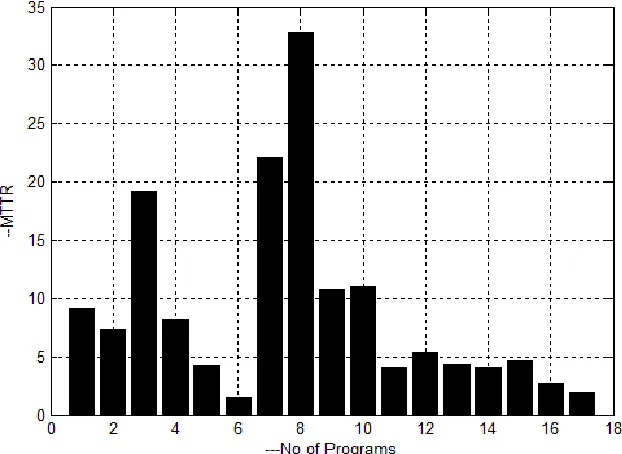
Figure 8: Analysis of MTTR ration w.r.t. number of programs
Figure 9: Analysis of MTBF ration w.r.t. number of programs
3.5 Theoretical Validation
From the above section 3.11 a theoretical valuation can be done with the formula mentioned in the context. For example at the 1st Iteration
International Journal of Research (IJR)
e-ISSN: 2348-6848, p- ISSN: 2348-795X Volume 2, Issue 08, August 2015Available at http://internationaljournalofresearch.org
x y(Measured Value)
f(a)=MTBF/(1+MTBF) Approximated value= y + h * f(a)
1 45.18 0.97835 45.237
2 20.78 0.95409 20.835
3 46.05 0.97875 46.107
4 23.51 0.9592 23.566
5 15.32 0.93873 15.374
6 24.09 0.96014 24.146
7 38.5 0.97468 38.557
8 86.14 0.98852 86.197
9 33.784 0.97125 33.84
10 17.12 0.94481 17.175
11 4.80 0.82759 4.848
12 8.43 0.89396 8.4818
13 5.03 0.83416 5.0784
14 8.46 0.89429 8.5119
15 11.08 0.91722 11.133
16 14.18 0.93412 14.234
17 9.69 0.90645 9.7426
At 2nd iteration
Table 5: calculation of Reliability & its approximation at 2nd iteration X y(Measured
Value)
f(a)=MTBF/(1+MTBF) Approximated value= y +h* f(a)
1 45.237 0.97835 45.294
2 20.835 0.95409 20.89
3 46.107 0.97875 46.164
International Journal of Research (IJR)
e-ISSN: 2348-6848, p- ISSN: 2348-795X Volume 2, Issue 08, August 2015Available at http://internationaljournalofresearch.org
4 23.566 0.9592 23.622
5 15.374 0.93873 15.428
6 24.146 0.96014 24.202
7 38.557 0.97468 38.614
8 86.197 0.98852 86.254
9 33.84 0.97125 33.896
10 17.175 0.94481 17.23
11 4.848 0.82759 4.896
12 8.4818 0.89396 8.5336
13 5.0784 0.83416 5.1268
14 8.5119 0.89429 8.5638
15 11.133 0.91722 11.186
16 14.234 0.93412 14.288
17 9.7426 0.90645 9.7952
At 3rd Iteration
Table 6: calculation of Reliability & its approximation at 3rd iteration X y(Measured
Value) f(a)=MTBF/(1+MTBF) Approximated value= y +h* f(a)
1 45.294 0.97835 45.351
2 20.89 0.95409 20.945
3 46.164 0.97875 46.221
4 23.622 0.9592 23.678
5 15.428 0.93873 15.482
6 24.202 0.96014 24.258
International Journal of Research (IJR)
e-ISSN: 2348-6848, p- ISSN: 2348-795X Volume 2, Issue 08, August 2015Available at http://internationaljournalofresearch.org
7 38.614 0.97468 38.671
8 86.254 0.98852 86.311
9 33.896 0.97125 33.952
10 17.23 0.94481 17.285
11 4.896 0.82759 4.944
12 8.5336 0.89396 8.5854
13 5.1268 0.83416 5.1752
14 8.5638 0.89429 8.6157
15 11.186 0.91722 11.239
16 14.288 0.93412 14.342
17 9.7952 0.90645 9.8478
At 4th Iteration
Table 7: calculation of Reliability & its approximation at 4th iteration
X y(Measured Value) f(a)=MTBF/(1+MTBF) Approximated value= y +h* f(a)
1 45.351 0.97835 45.408
2 20.945 0.95409 21
3 46.221 0.97875 46.278
4 23.678 0.9592 23.734
5 15.482 0.93873 15.536
6 24.258 0.96014 24.314
7 38.671 0.97468 38.728
8 86.311 0.98852 86.368
9 33.952 0.97125 34.008
10 17.285 0.94481 17.34
11 4.944 0.82759 4.992
12 8.5854 0.89396 8.6372
13 5.1752 0.83416 5.2236
International Journal of Research (IJR)
e-ISSN: 2348-6848, p- ISSN: 2348-795X Volume 2, Issue 08, August 2015Available at http://internationaljournalofresearch.org
14 8.6157 0.89429 8.6676
15 11.239 0.91722 11.292
16 14.342 0.93412 14.396
17 9.8478 0.90645 9.9004
% Reliability= (Average of Approximated vales/ Average of observed Values) x 100
In 4th iteration, we got 99.99%, so we stop iteration process because we got good approximated % of reliability.
3.6 Practical Validation
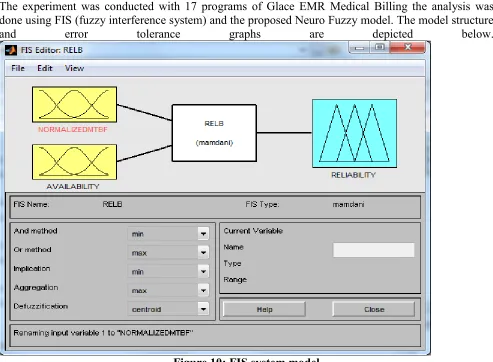
The experiment was conducted with 17 programs of Glace EMR Medical Billing the analysis was done using FIS (fuzzy interference system) and the proposed Neuro Fuzzy model. The model structure and error tolerance graphs are depicted below.
Figure 10: FIS system model
Overall percentage of Reliability= (24.28/ 24.44)*100=99.70
International Journal of Research (IJR)
e-ISSN: 2348-6848, p- ISSN: 2348-795X Volume 2, Issue 08, August 2015Available at http://internationaljournalofresearch.org
Figure 11: Membership function for MTBF and Availability
Figure 12: Neuro Fuzzy inference Model
International Journal of Research (IJR)
e-ISSN: 2348-6848, p- ISSN: 2348-795X Volume 2, Issue 08, August 2015Available at http://internationaljournalofresearch.org
Figure 14: Error Tolerance
Figure 15: Performance analysis
3.7. Comparison of proposed approach with Conventional Fuzzy system
International Journal of Research (IJR)
e-ISSN: 2348-6848, p- ISSN: 2348-795X Volume 2, Issue 08, August 2015Available at http://internationaljournalofresearch.org
environment(See Appendix-A). From the above the performance assessment for which an improvement of 11% is achieved with the current proposal.
MSE= ((Theoretical validation- practical Validation)/total no of readings)2 =
Average error = ((Theoretical validation- practical Validation)/total no of readings)=0.247;
Figure 16: Practical validation of the reliability percentage obtained using MATLAB
Table 8: Performance comparison between FIS & ANFIS of SR estimation
Method MSE AE
FIS 0.799 0.894
ANFIS 0.061 0.247
International Journal of Research (IJR)
e-ISSN: 2348-6848, p- ISSN: 2348-795X Volume 2, Issue 08, August 2015Available at http://internationaljournalofresearch.org
Future Work and Suggestions
Research is a continuing activity as a future research plans the following tasks are to be completed:
Software reliability can be predicted using hybrid intelligent system. In addition to neural network model genetic programming can be applied further.
Novel recurrent architectures for Genetic Programming (GP) and Group Method of Data Handling (GMDH) to predict software reliability can be proposed.
We can extend this work to the other machine learning techniques like Neuro Fuzzy systems approach, support vector machine approach, self-organizing maps approach, decision-region approach etc. for the better estimation of the software reliability at different stages of Software Development Life Cycle(SDLC) process. We can also incorporate recent evolutionary computational mechanisms for the purpose of assessing the software reliability.
CONCLUSION
From the research we found that Neuro Fuzzy model performs better in terms of less error in prediction as compared to existing analytical models and hence it is a better alternative to do software reliability test. As the weights are randomly initialized, thus the model gives different results for the same datasets and thus the performance of the model varies. The usefulness of a Neuro Fuzzy model is dependent on the nature of dataset up to a greater extent.
The preliminary computational results in the MATLAB environment seem quite promising and give insight into the generalization capability of these models. The results of the fuzzy logic and neural networks models were very promising. The error
difference between the actual and estimated response was small. This finding gives a good indication of prediction capabilities of the developed fuzzy model and neural networks for assessing the software reliability.
REFERENCES
[1] Hoyer, R. W. and Hoyer, B. B. Y., "What is quality?" Quality Progress, no. 7, pp. 52-62, 2001.
[2] Crosby P.B,” Quality is Free the Art of Making Quality Certain NY, McGraw –Hill-1979
[3] Deming & Edwards W,”Out of Crisis”, MIT Press-1986
[4] Feigenbaum A. V,”Total Quality Control”, McGraw – Hill-1983
[5] IEEE Std 610.12 (1990). IEEE Standard Glossary of Software Engineering Terminology, NY.
[6] ISO/IEC Std 9126-1,” Software Engineering – Product Quality “, Part 1: Quality Models, International Organization for Standards 2001.
[7] McCall J.A, Richards P.K & Walters G.F,” Factors in Software Quality”, Nat'1 Tech Information Services, - Vol 1-2, 1977
[8] AIAA/ANSI “Recommended Practice for Software Reliability, the American Institute of Aeronautics and Astronautics”, Washington DC, Aerospace Center, R-013, 1992,-ISBN 1-56347-024-1.
[9] Michael R. Lyu,” Handbook of software Reliability Engineering “, IEEE
International Journal of Research (IJR)
e-ISSN: 2348-6848, p- ISSN: 2348-795X Volume 2, Issue 08, August 2015Available at http://internationaljournalofresearch.org
engineering design. Marcel Dekker incorporated, Newyork, USA, pp2-10, 2002
[11] Schneidewind, N. F., 2001, „Modeling the fault correction processes, Proceedings of the 12th International Symposium on Software Reliability Engineering, pp. 185-190.
[12] Myrtveit, I., Stensrud, E. and Shepperd, M., 2005, „Reliability and validity in comparative studies of software prediction models‟, IEEE Transactions on Software Engineering, vol. 31, no. 5, pp. 380-391.
[13] Falcone, G. Hierachy-aware Software Metrics in Component Composition Hierarchies. PhD thesis, University of Mannheim.-2010
[14] Bass, L., Clements, P., and Kazman, R. “Software Architecture in Practice” , Second Edition. Addison-Wesley, Reading, MA, USA-2003
[15] Jain, R. The Art of Computer Systems Performance Analysis: Techniques for Experimental Design, Measurement, Simulation, and Modeling. Wiley.-1991
[16] Smith, C. U. and Williams, L. G. (2000). Software performance anti patterns. In Workshop on Software and Performance, pages 127-136.
[17] Immonen, A. and Niemel•a, E.,” Survey of reliability and availability prediction methods from the viewpoint of software architecture. Software and System Modeling-7(1):49{65)-2008
[18] AIAA/ANSI “Recommended Practice for Software Reliability, The American Institute of Aeronautics and Astronautics”, Washington DC, Aerospace Center, R-013, 1992,-ISBN 1-56347-024-1.
[19] Rosenberg Linda, Hammer Ted & Shaw Jack, “Software Matrices and Reliability”, ISSRE, 1998.
[20] N. E. Fenton and M. Neil. A critique of software defect prediction models. IEEE Transactions on Software Engineering, 25(5):675–689, 1999.
APPENDIX- A MATLAB PROGRAM FOR PRACTICAL VALIDATION
clear
aa= VECTOR OF MTBF VALUES; af=aa./mean(aa);
b= VECTOR OF AVAILABILITY VALUES;
% Read the FIS structure named as RELB
F=readfis('RELB.fis');
% Evalate the input with the given fuzzy structre
ff=evalfis([aa./max(aa)+.7,b+.7]',F)
% this section is regarding ANFIS,train the data for it give MTBF and Availability as inputs
trnData = [af , b]; numMFs = 7; mfType = 'dsigmf'; epoch_n = 100;
% generate a new anfis with this training data
International Journal of Research (IJR)
e-ISSN: 2348-6848, p- ISSN: 2348-795X Volume 2, Issue 08, August 2015Available at http://internationaljournalofresearch.org
out_fis = anfis(trnData,in_fis,60); ff'
mean(ff)
% evaluate the data with input anfis structure
oo=evalfis([b]',out_fis)' mean(oo)
Mr. Bonthu Kotaiah obtained his Bachelor's degree in Computer Applications from Nagarjuna University in 2001 and M.C.A from Nagarjuna University in 2008. During the period from September, 2001 to 2011, he has been involved in various aspects of Information Technology - an engineer(L-Cube Innovative Solutions), a Corporate Trainer (SyncSoft & Datapro(Vijayawada), COSS(Hyd.)), a Computer Programmer(Acharya Nagarjuna University). Currently he wishes to conduct research in the area of Software Engineering and Data Mining and Artifiicial Neural Networks, Fuzzy Logic & Genetic Alogorithms. His research interests include software Engineering, Neural networks. Presently, he is working as a Full-Time Research Scholar in Babasaheb Bhimrao Ambedkar University (A Central University) Lucknow, UP in the Department of Information Technology.
![Figure 1: Software reliability engineering Process Overview [9]](https://thumb-us.123doks.com/thumbv2/123dok_us/7795792.1293364/2.612.27.546.70.533/figure-software-reliability-engineering-process-overview.webp)