An Analysis of the ProtonMail
Cryptographic Architecture
Nadim Kobeissi
Symbolic Software
[email protected]
November 27, 2018
Abstract
ProtonMail is an online email service that claims to oer end-to-end encryption such that even [ProtonMail] cannot read and decrypt [user] emails. The service, based in Switzerland, oers email access via webmail and smartphone applications to over ve million users as of November 2018. In this work, we provide the rst independent analysis of Pro-tonMail's cryptographic architecture. We nd that for the majority of ProtonMail users, no end-to-end encryption guarantees have ever been provided by the ProtonMail service. We also nd and document weak-nesses in ProtonMail's Encrypt-to-Outside feature. We justify our nd-ings against well-dened security goals and conclude with recommenda-tions.
1 Introduction
ProtonMail1is an email service founded in 2014 and based in Geneva,
Switzer-land. By promoting its claims of end-to-end encryption features, the service was able to receive initial support through a crowdfunding campaign and now supports itself through paid plans being oered adjacent to its free-of-charge ser-vice. As of January 2017, ProtonMail claimed to have over 2 million users [1]. This number grew to over 5 million users by September 2018 [2]. ProtonMail is primarily accessed through its webmail interface, with iOS and Android appli-cations launching in 2016, two years after the service was opened to the public. ProtonMail has published a technical specication [3] detailing its security features and infrastructure in July 2016. Despite the strong security claims made in this paper and despite ProtonMail's success, no independent formal analysis of ProtonMail's security claims has been published.
In this work, we provide the rst independent analysis into ProtonMail's cryptographic design.
We begin by dening a set of security goals in 2which are based on Pro-tonMail's own claims as well as on cryptographic denitions for standard security goals.
In 3, we establish the cryptographic primitives relevant to our analysis. This allows us to describe ProtonMail's protocol ows in 4.
Based on our comparison of ProtonMail's security goals against its pro-tocol ows, we present a security analysis 5 in which we nd serious shortcomings with regards to ProtonMail's eective security guarantees. we provide recommendations in our conclusion (6).
In carrying out this analysis, we evaluated ProtonMail's security claims against well-dened security goals. We found that ProtonMail's cryptographic architecture ultimately does not guarantee end-to-end encryption for the major-ity of users. Furthermore, we also uncover weaknesses in ProtonMail's Encrypt-to-Outside functionality which is intended to allow ProtonMail users to send end-to-end encrypted email to recipients that do not use ProtonMail.
2 Security Denitions
ProtonMail conservatively assumes that all mail servers may eventually be compromised. Thus, ProtonMail uses end-to-end en-cryption to ensure that plaintext email data is never sent to the server. If a server only contains encrypted messages, then the risks of a central server breach are mitigated. ProtonMail Security Features and Architecture Specication [3]
We begin with security denitions for each of ProtonMail's security claims. Each security denition is motivated by claims made on ProtonMail's website and is dened in such a way as to be consistent with how such security goals are understood in modern cryptographic literature.
2.1 Security Assumptions
Our security denitions concern three clients: ProtonMail userA, ProtonMail
user B and Microsoft Outlook2 user S. We also consider two servers:
Pro-tonMail webmail server P and Microsoft Outlook webmail server M. These
principals operate under the following network assumptions:
Transport Layer Security. We assume that all communications be-tween all principals occur over an authenticated TLS link.
No Client State Compromise. We assume that none of the clientsA, BandS ever suer a local state compromise.
Untrusted Server. We assume thatP is untrusted and could act with
the intent to recover encrypted communications between clientsA, B,S.
We treatMas controlled by an adversary.
The Untrusted Server assumption is directly informed by the above-mentioned quotes from ProtonMail.
We are therefore assuming a relatively safe threat model where transport layer communications are always encrypted and where local state compromise never occurs.
2.2 End-to-End Encryption
ProtonMail's zero access architecture means that your data is encrypted in a way that makes it inaccessible to us. Data is encrypted on the client side using an encryption key that we do not have access to. This means we don't have the technical ability to decrypt your messages, and as a result, we are unable to hand your data over to third parties. With ProtonMail, privacy isn't just a promise, it is mathematically ensured. For this reason, we are also unable to do data recovery. If you forget your password, we cannot recover your data. ProtonMail Security Details Page [4]
End-to-end encryption denotes a collection of properties inherent to a cryp-tographic protocol, almost always a secure channel protocol. These properties, known as condentiality, integrity and authenticity, rst became available to the general public through the introduction of the Pretty Good Privacy (PGP) email encryption protocol in 1991. O-the-Record Messaging (OTR), a communica-tions system that meant to supersede PGP [5] built upon these properties and expanded them with new ones: forward secrecy and deniability. A decade later, rigorous formal analysis [6,7,8] of the Signal Protocol [9,10], which itself was in turn inspired by OTR and which currently encrypts all messages sent through WhatsApp and other applications, further formalized the security properties of modern end-to-end encryption systems. Tangentially, similarly rigorous formal analysis [11,12,13] of TLS, the protocol underlying the transport encryption of almost all web trac, further helped provide strong applied security denitions for the properties underlying end-to-end encryption.
Given that ProtonMail uses PGP to provide end-to-end encryption, we con-sider the following security properties as being the components that achieve end-to-end encryption in the context of ProtonMail3. Given that this is a practical
analysis, we colloquialize the understanding of the security properties provided by the cited work into the following denitions:
Condentiality. An email sent from any client to any other client can only be decrypted by the recipient and, optionally, the sender.
Authenticity. If a client receives a message that appears to be from another client, then this apparent sender must have sent the email to the recipient. Note that this denition of authenticity also encapsulates the standard denition of integrity in production end-to-end encryption systems.
2.3 Zero-Knowledge Password Proof
ProtonMail users enter a user-chosen password on each login, but while ProtonMail's backend is responsible for validating and re-setting the password, the password cannot be derived by either Pro-tonMail or an attacker with access to the network. This is achieved with the Secure Remote Password protocol, which as detailed be-low, conveys a Zero-Knowledge Password Proof from the user to the server. The security granted by this protocol extends to the user's private keys, which are encrypted with a salted hash of their pass-word before being sent to the server. [...] The Secure Remote Password protocol [15] promises theoretically optimal security. When using SRP, even an attacker who can arbitrarily read, modify, delay, destroy, repeat, or fabricate messages between ProtonMail and a le-gitimate user in an undetectable fashion is limited to checking only a single password guess per login attempt, a task which could be done just by trying to log in directly. Even if a server is compromised and acts maliciously, password-equivalent information is never revealed. This is all done without permanent private keys: all secret informa-tion is derived from the user's password. ProtonMail Security Features and Architecture Specication [3]
Zero-Knowledge Password Proofs (ZKPP) result from mechanisms intended to protect against dictionary attacks [16]. By employing ZKPP, a client can prove to a server that it knows the value of some password, without revealing any information about the password itself. This is dierent from more traditional design where the server stores a hash of the client's password. In the latter design:
Passwords are vulnerable to brute force attacks in the event that the adversary obtains the hash.
The server can distinguish a valid password from an invalid password entry by comparing it to the stored hash.
We therefore dene the ZKPP security goal thus: P should at no point
conduct a password verication scheme withAsuch that a network observer is
able to learn any information aboutA's password.4
Has usernameAu
A
Has verierv=gp
P
Au
k←− {R 0,1}128
s←− {R 0,1}128
S=gs+kv
S
c←− {R 0,1}128
C =gc
C
u=HASH(C, S)
g(c+up)s= (gs)c+up
x=HASH(C, S, g(c+up)s)
u=HASH(C, S)
g(c+up)s= (gcvu)s
x
x≡? HASH(C, S,(gcvu)s
y=HASH(C, x, g(c+up)s)
y
y≡? HASH(C, x, g(c+up)s)
3 Cryptographic Primitives
We dene the following cryptographic primitives:
Hashing. HASH(x)−→y. A standard one-way cryptographic hash
func-tion.
Encryption and Decryption.
Encryption. ENC(ek, p, a)−→(Eek,p,n,a,t, n, t). This is an
authen-ticated encryption with associated data (AEAD) construction where
ek is an encryption key,nis a randomly generated nonce,ais
asso-ciated data and tis an authentication tag.
Decryption. DEC(ek,Eek,p,n,a,t, n, a, t)−→ {p,⊥}.
PGP Interface. We also describe the following simplied PGP API:
Key Generation. PGPGEN(c)−→(sk, pk).
Encryption. PGPSEND(c, m, pk)−→PGPm,pk.
Decryption. PGPREAD(c,PGPm,pk, sk)−→ {m,⊥}.
In the operations described above,cindicates the application code that the
client is using in order to perform PGP operations, generally assumed to contain a correct implementation of the OpenPGP protocol. The relevance of cis such
that if c does not contain a correct implementation of OpenPGP, all output
generated byPGPGEN,PGPSENDandPGPREADcould be arbitrarily aected. PGPm,pk is a ciphertext of m encrypted towards public key pk. PGPREAD
decrypts this ciphertext if the corresponding secret key sk is provided for pk.
Otherwise, it returns ⊥.
4 Protocol Flows
In this section, we provide high-level descriptions of two distinct protocol ows:
ProtonMail-to-ProtonMail. A sends a PGP-encrypted messagemto BthroughP.
Encrypt-to-Outside. Asends a symmetrically encrypted email to S
through P which relays the email to S through M. S sends a
PGP-encrypted replyrtoAusing the web interfaceJ andA's PGP public key Apk, both provided byP.
4.1 Eects of Client Application Choice on Protocol Flows
Users have the option of accessing ProtonMail either through a webmail client or through a smartphone application.5 HowAaccesses their ProtonMail inbox
has substantial implications on protocol ows and ultimately on the security properties that their communications obtain. The reason for this has to do with the authenticity properties provided by the code delivery methods, which dier between applications.
4.1.1 ProtonMail Webmail
ProtonMail's webmail application appears to be the primary ProtonMail prod-uct and how ProtonMail is most often accessed by its users.6 When visiting
https://protonmail.com,A's web browser is served with JavaScript code
rep-resenting the ProtonMail web application [17] and its underlying OpenPGP implementation, also written in JavaScript [18].
Since communication between all ProtonMail users (includingA andB) to P is assumed to be encrypted using TLS (2.1), delivery of the ProtonMail web
application is assumed to be safe against a network attacker. However, we note that a maliciousP(also an assumption in 2.1) would be able to arbitrarily serve
compromised webmail clients to A or any other ProtonMail user without this
being detectable and that, conversely, correct delivery of webmail/OpenPGP client code is not veriable.
Therefore, forA, providing input to ProtonMail's webmail application
pro-vided byP is directly equivalent to providing input toP since, in eect,P acts
as a man-in-the-middle between the user and the webmail application code. No existing mechanism, including TLS, is sucient to oset P's middle-man
authority in this application scenario.
4.1.2 ProtonMail Smartphone Application
Mainstream smartphone applications on modern mobile platforms are delivered through a signicantly dierent process to ProtonMail's webmail application. When a new ProtonMail smartphone application version is released for the Apple App Store or the Google Play Store, its author must increment a version number and release timestamp. The application binary and its manifest are both cryptographically signed with a key owned by the author and again by Apple or Google (depending on the platform) upon publication.
Note that in this application scenario, releases are cryptographically au-thenticated and tracked through an incremental version number, and that the delivery of client code is restricted purely to software update instances. Users are therefore able to audit whether they received the same binary for some version of the application as everyone else. Furthermore, the application dis-tributor (Apple, Google) adds a second layer of authentication and its separate 5A desktop bridge application is also oered to paying customers. For simplicity, we group it with smartphone applications.
A
Has applicationJ
P
Has public keyBpk B
Bpk Bpk
J
PGPm,Bpk←−PGPSEND(J, m,Bpk)
PGPm,Bpk PGPm,Bpk
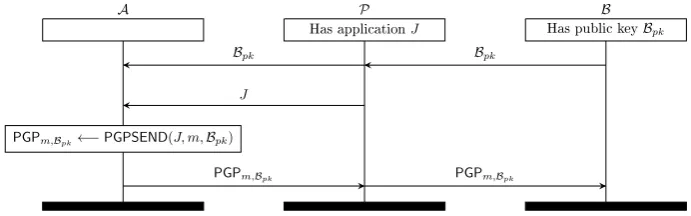
(a) A sends an email to B using the ProtonMail webmail application. We assume that A
authenticates the ngerprint for PGP public keyBpkout of band.
Has applicationI
A P
Has public keyBpk B
Bpk Bpk
PGPm,Bpk←−PGPSEND(I, m,Bpk)
PGPm,Bpk PGPm,Bpk
(b)Asends an email toBusing the ProtonMail smartphone application. We assume thatA
authenticates the ngerprint for PGP public keyBpkout of band.
Figure 2: A sends an email to B using the ProtonMail webmail application
(Fig. 2a) and using the ProtonMail smartphone application (Fig. 2b).
governance from ProtonMail renders targeted delivery of malicious code even more dicult for a maliciousP.
4.2 ProtonMail-to-ProtonMail
In Fig.2, we see a ProtonMail userAsending a PGP-encrypted email to another
ProtonMail user B. Notice that there is a signicant dierence in the protocol
ow depending on whether Alice uses the webmail application (Fig. 2a) or the smartphone application (Fig. 2b). In the former case,Ais forced to obtain an
unauthenticated copy ofJ fromP every time before sending an encrypted email
to B. In the latter case,A can simply rely on her local authenticated binary
residing in her smartphone.
4.3 Encrypt-to-Outside
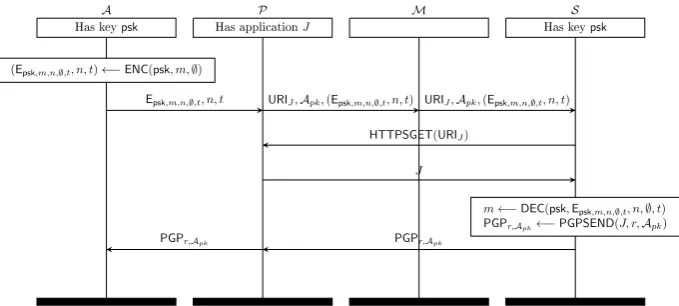
In Fig.3, we see a ProtonMail userAsending a symmetrically encrypted email
to a Microsoft Outlook userS using ProtonMail's Encrypt-to-Outside (ETO)
feature. Both the sender and the recipient are expected to have advanced knowl-edge of some symmetric encryption key psk. A sends her symmetrically
en-crypted message mthroughP mail servers, which add a URI toJ and a copy
of Alice's PGP public keyApk into the payload and in turn relay it to the
Has keypsk
A
Has applicationJ
P M
Has keypsk
S
(Epsk,m,n,∅,t, n, t)←−ENC(psk, m,∅)
Epsk,m,n,∅,t, n, t URIJ,Apk,(Epsk,m,n,∅,t, n, t) URIJ,Apk,(Epsk,m,n,∅,t, n, t)
HTTPSGET(URIJ)
J
m←−DEC(psk,Epsk,m,n,∅,t, n,∅, t)
PGPr,Apk←−PGPSEND(J, r,Apk)
PGPr,Apk PGPr,Apk
Figure 3: Asends an email containing messagemto Microsoft Outlook userS
symmetrically encrypted using a pre-shared key psk. S responds through the
webmail interface provided by P, encrypting his replyrusing PGP toApk.
to J using HTTPS, whereupon he enters pskin order to obtainm. Using J, S
may also send a replyrwhich is PGP-encrypted to public keyApk.
5 Security Analysis
In this section, we provide the results of our examination as to whether the protocol ows described in 4 achieve the end-to-end encryption security goals as dened in 2.2and the ZKPP security goals as dened in 2.3while operating under the assumptions dened in 2.1.
5.1 On End-to-End Encryption
We present three ndings showing that ProtonMail has, since its inception, never achieved end-to-end encryption security guarantees for the majority of its users.
5.1.1 ProtonMail Webmail Does Not Provide End-to-End Encryp-tion
A crucial security assumption, based on ProtonMail's self-professed security goals in its specication documents (2.1), is that the ProtonMail server P
is untrusted. In Fig. 2a, we see that this untrusted server P must serve an
authentic OpenPGP implementation J every time A logs into ProtonMail or,
in some cases, multiple times in between A same single ProtonMail session.
SinceP is untrusted and since no authentication mechanism is implemented to
check for the correctness of J, P can arbitrarily and untraceably compromise
The ProtonMail smartphone applications are unaected by this issue. How-ever, even ifAhas used the ProtonMail smartphone applications for the entire
lifetime of her ProtonMail account thus far and then logs into ProtonMail via the web application just once,P still obtainsA's PGP secret key and is therefore
able to not only impersonateAgoing forward but also to retroactively decrypt
all ofA's previous communications.
In eect, this means that any ProtonMail webmail user has never obtained end-to-end encryption guarantees under ProtonMail's own security model and security goal denitions.
5.1.2 Encrypt-to-Outside Allows Mail Servers to Recover Pre-Shared Key and Reply Plaintext
In Fig.3, we see thatP relays the URI for ProtonMail web application codeJ
toSthrough third-party mail serverM. This provides bothP andMwith the
ability to stage signicant Man-in-the-Middle attacks:
P is free to arbitrarily replaceJ with an incorrect OpenPGP
implemen-tation or to replaceApkwith a PGP public key corresponding to a secret
key thatP itself controls. The former would allow P to recoverpsk and m, while the later would allowP to recover r.
M is free to arbitrarily replace URIJ with any other arbitary URI to
a web application that it controls, which could in eect pretend to be ProtonMail. This would allowMto harvestpskas well asr. Mcan then
obtainA's legitimate ciphertext and decrypt it using J andpsk, thereby
obtaining m, and also encrypt r to A using Apk thereby performing an
undetected man-in-the-middle attack.
5.1.3 Mailbox Keys, PGP Secret Keys and Encrypt-to-Outside Pre-Shared Keys Vulnerable to Dictionary Attacks
In our testing7 of the ProtonMail applications, we were able to set both user
mailbox passwords and Encrypt-to-Outside pre-shared key passwords that were exceptionally weak and vulnerable to simple guessing attacks. These pass-words included 1, iloveyou and password and were used to derive encryp-tion keys for PGP secret keys that were later stored on ProtonMail servers as well as for Encrypt-to-Outside symmetric encryption.
As we will see in 5.2, the ProtonMail servers do indeed possess a pass-word oracle that renders dictionary and brute force attacks possible. Allowing extremely weak passwords only further exacerbates the issue and could poten-tially allow for the easy obtention of a user's PGP secret key. Furthermore, an attacker that obtains access to ProtonMail's database of millions of encrypted user PGP secret keys will likely nd that a signicant portion of them can be brute-forced using dictionary attacks that simply run through the top 100,000 most common passwords, a relatively small amount of guesses.
Has username
A
uA
P
Chooses password
p
(
A
sk,
A
pk)
←−
PGPGEN
(
c
)
(
E
p,Ask,n,∅,t, n, t
)
←−
ENC
(
p,
A
sk,
∅
)
E
p,Ask,n,∅,t, n, t
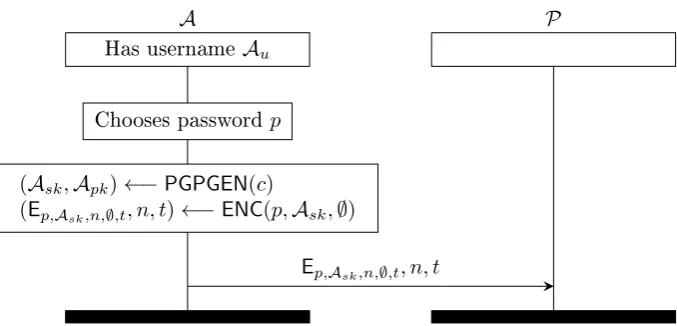
Figure 4: Asends an encrypted copy of her PGP secret key toP during account
creation. In this ow, the application code c provided to PGP operations is
irrelevant.
5.2 On User Authentication
While SRP authentication, as described in Fig. 1, does indeed provide ZKPP-based authentication, the ProtonMail Security Features and Architecture spec-ication also states the following:
The private key is symmetrically encrypted with the mailbox password using AES-256. The public key and encrypted private key are then stored on the ProtonMail server along with the user's other account information and retreived whenever a user logs in succes-fully. The encrypted private key is decrypted on successful mailbox password entry on the user's local device and can be used to read and sign messages during that session. ProtonMail Security Features and Architecture Specication [3]
Indeed, we document this functionality in Fig.4. During account creation,
Awill sendP a copy of her PGP secret keyAsk encrypted under her mailbox
password p. This encrypted secret key acts as an oracle for p. Therefore, P
posesses an oracle forA's mailbox password. This oracle can be used for brute
force or dictionary oine attack attempts.
ProtonMail uses the bcrypt [19] password hash which slows down dictio-nary attacks. However, ProtonMail restricts the number of bcryptrounds to a relatively small number of 210 [17] which, especially when coupled with recent
advances in bcrypt computation [20], renders dictionary attacks feasible once more.
literally, leading to the conclusion that ZKPP security goals are not met sinceP
possesses multiple oracles that allow it to derive a correct guess onA's password:
the verier v seen in Fig.1 as well as the encrypted PGP secret key described
above.
However, we take into consideration what ZKPP is historically understood to achieve which is to prevent a active network attacker only from learning in-formation about the password, and not the serverP itself. Under this denition,
ZKPP guarantees are indeed met by ProtonMail.
6 Recommendations and Conclusion
Our ndings, presented in 5, constitute serious shortcomings in ProtonMail's cryptographic architecture that we believe should be urgently remedied. As it stands, ProtonMail does not meet its self-professed security goals when these are subjected to analysis.
While this paper presents the rst formal argument justifying these ndings, some of them have already been documented: the results discussed in 5.1.1 seem to have been known informally since at least 2015 [21,22].
With regards to the ProtonMail web application, features such as Subre-source Integrity (SRI) [23] could arguably provide some increased authenticity to the code delivery mechanism. However, these features are deemed insu-cient for ProtonMail to meet its security goals, and it is our conclusion that no webmail-style application could. Other messaging services, such as WhatsApp and Signal, provide downloadable web applications which run locally on the user's device and therefore accomplish the same code integrity as ProtonMail's smartphone applications (as described in Fig.2b).
Failing the removal of ProtonMail's web application, ProtonMail simply should not claim end-to-end encryption except for use cases where both senders and recipients restrict themselves to ProtonMail's mobile applications.
We also recommend that ProtonMail never store user PGP secret keys on its servers. As shown in 5and in contradiction with ProtonMail's claims, these keys are indeed vulnerable to oine dictionary attacks and moreso with the allowance of exceptionally weak passwords. Instead, we recommend a system in which the device from which the user is signing up to ProtonMail from (iOS app, Android app, desktop app) locally derive a PGP identity and that this identity be communicated from device to device using QR codes. This method is already implemented by other popular secure messaging applications with success.
Finally, we would like to pre-empt ProtonMail's potential response, which could indicate that the ndings in this analysis were already known to Proton-Mail. If this is the case, then ProtonMail must radically overhaul its existing specications, documentation and product presentation materials ([3, 4, 17]) to remove all mentions of end-to-end encryption as they pertain to the web application and to Encrypt-to-Outside functionality, as any continued claim of achieving these properties would be misleading for most users and therefore indefensible.
Acknowledgements
This paper is dedicated to music composer Toby Fox. We also thank Santiago Zanella-Béguelin for his insight.
References
[1] Proton Technologies A.G. Fighting Censorship with ProtonMail En-crypted Email over Tor, Jan 2017. https://protonmail.com/blog/
tor-encrypted-email/. 1
[2] Nick Lucchesi. ProtonMail Hits 5 Million Accounts and Wants Users to Ditch Google by 2021, Sep 2018. https://www.inverse.com/article/
49041-protonmail-ceo-andy-yen-interview. 1
[3] Proton Technologies A.G. ProtonMail Security Features and Infrastructure, Jul 2016. https://protonmail.com/docs/business-whitepaper.pdf. 1,2,
4, 5,11,13
[4] Proton Technologies A.G. ProtonMail Security Details Page, Nov 2018.
https://protonmail.com/security-details. 3,13
[5] Nikita Borisov, Ian Goldberg, and Eric A. Brewer. O-the-record com-munication, or, why not to use PGP. In Proceedings of the 2004 ACM Workshop on Privacy in the Electronic Society, WPES 2004, Washington, DC, USA, October 28, 2004, pages 7784, 2004. 3
[6] Katriel Cohn-Gordon, Cas Cremers, Benjamin Dowling, Luke Garratt, and Douglas Stebila. A Formal Security Analysis of the Signal Messaging Proto-col. In Security and Privacy (EuroS&P), 2017 IEEE European Symposium on, pages 451466. IEEE, 2017. 3
[7] Paul Rösler, Christian Mainka, and Jörg Schwenk. More is Less: On the End-to-End Security of Group Chats in Signal, WhatsApp, and Threema. 2018. 3
[8] Nadim Kobeissi, Karthikeyan Bhargavan, and Bruno Blanchet. Automated Verication for Secure Messaging Protocols and their Implementations: A Symbolic and Computational Approach. In IEEE European Symposium on Security and Privacy (EuroS&P), 2017. 3
[10] Trevor Perrin and Moxie Marlinspike. The Double Ratchet Algorithm, 2016. https://signal.org/docs/specifications/doubleratchet/. 3
[11] Cas Cremers, Marko Horvat, Jonathan Hoyland, Sam Scott, and Thyla van der Merwe. A Comprehensive Symbolic Analysis of TLS 1.3. In Pro-ceedings of the 2017 ACM SIGSAC Conference on Computer and Commu-nications Security, CCS '17, pages 17731788, New York, NY, USA, 2017. ACM. 3
[12] Benjamin Dowling, Marc Fischlin, Felix Günther, and Douglas Stebila. A Cryptographic Analysis of the TLS 1.3 Handshake Protocol Candidates. In ACM Conference on Computer and Communications Security (CCS), pages 11971210, 2015. 3
[13] Karthikeyan Bhargavan, Bruno Blanchet, and Nadim Kobeissi. Veried models and reference implementations for the TLS 1.3 standard candidate. In Security and Privacy (SP), 2017 IEEE Symposium on, pages 483502. IEEE, 2017. 3
[14] Katriel Cohn-Gordon, Cas Cremers, and Luke Garratt. On Post-Compromise Security. In Computer Security Foundations Symposium (CSF), 2016 IEEE 29th, pages 164178. IEEE, 2016. 3
[15] Thomas Wu. SRP-6: Improvements and Renements to the Secure Remote Password Protocol, Oct 2002. 4
[16] Steven M Bellovin and Michael Merritt. Encrypted Key Exchange: Password-Based Protocols Secure Against Dictionary Attacks. In Research in Security and Privacy, 1992. Proceedings., 1992 IEEE Computer Society Symposium on, pages 7284. IEEE, 1992. 4
[17] Proton Technologes A.G. Ocial AngularJS web client for the ProtonMail secure email service. https://github.com/ProtonMail/WebClient. 7, 11,
13
[18] Proton Technologes A.G. OpenPGP.js: OpenPGP Implementation for JavaScript. https://github.com/openpgpjs/openpgpjs. 7
[19] Niels Provos and David Mazieres. Bcrypt algorithm. USENIX, 1999. 11 [20] Katja Malvoni, Designer Solar, and Josip Knezovi¢. Are your passwords
safe: Energy-ecient bcrypt cracking with low-cost parallel hardware. In WOOT'14 8th Usenix Workshop on Oensive Technologies Proceedings 23rd USENIX Security Symposium, 2014. 11
[21] Arno. A Case Study on ProtonMail Design Limits and Secu-rity Flaws, Sep 2015. https://arno0x0x.wordpress.com/2015/09/16/
end2end-encryption-protonmail/. 12
[22] Bob Ortiz. ProtonMail Security Concerns, Apr 2015. https://security.
stackexchange.com/questions/85047/protonmail-security-concerns.
12
[23] Devdatta Akhawe, Francois Marier, Frederik Braun, and Joel Weinberger. Subresource Integrity. W3C working draft, W3C, July, 2015. 12
![Figure 1: Authentication via SRP, as implemented in ProtonMail [3]. All arith-metic operations are modulo some safe 2048-bit Sophie-Germain prime.](https://thumb-us.123doks.com/thumbv2/123dok_us/7967060.1321370/5.595.129.468.229.578/figure-authentication-implemented-protonmail-operations-modulo-sophie-germain.webp)