65
Testing the Quantity Theory of Money in Zimbabwe under the Multiple Currency Regime: An ARDL Bound Testing Approach.
Sunge Regret* and Makamba Biatrice Simbisai**
Abstract:
Validity of the Quantity Theory of Money (QTM) continues to be heavily contested. The current examination is born out of the realization that there is no evidence for an economy using multiple currencies and deprived of monetary policy sovereignty. Using the Auto-Regressive Distributed-Lag approach to long-run association and co-integration analysis, we document weak evidence for the QTM for the period 01/01/2009-31/03/2018. However post-introduction of bond coins and notes in December 2014, we find sufficient evidence for the QTM. After controlling for other determinants, budget deficit was found to be the major peddler of inflation. We deduce that the multiple currency diluted the central bank’s discretion over monetary policy. We welcome the scraping of the multiple currency system. Nevertheless, to safeguard the abuse of the restored monetary policy sovereignty, we recommend money supply targeting as the primary monetary policy target.
Key Words: Quantity Theory of Money, Multiple Currency, ARDL Bound Testing Co-integration
JEL: E51, E52
*
Corresponding Author, Great Zimbabwe University,Department of Economics,P.O. Box 1235, Masvingo, Zimbabwe. Email [email protected]
**
Great Zimbabwe University,Department of Economics,P.O. Box 1235,Masvingo, Zimbabwe,Email [email protected]
66
1 Introduction
The recent global financial crises reminds us how devastating macroeconomic instability can be. As such, it remains a critical goal and condition for attainment of fundamental socio-economic objectives. Interrogations on macroeconomic stability has rightly been given priority in international development agenda. The Sustainable Development Goal 17 target 13 aims at enhancing global macroeconomic stability by promoting policy coordination and coherence (United Nations Development Programe [UNDP], 2019). It follows that macroeconomic stability is a prerequisite for economic growth. Among many intermediate targets, ensuring low and stable inflation rates is pivotal for macroeconomic stability (International Labour Organisation [ILO] et al., 2012; International Monetary Fund [IMF], 2019).
The significance of price stability is widely acknowledged. It is broadly agreed that most cases of macroeconomic instability arise from high price instability (Ocampo, 2005; Dhal et al., 2011). The IMF reiterates that the focal point of central banks should be low and stable prices, achieved through control of money supply. This follows conventional wisdom that inflation is everywhere and anywhere a monetary phenomenon. Hence understanding the nature, scope and depth of the relationship between money supply and inflation is imperative. The popular and undying quantity theory of money suggests that an increase in money supply growth triggers an equal rise in inflation (Lucas, 1980; Handa, 2009; Wang, 2017). Rightly so, this has attracted recurring empirical contestations.
On one hand studies (Lucas 1980; Qayyum, 2006; Diaz-Gimenez and Kirkby, 2013; Chuba, 2015) documents evidence for the QTM. In some cases (Teles et al., 2015) such evidence is very weak. On the other, for some countries, the theory may hold and break or may break and then hold. For instance, Wang (2017) provides more contentious results. He finds that for some OECD countries the QTM holds and then collapses, yet in others it never holds or never fails. Findings by Chuba (2015) and (Ditimi et al, 2018) for Nigeria echo Wang (2017). If the unsettled findings call for more examinations, then it has to be louder for Zimbabwe for two reasons.
Firstly, and perhaps more importantly, the Zimbabwean context of a multiple currency regime is distinct. Previous evidence relates to domestic mono-currencies, where monetary authorities enjoyed significant authority and sovereignty over money supply determination. How the QTM performs in an economy transacting in multiple currency and deprived of money supply control is still unknown. In a bid to rediscover its voice in money supply determination, the RBZ introduced a surrogate currency, bond coins and notes at par with the $USD in December 2014 and November 2016. Whether this worked in favor of the QTM added the keenness of this study. If anything, developments on the relationship between money supply growth and inflation amplified the need for an empirical test of the QTM. Over the period under analysis, monthly money supply growth rates averaged 3.18% while mean inflation, punctuated by disinflation and deflation between 2013 and 2017 was just 0.094% on average.
Secondly, there has been a dearth of studies on the QTM in Zimbabwe. Related studies prior to the multiple currency implicitly examined the relationship between money supply and inflation among other determinants. Evidence mainly blamed excessive growth in money supply (Makochekanwa, 2007 Coorey et al., 2007) and also high budget deficits (Makochekamwa,
67
2010; Topal (2013) used the QTM as the basis for his examination of the relationship between money supply and inflation prior to the multiple currency period. Despite suggesting the existence of a positive relationship between the two as in other studies, the study did not test the QTMper se. Post multiple currency, Pandiri (2012) relates inflation to exchange rate, money supply, expectations about future prices. Kavila and Roux (2016) and Makena (2017) provide evidence in which the blame on inflation shifted from money supply growth to South African rand/US dollar exchange rate, South African overall CPI as major determinants. Nyoni (2018) focused on forecasting inflation using GARCH models. A close study by Sunge (2018) inferred on whether money supply was exogenously or endogenously determined during the multiple currency era. In all these studies, no attempt was made to test the existence of the QTM.
In view of the above, we provide novel evidence on the QTM in an economy using multiple currencies. To add insight, we aim to examine the effect of the introduction1 of bond notes and
coins into the monetary grid. We do this by splitting our time period into two; before and after their introduction. The paper proceeds as follows. Section 2 gives the background to the study. In section 3 we detail the theoretical framework of our analysis as well as the econometric procedures used. Results presentation and discussion is done in section 4 while section 5 concludes by drawing key recommendations based on findings.
2 Money Supply Growth and Inflation in Zimbabwe
Few economic issues are as popular and controversial as the behavior of inflation and its relationship with money supply growth in Zimbabwe, particularly from 2000 to date. The economy was characterized by respectable macroeconomic stability and enjoyed progressive growth in the first 10 years (1980-1990) after independence. Between 1980 and 1990, real GDP growth was 4.2% with prices averaging 12% (Kanyenze et al., 2011). The money supply growth averaging 15.38% (World Bank [WB], 2019) was not inflationary because growth was healthy enough to absorb the pressure. Following the adoption of the Economic Structural Adjustment Programme the economy started to show signs of fatigue between 1990 and 1996 with growth retarding to an average of 2.8% and inflation rising to 26.6%. Still then inflation was still manageable and discussions on its determination and more still the role of money supply were not topical issues. However, a series of political events starting in the late 1990s triggered disturbances and drew attention to inflation and money supply determination.
It all started on the black Friday, 14 November 1997 when government awarded war veterans unbudgeted gratuities of Z$50 000-00 then equivalent to US$4 167-00 (Kanyenze et al., 2011). This was largely financed by borrowing and printing money. This triggered upsurge in the inflation rate which increased by 263.35% from 18.58% in 1997 to 67.51% in 2000 (WB, 2019) Between 1997 and 2002, growth in broad money supply (M3) averaged 45.5% . Hardly a year after, the situation was compounded by Zimbabwe’s unplanned involvement in the DRC war, which gobbled $US 33 million a month (Kairiza, 2009) translating to around $US1 million a day. Again the source of finance wasseigniorage. The government bowed to pressure and increased civil servants salaries. Furthermore, the chaotic fast track land redistribution programme in addition to increasing government expenditure, distorted Zimbabwe’s ties with the development partners (Nkomazana and Niyimbanira, 2014). The result was financial isolation
1 Coins were introduced in December 2014 and notes in November 2016 as part of the Reserve Bank of Zimbabwe
68
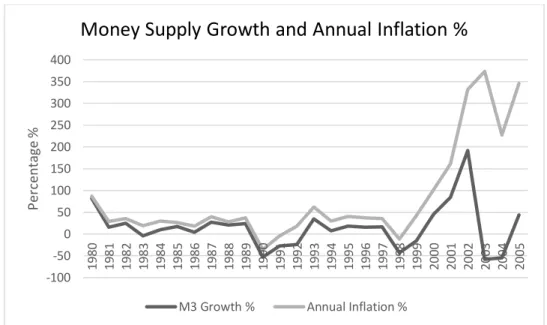
and growing a budget deficit. The fiscal deficit deteriorated from 6% of GDP in 1998 and at worst was 18% in 2000 before calming to around 8% in 2010 (Kanyenze et al., 2011). As Makochekanwa (2010) documents, the budget deficits were inflationary.The turmoil continued from 2000-2008. The relationship between money supply growth and inflation for the period 1980 to 2005 was very strong as shown in Figure 1 below.
Figure 1 Money Supply Growth and Inflation % 1980-2005)
Source: Authors’ Compilations from RBZ (2019)
As shown in Figure 1, post 2000, the variance between money supply growth and inflation widened significantly from around 13 points between 1980 and 1999 to 172 points between 2000 and 20052.This reflects the growth in influence of non-monetary variables in inflation determination. Apart from money supply growth and deficits, a number of studies including (Makochekanwa, 2007; Buigut, 2015) cited exchange rate instability, foreign currency shortages and emergence of black market premiums and political instability. By 2008 the economic crisis had reached its peak, with official inflation being recorded at 231million percent as of 31 July 2008 (RBZ, 2010). The local currency was rendered valueless by year end. On the political front, contested elections led to the Government of National Unit (GNU) which introduced the multiple currency regime3 in February 2009. In this arrangement, a basket of foreign currencies headlined by the $USD, the South African Rand and Botswana Pula were to be used as legal tender.
The multiple currency regime presented monetary authorities with mixed fortunes. The most celebrated outcome was the overnight plunge in inflation. By December 2009 the RBZ reported annual inflation rate of -7.7% (RBZ, 2010) while the World Bank reported annual inflation rate of just 3.03% in 2009, 1.63 in 2012. From 2013 up to 2017, the economy experienced deflation with annual inflation reaching its bottom-most level of -3.29% in October 2015. The greatest challenge was the loss in sovereignty over monetary policy, a condition the Ministry of Finance
2 From 1980 to 1999, mean inflation was 20.69% while money supply grew by 7.53%. From 2000 to 2005, mean
inflation was 214.80% against 42.06% money supply growth.
3 The multiple currency regime was officially abandoned on 25 June through Statutory Instrument 142/2019
-100 -50 0 50 100 150 200 250 300 350 400 1980 1981 1982 1983 1984 1985 1986 1987 1988 1989 1990 1991 1992 1993 1994 1995 1996 1997 1998 1999 2000 2001 2002 2003 2004 2005 P er centa ge %
Money Supply Growth and Annual Inflation %
69
and Economic Development (MoFED, 2019) confessed against and ended through introduction of a new domestic currency in June 2019. Using other countries’ currencies implied the RBZ could not manipulate monetary aggregates through printing. In December 2014 the RBZ introduced a surrogate currency, bond coins and later on (November 2016) bond notes at par with the $USD. The notes, amounting to $USD200 million, were introduced under the auspices of a 5% export incentive facility. However the share of bond currency in broad money supply was very small, averaging 1.31% between December 2014 and March 2018. The impact of the surrogate currency is also examined.
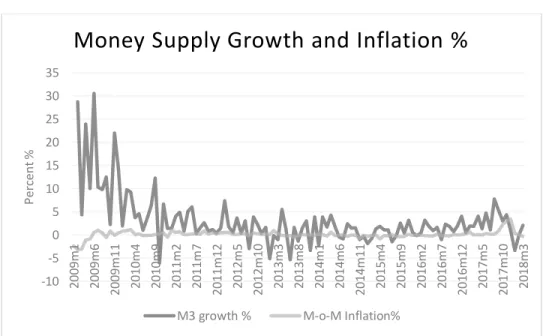
Comparing inflation rates with money supply growth provokes a re-examination of the relationship between the two. As Figure 2 shows, M3 growth (3.18%) has been above inflation rate (0.094%) between January 2009 and March 2018. The variance was large between January 2009 and December 2013, with M3 growth of 4.7% against inflation of 0.062%. From January 2014 to March 2018 mean inflation was 0.13% against money supply growth of 1.49%. Along the way the economy was characterized by disinflation and deflation regardless of relatively high money supply growth rates. Despite the adverse effects brought by disinflation and deflation, money supply was determined endogenously as the RBZ lacked the authority and sovereignty over monetary policy. As such, the relationship between money supply growth and inflation was unconventional as shown below.
Figure 2 Money Supply Growth and Inflation % January 2009 to March 2018
Source: Author’s compilation from RBZ Data (2019) -10 -5 0 5 10 15 20 25 30 35 2 00 9m 1 20 09 m 6 2 0 09 m 11 2 01 0m 4 2 01 0m 9 2 01 1m 2 2 01 1m 7 2 0 11 m 12 20 12 m 5 2 0 12 m 10 2 01 3m 3 2 01 3m 8 2 01 4m 1 2 01 4m 6 2 0 14 m 11 20 15 m 4 2 01 5m 9 2 01 6m 2 2 01 6m 7 2 0 16 m 12 2 01 7m 5 2 0 17 m 10 20 18 m 3 P er cent %
Money Supply Growth and Inflation %
70
Comparing the trends in money supply growth and inflation pre (Figure 1) and post multiple currency (Fig 2) reveals a sharp contrast. In the former, a positive correlation is quite visible and in the later inflation behavior is clearly divorced from money supply changes. It is this anomaly that has motivated testing the QTM for the multiple currency period.
3 Methods and Data
The empirical estimation is carried out with time series data covering 111 months from January 2009 to March 2018. The main variables are month-on-month inflation rate, monetary aggregates M1, M2 and M3, budget deficits and net exports. We use the Auto-Regressive Distributed Lag (ARDL) approach to long-run association and bound-test co-integration for our analysis executed with STATA 14 in two steps. Firstly, we split the time period into pre and post bond coins and notes and then test the QTM by regressing inflation on the three monetary aggregates. Secondly, we include other determinants of inflation and examined the long run relationship and co-integration.
3.1 Theoretical Framework
The Quantity Theory of Money (QTM)
Our model is grounded on the breaking work by Fisher (1911) which has become the backbone of monetary econometric analysis. In the original framework Fisher expressed the relationship between money supply and inflation through the quantity of equation:
𝑀. 𝑉 ≡ 𝑃. 𝑇 (1)
Where 𝑀 is money supply, 𝑉 is velocity of circulation of money, measuring the number of times money changes hands, 𝑃 is the average price level of goods and 𝑇 is the volume of transactions. Due to unavailability of data on 𝑇, real output, 𝑌 has been considered as a proxy. (Handa, 2009) regards Equation (1) as just a tautology which cannot be used as theory of price determination. According to Handa (2009) the identity differs from the theory in spirit and purpose in that it holds even in a state of disequilibrium. To transform the quantity equation into a theory of price determination, Fisher imposed assumptions on 𝑉 and 𝑌.
For the purpose of our analysis, we follow the modern classical economists’ view that 𝑉 is constant. However, output movements are permissible though money supply inelastic. These imply that 𝜕𝑉 𝜕𝑀⁄ = 0and 𝜕𝑌 𝜕𝑀⁄ = 0. Replacing 𝑇 with 𝑌 in (1), taking logarithms on both sides and differentiate with respect to time gives:
1 𝑃 𝑑𝑃 𝑑𝑡
= 𝛼 +
1 𝑀 𝑑𝑀 𝑑𝑡−
1 𝑌 𝑑𝑌 𝑑𝑡 (2)For plainness we denote (1 𝑋)⁄ (𝑑𝑋 𝑑𝑡) ⁄ by ∆𝑥𝑡 such that:
𝜋𝑡= 𝛼 + 𝛽∆𝑚𝑡− 𝛾∆𝑦𝑡(3)
Where 𝜋 = ∆𝑝𝑡 is the inflation rate and 𝛽 and 𝛾 are parameters to be estimated. Equation (3) says the inflation rate is a positive function of the constant velocity growth rate, money supply growth rate and a negative function of output growth rate. We follow Wang (2017) in accepting the money neutrality assumption which treats 𝑌 as an error term uncorrelated with ∆𝑀. By so doing (3) becomes:
71
𝜋𝑡= 𝛼 + 𝛽∆𝑚𝑡− 𝜖𝑡(4)
In this specification, 𝛽 = 1, signifying that inflation is always and anywhere a monetary phenomenon. It follows that a given money supply change cause a one to one effect on the inflation rate, a relationship which came to be christened as the quantity theory of money (QTM). In a follow up on the QTM, Pigou (1917) showed that the elasticity of prices to money supply, 𝜖𝑝.𝑚 = 1. This echoes an earlier discovery by Wicksell (1907), who however argued the existence of a time lag in the relationship to accommodate the transmission mechanism through which changes in money supply induces increases in inflation. We use (4) as our basis for testing the QTM.
Evidence is largely inconsistent and controversial. On one hand there are cases where the QTM never holds and still holds. On the other, the QTM holds and then collapses. Wang (2017) discloses that the QTM never holds in Germany and France. It used to exist in Australia and Italy not after 2000 and 1998 respectively. Teles et al. (2015) documents weak evidence for low inflation OECD countries. Few studies in developing countries suggest it holds for instance in Pakistan (Qayyum, 2006), Zimbabwe (Topal, 2013) and Nigeria (Chuba, 2015). Given the inconsistences, we opinion that the QTM is not a universal law. A candidate reason could be variations of monetary aggregates used. Early researches followed Lucas (1980) and were based on narrow money (M1). However Lucas cautioned and admitted that the monetary aggregate is largely arbitrary. As such, results continue to be mixed in this respect. For example Lucas [(1980); M1], Wang [(2017); M2], and (Alimi, 2012; Shagi et al; 2011; M3] find support for QTM. Whereas Wang (2017) rejected it using different aggregates for Germany and France. For Italy and Australia it was rejected after 2000 and 1998 using the same monetary aggregates upon which it was accepted.
We also recognize the differences in components of monetary aggregates owing to different levels of economic and financial development across countries. This controversy persuades us to regress (4) on M1, M2 and M3.After probing the QTM evidence based on (4), our additional objective is to examine other factors that have been responsible for inflation behavior. We are motivated by two issues. Firstly, there has been antagonism, both theoretically and empirically, on Friedman’s popular assertion that inflation is everywhere and anywhere a monetary phenomenon. Sharp and Flenvniken (1978) for instance advances that inflation is too complicated to be a function of just one variable. Secondly, and more specific to the Zimbabwean context, the possibility that inflation could have been determined more outside the monetary shadow during the study period is high. During the multiple currency regime, the RBZ lost its monetary policy sovereignty (Kavila and Roux (2016) and Makena (2017). In a related study, Sunge (2018) documents that money supply has been determined endogenously. This points to the fact that money supply growth was not exogenously determined by the central bank but rather by economic factors. In the coming section we consider fiscal and international factors that could have driven inflation behaviors. To do so we revert back to equation (1), restated:
𝑀. 𝑉 ≡ 𝑃. 𝑌 (1`) Taking logs, rearranging and differentiating with respect to time gives:
72
Where ∆𝑣𝑡 is the growth rate of velocity, ∆𝑦𝑡 is the growth in output. Due to unavailability of monthly gross domestic product, we use the Zimbabwe Stock Exchange (ZSE) grand market capitalization (mkt) as a proxy. 𝜌and𝛾 are parameters to be estimated. 𝑋𝑡is a vector of other
explanatory variables and 𝜑 is a vector of parameters to be estimated.
We start by asking questions on the assumptions on velocity. Fisher (1911) in Handa (2009) argued that assuming that 𝑉 is universally constant is wrong arguing that it can be expressed as a function of individual habits, technical factors and commercial customs. A significant number of studies provide evidence that the velocity of money mainly depends on the level of financial development (Komijani and Nazarian, 2004; Akhtaruzzaman, 2008; Sitikantha and Subhandhra, 2011; Akinlo, 2012; Okaforet al., 2013) and interest rates (Anyanwu, 1994; Saraçoğullari, 2010; Lucas and Nicolini, 2015).
Given this insight, we substitute into (5) two measures for 𝑣 : (1) financial development as proxied by credit to the private sector as a percentage of total deposits (fdv) and (2) interest rate spread (inspd). Our use of interest rate spread instead of interest rate marks another distinct feature of our analysis. By looking at the lending interest rates only, previous studies captured borrowing behavior and neglected savings behavior, irrespective of its potential impact on inflation. Expressing the relationships in natural logarithms gives:
(6)
To capture the role of fiscal policy in inflation determination, we include government budget deficit as an explanatory variable. Empirical evidence on the relationship between budget deficits can be categorized into 2 groups. First, the majority of studies (Zonuzi et al., 2011; Bakare et al., 2014; Erkam&Cetinkaya, 2014;Jalil et al., 2014; Ishaq, 2015) provide evidence that budget deficits are significantly inflationary. Bulawayo et al. (2018) shows that the impact is valid in the short-run. Second, a few studies for instance (Vieira, 2000) for 6 European countries and (Samirkas, 2014) for Turkey concluded that budget deficits have no impact on inflation. These studies were notably done in developed countries. Lwanga&Mawejje (2014) instead found that it is inflation that impacts deficits and not otherwise. Makochekanwa (2010) finds evidence that budget deficits are inflationary for Zimbabwe.
In addition to empirical considerations, developments during the period under review have persuaded the inclusion of budget deficits in our analysis. Zimbabwe enjoyed budget surpluses from 2009 to 2011, a period of cash budgeting. From 2012 up to 2018, the country has been experiencing fiscal deficits which became more pronounced from 2016 as a result of unbudgeted expenditure and dwindling revenues (Parliament of Zimbabwe, 2018). With monetary policy being dormant, there is every reason to suggest that the growing budget deficit could have accounted for a significant share of variations in the inflation rate. Adding budget deficit to (6) gives:
𝑙𝑔𝜋𝑡= 𝛼 + 𝛽𝑙𝑔∆𝑚𝑡+ 𝜌1𝑙𝑔𝐹𝑑𝑣𝑡+ 𝜌2𝑙𝑔𝐼𝑛𝑠𝑝𝑑 − 𝛾𝑙𝑔∆𝑚𝑘𝑡𝑡+ 𝜑1𝑙𝑔𝐵𝑑𝑓𝑐𝑡𝑡+ 𝜖𝑡 (7) To complete our model specification, we add net exports and oil prices to account for international factors influencing domestic inflation. Conventional wisdom predicts negative and positive impact of exports and imports on domestic inflation respectively. The final theoretical model therefore becomes:
73
𝑙𝑔𝜋𝑡 = 𝛼 + 𝛽𝑙𝑔∆𝑚𝑡+ 𝜌1𝑙𝑔𝐹𝑑𝑣𝑡+ 𝜌2𝑙𝑔𝐼𝑛𝑠𝑝𝑑 − 𝛾𝑙𝑔∆𝑚𝑘𝑡𝑡+ 𝜑1𝑙𝑔𝐵𝑑𝑓𝑐𝑡𝑡+ 𝜑2𝑙𝑔𝑁𝑥𝑝𝑜𝑡𝑡+ 𝜖𝑡 (8)
3.2 Econometric Estimation
Equation (8) is estimated using the Auto-Regressive Distributed Lag (ARDL) approach implicitlyintroduced by Davidson et al. (1978) and further developed and popularised by Pesaran and Shin (1995) and Pesaran et al. (1999). Estimating long-run relationships and co-integration analysis for both time series and panel data has been skewed towards the ARDL in recent years owing to its attractiveness over Vector Error Correction (VECM) and Vector Auto-Regressive (VAR). Unlike the later ARDL does not require variables to be integrated of the same order (Pesaranet al., 1999; Nkoro and Uko 2016). With the other methods, one would be forced to drop variables in case of both I(0) and I(1) variables. Testing for the presence of unit roots in data is not crucial but only serves to avoid I(2) variables, for which the approach fails (Paul, 2014). Nkoro and Uko (2016) adds that endogeneity is less likely in ARDL because it is immune to residual correlation. In addition the approach is more efficient in small samples (Pesaranet al., 2001) whereas the Johansen approach gives efficient results for large samples (Johansen and Juselius, 1990). Recently, Ghouseet al. (2018) show that ARDL reduces the risks of spurious regression. Furthermore, ARDL is a one stop shop approach. Over and above giving long-run and short run estimates of the model, Pesaranet al. (2001) provided for co-integration analysis using the Bound Testing. The ARDL (p, q) consists of lags p on the depended variable and lags q on the independent variables as follows Pesaranet al. (1999):
𝑦𝑡 = ∑ 𝜆𝑗𝑦𝑡−𝑗 𝑝 𝑗=1 + ∑ 𝛿𝑗𝑥𝑡−𝑗 𝑞 𝑗=0 + 𝜀𝑡 (9)
Where 𝑦𝑡 is the depended variable, 𝑥𝑡 represents a 𝑘𝑥1 vector of explanatory variables, 𝛿𝑗 is a 𝑘𝑥1 coefficient vector, 𝜆𝑗is the vector of scalars and 𝜀𝑡is the disturbance term distributed with a zero mean and a finite variance. Expressing (9) in error correction form gives:
Δ𝑦𝑡 = 𝜙𝑦𝑡−1+ 𝛽′𝑥𝑡+ ∑ 𝜆𝑗∗Δ𝑦𝑡−𝑗+ ∑ 𝛿𝑗∗𝑥𝑡−𝑗+ 𝜀𝑡 𝑞−1 𝑗=0 (10) 𝑝−1 𝑗=1 Where = −1[1 − ∑𝑝𝑗=1𝜆𝑗] ; 𝛽′ = ∑ 𝛿 𝑗 𝑞 𝑗=0 ; 𝜆𝑗∗ = ∑𝑝𝑚=𝑗+1𝜆𝑚, 𝑗 = 1,2, … . 𝑝 − 1 ; 𝛿𝑗∗ = ∑𝑞𝑚=𝑗+1𝛿𝑚, 𝑗 = 1,2, … . 𝑞 − 1.
Regrouping (10) and summarizing gives:
Δ𝑦𝑡 = 𝜙(𝑦𝑡−1+ 𝜃′𝑥 𝑡) + ∑ 𝜆𝑗∗Δ𝑦𝑡−𝑗+ ∑ 𝛿𝑗∗𝑥𝑡−𝑗+ 𝜀𝑡 𝑞−1 𝑗=0 (11) 𝑝−1 𝑗=1 𝜃 = − [𝛽
𝜙]shows the long-run multipliers or elasticities of 𝑥𝑡 on 𝑦𝑡. 𝜙is the error correction term
or speed of adjustment. It measures how fast 𝑦𝑡 moves to its long-run equilibrium following changes in 𝑥𝑡 (Seka et al., 2015). The coefficient should always be negative to imply convergence and stability in the long-run relationship (Ghouseet al., 2018). 𝜆𝑗∗and𝛿𝑗∗ are the
74
lagged differences of the depended and independent variables respectively. They measure the short-run elasticities on 𝑦𝑡.Given the theoretical model in (8) the econometric model to be estimated is given as:
In estimating (12) we use the Akaike Information Criterion (AIC) to determine the optimum lag length. The ARDL Bounds test of co-integration uses both the F-statistic and Wald-t tests to check the null hypothesis of no co-integration among the variables. The F and Wald t-statistics are matched with the two sets of critical values of the upper- and lower-bounds. If the estimated statistics value is higher, then H0 is rejected, otherwise it’s accepted. If it lies between the two
75
3.3 Data Description and Sources Table 1 Data Description
Variable Name Description
Inflation
Measured by the consumer price index reflects the monthly percentage change in the cost to the average consumer of acquiring a basket of goods and services
M1 Growth
Growth of M1- Narrow Money defined as notes and coin in circulation plus transferable deposits held by the depository corporations
M2 Growth
Growth rate of M2- M2 is defined as M1 plus savings deposits plus time deposits held by other depository corporations.
M3 Growth Growth rate of M34-Broad Money defined as M2 plus negotiable certificates of deposits.
Interest Rate Spread
The difference between minimum lending rates and 90 day savings deposit rates
Financial Development Credit to the private sector as a percentage of total deposits
Market Capitalization Growth
Growth in the Zimbabwe Stock Exchange Grant Market Capitalization
Budget Deficit
The excess of total government expenditure over total government revenue
Source: All the data was obtained from the Reserve Bank of Zimbabwe online publications and data sets
4 From January 2017, broad money is redefined using IMF’s Monetary and Financial Statistics Manual of 2016. A notable change is that Government deposits held by banks are no longer part of broad money.
76
4 Results presentation and Discussion 4.1 Descriptive Statistics
Table 2 Descriptive Statistics
Variable Obs Mean Std. Dev Min Max
inf 111 0.09% 0.78% -3.17% 3.46% m1 111 2,530,000,000 1,460,000,000 216,000,000 6,640,000,000 m1g 110 3.26% 8.11 -15.36% 48.82% m2 111 3,680,000,000 1,840,000,000 298,000,000 8,040,000,000 m2g 110 3.17% 5.73 -9.08% 29.74% m3 111 3,820,000,000 1,820,000,000 298,000,000 8,110,000,000 m3g 110 3.18% 5.73 -6.03% 30.54% lnr 111 2.024% 3.128 -6.76% 7.9% fdv 111 72.22% 17.53 30.98% 97.86% mkt 111 4,360,000,000 1,890,000,000 890,000,000 14,800,000,000 bdfct 111 -37,700,000 104,000,000 -492,000,000 286,000,000 nxpot 111 -282,000,000 289,000,000 -2,891,000,000 84,900,000 Source: Authors’ Compilation from STATA Output
Table 2 shows summary statistics for variables under consideration. Of interest is the discrepancies between monetary aggregates and inflation rate. Whilst M1, M2 and M3 growth averaged 3.26%, 3.17% and 3.18% respectively, inflation averaged only 0.09%. This somehow portrays a divorce between money supply growth and inflation. Growth in money supply did not produce equal increase in the inflation rate. For instance the biggest increase in broad money (M3) of 30.54% between May and June 2009 relates to inflation rate of only 0.56%. Concern can also be put on prevalence of twin deficits; budget and BOP. Over a period of 111 months (January 2009-March 2018), the budget was in deficit 68 times, representing 61.2% occurrence rate. The average budget deficit stood at $37.7 million with a high of $492 million incurred in August 2018. Mean net-exports are $282 million, with an unusually high $2.891 million recorded in October 2010. The next section presents econometric analysis results.
77
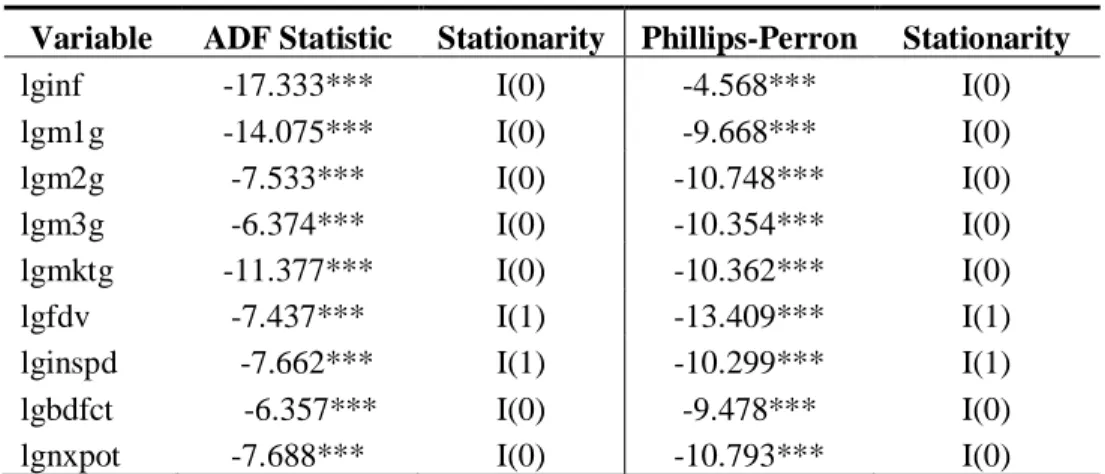
4.2 Unit Root Tests Table 3 Unit Root Test
Variable ADF Statistic Stationarity Phillips-Perron Stationarity
lginf -17.333*** I(0) -4.568*** I(0) lgm1g -14.075*** I(0) -9.668*** I(0) lgm2g -7.533*** I(0) -10.748*** I(0) lgm3g -6.374*** I(0) -10.354*** I(0) lgmktg -11.377*** I(0) -10.362*** I(0) lgfdv -7.437*** I(1) -13.409*** I(1) lginspd -7.662*** I(1) -10.299*** I(1) lgbdfct -6.357*** I(0) -9.478*** I(0) lgnxpot -7.688*** I(0) -10.793*** I(0)
Critical Values 1% (-4.037); 5% (-3.449); 10% (-3.149).***,** and * denotes 1%, 5% and 1% level of significance respectively
Results from the ADF and Phillips-Perron Unit Roots show that all variables but lgfdv andlginspd are stationary in levels [I(0)]. These become stationary at first difference [I(1)] at 1%. The fact that we have a mixed of order of integration amongst the variables relegates the use of Johannsen co-integration tests. Fittingly, the absence of I(2) variable validates the use of ARDL approach to long-run examination and the Bound Test for co-integration whose results are given in Table 4 below.
4.3 QTMAcross Monetary Aggregates Before and After Bond Coins and Notes
To test the existence of the QTM we regressed inflation rate on three monetary aggregates, M1, M2, and M23. This was motivated by variations in empirical studies due to different monetary aggregates. In line with our additional objective to assess the impact of bond notes on the QTM, we split our time period into two; before and after the introduction of the bond notes and coins.
78
Table 4 : Money Supply Aggregates and Inflation Before and After Bond Coins and Notes
Lgm1g Lgm2g Lgm3g Before After Overall Before After Overall Before After Overall Coefficient 0.107** (0.052) 1.569*** (0.336) 0.237*** (0.094) 0.084** (0.035) 1.425*** (0.386) 0.098 (0.072) 0.028 (0.021) 1.036*** (0.311) 0.159*** (0.059) [2.07 ]. [4.67] [2.80] [2.38] [3.69] [1.36] [1.35] [3.33] [2.70] ECT -0.786*** (0.105) -0.559*** (0.124) 0.505*** (0.076) -0.823*** (0.105) -0.462*** (0.107) -0.485*** (0.078) -0.823*** (0.110) -0.415*** (0.108) -0.523*** (0.078) [7.50] [-4.52] [-6.62] [-7.81] [ -4.30] [ -136] [ -7.48] [-3.86] -[6.74] 𝑅2 0.548 0.519 0.378 0.537 0.502 0.352 0.479 0.490 0.351 RMSE 0.047 0.051 0.054 0.047 0.051 0.055 0.049 0.051 0.055
In parenthesis (…) are standard error and in brackets […] are t statistics, ***,**,* shows level of significance at 1%, 5% and 10% respectively.
79
The results show that over the whole period, M1 and M3 had positive, statistically significant but very weak impact on inflation. M2’s impact is not only the weakest but statistically insignificant. This suggests that evidence of the QTM is very weak. For instance a 1% increase in M1 and M3 was only responsible for only 0.237% and 0.159% increase in inflation. The 𝑅2
for the monetary aggregates are 37.8%, 35.2% and 35.1% respectively. These indicate that just over 35% of variations in inflation was as a result of growth in these monetary aggregates. However looking at the period before and after the introduction of bond notes and coins tells an interesting story.
Before, money supply growth had a weak impact on inflation. Consider the impact of growth in M1 and M2 prior to December 2014. Coefficients of 0.107 and 0.084 which are statistically significant at 5% imply that a 1% increase in the monetary aggregates caused only 0.107% and 0.081% increase in inflation. After the introduction of the bond notes and coins, money supply elasticities for all aggregates (M1=1.569, M2=1.425, M3=1.036) are positive, statistically significant at 1% and are above 1. This conveys that 1% increase in growth in M1, M2 and M3 led to a 1.569%, 1.425% and 1.036% increase in inflation respectively. These elasticities are within vicinity of the QTM. For this period there is strong evidence in support of the QTM. The
𝑅2values increases to 51.9%, 50.2% and 49% respectively suggesting an increased role of money
supply in inflation determination. Possible explanation for this is that the introduction of the bond coins and notes allowed the central bank to relive its control over money supply determination.
The error correction terms for all monetary aggregates before, after and over the whole period are negative and statistically significant at 1%. It follows that following changes in monetary aggregates, the inflation rate will move back from the consequent disequilibrium towards equilibrium at the rate given by the error term. For example, the error correction term for M3 growth over the entire period is -0.523. This entails that inflation rate moves to state of equilibrium at the speed of 50%. It also implies that there exists a long run association between money supply aggregates and inflation during the mentioned time periods. The long-run association is cemented by the ARDL Bound tests co-integration results shown in Table 5 below.
80
Table 5 ARDL Bound Test for Co-integration
Statistic 10% Crit Value 5% Crit Value 1% Crit Value p-Value
Model I(0) I(1) I(0) I(1) I(0) I(1) I(0) I(1)
Lgm1g F = 32.899 4.081 4.873 5.031 5.909 7.212 8.255 0.000 0.000 Before t = -7.498 -2.564 -2.922 -2.879 -3.252 -3.500 -3.893 0.000 0.000 Lgm1g F=13.455 4.146 4.989 5.170 6.127 7.601 8.799 0.000 0.001 After t=-4. 521 -2.568 -2.932 -2.904 -3.286 -3.582 -3.992 0.000 0.003 Lgm1g F=27.835 4.061 4.831 4.979 5.828 7.056 8.049 0.000 0.000 Overall t=-6.623 -2.565 -2.918 -2.870 -3.238 -3.467 -3.855 0.000 0.000 Lgm2g F = 33.243 4.081 4.873 5.031 5.909 7.212 8.255 0.000 0.000 Before t = -7.813 -2.564 -2.922 -2.879 -3.252 -3.500 -3.893 0.000 0.000 Lgm2g F= 16.179 4.165 4.990 5.187 6.120 7.607 8.762 0.000 0.000 After t=-4.299 -2.578 -2.940 -2.911 -3.291 -3.582 -3.990 0.000 0.000 Lgm2g F= 19.220 4.061 4.831 4.979 5.828 7.056 8.049 0.000 0.000 Overall t=-6.173 -2.565 -2.918 -2.870 -3.238 -3.467 -3.855 0.000 0.000 Lgm3g F = 28.376 4.110 4.882 5.061 5.914 7.240 8.242 0.000 0.000 Before t = -7.483 -2.577 -2.937 | -2.889 -3.265 -3.505 -3.901 0.000 0.000 Lgm3g F= 14.335 4.165 4.990 5.187 6.120 7.607 8.762 0.000 0.000 After t=-3.859 -2.578 -2.940 -2.911 -3.291 -3.582 -3.990 0.000 0.014 Lgm3g F= 25.674 4.071 4.836 4.990 5.831 7.068 8.049 0.000 0.000 Overall t=-6.783 -2.569 -2.924 -2.874 -3.243 -3.469 -3.859 0.000 0.000 Source : Authors’ Compilation from STATA Output
81
As shown in Table 5, across all monetary aggregates and time periods, both F and t statistics are greater than the lower bound I(0) and the upper bound I(1) critical values even at 1%. Reading this together with very low probability values (𝑝 < 0.01) in all cases, the findings provide very strong evidence of co-integration between money supply and inflation rate. The key finding from this section is that the QTM holds only after the introduction of the bond notes and coins. Considering the entire period, there is very weak evidence, suggesting that over and above growth in money supply, other factors beyond could have been responsible for the inflation behavior. We present evidence on these factors in Table 6 below.
4.4 Other Determinants of inflation
Prior to the long-run estimation, unit root tests were conducted and results have been reported in Table 3. For the record, all other variables are I(0) and only lgfdv and lginspd are I(1). This gives weight to our use of ARDL approach.
Table 6 Auto-Regressive Distributed Lag (ARDL) Model Long-Run Results
Depended Variable: D.lginf
Variable Coefficient Stand. Error t statistic probability
ECT -0.728*** 0.076 -9.53 0.000 Lgm3g 0.142*** 0.041 3.48 0.001 lginspd -.018 0.015 -1.17 0.246 lgfdv 0.185** 0.087 2.12 0.037 lgmktg -.002 0.038 -0.52 0.606 lgbdf -0.245*** 0.038 -6.45 0.000 lgnxpts -0.028* 0.017 -1.67 0.098 Observations =107 R2 =64.7% Adjusted R2 =58.9% Log-Likelihood= 192.91 Root MSE =0 .043
***,**,* shows level of significance at 1%, 5% and 10% respectively
Source: Authors’ Compilation from STATA Estimates
The error correction term is negative (-0.728) and statistically significant at 1%. This is to say the speed of adjustment to inflation long run equilibrium following dynamics in the explanatory variable is 72%. The high speed confirms that the influence of the explanatory variables in inflation determination is quite high. This endorses long run association between the explanatory variables and inflation. The model variables’ combined explanatory power, at 65% is meaningfully high. This suggests that 65% of variations in the inflation rate is accounted for by changes in the explanatory variables.
The key result here is that the QTM is live but very tenuous. A 1% statistically significant and positive elasticity for M3 growth of 0.142 depicts that a 1% rise in M3 growth accounted for a mere 0.14% increase in inflation. This impact is arguably far away from the vicinity of the QTM, which should be close to 1. Our finding concurs with Teleset al. (2015) who also find weak evidence for QTM, particularly for countries with low inflation rates (less than 12%). However,
82
weak evidence of the QTM is actually rare for developing countries. Related studies (Qayyum, 2006; Topal; 2013; Chuba, 2015) suggested that evidence for QTM has been strong for Pakistan, Zimbabwe and Nigeria respectively.
Further insight is imperative here. Our finding of weak QTM evidence might not be surprising for two reasons. Firstly, during the period under study, the RBZ has adopted the use of multiple currencies following the demise of the local currency which was demonetized in 2015. The adoption of a basket of currency meant that the apex bank had lost its control over money supply determination. Given that money supply was endogenously determined as shown by Sunge (2018), manipulation of money supply through conventional instruments was practically impossible. Secondly, with the monetary side of the economy crippled all was left to fiscal policy to play a key role in fine-tuning the economy’s performance. Hence, the influence of money supply in inflation determination was greatly reduced.
With more focus on fiscal policy, we turn our discussion to the impact of budget deficits. The results reveals that fiscal deficits was the biggest mover of inflation. The negative and 1% statistically significant coefficient of 0.245 signifies that a 1% worsening of the budget deficit stirred a 0.25% rise in inflation. The budget deficit impact is about 10 points bigger than money supply growth impact. The finding that budget deficits are inflationary has been the conventional results in many studies including (Makochekanwa, 2010; Zonuzi et a.l, 2011; Bakare et al., 2014; Erkam and Cetinkaya, 2014;Jalil et al., 2014; Ishaq, 2015). However, for budget deficits to outplay money supply growth is somehow controversial, though not surprising for Zimbabwe over this period.
The budget deficits were largely incurred as a result of growing expenditure. After enjoying budget surpluses from 2009 to 2012, the budget deficits became more prevalent thereafter due to increase in public expenditure. Although public expenditure as a percentage of GDP of around 27% was below most SADC countries level of around 32%, it is its composition that is worrisome. Between 2011 and 2017, over 90% of public expenditure was recurrent or consumptive (mainly wages and salaries) leaving a paltry share for capital expenditure. Coupled by the fact that domestic debt was financed through domestic borrowing rather than money supply growth, it is in order that budget deficits were more inflationary than money supply growth.
Coefficients from interest rate spread and net-exports are in line with theoretical expectation.Net exports have a weak, negative (0.028) and hazily significant (10%) impact on inflation. It follows that a 1% increase in net exports reduced inflation by just 0.028%. The finding associates to the majority of outcomes including (Cooray, 2002; Ayubet al., 2014) which agrees to the Fisher effect However the weak impact of net exports serves to emphasize that inflation behavior was largely domestically influenced than foreign induced. Interest rates spread had the expected negative (0.018) yet weak and statistically insignificant impact at conventional significance levels. An increase in the spread discouraged savings and probably increased consumption. However, the fall in demand in credit as borrowing soured could have been more powerful than the increase in consumption thereby leading to a fall in inflation. This confirms to the conventional theoretical wisdom that interest rates are negatively related to inflation.
Finally estimates for lgfdv and lgmktg indicated opposite effects on inflation. Theoretically, as the share of deposits loaned out to the private sector increases, domestic production should be boosted with a fall in inflation as an end product. However, the coefficient of 0.185 which is
83
significant at 5% suggests that as more of deposits are loaned to the private sector, inflation increases by 0.185%. The contradictory finding may reflect the composition of the loans. A significant portion of these loans were mainly consumptive rather than productive loans. Last but not least, growth in market capitalization, our proxy for economic growth, had the expected negative but statistically insignificant impact on inflation. Increased market capitalization signifies availability of investments funds for the productive sector of the economy. More domestic production usually dampens inflationary pressures.
We also examined the existence of co-integration after including other determinants of inflation. The ARDL Bound test results are shown in Table 7 below.
Table 7: ARDL Bound Test Cointegration Results
Statistic 10% Crit Value 5% Crit Value 1% Crit Value p-Value
I(0) I(1) I(0) I(1) I(0) I(1) I(0) I(1)
F= 18.986 2.161 3.350 2.521 3.811 3.314 4.807 0.000 0.000 t=-9.526 -2.520 -4.009 -2.839 -4.377 -3.464 -5.079 0.000 0.000
Source : Authors’ Compilation from STATA Output
The results strongly rejects the null hypothesis of no-integration. For both F and t statistics, calculated values are well above the lower bound I(0) and upper bound I(1) critical values at all levels of significance. In addition all p values are well below the narrowest level of significance, 1%. Hence there is co-integration between inflation and the explanatory variables in the mode.
6. Conclusion
The aim of this paper was to test the validity of the quantity theory of money (QTM) in Zimbabwe during the multiple currency era for the period January 2009 to March 2018. The QTM proposition that a change in money supply growth causes an equal growth in nominal inflation has attracted undying research interest, with its validity being heavily contested. If the unsettled findings call for more investigations, it has to be louder for Zimbabwe for two reasons. Firstly, and perhaps more importantly, the Zimbabwean context of a multiple currency regime is distinct. Previous evidence relates to domestic mono-currencies, where monetary authorities enjoyed significant authority and sovereignty over money supply determination. How the QTM performs in an economy transacting in multiple currency and crippled over money supply control is still unknown. Furthermore the co-habitation of low inflation levels averaging 0.094% , punctuated by periods of disinflation and deflation between 2013 and 2017, with notably high money supply growth of 3.18% amplifies the need to examine the QTM validity.
Secondly, there has been a dearth of studies on the QTM in Zimbabwe. Related studies prior to the multiple currency implicitly examined the relationship between money supply and inflation among other determinants. Evidence mainly blamed excessive growth in money supply (Makochekanwa, 2007 Coorey et al., 2007) and also high budget deficits (Makochekamwa, 2010) .Topal (2013) used the QTM as the basis for his examination of the relationship between money supply and inflation prior to the multiple currency period. Post multiple currency introduction, Pandiri (2012) relates inflation to exchange rate, money supply, expectations about future prices. Kavila and Roux (2016) and Makena (2017) provide evidence in which the blame on inflation shifted from money supply growth to South African rand/US dollar exchange rate,
84
South African overall CPI as major determinants. In all these studies, no attempt was made to test the existence of the QTM. Hence the study provides new evidence on the validity of the QTM in a multiple currency regime.
We used the Auto-Regressive Distributed Lag (ARDL) approach for log-run association and co-integration analysis. Our estimation follows two stages. In the first, we tested the QTM hypothesis by regressing inflation on three monetary aggregates, M1, M2 and M3. We split the time period into two, the period before introduction of bond coins and notes (January 2009-December 2014) and post January 2015 to March 2018. In the second we examined other determinants of inflation. In addition to money supply, we included interest rates spread, credit to the private sector as a proxy for financial sector development and Zimbabwe Stock Exchange (ZSE) grant market capitalization as a proxy for economic activity. Furthermore fiscal budgets and net exports were included to capture the influence of fiscal policy and trade on inflation. First stage results suggest very weak evidence for the QTM for the whole period. For instance, a 1% increase in M3 led to only a 0.159% increase in inflation between January 2009 and March 2018. However we find co-integration between inflation and all money supply aggregates. After splitting the time period into pre and post bond notes introduction, findings indicate that strong evidence of the QTM post bond coins and notes introduction. After bond currency introduction, M3 elasticity changed from 0.028 to 1.036 which proves QTM. Evidence form second stage estimation reveals that the main pusher of inflation is fiscal deficits, with an impact approximately 10points higher than M3 growth. Overall, results imply that the multiple currency systems weakened the central bank’s ability to fine-tune inflation by controlling money. We welcome the scraping of the multiple currency system. However, to safeguard the abuse of the restored monetary policy sovereignty we recommend that the central bank prioritize money supply targeting as the primary monetary policy target.
REFERENCES
Akhataruzzaman, M. D. (2008) Financial development and velocity of money in Bangladesh: a vector auto-regressive analysis, Bangladesh Working Paper Series 0806.
Alimi, R. S. (2012) ‘The quantity theory of money and its long run Implications: Empirical evidence from Nigeria’, Munich Personal RePEc Archive.
Alimi, R. S. (2014) ‘ARDL bounds testing approach to cointegration: A re-examination of augmented Fisher hypothesis in an open economy’, Vol 2 No. (2), pp. 103–114.
Akinlo, A. E (2012) ‘Financial development and the velocity of money in Nigeria: An empirical analysis’,The Review of Finance and Banking, Vol 4 No. 2, pp.97-113
Ayub. G., Rehman, N.U., Iqbal, M. and Atif, M. (2014) ‘Relationship between inflation and interest rate: Evidence from Pakistan’, Research Journal of Recent Sciences, Volume 3 No 4, pp. 51-55.
Bakare, I. A. O., Adesanya, O. A. and Bolarinwa, S. A. (2014) ‘Empirical investigation between budget deficit, inflation and money supply in Nigeria’, European Journal of Business and Social Sciences, Vol 2 No. 12, pp.12-134
85
Benati, L. (2009) Long run evidence on money growth and inflation. https://ssrn.com/abstract_id=1345758
Buigut, S. (2015) ‘The effect of Zimbabwe’s journey to hyperinflation on bilateral trade: myth or reality’, International Journal of Economics and Financial Issues, Vol 5 No. 5, pp.690 - 700
Bulawayo, M., Chibwe, F. and Sheshani, V (2018) ‘The impact of budget deficits on inflation in Zambia’, Journal of Economics and Development Studies,Vol 6 No. 2, pp.13-23
Chuba, M.A. ‘Transmission mechanism from money supply to inflation in Nigeria’, Economics, Vol 4 No. 6, pp.98 - 105
Cooray, A. (2002) ‘Testing the Fisher effect for Sri Lanka with a forecast rate of inflation as proxy for inflationary expectation’, The Indian Economic Journal, Vol 50 No. 1, pp.26-37 Coorey, S., Clausen, J. R., Funke N., Muñoz, S. and Ould-Abdallah, B. (2007) Lessons from high
inflation episodes for stabilizing the economy in Zimbabwe, IMF Working Paper WP/07/99.
Davidson, J. E., Hendry, D. F., Srba, F. and Yeo, S. (1978) ‘Econometric modeling of the aggregate time series relationship between consumers’ expenditure and income in the United Kingdom’, The economic Journal ,Vol 88 No. 352, pp.661-692
Ditimi, A., Sunday, K. and Onyedikachio, E. (2018) ‘The upshot between money supply and inflation in Nigeria’, Journal of Economic Cooperation Development, Vol 39 No. 1, pp.33 - 108
Dhal, S., Kumar, P. and Ansari, J. (2011) Financial stability, economic growth, inflation and monetary policy linkages in India: An empirical reflection, Reserve Bank of India Occasional Papers ,Vol. 32 No. 3, Winter 2011
Diaz-Gimenez, J. and Kirkby R. (2013) Illustrating the quantity theory of money in the United States and in three model economies, Working paper, Universidad Carlos III, De Madrid El-Shagi, M., Giesen, S. and Kelly, L. (2011) ‘ The quantity theory revisited: a new structural
approach, macroeconomic dynamics’, Cambridge University Press, Vol 19 No. 1, pp.58 - 78
Erkam, S. and Chetinkaya, M. (2014) ‘Budget deficits and inflation: evidence from Turkey’, The Macrotheme Review,Vol 3 No. 8, pp.12-22
Ghouse, G., Khan, S. A. and Rehman, A.U. (2018) ‘ARDL model as a remedy for spurious regression: problems, performance and prospect’, Munich Personal RePEc Archive
Handa, J. (2009) Monetary Economics, 2nd ed., Routledge, London.
ILO, UNCTAD, UNDESA, WTO (2012) Macroeconomic stability, inclusive growth and employment: Thematic Think Piece, United Nations System Task on the post-2015 development agenda
Ishaq, T. and Mohsin, H. M. (2015) ‘Deficits and inflation: Are monetary and financial institutions worthy to consider or not?’,Borsa Istanbul Review, Vol 15 No. 3, pp.180-191
86
International Monetary Fund (2019), Monetary Policy and Central Banking. IMF Factsheet. Jalil, A., Tariq, R. and Bibi, N. (2014) ‘Fiscal deficit and inflation: new evidences from Pakistan
using a bounds testing approach’, Economic Modelling, Vol 34, pp.120-126
Johanesen, S. and Juselius, K. (1990) ‘Maximum likelihood estimation and inference on cointegration with application on demand for money’, Oxford Bulletin of Economics and Statistics, Vol 52 No.2 , pp.169 - 209
Kairiza, T. (2009) Unbundling Zimbabwe’s journey to hyperinflation and official dollarisation, Discussion Papers 09-12, National Graduate Institute for Policy Studies
Kanyeze, G., Kondo, T., Chitambara, P. and Martens, J. (Eds), (2011) Beyond the Enclave:Towards a Pro-poor and Inclusive Development Strategy for Zimbabwe; Weaver Press, Harare.
Kavila, W. and Le Roux, P. (2016) Inflation dynamics in a dollarised economy: The case of Zimbabwe, Economic Research Southern Africa (ERSA), Working Paper 606.
Komijani, A. and Nazarian, R. (2004) ‘Behavioral pattern of income velocity of money and estimation of its function (the case of Iran)’, Iranian Economic Review, Vol 9 No.11,pp. Lucas, R. E. (1980) ‘Two illustrations of the quantity theory of money’, The American Economic
Review, Vol 70 No. 5, pp.1005 - 1014
Lucas, R. E. and Nicolini, J. P. (2015) On the stability of money demand, Fereal Reserve Bank of Minneapolis, Research Working Paper 718.
Lwanga, M. M. and Mawejje, J. (2014) ‘Macroeconomic effects of budget deficits in Uganda: A VAR-VECM approach, EPRC Research Series, No 11, pp.25
Makena, P. (2017) Determinants of inflation in a dollarised economy: The case of Zimbabwe, Zimbabwe Economic Policy Analysis Research Institute (ZEPARU).
Makochekanwa, A. (2007) A dynamic enquiry into the causes of hyperinflation in Zimbabwe, Department of Economics University of Pretoria, Working Paper Series, WP 2007-10, Makochekanwa, A. (2010) The impact of a budget deficit on inflation in Zimbabwe,
https://mpra.ub.uni-muenchen.de/24227/
Ministry of Finance and Economic Development, 2018. The 2019 mid-year budget review and supplementary budget: Building a strong foundation for future prosperity, Harare: Ministry of Finance and Economic Development.
Nkomazana, L. and Niyimbanira, F. (2014) ‘An overview of the economic causes and effects of dollarization: case of Zimbabwe’, Mediterranean Journal of social sciences, Vol 5 No. 7, pp.69 - 73
Nkoro, E. and Uko, A. K. (2016) ‘Autoregressive distributed lag (ARDL) cointegration technique: Application and interpretation’, Journal of Statistical and Econometric methods, Vol 5 No. 4, pp. 63–91
87
Nyoni, T. (2018) ‘Modeling and forecasting inflation in Zimbabwe: a generalized autoregressive conditionality heteroskedastic (GARCH) approach’, Munich Personal RePEc Archive,[ online] https://mpra.ub.uni-muenchen.de/88132/ (Accessed 5 August 2019).
Okafor, P. N., Shitile, T. S., Osude, D., Ihediwa, C. C., Owolabi, O. H., Shom, V. C. and Agbadaola, E. T. (2013) ‘Determinants of income velocity of money in Nigeria’, Central Bank of Nigeria Economic and Financial Review, Vol 51 No.1, pp.29-59
Ocampo, J. A. (2005) ‘A broad view of macroeconomic stability’
www.un.org/esa/desa/papers/2005/wp1_2005.pdf (Accessed 5 August 2019)
Pandiri, C. (2012) ‘Monetary reforms and inflation dynamics in Zimbabwe’, International Research Journal of Finance and Economics,Vol 1 No. 90, pp.207-222
Patruti, A and Tatulescu, A. (2013) ‘Empirical evidence for the quantity theory of money: romania – a case study’, Romanian Statistical Review, Vol. 61 No. 11, pp.12 - 19
Paul, B. P. (2014) ‘Testing export-led growth in Bangladesh: An ARDL bounds test approach’, International Journal of Trade, Economics and Finance, Vol. 5 No. 1,pp.1 - 5
Pesaran, H.M. and Shin, Y. (1995) ‘Autoregressive distributed lag modeling approach to cointegration analysis’, Paper Presented at a Symposium, Norwegian Academy of Science and Letters, 3 – 5 March, Oslo, Norway.
Pesaran, M. H., Shin, Y., Smith, R. P. (1999) ‘Pooled mean group estimation of dynamic heterogeneous panels’, Journal of American Statistical Association, Vol 94 No. 446, pp. 621- 634.
Qayyum, A. (2006) ‘Money, inflation, and growth in Pakistan’, The Pakistan Development Review, Vol 45 No. 2, pp.203 - 212
RBZ (2010) Mid-year monetary policy statement. Reserve Bank of Zimbabwe.
Samirkas, M. (2014) ‘Effects of budget deficits on inflation, economic growth and interest rates: applications of Turkey in 1980-2013, Journal of Economics and Development Studies,Vol 2 No. 4, pp.203-210
Saraҫoǧullari, S. The Relationship between Velocity and Interest Rate in the Cash in Advance Model. Unpublished Master’s Thesis, Department of Economics, Bilkent University, Ankara
Seka, S. K. Teoa, X. Q. and Wonga Y. N. (2015) ‘A comparative study on the effects of oil price changes on inflation’, Elsevier B.V., Vol 26 No. 15, pp.630 – 636. doi: 10.1016/S2212-5671(15)00800-X.
Sharp, A. M. and Flenniken, P. S. (1978) ‘Budget deficits: a major cause of inflation?’,Public Finance Review,Vol 6 No. 1, pp.115 - 127.
Sikwila, M.N. (2013) ‘Dollarisation and Zimbabwe’s economy’, Journal of Economics and Behavioural Studies, Vol 5 No. 6, pp.398 - 405
Sitikantha, P. and Subhandra, S. (2011) The velocity crowding-out impact: Why high money growth is not always inflationary, Reserve Bank of India Working Paper Series, May 2011
88
Teles, P., Uhlig, H. and Vslle e Azevedo, J. (2015) ‘Is quantity theory still alive?’,The Economic Journal , Vol 126 No. 591, pp.442-464
Topal, Y.H. (2013) On the tracks of Zimbabwe’s hyperinflation: A quantitative investigation http://mpra.ub.uni-muenechen.de/56117/(Accessed 5 August 2019)
United Nations Development Programe (2019) Development and globalization facts and figures:
sustainable development goal 17: Partnerships for the goals https://stats.unctad.org/Dgff2016/partnership/goal17/target_17_13.html (Accessed 26 July
2019)
Viera, C. (2000) Are fiscal deficits inflationary? Evidence for the EU. Department of Economics, Loughborough University, Economics Research Paper No. 7, pp.1-16
Wang, X. (2017) The quantity theory of money: an empirical and quantitative reassessment Washington University in St.Louis Department of Economics Working Papers.https://cpb-us-w2.wpmucdn.com/sites.wustl.edu/dist/3/817/files/2017/09/QTMmainCIA-v3nep6.pdf World Bank (2019). World Development
Indicators.https://data.worldbank.org/country/zimbabwe (Accessed 28 June 2019)
Zonuzi, J. M., Pourvaladi, M. S. H. and Faraji, N. (2011) ‘The relationship between budget deficit and inflation in Iran, Iranian Economic Review, Vol 15 No. 28, pp.117-133