Application of Neural Network for Short
/Medium Term Load Forecasting
L.R.Arvind Babu*
٭Assistant Professor in Information Technology, CSE Wing, DDE, Annamalai University
Annamalainagar , Tamilnadu, India
ABSTRACT: This paper presents the application of neural network for short/medium term load forecasting. Short term load forecasting plays an important role in operation planning, control and interchange transaction scheduling for great saving in electric utility organizations. In this paper has concept in short term load forecasting using neural network involved is designed using back propagation learning technique which can forecast of peak and valley loads, hourly load and next day energy. Inputs data for neural network training is contain past daily loads and past temperature of various areas having forecasting and will separate for learning in day type contains Workday, Monday, Saturday or holiday of government and Sunday include 8 past days for training which the neural has various input neural is best suitable pattern. For hidden layer has 10 hidden neural gave least error in forecasting and results show accuracy forecasting. The testing results show that this paper has meanabsolute percentage error difference in time and load and error rate between actual and the predicted.
KEYWORDS: Short-term load forecasting, Back-propagation, Artificial Neural Networks (ANN), learning, training
I. INTRODUCTION
II. DEMAND PATTERNS
A broad spectrum of factors affects the system’s load level such as trend effects, cyclic-time effects, special effects, weather effects,load management, electricity tariff structures, and illumination level. In addition, total system load is subjected to random disturbances caused by sudden increase of large loads or outages. Thus the load profile is dynamic in nature with temporal, seasonal and annual variations
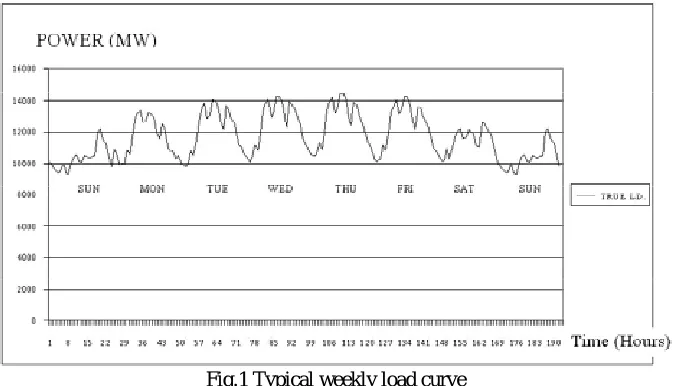
Fig.1 Typical weekly load curve
The electrical peak consumption is about 15,000 MW during a working day. This demand is highly volatile on a day-to-day basis and is being significantly affected by weather conditions. The weekly pattern is comprised of the daily shapes are Monday, Weekday (Tuesday through Friday), Sunday and Holiday, reflecting the main working activities. Figure 1 shows the shapes of the typical electrical load curve during a week. Generally the load pattern on normal weekdays, when work is already in full swing, remains almost constant with small random variations from varying industrial activities, weather conditions etc., Figure. 2 shows load on Mondays and Weekday is different from that on other weekdays due to pick-up loads on mornings when all business and industries just start work, and evening loads in weekdays, because of its proximity to the weekend. The load pattern on Saturday and Sunday are different from rest of the weekdays. The peak load also takes a dip on Saturday and Sunday, which is a rest day for most of the people. The shape of the load curve on Sundays is similar to that on holidays. The peak load decreases considerably before and after major public holidays.
Fig. 2 Typical load pattern of daily shape
III. STLF MODELING AND PROCEDURE
Network Architecture: The Artificial Neural Networks consists of the three-layer fully connected feed-forward neural network depicted in Fig.1 is used here; it includes input layer, hidden layer and output layer. Signal propagation is allowed only from the input layer to the hidden layer and from the hidden layer to the output layer. Input variables come from historical data corresponding to the factors that affect the load. The outputs are the desired forecasting results,which in this case are a = 24 i.e. one for each hour of the day. The number of inputs, the number of hidden nodes, transfer functions, scaling schemes, and training methods affect the forecasting performance and hence need to be chosen carefully.
Training ANN: Training basically consists on determining the network parameters such as weights and others, that allow achieving the desired objective based on the available training sets. Usually, multi-layer feedforward neural networks are trained in a supervised manner. Back-propagation is used as the training method here, and logistic sigmoid transfer function which is an iterative procedure that has three steps during each iteration:
1. Forward: The outputs are calculated for given inputs.
2. Backward : The errors at the output layer are Propagated backwards toward the input layer,with the partial derivatives of the performance with respect to the weights and biases calculated in each layer
3. Weight adjustment: A multivariate nonlinear numeric optimization algorithm finds the weights that minimize the error based on the gradient is shown equations:
Weight between output layer and hidden layer is w
rs(new) = wrs(old) + αδrar (1) ,where δr = ar(1- ar)(tr- ar) when wrs=
weight between r neural cell in output layer and s neural cell in hidden layer α = learning rate a
r = output of r neural cell in output layer tr = target output of r neural cell Weight between hidden layer and input layer
is w
sn(new) = wsn(old) + αδspn (2) when wsn= weight between s neural cell in hidden layer and n input as = output of s
neural cell in hidden layer p
n = n input j = number neural cell in hidden layer
IV. INPUT VARIABLE SELECTION AND MODELING
The most important work in building our soft computing based Short Term Load Forecasting (STLF) models is the selection of the input variables. Actually, there is no guaranteed rule that one could follow in this process. It mainly depends on experience and is carried out almost entirely by trial and error.
1. Input Data:
Temperature: Using minimum and maximum temperature of 6 main provinces all country which is temperature of 2 days ahead load forecasting, so we used 24 inputs.
Daily Types: Classified 4 daily types for different demand is Weekday, Monday, Holiday and Sunday, so we used 55 inputs.
2. Hidden layer:
Adjusting number of cells is 5, 10, 15 and 20 cells respectively to finding best suitable accuracy.
3. Output Data:Output data is shown hourly load of next day, so we used 24 outputs.We can calculate error of forecasting from MAPE (Mean Absolute Percent Error):
MAPE =Σ1/NPi-Ai/Ai٭100 (3)
Where, Pi = Load forecasting at i hour (MW) Ai = True Load at i hour (MW)
N = Number of hour for forecasting
V. RESULTS
The historical data of for2004 – 2014 was used for testing the proposed ANN-based STLF. By testing and analysis from number day, daily type, temperature forecasting etc. Finally we can test and forecast load accuracy. A neural network with 55 inputs, 10 hidden nodes, and 24 outputs, with the second scaling scheme as previously described, is used here and logistic sigmoid transfer function was chosen as the transfer function for the hidden layer, and a linear function for the output layer. This particular ANN was chosen based on several tests with different number of inputs, hidden nodes, transfer functions and scaling schemes.
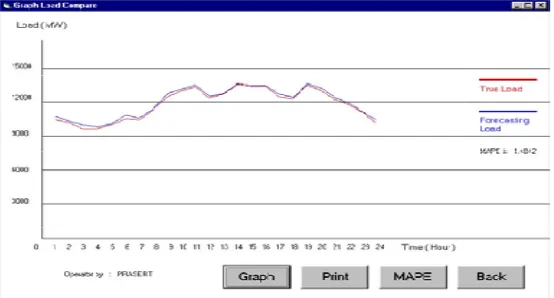
Fig. 4 Plot Compare hourly load forecasting and true load
The proposed STLF is also illustrated in reporting hourly load forecasting on particular period and the absolute percentage error plot for each hour shown in Figure.4. Observe the satisfactory forecasted results; the MAPE is 1.4842 (1.48%) from STLF software.
VI. CONCLUSIONS
STLF has an important role in the electricity distribution sector, as it is subsidiary to the control and management of networks, aiding in decision-making. The ANN, working as a methodology for short-term forecast, has been widely used with satisfactory results. STLF could be performed considering smaller areas and various large consumers to achieve higher forecasting accuracy. And we also tried ensemble neural network and it can reduce error, specially the peak error.
1) Input pattern for training neural network (train) must classified type of day group and 8 days of past day for training is best suitable.
2) Number of input for neural network is 55 inputs that best suitable and number of cells in hidden layer not difference for error in forecasting, but 10 cells that given minimum error.
4) The improvement comes from that ensemble network can reduce the variance error, so range of all in weekly MAPE is 1-2 % and MAPE of each day is nearly. The testing results shows that this paper has mean absolute percentage error less than 2.0 %.
REFERENCES
[1] K. Warwick, A. Ekwue and R. Aggarwal, ArtificialIntelligence Techniques in Power Systems, The Institution ofElectrical Engineers, London, (1997).
[2] Y. Al-Rashid and L.D. Paarmann, "Short-term electric loadforecasting using neural network models", in IEEE 39th MidwestSymposium on Circuits and Systems, 1996, Vol.3, pp.1436-1439.
[3] T. Senjyu, H. Takara, K. Uezato and T. Funabashi, "Onehour-ahead load forecasting using neural network", IEEETransactions on Power Systems, Vol.17, no.1, pp.113-118, Feb2002.
[4] R. Weron, Modeling and forecasting electricity loads andprices, Wiley, City (2006).
[5] J.-G. Choi, J.-K.Park, K.-H.Kim and J.-C. Kim, "A dailypeak load forecasting system using a chaotic time series", inProceedings of International Conference on Intelligent SystemsApplications to Power Systems, ISAP '96, pp.283-287.
[6] I. Drezga and S. Rahman, "Short-term load forecasting withlocal ANN predictors", IEEE Transactions on Power Systems,Vol.14, no.3, pp.844-850, Aug 1999.
[7] K.Y. Lee, Y.T. Cha and J.H. Park, "Short-term loadforecasting using an artificial neural network", IEEE Transactions on Power Systems, Vol.7, no.1, pp.124-132, Feb1992.
[8] D.C. Park, O. Mohammed, M.A. El-Sharkawi, and R.J.Marks, "An adaptively trainable neural network algorithm andits application to electric load forecasting", in Proceedings ofthe First International Forum on Applications of NeuralNetworks to Power Systems, pp.7-11, 23-26 Jul 1991. [9] O. Mohammed, D. Park, R. Merchant, T. Dinh, C. Tong,A. Azeem, J. Farah, and C. Drake, "Practical experiences withan adaptive neural network short-term load forecasting system,"IEEE Transactions on Power Systems, Vol.10, no.1, pp.254-265, Feb 1995.
[10] H.O. Sarmiento Maldonado and W.M. Villa Acevedo,“Artificial Intelligence in Forecasting Demands for Electricity:An Application in Optimization of Energy Resources”, RevistaColombiana de Tecnologías de Avanzada, 2008.
[11] S. Rahman and R. Bhatnagar, "An expert system basedalgorithm for short term load forecast", IEEE Transactions onPower Systems, Vol.3, no.2, pp.392-399, May 1988.
[12] C.-N. Lu, H.-T. Wu, and S. Vemuri, "Neural networkbased short term load forecasting", IEEE Transactions on Power Systems, Vol.8, no.1, pp.336-342, Feb 1993.
[13] S. Rahman and I.S. Moghram , "Application of a rulebasedtechnique to weekly load forecast," in Proceedings ofIEEE Southeastcon '89, Energy and Information Technologiesin the Southeast, pp.380-385.
[14] S. Rahman and O. Hazim, "A generalized knowledgebasedshort-term load-forecasting technique", IEEE Transactions on Power Systems, Vol.8, no.2, pp.508-514, May1993.