Securing Cloud Data in the New Attacker Model
Ghassan O. Karame1, Claudio Soriente2, Krzysztof Lichota3, Srdjan ˇCapkun2
1
NEC Laboratories Europe, Germany 2
ETH Zurich, Switzerland 3
9livesdata, Poland
Abstract. The world just witnessed the surge of a new and powerful attacker, which was able to coerce operators and acquire the necessary keys to break the privacy of users. Once the encryption key is exposed, the only viable measure to preserve data confidentiality is to limit the adversary’s access to the ciphertext. This may be achieved, for example, using multi-cloud storage systems. These systems spread data across multiple servers in different administrative domains, to cater for availability and fault tolerance. If the adversary can only compromise a subset of these domains, multi-cloud storage systems may prevent the adver-sary from accessing the entire ciphertext. However, if data is encrypted using existing encryption schemes, spreading the ciphertext on multiple servers does not entirely solve the problem since an adversary which has the encryption key, can still compromise single servers and decrypt the ciphertext stored therein. In this paper, we leverage multi-cloud storage systems to provide data confiden-tiality against an adversary which has access to the encryption key, and can com-promise a large fraction of the storage servers. For this purpose, we first introduce a novel security definition that captures data confidentiality in the new adversarial model. We then proposeBastion, a primitive that is secure according to our def-inition and, therefore, guarantees data confidentiality even when the encryption key is exposed, as long as the adversary cannot compromiseallstorage servers. We analyze the security ofBastion, and we evaluate its performance by means of a prototype implementation. Our results show thatBastionincurs less than 5% overhead compared to existing semantically secure encryption modes. We also discuss practical insights with respect to the integration ofBastionin commer-cial multi-cloud storage systems.
1
Introduction
The year 2013 witnessed the introduction of a new, and extremely powerful attacker model. Notably, the world became aware of a massive surveillance program which mined data from operators and ISPs, and performed illegal taps on digital communica-tion channels [27]. This surveillance program was not hindered by the various security measures deployed within the targeted services. For instance, although these services relied on secure encryption mechanisms, the necessary keying material was acquired, e.g., by means of backdoors, bribe, or coercion.
multiple administrative domains, in the hope that the adversary cannot compromise all of them. However, this countermeasure does not entirely solve the problem. Even if the data is encrypted and dispersed across different administrative domains, an adver-sary equipped with the appropriate keying material can compromise a single server and decrypt ciphertext blocks stored therein.
In this paper, we leverage multi-cloud storage systems [2, 4, 13, 14, 26, 28] to pro-vide data confidentiality against an adversary which knows the encryption key, and can compromise a large fraction of the storage servers. The adversary can acquire the keys either by exploiting flaws or backdoors in the key-generation software [27], or by com-promising the devices that store the keys (e.g., at the user-side or in the cloud). As far as we are aware, this adversary invalidates the security of most cryptographic solutions, including those that protect the keys by means of secret-sharing (since the keys are leaked at generation time).
We start by proposing a novel game-based definition which captures the capabilities of the new adversarial model. Our definition, called(n−λ)key-exposure or(n−λ)ke, models an adversary that has access to the encryption key and requires that no plaintext block can be recovered, as long as the adversary has access to at most(n−λ)ciphertext blocks, wherenis the total number of ciphertext blocks.
The definition of(n−λ)ke shares similarities with the notion of all-or-nothing transformations (AONT) [5,9,23]. An AONT is a block-wise transform (based on block ciphers) that cannot be inverted unless all the output blocks are known. AONT is not an encryption by itself, but can be used as a pre-processing step before encrypting the data with a block cipher, to ensure that the plaintext can be decrypted by the key holder, only if all of the ciphertext blocks are available. The resulting encryption—called AON encryption—was mainly intended to slow down brute-force attacks on the encryption key. However, AON encryption can also preserve the confidentiality of the plaintext in case the encryption key is exposed, as long as the adversary has access up to all but one ciphertext blocks. In other words, given a ciphertext ofnblocks, AON encryption is (n−1)kesecure. Existing AON encryption modes, however, requireat leasttwo rounds of block cipher encryptions on the data: one pre-processing round to create the AONT, followed by another round for the actual encryption. This results in considerable—often unacceptable—overhead to encrypt and decrypt large files.
con-siderably improves the performance (by more than 50%) of existing AON encryption schemes [9, 23]. Finally, we discuss practical insights with respect to the possible inte-gration ofBastionin commercial dispersed storage systems.
The remainder of the paper is organized as follows. In Section 2, we define our no-tation and building blocks. In Section 3, we describe our model and introduce a novel security definition modeling the new attacker. In Section 4, we present our scheme, Bastion, and analyze its security. In Section 5, we implement and evaluateBastionin realistic settings. In Section 6, we discuss practical insights with respect to the integra-tion ofBastionwithin existing dispersed storage systems. In Section 7, we overview related work in the area, and we conclude the paper in Section 8.
2
Preliminaries
We adapt the notation of [9] for our settings. We define a block cipher as a mapF :
{0,1,}k × {0,1}l → {0,1}l
, for positive kand l. If Pl is the space of all (2l)! l-bits permutations, then for any a ∈ {0,1}k
, we have F(a,·) ∈ Pl. We also write Fa(x) to denoteF(a, x). We modelF as an ideal block cipher, i.e., a block cipher picked at random fromBC(k, l), whereBC(k, l)is the space of all block ciphers with parameterskandl. For a given block cipherF ∈B(k, l), we denoteF−1∈BC(k, l) asF−1(a, y)or asF−1
a (y), fora∈ {0,1}k.
Encryption modes. An encryption mode based on a block cipherF/F−1is given by a triplet of algorithmsQ= (K,E,D)where:
K The key generation algorithm is a probabilistic algorithm which takes as input a security parameterkand outputs a keya∈ {0,1}kthat specifiesF
aandFa−1.
E The encryption algorithm is a probabilistic algorithm which takes as input a message x∈ {0,1}∗, and usesF
aandFa−1as oracles to output ciphertexty.
D The decryption algorithm is a deterministic algorithm which takes as input a cipher-texty, and usesFaandFa−1as oracles to output plaintextx∈ {0,1}∗, or⊥ifyis invalid.
For correctness, we require that for any keya ← K(1k), for any message x ∈
{0,1}∗, and for anyy← EFa,F− 1
a (x), we havex← DFa,F− 1 a (y).
Security is defined through the following chosen-plaintext attack (CPA) game adapted for block ciphers:
ExpindQ (A, b) F ←BC(k, l) a← K(1k) x0, x1, state←AE
Fa,F−1
a
(f ind) yb← EFa,F
−1
a (xb)
b′←A(guess, y
In theindexperiment, the adversary has unrestricted oracle access toEFa,F− 1 a
dur-ing the “find” stage. At this point,Aoutputs two messages of equal lengthx0, x1, and somestateinformation that are passed as input when the adversary is initialized for the “guess” stage (e.g.,statecan contain the two messagesx0, x1.) During the “guess” stage, the adversary is given the ciphertext of one message out ofx0, x1and must guess which message was actually encrypted. The advantage of the adversary in theind ex-periment is:
AdvindQ(A) =|Pr[ExpQind(A,0) = 1]−Pr[ExpindQ(A,1) = 1]|
Definition 1. An encryption modeQ= (K,E,D)is ind-secure if for any polynomial-time adversary A, we haveAdvindQ(A) ≤ ǫ, where ǫ is a negligible function in the security parameter.
All or Nothing Transformations. An All or Nothing Transformation (AONT) is an ef-ficiently computable transformation that maps sequences of input blocks to sequences of output blocks with the following properties:(i)given all the output blocks, the trans-formation can be efficiently inverted (i.e., the original input can be computed), and(ii) given all but one of the output blocks, it is infeasible to compute any of the original input blocks. The formal syntax of an AONT is given by a pair of polynomial-time algorithmsQ= (E,D)where:
E The encoding algorithm is a probabilistic algorithm which takes as input a message x∈ {0,1}∗, and outputs a pseudo-ciphertexty.
D The decoding algorithm is a deterministic algorithm which takes as input a pseudo-ciphertexty, and outputs either a messagex ∈ {0,1}∗ or⊥to indicate that the input pseudo-ciphertext is invalid.
For correctness, we require that for allx∈ {0,1}∗, and for ally ←E(x), we have x←D(y).
The literature comprises a number of security definitions for AONT (e.g., [5,9,23]). In this paper, we rely on the definition of [9] which uses theaontexperiment below. This definition specifies a block lengthlsuch that the pseudo-ciphertextycan be written as y=y[1]. . . y[n], where|y[i]|=landn≥1.
ExpaontQ (A, b) x, s←A(f ind) y0←E(x) y1← {0,1}|y0|
b′←AYb(guess, state)
AdvaontQ (A) =|Pr[ExpQaont(A,1) = 1]−Pr[ExpaontQ (A,0) = 1]|
Definition 2. An All-or-Nothing TransformationQ = E,Dis aont-secure if for any polynomial-time adversaryA, we haveAdvaontQ (A)≤ǫ, whereǫis a negligible function in the security parameter.
Proposed AONTs. Rivest [23] suggested the package transform which leverages a block cipherF/F−1and mapsmblock strings ton=m+ 1block strings. The first n−1output blocks are computed by XORing thei-th plaintext block withFK(i), where Kis a random key. Then-th output block is computed XORingKwith the encryption of each of the previous output blocks, using a keyK0that is publicly known. That is, givenx[1]. . . x[m], the package transform outputsy[1]. . . y[n], withn=m+ 1, where
y[i] =x[i]⊕FK(i), 1≤i≤n−1,
y[n] =K n−1
M
i=1
FK0(y[i]⊕i).
Desai [9] proposed a faster version where the block cipher round which usesK0is skipped and the last output block is set toy[n] =KLni=1−1y[i]. Both AONTs are secure according to Definition 2 [9].
Remark 1. Although the majority of proposed AONTs are based on block ciphers (e.g., [9, 23]), an AONT is not an encryption scheme. In particular, there is no secret-key information associated with an AONT. That is, given all the output blocks of the AONT, any party can recover the original input without knowledge of any secret.
3
(
n
−
λ
)
Key-Exposure Security
In this section, we detail our model, and we introduce the notion of(n−λ)key-exposure security.
3.1 Model
We consider a multi-cloud storage system which can leverage a number of commod-ity cloud providers (e.g., Amazon, Google) with the goal of distributing trust across different administrative domains. This “cloud of clouds” model is receiving increasing attention nowadays [2, 4, 28] with leading cloud storage providers such as EMC, IBM, and Microsoft, offering products for multi-cloud systems [13, 14, 26].
Fig. 1.The new attacker model. We assume a powerful adversary which can acquire all the cryp-tographic secret material, and can compromise a large fraction (up to all but one) of the storage servers.
write(v) The write routine splitsvintospieces{v1, . . . , vs}and sendshvjito server
Sj, forj∈[1. . . s].
read() The read routine fetches the stored value v from the servers. For each j ∈
[1. . . s], piecevjis downloaded from serverSjand all pieces are combined intov. We assume that the initial value of the storage is a special value⊥, which is not a valid input value for a write operation.
We assume that each user encrypts the data before invoking thewrite()routine.
To store file f, a user generates an encryption keyK, encryptsf intov ← EK(f), and invokeswrite(v). KeyKis stored at the user’s machine. At a later time, the user
invokesread()to fetchvand runsf ← DK(v)to recoverf.
The New Attacker Model. We assume the existence of a computationally-bounded ad-versaryAwhichcan acquire all cryptographic keys.The adversary may do so either(i) by leveraging flaws or backdoors in the key-generation software [27],(ii)by compro-mising the cloud infrastructure, or(iii)by compromising the user-device that stores the keys.
Since multi-cloud systems spread data across different domains, we assume that the adversary can compromise a large fraction (up to all but one) of the storage servers (cf. Figure 1). We model this adversary assuming that it has access to all butλciphertext blocks, whereλis a parameter of the encryption mode. While confidentiality withλ= 0 is clearly not achievable4, our goal is to design encryption modes whereλis as close as possible to1.
Note that if the adversary additionally learns the user’s credentials, logs into the storage servers, and acquires all the ciphertext blocks, then no cryptographic mecha-nism can preserve data confidentiality. However, we stress that compromising the en-cryption key does not necessarily imply the compromise of the user access credentials.
4
For example, encryption can occur on a specific-purpose device (e.g., [7]), and the key can be leaked, e.g., by the manufacturer; in this scenario, the user credentials to access the cloud servers are clearly not compromised.
3.2 The Notion of(n−λ)Key-Exposure Security
Existing security notions for encryption modes (e.g., Definition 1) capture data confi-dentiality against an adversary which does not have the encryption key. That is, if the key is leaked, the confidentiality of data is broken. We argue that the surge of “the new attacker model”—where the attacker has unrestricted access to the encryption key— clearly motivates the re-design of existing security notions. We capture the notion of confidentiality in the new attacker model with a new game-based definition for encryp-tion modes, that we call(n−λ)key-exposure or(n−λ)ke. Similar to [9],(n−λ)ke specifies a block lengthl such that a ciphertextycan be written as y = y[1]. . . y[n] where|y[i]|=landn≥1.
Exp(nQ−λ)ke(A, b) a← K(1k) x0, x1, state←AE
Fa,F−1
a
(f ind) yb← EFa,F
−1
a (xb)
b′←AYb,EFa,F
−1
a
(guess, state)
The adversary has unrestricted access toEFa,F− 1
a in both the “find” and “guess”
stages. On inputj, the oracleYbreturnsyb[j]and accepts up ton−λqueries. On the one hand, unrestricted oracle access toEFa,F−
1
a captures the adversary’s knowledge of
the secret key. On the other hand, the oracleYbmodels the fact that the adversary has access to all butλciphertext blocks. This is the case when, for example,λciphertext blocks are stored in a server that the adversary cannot compromise (cf. Figure 1). The advantage of the adversary is defined as:
AdvQ(n−λ)ke(A) =P r[ExpQ(n−λ)ke(A,1) = 1]−P r[Exp(nQ−λ)ke(A,0) = 1]
Definition 3. An encryption modeQ=K,E,Dis(n−λ)ke-secure if for any polynomial-time adversaryA, we haveAdv(nQ−λ)ke(A)≤ǫ, whereǫis a negligible function in the security parameter.
We stress that(n−λ)kedoes not consider confidentiality against “traditional” ad-versaries (i.e., adad-versaries which do not know the encryption key). Therefore, we seek for an encryption modeQwith the following properties:
1. Qmust beind-secure against an adversary which does not know the encryption key (cf. Definition 1).
2. Qmust be(n−λ)ke-secure against an adversary which knows the encryption key (cf. Definition 3).
Possible Solutions: In what follows, we briefly overview several encryption modes and argue about their security according to Definition 1 and to Definition 3.
CPA-encryption modes. Traditional CPA-encryption modes, such as theCTRmode, provideind-security but are only1kesecure. That is, an adversary equipped with the encryption key must only fetch two ciphertext blocks to break data confidentiality.5
CPA-encryption and secret-sharing. Another option is to rely on the combination of CPA-secure encryption modes and secret-sharing. In particular, a filefis first encrypted using a CPA-secure encryption mode. The resulting ciphertext is then secret-shared inn shares with the reconstruction threshold set to(n−1). This scheme is clearly(n−1)ke secure and is also secure according to Definition 1. However, the resulting ciphertext is ntimes larger than the size off, which makes it impractical for storing large files. We also point out that secret-sharing the encryption key does not provide better security against the adversary we consider. This is because, in our model, the adversary has access to the encryption key at generation time, and before the key shares are distributed across the servers.
AON encryption. Another alternative is to pre-process a message with an AONT and then encrypt its output with a CPA-secure encryption mode.6This paradigm is referred to in the literature as AON encryption and was first suggested by [23]. Existing AON encryption schemes require at least two rounds of block cipher encryption with two different keys: the first round is the actual AONT that embeds the first encryption key in the pseudo-ciphertext (cf. Section 2); a second round uses another encryption key that is kept secret to guarantee CPA-security. AON encryption increases the storage size by a single block. However, two encryption rounds constitute a considerable overhead when encrypting and decrypting large files.
Clearly, all existing solutions are either not satisfactory in terms of security or incur a large overhead and may not be suitable to store large files in a multi-cloud storage sys-tem. In what follows, we introduce our solution,Bastion, which considerably improves the performance of existing solutions.
5
We assume that the CTR encryption routine uses a random IV that is incremented at every block encryption.
6
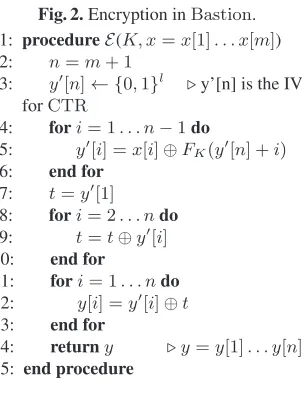
Fig. 2.Encryption inBastion. 1: procedureE(K, x=x[1]. . . x[m]) 2: n=m+ 1
3: y′[n]← {0,1}l
⊲y’[n] is the IV forCTR
4: fori= 1. . . n−1do 5: y′[i] =x[i]⊕F
K(y′[n] +i)
6: end for 7: t=y′[1]
8: fori= 2. . . ndo 9: t=t⊕y′[i]
10: end for
11: fori= 1. . . ndo 12: y[i] =y′[i]⊕t
13: end for
14: returny ⊲ y=y[1]. . . y[n] 15: end procedure
Fig. 3.Decryption inBastion. 1: procedureD(K, y=y[0]. . . y[n]) 2: t=y[n]
3: fori= 1. . . n−1do 4: t=t⊕y[i] 5: end for
6: fori= 1. . . ndo 7: y′[i] =y[i]⊕t
8: end for
9: fori= 1. . . n−1do 10: x[i] =y′[i]⊕F−1
K (y ′[n] +i)
11: end for
12: returnx ⊲ x=x[1]. . . x[n−1] 13: end procedure
4
Bastion
: An Efficient
(
n
−
2)
ke
Primitive
In this section, we present an efficient (n−2)ke secure encryption scheme, called Bastion.Bastionfirst encrypts the data with one round of block cipher encryption, and then applies an efficient linear post-processing to the ciphertext. By doing so,Bastion relaxes the notion of all-or-nothing encryption at the benefit of increased performance.
4.1 Description
On input a security parameter k, the key generation algorithm of Bastionoutputs a keyK ∈ {0,1}k
for the underlying block-cipher.Bastionleverages block cipher en-cryption in theCTRmode, which on input a plaintext bitstreamx, divides it in blocks x[1], . . . , x[m], where m is odd7 such that each block has size l.8
The set of input blocks is encrypted under key K, resulting in ciphertexty′ = y′[1], . . . , y′[m+ 1], wherey′[m+ 1]is randomly chosen from{0,1}l.
Next,Bastionapplies a linear transformation toy′, inspired by [25]. Letn=m+ 1 and assumeAto be ann-by-nmatrix where elementai,j = 0l ifi =jorai,j = 1l, otherwise.9 Bastioncomputes y = y′ ·A, where additions and multiplications are implemented by means of XOR and AND operations, respectively. That is,y[i]∈yis computed asy[i] =Lj=nj=1(y′[j]∧a
j,i), fori= 1. . . , n.
Given keyK, invertingBastionentails computingy′ =y·A−1and decryptingy′ usingK.10
7This requirement is essential for the correctness of the subsequent linear transformation on the
ciphertext blocks. That is, ifmis not odd, then the transformation is not invertible.
8l
is the block size of the particular block cipher used.
90l
and1l
denote a bitstring oflzeros and a bitstream oflones, respectively.
The pseudocode of the encryption and decryption algorithms ofBastionare shown in Figure 2 and Figure 3, respectively. We efficiently implement the linear transform using2nXOR operations by computing:
t=y′[1]⊕y′[2]⊕ · · · ⊕y′[n], y[i] =t⊕y′[i], 1≤i≤n.
Note that y′[1]. . . y′[n] computed up to line6 is the output of theCTRencryption mode, wherey′[n]is the initialization vector. Similar to CTRencryption mode, the final output ofBastionis one block larger than the original input.
Remark 2. We point out thatBastionis not restricted to theCTRmode and can be instantiated with otherind-secure block cipher encryption modes (e.g., CBC, OFB).
4.2 Security Analysis
In what follows, we analyze the security ofBastion.
Lemma 1. Bastion isind-secure.
Proof Sketch 1. Bastion uses anind-secure encryption mode (CTRmode) to en-crypt a message, and then applies a linear transformation on the ciphertext blocks. It is straightforward to conclude thatBastionisind-secure.
Lemma 2. Given anyn−2blocks ofy[1]. . . y[n]as output byBastion, it is infeasible to compute anyy′[i], for1≤i≤n.
Proof Sketch 2. Lety = y[1], . . . , y[n] ← E(K, x =x[1]. . . x[m]). Note that given anyn−1blocks ofy, the adversary can compute one block ofy′. In particular,y′[i] =
Lj=n
j=1,j6=iy[j], for any1≤i≤n. As it will become clear later, with one blocky′[i]and the encryption key, the adversary has non-negligible probability of winning the game of Definition 3.
However, if only(n−2) blocks ofy are given, then each of then blocks ofy′ can take on any possible values in{0,1}l, depending on the two unknown blocks ofy. Recall that each blocky′[i]is dependent onn−1blocks ofyand it is pseudo-random as output by theCTRencryption mode. Therefore, given any(n−2)blocks ofy, then y′[i]could take any of the2l
possibilities, for1≤i≤n.
Lemma 3. Bastion is(n−2)kesecure.
Proof Sketch 3. The security proof ofBastionresembles the standard security proof of theCTRencryption mode and relies on the existence of pseudo-random permutations. In particular, given an adversaryAwhich has non-negligible advantage in the(n−λ)ke experiment with λ = 2, we can construct an adversary B which has non-negligible advantage in distinguishing between a true random permutation and a pseudo-random permutation. Appendix A provides the details of the proof.
4.3 Performance Analysis
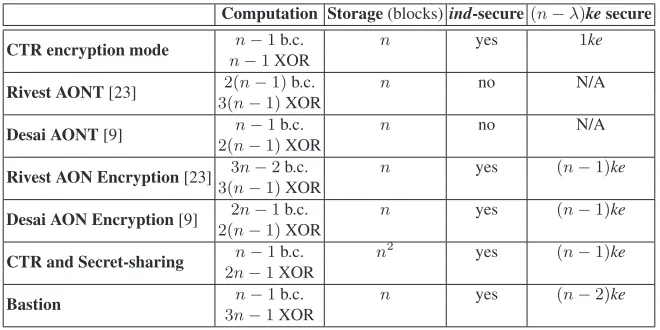
Table 1 compares the performance ofBastionwith the encryption schemes considered so far, in terms of computation, storage and security.
Given a plaintext of m blocks, theCTRencryption mode outputs n = m+ 1 ciphertext blocks, computed with (n−1)block cipher operations and(n−1)XOR operations. TheCTRencryption mode isind-secure, but only2kesecure.
Rivest AONT outputs a pseudo-ciphertext ofn=m+1blocks using2(n−1)block cipher operations and3(n−1)XOR operations. Desai AONT outputs the same number of blocks but requires only(n−1)block cipher operations and2(n−1)XOR operations. Both Rivest AONT and Desai AONT are, however, notind-secure since the encryption key used to compute the AONT output is embedded in the output itself.11Encrypting the output of Rivest AONT or Desai AONT with a standard encryption mode (both [9] and [23] use theECBencryption mode), requires additionalnblock cipher operations, and yields an AON encryption that isind-secure12and(n−1)kesecure. Secret-sharing encryption (cf. 3.2) isind-secure and(n−1)kesecure. It requires(n−1)block cipher operations andnXOR operations if additive secret sharing is used. However secret-sharing encryption results in a prohibitively large storage overhead ofn2blocks.
Bastionalso outputsn=m+1ciphertext blocks. It achievesind-security and(n−
2)kesecurity with only(n−1)block cipher operations and(3n−1)XOR operations (n−1)XOR operations for theCTRencryption and2nXOR operations for the linear transformation).
We conclude thatBastionachieves a solid tradeoff between the computational over-head of existing AON encryption modes and the exponential storage overover-head of secret-sharing techniques, while offering a comparable level of security. In Section 5, we con-firm the superior performance ofBastionby means of implementation.
5
Implementation and Evaluation
In this section, we describe and evaluate a prototype implementation modeling a read-write storage system based onBastion.
5.1 Implementation Setup
Our prototype, implemented in C++, emulates the read-write storage model of Sec-tion 3.1. We instantiateBastionwith theCTRencryption mode (cf. Figure 2) using both AES128 and Rijandael256, implemented using the libmcrypt.so.4.4.7 library. Since this library does not natively support theCTRencryption mode, we use it for the generation of theCTRkeystream, which is later XORed with the plaintext.
We compare Bastionwith the AON encryption schemes of Rivest [23] and De-sai [9]. For baseline comparison, we include in our evaluation the CTRencryption
11
Note that removing the pseudo-ciphertext block where the key is embedded would not achieve ind-security, because the transformation is not randomized.
12
Table 1.Comparison betweenBastionand existing constructs. We assume a plaintext ofm=
n−1blocks. Since all schemes are symmetric, we only show the computation overhead for the encryption/encoding routine in the column “Computation” (“b.c.” is the number of block cipher operations; “XOR” is the number of XOR operations.
Computation Storage(blocks)ind-secure(n−λ)kesecure
CTR encryption mode n−1b.c. n yes 1ke
n−1XOR
Rivest AONT[23] 2(n−1)b.c. n no N/A
3(n−1)XOR
Desai AONT[9] n−1b.c. n no N/A
2(n−1)XOR
Rivest AON Encryption[23] 3n−2b.c. n yes (n−1)ke
3(n−1)XOR
Desai AON Encryption[9] 2n−1b.c. n yes (n−1)ke
2(n−1)XOR
CTR and Secret-sharing n−1b.c. n
2
yes (n−1)ke
2n−1XOR
Bastion n−1b.c. n yes (n−2)ke
3n−1XOR
mode and the AONTs due to Rivest [23] and Desai [9], which are used in existing dis-persed storage systems, e.g., Cleversafe [22]. We do not evaluate the performance of secret-sharing because of its prohibitively large storage overhead (squared in the num-ber of input blocks).
We evaluate our implementations on an Intel(R) Xeon(R) CPU E5-2470 running at 2.30GHz. Note that the CPU processor clock frequency might have been higher dur-ing the evaluation due to the TurboBoost technology of the CPU. In our evaluation, we abstract away the effects of network delays and congestion, and we only assess the pro-cessing performance of the encryption for the considered schemes. This is a reasonable assumption since all schemes are length-preserving (plus an additional block oflbits), and are therefore likely to exhibit the same network performance. Moreover, we only measure the performance incurred during encryption/encoding, since all schemes are symmetric, and therefore the decryption/decoding performance is comparable to that of the encryption/encoding process.
We measure the peak throughput and the latency exhibited by our implementations with respect to various file sizes and block sizes. For each data point, we report the average of 30 independent runs. Due to their small width (in the order of 0.1), we do not show the corresponding 95% confidence intervals.
5.2 Evaluation Results
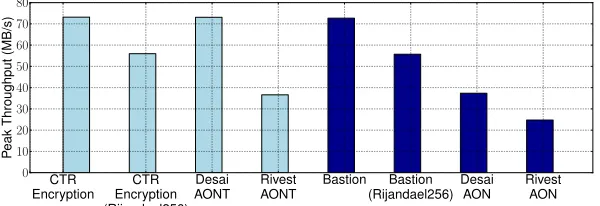
Our evaluation results are reported in Figure 4 and Figure 5. Both figures show that Bastionconsiderably improves (by more than 50%) the performance of existing(n−
CTR Encryption CTR Encryption (Rijandael256) Desai AONT Rivest AONT Bastion Bastion (Rijandael256) Desai AON Rivest AON 0 10 20 30 40 50 60 70 80 P e a k T h ro u g h p u t (M B /s )
Fig. 4. Peak throughput comparison. Unless otherwise specified, the underlying block cipher is AES128. Each data point is averaged over 30 runs. Histograms in dark blue depict encryp-tion modes which offer comparable security toBastion. Light blue histograms refer to encryp-tion/encoding modes where individual ciphertext blocks can be inverted when the key is exposed. In Figure 4, we show the peak throughput achieved by theCTRencryption mode, Bastion, Desai AONT/AON, and Rivest AONT/AON schemes. The peak throughput achieved byBastionreaches almost 72 MB/s and is only 1% lower than the one ex-hibited by theCTRencryption mode. When compared with existing(n−1)kesecure schemes, such as Desai AON encryption and Rivest AON encryption, our results show that the peak throughput ofBastion is almost twice as large as that of Desai AON encryption, and more than three times larger than the peak throughput of Rivest AON encryption.
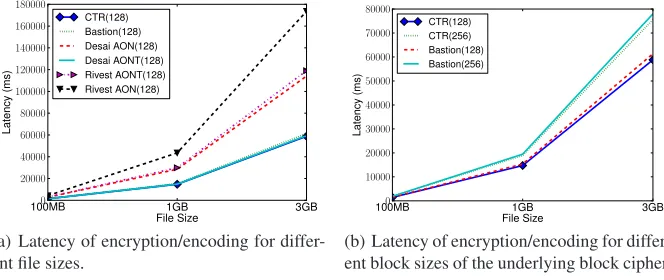
We also evaluate the performance ofBastion, with respect to different block sizes of the underlying block cipher. Our results show that—irrespective of the block size— Bastiononly incurs a negligible performance deterioration in peak throughput when compared to the CTRencryption mode. Figures 5(a) and 5(b) show the latency (in ms) incurred by the encryption/encoding routines for different file sizes. The latency ofBastionis comparable to that of theCTRencryption mode—for both AES128 and Rijandael256—and results in a considerable improvement over existing AON encryp-tion schemes (more than 50% gain in latency).
6
Practical Insights
In this section, we discuss practical insights with respect to the integration ofBastion within existing dispersed storage systems.
6.1 Bastionin Dispersed Storage Systems
Bastionis(n−2)kesecure according to Definition 3. However, in a multi-cloud storage system, since each server stores at least two ciphertext blocks (i.e.,2lbits of data)13, a (n−2)kesecure scheme likeBastionclearly preserves data confidentiality unlessall servers are compromised.
In scenarios where servers can be faulty,Bastioncan be combined with informa-tion dispersal algorithms (e.g., [21]) to provide data confidentiality and fault tolerance.
13
100MB 1GB 3GB File Size 0 20000 40000 60000 80000 100000 120000 140000 160000 180000 L a te n c y (m s ) CTR(128) Bastion(128) Desai AON(128) Desai AONT(128) Rivest AONT(128) Rivest AON(128)
(a) Latency of encryption/encoding for differ-ent file sizes.
100MB 1GB 3GB File Size 0 10000 20000 30000 40000 50000 60000 70000 80000 L a te n c y (m s ) CTR(128) CTR(256) Bastion(128) Bastion(256)
(b) Latency of encryption/encoding for differ-ent block sizes of the underlying block cipher. Fig. 5.Performance evaluation ofBastion. Each data point in is averaged over 30 independent runs. Unless otherwise specified, the underlying block cipher is AES-128. CTR(256) and Bas-tion(256) denote theCTRencryption mode and Bastion encryption routine, respectively, instan-tiated with Rijandael256.
Recall that information dispersal algorithms (IDA), parameterized witht1, t2 (where t1≤t2), encode data intot2symbols such that the original data can be recovered from anyt1encoded symbols.
In our multi-cloud storage system (cf. Section 3.1), a filef of sizeml-bits results in a ciphertext ofn=m+ 1blocks (oflbits each) when encrypted usingBastion.14 The ciphertext is then fed to the IDA encoding routine with parameterst1 ≤ n2 and t2 = s > t1, where s is the number of available servers. By settingt1 ≤ n2, we ensure that each symbol encodes at least two ciphertext blocks worth of data. Finally, the encoded symbols are input to thewrite()routine that distributes symbols evenly
to each of the storage servers. Recoveringf via theread()routine entails fetching at
leastt1distinct symbols from any subset of the servers and decoding them via the IDA decoding routine. The resulting ciphertext can be decrypted usingBastionto recover the original filef.
By doing so, data confidentiality is preserved in the new attacker model unlesst1 servers are compromised (and their stored data is acquired). Furthermore, data avail-ability is guaranteed in spite ofs−t1server failures.
6.2 Deployment within HYDRAstor
We now discuss the integration of a prototype implementation ofBastionwithin the HYDRAstor grid storage system [11, 20]. HYDRAstor is a commercial secondary stor-age solution for enterprises, which consists of a back-end architectured as a grid of storage nodes built around a distributed hash table. The front-end of HYDRAstor con-sists of a layer of access nodes which are scaled for performance. HYDRAstor relies on system-wide deduplication, and supports online extensions and upgrades. It also tol-erates multiple disk, node and network failures, rebuilds the data automatically after
14
failures, and informs users about recoverability of the deposited data. The reliability and availability of the stored data can be dynamically adjusted by the clients with each write operation, as the back-end supports multiple data resiliency classes [11].
HYDRAstor distributes written data to multiple disks using the distributed resilient data technology (DRD); the combination of Bastionwith DRD ensures that an ad-versary which has the encryption key and compromises a subset of the disks (i.e., de-termined by the reconstruction threshold), cannot acquire any meaningful information about the data stored on the disk (cf. Section 6.1).
In order to better assess the performance impact ofBastionin HYDRAstor, we evaluated the performance ofBastionin the newest generation HYDRAstor HS8-4000 series system, which uses CPUs with accelerated AES encryption (i.e., the AESNI in-struction set). In our experiments, all written data was unique (non-duplicate) to remove the effect of data deduplication. Our results show that the write bandwidth was not af-fected by the integration ofBastion. On the other hand, the read bandwidth decreased only by 3%. In both read and write operations, the CPU utilization in the system only increased marginally.
These experiments clearly suggest thatBastioncan be integrated in existing com-mercial storage systems in order to strengthen the security of these systems in the new attacker model, without affecting performance.
7
Related Work
To the best of our knowledge, this is the first work that addresses the problem of se-curing data stored in multi-cloud storage systems when the cryptographic material is exposed. In the following, we survey relevant related work in the areas of deni-able encryption, all-or-nothing transformations, secret-sharing techniques, and leakage-resilient cryptography.
Deniable Encryption:Our work shares similarities with the notion of “deniable en-cryption” [6,12,16]. An encryption scheme is “deniable” if—when coerced to reveal the encryption key—the legitimate owner can make the ciphertext “look like” the encryp-tion of a plaintext different from the original one, thus keeping the original plaintext private. Deniable encryption is typically achieved by constructing a ciphertext which can be decrypted into a number of plausible plaintexts, under different keying material. Deniable encryption therefore aims to deceive an adversary which does not know all the keying material but, e.g., can acquire a subset of the keys. Unlike deniable encryption, Bastionis secure against an adversary which knowsallthe necessary keying material.
achieves a comparable level of security with considerably better performance (by more than 50%). Resch et al. [22] combine AONT and information dispersal to provide both fault-tolerance and data secrecy, in the context of distributed storage systems. In [22], however, an adversary which knows the encryption key can decrypt data stored on sin-gle servers.
Secret Sharing: Secret sharing schemes [3] allow a dealer to distribute a secret among a number of shareholders, such that only authorized subsets of shareholders can re-construct the secret. In threshold secret sharing schemes [8, 24], the dealer defines a threshold t and each set of shareholders of cardinality equal to or greater than t is authorized to reconstruct the secret. Secret sharing guarantees security against a non-authorized subset of shareholders; however, they incur a high computation/storage cost, which makes them impractical for sharing large files.
Rabin [21] proposed an information dispersal algorithm with smaller overhead than the one of [24], however, this proposal does not provide any security guarantees when a small number of shares (less than the reconstruction threshold) are available. Krawczyk [17] proposed to combine both Shamir’s [24] and Rabin’s [21] approaches; in [17] a file is first encrypted using AES and then dispersed using the scheme in [21], while the encryption key is shared using the scheme in [24]. In Krawczyk’s scheme, individual ciphertext blocks encrypted with AES can be decrypted once the key is exposed.
Leakage-resilient Cryptography: Leakage-resilient cryptography aims at designing cryptographic primitives that can stand against adversary which learns partial informa-tion about the secret state of a system, e.g., through side-channels [19]. Different mod-els allow to reason about the “leaks” of real implementations of cryptographic primi-tives [1, 10, 19]. All of these models, however, limit in some way the knowledge of the secret state of a system by the adversary. In contrast, the adversary is given all the secret material in our model.
8
Conclusion
In this paper, we addressed the problem of securing data outsourced to the cloud in the new attacker model, in which the adversary can acquire the encryption keys (e.g., using bribe, coercion). For this purpose, we introduced a novel security definition that captures data confidentiality against the new adversary. We then proposedBastion, a primitive which ensures the confidentiality of encrypted data even when the adversary has the encryption key, and all buttwociphertext blocks.
Bastionis most suitable for settings where the ciphertext blocks are stored in multi-cloud storage systems. In these settings, the adversary would need to acquire the en-cryption key, and to compromise allservers, in order to recover any single block of plaintext.
References
1. A. Akavia, S. Goldwasser, and V. Vaikuntanathan. Simultaneous hardcore bits and cryptogra-phy against memory attacks. InTheory of Cryptography Conference (TCC), pages 474–495, 2009.
2. C. Basescu, C. Cachin, I. Eyal, R. Haas, and M. Vukolic. Robust Data Sharing with Key-value Stores. InProceedings of the 30th Annual ACM SIGACT-SIGOPS Symposium on Prin-ciples of Distributed Computing, PODC ’11, pages 221–222, New York, NY, USA, 2011. ACM.
3. A. Beimel. Secret-sharing schemes: A survey. InThird International Workshop on Coding and Cryptology (IWCC), pages 11–46, 2011.
4. A. Bessani, M. Correia, B. Quaresma, F. André, and P. Sousa. DepSky: Dependable and Secure Storage in a Cloud-of-clouds. InProceedings of the Sixth Conference on Computer Systems, EuroSys ’11, pages 31–46, New York, NY, USA, 2011. ACM.
5. V. Boyko. On the Security Properties of OAEP as an All-or-nothing Transform. In Proced-ings of CRYPTO, pages 503–518, 1999.
6. R. Canetti, C. Dwork, M. Naor, and R. Ostrovsky. Deniable Encryption. InProceedings of CRYPTO, 1997.
7. Cavalry. Encryption Engine Dongle. http://www.cavalrystorage.com/ en2010.aspx/.
8. C. Charnes, J. Pieprzyk, and R. Safavi-Naini. Conditionally secure secret sharing schemes with disenrollment capability. InACM Conference on Computer and Communications Secu-rity (CCS), pages 89–95, 1994.
9. A. Desai. The security of all-or-nothing encryption: Protecting against exhaustive key search. InAdvances in Cryptology (CRYPTO), pages 359–375, 2000.
10. Y. Dodis, Y. T. Kalai, and S. Lovett. On cryptography with auxiliary input. InACM Sympo-sium on Theory of Computing (STOC), pages 621–630, 2009.
11. C. Dubnicki, L. Gryz, L. Heldt, M. Kaczmarczyk, W. Kilian, P. Strzelczak, J. Szczepkowski, C. Ungureanu, and M. Welnicki. HYDRAstor: a Scalable Secondary Storage. InFAST’09: Proceedings of the 7th USENIX Conference on File and Storage Technologies, pages 197– 210, Berkeley, CA, USA, 2009. USENIX Association.
12. M. Duermuth and D. M. Freeman. Deniable Encryption with Negligible Detection Prob-ability: An Interactive Construction. To Appear in EUROCRYPT, 2011. Available from http://eprint.iacr.org/2011/066.pdf.
13. EMC. Transform to a Hybrid Cloud. http://www.emc.com/campaign/global/ hybridcloud/index.htm.
14. IBM. IBM Hybrid Cloud Solution. http://www-01.ibm.com/software/ tivoli/products/hybrid-cloud/.
15. ITIF. How Much Will PRISM Cost the U.S. Cloud Computing Industry?http://www2. itif.org/2013-cloud-computing-costs.pdf.
16. M. Klonowski, P. Kubiak, and M. Kutylowski. Practical Deniable Encryption. In Proceed-ings of SOFSEM: Theory and Practice of Computer Science, 2008.
17. H. Krawczyk. Secret Sharing Made Short. InInternational Conference on Advances in Cryptology, 1993.
18. L. Lamport. On interprocess communication, 1985.
19. S. Micali and L. Reyzin. Physically observable cryptography (extended abstract). InTheory of Cryptography Conference (TCC), 2004.
20. NEC Corporation. HYDRAstor Grid Storage System.http://www.hydrastor.com. 21. M. O. Rabin. Efficient Dispersal of Information for Security, Load Balancing, and Fault
22. J. K. Resch and J. S. Plank. AONT-RS: Blending Security and Performance in Dispersed Storage Systems. InUSENIX Conference on File and Storage Technologies (FAST), pages 191–202, 2011.
23. R. L. Rivest. All-or-Nothing Encryption and the Package Transform. InInternational Work-shop on Fast Software Encryption (FSE), pages 210–218, 1997.
24. A. Shamir. How to Share a Secret? InCommunications of the ACM, pages 612–613, 1979. 25. D. R. Stinson. Something About All or Nothing (Transforms). In Designs, Codes and
Cryptography, pages 133–138, 2001.
26. StorSimple. Learn about Cloud-integrated Storage.http://www.storsimple.com/. 27. Wikipedia. Edward Snowden. http://en.wikipedia.org/wiki/Edward_
Snowden#Disclosure.
28. Z. Wu, M. Butkiewicz, D. Perkins, E. Katz-Bassett, and H. V. Madhyastha. SPANStore: Cost-effective Geo-replicated Storage Spanning Multiple Cloud Services. InProceedings of the Twenty-Fourth ACM Symposium on Operating Systems Principles, SOSP ’13, pages 292–308, New York, NY, USA, 2013. ACM.
A
Proof of Lemma 3
Given an adversaryAsuch thatAdv(nBastion−2)ke(A)> ǫ, we show, in what follows, how to construct an adversaryBwhich has non-negligible advantage in distinguishing between a true random permutation and a pseudo-random permutation.
AdversaryB has access to oracleOand uses it to answer the encryption and de-cryption queries issued byA. In particular,A’s queries are answered as follows:
– Decryption query fory[1]. . . y[n] 1. Computet=y[1]⊕. . .⊕y[n]
2. Computey′[i] =y[i]⊕t, for1≤i≤n
3. Computex[i] =y′[i]⊕O(y′[n], i), for1≤i≤n−1 4. Returnx[1]. . . x[n−1]
– Encryption query forx[1]. . . x[n−1] 1. Pick randomy′[n]∈ {0,1}l
2. Computey′[i] =x[i]⊕O(y′[n], i), for1≤i≤n−1 3. Computet=y′[1]⊕. . .⊕y′[n]
4. Computey[i] =y′[i]⊕t, for1≤i≤n 5. Returny[1]. . . y[n]
WhenAoutputs two messagesx1[1]. . . x1[n−1]andx2[1]. . . x2[n−1],Bpicks b∈ {0,1}at random and does the following:
1. Pick randomy′
b[n]∈ {0,1}l 2. Computey′
b[i] =xb[i]⊕O(yb′[n], i), for1≤i≤n−1 3. Computet=y′b[1]⊕. . .⊕y
′ b[n] 4. Computeyb[i] =yb′[i]⊕t, for1≤i≤n