International Journal of Pharmaceutical Sciences Review and Research Page 135
Mrinal Singha1, Manju Tiwari2, Ravi Thakkar3, Sanjay Kumar4*
1
C. U. Shah College of Pharmacy & Research, Surendranagar, Gujarat- 363030, India.
2
Department of Biotechnology, Madhav Institute of Technology & Science, Gwalior-474005 (M.P) India.
3
Department of Chemical Engineering, I.I.T. Bombay, Mumbai, India.
4
Department of Botany, Nagaland University, Headquarter Lumami, Nagaland- 798601, India.
*Corresponding author’s E-mail: [email protected]
Accepted on: 20-09-2011; Finalized on: 20-12-2011. ABSTRACT
The applications of RNA interference (RNAi) has illustrated a promising tool for therapeutic applications by down regulating the expression of mutant genes in diseased cells, simultaneous functions of a number of redundancy analogous genes in an organism with respect to a particular function, drug screening and development by identifying resistant genes, gene knockdown related functional studies in plants, analyses quickly the functions of a number of genes in a wide variety of organisms and genome sequencing for identification of biological functions of genes. Although, RNAi process holds the key to future technological applications still detailed mechanism of RNAi and its related processes is waiting to be explored.
Keywords: RNA interference, mutant genes, genome sequencing.
INTRODUCTION
In the living system, RNA interference (RNAi) which belongs to one type of double stranded RNA molecule of 20-25 nucleotides in length, cause sequence specific post -transcriptional gene silencing. Alternatively, RNAi is a process in which translation of some of a cell's messenger RNA (mRNA) sequences is cleaved, because of the presence of matching double-stranded RNA sequences. Two types of small RNA molecules viz micro-RNA (miRNA) and small interfering RNA (siRNA) – play the central to RNA interference. The small interfering RNA is also known as silencing RNA. It prevents synthesis of specific proteins without mutating the DNA of interest by blocking corresponding mRNA which was produced in transcriptional stage. Normally cell has single-stranded RNA; double-stranded RNA (dsRNA) can only be found in disease condition when cell is infected with virus having dsRNA. When a cell detects dsRNA, it uses a nuclease enzyme that known as dicer to destroy it. Thus, RNA interference has an important role in defending cells against parasitic genes – viruses and transposons.
In 1990, siRNAs were first discovered by David Baulcombe’s group at the Sainsbury laboratory in Norwich, England, when attempt was made to develop colour intensity of flowers1. After that, Synthetic siRNAs were introduced in 2001. It was followed by an extensive research interest in this field and in 2002 it had earned the title of “Scientific Breakthrough of the Year”2. In recent time, it is constantly producing promising results both as therapeutic and diagnostic tools in various fields like biotechnology, molecular biology, microbiology, pharmacy, drug discovery etc.
MECHANISM OF ACTION
Generally all eukaryotic organisms possess siRNA except budding yeast. These belong to a family of small RNA and found in plant, fungi and animal. The dsRNA is the precursor of the siRNA and it is formed when the RNA sequence is transcribed from a complementary DNA sequence. Sometimes viral infection is also responsible for the triggering of the RNAi response mediated by the cell as a part of their antiviral defense. The mechanism is mediated by the activation of two major molecules; the initial activity of the endonuclease Dicer (an RNAse III family enzyme), followed by the activity of the RNA interfering silencing complex (RISC). An adenosine triphosphate (ATP) dependent reaction involving the endonuclease Dicer is responsible for cleaving the long ds nucleotide into short interfering (si) double-stranded RNAs of 21–23 nucleotides in length. Then RISC unwinds the double-stranded siRNA, using a helicase, and then binds to the free antisense strand. This complex is able to identify the specific complementary strand of mRNA and
degrades it with the help of one of its major components, Argonaute 2 protein. The result is destruction of the mRNA that is complementary to the antisense strand of the original dsRNA introduced into the cytosol, and prevention of translation and protein production.
APPLICATIONS
RNA interference (RNAi) have emerged as a promising tool for down regulation of gene expression in worms, plants, animals, and humans with great potential to serve both as a research tool and as a therapeutic modality for targeted knockdown of disease-causing genes. It is constantly showing potency to treat viral infections, inflammatory diseases, cancer, genetic and ocular
International Journal of Pharmaceutical Sciences Review and Research Page 136 diseases. The success of siRNA in RNAi is due to its
complementarily to its target mRNA.
RNAi in Pharmaceutical Target Validation and Toxicology
In modern era, the pharmaceutical industries have adopted various advanced techniques to explore potential drug targets for the treatment of disease. Unfortunately, the success rate of new drugs is declining due to mainly two reasons. One is unacceptable toxicity and other one is failure of the mechanism to provide significant clinical benefit. Both of these sources of attrition occur at a late stage in development and are costly both financially and in terms of resources expended. SiRNA has been promising to provide an early, specific, and relatively inexpensive method for studying a pharmacological mechanism in both preclinical models of efficacy and toxicity. This could result in reduction in mechanisms with efficacy and safety issues being progressed into late stages, diverting resource into more productive targets. Actually, the application of siRNA in toxicity screening has proved to be a potential tool that could reduce the number of animals in testing toxicity3. siRNA as a tool in Nasal Delivery
As application of RNAi in vivo is still in its nursery stages specific delivery is a significant problem. Mainly two routes systematic and local are used for the delivery of siRNA4,5. The nasal route presents an interesting regimen since it allows noninvasive means of delivery of siRNA to lung cells, which is experimentally as well as therapeutically useful. It can also be useful in treating such debilitating respiratory tract disorders such as chronic obstructive pulmonary disease (COPD), cystic fibrosis, asthma and many viral infections of the lung6. It is found that intranasal delivery with and without a vector (Transit TKO) was shown to be both protective and therapeutic when targeting Parainfluenza virus and Respiratory Syncytial virus5. Respiratory syncytial virus (RSV) is a major causative agent of respiratory tract infection. There is no effective vaccine or drug has been reported against RSV until now. The siRNA treatment on a RSV infected mice showed positive inhibition of RAV’s NS1 gene whose product interferes with the host interferon7.
RNAi in Animal Models of Disease
The success rate of new therapy or drug is largely dependent on the closeness of the experimental model to the actual physiologic condition of human body. In normal practices, key regulatory proteins are inhibited in laboratory animals to make these effective models which could resemble human diseases. We always try to use those animal models which show pathological difference as low as possible from human body. The RNAi is quite capable to produce rapid and cost effective models of human disease; especially for proteins involved in the inhibition in the embryo has significant effect on viability, apart from the use of gene knockout technology. Recently, adenovirus is used to introduce small inhibiting
RNA (siRNA) specifically targeting tyrosine hydroxylase mRNA within neurones of the mid brain. This enzyme is involved in the production of dopamine which is intern involved in regulating food intake, addiction, and movement control8. These animals are generally used as model for human Parkinson’s disease.
RNAi in drug Discovery
To understand the pathogenesis of various diseases we generally prepared different hypotheses which were tested later. These hypotheses normally include the over expression or inhibitions of cellular pathways via the over production or inhibition of cellular proteins. RNAi helps in rapid development of the specific inhibition of protein expression in vivo to investigate pathological toxicity of administered compounds in animals devoid of pathways suspected of initiating pathological findings.
siRNA as Anticancer Agents in a Cervical Cancer Model
Protocols of using small interfering RNA (siRNA) or short hairpin RNA (shRNA) delivery by a lentiviral vector, as a means to stop cancer-causing genes in cervical cancer is used as a model to demonstrate the inhibition of the human papillomavirus (HPV) oncogenes E6 and E7 in cervical cancer cells by RNAi and inhibition of the cell growth in vitro and tumor growth in mouse models. siRNA or shRNA can silence a target gene at the posttranscriptional level (i.e., they do not affect genomic DNA) and in a sequence-specific manner. These treatments can be effectively used in the treatment of viral infections, genetic disorders, and cancer9,10. The genes which are responsible for the above diseases are potential targets for RNAi treatment. As a result, a number of preclinical and even a few clinical studies with siRNA have recently been reported.
However, at present, the most effective and powerful way to deliver these plasmids is lentiviral delivery, although its bio-safety is still uncertain. HIV (Human immunodeficiency virus), SIV (Simian immunodeficiency virus) and FIV (Feline immunodeficiency virus) are the examples of lentiviruses. lentivirus can deliver a significant amount of genetic information into the DNA of the host cell and have the unique ability among retroviruses of being able to replicate in non-dividing cells, so they are preferred as gene delivery vector. The advantages of lentiviral delivery system compared with synthetic and vector-borne siRNA include the ability to highy transducer in dividing and non-dividing cells. In addition, the lentivirus is non-toxic and no viral genes are encoded in the vector genome because it is minimally immunogenic. In gene delivery system, the lentiviral vector has produced promising result in preclinical stages. Recently, a new version of a non-integrating lentiviral vector has been reported and a new SV40-based pseudoviron delivery system has also been investigated. RNAi as a Therapeutic Agent
International Journal of Pharmaceutical Sciences Review and Research Page 137 are many technical burdens to be overcome before the
technology would be of applicable to man. Currently, a huge number of researches are being done on RNAi in experimental animals in order to make it effective to human. RNAi has an advantageous process to cure diseases that happen to be due to the presence of single defective gene11. These types of diseases are generally classified as cancer or neurobiological disorders. Many
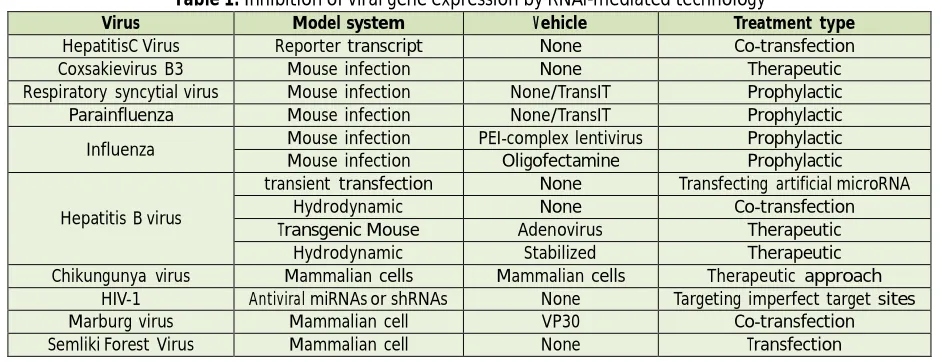
therapeutics aids has already been taken place for the treatment of disease by RNAi technology (Table 1). It is evident that RNAi is a more efficient technique as compared to the techniques like antisense and gene therapy.
Table 1: Inhibition of viral gene expression by RNAi-mediated technology
Virus Model system Vehicle Treatment type
HepatitisC Virus Reporter transcript None Co-transfection
Coxsakievirus B3 Mouse infection None Therapeutic
Respiratory syncytial virus Mouse infection None/TransIT Prophylactic
Parainfluenza Mouse infection None/TransIT Prophylactic
Influenza Mouse infection PEI-complex lentivirus Prophylactic
Mouse infection Oligofectamine Prophylactic
Hepatitis B virus
transient transfection None Transfecting artificial microRNA
Hydrodynamic None Co-transfection
Transgenic Mouse Adenovirus Therapeutic
Hydrodynamic Stabilized Therapeutic
Chikungunya virus Mammalian cells Mammalian cells Therapeutic approach
HIV-1 Antiviral miRNAs or shRNAs None Targeting imperfect target sites
Marburg virus Mammalian cell VP30 Co-transfection
Semliki Forest Virus Mammalian cell None Transfection
Human immunodeficiency virus (HIV)
At present, HAART is the only technique that is effective against the HIV. This can only extend the life span of a HIV infected patient but does not give permanent solution12. Moreover, prolonged use of this technique is found to be toxic effects in body. It has been reported that expression or replication of the virus can be very effectively eliminated by using virus specific siRNA either in-vivo or in-vitro. HIV has some special proteins that form complexes with siRNA and make them resistance against the silencing. So it would be better to target the cellular receptors and co-receptor that allow the entry of HIV into the host cell. CD4, CCR5 and CXCR4 are the main receptors which facilitate the entry of HIV into the host. The antiviral activity of the siRNA declines after it’s delivery into the cell due to degradation and dilution associated with cell division. In this case a lentiviral vector plays a valuable role to maintain its effectiveness. Lentiviral delivery of the siRNA against tat, tat-rev genes of HIV-1 in cell line, macrophages and primary T cells showed excellent result13. The ability to induce RNAi across mucosal surfaces is also being explored as a means of treating sexually transmitted disease (STD). Intravaginal delivery of RNAi targeting 2 viral genes has been shown to protect the mice from the otherwise lethal Herpes simplex virus-214.
Cancer
In the treatment of cancer, it is very important to remember that drug should not destroy to normal cells. The siRNA can prevent multiple oncogenic gene fusion and suppress disease development which is found in some special type of cancer like lymphoma and leukemia15. In a preclinical model, siRNA is able to resist
the development of tumor by targeting cellular p53 gene that is involved in the development of cancer. Experiment on breast cancer revealed that siRNA is capable of blocking the further expansion of breast cancer by suppressing the function of the chemokine receptor CXCR4. Another experiment showed that tumor cells become sensitized to the common drug like chemotherapy agents once siRNA suppressed the function of the anti-apoptotic bcl-2 gene16.
Neurobiological disease
Pre-clinical application of RNAi in invertebrate models (Drosophila and C. elegans) has shown promising result. Invertebrate models are chosen instead of vertebrate one because different cellular processes like membrane trafficking, formation of cellular junctions, intracellular signaling, neural plasticity, cell cycle, axon guidance and embryonic development present in invertebrate animals would give better idea of neurobiological diseases17. Use of RNAi therapy in the treatment of neurological diseases is preferred over the techniques like antisense, chemotherapy because it targets multiple genes that are thought to be involved with the disease development process and it is non-toxic to the cell too. This technique seems to be effective against retinal disorders, neurodegenerative disorders, CNS tumors, trinucleotide repeat diseases, etc.
Viral infections
International Journal of Pharmaceutical Sciences Review and Research Page 138 trunk or limbs and arthritis affecting multiple joints. Other
nonspecific symptoms can include headache, conjunctival infection, and slight photophobia. A newly synthesized siRNAs is effectively used against the conserved regions of nsP3 and E1 genes of Chikungunya virus with 99% inhibition18. Marburg virus is known to produce haemorrhagic fever. Many of the symptoms are similar to those of malaria or typhoid. RNA interference (RNAi) has been employed to resist this disease to some extent19. Monkey pox virus causes the disease monkey pox in both humans and animals. Symptoms include swelling of lymph nodes, muscle pain, headache, rash and fever. Monkey pox or other orthopox viruses pose a serious threat to public health and there are no licensed drugs to treat these infections20. Recently a model which uses MPV as carrier vector is reported monkey pox virus infections1. Hepatitis
Hepatitis is characterized by inflammation of the liver and a group of viruses (hepatisis A, herpes simplex, adenovirus and cytomegalovirus) are mostly responsible for this disease which leads to jaundice, anorexia and malaise. Hepatitis B virus (HBV) infection is a serious threat to health and increase the risk of chronic liver disease and hepatocellular carcinoma in human. RNAi has been applied to inhibit the production of HBV in mice transfected with a HBV plasmid. Hepatitis C virus (HCV) is characterized by small (55-65 nm in size), enveloped, positive-sense single-stranded RNA virus. Currently it affects approximately more than 270 million worldwide and it is a major cause of chronic liver disease. RNA interference activity has been used to treat HCV replication on the liver21.
Prion disease
Prion falls under the class of neurodegenerative diseases, which consist of two or three parts: a helical molecule, protein coat and sometimes a viral wrapper. All prion diseases affect the structure of the brain or other neural tissue and all are currently untreatable and universally fatal. Symptoms include depression, unsteady gait, myoclonus, insomnia, memory problem, and inability to move. RNAi has shown considerable therapeutic potential in animal models of several prion diseases, including Alzheimer disease, spinocerebellar ataxia, and Huntington disease. According to a recent report, prion replication and pathogenesis require neuronal prion protein (PrPC) which is effectively inhibited by lentivector mediated RNAi delivery therapy22.
Cardiovascular diseases
Atherosclerosis is probably main cause of various cardiovascular diseases which involve with the heart or blood vessels (arteries and veins). High blood cholesterol is a major risk factor for atherosclerosis. RNAi mediated silencing of PCSK9 gene lowered LDL cholesterol in cynomolgus monkeys and rodents without affecting HDL or triglyceride levels.
COMBINATORIAL RNAi
The main disadvantage of monotherapy using RNAi is to control viral escape mutants, which can rapidly arise due to the often high viral mutation rate25. This is quite true for RNA viruses, such as hepatitis C virus (HCV), which can even produce 10–3 mutations per viral nucleotide per year, or HIV, which is one of the fastest evolving of all organisms. A smart solution would be to target their genomes with a combination of siRNAs or with vectors expressing multiple shRNAs. Although RNAi differs from other techniques like antisense and gene therapy in their experimental design it is evident that RNAi is more efficient than others techniques. For the manipulate gene expression in animal and plants, RNAi seems to be a natural technique since antiviral response is already present within the body26. A single dose of RNAi therapy can target more than one sequence of a single gene or a group of genes. These RNAi target different sites of the viral genome simultaneously. It is found that combinations of only three or four siRNAs/shRNAs may enough to control even highly mutagenic viruses such as HIV27.
Co-suppression of two genes (BRAF and SKP2) that are frequently upregulated and mutated in melanoma cells which is achieved using a mono therapeutic approach with higher efficacy28. In order to enhance the efficacy of conventional cancer drugs a synergistic cosuppression therapy is used which inhibits oncogenes and genes that contribute to resistance to chemotherapy or irradiation simultaneously. Example includes the P-glycoprotein (encoded by MDR1), whose retrovirus/shRNA-mediated silencing in colon cancer cells resulted in enhanced sensitivity to cytotoxic drugs29. In another study, adenoviral vector–mediated shRNA expression was used to suppress HIF-1α (upregulated in rapidly progressing tumors under hypoxic conditions)30. This delays tumor growth in mice and at same time enhances co-irradation. Very recent, a new tool in iRNA therapy, introduced with great future possibility is known as miRNA sponges. A miRNA sponge is a novel technique consisting of a single-stranded mRNA with no translational start codon, but whose sequence contains repeated copies of a specific miRNA binding site. In transfected cells, each sponge would be able to bind up to 7 miRNA copies. Expressing the sponge gene in a cell could result in a decrease in the cellular levels of the target miRNA, thus causing the deregulation of the mRNA regulated by the miRNA. A miRNA sponges has definite binding sites to specific to the miRNA seed region, which allows them to block a whole family of related miRNAs.
CONCLUSION
International Journal of Pharmaceutical Sciences Review and Research Page 139 validation studies in the post-genomic era. It could be the
genetic tool to solve various diseases associated with genetic mal-functionalities. Pharmaceutical companies are now showing interest in the investment of capital for the development of new iRNA molecules intended for the treatments of diseases like cancer, inflammation/immune dysfunction, CNS disorders and cardiology/metabolism. Currently, there are 37 RNAi-based companies in the world who engage in the development of iRNA. According to a report, the total RNAi therapy market is forecast to reach a value of $580mn by 2012.
Several success stories have been achieved in this context like human proof-of-concept has been produced in a Phase 2 trial of an inhaled siRNA targeting respiratory syncytial virus (RSV) and1 another 18 anti-viral RNAi agents are in commercial development. Currently, there are 29 RNAi therapeutic cancer products in pie line. At least 22 RNAi agents are in development for conditions involving pathological inflammation. The most advantageous aspect of iRNA therapy is it targets diseases which are hard to treat. RNAi represents a novel treatment approach for several conditions which are increasing in frequency and treatment difficulty, particularly certain viral infections, cancer, and chronic inflammatory diseases. Uncertainty over delivery and non-specificity are few factors which decline effectiveness of iRNA therapy. Companies are currently optimizing nanotransporter and lipid-based mechanisms, and also investigating other modes to overcome the limitations.
REFERENCES
1. Couzin J, Small RNAs make big splash, Science, 298, 2002, 2296–2297.
2. Elbashir SM , Harborth, J, Lendeckel W, Yalcin A, Weber K, Tuschl T, Duplexes of 21-nucleotide RNAs mediate RNA interference in cultured mammalian cells, Nature, 411, 2001, 494–498.
3. Henny MM, IAN TP, Review of the Application of RNA Interference Technology in the Pharmaceutical Industry, Toxicologic Pathology, 35, 2007, 327–336.
4. Barik S, Silence of the transcripts: RNA interference in medicine, Journal Molecular Medicine, 83, 2005, 764–773.
5. Bitko V, Musiyenko A, Shulyayeva O, Barik S, Inhibition of respiratory viruses by nasally administered siRNA, Nature Medicine, 11, 2004, 50–55.
6. Massaro D, Massaro GD, Clerch LB, Noninvasive delivery of small inhibitory RNA and other reagents to pulmonary alveoli in mice, Am. J. Physiol. Lung. Cell Mol. Physiol. 287, 2004, L1066–L1070.
7. Zhang W, Yang H, Kong X, Mohapatra S, Juan Vegara HS, Hellermann G, Behera S, Singam R, Lockey RF, Mohapatra SS, Inhibition of respiratory syncytial virus infection with intranasal siRNA nanoparticles targeting the viral NS1 gene, Nature Medicine, 11(1), 2005, 56-62.
8. Hommel JD, Sears RM, Georgescu D, Simmons DL, DiLeone RJ, Local gene knockdown in the brain using viral-mediated RNA interference, Nature Medicine, 9, 2003, 1539–43.
9. Capodici J, Kariko K, Weissman D, Inhibition of HIV-1 infection by small interfering RNA-mediated RNA interference, J. Immunology, 169, 2002, 5196–5201.
10. Jacque JM, Triques K, Stevenson M, Modulation of HIV-1 replication by RNA interference, Nature, 418, 2002, 435– 438.
11. Brummelkamp TR, Nijman SM, Dirac AM, Bernards R, Loss of the cylindromatosis tumour suppressor inhibits apoptosis by activating NF-kappaB, Nature, 2003, 424, 797-801.
12. Chen M, Du Q, Zhang H, Wahlestedt C, Liang Z, Vector-based siRNA delivery strategies for high-throughput screening of novel target genes, Journal of RNAi and Gene Silencing, 1(1), 2005, 5-11.
13. Chhabra M, Mittal V, Bhattacharya D, Rana UVS, Lal S, Chikungunya fever: A re-emerging viral infection, Indian J. Med. Microbiol, 26 (1), 2008, 5–12.
14. Palliser D, Chowdhury D, Wang Q, Lee SJ, Bronson RT, Knipe DM, Lieberman J, An siRNA-based microbicide protects mice from lethal Herpes simplex virus 2 infection, Nature, 439, 2006, 89–94.
15. Fuchs U, Damm-Welk C, Borkhardt A, Silencing of disease-related genes by small interfering RNAs. Curr. Mol. Medicine, 4(5), 2004, 507–517.
16. Martinez LA, Naguibneva I, Lehrmann H, Vervisch A, Tchenio T, Lozano G, Harel-Bellan A, Synthetic small inhibiting RNAs: efficient tools to inactivate oncogenic mutations and restore p53 pathways, Proc. Natl. Acad. Sci. USA, 99, 2002, 14849–14854.
17. Genc S, Tolga FK, Genc K, RNA interference in neuroscience, Molecular Brain Research, 132(2), 2004, 260-270.
18. Dasha PK, Tiwaria M, Santhosha SR, Paridaa M, Rao PVL, RNA interference mediated inhibition of Chikungunya virus replication in mammalian cells, Biochemical and Biophysical Research Communications, 376(4), 2008, 718-722.
19. Fowler T, Bamberg S, Möller P, Klenk HD, Meyer TF, Becker S, Rudel T, Inhibition of Marburg virus protein expression and viral release by RNA interference, J. Gen. Virology, 86, 2005, 1181-1188.
20. De-Clercq E, Acyclic nucleoside phosphonates: past, present and future. Bridging chemistry to HIV, HBV, HCV, HPV, adeno-, herpes-, and poxvirus infections: the phosphonate bridge, Biochem Pharmacology, 73, 2007, 911-922.
21. Wilson JA, Richardson CD, Hepatitis C Virus Replicons Escape RNA Interference Induced by a Short Interfering RNA Directed against the NS5b Coding Region, Journal of Virology, 79(11), 2005, 7050–7058.
22. Ryan KJ, Ray CG. Sherris Medical Microbiology, (4th ed.), McGraw Hill. pp. 624–628. ISBN 0-8385-8529-9, vol 24, 2004, 144.
International Journal of Pharmaceutical Sciences Review and Research Page 140
24. Liu J, Carmell MA, Rivas FV, Marsden CG, Thomson JM, Song J, Hammond SM, Joshua-Tor L, Hannon GJ, Argonaute 2 is the catalytic engine of mammalian RNAi, Science, 305, 2004, 1437–41.
25. Leonard JN, Schaffer DV, Antiviral RNAi therapy: emerging approaches for hitting a moving target, Gene Therapy, 13, 2006, 532–540.
26. Grimm D, Kay MA, Therapeutic short hairpin RNA expression in the liver: viral targets and vectors, Gene Therapy, 13, 2006, 563–575.
27. Grimm D, Kay MA, Combinatorial RNAi: a winning strategy for the race against evolving targets, Mol. Therapy, 15, 2007, 878–888.
28. Sumimoto H, Hirata K, Yamaqata S, Miyoshi H, Miyagishi M, Taira K, Kawakami Y, Effective inhibition of cell growth and invasion of melanoma by combined suppression of BRAF (V599E) and Skp2 with lentiviral RNAi, Int. J. Cancer, 118, 2006, 472–476.
29. Pichler A, Zelcer N, Prior JL, Kuil AJ, Piwnica-Worms D, In
vivo RNA interference mediated ablation of MDR1
P-glycoprotein, Clinical Cancer Research, 11, 2005, 4487– 4494.
30. Zhang X, Kon T, Wang H, Li F, Huanq Q, Rabbani ZN, Krikpatrick JP, Vujaskovic Z, Dewhirst MW, Li CY, Enhancement of hypoxia induced tumor cell death in vitro and radiation therapy in vivo by use of small interfering RNA targeted to hypoxia-inducible factor-1alpha, Cancer Research journal, 64, 2004, 8139–8142.