Recent Research Activity o f Probabilistic Fracture Mechanics f o r Nuclear
Structural Components in Japan
G. Yagawa1 ), Y. Kanto2 ), S. Yoshimura3 ) and K. Shibata4 )
1) Department of Quantum Engineering and Systems Science, University of Tokyo 2) Department of Mechanical Engineering, Toyohashi University of Technology 3) Institute of Environmental Studies, University of Tokyo
4) Japan Atomic Energy Research Institute
ABSTRACT
This paper describes a review of recent Japanese activities on probabilistic fracture mechanics (PFM) analyses. Japan Atomic Energy Research Institute (JAERI) has sponsored research committees on PFM organized by Japan Society of Mechanical Engineers (JSME) and Japan Welding Engineering Society (JWES) for more than a decade. The purpose of the continuous activity is to establish standard procedures for evaluating failure probabilities of Japanese nuclear structural components such as PV&P and steam generator tube, combining the state-of-the-art knowledge on structural integrity of nuclear structural components and modern computer technology such as parallel processing. This paper shows the newest results of the round-robin analyses carried out by the JWES research committee.
INTRODUCTION
In design and integrity evaluation processes for nuclear structural components, deterministic approaches have mainly been employed. All kinds of uncertainty related to operating history, material property change and damage mechanisms are taken into account in so-called safety factors. It is easily expected that the results obtained are too conservative to perform a rational evaluation of plant safety and to make judgment of life extension because of the accumulation of conservatism of all related factors.
Probabilistic Fracture Mechanics (PFM) has become an important tool [1, 2]. The PFM approach is regarded as an appropriate method in rationally evaluating plant life and in risk-based decision making such as risk-informed inspection [3] since it can consider various uncertainties such as sizes and distributions of cracks, degradation of material strength due to aging effects, fluctuating loading histories, accuracy and frequency of pre- and in-service inspections. Thus, various PFM computer programs have been developed and applied in practical situations in the last two decades.
nuclear structural components and modern computer technology such as parallel processing.
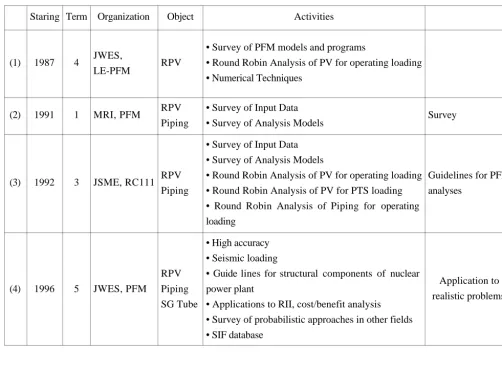
This paper describes one of the recent results of the above activities[7-12], sensitivity analyses to evaluate the effect of thermal annealing of RPV subjected to PTS loading. Other results are briefly summarized.
Table 1 PFM research activities sponsored by JAERI
Staring Term Organization Object Activities
(1) 1987 4 JWES,
LE-PFM RPV
• Survey of PFM models and programs
• Round Robin Analysis of PV for operating loading • Numerical Techniques
(2) 1991 1 MRI, PFM RPV Piping
• Survey of Input Data
• Survey of Analysis Models Survey
(3) 1992 3 JSME, RC111 RPV Piping
• Survey of Input Data • Survey of Analysis Models
• Round Robin Analysis of PV for operating loading • Round Robin Analysis of PV for PTS loading • Round Robin Analysis of Piping for operating loading
Guidelines for PFM analyses
(4) 1996 5 JWES, PFM
RPV Piping SG Tube
• High accuracy • Seismic loading
• Guide lines for structural components of nuclear power plant
• Applications to RII, cost/benefit analysis • Survey of probabilistic approaches in other fields • SIF database
Application to realistic problems
EFFECT OF THERMAL ANNEALING OF RPV
JAERI has developed PASCAL(PFM Analysis of Structural components in Aging LWR)[13, 14] code to evaluate failure probability of vessels subject to transient loading, such as PTS loading. Main features of PASCAL program is summarized in Table 2. The program has been verified and applied some case studies[15]. This paper describes one of them, effect of thermal annealing.
of this calculation is to evaluate influence of annealing parameters and to show the applicability of PASCAL program to this problem.
Table 2 Summary of main features of PASCAL
Analysis method (1) Monte Carlo simulation with importance sampling (2) Monte Carlo simulation with stratified sampling
Fracture criterion (1) Linear-elastic fracture criterion (KIC/KIa)
(2) R6 method
• Failure assessment curve: Option 1 and Option 2 • Analysis category: Cat. 1, Cat. 3 and Cat. 1+ Cat. 3
Type of initial crack geometry
(1) Infinite edge crack • With a fixed depth • With a depth distribution (2) Semi-elliptical surface crack
• With a fixed length with depth distribution • With a fixed depth and length
• With a fixed aspect ratio with depth distribution • With an aspect ratio distribution adn depth distribution
Extension analysis of semi-elliptical crack
(1) Model 1(Simplified model): Semi-elliptical crack is replaced by an infinite edge crack subsequently to the crack initiation to the depth direction.
(2) Model 2(Simplfied model): Semi-elliptical crack is replaced by an infinite edge crack subsequently to the crack initiation to the surface direction.
(3) Model 3(Exact model): Incremental crack extension both to thickness and surface direction is evluated independently, thus the crack configuration during extension can be evaluated.
Evaluation of the effect of thermal annealing
The effect of embrittlement recovery by thermal annealing and post-annealing embrittlement of a RPV can be evaluated based on the method prescribed by USNRC R. G. 1.162.
Evaluation of the effect of Warm Pre-Stress
The effect of WPS is evaluated based on the procedure considering the history of the stress intensity factor, i. e., without counting the crack extension during the stress intensity factor is decreasing.
Evaluation of the effect of overlay cladding
(1) A simplified method is introduced by dividing the stresss distribution into three polynomial distributions and superposing the stress intensity factors obtained from each distribution.
(2) For an infinite edgge crack, influence functon can be used.
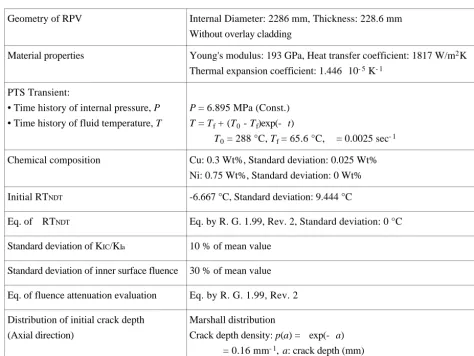
The calculation conditions are taken from the USNRC/EPRI PTS benchmark problem A5[16] as shown in Table 3. Before the PFM analyses, distributions of temperature and thermal stress are calculated by FE analyses according to the given temperature and pressure transients. The following parameters are chosen for sensitivity analyses: annealing timing, recovering ratio, chemical components, evaluation method of embrittlement, crack detection ratio of NDI, aspect ratio of semi-elliptical surface crack, WPS and evaluation method of fracture toughness. Annealing conditions and recovery of DRTNDT and DUSE are summarized in Table 4. These conditions are decided by using the embrittlement evaluation method
Wt%, respectively.
Table 3 Main parameters of NRC/EPRI PTS benchmark problem(A5)
Geometry of RPV Internal Diameter: 2286 mm, Thickness: 228.6 mm Without overlay cladding
Material properties Young's modulus: 193 GPa, Heat transfer coefficient: 1817 W/m2K
Thermal expansion coefficient: 1.446¥10- 5 K- 1
PTS Transient:
• Time history of internal pressure, P • Time history of fluid temperature, T
P = 6.895 MPa (Const.) T = Tf + (T0 - Tf)exp(-lt)
T0 = 288 °C, Tf = 65.6 °C, l = 0.0025 sec- 1
Chemical composition Cu: 0.3 Wt%, Standard deviation: 0.025 Wt% Ni: 0.75 Wt%, Standard deviation: 0 Wt%
Initial RTNDT -6.667 °C, Standard deviation: 9.444 °C
Eq. of DRTNDT Eq. by R. G. 1.99, Rev. 2, Standard deviation: 0 °C
Standard deviation of KIC/KIa 10 % of mean value
Standard deviation of inner surface fluence 30 % of mean value
Eq. of fluence attenuation evaluation Eq. by R. G. 1.99, Rev. 2
Distribution of initial crack depth (Axial direction)
Marshall distribution
Crack depth density: p(a) = lexp(-la) l = 0.16 mm- 1, a: crack depth (mm)
Table 4 Annealing conditions and recovery of DRTNDT and DUSE
Temperature (°C) Time (hours)
Recovery of DRTNDT (%)/ Recovery of DUSE
Cu: 0.1 % Cu: 0.2 % Cu: 0.3 %
A 350 541.1 22.7 / 77~99 15.7 / 65~74 10 / 59~60
B 400 67.5 49.1 / 93~100 32.9 / 79~100 20 / 75~86
C 420 26.8 75.1 / 90~100 58.0 / 76~100 40 / 74~88
D 450 275.9 95.8 / 100 90.0 / 94~100 80 / 93~100
Life extension effect = Dfpost-anneal / fanneal (1)
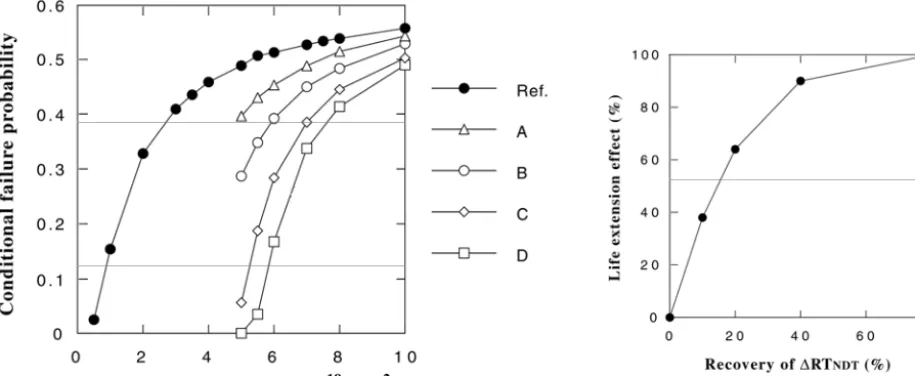
where, Dfpost-anneal is the required fluence after annealing to reach the same level of failure probability just before the annealing, and fanneal is the fluence at the annealing. Figure 2 shows the life extension effect of annealing where the annealing is performed at 5¥101 9 n/cm2. It shows that the lower recovery ratio can give a satisfactory value of life extension effect, e. g., 20 % recovery of DRTNDT gives 60 % life extension effect. This is very important considering that the cost of
annealing rises sharply for 40 % or 80 % recovery.
Fig. 1 Effect of recovery of DRTNDT on conditional failure probability Fig. 2 Effect of recovery of DRTNDT on life extension
Figure 3 shows the conditional failure probabilities without anneal. Two evaluation methods of crack detection ratio, VISA-II(worst)[18] and Arakawa's method[19], are compared in this figure. Arakawa's method gives higher detection ratio than VISA-II(worst) method. And the effect appears quite clearly in this figure. Lower Cu content and JEAC4206 evaluation method of embrittlement[20] other than the method of USNRC R. G. 1.99 Rev.2 also reduce failure probability significantly. Other parameters listed above are found to be less significant under these analysis conditions.
OTHER RESULTS
As mentioned above, the activities of JWES-PFM subcommittee extend from surveys to application of PFM analysis. Some of them are presented at SMiRT 16 conference[21-24]. The results of five-year research of the subcommittee are summarized as follows.
Improvement of PFM methodology for RPV and piping
To improve the PFM methodology developed by JSME-PFM research committee[5], the following issues are picked up: consideration of seismic loading, consideration of embedded cracks and effect of annealing.
(a) Seismic loading:
Elaborate surveys were made on (i) its treatment in the current nuclear structural design, (ii) the calculation method in PRAISE code and (iii) treatment of seismic hazard curve and response factor in seismic PSA. Based on the results, a new PFM model was proposed considering uncertainties about seismic hazard curve and amplification factor of seismic loading in nuclear plant buildings. The various sensitivity analyses have indicated that failure probability of primary piping is largely affected by seismic loading and amplification factor of seismic loading in nuclear plant buildings has dominant effect. A tentative guideline for PFM analysis of piping subject to seismic loading was proposed according to the above results.
(b) Embedded crack:
A new PFM model, where an embedded crack is supposed instead of surface crack as initial flaw, was proposed. Various sensitivity analyses shows that the embedded crack model gives much smaller value of failure probability than the surface crack model. A tentative guideline for PFM analysis of RPV considering embedded crack was proposed according to the above results. In this research, analyses are made for RPV subject to normal and upset operating conditions, but the embedded crack model can be applied to other structural components.
(c) Anneal effects:
Because annealing is important especially in structural integrity of nuclear RPV subject to PTS loading, a survey was made on anneal characteristics of RPV steel at first. Using PASCAL code which is developed by JAERI, a PFM model considering anneal characteristics was analyzed and the anneal effects were evaluated quantitatively. It is found that (i) relatively lower recovery rate of DRTNDT can be expected to give a large life extension effect, (ii) dominant factors to failure
probability are precision of NDI, Cu content and embrittlement evaluation method. This study also aimed usability test of PASCAL code and useful information was collected for improvement of user-interface, function and its manual.
Evaluation method of failure probability of other structural components
Previous works[5] focused on RPV and primary piping because of their importance for structural integrity. But failure of other components, even if less important for structural integrity, may have an adverse influence on economic loss and public acceptance. PFM methodology seems effective on such structural components. SG tube under SCC condition was selected after surveys and discussions on several nuclear structural components. Various sensitivity analyses quantitatively clarified the effect of improvement of SCC-proofness and the effect of maintenance regulatory. A tentative guideline for PFM analysis of SG tube was proposed according to the above results.
Risk-benefit analysis of nuclear structural components based on PFM methodology
Surveys of application of probabilistic methodology in other fields
Public acceptability, as well as establishment of best-estimate methods, is very important to promote the PFM methodology into decision making in the nuclear field. From this point of view, surveys were made on application of probabilistic approaches in other engineering fields, such as railroad, aircraft, spacecraft and so on. Public acceptability of risk was also surveyed. It was confirmed that the probabilistic approaches have become gradually utilized as tools to evaluate risks rationally and quantitatively in various fields of engineering.
Stress intensity factor database
PFM analyses require precise evaluation methods of fracture parameter for various 3-dimensional cracks, such as surface crack, embedded crack, interfering cracks and under-clad cracking. However, available solutions are limited to problems under simpler geometrical and mechanical conditions. In this study, deep cracks and penetrating cracks were calculated by using parallel FEM program with one to ten million DOF mesh models to develop SIF database for PFM analyses.
CONCLUSIONS
Part of recent results of Japanese activities on PFM analyses are briefly summarized. Five-year activities of JSME-PFM subcommittee have aimed to propose standard methods to obtain reliable failure probability of nuclear structural components based on Japanese data. These results shown here are not considered to be used straightforwardly in evaluation of structural integrity for real nuclear structural components. But they are expected to be a basis of the future Japanese regulation of PFM methodology.
The following issues remain as future tasks:
(i) To develop reliable PFM programs which are open and well-understood. PASCAL program developed by JAERI may be one of the candidates. It may be necessary to improve PASCAL program according to the results of this research.
(ii) To perform pilot studies for real plants. It is necessary to demonstrate reliability of input data, analysis models and numerical techniques at the practical level, and to accumulate experiences of PFM analyses.
(iii) To develop general purpose systems, such as a risk-benefit evaluation system.
ACKNOWLEDGEMENT
REFERENCES
1. Yagawa, G., “Structural integrity assessment of nuclear power plants using probabilistic fracture mechanics,” Nuclear Eng., Vol.34, 1988, pp.19-30. (in Japanese)
2. Harris, D. O. and Balkey, K. R., “Probabilistic considerations in life extension and aging,” Technology for the '90s, ASME PVP Division, 1993, pp.243-269.
3. Balkey, K. R., Closky, N. B. and Vermaut, M. K., “Application of risk-based methods to inservice inspection and testing,” Trans. 14th SMiRT, M05/2, Lyon, France, 1997.
4. JWES Report of LE Subcommittee, Japan Welding Eng. Society (JWES), JWES-AE-9003, 1990. (in Japanese) 5. Final Report of RC111 Committee, Japan Society of Mechanical Engineers (JSME), 1995. (in Japanese) 6. JWES Report of PFM Subcommittee, JWES, JWES-AE-9705, 1997. (in Japanese)
7. Yoshimura, S., Yagawa. G. et al., “PFM analyses of LWR's pressure vessels and piping: Quantitative study on influences of distributions of initial crack sizes,” Proc. 20th MPA Seminar, Vol.2, 1994, pp.44.1-10.
8. Yagawa, G., Yoshimura, S. et al., “Study on life extension of aged RPV material based on PFM - Japanese round robin,” Trans. ASME, J. Pressure Vessel Technology, Vol. 117, 1995, pp.7-13.
9. Yagawa, G. and Yoshimura, S., “Probabilistic fracture mechanics analyses of nuclear pressure vessels and piping: A review of Japanese activity,” Trans. 14th SMiRT, GMW/1,Lyon, France, 1997.
10. Yagawa, G., Kanto, Y. and Yoshimura, S., “Probabilistic fracture mechanics of nuclear structural components: Consideration of transition from embedded crack to surface crack,” 2nd Int. Workshop on the Integrity of Nuclear Components, JWES-SAFE, April 1998, pp.31-48.
11. Kanto, Y. and Yagawa, G., “Probabilistic fracture mechanics analysis of nuclear reactor pressure vessels: Effects of transition from embedded crack to surface crack,” Trans. 15th SMiRT, X-331-X-338, Seoul, Korea, 1999.
12. Yagawa, G. et. al., “Probabilistic fracture mechanics analysis of nuclear structural components: A review of recent Japanese activities,” SMiRT15 11th Post Conf. Sem. 2(PCS-2), Tokyo, pp.11-30, 1999.
13. Shibata,K., Kato,D. and Y.Li, “Development of PFM Code for Evaluating Reliability of Pressure Components Subject to Transient Loading,” to be published in Nucl. Eng. and Des.
14. Li,Y., Kato.D., Shibata, K. and Onizawa, K., “Improvements to Probabilistic Fracture Mechanics Code for Evaluating the Integrity of a RPV under Transient Loading,” to be published in Int. Jour. Press. Vessel and Piping.
15. Shibata, K., Onizawa, K., Kato, D., Li, Y. and Yagawa, G., “Research and development related to PFM for aged nuclear components,” Nuclear Engineering and Design, submittesd for publication.
16. EPRI/TR-105001, “Documentation of probabilistic fracture mechanics codes used for reactor pressure vessels subjected to pressurized thermal shock loading, Part 1 and 2,” 1995.
17. USNRC R. G. 1.99 Rev.2
18. Simonen, F. A. et al.,VISA-II, NUREG/CR-4486, PNL-5775 RF, R5, 1986.
19. Arakawa, T., “Japanese evaluation of the Japanese results,” Ultrasonic Inspection of Heavy Steel Components, The PISC II Final Report Part-II, p.409-492, 1988.
20. Japan Electric Association, JEAC4206, Confirmation testing procedures of fracture toughness for nuclear power plant components, 2000. (in Japanese)
21. Kanto, Y. and Yagawa, G., “PFM analysis of embedded crack in RPV,” to be presented at SMiRT 16, USA, 2001. 22. Machida, M. et. al., “Effect of dispersion of seismic loading on integrity of nuclear power plant piping,” to be presented
at SMiRT 16, USA, 2001.
23. Isobe, Y. et. al., “Application of PFM to optimization of SG tube maintenance,” to be presented at SMiRT 16, USA, 2001.