Copyright2001 by the Genetics Society of America
Analysis of Expressed Sequence Tags From Two Starvation, Time-of-Day-Specific
Libraries of
Neurospora crassa
Reveals Novel Clock-Controlled Genes
Hua Zhu,*
,1Minou Nowrousian,
†,1Doris Kupfer,* Hildur V. Colot,
†Gloria Berrocal-Tito,
†Hongshing Lai,* Deborah Bell-Pedersen,
‡Bruce A. Roe,* Jennifer J. Loros
†and Jay C. Dunlap
†*Department of Chemistry and Biochemistry, Advanced Center for Genome Technology, University of Oklahoma, Norman, Oklahoma 73019, †Departments of Genetics and Biochemistry, Dartmouth Medical School, Hanover, New Hampshire 03755 and
‡Department of Biology, Biological Sciences, Texas A&M University, College Station, Texas 77843 Manuscript received October 11, 2000
Accepted for publication December 19, 2000
ABSTRACT
In an effort to determine genes that are expressed in mycelial cultures of Neurospora crassaover the course of the circadian day, we have sequenced 13,000 cDNA clones from two time-of-day-specific libraries (morning and evening library) generatingⵑ20,000 sequences. Contig analysis allowed the identification of 445 unique expressed sequence tags (ESTs) and 986 ESTs present in multiple cDNA clones. Forⵑ50% of the sequences (710 of 1431), significant matches to sequences in the National Center for Biotechnology Information database (of known or unknown function) were detected. About 50% of the ESTs (721 of 1431) showed no similarity to previously identified genes. We hybridized Northern blots with probes derived from 26 clones chosen from contigs identified by multiple cDNA clones and EST sequences. Using these sequences, the representation of genes among the morning and evening sequences, respectively, in most cases does not reflect their expression patterns over the course of the day. Nevertheless, we were able to identify four new clock-controlled genes. On the basis of these data we predict that a significant proportion of the expressed Neurospora genes may be regulated by the circadian clock. The mRNA levels of all four genes peak in the subjective morning as is the case with previously identifiedccgs.
T
HE ascomyceteNeurospora crassahas a long history substantial proportion of Neurospora genes might be regulated by the circadian clock, but the extent of this as a model organism for both classical andmolecu-lar genetics in general (Davis2000) as well as for investi- control is yet unclear. Therefore, it was decided to use an expressed sequence tag (EST) sequencing approach gation of circadian rhythmicity (Dunlap1999). Several
efforts have been made recently to map and sequence to address the question of clock regulation at a larger scale as well as to identify novel ESTs and to examine the Neurospora genome (Fungal Genome Resources at
http://gene.genetics.uga.edu/ and Munich Information global gene expression under conditions (starvation in the dark) not previously examined.
Centre for Protein SequencesNeurospora crassaDatabase
EST sequences are highly valuable in genomic ap-at http://www.mips.biochem.mpg.de/proj/neurospora/)
proaches. EST data can be used to identify novel genes, as well as to address the expression of genes at different
search for homologous genes in different organisms, stages of the Neurospora developmental cycle
(Neuro-analyze alternative splicing, and identify chromosomal spora Genome Project at http://www.unm.edu/ⵑngp/;
locations of genes and other applications (Pandeyand
Nelsonet al.1997;Dolanet al.2000).
Lewitter1999;OhlroggeandBenning2000). With One of the most notable aspects of N. crassa is the
large numbers of ESTs available, so-called “digital fact that a great part of its life is tightly controlled by the
Northerns” or “electronic transcriptional profiling” can circadian clock. Not only the formation of macroconidia
be performed by counting the number of ESTs for a but also the expression of genes important for general
given gene within the EST population (Pandey and metabolism occur in a circadian fashion (Loros1998).
Lewitter1999;Pradeet al.2001). Also, cDNA clones Using differential screening procedures of cDNA
librar-with known sequences are used to establish cDNA mi-ies, several genes have been shown to be under clock
croarrays with which genome-wide expression patterns control (Loroset al.1989;Bell-Pedersenet al.1996).
can be investigated (Dugganet al.1999). These studies have confirmed the impression that a
In the project described here, cDNA clones from two mycelial libraries of N. crassawere partially sequenced. The libraries were made from time-of-day-specific tissues
Corresponding author:Jay C. Dunlap, Department of Genetics,
Dart-and had been used to characterize clock-controlled genes
mouth Medical School, Hanover, NH 03755.
(ccgs) earlier (Bell-Pedersen et al. 1996). The ESTs
E-mail: [email protected]
1These authors contributed equally to this work. were organized into contiguous sequences (contigs)
and compared to the sequences within the National Center for Biotechnology Information (NCBI) data-base. Besides genes that have homologs in the NCBI database, the sequencing yielded a large number of yet unknown ESTs (50% of 1431 different genes identified
Figure1.—Derivation of ESTs. Sequences generated using
within the libraries). Northern blots were hybridized
the forward and reverse primers correspond to the 5⬘and 3⬘
with probes derived from 26 cDNA clones, and 4 of
ends of the cDNA clones and are denoted with f1 and r1,
these genes were found to be rhythmically expressed.
respectively, at the end of their sequence identification
num-Again, this confirms the prediction that a significant ber. cDNAs were directionally cloned using asymmetric prim-proportion of N. crassagenes may be regulated by the ers and linkers as described inBell-Pedersenet al.(1996).
circadian clock.
manually retracked and analyzed using the ABI sequencing analysis software. See http://www.genome.ou.edu/proto.html MATERIALS AND METHODS
for more detailed descriptions of protocols.
Strains and growth conditions: The following N. crassa Informatics:DNA sequences were automatically surveyed
strains were used: frq⫹strain 87-3 (bd; a) and long period for quality using the phred software (Ewinget al.1998). Se-mutant 585-7 (bd; a; frq7). Neurospora media (Vogel’s) were
quences were screened for the presence of vector sequences, as described (DavisanddeSerres1970). Culture conditions low quality sequences (Phred-16), and small inserts (⬍100 for rhythmic RNA analysis and light induction experiments bp) and were trimmed to remove poly(A) tail and vector se-were performed according to published methods (Loroset quences. All sequences were screened for homology to
ribo-al.1989). somal RNA, mitochondrial DNA, and E. coli genomic
se-Preparation and analysis of RNA: RNA was prepared as quences using BLASTN (Altschulet al.1997) and matches described previously (Yarden et al. 1992). Northern blots, were removed. To reduce the redundancy of the libraries and slot blots, and probing with DNA probes or riboprobes were determine the relative abundance of the members, overlap-performed according to standard techniques (Maniatiset al. ping cDNA sequences were identified and organized into
con-1982). tigs using the phrap software (P. Green, copyright 1994–1996,
Template preparation for DNA sequencing:The libraries http://bozeman.mbt.washington.edu/phrap.docs/phrap.html) from which the sequenced clones are derived have been de- with a window size of 14 and a minimal score of 80. A contig scribed previously (Bell-Pedersenet al.1996); they were not here, then, arises from the alignment of clustered ESTs on the further amplified or modified except for those modifications basis of sequence similarity. The derived peptide sequences that normally arise during the process of phagemid excision corresponding to the cDNA sequences were compared with (see below). Template preparation, sequencing, and analysis the protein database available through the NCBI (Bethesda, were performed at the Advanced Center for Genome Technol- MD) using the BLASTX algorithm (Altschulet al. 1997). ogy, University of Oklahoma. For each library, infection of EST sequences and results of comparisons can be obtained
Escherichia colistrain SOLR with aliquots from the mass library through the website http://www.genome.ou.edu/fungal.html. excision converted the single-stranded phagemids to the dou- The site also provides the opportunity to search the EST se-ble-stranded form. The appropriate volume of F1lysate con- quences using BLAST. The EST sequences were also deposited taining the single-stranded phagemids was added to the SOLR in the dbEST database of GenBank (Boguskiet al.1993). cells to yield 200–300 colonies per 2⫻107of infected SOLR
cells. Single white colonies were picked to individual wells of a 96-well block containing 1.5 ml TB with ampicillin per well.
RESULTS After growth, triplicate 100-l aliquots of each cell culture
were mixed with glycerol (final concentration 17%) and stored Sequence analyses: Plasmid DNA from ⬎13,000 at⫺70⬚. Individual clones are available publicly from the
Fun-clones derived from two N. crassa cDNA libraries was
gal Genetics Stock Center, University of Kansas Medical Center
sequenced using the universal reverse or universal
for-(Kansas City, KS; http://www.fgsc.net). Double-stranded DNA
template was robotically isolated from the remaining cell cul- ward primer (Figure 1). The libraries have been used
ture using a modified plasmid preparation procedure (http:// previously to identify clock-controlled genes (ccgs) and genome. ou.edu/proto.html;BirnboimandDoly 1979) on correspond to “morning” (circadian time CT1) and a Biomek 2000 (Beckman, Fullerton, CA).
“evening” (CT13;Bell-Pedersenet al.1996). For ⬎53%
DNA sequencing:Partial nucleotide sequences of the cDNA
of all clones, high-quality sequence data (seematerials
inserts were determined by single-pass sequencing using the
Big Dye sequencing system (Perkin Elmer, Norwalk, CT; and methods) were obtained with both primers, 28%
Rosenblumet al.1997) with either the universal forward (5⬘ of all clones were sequenced only with the forward GACGTTGTAAAACGACGGCC) or the universal reverse primer, and 19% only with the reverse primer. Typically primer (5⬘CACAGGAAACAGCTATGACC). Generally, 0.2g
300–500 bp of high-quality sequence was obtained.
Se-of each template was cycle sequenced with 6.5 pmol primer
quences obtained with the reverse primer should
corre-and 2l of a 1:4 diluted AmpliTaq DNA polymerase Big Dye
termination mix in a final volume of 5–7l. Cycling conditions spond to the 3⬘end and are designated in the database
were 60 cycles of 95⬚ for 10 sec, 50⬚ for 5 sec, and 60⬚ for with an “r1” at the end of the sequence identification 4 min in Perkin Elmer thermocyclers 9600 or 9700. Reactions number; sequences obtained with the forward primer were purified by centrifugation through Sephadex G-50
micro-should correspond to the 5⬘end and have “f1” at the end
titer plate spin columns (Bodenteichet al.1994) and
electro-of their identification number. Exceptions occurred for
phoresed on an ABI 377 sequencer (Applied Biosystems,
in reverse orientation. The sequences are available in dance of cDNAs in the morningvs.the evening library reflects the situation in vivo.Insert DNAs of 26 cDNA a publicly searchable format as described inmaterials
and methods. clones representing contigs that contain multiple cDNA
clones were used to hybridize Northern or slot blots
Contig analysis and cDNA identities: We obtained
9148 sequences from the evening and 10,871 sequences with RNA from time courses. Growth and harvest of tissues was performed as described previously (
Bell-from the morning library, representing a total of 1431
different genes. Of these genes, 445 are represented Pedersen et al. 1996); the clones used as probes are given in Table 1. Among the 26 genes represented by only once within the libraries, whereas 986 are
repre-sented by more than one EST. The EST sequences were the cDNAs, 19 should be differentially expressed with
P⬎0.999 according to published formulas (http://igs-organized into contigs using the phrap software (P.
Green, copyright 1994–1996, http://bozeman.mbt. server.cnrs-mre.fr; Audic and Claverie 1997). Two genes have probabilities of being differentially ex-washington.edu/phrap.docs/phrap.html). To identify
potential homologs to the Neurospora genes, the pressed between 0.95 and 0.999, and 5 have probabilities of ⬍0.95; cDNAs representing these latter ones were BLASTX algorithm (Altschulet al.1997) was used to
translate each contig nucleotide sequence into the six chosen as “negative controls” (Table 1). These results indicate that preferential occurrence in either the possible reading frames and to compare the predicted
protein sequences with the NCBI protein sequence data- morning or evening library did not generally corre-spond to rhythmic expression in vivo or to enhanced base. In previously published sequence analyses of
Neu-rospora ESTs (Nelsonet al. 1997), matches (putative expression at the time of day indicated by the occur-rence of transcripts in the libraries (Table 1). The major-homologs) were divided into highly significant (P/E
values ⱕ 10⫺20), moderately significant (10⫺5–10⫺19), ity of the genes investigated showed more or less even
expression over the course of the circadian day or dis-and weakly significant (10⫺2–10⫺4). Here, we present
only those matches that are at least moderately signifi- played small peaks at random times (data not shown). Also, previously characterized ccgs (Bell-Pedersen et
cant. The data upon which this analysis is based can be
viewed at the Genetics website at http://www.genetics. al.1996) were in most but not all cases represented in the libraries according to their expression patternsin
org/supplemental/, http://www.genome.ou.edu.fungal.
html, and http://www.dartmouth.edu/ⵑjdunlap/. The vivo(Table 2). As has been shown previously,ccgspeak preferentially in the late night or early morning (
Bell-clones are shown according to the classification scheme
utilized by the Expressed Gene Anatomy Database (EGAD, Pedersenet al.1996), but this pattern could be found within the EST sequences only in five out of sevenccgs
available at http://www.tigr.org/docs/tigr-scripts/egad_
scripts/role_report.spl; White andKerlavage1996). (Table 2). Possible explanations for these findings are discussed below (seediscussion).
A total of 710 of 1431 sequences (50%) correspond to
characterized genes, including genes of known function Identification of clock-controlled genes: Of the 26 cDNA clones used to probe Northern or slot blots, 4 as well as putative open reading frames. The remaining
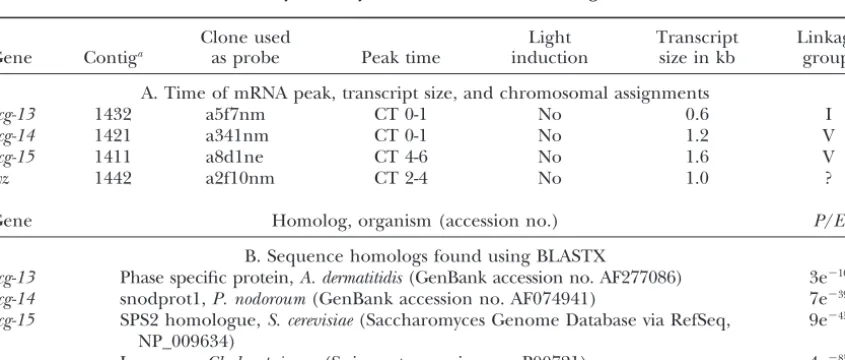
721 genes (50%) do not have any significant matches displayed rhythmic expression patterns (Table 3, Figure 2). These were namedccg-13,ccg-14,ccg-15, andlyzand within the NCBI database. Of the total set of 1431 genes,
ⵑ35% were represented in the New Mexico Neurospora corresponded to contigs 1432, 1421, 1411, and 1442 (Table 3). Probes derived from representative cDNA EST database (Nelsonet al.1997), and of these about
half had sequence homologs in the NCBI database and clones were hybridized to RNA from bothfrq⫹andfrq7
cultures to verify that the period length of the rhythm half did not.
Transcript abundance in the morning and evening is dependent on thefrqallele (21.5 hr forfrq⫹and 29 hr forfrq7) and, therefore, that the expression is clearly
libraries: With a large number of ESTs available,
so-called “digital Northerns” or “electronic transcriptional under clock control. As shown in Figure 2, expression of ccg-13 and ccg-14 was cyclic, displaying high ampli-profiling” can be performed by counting the number
of ESTs for a given gene within an EST population. tudes, and the troughs of their rhythms were very consis-tent (Figure 2B). The other two genes,ccg-15 and lyz, Formulas have been developed to estimate the statistical
significance of this electronic transcript profiling (Audic displayed much lower amplitudes, and the variation be-tween different assays appears to be much greater (Fig-andClaverie 1997), but few efforts have been made
to evaluate the correlation between digital Northerns ure 2B). Nevertheless, a consistent pattern of peaks and troughs could be observed in bothfrq⫹andfrq7strains
and laboratory methods for the analysis of gene
expres-sion. Several reports describe approaches to correlate for ccg-15 as well as lyz, and although clock control is not as strong as with otherccgs, the expression of these these data for human or plant EST databases (Huang
et al.1999;Bortoluzziet al.2000;Hwanget al.2000; genes appears to be clock regulated. Expression of the newccgspeaked between CT0 and CT6; therefore, they
Mekhedovet al.2000), but no data have been published
previously to achieve this for fungal gene expression were morning specific as are previously identified ccgs
(Bell-Pedersenet al.1996). The newly identifiedccgs
profiling (see, however,Pradeet al.2001). Therefore,
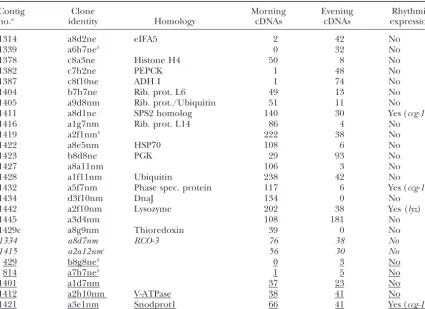
TABLE 1
Clones used for hybridizing time-specific RNAs
Contig Clone Morning Evening Rhythmic
no.a identity Homology cDNAs cDNAs expression
1314 a8d2ne eIFA5 2 42 No
1339 a6h7neb 0 32 No
1378 c8a3ne Histone H4 50 8 No
1382 c7h2ne PEPCK 1 48 No
1387 c8f10ne ADH I 1 74 No
1404 b7h7ne Rib. prot. L6 49 13 No
1405 a9d8nm Rib. prot./Ubiquitin 51 11 No
1411 a8d1ne SPS2 homolog 140 30 Yes (ccg-15)
1416 a1g7nm Rib. prot. L14 86 4 No
1419 a2f1nmb 222 38 No
1422 a8e5nm HSP70 108 6 No
1423 b8d8ne PGK 29 93 No
1427 a8a11nm 106 3 No
1428 a1f11nm Ubiquitin 238 42 No
1432 a5f7nm Phase spec. protein 117 6 Yes (ccg-13)
1434 d3f10nm DnaJ 134 0 No
1442 a2f10nm Lysozyme 202 38 Yes (lyz)
1445 a3d4nm 108 181 No
1429c a8g9nm Thioredoxin 39 0 No
1334 a8d7nm RCO-3 76 38 No
1415 a2a12nmc 56 30 No
429 b8g8neb 0 3 No
814 a7h7neb 1 5 No
1401 a1d7nm 37 23 No
1412 a2h10nm V-ATPase 38 41 No
1421 a3e1nm Snodprot1 66 41 Yes (ccg-14)
The identity of the clones from which the probes were derived is given in the second column, and the numbers of the contigs to which the clones are assigned are given in the first column. More detailed information about homologies is given at http://www.genetics.org/supplemental/, http://www.genome.ou.edu/fungal.html, and http://www.dartmouth.edu/ⵑjdunlap/. Blocks of contigs are italicized or underlined according to their probabilities for differential expression as calculated from the number of ESTs present in the morning and evening libraries (AudicandClaverie1997). The first 19 genes represented by the contigs shown below have a probability of⬎0.999 of being differentially expressed, the next two contigs between 0.95 and 0.999 (italicized), and the last five contigs⬍0.95 (underlined). PEPCK, phosphoenolpyruvate carboxykinase; PGK, phosphoglycer-ate kinase; V-ATPase, vacuolar ATPase.
aA single contig identification number is given in those cases in which several contigs have homology to
the same gene. This can happen in cases when one contig corresponds to the 5⬘end and one to the 3⬘end of a given gene. A complete list of contigs corresponding to a single gene can be found at the Genetics website at http://www.genetics.org/supplemental/, at http://www.genome.ou.edu/fungal.html, and at http:// www.dartmouth.edu/ⵑjdunlap/.
bIn these cases, the PCR fragments used for hybridization were not derived from the clones given, but from
other clones from the same contig. The clone numbers given here are clones with significant overlap to the probes used.
cThe clone with the sequence of a2a12nm is in Well a2b12nm of the library.
that were extracted from mycelia exposed to continuous dermatitidis (GenBank accession no. AF277086, P/E
value 3e⫺10). The putative 5⬘ nontranslated region of
light for intervals of 15 min to 2 hr, but none of them was
light induced under these conditions (data not shown). contig 1432 (representingccg-13) shows identity to the end of cosmid H37F12, which was sequenced by the Riboprobes were generated for both strands of the new
ccgsand, as expected, all of them were found to encode University of Georgia mapping project (available at http://gene.genetics.uga.edu/). This cosmid was map-mRNAs within their f1 strands (Figure 1).
Sequence similarities and chromosomal locations of ped to linkage group I by the same group (linkage data at http: // www.fgsc.net/mappingdata/mapping1.htm);
the new clock-controlled genes: Comparison of the
newly identifiedccgsto the databases revealed the follow- therefore, ccg-13 should be located on linkage group I. ccg-14 is very similar to snodprot1 from the ascomy-ing (Table 3):ccg-13shows strong sequence similarity to
TABLE 2 Genome Database via RefSeq, accession no. NP_009634,
P/E value 9e⫺45) and is contained in clone 3e7 from
Abundance of previously identifiedccgs
the MIPSN. crassadatabase, which also maps to linkage
among the EST sequences
group V. Thus, although there are clear sequence homo-logs toccg-13,ccg-14, andccg-15, there is at present
noth-Ratio
Morning Evening morning/evening ing about the biology of Neurospora to suggest
biologi-Gene cDNAs cDNAs in libraries cally (or phenotypically) meaningful names for these
genes, and so they have provisionally been identified as
ccg-1 351 191 1.8
ccg-13, 14, and 15, pending functional studies. Contig
ccg-2 457 248 1.8
ccg-4 0 42 — 1442 shows the strongest homology to lysozyme from
ccg-6 33 179 0.2 the ascomyceteChalaropsissp. (Swissprot accession no.
ccg-7 692 214 3.2 P00721,P/Evalue 4e⫺85;Felchet al.1975); therefore,
ccg-8 37 0 — the gene was named
lyz.This sequence was not present
ccg-9 66 26 2.5
in either of the Neurospora mapping projects (MIPS
The number of sequences corresponding to a certainccg N. crassadatabase or Fungal Genome Resource at http://
obtained from the morning or evening libraries is given in gene.genetics.uga.edu/). the second and third column, respectively, and their ratios
are given in the fourth column. The ESTs for the evening library were normalized by multiplying by 1.2, as there were
DISCUSSION fewer EST sequences obtained from the eveningvs.the
morn-ing library (9148vs.10,871).
Many aspects of the developmental cycle ofN. crassa
are under the control of the circadian clock (Loros
1998). As was shown previously, clock control of gene AF074941, P/E value 7e⫺39), a protein that displays
expression can be observed in submerged shaken cul-strong similarity to cerato-platanin, a phytotoxin from
tures, although development is suppressed under these the ascomyceteCeratocystis fimbriatawith N-terminal
ho-conditions (Loros et al. 1989). cDNAs were therefore mology to the hydrophobin family (Pazzagli et al.
sequenced from two mycelial libraries that correspond 1999). It is contained in contig 9A11 from the MIPS
to two different times within the circadian day ( Bell-N. crassadatabase (http://www.mips.biochem.mpg.de/
Pedersen et al. 1996) to identify genes that are ex-proj/neurospora/), which maps to linkage group V.
pressed under these conditions and to find new
clock-ccg-15 displays strong sequence similarity to an SPS2
homolog from Saccharomyces cerevisiae (Saccharomyces controlled genes.
TABLE 3
Summary of newly identified clock-controlled genes
Clone used Light Transcript Linkage
Gene Contiga as probe Peak time induction size in kb groupb
A. Time of mRNA peak, transcript size, and chromosomal assignments
ccg-13 1432 a5f7nm CT 0-1 No 0.6 I
ccg-14 1421 a341nm CT 0-1 No 1.2 V
ccg-15 1411 a8d1ne CT 4-6 No 1.6 V
lyz 1442 a2f10nm CT 2-4 No 1.0 ?
Gene Homolog, organism (accession no.) P/E
B. Sequence homologs found using BLASTX
ccg-13 Phase specific protein,A. dermatitidis(GenBank accession no. AF277086) 3e⫺10
ccg-14 snodprot1,P. nodoroum(GenBank accession no. AF074941) 7e⫺39
ccg-15 SPS2 homologue,S. cerevisiae(Saccharomyces Genome Database via RefSeq, 9e⫺45 NP_009634)
lyz Lysozyme,Chalaropsissp. (Swissprot accession no. P00721) 4e⫺85
aA single contig identification number is given in those cases in which several contigs have homology to
the same gene. This can happen in cases when one contig corresponds to the 5⬘end and one to the 3⬘end of a given gene. A complete list of contigs corresponding to a single gene can be found at the Genetics website at http://www.genetics.org/supplemental/, at http://www.genome.ou.edu/fungal.html/, and at http://www.dart mouth.edu/ⵑjdunlap/.
bAssignment to linkage groups was done by comparison to databases of different mapping projects; for more
Figure2.—Rhythmic transcript accumulation of newly identified
ccgsinfrq⫹andfrq7(29-hr period)
strains. (A) Northern blot hybrid-ization of total RNA (40 g) ex-tracted from frq⫹and frq7 strains
after growth in darkness for the indicated constant darkness (DD) times. The corresponding CT (cir-cadian time) is given below the DD values. Probes used for hybrid-ization are indicated on the left. (B) Densitometry of ccgmRNAs. Normalization was to ethidium-bromide-stained rRNAs on the gels. The lowest value was set to 1. For each graph, at least three independent experiments were used for the calculations of aver-ages and error bars, two of which were conducted with afrq⫹strain, and one with afrq7strain. (In the
case of lyz, the last three data points consist of only two indepen-dent experiments, one with afrq⫹
strain and one with afrq7strain.)
A large number of previously unknown genes were previously identified genes within the NCBI database, whereas 710 genes have matches among the sequences
identified by sequencing cDNAs from two mycelial
li-braries of N. crassa: The RNAs used as templates for within the NCBI nonredundant databases, as of Novem-ber 2000. As the total numNovem-ber of Neurospora genes is the construction of the cDNA libraries sequenced in
these studies were derived from cultures held under estimated to be between 10,000 and 14,000 (Kelkaret al.2001), it is surprising that the number of expressed starvation conditions in the dark for 43 hr (
Bell-Pedersenet al.1996). cDNA libraries sequenced in pre- genes identified here represents only 10% of the poten-tially expressed sequences of N. crassa. However, the vious studies in Neurospora correspond to genes
ex-pressed in vegetative mycelial, conidiating, or sexually ESTs generated within this project provide a valuable tool for fungal researchers and can be used for further developing cultures (Nelson et al. 1997; Dolan et al.
2000). Thus, because the growth conditions were dis- studies of gene expression, including as probes for mi-croarrays in transcriptional profiling experiments. tinct, we expected to identify a large number of novel
genes, and this appears to be the case. Among the 1431 The relative abundance of cDNAs in the two libraries does not necessarily reflect gene expression patternsin
genes that were identified within the 20,000 sequences
“digital Northerns” that were confirmed by conven- sion levels, similar to investigations done by other groups (Bortoluzziet al.2000;Mekhedovet al.2000), tional methods at a larger scale (see, however,Prade
et al. 2001). Hwang and co-workers identified genes but that the more subtle changes regulated by the circa-dian clock are not yet visible among the number of involved in cardiac hypertrophy (Hwang et al. 2000),
andHuanget al.(1999) found several genes differen- ESTs generated to date. Also to be taken into account is the fact that genes that are neither under clock control tially expressed in prostate cancer by EST profiling.
Both groups confirmed their results using Dot Blot and nor under any stringent control mechanism under the chosen growth conditions may display random fluctua-reverse transcription PCR techniques to survey the
ex-pression of 22 and 7 candidate genes, respectively. In tions of expression. This could mimic the peak and trough patterns of clock-controlled genes when viewed an approach to construct the transcriptional profile for
skeletal muscle, Bortoluzzi et al. (2000) found that only at two time points.
Another issue to be considered is the evaluation of electronic expression profiles correlated with serial
analysis of gene expression results for overall expression the statistical significance of the data available. Most of the genes used as probes displayed differences of counts levels of the highly expressed genes in muscle. Efforts
have been made to investigate the genes for plant lipid in the morning vs. the evening libraries that indicate differential expression with probability levels of⬎0.999 biosynthesis and to compare electronic expression
pro-files with enzyme activities in vivo (Mekhedov et al. according to formulas developed to evaluate the out-come of electronic transcriptional profiling (Audicand 2000). The authors find similarities as well as differences
betweenin silicoandin vivo, but as enzyme activities do Claverie1997). However, this significance level might still be too high given that Hwang et al.(1999) used not necessarily reflect mRNA expression patterns, the
reasons for these differences remain to be clarified. significance levels ⬍0.0002 to identify putative candi-date genes for differential expression in cardiac hyper-In this investigation, hybridization of RNA time
courses with 26 probes derived from cDNA clones repre- trophy and still found the ratio of false positives to be 10–30%. Also, the formula does not require a minimal senting different contigs did not reveal a strong
correla-tion between the relative abundance of a cDNA among number of EST counts, which might be required to make valuable predictions (see above). Plus, the ratios the EST sequences and the expression pattern of the
genein vivo. Of the 19 genes with a high probability were calculated with the assumption that the overall number of mRNAs present in the mycelium is the same for differential expression (AudicandClaverie1997),
three turned out to be under clock control and showed in the morning and the evening. This assumption may not be correct, asMartensandSargent(1974) found peak mRNA levels in the subjective morning, whereas
the other 16 did not reveal consistent patterns of differ- that overall RNA contents in Neurospora mycelium grown on solid medium cycle rhythmically over the cir-ential expression (Table 1). Among the two genes with
probabilities for differential expression between 0.95 cadian day, although with low amplitude. The authors found that the amplitude of the RNA rhythm was even and 0.999, none is under clock control (Table 1).
Screening of 5 genes that displayed probabilities of lower in liquid medium, but as they did not use starva-tion condistarva-tions, this might not be true for the mycelia
⬍0.95 for differential expression did reveal one
clock-controlled gene (Table 1), which might indicate that that were used for the libraries in the present study. Also, their study dealt with overall RNA content, not these significance levels lead to many false-positive but
few false-negative results. Overall, the number of false with mRNA.
If the number of mRNAs is greatly different in the positives is relatively high, beingⵑ82%, which does not
indicate a strong correlation between EST abundance morning vs. the evening, then sequencing about the same number of cDNA clones for both libraries will not andin vivoexpression.
There are several possible explanations for this find- give an accurate picture. Also, the presence of multiple cDNAs for highly expressed genes (such as ccg-1,ccg-2, ing. One might be that the number of sequences
ob-tained is still too low to result in a representative picture andccg-7; see Table 2) may lead to an underrepresenta-tion of genes with lower expression, especially at the of gene expression. The number of genes encoded by
the Neurospora genome has been estimated between time when the highly expressed genes reach their peaks; the 20 genes with the highest count numbers constitute 10,000 and 14,000 (Nelson et al. 1997; Kelkaret al.
2001); therefore, sequencing 13,000 cDNA clones might 32% of all ESTs in the morning library and only 11% of all ESTs in the evening library (data not shown). not be enough to make reliable predictions about the
situationin vivo.This possibility is strengthened by the Another caveat might be that some of the clones in the libraries were sequenced from both ends and others finding that the five out of seven previously identified
ccgs, which are predicted correctly by the digital North- only from one end, meaning that some clones would be counted twice. But as this occurs randomly within ern (Table 2), are among theN. crassa genes with the
highest expression levelsin vivo as well as the highest the whole data set, it may be assumed that this would not influence the overall outcome of the analysis. Still count numbers in the libraries. This might also indicate
made from different strains (the morning library from LITERATURE CITED
a frq7 strain and the evening library from afrq⫹ strain;
Altschul, S. F., T. L. Madden, A. A. Schaffer, J. Zhang, Z. Zhang
Bell-Pedersenet al.1996) to harvest tissues at the same et al., 1997 Gapped BLAST and PSI-BLAST: a new generation of protein database search programs. Nucleic Acids Res.25:3389–
developmental stage but at different times within the
3402.
circadian cycle. Although the strains were believed to Audic, S.,andJ.-M. Claverie,1997 The significance of digital gene be isogenic, except for thefrqallele, the formal possibil- expression profiles. Genome Res.7:986–995.
Bell-Pedersen, D., M. L. Shinohara, J. J. LorosandJ. C. Dunlap,
ity exists that strain differences might contribute to the
1996 Circadian clock-controlled genes isolated fromNeurospora
divergence of sequencing data fromin vivoexpression, crassaare late night to early morning specific. Proc. Natl. Acad. although until now, no difference in overall expression Sci. USA93:13096–13101.
Birnboim, H. C.,and J. Doly,1979 A rapid alkaline extraction
levels betweenfrq⫹andfrq7strains was observed (
Bell-procedure for screening recombinant plasmid DNA. Nucleic
Pedersenet al.1996). Acids Res.7:1513–1522.
Four new clock-controlled genes were identified:Hy- Bodenteich, A., S. Chissoe, Y. F. WangandB. A. Roe,1994 Shot-gun cloning as the strategy of choice to generate templates for
bridization of rhythmic RNA time courses with probes
high-throughput dideoxynycleotide sequencing, pp. 42–50 in
Au-representing different contigs resulted in the
identifica-tomated DNA Sequencing and Analysis Techniques, edited byM. D.
tion of four new clock-controlled genes,ccg-13,ccg-14, Adams, C. FieldsandJ. C. Venter.Academic Press, London.
Boguski, M. S., T. M. LoweandC. M. Tolstoshev,1993 dbEST— ccg-15, andlyz.The newccgsvary greatly in their
ampli-database for “expressed sequence tags.” Nat. Genet.4:332–333.
tudes and robustness of rhythm (Figure 2). Since the
Bortoluzzi, S., F. d’Alessi, C. RomualdiandG. A. Danieli,2000
signals and the robustness of the rhythm seen withccg-15 The human adult skeletal muscle transcriptional profile recon-structed by a novel computational approach. Genome Res.10:
andlyzwere significantly reduced, there might be some
144–349.
doubts about the extent of rhythmicity. Nevertheless,
Davis, R. L.,andD. deSerres,1970 Genetic and microbial research
these data are reported as they may indicate different techniques forNeurospora crassa.Methods Enzymol.27A:79–143.
Davis, R. W., 2000 Neurospora: Contributions of a Model Organism.
levels of clock control. The Neurospora clock is thought
Oxford University Press, New York.
to exert its function over a variety of different pathways
Dolan, P. L., D. O. NatvigandM. A. Nelson,2000 Neurospora
and is also interconnected with other levels of regulation proteome 2000. Fungal Genet. Newsl.47:7–24.
such as nutrition and development (Loros1998;Dun- Duggan, D., M. Bittner, Y. Chen, P. MeltzerandJ. Trent,1999 Expression profiling using cDNA microarrays. Nat. Genet.21:
lap 1999). Therefore, it is likely that a variety of ccgs
10–14.
are expressed with different degrees of amplitude and Dunlap, J. C.,1999 Molecular bases for circadian clocks. Cell96: robustness of rhythm. The new ccgs peak in the early 271–290.
Ewing, B., L. Hillier, M. C. Wendl and P. Green,1998
Base-subjective morning, as do previously identified
clock-calling of automated sequencer traces using phred. I. Accuracy
controlled genes (Bell-Pedersen et al. 1996). ccg-13 assessment. Genome Res.8:175–185.
shows similarity to a phase-specific protein fromA. der- Felch, J., T. InagamiandJ. Hash,1975 TheN,O -diacetylmurami-dase ofChalaropsis species.V. The complete amino acid sequence. matitidis (GenBank accession no. AF277086), ccg-14 is
J. Biol. Chem.250:3713–3720.
strongly homologous to snodprot1 from the ascomycete Hwang, D. M., A. A. Dempsey, C.-Y. LeeandC.-C. Liew,2000
Iden-P. nodorum (GenBank accession no. AF074941), and tification of differentially expressed genes in cardiac hypertrophy by analysis of expressed sequence tags. Genomics66:1–14. ccg-15 displays strong sequence similarity to a
sporula-Huang, G. M., W. Ng, J. Farkas, L. He, H. A. Lianget al., 1999
Pros-tion-specific protein (SPS2) homolog fromS. cerevisiae tate cancer expression profiling by cDNA sequencing analysis.
(Saccharomyces Genome Database via RefSeq, acces- Genomics59:178–186.
Kelkar, H. S., J. Griffith, M. E. Case, S. F. Covert, R. D. Hallet
sion no. NP_009634), but the actual function of all three
al., 2001 TheNeurospora crassagenome: cosmid libraries sorted
genes in Neurospora remains to be elucidated. lyz is by chromosome. Genetics157:979–990.
quite similar to lysozyme from the ascomycete Chala- Loros, J. J.,1998 Time at the end of the millennium: the Neuro-spora clock. Curr. Opin. Microbiol.1:698–706.
ropsissp. (Swissprot accession no. P00721) and therefore
Loros, J. J., S. A. DenomeandJ. C. Dunlap,1989 Molecular
clon-almost certainly encodes the corresponding enzyme in ing of genes under the control of the circadian clock in Neuro-Neurospora; it might be involved in defense mecha- spora. Science243:385–388.
Maniatis, T., E. F. FritschandJ. Sambrooke,1982 Molecular
Clon-nisms. The fact that 4 out of 26 genes tested displayed
ing: A Laboratory Manual.Cold Spring Harbor Laboratory Press,
rhythmic expression confirms the prediction that a sig- Cold Spring Harbor, NY.
nificant proportion of N. crassa genes is under clock Martens, C. L., andM. L. Sargent,1974 Circadian rhythms of nucleic acid metabolism inNeurospora crassa.J. Bacteriol.117:
control. Future studies may reveal additional
clock-1210–1215.
influenced gene expression patterns in Neurospora.
Mekhedov, S., O. Martinez de IlarduyaandJ. Ohlrogge,2000 Toward a functional catalog of the plant genome. A survey of The authors thank Dr. Christian Heintzen for sharing materials
genes for lipid biosynthesis. Plant Physiol.122:389–401. and stimulating discussions. This research was supported by grants
Nelson, M. A., S. Kang, E. Braun, M. Crawford, P. Dolanet al., from the National Institute of Health (R37-GM 34985 to J.C.D. and
1997 Expressed sequences form conidial, mycelial, and sexual MH44651 to J.C.D. and J.J.L.), the National Science Foundation
stages of Neurospora. Fungal Genet. Biol.21:348–363. (MCB-0084509 to J.J.L.), the Norris Cotton Cancer Center core grant
Ohlrogge, J.,andC. Benning,2000 Unraveling plant metabolism at Dartmouth Medical School, and by a grant from the National by EST analysis. Curr. Opin. Plant Biol.3:224–228.
Science Foundation EPSCoR program to B.A.R. M.N. received an Pandey, A.,andF. Lewitter,1999 Nucleotide sequence databases: Emmy-Noether-Fellowship from the German Science Foundation a gold mine for biologists. Trends Biochem. Sci.24:276–280. (Deutsche Forschungsgemeinschaft, Bonn-Bad Godesberg, Ger- Pazzagli, L., G. Cappugi, M. Giampaolo, G. Camici, A. Santiniet al.,
cerato-platanin, a new phytotoxic protein fromCeratocystis fimbri- DNA sequencing patterns. Nucleic Acids Res.25:4500–4504.
White, O., andA. R. Kerlavage,1996 TDB: new databases for
ataf. sp.platani.J. Biol. Chem.274:24959–24964.
Prade, R. A., P. Ayoubi, S. Krishnan, S. MacwanaandH. Russell, biological discovery. Methods Enzymol.266:27–40.
Yarden, O., M. Plamann, D. EbboleandC. Yanofsky,1992 cot-1, 2001 Accumulation of stress and inducer-dependent
plant-cell-wall-degrading enzymes during asexual development inAspergil- a gene required for hyphal elongation in Neurospora crassa en-codes a protein kinase. EMBO J.11:2159–2166.
lus nidulans.Genetics157:957–967.
Rosenblum, B. B., L. G. Lee, S. L. Spurgeon, S. H. Khan, S. M.