R E S E A R C H
Open Access
On the energy/spectral efficiency of
multi-user full-duplex massive MIMO systems
with power control
Ximing Wang, Dongmei Zhang, Kui Xu
*and Wenfeng Ma
Abstract
In this paper, we consider a multi-user full-duplex (FD) massive multiple-input multiple-output (MIMO) system. The FD base station (BS) is equipped with large-scale antenna arrays, while each FD user is equipped with two antennas (one for transmission and the other one for reception). We assume that the channel state information (CSI) is imperfect, and no instantaneous CSI of loop interference (LI) channel is obtained. On the basis of low-complexity uplink beamforming and downlink precoding techniques, i.e. maximum-ratio combining/maximum-ratio transmission (MRC/MRT) and zero-forcing reception/zero-forcing transmission (ZFR/ZFT), the asymptotic expressions of signal-to-interference-plus-noise ratio (SINR) of uplink and downlink are derived respectively when the number of antennas of the BS tends to infinity. Based on the asymptotic SINR expressions, we first analyse the spectral efficiency (SE) performance assuming that the generalized power scaling scenario is adopted. Through the theoretical derivation, it is shown that the detrimental impact of the LI can be eliminated by the very large number of antennas at the BS if the power scaling scenario is appropriately applied, as well as the interference caused by the imperfect channel estimation, the multi-user interference (MUI) and inter-user interference (IUI). Then, we propose power allocation (PA) scenarios to maximize the energy efficiency (EE) and the sum SE with the constraint of maximum powers at the BS and users. The simulation results verify the accuracy of the asymptotic method, we also validate the effectiveness of the EE and the sum SE maximization PA algorithms. We show that adopting the PA scheme to maximize the sum SE can make the multi-user FD massive MIMO system outperform the half-duplex (HD) counterpart regardless of the level of LI.
Keywords: Multi-user, Full duplex, Imperfect channel state information (CSI), Maximum-ratio
combining/maximum-ratio transmission (MRC/MRT), Zero-forcing reception/zero-forcing transmission (ZFR/ZFT), Power scaling, Power allocation
1 Introduction
Now, the fourth generation (4G) wireless system has come to the mature stage, and with the booming development of all kinds of mobile smart terminals, the mobile Internet traffic in the recent years grows exponentially, which will increase by 1000 times beyond 2020. Meanwhile, the ratio of energy consumption in information technology system has been rapidly increasing, making it an urgent mission to decrease the energy consumption of the mobile com-munication systems. However, the current 4G is unable to satisfy the continuously increasing demands in the
*Correspondence: [email protected]
Institute of Communication Engineering, PLA University of Science and Technology, No. 88, Houbiaoying Street, Nanjing, China
future mobile communication, which put forward a great challenge to the fifth generation (5G) wireless systems [1]. Adopting multiple-input multiple-output (MIMO) techniques is an essential way to utilize the wireless spa-tial resources and improve the spectral efficiency (SE) and energy efficiency (EE). Massive MIMO has been deemed to be one key technology for 5G, which uses large-scale antenna arrays (with orders of magnitude more antennas, e.g., 100 or more) to replace the currently adopted multi-ple antennas [2]. As the number of antennas grows larger, the simple linear precoder and detector tend to optimal, and the noise along with the uncorrelated interference can be ignored [3]. What is more, the spatial resolution of massive MIMO is remarkably enhanced compared with the conventional MIMO and can focus the signal
beam within a narrow range; thus, the interference can be reduced by a wide margin [4], which as a result can significantly improve SE and EE [5].
On the parallel avenue, full duplex (FD) is another potential key technology for 5G. FD communication is the technology where signals are transmitted and received at the same time-frequency resource. In the conventional half-duplex (HD) systems, bi-direction link is separated by orthogonal time or frequency resources (the corre-sponding systems are time-division duplex (TDD) systems and frequency-division duplex (FDD) systems), where theoretically wastes half of the time-frequency resource. Nevertheless, in FD systems, due to the large amplitude difference between received signals and transmitted sig-nals, signals leaking from the output to the input lead to severe loop interference (LI), typically 100 dB [6]. As a result, the primary task to apply FD technique is LI cancellation. With the development of signal pro-cessing techniques and hardware propro-cessing techniques, various kinds of LI cancellation techniques have been developed, including analog-domain LI cancellation [7], the cancellation of known signals in digital domain, or the combination of them [8, 9]. Because of the con-siderable potential of theoretically doubling the SE and making the usage of spectrum more flexible, FD tech-nique has become a hotspot of research at present. For example, [10] analyses the complete achievable rate regions of a small-area radio system where a multiple-antennas FD access point serves two multiple-multiple-antennas HD devices, and the analytical results characterize the effect of self-interference at the access point and inter-device interference on the achievable rate regions. In [11], the authors consider the relay selection schemes for FD relaying protocol, over Nakagami-mfading channels, they show that the proposed schemes achieve better outage performance when compared with traditional schemes and are robust to the residual LI caused by the FD operation.
Those attractive benefits discussed above motivate researchers to combine massive MIMO and FD tech-nique together so as to obtain better system perfor-mance. For example, FD massive MIMO relaying systems are considered in [12–14]. [12] considers a multi-pair FD decode-and-forward (DF) relay with maximum-ratio combining/maximum-ratio transmission (MRC/MRT) to process the signals, and the authors propose the use of massive antenna arrays at the relay station to sig-nificantly reduce the LI effect. In [13], a two-way FD relay system with FD users under MRC/MRT and zero-forcing reception/zero-zero-forcing transmission (ZFR/ZFT) processing is considered, and four typical power scaling schemes are applied, then the upper bounds of the sum rates for each power scaling schemes are derived. It is shown that the LI can be decreased through reducing
the power of FD relay. However, both [12] and [13] assume that some novel LI mitigation scenarios in [15] are applied, which is impractical in massive MIMO sys-tems, and the reason will be explained in Section 2. [14] considers a multi-pair FD amplify-and-forward (AF) relaying system with ZFR/ZFT processing. It is shown that adopting low-complexity signal processing tech-niques can significantly decrease the detrimental impact of LI as well as multi-pair interference if the power scaling scheme is appropriately chosen, and FD sys-tems combined with massive MIMO outperforms the HD counterpart in spectral efficiency even without active LI cancellation.
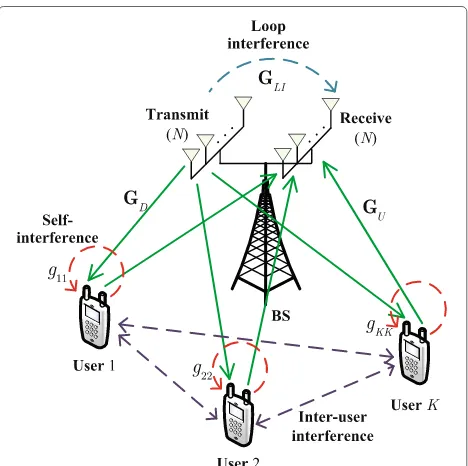
In this paper, we consider a multi-user FD massive MIMO system where the FD base station (BS) is equipped with large-scale antennas and each FD user is equipped with two antennas (one for transmitting and the other one for receiving) (Fig. 1). A general power scaling scenario is adopted at the BS or/and users to obtain a better EE per-formance. Note that the power scaling scenarios applied in [13, 16, 17] are just some special cases. It needs to be mentioned that this paper is different from [12] in sev-eral aspects: (a) a different approach is taken to derive the asymptotic expressions of uplink and downlink signal-to-interference-plus-noise ratio (SINR); (b) both the SE and EE are optimized; (c) new power scaling results on the SE and EE of multi-user FD massive MIMO system are obtained with the general power scaling scenario adopted at the BS and users. The main contributions of our work are as follows:
• A new asymptotic method is used to derive the asymptotic expressions of uplink and downlink SINR for thek th user, which turns out to be effective. • We adopt general power scaling scenario at the BS
and users, and based on the derived SINR expressions, we analyse how the number of BS antennas and the transmit power of BS and users impact the system performance. To be specific, the transmit powers of users and BS are scaled down by 1/Npand1/Nq, respectively, where0≤p,q≤1, andN represents the number of BS transmit or receive antennas. We show that asN grows larger, the harmful effect of LI can be wiped out whenq>0 and the multi-user interference (MUI), CSI
estimation error and inter-user interference (IUI) can be eliminated whenp>0.
• We consider a power allocation (PA) scenario to control the transmit power at the BS and users so as to maximize the SE and EE, which is under the constraint of the maximum of transmit power.
Notation:We use boldface uppercase letterAand bold-face lowercase letter a to represent matrix and column vector, respectively. E(·), ·, (·)∗, (·)H, X(·), and Tr(·) stand for the expectation, the Euclidean norm, the con-jugate, the conjugate transpose, the spectral radius of a matrix, and trace of a matrix, respectively. [A]ij denotes theith-row andjth-column entry of matrixA.IN repre-sents theN×Nidentity matrix.CNμ,σ2stands for the
complex-Gaussian distribution with mean ofμand vari-ance ofσ2.e
irepresents a vector whoseith entry is 1 and the other are 0.
2 System model
We consider a multi-user FD massive MIMO system, whereKusers are within a single cell. Both the users and the BS operate in FD mode. We assume that the BS is equipped with two separate large-scale antennas arrays in whichNfor transmission andNfor reception, while each user is equipped with two antennas in which one for trans-mitting signal and the other for receiving. All the users share the same time-frequency resource.
LetGD=[gD,1,· · ·,gD,K]∈CN×K represent the down-link channel matrix between the transmit antenna array of the BS and theKusers and letGU =[gU,1,· · ·,gU,K]∈ CN×K denote the uplink channel matrix betweenKusers and the receive antenna array of the BS. Ga (a ∈
{D,U}) is modelled as Ga = HaD1a/2, where Ha ∈ CN×K characterizes the small-scale fading of the chan-nel which has independent and identically distributed (i.i.d.)CN(0, 1)elements, whileDais the large-scale fad-ing diagonal matrix whose kth diagonal entry [Da]kk =
βa,k denotes the large-scale fading coefficient. Moreover,
GLI =[gLI,1,· · ·,gLI,N]∈ CN×N denotes the LI channel
matrix between the transmit and receive antennas of the BS, whose entries are i.i.d. with distributionCN(0,βLI).
GIU =[gIU,1,· · ·,gIU,K]∈ CK×K denotes the channel matrix between users whose entry [GIU]ij = gij repre-sents the IUI channel coefficient from theith user to the
jth user, which are modelled as i.i.d.CN(0,σij). Note that [GIU]kk = gkk denotes the coefficient of self-interference channel for thekth user.
2.1 Imperfect channel estimation phase
In [12] and [13], it made an assumption that the resid-ual LI can be regarded as additive noise after apply-ing some novel LI mitigation scenarios, on the basis of knowing the CSI of GLI to compute the filter matrices [15]. It may work in the conventional MIMO systems where the antennas deployed at the relay or BS are in a small quantity. Nevertheless, with the growth of the number of transmit and receive antennas at the relay or BS, the dimension of GLI increases, and in order to
obtain the CSI of GLI, the length of pilot sequence τ
should satisfyτ ≥ N which is unprocurable in the mas-sive MIMO systems owing to the limited duration of channel coherent time. Hence, in this paper, we assume that the instantaneous knowledge of GLI is unknown
and the CSI of GU and GD are obtained by MMSE estimation.
In order to realize the FD transmission, the informations ofGU andGDneed to be acquired at the BS1. Therefore, during the channel coherent time, a part of the resource has to be assigned to the pilot sequences to do the chan-nel estimation job. During the estimation phase, all the users’ antennas transmit the pilot sequences to the BS simultaneously2. Then the received pilot signals at the transmit and receive antennas at the BS are written as
YR=
τPPGRRXR+
τPPGUXT+NR, (1)
YT =
τPPGDXR+
τPPGTTXT +NT, (2)
respectively, whereτis the length of the pilots,PPdenotes the transmit power of each pilot symbol;GRR ∈ CN×K andGTT ∈ CN×K denote the channels from the users’ transmit antennas to the transmit antennas of the BS and the users’ receive antennas to the receive antennas of the BS, respectively;XR ∈ CK×τ andXT ∈ CK×τ represent the pilot sequences which are transmitted from the receive antennas and transmit antennas ofK users, respectively;
NRandNT denote the AWGN matrices whose elements are i.i.d.CN(0, 1). Note that all the pilot sequences are assumed to be orthogonal, i.e.XaXHa =IK,a∈ {R,T}, and
Based on the MMSE estimation, the estimated channel matricesGˆUandGˆDcan be expressed as
ˆ
GU=
1 √
τPP
YRXHTU =
GU+
1 √
τPP
˜
NR
U, (3)
ˆ
GD=
1 √
τPP
YTXHRD=
GD+
1 √
τPP
˜
NT
D, (4)
where U =
D−U1/(τPP)+IK −1
and D = (D−D1/
(τPP)+IK)−1andN˜R=NRXHT andN˜T =NTXHR, both of which have i.i.d.CN(0, 1)elements due to the orthogonal rows ofXTandXR.
According to the MMSE estimation, the channel matri-cesGUandGDcan be decomposed as
Gi= ˆGi+Gi,i∈ {U,D} (5)
where Gi represents the estimation error matrix. According to the property of MMSE channel estimation, we can conclude thatGˆi andGi are independent and the rows of them are mutually independent which com-ply with distributionsCN(0,Dˆi)andCN(0,Di). BothDˆi andDiare diagonal matrices whosekth diagonal entries are expressed asβˆi,k =τPPβi2,k/τPPβi,k+1
andβi,k =
βi,k/
τPPβi,k+1
, respectively [5].
2.2 Data phase
The received signal at the BS can be expressed as
yU =
PUFHGUxU+
PDFHGLIWxD+FHnU (6)
whereF=[f1,· · ·,fK]∈CN×K denotes the uplink beam-forming matrix;W =[w1,· · ·,wK]∈ CN×K denotes the downlink precoding matrix; xD = [xD,1,· · ·,xD,K]T and
xU =[xU,1,· · ·,xU,K]Trepresent the transmit signal vec-tors of the BS and users, respectively, with E{xaxHa} =
IK, (a ∈ {D,U}); nU ∼ (0,σUIN) denotes the additive white Gaussian noise (AWGN) vector at the BS; andPD andPU denote the transmit powers of the BS and users, respectively.
The received signals at users,yD, can be expressed as
yD=
PDGHDWxD+
PUGHIUxU+nD (7)
wherenD∼(0,σDIK)denotes AWGN vector at users. In order to keep the complexity low, the BS adopts lin-ear processing techniques. With the linlin-ear beamforming and precoding matrices, the BS can separate the receive and transmit signals intoKstreams, i.e.yU andyDcan be separated intoKelements. The received signals of thekth user at the BS, i.e. thekth element ofyUis given by
yU,k =
PUfHkgU,kxU,k+fHknU
+
K
i=1,i =k
PUfHkgU,ixU,i
MUI
+ PDfHkGLIWxD
LI
.
(8)
The first term of the right side of (8) is the transmit sig-nal of thekth user. The second term is AWGN at the BS. The third term is the signals transmitted by users except thekth user, which is MUI for thekth user. The last term denotes LI at the BS. The received signal of thekth user can be expressed as
yD,k =
PDgHD,kwkxD,k+nD,k
+
K
i=1,i =k
PDgHD,kwixD,i
MUI
+PUgHIU,kxU
IUI
. (9)
The first term of the right side of (9) is the downlink sig-nal for thekth user. The second term is AWGN at thekth user. The third term is the MUI which is the downlink sig-nal transmitted for other users. And the last term denotes the IUI comes from the signals transmitted by other users. Before the analysis, we introduce the following lemma which is useful in the field of massive MIMO system.
Lemma 1[[18], Lemma 1] Let A be a deterministic
n× n complex matrix with uniformly bounded spectral
radius for all n. Let p = √1
n
p1,· · ·,pn T
and q =
1
√
n
q1,· · ·qn T
denote two mutually independent n× 1
complex random vectors, whose elements are i.i.d. zero-mean random complex variables with unit variance and finite eighth moment. Then
pHAp→ 1
nTr(A)andp
HAq→0 (10)
almost surely as n→ ∞.
3 Analysis of asymptotic uplink and downlink SINR with MRC/MRT scenario
According to [19], with MMSE estimation at the BS, the uplink beamforming matrix F and downlink precoding matrixWbased on the MRC/MRT scenario are given by
F= ˆGU, (11)
W= ˆGD
TrGˆHDGˆD −1/2
3.1 Analysis of asymptotic uplink SINR
3.1.1 Asymptotic expression of uplink SINR
Substituting (5) and (11) into (8), the received signal for
kth user at the BS can be re-expressed as
yU,k error, and the LI, respectively, which can be expressed as
IUMUI,k =
According to Lemma 1 in [16] (i.e. the law of large num-ber, LLN), the first two items of the right side of (12) can be obtained by
N→∞ represents the almost sure convergence as
N → ∞and−−−−→d
N→∞ denotes the convergence in
distribu-tion whenNtends to infinity.
Then, the instantaneous power of MUI for thekth user at the BS can be given by
According to (16) and LLN, the asymptotic expres-sion of instantaneous power of MUI when the number
of antennas at the BS approaches to infinity can be expressed as
same method to obtainE it can be derived that
ˆ
and based on LLN, we have
GHDGD
N
a.s.
−−−−→
Substituting (21) and (22) into (20), then the power of LI asNapproaches to infinity is written as
EIULI,k2−−−−→a.s.
N→∞ PDβˆU,kβLI. (23)
As a result, substituting (14), (17), (18), and (23) into (10), we can get the asymptotic uplink SINR for the kth user under MRC/MRT scheme as
γMR
3.1.2 Uplink power scaling analysis
When the number of BS antennas grows larger, we can scale downPUor/andPDby the number of antennas while maintaining the desired performance. Hence, we consider the generalized scaling scenariosPU =EU/NpandPD =
ED/Nq, substituting which into (24) we can obtain the power-scaled asymptotic uplink SINR as
˜ scaling scenarios in this part.
• Case 1,p=q=0: We assume there is no power scaling at the BS and users. It is obvious that under case 1, the uplink SINR tends to infinity asN → ∞
when there is no power scaling scheme adopted. From (25), we can see that all components (including the MUI, channel estimation error (CEE), LI, and the noise at the BS) which have baneful impact on the k th user diminish whenN→ ∞, while the desired signal is maintained. The reason is that in the regime of largeN, the MUI is averaged. Similarly, due to the sufficient diversity gain and power constraint of the BS, the rest of the unexpected signals at the BS approach to zero whenN tends to infinity.
• Case 2,0<p≤1,q=0: Case 2 is the power scaling scheme only adopted at the users. When0<p<1, all the detrimental signals are averaged out as
N→ ∞, which is similar to case 1. However, when the power of users are scaled down byN, i.e.p=1, although the harmful effect of MUI and CEE are eliminated asN grows larger, the LI and the noise at the BS cannot be wiped out, which makes the uplink SINR tends to a ceiling value asN→ ∞.
• Case 3,p=0, 0<q≤1: Case 3 denotes the power scaling scheme adopted at the BS. From Eq. (25), it can be seen that the asymptotic SINR of case 3
becomes infinite whenN→ ∞, which is similar to case 1. What is more, theN1 factor before LI indicates that, with power scaling at the BS, the harmful effect of LI which is amplified by the BS can be diminished whenN approaches to infinity.
• Case 4,0<p≤1, 0<q≤1: Case 4 represents the power scaling scenario applied both at the BS and users. Whenq=1, it can be observed from (25) that the detrimental effect of MUI, CEE, and LI disappear asN→ ∞while the noise at the BS cannot be eliminated, under which situation the noise at the BS poses greater influence to the uplink SE performance whenN is large. When0<q<1, all the unexpected signals vanish whenN approaches to infinity.
3.2 Analysis of asymptotic downlink SINR
3.2.1 Asymptotic expression of downlink SINR
Substituting (5) and (11) into (9), the received signal of the
kth user can be rewritten as
yD,k =
According to LLN, the first item of the right side of (26) can be expressed as
ˆ
Similar with the derivation of (17) and (18), the instan-taneous power ofIDkMUI andIDk whenN tends to infinity for thekth downlink user are expressed as
EID,k2−−−−→a.s.
It is easy to achieve the instantaneous power of the interference introduced by IUI as
EIDIUI,k2
Then, substituting (28), (29), (30), and (31) into (26), the asymptotic downlink SINR for the kth user with MRC/MRT processing can be achieved as (32), shown below.
3.2.2 Downlink power scaling analysis
The power-scaled asymptotic downlink SINR is given by (33), shown above. Similarly, we analyse the impact of scaling power on the downlink SINR
• Case 1,p=q=0: (33) implies that the downlink SINR of case 1 tends to infinity whenN→ ∞. All the MUI, CEE, IUI, and the noise at thek th user are wiped out asN goes to infinity, and only the desired signal is maintained.
• Case 2,0<p≤1,q=0: From (33), we can see that the downlink SINR of case 2 goes to infinity whenN is large enough. Different from case 1, we can conclude that scaling down the transmit power of users can decrease the detrimental effect of IUI which is amplified by it.
• Case 3,p=0, 0<q≤1: In case 3, MUI and CEE are eliminated whenN is large enough. Nevertheless, whenq=1, due to the remained baneful effect of IUI and AWGN at thek th user, the asymptotic downlink SINR for case 3 tends to be deterministic whenN approaches infinity. If0<q<1, the SINR increases without upper bound asN grows.
• Case 4,0<p≤1, 0<q≤1: WhenN→ ∞, MUI, CEE, and IUI tend to be eliminated. Similar to uplink case 4, whenq=1, the detrimental effect of noise at k th user still remains, the AWGN at the users has more influence to the downlink SE for largeN. When 0<q<1, all the harmful signals disappear and the
downlink SINR tends to infinity whenN grows infinite.
Remark:From the above analysis, we can conclude that scaling down the BS power can decrease the adverse effect of LI and cutting down the user power can minish the MUI, CEE, and IUI. However, decreasePUandPDcan also decrease the SE, which as a result exits a tradeoff between EE and SE, and we will discuss it in the simulation section.
4 Analysis of asymptotic uplink and downlink SINR with ZFR/ZFT processing
According to [19], the beamforming and precoding matri-ces based on the ZFR/ZFT scenario are given by
F= ˆGU
4.1 Analysis of asymptotic uplink SINR
Substituting (34) into (8), the received signal forkth user at the BS can be rewritten as
√
According to LLN, the asymptotic expression of the second term of the right side of (35) can be derived as
From (36),E
ID,k2
can be represented as
EIU,k2
where the latter equality is according to LLN. Then, the
approximate expression of E
ID,k2
can be derived in
the method adopted in (15), which can be obtained as
EID,k2
Then, based on LLN, we can obtain the asymptotic expression of (40) as
EIULI,k2−−−−→a.s.
We can observe that (41) has the similar form as (19), then using the similar approach of (19), i.e. gˆD,igˆHD,i =
In the end, by substituting (37), (39), and (42) into (35), we can obtain the asymptotic uplink SINR with ZFR/ZFT processing as
Since the method of derivation and analysis for the power-scaled ZFR/ZFT scheme is similar to the MRC/MRT cases, therefore, we omit them.
4.2 Analysis of asymptotic downlink SINR
Substituting (34) into (9), the received signal ofkth user can be expressed as
yD,k =
Based on LLN, we have ˆ
Based on Lemma 1, we can achieve
Hence, according to (48) and (31), the asymptotic down-link SINR of the kth user under ZFR/ZFT scenario is achieved as
Remark: Based on the above analysis, we define the
uplink asymptotic SE CU, downlink asymptotic SE CD, and sum asymptotic SECsumas
CU=
respectively. In order to validate the accuracy of the asymptotic method in this paper, we compare our asymp-totic SE with the ergodic SE. In Section 6, Monte-Carlo simulation method is adopted to generate the ergodic SE curve in the figures of the simulation results, and we will show that the approximate results are quiet tight even whenNis small (e.g.,N=25).
5 Power control
Obviously, the primary intention of applying FD tech-niques in wireless communication systems is to enhance the SE performance. It is worth noting that since the uplink and downlink channels transmit simultaneously and LI cancellation techniques are adopted in FD systems; therefore, more energy is consumed than the HD coun-terpart. Due to the increasing attention to green com-munications, EE is another metric widely used in many systems to evaluate the performance, especially in massive MIMO systems where enhancing the EE performance is significant [5].
Observing (24), (32), (43), and (49), we can see that the SINR of each user is different due to the different fad-ing channels each user experiences, and in the previous
sections, the transmit powers ofK users, i.e.PU, are all assumed to be the same, and the powers allocated to the
Kstreams of downlink signals are fixed, which as a result may not achieve the optimal SE/EE performance. Hence, in this section, we assume the transmit power ofkth user and the power allocated to thekth downlink stream are different and propose the PA schemes to maximize the sum SE and EE subject to power constraints, which are called SE PA and EE PA for short.
5.1 Maximization of the SE
In this section, we assume that the transmit power of
kth user and the power allocated to the kth downlink stream arePU,kandPD,kwk2, respectively. Then, we can formulate the SE optimization problem as
max
In order to facilitate the analysis, we first rewrite the asymptotic uplink and downlink SINR as
γU,k =
which represent the unified uplink and downlink SINR expressions of MRC/MRT and ZFR/ZFT, respectively. For more details, with MRC/MRT scheme, we have
For ZFR/ZFT processing scheme, we have
We can see that the form of SE optimization problem in (56) is very close to a geometric programming (GP) except for the target which is not in the posynomial form [20]. Fortunately, we can use the technique in [21] to approx-imate the target so as to use convex optimization tools to solve (56). To be specific, 1 + γa,k can be approxi-Thus, (56) can be reformulated as (57), shown below.
min
In this way, the SE optimization problem in (57) becomes a standard GP which can be solved by the Algorithm 1.
Algorithm 1Solving problem (57) by GP
1. Initialization: Compute the initial value γˆU(0,)k and ˆ
γ(0)
D,kusing (52) and (53),i=1, set the value of tolerance
εand limited iteration numberL.
2. Forthenth iteration:
• Computeμa,k = ˆγa(,nk) • Solve problem (57) by GP:
min
5.2 Maximization of the EE
The EE is defined as
ηEE= Csum
wherePciris the power consumed by the circuits.
Then we can formulate the EE optimization problem as
max
whereC¯sumdenotes the required sum SE.
For the sake of illustration, define
C=
Solving the EE maximization problem (59) can be sep-arated into three steps: (a) Check whether the optimal solution of problem Q1, i.e., PQ∗1 satisfies the SE
con-straint. If it does, go to (b). If not, then the problem is infeasible. (b) Check whether the optimal solution of problem Q2 satisfies the SE constraint. If it satisfies,
then PQ∗
2 is the solution of (59). Otherwise, go to (c),
i.e. obtain PQ∗
3 of problem Q3 which is the solution of
(59). In this paper, the required sum SE C¯sum and the
power constraints are set to make the EE maximization problem feasible. Next, the detailed solutions to the sub-problems Q2 and Q3 are introduced in the following
subsections.
5.2.1 Solution to problemQ2
Observing the function of sum SE we can see thatCsum
can be rewritten as
Csum=n(P)−d(P) (63)
which is generally non-convex due to the convexity of (64) and (65). In order to make (63) convex, we use the convexity to linearly approximate d(P), i.e., based on log(1+x)≤log(1+x0)+(1+x0)−1(x−x0)forx≥0,
Therefore, the EE maximization problem at the nth iteration can be formulated as
max
Based on the fraction form, we can use the Dinkelbach-type algorithm [23], i.e. by introducing a parameterλto solve the convex optimization problem forλ≤λoptimal
max
In conclusion, the method to solving the subproblem Q2
is given in detail by Algorithm 2.
Algorithm 2Solving problem (59) by CVX [24]
1. Initialization:Set the arbitrary initial value{P(U0,)k}, {PU∗,k},{P(D0,)k},{P∗D,k}wherek=1,· · ·,K, and the value of toleranceε.
2. Forthenth iteration:
• Computed¯(n)(P),λ(n)= n(PP∗)−¯d(n)(P∗)
sum(P∗) . • Solve problem (68) by CVX to obtain theP∗and
the value of the objective functioncvx(outpn) : max
5.2.2 Solution to problemQ3
We can reformulate the Q3problem as
min
It can be observed that we can use the similar asymp-totic method of (57), then EE maximization problem can be reformulated as (70), shown below. Since the algorithm solving (70) is similar to Algorithm 1, only the objec-tive function and constraints are different; therefore, we omit the algorithm of solving problem Q3due to the page
limitation.
In this section, we examine the simulation results of the derivation and analysis conducted in the above sections. In order to validate the accuracy of the asymptotic method in this paper, we compare our asymptotic SE with the ergodic SEC˜U andC˜D generated by Monte-Carlo simu-lation method. The SE of multi-user HD massive MIMO system proposed in [5] is also simulated for comparison, where the BS and users operate in the HD mode, and the sum SE of the system is defined asCsumHD = CDHD+CHDU
and the factor 1/2 is for the HD BS. Since the FD sys-tems take only one time slot to transmit while two time
slots are needed in the HD systems, the transmit pow-ers of the BS and uspow-ers in HD systems are set to 2PDand 2PU for a fair comparison. The length of channel coher-ence time is set toT = 300 (symbols), and the length of pilot sequence is set toτ = 2K. The number of users is assumed to beK = 10 in this system, andPcir = 1W, σU =σD=σik =1.
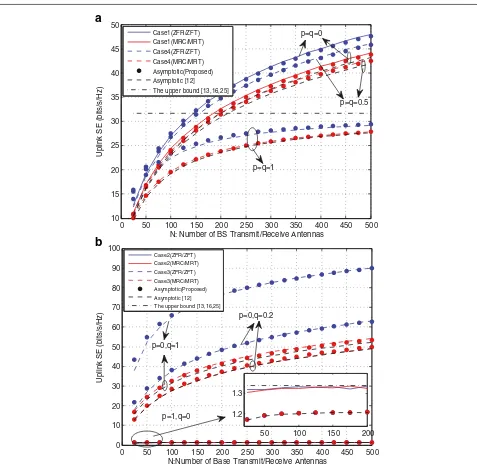
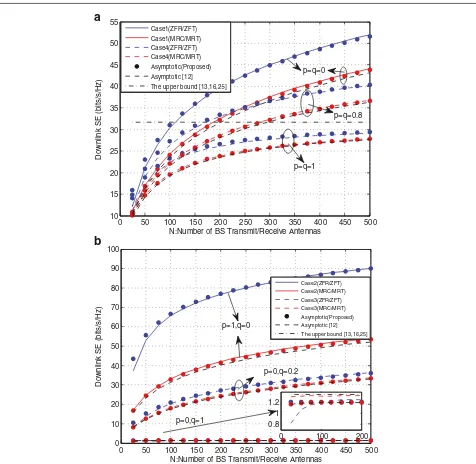
Figures 2 and 3 show the uplink and downlink SEs for cases 1∼4 versusN, where we set βLI = 0 dB, DU =
DD = IK. As analysed in the above sections, all SEs for cases 1∼4 increase whenNgrows. From Figs. 2a and 3a, we can see that, if p = q for case 4, the SE increases with the decreasing of p and q and hits the top when
p = q = 0 (i.e., case 1). The reason is that whenN is large, those unexpected signals are averaged due to large diversity gain, and the desired signal is dominant. From Figs. 2b and 3b we can see that the uplink SE for case 3 improves whenqincreases and the downlink SE for case 2 increases aspgrows. Scaling down the transmit power of BS can diminish the LI which is amplified by it and cutting down the transmit power of users can decrease the detrimental effect of IUI which is amplified by it, which can be found in (25) and (33). Moreover, we can observe that ZFR/ZFT scheme has better performance than MRC/MRT scheme, this is because ZFR/ZFT pro-cessing can wipe out MUI while MRC/MRT propro-cessing needs the condition of infiniteN.
Note that we compare the asymptotic method adopted in this paper with the one used in [12, 13, 16, 25]. From Figs. 2 and 3, we can see that our asymptotic results matches the exact results perfectly even whenNis small, which means we can predict the exact results of SE through the asymptotic analysis method adopted in this paper even whenNis small (N = 25 for example). Nev-ertheless, the upper bound of each power scaling scheme provided in [13, 16, 25] matches the exact curve only in the largeNscenario. This is due to the fact that we use two kinds of law of large number, i.e. Lemma 1 in this paper and Lemma 1 in [16], to make the asymptotic results quiet tight, while [13, 16, 25] only use Lemma 1 in [16] to get the limit results. From the simulation results, it can also be observed that our asymptotic result is closer to the exact result than the one provided in [12].
Fig. 4 shows the EE versusNfor different power scaling schemes under perfect and imperfect CSI in FD sys-tems and imperfect HD syssys-tems. Here, we only consider ZFR/ZFT processing for the sake of simplification. It is seen that the morePDandPUare scaled down, the more severelyPcirlimits the EE performance. Take HD systems
with p = q = 1 for example, the EE performance gap between p = q = 1 and p = q = 0.8 decreases as
0 50 100 150 200 250 300 350 400 450 500 10
15 20 25 30 35 40 45 50
Uplink SE (bits/s/Hz)
N: Number of BS Transmit/Receive Antennas Case1(ZFR/ZFT)
Case1(MRC/MRT) Case4(ZFR/ZFT) Case4(MRC/MRT) Asymptotic(Proposed) Asymptotic [12]
The upper bound [13,16,25]
p=q=0
p=q=1
p=q=0.5
0 50 100 150 200 250 300 350 400 450 500
0 10 20 30 40 50 60 70 80 90 100
Uplink SE (bits/s/Hz)
N:Number of Base Transmit/Receive Antennas Case2(ZFR/ZFT)
Case2(MRC/MRT)
Case3(ZFR/ZFT)
Case3(MRC/MRT)
Asymptotic(Proposed) Asymptotic [12]
The upper bound [13,16,25]
50 100 150 200
1.2 1.3 p=0,q=1
p=0,q=0.2
p=1,q=0
a
b
Fig. 2 aUplink SE for cases 1 and 4.bUplink SE for cases 2 and 3. Comparison of uplink SE for four schemes versusNwithEU=10 dB,ED=KEU,
PP=0 dB, andβLI=0 dB
when N is small. However, as N goes larger,N > 110 with p = q = 1 for example, FD EE can eventually surpass HD EE. The reason is that whenN is small, the harmful effect of LI and IUI at the BS and users can-not be neglected, while those can be reduced by scaling down the transmit powers at the BS and users as discussed previously.
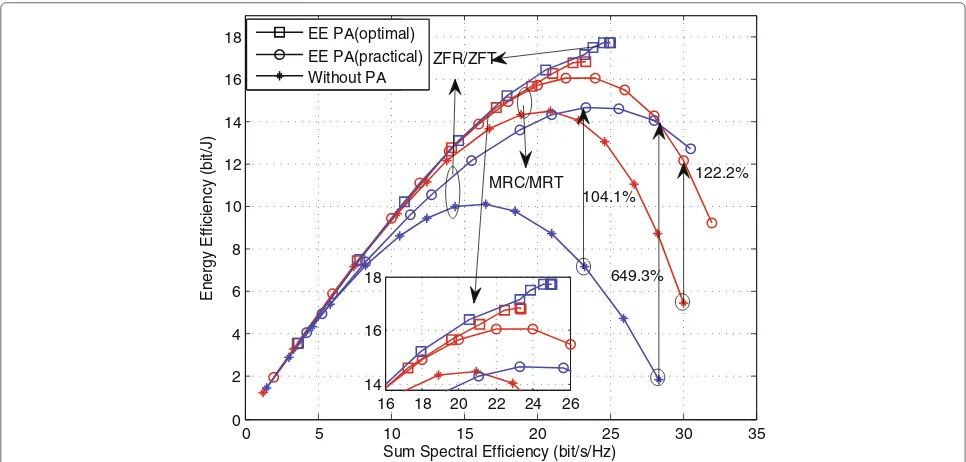
Comparing the above SE and EE performance analysis, we can see that there is a tradeoff between EE and SE. Therefore, Fig. 5 shows the comparison between the EE
with EE PA and without EE PA versus the sum SE. In order to match the practical communication environment in a cellular system, we model the large-scale fading byβa,k =
0 50 100 150 200 250 300 350 400 450 500 10
15 20 25 30 35 40 45 50 55
Downlink SE (bits/s/Hz)
N:Number of BS Transmit/Receive Antennas Case1(ZFR/ZFT)
Case1(MRC/MRT) Case4(ZFR/ZFT) Case4(MRC/MRT) Asymptotic(Proposed) Asymptotic [12]
The upper bound [13,16,2 ]
p=q=0.8
p=q=1 p=q=0
0 50 100 150 200 250 300 350 400 450 500
0 10 20 30 40 50 60 70 80 90 100
Downlink SE (bits/s/Hz)
N:Number of BS Transmit/Receive Antennas Case2(ZFR/ZFT)
Case2(MRC/MRT)
Case3(ZFR/ZFT)
Case3(MRC/MRT) Asymptotic(Proposed)
Asymptotic [12]
The upper bound [13,16,25]
0 100 200
0.8 1 1.2
p=0,q=1
p=0,q=0.2 p=1,q=0
a
b
Fig. 3 aDownlink SE for cases 1 and 4.bDownlink SE for cases 2 and 3. Comparison of downlink SE for four power scaling schemes versusNwith EU=10 dB,ED=KEU,PP=0 dB, andβLI=0 dB
large-scale fading matrices of uplink and downlink are set to
DU =diag(0.032 , 1.217, 0.018, 1.689, 2.298, 0.092, 0.946, 0.687, 0.149, 0.501),
DD=diag(0.432 , 3.026, 0.124, 0.802, 0.541, 0.825, 0.066, 0.213, 1.428, 0.295).
(71)
Besides, in order to satisfy the SE requirement for both uplink and downlink instead of the sum SE, we replace the required sum SE in (69) with the required uplink and
downlink SE which are set to be equal (the practical case in the Fig. 5). From Fig. 5, we can see that whenCsum<8,
the EEs with PA and without PA are nearly the same and increase as the sum SE grows, which is becausePcir
dom-inates the consumed power when the sum SE is small. With the increasing of the sum SE, the users and the BS become the main energy consumer; thus, there is a trade-off between the sum SE and the EE when the sum SE is high.
0 50 100 150 200 250 300 350 400 450 500 0
5 10 15 20 25 30 35 40
Energy Efficiency (bit/J)
N: Number of BS Transmit/Receive Antennas FD:Exact(imperfect CSI)
FD:Exact(perfect CSI) HD:Exact(imperfect CSI)[5] Asymptotic(Proposed)
p=q=1
p=q=0.8
p=q=0.5
p=q=0.2
Fig. 4Comparison of FD and HD EE for different power scaling schemes versusNunder perfect CSI and imperfect CSI withEU=10 dB,ED=KEU,
PP=0 dB, andβLI=10 dB
achieved by (62) can be viewed as the achievable EE, which is improved remarkably, especially for ZFR/ZFT scheme. Besides, the improvement of the practical PA case is also significant. For example, whenCsum = 23.3,
28.3 b/s/Hz under ZFR/ZFT processing and Csum =
30 b/s/Hz under MRC/MRT processing, the performance improvement obtained by the PA algorithm is about 104.1,
649.3, and 122.2%, respectively. What is more, from the performance improvement of ZFT/ZFR processing we can see that ZFT/ZFR suffers more from the large-scale fading than MRC/MRT, especially the practical large-scale fading like (71). Due to the inversion operation in the ZFT/ZFT processing (34), the large-scale fading factors which are close to zero (for example, 0.018 in (71)) have a
0 5 10 15 20 25 30 35
0 2 4 6 8 10 12 14 16 18
Energy Efficiency (bit/J)
Sum Spectral Efficiency (bit/s/Hz) EE PA(CVX)
EE PA(GP) Without PA
16 18 20 22 24 26 14
16 18 EE PA(optimal) EE PA(practical) Without PA
MRC/MRT
104.1%
649.3%
122.2% ZFR/ZFT
−25 −20 −15 −10 −5 0 5 10 15 20 25 10
15 20 25 30 35 40 45 50 55 60 65 70
Sum Spectral Efficiency (bit/s/Hz)
βLI(dB)
FD:With SE PA FD:Without PA HD:Without PA [5]
ZFR/ZFT
MRC/MRT
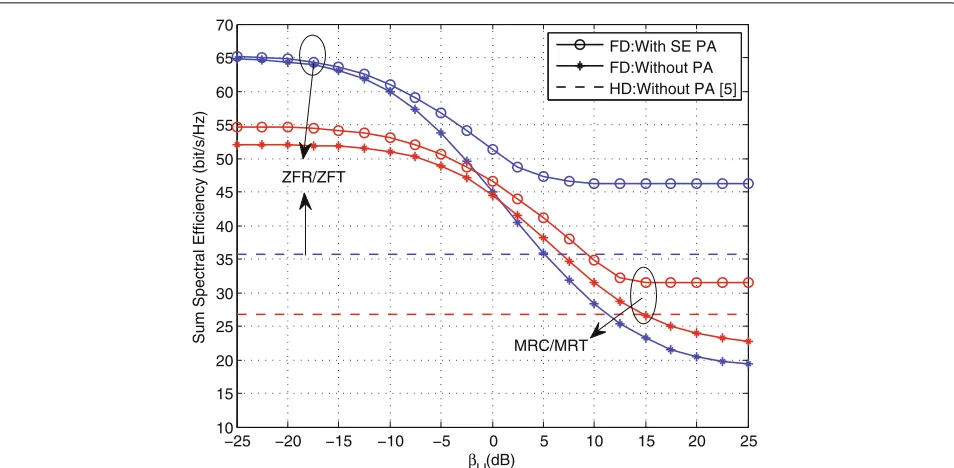
Fig. 6Comparison of sum SE with and without SE PA versusβLIwherep=q=0.5,PP=0 dB,N=200,EU=10 dB, andED=KEU
strong impact on the SE performance, in which case the PA scheme is particularly meaningful.
The main bottleneck of the FD systems is the level of LI. As a result, Fig. 6 shows the comparison between the sum SE with SE PA and without SE PA versusβLI. The large-scale fading coefficients are the same as the practical setup for Fig. 5. It is obvious that whenβLIis small, the LI has little impact on the system. However, whenβLIincreases from−10 dB, the sum SE reduces sharply. Specifically, for the without PA case, whenβLI > 5 dB under ZFR/ZFT processing andβLI > 15 dB under MRC/MRT process-ing, the HD system outperforms the FD system. However, the most encouraging result in Fig. 6 is that when βLI is large, the sum SE performance can be significantly improved after adopting the SE PA. Moreover, the curve with SE PA is beyond the corresponding dotted line for arbitrary βLI, which means adopting the SE PA scheme in FD massive MIMO systems can effectively enhance the ability to resist the LI in FD massive MIMO systems and make the FD systems outperform the HD counterpart regardless ofβLI.
7 Conclusions
In this paper, we consider a multi-user FD massive MIMO system, where the BS is equipped with large-scale antenna arrays, while each FD user is equipped with two anten-nas (one for transmission and the other one for recep-tion). The linear processing techniques of MRC/MRT and ZFR/ZFT are adopted at the BS to process the signals. Based on the signals processing, the asymptotic expres-sions of SINR are derived. With a general power scaling scenario at each downlink stream and user, it is shown that
the detrimental effect of MUI, CEE, LI, and AWGN can be wiped out asN goes large if the scenario is appropri-ately chosen. On the basis of the asymptotic expressions of SINR, the PA schemes at the BS and users are proposed to maximize the EE and the sum SE of the multi-user FD massive MIMO system. In the simulation part, we verify the accuracy of the analysis and show the ZFR/ZFT pro-cessing is more susceptible to the large-scale fading. Then, we show the effectiveness of our PA schemes. Finally, we show that the SE PA can make the multi-user FD massive MIMO system outperform the HD counterpart no matter how bigβLIis.
Endnotes
1Due to the separate antenna configuration at the BS,
therefore, the reciprocity of uplink and downlink channels does not hold.
2In order to accomplish the channel estimation, the
receive antenna of each user and the transmit antenna array of the BS are assumed to be shared antennas, i.e. the transmit and receive radio-frequency chains share the same antenna [8].
Funding
This research was supported by National Natural Science Foundation of China (No. 61671472), Jiangsu Province Natural Science Foundation (BK20160079), and National Natural Science Foundation of China (No. 61371123, No. 91438115).
Authors’ contributions
Competing interests
The authors declare that they have no competing interests.
Publisher’s Note
Springer Nature remains neutral with regard to jurisdictional claims in published maps and institutional affiliations.
Received: 18 November 2016 Accepted: 11 April 2017
References
1. CX Wang,et al, Cellular architecture and key technologies for 5G wireless communication networks. IEEE Commun. Mag.52(2), 122–130 (2014) 2. EG Larsson, O Edfors, F Tufvesson, TL Marzetta, Massive MIMO for next generation wireless systems. IEEE Commun. Mag.52(2), 186–195 (2014) 3. T Marzetta, Noncooperative cellular wireless with unlimited numbers of
base station antennas. IEEE Trans. Wirel. Commun.9(11), 3590–3600 (2010)
4. C Sun, X Gao, S Jin, M Matthaiou, Z Ding, C Xiao, Beam division multiple access transmission for massive MIMO communications. IEEE Trans. Commun.63(6), 2170–2184 (2015)
5. HQ Ngo, E Larsson, T Marzetta, Energy and spectral efficiency of very large multiuser MIMO systems. IEEE Trans. Commun.61(4), 1436–1449 (2013) 6. S Hong,et al, Applications of self-interference cancellation in 5G and
beyond. IEEE Commun. Mag.52(2), 114–121 (2014)
7. Z Zhang, X Chai, K Long, AV Vasilakos, L Hanzo, Full duplex techniques for 5G networks: self-interference cancellation, protocol design, and relay selection. IEEE Commun. Mag.53(5), 128–137 (2015)
8. D Kim, H Lee, D Hong, A survey of in-band full-duplex transmission: from the perspective of PHY and MAC layers. IEEE Commun. Surv. Tutorials.
17(4), 2017–2046 (2015)
9. A Sabharwal, P Schniter, D Guo, DW Bliss, S Rangarajan, R Wichman, In-band full-duplex wireless: challenges and opportunities. IEEE J. Sel. Areas Commun.32(9), 1637–1652 (2014)
10. M Vehkaperä, MA Girnyk, T Riihonen, R Wichman, LK Rasmussen, On achievable rate regions at large-system limit in full-duplex wireless local access. 2013 First International Black Sea Conference on Communications and Networking (BlackSeaCom), Batumi, 7–11 (2013)
11. Y Wang, Y Xu, N Li, W Xie, K Xu, X Xia, Relay selection of full-duplex decode-and-forward relaying over Nakagami-mfading channels. IET Commun.10(2), 170–179 (2016)
12. HQ Ngo, HA Suraweerat, M Matthaiou, EG Larsson, in2014 IEEE International Conference on Communications (ICC). Multipair massive MIMO full-duplex relaying with MRC/MRT processing (Sydney, 2014), pp. 4807–4813
13. Z Zhang, Z Chen, M Shen, B Xia, Spectral and energy efficiency of multipair two-way full-duplex relay systems with massive MIMO. IEEE J. Sel. Areas Commun.34(4), 848–863 (2016)
14. X Xia, Y Xu, K Xu, D Zhang, W Ma, Full-duplex massive MIMO AF relaying with semiblind gain control. IEEE Trans. Veh. Technol.65(7), 5797–5804 (2016)
15. T Riihonen, S Werner, R Wichman, Mitigation of loopback self-interference in full-duplex MIMO relays. IEEE Trans. Signal Process.59(12), 5983–5993 (2011)
16. H Cui, L Song, B Jiao, Multi-Pair two-way amplify-and-forward relaying with very large number of relay antennas. IEEE Trans. Wireless Commun.
13(5), 2636–2645 (2014)
17. S Jin, X Liang, KK Wong, X Gao, Q Zhu, Ergodic rate analysis for multipair massive MIMO two-way relay networks. IEEE Trans. Wirel. Commun.14(3), 1480–1491 (2015)
18. J Evans, DNC Tse, Large system performance of linear multiuser receivers in multipath fading channels. IEEE Trans. Inf. Theory.46(6), 2059–2078 (2000)
19. H Yang, T Marzetta, Performance of conjugate and zero-forcing beamforming in large-scale antenna systems. IEEE J. Sel. Areas Commun.
31(2), 172–179 (2013)
20. S Boyd, L Vandenberghe,Convex Optimization. (Cambridge University Press, 2004)
21. PC Weeraddana, M Codreanu, M Latva-aho, A Ephremides, Resource allocation for cross-layer utility maximization in wireless networks. IEEE Trans. Veh. Technol.60(6), 2790–2809 (2011)
22. H Ren, N Liu, C Pan, C He, Energy Efficiency optimization for MIMO distributed antenna systems. IEEE Trans. Veh. Technol.PP(99), 1–1. doi:10.1109/TVT.2016.2574899
23. JB Frenk, S Schaible,Handbook of Generalized Convexity and Eneralized Monotonicity. (SpringerVerlag, New York, 2006)
24. Inc CVX Research, CVX: Matlab Software for Disciplined Convex Programming, version 2.0 (2011). http://cvxr.com/cvx. 5 Mar 2017 25. HA Suraweera, HQ Ngo, TQ Duong, C Yuen, EG Larsson, inProc. 2013 IEEE
Int. Conf. on Commun. (ICC). Multi-pair amplify-and-forward relaying with very large antenna arrays, (2013), pp. 4635–4640
Submit your manuscript to a
journal and benefi t from:
7Convenient online submission
7Rigorous peer review
7Immediate publication on acceptance
7Open access: articles freely available online
7High visibility within the fi eld
7Retaining the copyright to your article