GENETIC CONTROL
O F
A MULTIENZYME COMPLEX: SUBUNIT STRUCTURESOF
MUTATIONALLY ALTERED FORMSJOHN H. CHALMERS, JR.* AND J. A. DEMOSS
Department of Biology, University of California, San Diego, La Jolla, California 92037
Received December 11, 1969
I N Neurospora crassa, anthranilate synthetase, N- (5’-phosphoribosyl) anthrani- late (PRA) isomerase, and indole-3-glycerol phosphate (InGP) synthetase are organized in a multienzyme complex whose structure and function are jointly controlled by the tryp-2 and tryp-2 loci (DEMOSS and WEGMAN 1965;
DEMOSS,
JACKSON and CHALMERS 1967). The wild-type complex has a molecular weight of 240,000 and is composed of six subunits of two distinct types (GAERTNER and DEMOSS 1969). It was proposed that these subunits are the gene products of the tryp-2 and tryp-2 loci and that complex formation is a n obligate step in the expres- sion of anthranilate synthetase. This suggestion is supported by the finding that a n active complex with a sedimentation constant of 10s can be produced in vitro by mixing extracts of certain zryp-2 and tryp-2 mutants (ARROYO-BEGOVICH and DEMOSS 1969).Mutations at both loci independently affect the three catalytic activities and the overall integrity of the complex (DEMOS, JACKSON and CHALMERS 1967). TO
understand the relationship between structure and activity we have isolated, by genetic methods, various mutationally altered gene products and have studied their interaction with wild-type subunits in uitro. The results demonstrate that the expression of anthranilate synthetase is dependent upon the specific associa- tion of the products of the tryp-1 and tryp-2 genes and have allowed us to infer the subunit structures of the altered complexes in tryp-1 and tryp-2 mutants.
MATERIALS A N D METHODS
The strains used in this investigation arc from the culture collection of this laboratory. With the exception of 75001 (tryp-2, FGSC #511), all mutants were induced in wild types 74A, 74- OR23-1A, or 74AF, either in this laboratory or in that of DR. ANN LACY and crossed to 74-OR8-la. The tryp-1 and tryp-2 single mutants were identified and classified according to procedures described elsewhere (DEMOSS and WEGMAN 1965; CHALMFLRS 1968).
tryp-I; tryp-2 double mutants were constructed by crossing alleles and analyzing random spore isolates. Double mutants were identified by their inability to complement in heterocaryons with either parent but with an isogenic tryp-3 tester strain. Confirmation was achieved by back- crossing the putative double mutants to wild type and analyzing the progeny by nutritional and
Stock cultures were maintained on minimal medium (VOGEL 1964), supplemented with 150 pg L-tryptophan per m l and 1.5% agar. Bulk mycelium for enzyme studies was grown in liquid medium plus 150 pg L-tryptophan or 20 pg indole per ml. Extracts were prepared according to
complementation tests (CHALMERS 1968).
* Present address: Department of Genetics, University of Washington Seattle, Washington 98105
214 J. H. CHALMERS, J R . A N D J. A. DEMOSS
DEMOSS (1965) and CHALMERS (1968). All extracts and sucrose gradients were made in 0 . 0 5 ~ potassium phosphate buffer at pH 7.0, containing ~ W M EDTA and 2 x ~ W M dithiothreitol. Con- centrated ammonium sulfate fractions were made by adding solid ammonium sulphate to 50% of saturation and suspending the precipitate in 0.1 of the original volume. For assays, this extract was either passed over G-25 Sephadex or diluted at least ten-fold with buffer to reduce the salt concentration.
Anthranilate synthetase was assayed fluorometrically by the method of DEMOSS (1965). PRA isomerase was determined by the technique described in DEMOS, JACKSON and CHALMERS, (1967). InGP synthetase was measured according to DEMOSS and WEGMAN (1965). Activity is expressed in units defined as that amount of enzyme which converts or produces 1 pmole of substrate o r product in one hour at 37°C. Protein was estimated by the assay of LOWRY et al. (1951).
CDmplex formation in uifro was performed according to the methods of ARROYO-BEGOVICH and DEMOSS (1969). tryp-2(6)A was used as a source of the tryp-1 gene product, while tryp-f (10)A served for the tryp-2 product. In uitro complementation activity is expressed as units of anthran- ilate synthetase activity formed in 20 min at 20°C. Crude extracts, sucrose gradient fractions, and diluted ammonium sulfate fractions could be assayed quantitatively by this method.
Zone centrifugation i n sucrose density gradients was done as described in DEMOS, JACKSON
and CHALMERS (1967), using crystalline catalase (Worthington) as an internal marker at 1 IS. Ten-drop fractions were collected and diluted with buffer to 2 ml. Gradient fractions were rou- tinely assayed only f o r InGP synthetase and anthranilate synthetase. In several cases, PRA isomerase was determined and found to be coincident with the InGP synthetase activity. In
cases of very low activity, undiluted fractions were assayed directly for anthranilate synthetase and in uitro complex formation.
Crosses were carried out according to the technique of KAPLAN, SUYAMA and BONNER (1964) on cornmeal agar supplemented with 500 pg of L-tryptophan per ml.
RESULTS
I n our earlier studies (GAERTNER and DEMOSS 1969; ARROYO-BEGOVICH and
DEMOSS 1969), several lines of evidence suggested that the wild-type complex is formed
in vitro
from the unassociated gene products of the tryp-1 and tryp-2 loci. The two interacting components in this reaction were an enzymatically inactive 4.5s component, present in a tryp-I mutant, and a 7.5s component possessing PRA isomerase and InGP synthetase activity accumulated by a tryp-2 mutant. These two components were essentially identical in their respective properties to two subunits generated from the isolated wild-type complex by a pCMB treat- ment. The two derived subunits were a dimer and a tetramer composed of distinct polypeptide chains and were assumed to be the products of the tryp-2 and tryp-1genes, respectively. The assembly of the complex from its subunits may be fol- lowed by anthranilate synthetase formation and since the active complex does not readily dissociate, this reaction provides a sensitive assay for the presence of either unassociated subunit when the other subunit is supplied in excess. As a first step in determining the structure of the altered mutant complexes we ex- amined various tryp-I and tryp-2 mutants for the presence of unassociated sub- unit by this assay.
The tryp-2 mutants studied were selected as representative of the mutant classes previously described at this locus (DEMOS, JACKSON and CHALMERS
STRUCTURE O F MULTIENZYME COMPLEXES
TABLE 1
Classes of t u p - 2 mutants
21 5
Strains
Estimated sedimentation constant of PRA isomerase and InGP synthetase*
7s 1
os
* Estimated by comparing peak of activity to position of catalase markers as described in
METHODS
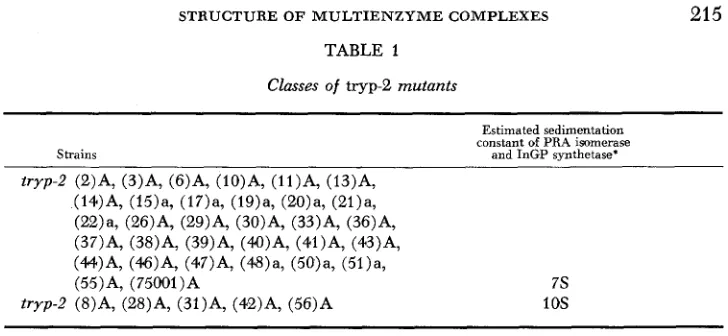
constant of the PRA isomerase and InGP synthetase remaining. Of 37 inde- pendently isolated tryp-2 mutants, 32 had the 7s form of PRA isomerase and InGP synthetase, while the remaining 5 had only the 10s enzyme (Table 1). Complementation tests were carried out in heterocaryons with many of the tryp-2 mutants including both 10s and 7s strains. In agreement with CATCHESIDE
(1964), no complementation was observed. These strains have been mapped by two-point crosses to a set of standard mutants (CHALMERS 1968). The maximum prototroph frequency measured was 0.19%. These data indicate that the tryp-2
locus is a single cistron controlling both anthranilate synthetase activity and the state of association of the complex.
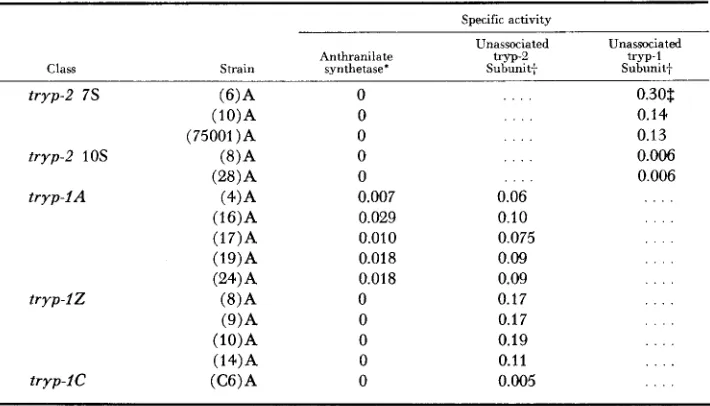
Mutants of the 7s class accumulated high levels of the normal tryp-I gene product measured by the in vitro formation of anthranilate synthetase (Table 2),
showing that in these strains the mutant product of the tryp-2 locus does not associate with o r otherwise mask the wild-type tryp-I subunit. On the other hand, the 10s mutants had essentially no pools of free tryp-1 gene product by this assay. Apparently the products of both loci are associated in a stable complex and the normal tryp-I subunit present in these tryp-2 mutants is unavailable for inter- action with the added wild-type tryp-2 subunit.
From the tryp-I mutants previously reported (DEMOS, JACKSON and CHAL- MERS 1967), we selected a number from each of the major classes for analysis. Five of those mutants lacking all three activities of the complex (tr yp -1 2) were examined by the in vitro association assay for the presence of unassociated tryp-2 gene product (Table 2). These strains all had large amounts of the normal tryp-2 subunit, indicating that tryp-12 mutants fail to make a tryp-1 product which can effectively bind the tryp-2 subunit. The tryp-1 strains retaining only anthranilate synthetase (tryp-IA) have an abnormally labile enzyme with a
216 J . H . CHALMERS, J R . A N D J. A. DEMOSS
TABLE 2
Biochemical properties of tryp-2 and tryp-1 mutants
Specific activity
Una s soc i a t e d Unassociated Anthranilate “yp-& t r y p l Class Strain synthetase. Suburut+ Subunit?
tryp-2 7 s (6)A 0 . . . . 0.303
(10)A 0 . . . . 0.14
(75001 ) A 0 . . . . 0.13
tryp-2 10s (8)A 0 . . . . 0.006
t r y p - l A (4)A 0.007 0.06 . . . .
(16)A 0.029 0.10 . . . .
(171-4 0.010 0.075 . . .
(19)A 0.018 0.09 . . . .
(24) A 0.018 0.09 . . . .
tryp-12 (8)A 0 0.17 . . . .
(9)A 0 0.17 . . . .
(10)A 0 0.19 . . . .
( 1 4 ) ~ 0 0.11 . . . .
tryp-lC ( W A 0 0.005 . . . .
(28)A 0 . . . . 0.006
* Units are pmoles anthranilate produced/mg protein/hour in crude extracts.
+Assayed as anthranilate synthetase produced in the in uitro association assay. Activity is
expressed as units of anthranilate synthetase formed per mg protein.
Measured on a fraction concentrated 3-fold by ammonium sulfate precipitation.
tryp-2 product is present in the 7s anthranilate synthetase complex and unavail- able for
in uitro
complex formation. The PRA isomerase and InGP synthetase activity in a tryp-I mutant lacking only anthranilate synthetase ( t r y p - I C ) was in a 10s form (Figure 1) ; this mutant exhibited virtually no pool of free tryp-2 subunit (Table 2 ) . The situation in this mutant is analogous to the 10s tryp-2 strains in that both classes have stable 10s complexes apparently defective only in the anthranilate synthetase reaction.From the above results we conclude that the t r y p - I 2 mutants either form no tryp-1 subunits or form products incapable of interacting with tryp-2 subunits. Therefore a tryp-I; tryp-2 double mutant containing a t r y p - I 2 allele should accumulate the altered tryp-2 subunit in a n unassociated form. In a similar way,
STRUCTURE O F MULTIENZYME COMPLEXES 21 7 W cn 0 W -c c h c c v) 0 ) U c U c c c
-
--
L c Q.-
>-t
L
I- O e W > I- Q -1 W U-
I
.oo
0.67
0.33
0 -
1.00
-0
-
-
:;:
1;
0
0
5
IO
15
20 25
FRACTION N U M B E R
FRACTION NUMBER
FIGURE 1 .-Zone centrifugation profiles of anthranilate synthetase (0-0) and InGP syn- thetase ( A - A ) . Gradients A, B, and C are analyses of t r y p - 1 ( 1 7 ) , of the t r y p - l ( l 7 ) ; t r y p - 2 ( 6 )
double mutant, and of the in uilro complex formed by mixing extracts of the double mutant with wild-type tryp-2 subunit. Enzyme activities in units/ml are: A(000) 0.010, B(000) 0.009, C(OO0)
0.008. Gradients D, E, and F are, respectively, of t r y p - l ( C 6 ) , of the t r y p - l ( C 6 ) ; t r y p - 2 ( 6 ) double mutant, and of the in vitro complex formed by mixing extracts of the double mutant with limit- ing amounts of tryp-2 subunit. Enzyme activities in units/ml are: D(A-A) 3.3, E(A-A) 3.4, F ( A - A ) 2.0. The arrow indicates the position of the 11s catalase marker. The apparent sedi- mentation constants of the peak tubes are: A, 7 s ; B, 4s; C , 7 s ; D, 10s; E, 7 s ; F, 10s and 7 s .
218 J. H. CHALMERS, J R . A N D J. A. DEMOSS TABLE 3
Biochemical properties of tryp-I ; tryp-2 double mutants
Enzyme specific activity*
Anthranilate InGP t r y p - f f
Strains synthetase synthetase Gene product Parental classes
tryp-1 (IO); tryp-2(6) 0 0 0.000 tryp-IZ, 7s t r y p 2
tryp-I ( 16) ; tryp-2 (6) 0 0 0.002 tryp-IA, 7s tryp-2
tryp-1 (C6) ; tryp 2 (6) 0 0.3$ 0.000 tryp-IC, 7s tryp-2
tryp-1 ( I O ) ; tryp-2(8) 0 0 - tryp-IZ, 10s tryp-2
tryp-1 ( I O ) ; tryp-2 (28) 0 0 - tryp-IZ, 10s tryp-2
tryp-l(17); tryp-2(6) 0 0 0.002 tryp-IA, 7s tryp-2
* pmoles product/mg protein/hour
+Assayed as anthranilate synthetase formed in vitro in the presence of added tryp-2 gene
$ Assayed in concentrated ammonium sulphate fraction
product. Expressed as units of anthranilate synthetase formed per mg protein.
0 indicates no measurable activity
- indicates no measurement made
mixture with buffer. The material in the double mutant which was active in forming anthranilate synthetase had a sedimentation constant of 3-4s. The anthranilate synthetase formed in this reaction was approximately 7S, similar to the anthranilate synthetase present in the parental strain.
The double mutant of tryp-2 (6) and tryp-l (C6 ) had virtually parental levels of InGP synthetase (Table 3 ) and this activity banded in a sucrose gradient at approximately
7s
(Figure 1E) compared to the 10s activity in the parental strain (Figure 1D). A calculated excess of the extract from the double mutant was mixed with an extract of tryp-l (1 0) (containing unassociated wild-type tryp-2gene product). T h e mixture was concentrated by ammonium sulfate precipita- tion and subjected to zone centrifugation. I n this case no anthranilate snythetase activity was formed, but the interaction produced a 10s component with InGP synthetase activity (Figure 1F).
A similar study was carried out with two 10s tryp-2 mutants. The double mutants produced from either tryp-2 (8) or tryp-2 (28) contained no InGP syn- thetase or anthranilate synthetase (Table 3 ) . When extracts from these double mutants were mixed with a source of tryp-l gene product (tryp-2(6) extract), no anthranilate synthetase was produced, but the InGP synthetase originally present as the unassociated tryp-l gene product was shifted to the 10s region of the sucrose gradient. The altered tryp-2 gene product present in the double mutants aggregated with the tryp-l gene product to form a defective 10s complex similar to the aggregate in the parental strain.
DISCUSSION
STRUCTURE O F MULTIENZYME COMPLEXES 219
DEMOSS,
JACKSON
and CHALMERS 1967). From the results presented here we have deduced the subunit structures of the various altered complexes formed by tryp-Iand tryp-2 mutants. Our inferences as to the structure of each type of complex, based on the in vitro association of subunits derived from double mutants, are summarized in Table 4. In this table, we have called the products of the tryp-1 and tryp-2 genes the I and A components, respectively, and have represented the various complexes as combinations of these monomers or their altered forms. I n this terminology the wild-type complex is A,I, ( GAERTNER and DEMOSS 1969). These results directly demonstrate that the two subunits of the complex are the products of the tryp-I and tryp-2 genes. In the case of the tryp-2 10s mutant, a mutation at the tryp-2 locus results in the formation of a n altered A subunit which still participates in complex formation but is enzymatically inactive. Like- wise, specific mutations in the tryp-I gene (tryp-IC and tr yp -IA ) alter the structure of the I subunit so that an aberrant complex is formed which has only anthranilate synthetase activity ( tr y p- I A) or a 10s complex is formed which has only PRA isomerase and InGP synthetase activities (tr yp -IC)
.
Furthermore, the participation of the products of both loci in the expression of anthranilate synthetase is also clearly shown by these studies. Mutants of the
t ryp- I2 class accumulate wild-type levels of unassociated tryp-2 subunit but contain no discernible tryp-1 subunit which can either stimulate or inhibit the
in vitro
formation of anthranilate synthetase in the presence of added wild-type tryp-1 subunit. These mutants entirely lack anthranilate synthetase. The tryp-IAmutants have, in addition to a small pool of normal tryp-2 product, a n abnormal
7s form of anthranilate synthetase. Our data reveal that this activity is due to the association of the wild type A, subunit with an altered tryp-I gene product which is a 3-46 component (probably I:) to give a n aberrant A212’ 7 s complex. The tryp-IC mutant which phenotypically mimics tryp-2 mutants, is clearly the result of a mutation which, while preserving PRA isomerase and InGP syn- thetase, yields an I/ which fails to generate the catalytic site for anthranilate synthetase although it can still associate with the A, subunit. Whether this failure is caused by the substitution of an amino acid essential to the active site or by a more general conformational change in the complex is not known. W e conclude that, although the association of the two gene products is required for anthranilate synthetase activity, association is not sufficient. Mutations at both loci exist which result in subunits capable of association but incapable of producing anthranilate synthetase in the complex formed.
Mutants of the tryp-IA, tryp-IC and 10s tryp-2 classes all produce detectable subunits. For this reason we feel that most of these strains are simple missense mutants. This conclusion is supported by the fact the majority of these strains revert to prototrophy with ultraviolet light (DEMOS, JACKSON and CHALMERS
J. H. CHALMERS, J R . A N D J. A. DEMOSS
220
N
U
4
4
E?
I
0 0
0 0
+
0U
4
cn
2
+
+
STRUCTURE O F MULTIENZYME COMPLEXES 221
and CHALMERS 1967; CHALMERS 1968). Recently a number of these strains have been identified as nonsense mutants by their response to known nonsense sup- pressors.
The authors thank Mrs. ROBERTA BRADFORD for her excellent technical assistance. This research was supported by Grant GB-4687 from the National Science Foundation J.H.C. was a Public Health Service Predoctoral Fellow.
SUMMARY
A multienzyme complex of anthranilate synthetase, PRA isomerase and InGP synthetase is controlled by the tryp-l and tryp-2 genes in Neurospora. Mutations at either locus lead to the formation of various types of altered complexes. Un- associated subunits of the complex were detected in extracts of some of the mutants by following the formation of the wild-type complex in uitro in the presence of an added excess of the other subunit. Double mutants were con- structed which accumulated only the altered product of one of the two genes. These unassociated, altered subunits were identified and characterized by virtue of their interaction in uitro with wild-type subunits to form altered complexes with partial enzyme activities. From the results it was possible to infer the sub- unit structures of a number of the altered complexes. These studies show that the subunits of the multienzyme complex are the tryp-l and tryp-2 gene products and that the specific association of these two types of subunits is necessary for the expression of anthranilate synthetase.
LITERATURE CITED
ARROYO-BEGOVICH, A. and J. A. DEMOS, 1969 In vitro formation of a n active multienzyme complex in the tryptophan pathway of Neurospora crassa. Proc. Natl. Acad. Sci. U.S. (in press).
CATCHESIDE, D. G., 1964 CHALMEFS, JR., H. J., 1968
DEMOS, J. A., 1965
DEMOS, J. A., R. W. JACKSON and J. H. CH~LMERS, JR., 1967
Interallelic complementation. Brookhaven Symp. Biol. 17: 1-14. The expression of an enzyme aggregate in Neurospora. Ph.D. thesis. University of California, La Jolla, Calif.
The conversion of shikimic acid to anthranilic acid by extracts of Neuro- spora crassa. J. Biol. Chem. 240: 1231-1235.
Genetic control of the structure and function of an enzyme aggregate in the tryptophan pathway of Neurospora crassa. Genetics 56: 413-424.
An enzyme aggregate i n the tryptophan pathway of
.Neurospora crassa. Proc. Natl. Acad. Sci. U.S. 54: 241-247.
Purification and Characterization of a multienzyme complex in the tryptophan pathway of Neurospora crassa. J. Biol. Chem. 244: 2716-2725.
Fine structure analysis of the td locus of
Neurospora crassa. Genetics 49: 145-158.
Protein measurement with the folin phenol reagent. J. Biol. Chem. 193: 265-275.
Distribution of lysine pathways among fungi: Evolutionary implications. Amer. Naturalist 98: 435--446.
DEMOS, J. A. and J. WEGiwAN, 1965
GAERTNER, F. and J. A. DEMOS, 1969
KAPLAN, S., Y. SUYAMA and D. M. BONNER, 1964
LOWRY, 0. H., N. ROSEBROUGH, S. L. FARR and R. J. RANDALL, 1964