ad-hoc anonymous identification scheme at
CT-RSA 05
?Fangguo Zhang1and Xiaofeng Chen2
1
Department of Electronics and Communication Engineering, Sun Yat-sen University, Guangzhou 510275, P.R.China
2
Department of Computer Science,
Sun Yat-sen University, Guangzhou 510275, P.R.China
Abstract. An ad-hoc anonymous identification scheme is a new multi-user cryptographic primitive that allows participants from a multi-user popula-tion to form ad hoc groups, and then prove membership anonymously in such groups. Recently, Nguyen [11] proposed an ID-based ad-hoc anony-mous identification scheme from bilinear pairings. However, in this paper, we propose an attack on Nguyen’s ID-based ad-hoc anonymous identi-fication scheme. We show that any one can impersonate a valid group member to perform the anonymous identification protocol successfully. Furthermore, we propose a solution to improve this scheme against our attack.
Keywords: Bilinear pairings, Ad-hoc anonymous identification, Attack
1
Introduction
Identification schemes allow a prover (say Alice) to securely identify herself to a verifier (say Bob). Secure identification schemes were introduced by Feige, Fiat and Shamir [9, 7, 8].
In an anonymous group identification scheme, a member A of a group G can convince B that she is a member of G without revealing any information about her identity. This is a very useful primitive which enables A to control her privacy while enjoying privileges of the groups. For example, being able to enter an office building by proving that she is an employee while ensuring that her entrance to the building will not be logged. Secure group identification systems have been be designed in [2, 10, 12, 13] using public key cryptography.
Ad-hoc anonymous identification was introduced by Dodoset al. at EURO-CRYPT 2004 [6]. An ad-hoc anonymous identification scheme is a new multi-user
?This work is supported by the National Natural Science Foundation of China (No.
cryptographic primitive that allows participants from a user population to form ad hoc groups, and then prove membership anonymously in such groups. An accumulator with one-way domain is the main tool in construction of ad-hoc anonymous identification scheme. Dodos et al. demonstrated the relationship between the accumulator with one-way domain and ad-hoc anonymous identi-fication scheme by presenting a generic construction based on any accumulator with one-way domain.
Recently, Nguyen [11] proposed a dynamic accumulator scheme from bilinear pairings and used it to construct an ID-based ad-hoc anonymous identification scheme and identity escrow scheme with membership revocation. However, in this paper, we propose an attack on Nguyen’s ID-based ad-hoc anonymous iden-tification scheme. We show that any one can impersonate a valid group member to perform the anonymous identification protocol successfully. Furthermore, we propose a proposal to repair this scheme.
The rest of this paper is organized as follows. After introducing bilinear pair-ings in next section, we review Nguyen’s ID-based ad-hoc anonymous identifica-tion scheme in brief in Secidentifica-tion 3. We propose our attack in Secidentifica-tion 4. In secidentifica-tion 5, we propose a solution to improve this scheme against our attack. Section 6 concludes the paper.
2
Bilinear Pairings
The bilinear pairings, namely the Weil pairing and the Tate pairing of algebraic curves, are important tools for researching on algebraic geometry. In the last couple of years, the bilinear pairings have been found various applications in cryptography. They can be used to realize some cryptographic primitives that were previously unknown or impractical [1]. More precisely, they are basic tools for construction of ID-based cryptographic schemes [3].
LetG1be a cyclic additive group generated byP, whose order is a primep,
andGMbe a cyclic multiplicative group with the same orderp.Lete:G1×G1→ GM be a bilinear pairing with the following properties:
1. Bilinearity:e(aP, bQ) =e(P, Q)ab for allP, Q∈G
1, a, b∈Z∗p;
2. Non-degeneracy:There existsP, Q∈G1 such thate(P, Q)6= 1, in other words, the map does not send all pairs inG1×G1 to the identity inGM;
3. Computability:There is an efficient algorithm to compute e(P, Q) for all
P, Q∈G1.
We consider the following problems in the additive group (G1; +).
– Discrete Logarithm Problem (DLP):Given two group elementsP and
Q, find an integer n ∈ Z∗
p, such that Q = nP whenever such an integer exists.
– Computational Diffie-Hellman Problem (CDHP):Fora, b∈Z∗ p,given
3
Review of Nguyen’s ID-based ad-hoc anonymous
identification scheme
We first review Nguyen’s ID-based ad-hoc anonymous identification scheme in brief using the same notation as [11].
Nguyen’s identity-based ad-hoc anonymous identification scheme is defined as a tupleIA=(Setup, KeyGen, Make-GPK, Make-GSK, IAIDP,IAIDV) of PT (polynomial-time) algorithms, which are described as follows.
– Setup, on a security parameterl, generates the public parametersparams= (l, t, t0, f, g, Q, Q
pub, u,H), here t= (p,G1,GM, e, P), e:G1×G1 →GM is a bilinear pairing andP is a generator of G1.t0 = (P, P
pub =sP, . . . , sqP), where s ∈R Z∗p and q is the upper bound on the number of identities to be aggregated. The auxiliary informations can be safely deleted, as it will never be used later.f andg are two functions defined as:
f :Zp×Zp→Zp f(u, x)→(x+s)u
g:Zp→G1 g(u)→uP
Q ∈R G1, u, sm ∈R Zp∗ and Qpub = smQ. H is a collision-free function
H:{0,1}∗→Z
p . The master key ismk=sm.
– KeyGen extracts a private key sid = Rid for an identity id as Rid = 1
H(id)+smQ. The user can verifies the private key by checking e(H(id)Q+Qpub, Rid) =e(Q, Q).
– Make-GPK, given a set of identities{idi}ki=1, computes the setX={H(idi)}ki=1 and generates the group public key for the setgpk=V =g(f(u,X)).
– Make-GSK generates the group secret keygsk for a user id and a set of identities{idi}ki=1by computing the setX
0
={H(idi)}k
i=1,hid =H(idi) and the witnessW =g(f(u,X0
)). The group secret key is gsk= (hid, sid, W).
– (IAIDP,IAIDV). This protocolIAIDhas the common input paramsand
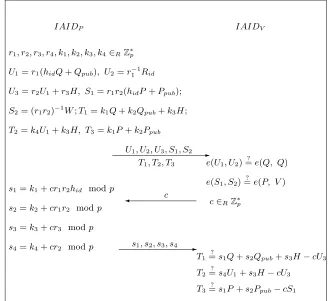
gpkand the prover (user id) also has gsk. It is a combination of the proof that an identity is accumulated and a proof of knowledge of the user pri-vate key corresponding to that identity. The protocol proves the knowl-edge of (hid, Rid, W) satisfying equations e(hidQ+Qpub, Rid) = e(Q, Q) ande(hidP +Ppub, W) =e(P, V). The details of the identification protocol are shown in Fig. 1.
About the correctness and the security analysis of the scheme, please refer to [11].
4
Cryptanalysis of Nguyen’s ID-based ad-hoc anonymous
identification scheme
IAIDP IAIDV
r1, r2, r3, r4, k1, k2, k3, k4∈RZ∗ p
U1=r1(hidQ+Qpub), U2=r1−1Rid U3=r2U1+r3H, S1=r1r2(hidP+Ppub);
S2= (r1r2)−1
W;T1=k1Q+k2Qpub+k3H;
T2=k4U1+k3H, T3=k1P+k2Ppub
U1, U2, U3, S1, S2 -T1, T2, T3
c
e(U1, U2)=? e(Q, Q) e(S1, S2)=? e(P, V)
c∈RZ∗ p s1=k1+cr1r2hid modp
s2=k2+cr1r2 mod p
s3=k3+cr3 modp
s4=k4+cr2 modp s1, s2, s3, s4
-T1=? s1Q+s2Qpub+s3H−cU3 T2=? s4U1+s3H−cU3
T3=? s1P+s2Ppub−cS1
Fig. 1.The anonymous identification protocol
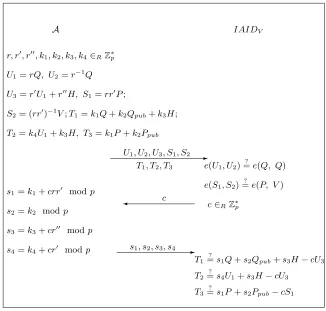
Assume thatAis an adversary, who does not have any valid group member’s secret key. However, we show that he can impersonate a valid group member to perform the anonymous identification protocol. The details of the attack are described as follows:
The(Setup, KeyGen, Make-GPK,andMake-GSK are same as above description. For the anonymous identification protocol, A can impersonate a valid group member to perform it withIAIDV successfully without any secret key as show in Fig. 2.
IAIDV will acceptA, this is because:
s1Q+s2Qpub+s3H−cU3
= (k1+crr0)Q+k2Qpub+ (k3+cr00)H−c(r0U1+r00H) =k1Q+k2Qpub+k3H+crr0Q+cr00H−c(r0rQ+r00H) =k1Q+k2Qpub+k3H
A IAIDV
r, r0, r00, k1, k2, k3, k4∈ RZ∗p
U1=rQ, U2=r−1 Q
U3=r0U1+r00H, S1=rr0P;
S2= (rr0)−1
V;T1=k1Q+k2Qpub+k3H;
T2=k4U1+k3H, T3=k1P+k2Ppub
U1, U2, U3, S1, S2 -T1, T2, T3
c
e(U1, U2)=? e(Q, Q) e(S1, S2)=? e(P, V)
c∈RZ∗ p s1=k1+crr0 modp
s2=k2 modp
s3=k3+cr00 mod p
s4=k4+cr0 modp
-s1, s2, s3, s4
T1=? s1Q+s2Qpub+s3H−cU3 T2=? s4U1+s3H−cU3
T3=? s1P+s2Ppub−cS1
Fig. 2.The impersonation attack
s4U1+s3H−cU3
= (k4+cr0)U1+ (k3+cr00)H−c(r0U1+r00H) =k4U1+k3H+cr0U1+cr00H−cr0U1−cr00H =k4U1+k3H
=T2
s1P+s2Ppub−cS1
= (k1+crr0)P+k2Ppub−crr0P =k1P+k2Ppub+crr
0
P−crr0P
From the above impersonation attack, A can convince IAIDV that he is a valid group member without any secret key. This means that the scheme is totally broken.
In [11], the author also designs an ID-based ring signature scheme and an identity escrow scheme with membership revocation using his ID-based ad-hoc anonymous identification scheme. Because of the above attack on the ID-based ad-hoc anonymous identification scheme, both the ID-ID-based ring signature scheme and the identity escrow scheme with membership revocation are insecure.
5
Improvements
At the anonymous identification phase, the prover will convince a verifier that she has a valid group certificate without revealing any information about her certifi-cate. The identification protocol proves the knowledge of (hid, Rid, W) satisfying the equationse(hidQ+Qpub, Rid) =e(Q, Q) ande(hidP+Ppub, W) =e(P, V). In Nguyen’s ID-based ad-hoc anonymous identification scheme,IAIDPprovides
U1, U2, U3, S1, S2to IAIDV which satisfye(U1, U2) =e(Q, Q) ande(S1, S2) =
e(P, V). Meanwhile, IAIDP provides IAIDV a proof that he knows the rep-resentations of U3 aboutQ, Qpub andH,U3 aboutU1 andH,S1 aboutP and
Ppub.
Our attack on Nguyen’s ID-based ad-hoc anonymous identification scheme is based on follow facts:
– The commitmentsU1, U2, U3, S1, S2, T1, T2, T3 in the anonymous identifica-tion phase are not fixed, they can be different and random at each perfor-mance.
– Even the representation ofU3 about Qpub is zero, we still can give a proof that we know the representations ofU3aboutQ, Qpub andH.
Our attack is due to these facts. To avoid such an attack, a simple solution is to employ a proof that the representation ofU3aboutQpub(and/orS1about
Ppub) is not zero, or it lies in an interval [1, q−1], i.e.,
ZKP{(α, β, γ)|U3=αQ+βQpub+γH∧β ∈[1, p−1]}.
Such protocols can be found at [4, 5].
6
Conclusion
References
1. P. S. L. M. Barreto, The Pairing-Based Crypto Lounge. Available at http://planeta.terra.com.br/informatica/paulobarreto/pblounge.html.
2. D. Boneh and M. Franklin,Anonymous authentication with subset queries, In Pro-ceedings of 6th ACM-CCS, pp.73-82. ACM press, 1999.
3. D. Boneh and M. Franklin, Identity-based encryption from the Weil pairing, Ad-vances in Cryptology-Crypto 2001, LNCS 2139, pp.213-229, Springer-Verlag, 2001. 4. F. Boudot,Efficient proofs that a committed number lies in an interval, Advances
in Cryptology-Eurocrypt 2000, LNCS 1807, pp.431-444, Springer-Verlag, 2000. 5. A. Chan, Y. Frankel, and Y. Tsiounis,Easy come – easy go divisible cash, Advances
in Cryptology-Eurocrypt 1998, LNCS 1403, pp. 561-575, Springer-Verlag, 1998. 6. Y. Dodis, A. Kiayias, A. Nicolosi, and V. Shoup,Anonymous identification in Ad
Hoc groups, Advances in Cryptology-Eurocrypt 2004, LNCS 3027, pp. 609-626, Springer-Verlag, 2004.
7. U. Feige, A. Fiat, and A. Shamir,Zero knowledge proofs of identity, In Proceedings of the Nineteenth Annual ACM Symposium on Theory of Computing (STOC’87), pp. 210-217, New York City, 1987.
8. U. Feige, A. Fiat, and A. Shamir,Zero knowledge proofs of identity, Journal of Cryptology. 1: 77-94. 1988.
9. A. Fiat and A. Shamir,How to prove yourself: practical solutions to identification and signature problems, Advances in Cryptology-Crypto 1986, LNCS 263, pp. 186-194, Springer-Verlag, 1987.
10. C. H. Lee, X. Deng, and H. Zhu,Design and security analysis of anonymous group identification protocols, PKC 2002, LNCS 2274, pp. 188-198, Springer-Verlag, 2002. 11. L. Nguyen,Accumulators from bilinear pairings and applications, CT-RSA 2005,
LNCS 3376, pp. 275-292, Springer-Verlag, 2005.
12. A. D. Santis, G. D. Crescenzo and G. Persiano, Communication-efficient anony-mous group identification, In Proceedings of 5th Conference on Computer and Communications Security, 1998, pp.73-82. ACM press, 1998.