ID Based Signcryption Scheme in Standard Model
S. Sharmila Deva Selvi1, S. Sree Vivek1, Dhinakaran Vinayagamurthy2 ?, and C. Pandu Rangan1
1
Theoretical Computer Science Lab, Department of Computer Science and Engineering, Indian Institute of Technology, Madras, India.
{sharmila,svivek,rangan}@cse.iitm.ac.in
2 Department of Computer Science and Engineering, College of Engineering, Guindy,
Anna University, Chennai, India.
Abstract. Designing an ID based signcryption scheme in the standard model is among the most interesting and important problems in cryptography. However, all the existing systems in the ID based setting, in the standard model, do not have either the unforgeability property or the indistinguishability property or both of them. In this paper, we present the first provably secure ID based signcryption scheme in the standard model with both these properties. The unforgeability property of this scheme is based on the hardness of Computational Diffie-Hellman problem and the indistinguishability property of this scheme is based on the hardness of Decisional Bilinear Diffie-Hellman problem. Our scheme is strongly unforgeable in the strong attack mode called insider security. Moreover, our scheme possess an interesting property called public verifiability of the ciphertext. Our scheme integrates cleverly, a modified version of Waters’ IBE and a suitably modified version of the ID based signature scheme in the standard model proposed by Paterson et al. However, our security reductions are more efficient. Specifically, while the security reductions for indistinguishability is similar to the bounds of Waters’ scheme, the unforgeability reductions are way better than the bounds for Paterson et al.’s scheme.
Keywords: Provable Security, ID based signcryption, Strong Unforgeability, Standard Model, Public Ciphertext Verifiability, Insider Security
1
Introduction
Signcryption aims at providing the confidentiality property of encryption and authentication and non-repudiation properties of signature simultaneously with a cost significantly less than the cost of performing encryption and signature separately. This notion was introduced by Zheng [31] in 1997. The reduction in the computational and communication cost makes the scheme more practical and hence it has numerous real time applications. Fast, compact, secure, unforgeable and non-repudiated key transport, multi-cast, electronic commerce, authenticated email are some of the areas where signcryption is highly applicable.
ID based cryptography, introduced by Shamir in 1984 [22] suggests the use of user identity, such as his e-mail address or his telephone number, as his public key rather than using some arbitrary strings which requires certificates from the Certificate Authority (CA). A Private Key Generator (PKG) is a trusted entity which when given a user’s identity computes the private key for the corresponding user and returns it to the user through a secure channel. This method eliminates the need for certificates, which were used in the conventional public key setting.
The first ID based signcryption scheme was proposed by Malone-Lee [18] in 2002. Many ID based sign-cryption schemes have been proposed since then, adopting many different strategies, thereby reducing com-putational cost and also reducing the ciphertext size ([5], [8], [17], [7], [2]).
But all these above schemes were proven secure in the random oracle model. Canetti et al. in 2004 [6] showed the limitations and challenges of using random oracle model. The instantiation of random oracles with real world hash functions may result in insecure schemes. So, there is a natural urge to design systems
that are secure in standard model. It should be noted that the systems that are secure in standard model are in general computationally more expensive than the systems that are secure in random oracle model. We need to pay such an extra cost due to more stringent demands of standard models.
The first ID based signcryption scheme without random oracles was proposed by Yu et al. in 2009 [28] based on Waters’ ID based encryption [26]. But their scheme was shown CPA insecure by Wang et al. [24], Zhang et al. [30] and Zhang [29]. Zhang [29] also showed that [28] is SUF-insecure. Meanwhile, Ren and Gu [27] proposed a Signcryption scheme based on Gentry’s IBE [9] but it was shown by Wang et al. [25] that it has neither confidentiality nor existential unforgeability. An improved semantically secure scheme was proposed by Jin, Wen and Du [11] again based on Waters IBE but Li et al. [13] showed that the scheme in [11] satisfies neither IND-CCA2 property nor EUF-CMA property. Zhang [29] also proposed a new scheme. But Li et al. in 2011 [15] showed that Zhang’s scheme [29] did not have IND-CPA property and they proposed a new scheme claiming it to have both IND-CCA2 and EUF-CMA properties. But the new scheme in [15] satisfies neither IND-CCA2 property nor EUF-CMA property as shown by Selvi et al. in [21]. Li et al. [14] proposed another scheme based on IBE proposed by Kiltz et al. [12] and IBS proposed by Paterson et al. [20]. But Selvi et al. [21] have also shown that there are inconsistencies in the proof of security of [14], thus concluding that all the ID based signcryption schemes proposed till now for the standard model are not provably secure. Selvi et al. [21] have also concluded that achieving a provably secure ID based signcryption scheme in the standard model through direct combination of an ID based signature scheme and an ID based encryption scheme can only be done by the Sign then Encrypt approach. However, for any Sign then Encrypt scheme, cost of signcryption=cost of signature+cost of encryption. But our objective of designing a signcryption scheme is to have a scheme that hascost of signcryption < cost of signature+cost of encryption [31]. Hence we need to take a fresh look at the design of the signcryption protocol and arrive at an efficient customized scheme of signcryption. In the subsequent section we present one such novel scheme and formally prove its security.
Hea An, Dodis and Rabin in 2002 [1] introduced the notion ofstrong unforgeability, to avoid the problems due to malleability. If a scheme is malleable, then an adversary can produce a valid signature on a message when another valid signature on the same message is available. So, they proved the unforgeability property of their signcryption scheme using this strong notion. A signature scheme becomes non-malleable when it satisfies this property. There are several transformations available in literature to convert an EUF-CMA secure scheme to a SUF-CMA secure scheme for signature schemes. Some of the transformations available for the standard model are the transformations proposed by Boneh et al. [4], Bellare et al. [3], Teranishi et al. [23] and Huang et al. [10].
Thepublic ciphertext verifiabilityproperty of a scheme is very useful in low power devices. This property allows any third party application, like firewalls, to verify the validity of the sender and ciphertext without any interaction with the receiver i.e without knowing the receiver’s secret key. This will allow the application to prevent the ciphertexts, modified by an adversary, from reaching the devices. Only valid ciphertexts can reach them, thus preventing unnecessary use of their resources for decrypting the invalid ciphertexts. Here, the important property is that, the third party application while verifying should not obtain any knowledge about the message that is signcrypted. This property is provided by the signcryption scheme proposed by Chow et al. [8]. But that scheme was proven secure only in the random oracle model.
1.1 Our Contribution
verifiability. Recall that all the ID based signcryption schemes in the standard model such as [28], [27], [11], [29] and [15] are completely broken and the most recent scheme proposed by Li et al. [14] has flaws in the proof. Even if the flaws in the proof of [14] are fixed, our scheme has the following advantages over [14].
– The security of our scheme is based on a harder assumption i.e DBDH, compared to the modified DBDH (mDBDH) used by [14].
– Our scheme has a tighter security reduction.
– Our scheme is more efficient than the one in [14].
1.2 Organisation
The rest of this paper is organized as follows. In section 2, preliminaries like bilinear pairing, computational assumptions, a generic ID based signcryption scheme, formal security model for ID based signcryption scheme are explained. We present our ID based signcryption scheme in section 3. We prove the confidentiality property and the strong unforgeability property of our scheme in section 4. The efficiency of our scheme is explained in section 5 and the paper is concluded in section 6.
2
Preliminaries
2.1 Bilinear Pairing
LetGandGT be multiplicative groups of prime orderpand letg be generator ofG. The bilinear map ˆeis
admissible only if it satisfies the following conditions:
– Bilinearity. For allg1, g2, g3∈G,
• ˆe(g1g2, g3) = ˆe(g1, g3)ˆe(g2, g3)
• ˆe(g1, g2g3) = ˆe(g1, g2)ˆe(g1, g3)
• ˆe(ga
1, g2b) = ˆe(g1, g2)abfor alla, b∈Zp.
– Non-Degeneracy.For allg1, g2∈G, ˆe(g1, g2)=6 IGT, whereIGT is the identity element ofGT.
– Computability. There exists an efficient algorithm to compute ˆe(g1, g2) for all g1, g2∈G.
2.2 Computational Assumptions
In this section, we review the computational assumptions relevant to the protocol we propose.
Computational Diffie-Hellman Problem (CDH) Given (g, ga, gb) ∈
G3 for unknown a, b ∈ Zp, the CDH problem inGis to computegab.
Definition.The advantage of any probabilistic polynomial time algorithmAin solving the CDH problem inGis defined as:
AdvCDHA =P r
A(g, ga, gb) =gab |a, b∈Zp
TheCDH Assumption is that, for any probabilistic polynomial time algorithm A, the advantage AdvCDH A is negligibly small.
Decisional Bilinear Diffie-Hellman Problem (DBDH) Given (g, ga, gb, gc, α)∈
G4×GT for unknown a, b, c∈Zp, the DBDH problem inGis to decide ifα= ˆe(g, g)abc.
Definition.The advantage of any probabilistic polynomial time algorithmAin solving the DBDH problem inGis defined as:
AdvADBDH=P r
A(g, ga, gb, gc,ˆe(g, g)abc) = 1]−P r
A(g, ga, gb, gc, α) = 1
|a, b, c∈Zp
2.3 ID based Signcryption
A generic ID based signcryption scheme consists of the following four algorithms.
– Setup: This algorithm is run by the Private Key Generator (PKG). When given a security parameter k, this algorithm outputs public parameters params and a master secret key MSK. PKG keeps the corresponding MSK as its secret value.
– Extract: When given an Identity ID, the PKG runs this algorithm using the params and MSK and generates the private key du for the user. The PKG then transmits the generated private key to the corresponding user through a secure channel.
– Signcrypt: This algorithm is run by the sender. It takes as input, the public parameters params, the private key dA of the sender, the identity of the receiver IDB and the message m to be sent to the receiver. The signcryptionσis produced as output which is sent to the receiver.
– Unsigncrypt: On receiving the signcryption σfrom the sender, the receiver runs this algorithm. The public parameters params, the identity of the sender IDA, the private key of the receiver dB and the signcryption σ are given as input to this algorithm. The message m is obtained as output if the signcryption is valid or⊥is given as output.
For the consistency of the signcryption algorithm, if σ = Signcrypt(params, dA, IDB, m), then m = U nsigncrypt(params, IDA, dB, σ).
2.4 Security model for ID based signcryption
Indistinguishability In 2002, Malone-Lee [18] proposed the first ID based signcryption scheme. He ex-tended the semantic security of encryption schemes to signcryption schemes as Indistinguishability of ID based signcryption under Adaptive Chosen Ciphertext Attack (IND-IBSC-CCA2). Later, Chow et al. [8] used a stronger notion of security by allowing the adversary to adaptively choose the identities to create a forgery during the challenge phase. This is similar to the one proposed in [16]. This model was termed as Indistinguishability of ID based signcryption under Adaptive Chosen Ciphertext and Identity Attack (IND-IBSC-CCIA2). This is the strongest notion available in the literature for proving the Indistinguishability property of the signcryption schemes. The formal definition is given below.
A signcryption scheme is semantically secure against chosen ciphertext and identity attack (IND-IBSC-CCIA2) if no probabilistic polynomial time adversary A has a non-negligible advantage in the following game.
1. The challengerC runs theSetupalgorithm and sends the public parameters to the adversaryA
2. Training Phase 1:The adversary Acan ask a polynomially bound number of queries to the following oracles.
– Extract Oracle:WhenA queries for the private key of an identity ID, the challenger C runs the
Extractalgorithm giving the ID andparamsas input.C forwards the private keydu of ID output by the Extract algorithm toA.
– Signcrypt Oracle:Acan ask for the signcryption on any messagemfrom any sender identityIDA to any receiver identityIDB. WhenAdoes so,C runs theExtractalgorithm for the sender identity IDAand gets the private keydAofIDA.Cthen inputshm, dA, IDBiinto theSigncryptalgorithm and forwards its outputσ toA.
– Unsigncrypt Oracle:Aqueries for the unsigncryption of the ciphertextσby producing the sender identity IDA and receiver identity IDB. The challenger C runs the Extractalgorithm to find the private keydB of the receiverIDB.C then runs theUnsigncrypt algorithm givinghσ, IDA, dBias input and forwards the outputmor ⊥toA.
During this phase Acan produce its queries adaptively i.e every query can be asked dependent on the output of the previous queries.
3. Challenge Phase At the end of Phase 1, A chooses two plaintext messages m∗0, m∗1 ∈ {0,1}lm, two
identities i.e. sender identityIDA∗ and receiver identityID∗Bon which it wishes to be challenged and sends them to the challenger C. In this case,Ashould not have queried the Extract oracle forIDB∗.Ctakes a bitbrandomly from{0,1}and runsSigncrypt(m∗b,d∗A,ID∗B), whered∗Ais the output of Extract(IDA∗).
4. Training Phase 2: The adversaryA, after receivingσ∗ can ask again for polynomially bound number of queries on the above mentioned oracles adaptively in the same way as in Phase 1 except thatAcannot ask for theExtract(ID∗
B) query and Unsigncryptquery involvinghσ∗,ID∗A,ID∗Bi. 5. Once this Phase 2 of Training is over,Aoutputsb0. Awins this game ifb0=b.
The advantage of adversary Ain the above game is defined byAdv(A) = (2×P r(b0=b)−1).
The importance of this security model is that the adversary A can ask for the private key d∗A of the sender whose identity isIDA∗ during Phase 2. This captures theinsidersecurity model, which means that
Awill not have any added advantage in the above game even when the private key of the sender is leaked. Also,A is allowed to query the Signcrypt oracle with the challenge messagesm∗0 orm∗1 with the sender identity asID∗Aand receiver identity asID∗B.
Unforgeability Malone-Lee [18] proposed the Existential Unforgeability of ID based signcryption under Chosen Message Attack (EUF-IBSC-CMA). Later, Chow et al. [8] proposed a stronger notion of security calledExistential Unforgeability of ID based signcryption under Chosen Message and Identity Attack (EUF-IBSC-CMIA), where the adversary can not only choose the message to attack adaptively but also the identities on which it is going to attack. This notion is defined by the game between challenger and adversary as given below.
An ID based signcryption scheme is said to have the property ofExistential Unforgeability under Chosen Message and Identity Attack if no probabilistic polynomial time adversaryAhas a non-negligible advantage in the following game.
1. The challengerC runs theSetupalgorithm and generates the public parameters and the Master Secret Key MSK.C then gives the public parametersparamsto the adversaryA
2. Now the adversaryAcan ask a polynomially bound number of queries to any of the following oracles.
– Extract Oracle:WhenA queries for the private key of an identity ID, the challenger C runs the
Extractalgorithm giving the ID,paramsand MSK as input.Cforwards the outputdugiven by the algorithm to the adversaryA.
– Signcrypt Oracle:A can ask for the signcryption on any messagem by the sender identityIDA for the receiver identity IDB. In this case, C runs the Extract algorithm for the sender identity IDAand gets the private keydAofIDAas output.C then inputshm,dA,IDBiinto theSigncrypt
algorithm and forwards its outputσtoA.
– Unsigncrypt Oracle:WhenAqueries for the unsigncryption of the ciphertextσby producing the sender identityIDAand receiver identityIDB. The challengerCfirst runs theExtractalgorithm for finding the private keydB of the receiver IDB. C then runs theUnsigncrypt algorithm inputting
hσ,IDA, dBiand forwards its outputmtoA.
During this phase A can produce its queries adaptively i.e every query is dependant on the previous queries.
3. At the end this training phase,Aoutputs the forgeryhσ∗, IDA∗, IDB∗ifor some messagem∗. This forgery is valid whenID∗
Ais not queried to theExtractoracle and ifhm∗, IDA∗, ID∗Biis not already queried to theSigncrypt oracle.
4. Awins the game ifσ∗is a valid forgery on the messagem∗as signcrypted by the identityID∗Aintended for the identityIDB∗.
The advantage of adversary Ain the above game is defined by
Adv(A) =P r[U nsigncrypt(σ∗, ID∗A, IDB∗) = m∗]
Strong Unforgeability Hea An et al. [1] proposed that there is no necessity for an adversary to produce forgery on a message that is not already queried. Forgery can also be produced on the message that is queried already to the Signcrypt oracle with the condition that the forged signcryption onmis not the same as the one that is output by theSigncrypt oracle for the same message m, with the same sender and the same receiver as the forgery. This notion is calledStrong Unforgeability. Our new scheme satisfies the notion of Strong Unforgeability of ID based signcryption under Chosen Message and Identity Attack (SUF-IBSC-CMIA). This is the strongest security notion available for proving the unforgeability property of signcryption schemes. We state this notion formally as follows.
An ID based signcryption scheme is said to have the property of Strong Unforgeability under Chosen Message and Identity Attack if there is no probabilistic polynomial time adversary Ahas a non-negligible advantage in the game described as follows.
1. The challenger follows the same procedure as EUF-IBSC-CMIA game during the setup and the training phases.
2. After training is over, the adversary A, produces hσ∗, IDA∗, ID∗Bi for the message m∗, where ID∗A is not queried to the Extract oracle andσ∗ is not the output of the Signcrypt query asked by A with
hm∗, ID∗A, IDB∗ias input.
3. Awins the game ifσ∗is a valid forgery on the messagem∗as signcrypted from the sender identityIDA∗ to the receiver identityID∗B.
The advantage of adversary Ain the above game is defined by
Adv(A) =P r[U nsigncrypt(σ∗, ID∗A, IDB∗) = m∗]
In the above security model, Acan produce any validhσ∗, IDA∗, IDB∗ituple for the messagem∗, where
hm∗, σ∗iis not the output of anySigncryptquery withIDA∗ andIDB∗ as the sender and receiver identities during the training phase. So,m∗ may have been queried already to the Signcrypt oracle provided thatσ∗is not the output of the oracle during that query with the sender and receiver identities being the same during that query and the forgery.
3
Our Scheme
Setup
Consider groups G,GT of prime order p whose size is determined by the security parameter k. Let g be the generator of the groupG. There exists a bilinear map defined by ˆe:G×G→GT, which is efficiently computable. Now, choose α ∈ Zp randomly and compute g1 = gα. Randomly pick g2, h2 from G and
compute gα
2, hα2. Also, choose h1, h3 randomly from G. Choose u0, v0, m0 randomly from the group G and also choose vectors U = (ui) and V = (vi) each of length nu and M = (mi) of length l, whose elements
are randomly chosen from group G. Here, nu is the length of the identity strings that are used. Let nm
be the length of the message sent. There are four one-way, collision resistant cryptographic hash functions H1:GT× {0,1}lτ → {0,1}nm, H2:{0,1}|p|+nu+lτ → {0,1}l,H3:G→Z∗p andH4:{0,1}nm+|p|+nu →Z∗p, wherel is large enough that the hash functions are collision resistant andlτ≈40. Note that a typical value of l could be 256 and a random bit string of length l cannot be guessed in polynomial time. The system parameter params is given by hG,GT,e, Hˆ 1, H2, H3, H4, g, g1, g2, h1, h2, h3, u0, v0, m0,U,V,Mi. The master
secret key of the system ishα, gα
2, hα2i. The following algorithms define our scheme.
Extract(u, params, MSK)
Let an identity of a userube represented byIDu which is a bit string of lengthnu and letIDu[i] be the ith bit ofIDu. DefineΩu ⊆ {1,2, ..., nu} to be the set of indicesisuch that IDu[i] = 1. The private key of a useruis constructed by choosing a randomru∈Z∗p and then computing
du= (dS, dU S, dR) = (gα2(u0 Y i∈Ωu
ui)ru, hα
2(v 0 Y
i∈Ωu
Signcrypt(params,dA, B, m)
The private key of the senderA with identityIDA as given by the PKG is
dA= (dSA, dU SA, dRA) = (g
α 2(u0
Y
i∈ΩA
ui)rA, hα
2(v0
Y
i∈ΩA
vi)rA, grA)
whereΩA⊆ {1,2, ..., nu}is the set of indicesisuch thatIDA[i] = 1. Now, when given a messagem∈ {0,1}nm
signcryption on the message is done by the senderAas follows.
– Chooser∈Zp randomly and computeσ1=gr∈G
– Encrypt the message asσ2=H1(ˆe(g1, h2)r, τ)⊕m∈ {0,1}nm, where τ∈R{0,1}lτ
– Compute σ3 = (v0Q
i∈ΩBvi)
r ∈
G, where ΩB is the set of vertices isuch that IDB[i] = 1. Here,B is
the receiver of the message.
– Setσ4=dRA∈G
– Computeλ=H3(σ1),β=H2(σ4, IDA, τ),ρ=H4(σ2, σ3, IDB)
– Computeσ5=dSA(m0Q
j∈βmj) r hλ
1h3
rρ
∈G, where β⊆ {1,2, ..., l}denotes the set of indicesj such
that β[j] = 1
The ciphertextσ=hσ1, σ2, σ3, σ4, σ5, τiis sent to the receiver.
The size of the ciphertext formed is 4|p|+nm+lτ. Note that this scheme achieves the property of strong unforgeability without using any of the transformations available to convert an existentially unforgeable scheme to a strongly unforgeable one.
Unsigncrypt(params, A, dB, σ )
When the receiverB receives the ciphertextσ=hσ1, σ2, σ3, σ4, σ5, τi, he proceeds as follows.
– The private keydB received from the PKG is
dB= (dSB, dU SB, dRB) = (g
α 2(u0
Y
i∈ΩB
ui)rB, hα2(v0
Y
i∈ΩB
vi)rB, grB)
– Computeλ=H3(σ1),β=H2(σ4, IDA, τ),ρ=H4(σ2, σ3, IDB)
– Then, using β,ρandλ, check the validity ofσas follows
ˆ e(σ5, g)
?
= ˆe(g1, g2) ˆe(u0
Y
i∈ΩA
ui, σ4) ˆe((m0
Y
j∈β
mj)(hλ1h3)ρ, σ1) (1)
where ΩA is the set of indices i such that IDA[i] = 1 and β ⊆ {1,2, ..., l} denotes the set of indices j such thatβ[j] = 1
– Ifσis invalid, reject σand halt.
– Ifσis valid, compute ˆe(g1, h2)r= ˆ
e(dU SB, σ1)
ˆ
e(dRB, σ3)
– Obtain the message as m=σ2⊕H1(ˆe(g1, h2)r, τ)
The above verification process stated in equation (1) can be done by any user who has access toσ, because all the components used in the verification process are either the values inparamshg, g1, g2, u0,U, m0,M, h1, h3i,
Correctness of the Unsigncrypt algorithm
When the receiverB receives the ciphertext σ=hσ1, σ2, σ3, σ4, σ5, τi, he can calculate ˆe(g1, h2)r using his
Unsigncrypt private keyhdU SB, dRBiby
ˆ
e(dU SB, σ1)
ˆ
e(dRB, σ3)
as shown below.
ˆ
e(dU SB, σ1)
ˆ
e(dRB, σ3) = ˆ e(hα2(v0
Q
i∈ΩBvi)
rB, gr)
ˆ
e(grB,(v0Q
i∈ΩBvi)
r) = ˆ
e(hα2, gr) ˆe((v0
Q
i∈ΩBvi)
rB, gr)
ˆ
e(grB,(v0Q
i∈ΩBvi)
r) = ˆe(g1, h2) r
The correctness of the verification procedure is shown below.
ˆ
e(σ5, g) = ˆe(dSA(m0Q
j∈βmj)r(hλ1h3)rρ, g) = ˆe(g2α(u0
Q
i∈ΩAui)
rA(m0Q
j∈βmj) r(hλ
1h3)rρ, g) = ˆe(gα
2, g) ˆe((u0
Q
i∈ΩAui)
rA, g) ˆe((m0Q
j∈βmj)r, g) ˆe((hλ1h3)rρ, g) = ˆe(gα, g2) ˆe(u0Q
i∈ΩAui, g
rA) ˆe(m0Q
j∈βmj, gr) ˆe((hλ1h3)ρ, gr) = ˆe(g1, g2) ˆe(u0Q
i∈ΩAui, σ4) ˆe((m
0Q
j∈βmj)(h λ 1h3)
ρ, σ1)
where the definitions of β andΩAare as explained in the Unsigncryptalgorithm.
4
Security
4.1 Indistinguishability
We first prove the Indistinguishability property,Indistinguishability of ID based signcryption under Adaptive Chosen Ciphertext and Identity Attack (IND-IBSC-CCIA2) of our scheme with the following theorem.
Theorem 1. If there exists an IND-IBSC-CCIA2 adversary for our scheme which can distinguish ciphertexts during the IND-IBSC-CCIA2 game explained above, with a non-negligible probability when it runs for a polynomial timet, asking at mostqE extract queries,qS signcrypt queries andqU S unsigncrypt queries, then there exists another algorithm, which can solve the Decisional Bilinear Diffie-Hellman (DBDH) problem with probability0 in polynomial timet0, where
0 ≥
4(qE)(nu+ 1)
t0 ≤t+O((nuqE+ (nu+l)(qS+qU S))tm+ (qE+qS+qU S)te+ (qS+qU S)tp)
where nu is the length of the identity string, tm, te, tp are the time required for each multiplication, each exponentiation and each bilinear pairing respectively andlis a value large enough such that the hash functions outputting{0,1}l in the scheme are collision resistant.
Proof
Let us assume that a (, t, qE, qS, qU S)-adversaryAfor our scheme exists. We will construct another algorithm
B from this adversary A, who can solve the Decisional Bilinear Diffie- Hellman (DBDH) problem with a non-negligible probability0 in polynomial timet0.
The algorithm B receives a DBDH tuplehg, ga, gb, gc, Ti ∈G4×GT, where g is a generator of a prime order groupGof order p. Bsimulates a challenger for the adversaryA to decide whetherT is ˆe(g, g)abc or
Setup
The simulator B sets lu = 2(qE), where qE is the number of Extract queries. Here, the values qS andqU S are not bounded because the Signcrypt and the Unsigncrypt queries do not abort when an Extract query of the sender or receiver identity, used in any Signcrypt or Unsigncrypt query, aborts. This will be evident from the explanation for the Signcrypt and the Unsigncrypt oracles.Bthen chooses an integerkurandomly such that 0≤ku≤nu. For the given values of qE,qS,qU S and nu, we assume thatlu(nu+ 1)< p. Then,
B choosesx0 ∈Zlu randomly and also chooses a vectorX= (xi) of length nu where the elements of Xare
chosen randomly from Zlu. B chooses an integery
0 randomly from
Zp and a vectorY= (yi) of lengthnu,
where the elements ofYare also chosen randomly fromZp.
Here we define a pair of functions for a user with identityIDuas follows:
F(u) =x0+P
i∈Ωuxi−luku J(u) =y
0+P
i∈Ωuyi
The simulator now sets the public parameters as follows:
g1=ga g2=gd h1=g (λ∗)−1
1 h3=g−11 gθ h2=gb
where dand θare chosen randomly fromZp andλ∗=H3(gc). The values ga, gb, gc are from the DBDH tuple given to the challengerC.
v0 =hx0−luku
2 gy
0
vi=hxi
2 gyi v0
Q
i∈Ωvi =h F(u) 2 gJ(u)
Finally,Bchooses two integerse0andf0randomly fromZpand two vectorsE= (ei) andF= (fi) of lengths
nu andnmrespectively, where the elements of EandFare chosen randomly fromZp.
For any identity IDu,
u0=ge0 ui=gei u0Q
i∈Ωuui=g
e0gP
i∈Ωuei=ge0+Pi∈Ωuei
where Ωu⊆ {1,2, .., nu} is the set of indicesiwhereIDu[i] = 1.
For anyβ got for a messagemas explained in the scheme,
m0=gf0 mi=gfi m0Q
i∈βmi=g f0
gPi∈βfi =gf0+Pi∈βfi
There are four one-way, collision resistant, cryptographic hash functionsH1:GT × {0,1}lτ → {0,1}nm, H2:{0,1}|p|+nu+lτ → {0,1}l,H3:G→Z∗pandH4:{0,1}nm+|p|+nu →Z∗p, wherelis large enough that the hash functions are collision resistant andlτ≈40. Note that a typical value ofl could be 256 and a random bit string of lengthl cannot be guessed in polynomial time.
Training Phase 1
The simulator during this phase answers to the queries from the adversaryAas follows.
Extract Queries
The simulatorBdoes not know the master secret keyha
2. So, when the adversary Aasks for the private key of an identity IDu, B responds as follows. B calculates F(u) for the identity IDu. If F(u) = 0 mod p, it aborts. Otherwise,Brandomly chooses ru∈Zp and calculates the private key as
du= (dS, dU S, dR) = gd1 u0 Y i∈Ωu
ui
!ru
g−(e
0+P
i∈Ωuei)/F(u)
1 , g
−J(u)/F(u)
1 v
0 Y
i∈Ωu
vi
!ru
, g1−1/F(u)gru
!
The correctness of this equation is shown as follows:
dS =g1d u0
Q
i∈Ωuui
ru
g−(e
0+P
i∈Ωuei)/F(u)
1 =gadg(e0+P
i∈Ωuei)rug−a(e0+Pi∈Ωuei)/F(u)
=g2a u0Q
i∈Ωuui
ru−a/F(u)
dU S=g
−J(u)/F(u)
1 v0
Q
i∈Ωuvi
ru
=ha 2h
−a 2 g
−J(u)/F(u)
1 (h
F(u)
2 gJ(u))ru =ha2h
−aF(u)/F(u)
2 g−aJ(u)/F(u)(h F(u)
2 g
J(u))ru
=ha 2
hF2(u)gJ(u)−a/F(u)(hF(u)
2 gJ(u))ru =ha2 v0Q
i∈Ωuvi
ru−a/F(u)
Here, we can writeru=ru−a/F(u). Thus the private key generated by the simulator can be written as
du= (dS, dU S, dR) = (ga2(u0
Y
i∈Ωu
ui)ru, ha2(v0
Y
i∈Ωu
vi)ru, gru)
which is a valid and mathematically consistent private key for the identityIDu queried byA.
Signcrypt Queries
When A queries the Signcrypt oracle for signcryption of a message m by the user with identity IDA as sender and the user with identityIDB as the intended receiver,Bsimulates a valid ciphertext as follows.
σ1=gr, wherer∈Zpis randomly chosen by B
σ2=H1(ˆe(g1, h2)r, τ)⊕m, whereτ∈
R{0,1}lτ
σ3= v0Q
i∈ΩBvi
r
σ4=grA, whererA is the randomness stored forIDA in the listlr. Otherwise chooserA∈Zp randomly and store it inlr. Note thatlr is the list that storeshIDu, ruituples.
β =H2(σ4, IDA, τ),ρ=H4(σ2, σ3, IDB) andλ=H3(σ1)
σ5=gd 1 u0
Q
i∈ΩAui
rA
m0Q
j∈βmj
r
hλ 1h3
rρ
=ga 2 u0
Q
i∈ΩAui
rA
m0Q
j∈βmj
r
hλ 1h3
rρ
whereβ⊆ {1,2, ..., l}denotes the set of indicesjsuch thatβ[j] = 1. The equation above forσ5is correct becauseg1d= (ga)d= (gd)a=ga2.
The ciphertextσ=hσ1, σ2, σ3, σ4, σ5, τiis sent to the adversaryA. Here, the Signcrypt queries never abort and they do not need an Extract query for the sender identityIDA within them.
Unsigncrypt Queries
When A queries hσ, IDA, IDBi i.e the unsigncryption of the ciphertext σ which was signcrypted by the senderIDA for the intended receiverIDB, to the Unsigncrypt oracle simulated byB, it proceeds as follows.
private key forIDB as output from the Extract oracle as
dB= (dSB, dU SB, dRB) = (ga2(u0 Y i∈ΩB
ui)rB, ha
2(v 0 Y
i∈ΩB
vi)rB, grB)
The simulator uses the private keysdU SB, dRB got from the extract oracle to unsigncrypt the ciphertextσ using the Unsigncrypt algorithm as given in the Scheme.
If the extract query aborts i.e if F(B) = 0 mod p, the simulator proceeds as follows. The simulator calculates∆ as given below.
∆= σ5
gd 1σ
(e0+P
i∈ΩAei)
4 σ
(f0+P
i∈βfi)
1 σ
θρ 1
= σ5
dSA(u0Q
i∈ΩAui)
rA(m0Q
j∈βmj)rσ θρ 1
=(h λ 1h3)rρ
σ1θρ = (g
(λ/λ∗)−1
1 )
rρ
Then, we calculate∆∗=∆(((λ/λ∗)−1)ρ)−1
=gr
1, whereλ=H3(σ1). Now, we can obtain the message as follows.
m=σ2⊕H1(ˆe(∆∗, h2), τ) =σ2⊕H1(ˆe(g1r, h2), τ) =σ2⊕H1(ˆe(g1, h2)r, τ)
This message can be returned if the verification in Eq.(1) is satisfied. Thus, the Unsigncrypt queries never abort even if the Extract queries for the corresponding receiver identities abort.
Challenge Phase
The adversary Acan adaptively ask polynomially bound number of these Extract, Signcrypt and Unsign-crypt queries to B. When A decides that training is enough, it produces two messages m∗0 and m∗1 along with the sender identityIDA∗ and receiver identityIDB∗ adaptively and sends them to the challenger. The challenger randomly choosesγ∈ {0,1} and then simulates the challenge ciphertext as follows.
σ∗1 =gc
σ∗2 =H1(T, τ∗)⊕mγ∗, wheregc andT are taken byBfrom the DBDH tuple given andτ∗∈
R{0,1}lτ.
σ∗ 3 = v0
Q
i∈ΩBvi
c
= (gc)J(B∗), where F(B∗) = 0mod p σ∗4 =grA, whererA∈
Zp is randomly chosen
β∗=H2(σ∗4, IDA∗, τ∗),ρ∗=H4(σ∗2, σ3∗, IDB∗) andλ∗=H3(σ1∗)
σ∗5 =g2a u0
Q
i∈ΩAui
rA
m0Q
j∈β∗mj
c
hλ1∗h3
cρ∗
=g1d u0
Q
i∈ΩAui
rA
(gc)f0+Pj∈β∗fi(gc)θρ∗
where β∗⊆ {1,2, ..., l} denotes the set of indicesj such thatβ∗[j] = 1.
Note that, the simulator will be able to successfully simulate the challenge ciphertext without aborting, as explained above, only ifF(B∗) = 0mod p. The simulator aborts ifF(B∗)6= 0mod pas it will not be able to simulate the componentσ3 whenF(B∗)6= 0mod p. The ciphertext σ∗=hσ∗1, σ2∗, σ3∗, σ∗4, σ5∗, τ∗iis sent to the adversaryA.
Here, if the simulatorBwas given a valid DBDH tuple i.e. ifT = ˆe(g, g)abc, then the challenge ciphertext σ∗=hσ1∗, σ2∗, σ∗3, σ4∗, σ∗5, τ∗i, which is sent to the adversaryA, is a valid signcryption on the messagem∗γ by the sender with identityID∗Afor the receiver with identityIDB∗.
Training Phase II
In this phase, the simulator answers to the queries from the adversaryA in the same way as it did in the Training Phase I. Here,Acannot ask for the Unsigncrypt query of the challenge ciphertextσ∗ with sender identity asID∗Aand receiver identity asID∗B and the Extract query for the receiver identityID∗B.
The strength of our scheme is that the adversary can again query the Signcrypt Oracle for the signcryption of either of the challenge ciphertextsm∗0orm∗1with the sender identity asID∗Aand receiver identity asID∗B, during this phase.Acan also query the Extract oracle for the sender identityID∗A, which makes our scheme insider secure.
Guess Phase
When the adversaryAdecides the training is enough, Aoutputs its guessγ0 ofγ.
If the guessγ0=γ, then the simulator outputs thatT in the given DBDH tuple is valid i.eT = ˆe(g, g)abc. OtherwiseBoutputs thathg, ga, gb, gc, Tiis not valid DBDH tuple.
Thus, Bsimulates a challenger for the adversaryAand solves the DBDH problem with a probability 0 from the forgery produced byA. This concludes the description of the simulation.
Analysis
In this section, we analyse the probability0 with which the simulator will be able to solve the hard problem DBDH, given that the adversary is able to produce a valid forgery with a non-negligible probability . The simulation done is completed without aborting if in all the Extract queries, F(u) 6= 0 mod lu(since lu(nu+ 1)< p, F(u) 6= 0mod lu =⇒ F(u)6= 0 mod p), for the identity IDu during the Training phase and ifF(u∗) = 0 mod pduring the Challenge phase. Thus, lu set as 2(qE), sets a bound on the number of Extract queries to be asked byA, whereas no bound is needed for the number of Signcrypt and Unsigncrypt queries because the signcryption and the unsigncryption oracles are always simulated without aborting. Let us assume the eventsAi,A∗ as follows.
Ai :F(u)6= 0mod lu ; A∗:F(u∗) = 0mod p
Thus, from the analysis done above probability for the simulation not aborting is
P r[¬Abort] =P r[ qE
^
i=1
Ai∧A∗]
Sincelu(nu+ 1)< p,F(u) = 0mod pimpliesF(u) = 0mod lu. For the eventA∗to occur,x0+P
i∈Ωxi= 0mod lu, henceF(u∗) = 0mod lu. And also, there should be a unique value ofku, where 0≤ku≤nu, such thatF(u∗) = 0mod p. Here,kuis randomly chosen. So, the probability for the eventA∗to occur is
P r[A∗] =P r[F(u∗) = 0mod p∧F(u∗) = 0mod lu]
=P r[F(u∗) = 0mod lu]P r[F(u∗) = 0mod p|F(u∗) = 0mod lu]
= 1 lu
1 nu+ 1
Since, the adversary cannot produce forgery on a message for which an Extract query is asked, the events Ai and A∗ are independent. Also, the events Ai and Aj i.e F(ui) = 0mod p and F(uj) = 0mod p are independent. So,
P r[ qE
^
i=1 Ai] =
qE
Y
Thus, the probability for not aborting becomes,
P r[ qE
^
i=1
Ai∧A∗] =P r[ qE
^
i=1
Ai]P r[A∗]
≥
1− 1
lu
qE 1
lu 1 nu+ 1
≥
1−qE
lu
1
lu 1 nu+ 1
P r[ qE
^
i=1
Ai∧A∗]≥
1
4(qE)(nu+ 1)(∵lu= 2qE)
Thus, the probability for the challenger to produce a valid forgery 0 is defined as
0 ≥
4(qE)(nu+ 1)
The tightness of the security reduction in the proof of CCIA2 security of our scheme is of the order of the tightness of security reduction of Waters’ scheme [26].
4.2 Unforgeability
We now prove the unforgeability property, Strong Unforgeability under Chosen Message and Identity At-tack(SUF-CMIA) of our scheme with the following theorem.
Theorem 2. If there exists an SUF-CMIA adversary for our scheme who can create valid ciphertexts during the SUF-CMIA game explained above, with a non-negligible probabilitywhen it runs for a polynomial time t, asking at most qE extract queries, qS signcrypt queries and qU S unsigncrypt queries, then there exists another algorithm, who can solve the Computational Diffie-Hellman (CDH) problem with probability 0 in polynomial timet0, where
0≥
4κqE(nu+ 1)(nm+ 1)
t0 ≤t+O((nuqE+ (nu+l)(qS+qU S))tm+ (qE+qS+qU S)te+ (qS+qU S)tp)
wherenuis the length of the identity string andnm is the length of the message,κis the security parameter, tm, te, tp are the time required for each multiplication, each exponentiation and each bilinear pairing respec-tively andl is a value large enough such that the hash functions outputting{0,1}l in the scheme are collision resistant.
Proof
Let us assume that a (, t, qE, qS, qU S)-adversaryAfor our scheme exists. We will construct another algorithm
B from this adversary A, who can solve the Computational Diffie- Hellman (CDH) problem with a non-negligible probability0 in polynomial timet0.
The algorithmBreceives a CDH tuplehg, ga, gbi, wheregis a generator of prime order groupGof order
p. B simulates a challenger for the adversary A to calculate gab from the tuple given. This simulation is described as follows:
Setup
z0 ∈Zlm randomly and also chooses two vectorsX= (xi) of length nu and Z= (zi) of lengthl where the
elements ofX are chosen randomly fromZlu and the elements of Zare chosen randomly fromZlm, withl
large enough so that the hash functions are collision resistant.Balso chooses two integersy0andw0randomly from Zp and two vectors Y= (yi) of length nu and W= (wi) of length l, where the elements ofY andW
are chosen randomly fromZp.
Here we define two pairs of functions for a user with identityIDuand for a valueβ ∈ {0,1}l as follows:
F(u) =x0+P
i∈Ωuxi−luku J(u) =y
0+P
i∈Ωuyi
K(β) =z0+P
j∈βzj−lmkm L(β) =w0+Pj∈βwi
The simulator now sets the public parameters as follows:
g1=ga g2=gb h1=gθ h3=gθ
0
h2=gd
whered,θandθ0 are chosen randomly fromZp. Here,ga andgbare taken byBfrom the CDH tuple.
u0=gx0−lukugy0 ui=gxi
2 gyi u0
Q
i∈Ωuui=g
F(u) 2 gJ(u) m0=gz0−lmkmgw0 m
i =g2zigwi m0
Q
i∈βmi=g K(β) 2 gL(β)
Finally,Bchooses an integere0 randomly fromZp and a vectorE= (ei) of lengthnu, where the elements of Eare chosen randomly fromZp.
v0 =ge0 vi=gei v0Q
i∈Ωuvi=g
e0gP
i∈Ωuei =ge0+Pi∈Ωuei
There are four one-way, collision resistant, cryptographic hash functions defined asH1:GT× {0,1}lτ →
{0,1}nm,H
2:{0,1}|p|+nu+lτ → {0,1}l, H3:G→Z∗p andH4:{0,1}nm+|p|+nu →Z∗p, where lτ ≈40.
Training Phase
The simulator during this phase answers to the queries from the adversaryAas follows.
Extract Queries
The simulatorBdoes not know the master secret keyg2a. So, when the adversaryAasks for the private key of an identity IDu, B responds as follows.B calculates F(u) for the identityIDu. IfF(u) = 0 mod p, the simulator aborts. Otherwise,B randomly choosesru∈Zpand calculates the private key as
du= (dS, dU S, dR) = g
−J(u)/F(u)
1 u0
Y
i∈Ωu
ui
!ru
, gd1 v0 Y i∈Ωu
vi
!ru
g−(e
0+P
i∈Ωuei)/F(u)
1 , g
−1/F(u)
1 g
ru
!
whereΩu⊆ {1,2, ..., nu} is the set of indicesisuch thatIDu[i] = 1.
Signcrypt Queries
WhenAqueries the Signcrypt oracle for signcryption of messagem by the identityIDA and with IDB as the intended receiver,Bsimulates a valid ciphertext as follows.
B asks for the Extract query of the sender identity IDA. IfF(A)6= 0 mod lu, B follows the Signcrypt algorithm using the private keydA for identityIDAgot from the Extract algorithm to signcrypt the given messagem as done by identityIDAand withIDB as the intended receiver.
1. Chooser∈Zp randomly and calculate the following parameters.
2. σ4 =grA, where rA is taken from the list lr corresponding to IDA. If there is no entry for IDA in lr,
then choose rA∈RZp and storehIDA, rAiinlr.
3. β =H2(σ4, IDA, τ), whereτ ∈R{0,1}lτ
4. IfK(β) = 0mod p, repeat the simulation process from Step 3 by choosing a different τ∈R{0,1}lτ, else continue.
5. σ1=grg −1/K(β)
1 =grandλ=H3(σ1)
6. σ2=H1(ˆe(g1, h2)reˆ(g1, g1)−d/K(β), τ)⊕m=H1(ˆe(g1, h2)reˆ(g1, gd)−a/K(β), τ)⊕m=H1(ˆe(g1, h2)r, τ)⊕
m
7. σ3= v0Q
i∈ΩBvi
r
g−(e
0+P
i∈ΩBei)/K(β)
1 =
g(e0+Pi∈ΩBei)r g−(e
0+P
i∈ΩBei)/K(β)
1 = v0
Q
i∈ΩBvi
r
8. ρ=H4(σ2, σ3, IDB) 9. σ5= u0Q
i∈ΩAui
rA
m0Q
j∈βmj
r
g1−L(β)/K(β) hλ 1h3
rρ
g−(θλ+θ
0)ρ/K(β)
1 = u0Q
i∈ΩAui
rA
ga 2
m0Q
j∈βmj
r−a/K(β)
hλ 1h3
(r−a/K(β))ρ
=ga 2 u0
Q
i∈ΩAui
rA
m0Q
j∈βmj
r
hλ 1h3
rρ
whereβ⊆ {1,2, ..., l}denotes the set of indicesjsuch thatβ[j] = 1. The above steps in the calculation ofσ5 take place similar to the simulation ofdS in the Extract algorithm.
10. The ciphertextσ=hσ1, σ2, σ3, σ4, σ5, τiis sent to the adversaryA.
Here, sinceβis chosen in such a way thatK(β)6= 0mod p, this simulation of the signcrypted ciphertext σnever aborts. Thus, Signcrypt queries never abort.
Unsigncrypt Queries
When A queries hσ, IDA, IDBi i.e the unsigncryption of the ciphertext σ which was signcrypted by the senderIDAfor the intended receiverIDB, to the challenger simulated byB, it proceeds as follows.
Bcan directly calculate ˆe(g1, h2)ras ˆe(g1, h2)r= ˆe(g1, g)dr= ˆe(g1, gr)d = ˆe(g1, σ1)d
The calculation of ˆe(g1, h2)r can also be done as per the Unsigncrypt algorithm first by simulating
hdU SB, dRBifor the receiver identityIDB as
hdU SB, dRBi=hgd1(v0
Q
i∈ΩBvi)
rB =ha
2(v0
Q
i∈ΩBvi)
rB, grBi
where rB is randomly chosen fromZp and then ˆe(g1, h2)r= ˆ
e(dU SB, σ1)
ˆ
e(dRB, σ3) Then, in both these cases,mis calculated asm=σ2⊕H1(ˆe(g1, h2)r, τ)
Verification is done as mentioned in the Unsigncrypt algorithm andmis returned if this verification test is passed, else⊥is returned. Note that, the Unsigncrypt queries never get aborted for a valid ciphertext.
Forgery Phase
signcrypted ciphertext for the message m∗ by the identityIDA∗ for the identity ID∗B who is the intended receiver. Here, note that as per the security model for SUF-CMIA, the hσ∗, m∗, ID∗A, IDB∗i given by the adversaryAis valid only when hσ∗, m∗iis not the output of any Signcrypt Query with ID∗
A as the sender identity and withIDB∗ as the intended receiver. But, there is no constraint on the adversary that the forgery should be on a messagem∗that was not a part of any Signcrypt Query with the sender and receiver identities as ID∗A and ID∗B respectively. Acan also adaptively choose the sender identity IDA∗ and receiver identity IDB∗, irrespective of the Signcrypt queries during the Training phase. Asendshσ∗, m∗, ID∗A, IDB∗itoB.
When the simulator receives the tuplehσ∗, m∗, IDA∗, ID∗Bi, it calculates the solution to the given instance of the CDH problem as follows.
σ5∗ σ∗J(A∗)
4 σ∗
L(β∗)
1 σ
(θλ∗+θ0)ρ
1
= g a 2(g
F(A∗)
2 gJ(A
∗)
)rA(gK(β
∗)
2 gL(β
∗)
)r(hλ 1h3)rρ) (grA)J(A∗)(gr)L(β∗)(gr)(θλ∗+θ0)ρ =g
a 2 =g
ab
whereλ∗=H3(σ1∗),ρ=H4(σ∗2, σ3∗, IDB∗) andβ∗=H2(σ4∗, IDA∗, τ∗)
This can happen only when whereF(A∗) = 0mod pandK(β∗) = 0mod p. The simulator aborts other-wise.
Thus, the simulator solves the given instance of the CDH problem with probability 0, from the forgery produced by the adversaryA, by simulating a challenger for A.
Analysis
Here, we analyse the probability0 with which the simulator will be able to solve the instance of the CDH problem given to the challenger, given that the adversary is able to produce a valid forgery with a non-negligible probability. The simulation done is completed without aborting if for all the Extract queries of identityIDu,F(u)6= 0mod lu and ifF(u∗) = 0mod pandK(β∗) = 0mod pduring the Forgery phase. Let us assume the eventsAi,A∗ andB∗ as follows.
Ai:F(u)6= 0 mod lu ; A∗:F(u∗) = 0 mod p; B∗ :K(β∗) = 0mod p
Thus, from the analysis done above, the probability for the simulation not aborting is
P r[¬Abort] =P r[ qE
^
i=1
Ai∧A∗∧B∗]
The estimation ofP r[¬Abort] is similar to the one done after the IND-CCIA2 game. The probability for the challenger to produce a valid forgery0 is defined as
0≥
4κqE(nu+ 1)(nm+ 1) (2)
Thus, the probability for the challenger to solve the instance of CDH problem in the unforgeability game isΘ(2κ) times more for our scheme than [20]. This makes the security reduction of our scheme tighter than [20].
5
Efficiency
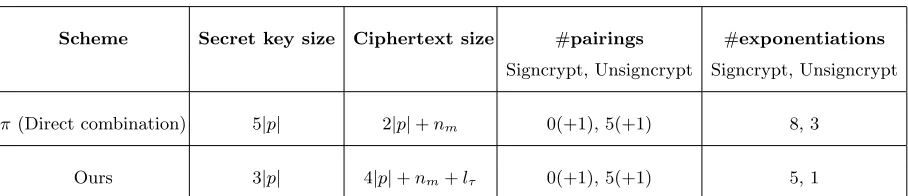
that the calculation of (hλ1h3)ρ involves only one exponentiation according to the well known “square and multiply” technique explained in [19]. When the number of computations performed by our scheme and the scheme in Li et al. [14] are compared (excluding the precomputed values), our scheme performs one exponentiation less than [14] with same number of bilinear pairings.
Since none of the ID based signcryption schemes without random oracles are provably secure in the literature, we will compare the efficiency of our scheme with the ID based signcryption schemeπthat was conceptually formatted in [21] obtained by the ‘Sign then Encrypt’ approach. Note thatπis the most efficient signcryption scheme that can be got by the direct combination of IBE and IBS schemes, since [20] and [12] are the most efficient IBS and IBE schemes with SUF-CMA and IND-CCA2 properties respectively in the standard model.
Table 1.Computational Complexity ofπand Ours
Scheme Secret key size Ciphertext size #pairings #exponentiations Signcrypt, Unsigncrypt Signcrypt, Unsigncrypt
π(Direct combination) 5|p| 2|p|+nm 0(+1), 5(+1) 8, 3
Ours 3|p| 4|p|+nm+lτ 0(+1), 5(+1) 5, 1
The numbers shown in the brackets indicate the values that can be precomputed before the algorithm begins (and they remain same for all runs of the protocol)
6
Conclusion
We have presented the first secure ID based signcryption scheme and proven its security in the standard model. This scheme satisfies the strongest notions of security available for the signcryption schemes. Moreover, it has additional interesting properties such as public ciphertext verifiability which is very useful in the context of firewalls and spam filters. The security reduction is also tighter compared to many other schemes in the standard model. There is a trade-off in this scheme between the size of public parameters and the tightness to the underlying hard assumption. In our scheme we have included some extra parameters namely a unsigncryption key to increase the probability to a much larger value so that the security of our scheme is more tight to the underlying hard problem much more than the existing signcryption schemes. An interesting and potential future direction will be designing a more efficient protocol with reduced public parameters, key size and reduced ciphertext size.
Acknowledgements: We sincerely thank Prof. Qiong Huang for shepherding and for pointing us a subtle inconsistency in the proof. We also thank the anonymous reviewers of the ProvSec 2012 program committee for their insightful reviews.
References
1. Jee Hea An, Yevgeniy Dodis, and Tal Rabin. On the security of joint signature and encryption. InEUROCRYPT, pages 83–107, 2002.
2. Paulo S. L. M. Barreto, Benoˆıt Libert, Noel McCullagh, and Jean-Jacques Quisquater. Efficient and provably-secure identity-based signatures and signcryption from bilinear maps. InASIACRYPT, pages 515–532, 2005. 3. Mihir Bellare and Sarah Shoup. Two-tier signatures, strongly unforgeable signatures, and fiat-shamir without
4. Dan Boneh, Emily Shen, and Brent Waters. Strongly unforgeable signatures based on computational diffie-hellman. InPublic Key Cryptography, pages 229–240, 2006.
5. Xavier Boyen. Multipurpose identity-based signcryption (a swiss army knife for identity-based cryptography). InCRYPTO, pages 383–399, 2003.
6. Ran Canetti, Oded Goldreich, and Shai Halevi. The random oracle methodology, revisited. J. ACM, 51(4):557– 594, 2004.
7. Liqun Chen and John Malone-Lee. Improved identity-based signcryption. InPublic Key Cryptography, pages 362–379, 2005.
8. Sherman S. M. Chow, Siu-Ming Yiu, Lucas Chi Kwong Hui, and K. P. Chow. Efficient forward and provably secure id-based signcryption scheme with public verifiability and public ciphertext authenticity. InICISC, pages 352–369, 2003.
9. Craig Gentry. Practical identity-based encryption without random oracles. InEUROCRYPT, pages 445–464, 2006.
10. Qiong Huang, Duncan Wong, Jin Li, and Yi-Ming Zhao. Generic transformation from weakly to strongly unforge-able signatures. Journal of Computer Science and Technology, 23:240–252, 2008. 10.1007/s11390-008-9126-y. 11. Zhengping Jin, Qiaoyan Wen, and Hongzhen Du. An improved semantically-secure identity-based signcryption
scheme in the standard model. Computers&Electrical Engineering, 36(3):545–552, 2010.
12. Eike Kiltz and Yevgeniy Vahlis. Cca2 secure ibe: Standard model efficiency through authenticated symmetric encryption. InCT-RSA, pages 221–238, 2008.
13. Fagen Li, Yongjian Liao, and Zhiguang Qin. Analysis of an identity-based signcryption scheme in the standard model. IEICE Transactions, 94-A(1):268–269, 2011.
14. Fagen Li, Fahad Bin Muhaya, Mingwu Zhang, and Tsuyoshi Takagi. Efficient identity-based signcryption in the standard model. InProvSec, pages 120–137, 2011.
15. Fagen Li and Tsuyoshi Takagi. Secure identity-based signcryption in the standard model. Mathematical and Computer Modelling, 2011. http://www.sciencedirect.com/science/article/pii/S0895717711003840.
16. Benoit Libert and Jean-Jacques Quisquater. New identity based signcryption schemes from pairings. In IEEE Information Theory Workshop 2003, pages 155–158, 1 2003. extended version.
17. Benoˆıt Libert and Jean-Jacques Quisquater. Efficient signcryption with key privacy from gap diffie-hellman groups. InPublic Key Cryptography, pages 187–200, 2004.
18. John Malone-Lee. Identity-based signcryption. Cryptology ePrint Archive, Report 2002/098, 2002. http://eprint.iacr.org/.
19. Wenbo Mao. Modern Cryptography: Theory and Practice. Prentice Hall Professional Technical Reference, 2003. 20. Kenneth G. Paterson and Jacob C. N. Schuldt. Efficient identity-based signatures secure in the standard model.
InACISP, pages 207–222, 2006.
21. S. Sharmila Deva Selvi, S. Sree Vivek, Dhinakaran Vinayagamurthy, and C. Pandu Rangan. On the security of id based signcryption schemes. Cryptology ePrint Archive, Report 2011/664, 2011. http://eprint.iacr.org/. 22. Adi Shamir. Identity-based cryptosystems and signature schemes. InCRYPTO, pages 47–53, 1984.
23. Isamu Teranishi, Takuro Oyama, and Wakaha Ogata. General conversion for obtaining strongly existentially unforgeable signatures. InINDOCRYPT, pages 191–205, 2006.
24. Xing Wang and Hai feng Qian. Attacks against two identity-based signcryption schemes. InSecond International Conference on Networks Security Wireless Communications and Trusted Computing (NSWCTC), volume 1, pages 24 –27, april 2010.
25. Xu An Wang, Weidong Zhong, and Haining Luo. Cryptanalysis of efficient identity based signature/signcryption schemes in the standard model. In Intelligence Information Processing and Trusted Computing (IPTC), 2010 International Symposium on, pages 622 –625, oct. 2010.
26. Brent Waters. Efficient identity-based encryption without random oracles. In EUROCRYPT, pages 114–127, 2005.
27. Ren Yanli and Gu Dawu. Efficient identity based signature/signcryption scheme in the standard model. InThe First International Symposium on Data, Privacy, and E-Commerce, 2007. ISDPE 2007., pages 133 –137, 2007. 28. Yong Yu, Bo Yang, Ying Sun, and Shenglin Zhu. Identity based signcryption scheme without random oracles.
Computer Standards&Interfaces, 31(1):56–62, 2009.
29. Bo Zhang. Cryptanalysis of an identity based signcryption scheme without random oracles. Journal of Compu-tational Information Systems, 6(6):1923–1931, 2010.
30. Mingwu Zhang, Pengcheng Li, Bo Yang, Hao Wang, and Tsuyoshi Takagi. Towards confidentiality of id-based signcryption schemes under without random oracle model. In Hsinchun Chen, Michael Chau, Shu-hsing Li, Shalini Urs, Srinath Srinivasa, and G. Wang, editors,Intelligence and Security Informatics, volume 6122 ofLecture Notes in Computer Science, pages 98–104. Springer Berlin / Heidelberg.