A generalized method for iterative error mining in parsing results
Dani¨el de Kok University of Groningen
Jianqiang Ma University of Groningen
Gertjan van Noord University of Groningen
Abstract
Error mining is a useful technique for identifying forms that cause incomplete parses of sentences. We extend the iter-ative method of Sagot and de la Clerg-erie (2006) to treat n-grams of an arbi-trary length. An inherent problem of in-corporating longer n-grams is data sparse-ness. Our new method takes sparseness into account, producing n-grams that are as long as necessary to identify problem-atic forms, but not longer.
Not every cause for parsing errors can be captured effectively by looking at word n-grams. We report on an algorithm for building more general patterns for min-ing, consisting of words and part of speech tags.
It is not easy to evaluate the various er-ror mining techniques. We propose a new evaluation metric which will enable us to compare different error miners.
1 Introduction
In the past decade wide-coverage grammars and parsers have been developed for various lan-guages, such as the Alpino parser and grammar (Bouma et al., 2001) for Dutch and the English Resource Grammar (Copestake and Flickinger, 2000). Such grammars account for a large num-ber of grammatical and lexical phenomena, and achieve high accuracies. Still, they are usually tailored to general domain texts and fail to reach the same accuracy for domain-specific texts, due to missing lexicon entries, fixed expressions, and grammatical constructs. When parsing new texts there are usually two types of parsing errors:
• The parser returns an incorrect parse. While the parser may have constructed the correct
parse, the disambiguation model chose an in-correct parse.
• The parser can not find an analysis that spans the full sentence. If that sentence is allowed in the language, the grammar or lexicon is in-complete.
While the first type of errors can be alleviated by improving the disambiguation model, the sec-ond type of problems requires extension of the grammar or lexicon. Finding incomplete descrip-tions by hand can become a tedious task once a grammar has wide coverage. Error mining tech-niques aim to find problematic words or n-grams automatically, allowing the grammar developer to focus on frequent and highly suspicious forms first.
2 Previous work
In the past, two major error mining techniques have been developed by Van Noord (2004) and Sagot and de la Clergerie (2006). In this paper we propose a generalized error miner that combines the strengths of these methods. Both methods fol-low the same basic principle: first, a large (unan-notated) corpus is parsed. After parsing, the sen-tences can be split up in a list of parsable and a list of unparsable sentences. Words or n-grams that occur in the list of unparsable sentences, but that do not occur in the list of parsable sentences have a high suspicion of being the cause of the parsing error.
2.1 Suspicion as a ratio
Van Noord (2004) defines the suspicion of a word as a ratio:
S(w) = C(w|error)
C(w) (1)
where C(w) is the number of occurrences of word w in all sentences, and C(w|error) is the
number of occurrences of w in unparsable setences. Of course, it is often useful to look at n-grams as well. For instance, Van Noord (2004) gives an example where the word via had a low suspicion after parsing a corpus with the Dutch Alpino parser, while the Dutch expressionvia via
(via a complex route) was unparsable.
To account for such phenomena, the notion of suspicion is extended to n-grams:
S(wi..wj) =
C(wi..wj|error)
C(wi..wj)
(2)
Where a longer sequence wh...wi...wj...wk is only considered if its suspicion is higher than each of its substrings:
S(wh...wi...wj...wk)> S(wi...wj) (3)
While this method works well for forms that are unambiguously suspicious, it also gives forms that just happened to occur often in unparsable sen-tences by ’bad luck’ a high suspicion. If the occur-rences in unparsable sentences were accompanied by unambiguously suspicious forms, there is even more reason to believe that the form is not prob-lematic. However, in such cases this error mining method will still assign a high suspicion to such forms.
2.2 Iterative error mining
The error mining method described by Sagot and de la Clergerie (2006) alleviates the problem of ‘accidentally suspicious’ forms. It does so by taking the following characteristics of suspicious forms into account:
• If a form occurs within parsable sentences, it becomes less likely that the form is the cause of a parsing error.
• The suspicion of a form should depend on the suspicions of other forms in the unparsable sentences in which it occurs.
• A form observed in a shorter sentence is ini-tially more suspicious than a form observed in a longer sentence.
To be able to handle the suspicion of a form within its context, this method introduces the no-tion ofobservation suspicion, which is the cion of a form within a given sentence. The suspi-cion of a form, outside the context of a sentence,
is then defined to be the average of all observation suspicions:
HereOfis the set of all observations of the form
f,oi,j is thejthform of theithsentence, andSi,j is the observation suspicion ofoi,j. The observa-tion suspicions themselves are dependent on the form suspicions, making the method an iterative process. The suspicion of an observation is the suspicion of its form, normalized by suspicions of other forms occurring within the same sentence:
Si,j(n+1) =error(si)
Hereerror(si)is the sentence error rate, which is normally set to0 for parsable sentences and1 for unparsable sentences. SF(oi,j)is the suspicion
of the form of observationoi,j.
To accommodate the iterative process, we will have to redefine the form suspicion to be depen-dent on the observation suspicions of the previous cycle:
Since there is a recursive dependence between the suspicions and the observation suspicions, starting and stopping conditions need to be defined for this cyclic process. The observation suspicions are initialized by uniformly distributing suspicion over observed forms within a sentence:
Si,j(0)= error(si) |Si|
(7)
The mining is stopped when the process reaches a fixed point where suspicions have stabilized.
This method solves the ‘suspicion by accident’ problem of ratio-based error mining. However, the authors of the paper have only used this method to mine on unigrams and bigrams. They note that they have tried mining with longer n-grams, but encountered data sparseness problems. Their pa-per does not describe criteria to determine when to use unigrams and when to use bigrams to represent forms within a sentence.
3 N-gram expansion
3.1 Inclusion of n-grams
bigrams, our prior experience with the miner de-scribed by Van Noord (2004) has shown that in-cluding longer n-grams in the mining process can capture many additional phenomena. To give one example: the words de (the), eerste (first), and
beste (best) had very low suspicions during er-ror mining, while the trigrameerste de beste had a very high suspicion. This trigram occurred in the expressionde eerste de beste(the first you can find). While the individual words within this ex-pression were described by the lexicon, this multi-word expression was not.
3.2 Suspicion sharing
It may seem to be attractive to include all n-grams within a sentence in the mining process. However, this is problematic due tosuspicion sharing. For instance, consider the trigramw1, w2, w3in which
w2 is the cause of a parsing error. In this case,
the bigrams w1, w2 andw2, w3 will become
sus-picious, as well as the trigramw1, w2, w3. Since
there will be multiple very suspicious forms within the same sentence the unigramw2will have no
op-portunity to manifest itself.
A more practical consideration is that the num-ber of forms within a sentence grows at such a rate (n+ (n−1)...+ 1) that error mining becomes unfeasible for large corpora, both in time and in space.
3.3 Expansion method
To avoid suspicion sharing we have devised a method for adding and expanding n-grams when it is deemed useful. This method iterates through a sentence of unigrams, and expands unigrams to longer n-grams when there is evidence that it is useful. This expansion step is a preprocessor to the iterative miner, that uses the same iterative al-gorithm as described by Sagot and De la Clergerie. Within this preprocessor, suspicion is defined in the same manner as in Van Noord (2004), as a ra-tio of occurrences in unparsable sentences and the total number of occurrences.
The motivation behind this method is that there can be two expansion scenarios. When we have the bigramw1, w2, either one of the unigrams can
be problematic or the bigram w1, w2. In the
for-mer case, the bigramw1, w2 will also inherit the
high suspicion of the problematic unigram. In the latter case, the bigram will have a higher suspicion than both of its unigrams. Consequently, we want to expand the unigramw1to the bigramw1, w2if
the bigram is more suspicious than both of its un-igrams. Ifw1, w2 is equally suspicious as one of
its unigrams, it is not useful to expand to a bigram since we want to isolate the cause of the parsing error as much as possible.
The same methodology is followed when we expand to longer n-grams. Expansion ofw1, w2
to the trigram w1, w2, w3 will only be permitted
ifw1, w2, w3is more suspicious than its bigrams.
Since the suspicion of w3 aggregates to w2, w3,
we account for both w3 andw2, w3 in this
com-parison.
The general algorithm is that the expansion to an n-grami..jis allowed whenS(i..j)> S(i..j− 1)andS(i..j)> S(i+ 1..j). This gives us a sen-tence that is represented by the n-grams n0..nx,
n1..ny, ... n|si|−1..n|si|−1.
3.4 Data sparseness
While initial experiments with the expansion al-gorithm provided promising results, the expansion algorithm was too eager. This eagerness is caused by data sparseness. Since longer n-grams occur less frequently, the suspicion of an n-gram oc-curring in unparsable sentences goes up with the length of the n-gram until it reaches its maximum value. The expansion conditions do not take this effect into account.
To counter this problem, we have introduced an expansion factor. This factor depends on the fre-quency of an n-gram within unparsable sentences and asymptotically approaches one for higher fre-quencies. As a result more burden of proof is inflicted upon the expansion: the longer n-gram either needs to be relatively frequent, or it needs to be much more suspicious than its (n-1)-grams. The expansion conditions are changed to
S(i..j)> S(i..j−1)·extF actorandS(i..j) > S(i+ 1..j)·extF actor, where
extF actor= 1 +e−α|Of,unparsable| (8)
In our experimentsα= 1.0proved to be a good setting.
3.5 Pattern expansion
ex-pansion. We use the same methodology as word-based n-gram expansion, however we also con-sider expansion with a part of speech tag.
Since we are interested in building patterns that are as general as possible, we expand the pat-tern with a part of speech tag if that creates a more suspicious pattern. Expansion with a word is attempted if expansion with a part of speech tag is unsuccessful. E.g., if we attempt to ex-pand the word bigramw1w2, we first try the tag
expansion w1w2t3. This expansion is allowed
when S(w1, w2, t3) > S(w1, w2) · extF actor
and S(w1, w2, t3) > S(w2, t3)·extF actor. If
the expansion is not allowed, then expansion to
S(w1, w2, w3)is attempted. As a result, mixed patterns emerge that are as general as possible.
4 Implementation
4.1 Compact representation of data
To be able to mine large corpora some precau-tions need to be made. During the n-gram expan-sion stage, we need quick access to the frequen-cies of arbitrary length n-grams. Additionally, all unparsable sentences have to be kept in memory, since we have to traverse them for n-gram expan-sion. Ordinary methods for storing n-gram fre-quencies (such as hash tables) and data will not suffice for large corpora.
As Van Noord (2004) we used perfect hashing to restrict memory use, since hash codes are gen-erally shorter than the average token length. Addi-tionally, comparisons of numbers are much faster than comparisons of strings, which speeds up the n-gram expansion step considerably.
During the n-gram expansion step the miner calculates ratio-based suspicions of n-grams us-ing frequencies of an n-gram in parsable and un-parsable sentences. The n-gram can potentially have the length of a whole sentence, so it is not practical to store n-gram ratios in a hash table. Instead, we compute a suffix array (Manber and Myers, 1990) for the parsable and unparsable sen-tences1. A suffix array is an array that contains in-dices pointing to sequences in the data array, that are ordered by suffix.
We use suffix arrays differently than Van No-ord (2004), because our expansion algorithm re-quires the parsable and unparsable frequencies of the (n-1)-grams, and the second (n-1)-gram is not
1We use the suffix sorting algorithm by Peter M. McIlroy
and M. Douglas McIlroy.
(necessarily) adjacent to the n-gram in the suffix array. As such, we require random access to fre-quencies of n-grams occurring in the corpus. We can compute the frequency of any n-gram by look-ing up its upper and lower bounds in the suffix ar-ray2, where the difference is the frequency.
4.2 Determining ratios for pattern expansion
While suffix arrays provide a compact and rela-tively fast data structure for looking up n-gram fre-quencies, they are not usable for pattern expansion (see section 3.5). Since we need to look up fre-quencies of every possible combination of repre-sentations that are used, we would have to create
dl suffix arrays to be (theoretically) able to look up pattern frequencies with the same time com-plexity, wheredis the number of dimensions and
lis the corpus length.
For this reason, we use a different method for calculating pattern frequencies. First, we build a hash table for each type of information that can be used in patterns. A hash table contains an in-stance of such information as a key (e.g. a specific word or part of speech tag) and a set of corpus in-dices where the instance occurred in the corpus as the value associated with that key. Now we can look up the frequency of a sequencei..j by calcu-lating the set intersection of the indices ofj and the indices found for the sequencei..j −1, after incrementing the indices ofi..j−1by one.
The complexity of calculating frequencies fol-lowing this method is linear, since the set of in-dices for a given instance can be retrieved with a O(1) time complexity, while both increment-ing the set indices and set intersection can be per-formed in O(n) time. However, n can be very large: for instance, the start of sentence marker forms a substantial part of the corpus and is looked up once for every sentence. In our implementation we limit the time spent on such patterns by caching very frequent bigrams in a hash table.
4.3 Removing low-suspicion forms
Since normally only one form within a sentence will be responsible for a parsing error, many forms will have almost no suspicion at all. However, dur-ing the mindur-ing process, their suspicions will be recalculated during every cycle. Mining can be sped up considerably by removing forms that have a negligible suspicion.
2Since the suffix array is sorted, finding the upper and
If we do not drop forms, mining of the Dutch Wikipedia corpus described in section 5.3, with n-gram expansion and the extension factor en-abled, resulted in 4.8 million forms with 13.4 mil-lion form observations in unparsable sentences. If we mine the same material and drop forms with a suspicion below 0.001 there were 3.5 million forms and 4.0 million form observations within unparsable sentences left at the end of the iterative mining process.
5 Evaluation
5.1 Methodology
In previous articles, error mining methods have primarily been evaluated manually. Both Van No-ord (2004) and Sagot and de la Clergerie (2006) make a qualitative analysis of highly suspicious forms. But once one starts experimenting with var-ious extensions, such as n-gram expansion and ex-pansion factor functions, it is difficult to qualify changes through small-scale qualitative analysis.
To be able to evaluate changes to the error miner, we have supplemented qualitative analysis with a automatic quantitative evaluation method. Since error miners are used by grammar engineers to correct a grammar or lexicon by hand, the eval-uation metric should model this use case:
• We are interested in seeing problematic forms that account for errors in a large number of unparsable sentences first.
• We are only interested in forms that actually caused the parsing errors. Analysis of forms that do not, or do not accurately pinpoint ori-gin of the parsing errors costs a lot of time.
These requirements map respectively to the call and precision metrics from information re-trieval:
P = |{Sunparsable} ∩ {Sretrieved}| |{Sretrieved}|
(9)
R= |{Sunparsable} ∩ {Sretrieved}| |{Sunparsable}|
(10)
Consequently, we can also calculate the f-score (van Rijsbergen, 1979):
F−score= (1 +β
2)·(P·R)
(β2·P +R) (11)
The f-score is often used withβ = 1.0to give as much weight to precision as recall. In evalu-ating error mining, this can permit cheevalu-ating. For
instance, consider an error mining that recalls the start of sentence marker as the first problematic form. Such a strategy would instantly give a re-call of 1.0, and if the coverage of a parser for a corpus is relatively low, a relatively good initial f-score will be obtained. Since error mining is often used in situations where coverage is still low, we give more bias to precision by usingβ= 0.5.
We hope to provide more evidence in the future that this evaluation method indeed correlates with human evaluation. But in our experience it has the required characteristics for the evaluation of error mining. For instance, it is resistant to recalling of different or overlapping n-grams from the same sentences, or recalling n-grams that occur often in both parsable and unparsable sentences.
5.2 Scoring methods
After error mining, we can extract a list of forms and suspicions, and order the forms by their sus-picion. But normally we are not only interested in forms that are the most suspicious, but forms that are suspicious and frequent. Sagot and de la Clerg-erie (2006) have proposed three scoring methods that can be used to rank forms:
• Concentrating on suspicions:Mf =Sf
• Concentrating on most frequent potential er-rors:Mf =Sf|Of|
• Balancing between these possibilities:Mf =
Sf·ln|Of|
For our experiments, we have replaced the ob-servation frequencies of the form (|Of|) by the frequency of observations within unparsable sen-tences (|{Of,unparsable}|). This avoids assigning a high score to very frequent unsuspicious forms.
5.3 Material
In our experiments we have used two corpora that were parsed with the wide-coverage Alpino parser and grammar for Dutch:
• Quantitative evaluation was performed on the Dutch Wikipedia of August 20083. This cor-pus consists of 7 million sentences (109 mil-lion words). For 8.4% of the sentences no full analysis could be found.
• A qualitative evaluation of the extensions was performed on the Flemish Mediargus news-paper corpus (up to May 31, 2007)4. This corpus consists of 67 million sentences (1.1 billion words). For 9.2% of the sentences no full analysis could be found.
Flemish is a variation of Dutch written and spo-ken in Belgium, with a grammar and lexicon that deviates slightly from standard Dutch. Previously, the Alpino grammar and lexicon was never specif-ically modified for parsing Flemish.
6 Results
6.1 Iterative error mining
We have evaluated the different mining methods with the three scoring functions discussed in sec-tion 5.2. In the results presented in this secsec-tion we only list the results with the scoring function that performed best for a given error mining method (section 6.3 provides an overview of the best scor-ing functions for different minscor-ing methods).
Our first interest was if, and how much itera-tive error mining outperforms error mining with suspicion as a ratio. To test this, we compared the method described by Van Noord (2004) and the iterative error miner of Sagot and de la Clerg-erie (2006). For the iterative error miner we eval-uated both on unigrams, and on unigrams and bi-grams where all unibi-grams and bibi-grams are used (without further selection). Figure 6.1 shows the f-scores for these miners afterNretrieved forms.
0
Figure 1: F-scores after retrieving N forms for ratio-based mining, iterative mining on unigrams and iterative mining on uni- and bigrams.
4http://www.mediargus.be/
The unigram iterative miner outperforms the ratio-based miner during the retrieval of the first 8000 forms. The f-score graph of the iterative miner on unigrams flattens after retrieving about 4000 forms. At that point unigrams are not spe-cific enough anymore to pinpoint more sophisti-cated problems. The iterative miner on uni- and bi-grams performs better than the ratio-based miner, even beyond 8000 forms. More importantly, the curves of the iterative miners are steeper. This is relevant if we consider that a grammar engineer will only look at a few thousands of forms. For instance, the ratio-based miner achieves an f-score of0.4 after retrieving8448forms, while the iter-ative miner on uni- and bigrams attains the same f-score after retrieving5134forms.
6.2 N-gram expansion
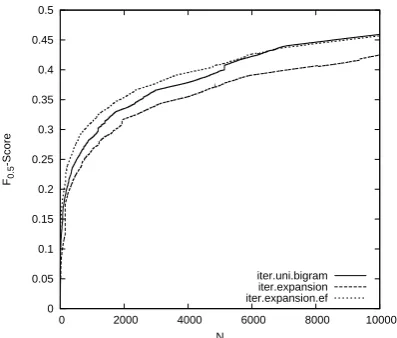
In our second experiment we have compared the performance of iterative mining on uni- and bi-grams with an iterative miner using the n-gram expansion algorithm described in section 3. Fig-ure 6.2 shows the result of n-gram expansion com-pared to mining just uni- and bigrams. Both the results for expansion with and without use of the expansion factor are shown.
0
Figure 2: F-scores after retrieving N forms for it-erative mining on uni- and bigrams, and itit-erative mining using n-gram expansion with and without using an expansion factor.
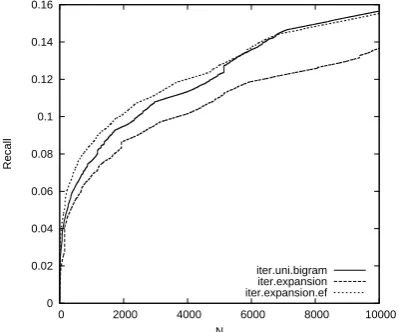
average, as can be seen in figure 6.2. But if sparse-ness is taken into account through the use of the expansion factor, we achieve higher f-scores than mining on uni- and bigrams up to the retrieval of circa five thousand forms. Since a user of an error mining tool will probably only look at the first few thousands of forms, this is a welcome improve-ment.
0 0.02 0.04 0.06 0.08 0.1 0.12 0.14 0.16
0 2000 4000 6000 8000 10000
Recall
N
iter.uni.bigram iter.expansion iter.expansion.ef
Figure 3: Recall after retrieving N forms for it-erative mining on uni- and bigrams, and itit-erative mining using n-gram expansion with and without using an expansion factor.
Among the longer n-grams in the mining results for the Mediargus corpus, we found many Flemish idiomatic expressions that were not described in the Alpino lexicon. For example:
• had er (AMOUNT) voor veil [had
(AMOUNT) for sale]
• (om de muren) van op te lopen [to get terribly annoyed by]
• Ik durf zeggen dat [I dare to say that]
• op punt stellen [to fix/correct something]
• de daver op het lijf [shocked]
• (op) de tippen (van zijn tenen) [being very careful]
• ben fier dat [am proud of]
• Nog voor halfweg [still before halfway]
• (om duimen en vingers) van af te likken [de-licious]
Since these expressions are longer than bi-grams, they cannot be captured properly without using n-gram expansion. We also found longer n-grams describing valid Dutch phrases that were not described by the grammar or lexicon.
• Het stond in de sterren geschreven dat [It was written in the stars that]
• zowat de helft van de [about half of the]
• er zo goed als zeker van dat [almost sure of]
• laat ons hopen dat het/dit lukt [let us hope that it/this works]
6.3 Scoring methods
The miners that use n-gram expansion perform best with the Mf = Sf|Of| function, while the other miners perform best with the Mf = Sf ·
ln|Of| function. This is not surprising – the it-erative miners that do not use n-gram expansion can not make very specific forms and give rela-tively high scores to forms that happen to occur in unparsable sentences (since some forms in a sen-tence will have to take blame, if no specific sus-picious form is found). If such forms also hap-pen to be frequent, they may be ranked higher than some more suspicious infrequent forms. In the case of the ratio-based miner, there are many forms that are ‘suspicious by accident’ which may become highly ranked when they are more fre-quent than very suspicious, but infrefre-quent forms. Since the miners with n-gram expansion can find specific suspicious forms and shift blame to them, there is less chance of accidentally ranking a form to highly by directly including the frequency of observations of that form within unparsable sen-tences in the scoring function.
6.4 Pattern expansion
We have done some preliminary experiments with pattern expansion, allowing for patterns consisting of words and part of speech tags. For this exper-iment we trained a Hidden Markov Model part of speech tagger on 90% of the Dutch Eindhoven cor-pus using a small tag set. We then extracted 50000 unparsable and about 495000 parsable sentences from the Flemish Mediargus corpus. The pattern expansion preprocessor was then used to find in-teresting patterns.
by a (proper) noun). In Flemish a sentence such asWe reden met de auto doorheen Frankrijk (lit-eral: We drove with the car through France) is al-lowed, while in standard Dutch the particle heen
is separated from the preposition door. Conse-quently, the same sentence in standard Dutch isWe reden met de auto door Frankrijk heen. Mining on word n-grams provided hints for this difference in Flemish through forms such asdoorheen Krot-tegem,doorheen Engeland,doorheen Hawai, and
doorheen Middelkerke, but the pattern provides a more general description with a higher frequency. Another pattern that was found iswegens Prep Adj (because of followed by a preposition and an adjective). This pattern captures prepositional modifiers where wegens is the head, and the fol-lowing words within the constituent form an ar-gument, such as in the sentence Dat idee werd snel opgeborgen wegens te duur(literal: That idea became soon archived because of too expensive). This pattern provided a more general description of forms such as wegens te breed (because it is too wide), wegens te deprimerend (because it is too depressing),wegens niet rendabel(because it is not profitable), and wegens te ondraaglijk( be-cause it is too unbearable).
While instances of both patterns were found us-ing the word n-gram based miner, patterns consol-idate different instances. For example, there were 120 forms with a high suspicion containing the wordwegens. If such a form is corrected, the other examples may still need to be checked to see if a solution to the parsing problem is comprehensive. The pattern gives a more general description of the problem, and as such, most of these 120 forms can be represented by the patternwegens Prep Adj.
Since we are still optimizing the pattern ex-pander to scale to large corpora, we have not per-formed an automatic evaluation using the Dutch Wikipedia yet.
7 Conclusions
We combined iterative error mining with expan-sion of forms to n-grams of an arbitrary length, that are long enough to capture interesting phe-nomena, but not longer. We dealt with the prob-lem of data sparseness by introducing an expan-sion factor that softens when the expanded form is very frequent.
In addition to the generalization of iterative er-ror mining, we introduced a method for automatic
evaluation. This allows us to test modifications to the error miner without going through the tedious task of ranking and judging the results manually.
Using this automatic evaluation method, we have shown that iterative error mining improves upon ratio-based error mining. As expected, adding bigrams improves performance. Allowing expansion beyond bigrams can lead to data ness problems, but if we correct for data sparse-ness the performance of the miner improves over mining on just unigrams and bigrams.
We have also described preliminary work on a preprocessor that allows for more general pat-terns that incorporate additional information, such as part of speech tags and lemmas. We hope to optimize and improve pattern-based mining in the future and evaluate it automatically on larger cor-pora.
The error mining methods described in this pa-per are generic, and can be used for any grammar or parser, as long as the sentences within the cor-pus can be divided in a list of parsable and un-parsable sentences. The error miner is freely avail-able5, and is optimized to work on large corpora. The source distribution includes a graphical user interface for browsing mining results, showing the associated sentences, and removing forms when they have been corrected in the grammar or lex-icon.
References
Gosse Bouma, Gertjan van Noord, and Robert Malouf. 2001. Alpino: Wide-coverage Computational Anal-ysis of Dutch. InComputational Linguistics in The Netherlands 2000.
Ann Copestake and Dan Flickinger. 2000. An
open source grammar development environment and broad-coverage English grammar using HPSG. In Proceedings of LREC 2000, pages 591–600.
Udi Manber and Gene Myers. 1990. Suffix arrays: a new method for on-line string searches. In SODA ’90: Proceedings of the first annual ACM-SIAM symposium on Discrete algorithms, pages 319–327. Society for Industrial and Applied Mathematics.
Benoˆıt Sagot and ´Eric de la Clergerie. 2006. Error mining in parsing results. In ACL-44: Proceed-ings of the 21st International Conference on Com-putational Linguistics and the 44th annual meeting of the Association for Computational Linguistics, pages 329–336, Morristown, NJ, USA. Association for Computational Linguistics.
Gertjan Van Noord. 2004. Error mining for wide-coverage grammar engineering. InACL ’04: Pro-ceedings of the 42nd Annual Meeting on Associa-tion for ComputaAssocia-tional Linguistics, page 446, Mor-ristown, NJ, USA. Association for Computational Linguistics.