!
"
#"#
$ % %#
&
'
((( )
The Process of Innovation and Implement Based on Diffusion of Innovation and
Innovation Radar
Ming-Chang Lee*
Department of Information Management Fooyin University, Taiwan [email protected]
To Chang
Department of Information Management Shu-Te University, Taiwan
Wen-Tien Chang Chien
Department of MIS; Fooyin University Taiwan
Abstract:The time of knowledge economy oncoming, the importance of innovation becomes explicit. However, many enterprises have still not regard innovation as the key point which the enterprise manages, its execution under used. The reason is enterprise's procedure only limits in the narrow scope. It’s very easy to lose innovation opportunity. Therefore this research emphasizes the establishment the innovation readiness levels concept and the process of innovation implement. This level is emphatically concealing the management, the enhancement innovation process and innovation implementation review. This research procedure is doing from the innovation theory (product life cycle, system readiness levels and innovation diffusion theory) and case studies to map the innovation readiness levels. This proposed model will also unify the innovation radar to the innovation process and helps the enterprise develop or improve innovation work. The innovation process draws out the step of enterprise innovation implementation and its appraisal
Keywords: product life cycle, Innovation readiness levels; innovation radar; innovation diffusion theory
I. INTRODAUCTION
Innovation has become the driving force for business growth and success. With the increasing pace of the emergence and development of innovation, coping with competition and risk has become a foremost concern for technology managers. However, successful and sustained innovation presents challenges rooted in technological uncertainties, ambiguous market signals and embryonic competitive structure [5], [10]), which demand improved managerial approaches. Thus, successful innovation is highly dependent on how the process is managed.
Innovation involves more than the development of a new products. There are many models that describe the myriad ways an organization can innovate. It also highlights the importance of communication for the implementation of new ideas, products, and services. A particularly useful framework is the innovation Radar [16]. The market adoption model which was developed based on the DOI theory (Diffusion of innovations) [15], and Product /Service Life Cycle [2]. The lifecycle model suggests that market adoption reflects a bell curve that tracks to customer/customer adoption of a new technology, product and services.
System Readiness level (SRL) will be defined by the current state of development of a system in relation to the United States Department of Defense’s (DoD) Phases of Development for the Life Cycle Management Framework [7]. SRL has five phases (readiness level): (1) concept refinement, (2) technology development, (3) system development & demonstration, (4) operation & support.
Although innovation is currently amongst the top-issues of many corporations, many executives have a wrong, too
narrow view of it. They see innovation as synonymous with New Product Development or Traditional R&D. To clarify this error, [16] in the MIT Sloan Management Review (Spring 2006) introduce their Innovation Radar.
The conceptual of IRL is proposed by [17], [18]. The framework separates the comprehensive lifecycle of innovation into six readiness levels, and addresses the management of the process of innovation by considering five key aspects (Technology, Market, organization, partnership, and risk).
The innovation readiness level’s (IRL) provided organizations interested in adopting change an opportunity to assess the likelihood of success in marking a change. IRL is intended to depict the development of innovation. IRL helps implement innovation over the lifecycle more effectively.
We will draw on this study to construct a framework that gives an over idea of how companies and regions can sustain their ability to innovation and how communication can contribute to this. This concept is called innovation readiness. Some existing theories stress the technological development, such as the market adoption model [15], system Readiness levels (DoD), Technology readiness levels [13], and life cycle of innovation [2].
The aim of this study is to develop an explicit model which can be used as a tool for managing the process of incremental innovation and to help to identify opportunities in consideration of all aspects of the business.
II.THERESEARCH
establish generic activities and criteria for each phase of the innovation lifecycle.
Further cases studies were then conducted with leading companies in various industrial sectors, in order to develop and refine the conceptual framework of IRL. The objective in selecting the research subjects is to choose an appropriate population that would allow generalization of findings.
A. Literature Review
This research procedure is doing from the innovation theory such as product life cycle, system readiness levels, technology readiness levels, market Adoption and innovation diffusion theory.
B. Interviewing (Practice) Review
In this section, case studies conducted for developing the conceptual framework of IRL are discussed.
C. Emerging Framework
The framework is six ‘C” model, which separates the comprehensive life cycle of innovation into six phases (readiness levels), and addresses the management of process of innovation by considering five key aspects which are defined below. The purpose of defining these terms is to provide a precise understanding in context of this research.
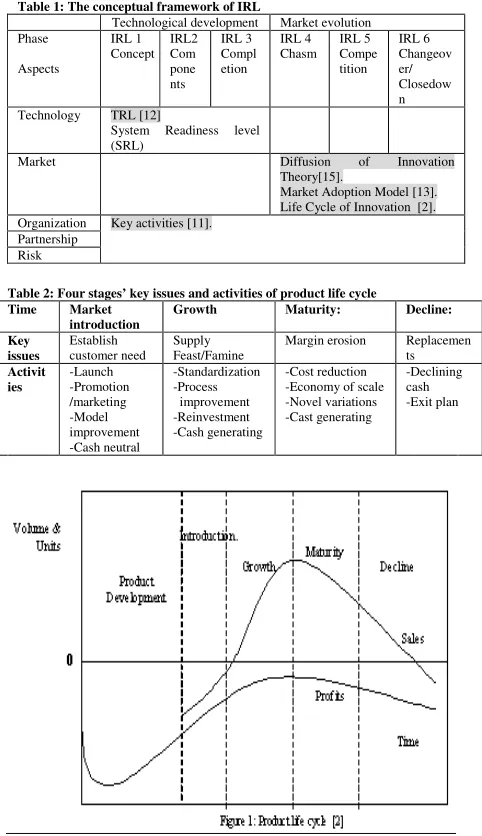
Based on the discussion above, the key literature reviewed that relates to lifecycle models is mapped onto the conceptual framework of IRL, presenting an overview of existing literature (Table 1)
D. Content Analysis (Interviewing And Analysis)
E. Refined Framework
III. EXISTING THEORIES
A. The Product/Service life cycle
The life cycle, as Figure 1 portrays, can be described by an S-curve. From the perspective of profit with respect to time, the curve can generally be classified into four stages as follows:
[a] Market introduction: The market introduction of products begins when a new and innovative product passes quality and function tests, and is introduced to customers. No products already in the market share the functions or appearance of the product, and thus the market is uncontested.
[b] Growth: When the innovative products are marketed and gradually approved by customers, profits also increase. If the products have superior functions and technology to existing products, and if this superiority is confirmed by market testing and use, the products and their corresponding technologies will replace existing products. However, if customers do not appreciate the innovations, the products will quickly vanish from the market. When a product is successful, more and more enterprises will begin to develop similar products and technology. Meanwhile, the original enterprises, which have been involved in researching such products since their beginnings, will seek to constantly improve their products according to the
requirements of customers to enhance their competitiveness.
[c] Maturity: Reliability and quality of products peak during this period. Enterprises also profit enormously, but profit growth begins to slow. A few brands of products dominate the market.
[d] Decline: A new generation of products appears. Most enterprises’ products lose their competitiveness since the appearance of mainstream brands. Price competition characterizes this period.
Four stages’ key issues and activities are denotes as Table 2.
B. System Readiness level
System Readiness level (SRL) will be defined by the current state of development of a system in relation to the United States Department of Defense’s (DoD) Phases of Development for the Life Cycle Management Framework [7]. SRL has five phases (readiness level): (1) concept refinement, (2) technology development, (3) system development & demonstration, (4) production & development (5) operation & support. Table 3 is denoted that the definition of system readiness level.
C. The Diffusion Process
Rogers' suggests a total of five categories of adopters in order to standardize the usage of adopter categories in diffusion research. It should be noted that the adoption of an innovation follows an S curve when plotted over a length of time. The categories of adopters are: innovators, early adopters, early majority, late majority, and laggards [1]. [a] Innovators: Innovators are the first individuals to adopt
an innovation. Innovators are willing to take risks, youngest in age, have the highest social class, have great financial lucidity, very social and have closest contact to scientific sources and interaction with other innovators.
[b] Early Adopters: This is second fastest category of individuals who adopt an innovation. These individuals have the highest degree of opinion leadership among the other adopter categories. Early adopters are typically younger in age, have a higher social status, have more financial lucidity, advanced education, and are more socially forward than late adopters.
[c] Early Majority: Individuals in this category adopt an innovation after a varying degree of time. This time of adoption is significantly longer than the innovators and early adopters. Early Majority tend to be slower in the adoption process, have above average social status, contact with early adopters, and show some opinion leadership.
[d] Late Majority: Individuals in this category will adopt an innovation after the average member of the society. These individuals approach an innovation with a high degree of skepticism and the majority of society has to have adopted the innovation. Late Majority are typically skeptical about an innovation, have below average social status, very little financial lucidity, in contact with others in late majority and early majority, very little opinion leadership.
categories, individuals in this category show little to no opinion leadership. These individuals typically have an aversion to change-agents and tend to be advanced in age. Laggards typically tend to be focused on “traditions”, have lowest social status, lowest financial fluidity, oldest of all other adopters, in contact with only family and close friends, very little to no opinion leadership. The diffusion process is showed as Figure 2.
D. Market Adoption Model [15]
[image:3.612.322.549.49.581.2]The Lifecycle model suggests that market adoption reflects a ball curve that tracks to customer/customer adoption of a new technology, product service. The “early adopters” are interested in testing out and trying something new. After the early adopters targeted market beachheads that represent segments with specific needs that become reference points for other segments. The technology then moves from customer solutions for specific segments to mass manufacturing and distribution of standardized products for the mass market. From there, the market matures. This is when late adopters who are adverse to “risk” begin purchasing the tried and true solutions. Competitiveness becomes almost entirely based on incremental improvements and economies of sale.
Table 1: The conceptual framework of IRL
Technological development Market evolution Phase
Aspects
IRL 1 Concept
IRL2 Com pone nts
IRL 3 Compl etion
IRL 4 Chasm
IRL 5 Compe tition
IRL 6 Changeov er/ Closedow n Technology TRL [12]
System Readiness level (SRL)
Market Diffusion of Innovation
Theory[15].
Market Adoption Model [13]. Life Cycle of Innovation [2]. Organization Key activities [11].
Partnership Risk
Table 2: Four stages’ key issues and activities of product life cycle
Time Market
introduction
Growth Maturity: Decline:
Key issues
Establish customer need
Supply Feast/Famine
Margin erosion Replacemen ts
Activit ies
-Launch -Promotion /marketing -Model improvement -Cash neutral
-Standardization -Process
improvement -Reinvestment -Cash generating
-Cost reduction -Economy of scale -Novel variations -Cast generating
-Declining cash -Exit plan
Table 3: The definition of system readiness level SRL Name Definition
5 Operations & Support
Execute a support program that meets operational support performance requirements and sustains the system in the most cost-effective manor over its total life cycle.
4 Production & Development
Achieve operational capability that satisfies mission needs.
3 System Development &
Demonstration
Develop a system or increment of capability; reduce integration and manufacturing risk; ensure operational supportability; reduce logistics footprint; implement human systems integration; design for reducibility; ensure affordability and production of critical program information; and demonstrate system integration, interoperability, safety, and utility.
2 Technology Development
Reduce technology risks and determine appropriate set of technologies to integrate into full system.
1 Concept Refinement
Refine initial concept.
Develop system/technology development strategy
Figure 3: Market Adoption Model [13]
E. Technology readiness levels
[image:3.612.56.297.322.740.2]The primary purpose of using Technology Readiness Levels is to help management in making decisions concerning the development and transitioning of technology. TRL 1: Basic principles observed and reported
TRL 2:Technology concept and/or application formulated TRL 3:Analytical and experimental critical function and/or characteristic proof of concept
TRL 4: Component and/or breadboard validation in laboratory environment
TRL 5:Component and/or breadboard validation in relevant environment
TRL 6: System/subsystem model or prototype demonstration in a relevant environment
TRL 7:System prototype demonstration in an operational environment
TRL 8: Actual system completed and ‘flight qualified’ through test and demonstration
TRL 9: Actual system ‘flight proven’ through successful mission operations
Advantages include:
[a] Provides a common understanding of technology status [b] Risk management
[c] Used to make decisions concerning technology funding [d] Used to make decisions concerning transition of
technology Disadvantages include:
[a] More reporting, paperwork, reviews
[b] Relatively new, takes time to influence the system
F. Innovation Radar
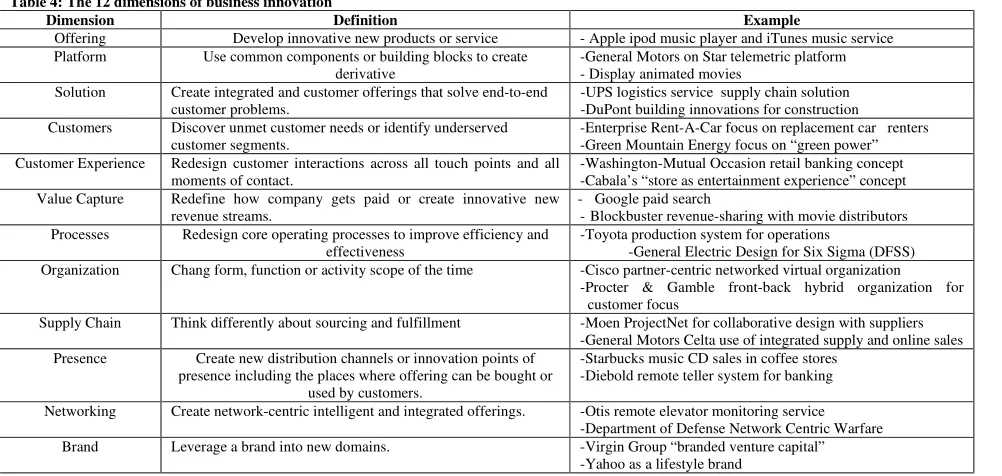
It’s a nice tool for companies concerned about their capacity and depth of innovative exercise, as it broadens the spectrum beyond product delivery and into value creation. Spread across these, a company can innovate way beyond product or technology and can also track the status of its innovative capacity well beyond them. In fact, from these 4 key anchors the radar provides a vision enabling companies
to innovate in these 12 areas: For that they have built radar which covers 4 major dimensions or business anchors:
Offerings a company creates (WHAT); Customers it serves
(WHO); Processes it employs (HOW); and Presence it uses to take its offerings to market (Where).
[image:4.612.327.552.271.406.2]We define business innovation as the creation of substantial new value for customers and the firm by creatively changing one or more dimensions of the business system. Successful business innovation requires the careful consideration of all aspects of a business. A great product with a lousy distribution channel will fail just as spectacularly as a terrific new technology that lacks a valuable end-user application. Thus, when innovating, a company must consider all dimensions of its business system. The innovation radar displays the 12 dimensions of business innovation, anchored by the offerings a company creates, the customer it serves, the process it employs and the points of presence it uses to take its offering to market. Table 4 is denoted as 12 Dimensions of business.
Figure 4: The innovation radar (12 dimensions of business innovation
[image:4.612.62.563.461.699.2]Source from: [16]
Table 4: The 12 dimensions of business innovation
Dimension Definition Example
Offering Develop innovative new products or service - Apple ipod music player and iTunes music service Platform Use common components or building blocks to create
derivative
-General Motors on Star telemetric platform - Display animated movies
Solution Create integrated and customer offerings that solve end-to-end customer problems.
-UPS logistics service supply chain solution -DuPont building innovations for construction Customers Discover unmet customer needs or identify underserved
customer segments.
-Enterprise Rent-A-Car focus on replacement car renters -Green Mountain Energy focus on “green power” Customer Experience Redesign customer interactions across all touch points and all
moments of contact.
-Washington-Mutual Occasion retail banking concept -Cabala’s “store as entertainment experience” concept Value Capture Redefine how company gets paid or create innovative new
revenue streams.
- Google paid search
- Blockbuster revenue-sharing with movie distributors Processes Redesign core operating processes to improve efficiency and
effectiveness
-Toyota production system for operations
-General Electric Design for Six Sigma (DFSS) Organization Chang form, function or activity scope of the time -Cisco partner-centric networked virtual organization
-Procter & Gamble front-back hybrid organization for customer focus
Supply Chain Think differently about sourcing and fulfillment -Moen ProjectNet for collaborative design with suppliers -General Motors Celta use of integrated supply and online sales Presence Create new distribution channels or innovation points of
presence including the places where offering can be bought or used by customers.
-Starbucks music CD sales in coffee stores -Diebold remote teller system for banking
Networking Create network-centric intelligent and integrated offerings. -Otis remote elevator monitoring service -Department of Defense Network Centric Warfare Brand Leverage a brand into new domains. -Virgin Group “branded venture capital”
Table 5: The life cycle of innovation
Technological development Market evolution
Phase Aspects
IRL 1 Concept
IRL2 Components
IRL 3 Completion
IRL 4 Chasm
IRL 5 Competition
IRL 6 Changeover/
Closedown Technology
Market Organization
Partnership Risk
Table 6: The comparison of background information
A B C D
Established year 1992 2005 1997 1996
Industry attribute EDA tools and IP provider Web and blog design IC design IC design
Location Taiwan, China Taiwan Taiwan ,China Taiwan, China and USA
Domestic/multinational Multinational Domestic Multinational Multinational
Employees 22 12 to 22 98 80
Capitals NT$60million NT$10million NT$307million NT$3000million
Products EDA tools and IP Blog and websites
IC design products: Micro Control Unit (MCU) and Digital Signal Proceeding
IC Design product: high performance application specific memory and video
processing circuits. Source from: [4]
Table 7: A Framework of Innovation readiness Levels (IRL)
Technological Development
Pre-IRL IRL 1 Concept IRL 2 Components IRL 3 Completion Technology -Basic scientific principles observed and
reported;
-Technology feasibility confirmed for radical innovation:
-Determine the innovation is radical -Unique advantage identified
-Progressive identification of technical goals
-Individual components tested -Prototypes demonstrated -IP protected
-Technology/product documented;
-Launch-Expertise formed;
Market -on-going market research
-Identity and develop the opportunities
--Working with leading customers; -Customer need and demand observed For
radical innovation:
-Locate the initial market
-End-customer identified; -Detailed market launch plan
issued
-Specific needs and requirements of customers known
-Market segment, size and share predicted;
-Pricing & Launching issued Organization -Foe radical
innovation place responsibility in an independent
organization
-Strategy fit confirmed;
-Informal, loose structure (mainly R&D team) -For radical innovation:
-Define the strategic significance of the radical innovation;
-Free communication channels
-Business analyzed and plan issued;
-Key individuals involved
-Formalizing organization
Partnership -Potential partners identified -Partners selected; -Calibration established
-Partnership formally established Risk -Technology risk considered -Technological risk assessed
(Alternative solution considered);
-Organizational risk considered (Investment plan initiated and investment started)
-Technological risk assessed;- -Organizational risk assessed
(Profit predicted Large investment issued)
Table 8: A Framework of innovation readiness Levels (IRL) (continue)
Market Evolution
IRL 4 Chasm IRL 5 Competition IRL 6 Changeover/Closedown
Technology -General availability to the whole market -After sales supports
-Lower R&D activities;
-Technology maintenance enabled; -Technological service provided
-Disruptive innovation identified; -Learning from experiences and
re-innovate or exit Market -Positioning in the market;
-Business model established; -Customer-intimate marketing
(feedback); -Competitors identified -Use partnership to compete
-Differentiate products; -Provide service and solutions; -Business model refined -Use partnership to compete
-Declining market confirmed; -Market research for approval to
re-innovate or exit
Organization -Form established (e.g. dynamic network) -Improved effectiveness and cooperation;
-Necessary re-structure made Partnership -Cooperation within dynamic network;
-On-going management
-Cease partnership; -(Academic partners sought ) Risk -Organizational risk periodically assessed
(especially financial indicators)
Organizational risk periodically assessed (especially financial indicators
IV. CONCEPTUALFRAMEWORKOFINNOVATION
READINESSLEVELS
The framework is six ‘C” model, which separates the comprehensive life cycle of innovation into six phases (readiness levels), and addresses the management of process of innovation by considering five key aspects which are defined below. The purpose of defining these terms is to provide a precise understanding in context of this research. The life cycle of innovation is denoted as Table 5.
A. Defining The Key Aspects Considered In IRL:
[a] Technology: Technology as the ways and means by which humans produce purposeful material artifacts and effects [3]. Technology is the process by which humans modify nature to meet their needs and wants. Most people, however, think of technology in terms of its artifacts, such as computers and software, mobile phones, automobiles, aircraft, and medical devices. But technology is more than these tangible products. It includes the entire infrastructure and knowledge necessary for the design, manufacture, operation, and repair of technological artifacts, from corporate headquarters and engineering
s
chools to manufacturing plants and maintenance facilities.[b] Market: The term market refers to the groups of consumers or organizations that are interested in innovative technology or the product, have the resources to purchase the product, and are permitted by law and other regulations to acquire the product [8]. [c] Organization: The companies involved are all
established. However, the notion of organization does not refer to the whole corporation. It actually refers to the parts of organization(s) involved in the process of innovation whose goal is to implement the innovation, to generate specific services and/or to produce goods throughout the lifecycle.
[d] Partnership: The term ‘partnership’ is taken in this research to specify a range of inter-organizational relationships: in which the parties maintain autonomy but are bilaterally dependent to a non-trivial degree[20]. Examples of partners include suppliers, resellers, and research partners.
[e] Risk: Goffin and Mitchell ([9] point out, “ways of assessing of addressing risks must come high on the list of techniques for managing innovation projects.”. Risk refers to a combined concept that denotes a potential negative impact on innovation at the business level. In the management of the process of innovation, this concept integrates technological, market and organizational risks [6], which are considered or assessed in certain levels of IRL.
B. Defining the phases of IRL
[a] Concept: Basic scientific principles of the innovation have been observed and reported, and the critical functions and/or characteristics have been confirmed through experiments (equivalent to TRL 1-3).
[b] Components: Components have been developed and validated, and a prototype has been developed to demonstrate the technology (equivalent to TRL 4-6). [c] Completion: Technological development has been
completed and the complete system functionality has
proven in the field (equivalent to TRL 7-9).
[d] Chasm: The term chasm here is broader than Moore’s definition (1999): “the chasm between the early adopters of high technology and the product (the enthusiasts and visionaries) and the early majority (the pragmatists)”. Chasm in the IRL framework refers to the challenges and difficulties that innovation may encounter when first introduced to market (early stage). [e] Competition: This is the mature phase of the market, when it has reached a state of equilibrium marked by the absence of significant growth or innovation (adapted from Moore, 1999). The main mission in this phase is to maintain and enhance the position of innovation and to cope with competition.
[f] Changeover/Closedown: These are the two options in the declining stage of the market. Changeover refers to the re-innovation of technology, inaugurating new markets transformation of the business model, and corporate re-invention, in order to seek and develop competitive advantage. On the other hand, closedown
means the innovation has come to obsolescence and exits
C. Case Studies
The innovation supply chain is a methodology used to efficiently integrate suppliers and research-intensive organizations to ensure materials and information are made accessible and distributed in the right quantities, to the right locations, at the right time. In order to speed up the process of innovation, reduce costs and improve quality. Table 9 shows the comparison of background information for the four case studies in this research. From the table we can see that only B Crop is the start-up firm, the other firms were established ten or more than ten years ago. A Corp is the supplier for IC design industries such as C and D Corp is the web and blog Design Company; it can provide any industry with innovative products, process and services via web and blog technology. Only B Corp is based on Tainan, the other firms are all multinational corporations. A and B Corp small high-tech small and medium-size enterprise regularly employing under 22 works, while C and D Corp each employ 80 to 100 works. The current investment capitals for A and B are 10-60 million, for C and D they are about 300 million.. The main products for A Corp are FDA tools and IP, for B they are web and blog products, foe C and D they are design products.
[A] Corp-- EDA tools and IP provider
A Corp efficiently integrates suppliers and customers to ensure products and information are made accessible and distributed at the right qualities, to the right locations, at the right time, in order to speed the process of information reduce costs and innovation quality. When developing re-configurable logical process, and issues perceived by Corp A were.
[b] A Corp involves full co-operation between suppliers, R&D, designer/engineers, marketers, distributors and customers in practice. It focus on developing, using, maintaining and extending the enabling determinants for effective implementation mechanisms and structures, effective external linkages, strategic approaches to innovation, and supporting organizational context for the innovation process.
[B] Corp-- Web and blog design
B Corp helped itself and other firms to establish a virtual industry through its innovation supply chain. Corp B is seeking possibilities to establish a formal process for management technological innovation with the following functions:
[a] The blog of B Corp is the website component platform with the greatest sale and depth, it can dynamically decompose and construct a whole website and provide cross-website copy capabilities of the whole website. [b] It provides the design platform of the website DNA
version; there is no need to revise the program, it quickly provides ten thousand website versions due to its industrial characteristics, and provides upgrading capability of dynamic website DNA.
[c] The innovation of marketing strategy of B Corp was”4P” (Promotion, Price, Place and Product). 1P (promotion) is scenario marketing—integrative scenario push-force, consumer-experienced pull-force. 2P (Price) collaborative website: The pricing strategy is a collaborative website of “pricing value” but not pure pricing. The on-line platform provides real-time and quick response for consumers. 3P (place) virtual channel: The place strategy is a “place virtualization”. It provides quick expansion of scope, depth, and stickiness. It is also a matrix (vertical and horizontal) connection collaboration network. 4P (product) is wisdom workshop-information, knowledge and wisdom. It provides the services of real time and interaction, consumer experience opinions, personalization service needs, new market product trends, the reliving of wisdom products.
[d] B Corp provides the capability of marketing advertising and information distribution which is based on a “channel supply chain”: through the platform function of “collaboration platform”, “connection and collaboration”, “organic blog”. B Corp is able to assist the newest mobile phone of Nokia synchronal on sale in ten thousand stores within 10 minutes.
[C] Corp-- IC design
C Corp develops a “Fables Vertical Solution” to realize the requirements of Fables Management Automation for IC design industry. The completion of an IC product, from the design, trial-production, to mass-production is based on the principle of industrial vertical decentralization. These manufacturing processes are usually completed by different outsourcing foundries. Suppliers and collaborative partners can assist the innovation process through access to technologies, skills or information and through providing complementary expertise to improve the speed to market of new product developments.
[D] Corp-- IC design
D Corp efficiently integrates and fully co-operates with R&D, design, manufacturing, marketing and distribution to form a complete innovation supply chain and to ensure products and information are made accessible and distributed at the right qualities, to the right locations, at the right time, in order to speed the process of innovation, reduce costs and improve quality. Detailed issues are discussed respectively:
[a] D Corp has developed an innovation supply chain consisting of R&D, design, manufacturing, marketing and distribution with suppliers, partners, customers and distributors.
[b] D Corp provides a framework for seamless, streamlined approach to planning, sourcing and delivering products and products. It has introduced intellectual capital, information management (Web technology) and regulatory compliance (commitment to customers and employees) into the traditional supply chain methodology. This is necessary, effective, and inevitable strategy to reduce costs, focus on the core business, maintain competitiveness, and obtain needs capabilities. [c] he target of this borrowed strength is the upstream suppliers (such as EDA tools and IP venders), partners (such as TSMC and UMC) and the downstream customers (such as related information and know-how of IC design and facilitate contributed innovation and value creation for all the members of information supply chain.
Table 7 is a framework of innovation readiness levels (IRL)
V.ASSESSINGINNOVATIONREADINESS
A. Putting the innovation Radar to work
In our current research, we are investigating how companies can use the innovation radar to construct a strategic approach to innovation. Specifically, the radar could help a firm determine how its current innovation strategy stacks up against its competitors. Using the information, the company could then identify opportunities and prioritize on which dimensions to focus its efforts.
Consider Apple Computer Inc. Its famously successful iPod is more than a nifty product. It is also an elegant solution for customers (simple, integrated buying and consumption of digital music), content owners (secure pay-per-song model for legal music downloads). With respect to the innovation radar, Apple attacked not only the offerings and platform dimensions but also the supply chain (count owners), presence (portability of customer’s entire collection of music photos and videos), networking (connecting with Mac or Windows computers), value capture (iTunes), customer experience (the complete iPod experience) and brand (extending the Apple brand).
B. Checklist rating system [21]
The following checklists are designed to assist business wishing to develop or improve an innovation program. The checklist are based on the results of a large-scale industry survey and 12 innovation case studies which have formed the basis of a new industry guide ‘innovative Now’.
[a] Do you have robust relationships with key industry participants (e.g. clients, manufactures, consultants and technical support providers?)
[b] Do you activity monitors international best practice in your field?
[c] Do you activity monitors advances in related industries that might be applicable to your business?
[d] Do you have a formal system for transferring project learning into your continuous business processes? [e] Do you view problems or failures as opportunities for
learning and growth?
[f] When you make changes, do you measure how well the changes have worked?
[g] Do you seek to win projects with “demanding” client? [h] Do you allow sufficient time for value management,
planning and review activities? [i] Do you invest in R&D
Score “1” for each “Level 1” responses through to “5” for each Level 5” response. Add the sub-totals to each level to calculate your final score. Any business achieving a score of 35 or less can use their results to guide improvement strategies, while higher scoring business can seek to capitalize on the experiences.
Final score and innovation readiness 36 or more: Your
business has excellent innovation practices compared to best practice 18~35: Your business is demonstrating average performance against best practice 17 or less: Your business is currently underperforming compared to best practice
C. Combination of Innovation strategy with Innovation radar
Traditionally, most firms’ innovation strategies are the result of simple inertia or industry convention. But when a company identifies and pursues neglected innovation dimensions, it can change the basis of competition and leave other firms at a distinct disadvantage because each dimension requires a different set of capabilities that cannot be developed or acquired overnight. And innovating along one dimension often influences choices with respect to other dimension. Brand dimension, for example, might require concurrent innovations along the dimensions of customer experience, offerings and presence. As such, selecting and acting on dimensions that define a firm’s innovating strategy requires a deliberate, portfolio-based approach the must be communicated clearly within the company as well as to external constituents. Thus, the combination of innovation strategy with innovation radar, We Have the following senses: (1) According to different stages in product/service life cycle to design innovation strategy. (2) Innovation strategy is an indicator portfolio and the business index is a basis of indicator portfolio. (3) According the product/service life cycle, enterprise creates innovation radar, in order to create innovation monitor.
VI. CONCLUSION
This paper has proposed and demonstrated the emerging framework of a new approach, “the process of innovation and implement”, depicting the development of incremental innovation over the life cycle. It is also expected to apply as a tool to enable companies to assess their innovation management. Thus we provide the integration of innovation theories and innovation process to introduce a strategic management approach towards
assessing innovation readiness as a source of sustainable competitive advantage. The innovation theories include the product/service life cycle, system readiness levels, the market adoption model, and technology readiness levels. The innovation process include conceptual framework of innovation readiness levels, and innovation radar. Assessing innovation readiness includes putting the innovation radar to work, checklist rating system, and firm specific measures of innovation.
Future testing of the framework is necessary in order to increase its robustness and to better understand its application and impacts on developing effective incremental innovation approach
VII.REFERENCES
[1] Adam, P. (2009). The management of marketing knowledge in early phases of the innovation process. International Journal of Technology Marketing, 4(2/3), 113-128.
[2] Beacham, j. (2006). Succeeds through innovation: 60 minute guide to innovation, turning ideas into Profit. From: http://www. berr.gov.uk/files/file34902.pdf [3] Braun, E. (1998). Technology in Context: Technology
assessment for managers, London: Routledge
[4] Chen, Te Fu (2007). A case study of innovation supply chain in high-tech SMEs. Journal for SME Development, 6, 105-13
[5] Construction Excellence in the UK (2001) http://www.constructingexcellence.org.uk
[6] Day, G. S., Schoemaker, P. J. & Gunther, R. (2000). Managing Emerging Technologies, in the Wharton School, John Wiley and Sons, Inc.
[7] DoD, (2005). Technology Readiness Assessment (TRA) desk book, DUSD(S&T), Editor, 2005, Department of Defense
[8] Doyle, P. (2002). Marketing Management and Strategy. 3rd ED, Harlow: Financial Times/Prentice Hal
[9] Goffin, K. and Mitchell, R. (2005). Innovation Management, Palgrave Macmillan, New York.
[10] Islam, N. (2010). Innovation manufacturing readiness levels (IMRLs): a new readiness matrix. International Journal on Nanomanufacturing, 6(1/2/3/4), 362-375. [11] Lee, C. K., Tan, B., Chiu, J. Z., (2008). The impact of
organizational culture and learning on innovation performance. International Journal of Innovation and Learning, 5(4), 413-428.
[12] Mankins, J. C. (1995). Technology Readiness Levels. in Advanced Concept Office, Office of Space Access and Technology, NASA.
[13] Moore, G. A. (1999). Crossing the chasm, in Harper Business, New York.
[14] NASA, Mars Climate Orbiter, Mishap Investigation Board: Phase1 Report, 1999
[15] Rogers, E., (1995). Diffusion of Innovations , in the Free Press, New York.
[16] Sawhney, M. Wolcott, R. C. & Arroniz, I. (2006). The 12 Different Ways for Companies to Innovate. Management of Technology and Innovation, 47(3), 75-81.
[18] Tao, L., Probert, D. and Phaal, R. (2010). Towards an integrated framework for managing the process of innovation. R &D Management, 40(1), pp. 19-30. [19] UK MoD (2008).UK MOD Defense Acquisition, AOF
Technology Management, policy. Information guidance
on the technology management aspects of Version 1.0.1- November, 2008
[20] Williams,O. E. (1991). Comparative economic organization: the analysis of discrete structural alternative. Science Quality, 36, 269-296.