Volume 6, No. 2, March-April 2015
International Journal of Advanced Research in Computer Science
RESEARCH PAPER
Available Online at www.ijarcs.info
Evaluation of Efficient Wi-Max Mobile Network using MIMO and Mean Filter
Suman Kushwaha, Prof Sini Shibu
Department of Computer Science and Engineering NRI, Bhopal,India
Abstract - The modern Wi-max mobile communication system is the future of wireless communication and the end to end performance of the system is need to be improved. This improvement is analyzed in terms of error rate. The bit error rate (BER) is a measure of information sent from source is how much received correctly. However if the whole communication system from source to destination is quite powerful to deliver information correctly to the destination, than such system is said to be efficient. In this paper we have taken same system under simulation with addition of MIMO technology with efficient 8-PSK modulation technique with different iterations by applying mean filtering. The simulation results shows the error rate reduced up to 10-7.
Keywords - Wi-Max, MIMO, Mean Filtering, Mobile Network.
I. INTRODUCTION
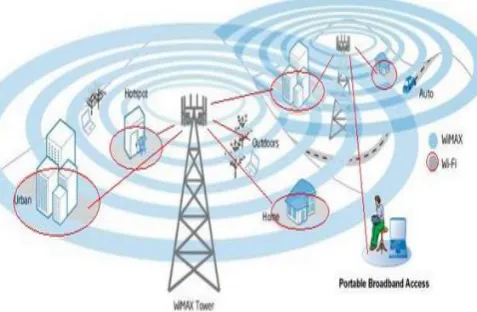
[image:1.595.40.279.487.643.2]WiMAX has emerged as a promising solution for last mile access technology to provide high speed internet access in the residential as well as small and medium sized enterprise sectors. At this moment, cable and digital subscriber line (DSL) technologies are providing broadband service in this sectors. But the practical difficulties in deployment have prevented them from reaching many potential broadband internet customers. Many areas throughout the world currently are not under broadband access facilities. Even many urban and suburban locations may not be served by DSL connectivity as it can only reach about three miles from the central office switch [3].
Figure. 1 WiMAX as the wireless broadband technology
On the other side many older cable networks do not have return channel which will prevent to offer internet access and many commercial areas are often not covered by cable network. But with BWA this difficulties can be overcome. Because of its wireless nature, it can be faster to deploy, easier to scale and more flexible, thereby giving it the potential to serve customers not served or not satisfied by their wired broadband alternatives. IEEE 802.16 standard for BWA and its associated industry consortium, Worldwide Interoperability for Microwave Access (WiMAX) forum
promise to offer high data rate over large areas to a large number of users where broadband is unavailable. This is the first industry-wide standard that can be used for fixed wireless access with substantially higher bandwidth than most cellular networks [2]. Wireless broadband systems have been in use for many years, but the development of this standard enables economy of scale that can bring down the cost of equipment, ensure interoperability, and reduce investment risk for operators. The first version of the IEEE 802.16 standard operates in the 10–66GHz frequency band and requires line-of-sight (LOS) towers. Later the standard extended its operation through different PHY specification to 2-11 GHz frequency band enabling non line of sight (NLOS) connections, which require techniques that efficiently mitigate the impairment of fading and multipath [4]. Taking the advantage of OFDM technique the PHY is able to provide robust broadband service in hostile wireless channel. The OFDM-based physical layer of the IEEE 802.16 standard has been standardized in close cooperation with the European Telecommunications Standards Institute (ETSI) High PERformance Metropolitan Area Network (HiperMAN) [5]. Thus, the HiperMAN standard and the OFDM-based physical layer of IEEE 802.16 are nearly identical. Both OFDM-based physical layers shall comply with each other and a global OFDM system should emerge [4]. The WiMAX forum certified products for BWA comply with the both standards.
frame and from SS to SS, depending on the robustness of the connection. The standard supports both Time Division Duplexing (TDD) and Frequency Division Duplexing (FDD) as duplexing technique.
An important feature of 802.16-2001 is its ability to provide differential Quality of Service (QoS) in the MAC Layer. A Service Flow ID does QoS check. Service flows are characterized by their QoS parameters, which can then be used to specify parameters like maximum latency and tolerated jitter [10]. Service flows can be originated either from BS or SS. 802.16-2001 works only in (Near) Line of Sight (LOS) conditions with outdoor Customer Premises Equipment (CPE).
A. Application of IEEE 802.16 based network:
[image:2.595.332.564.58.199.2]IEEE 802.16 supports ATM, IPv4, IPv6, Ethernet and Virtual Local Area Network (VLAN) services [1]. SO, it can provide a rich choice of service possibilities to voice and data network service providers. It can be used for a wide selection of wireless broadband connection and solutions. ¨ Cellular Backhaul: IEEE 802.16 wireless technology can be an excellent choice for back haul for commercial enterprises such as hotspots as well as point-to-point back haul applications due to its robust bandwidth and long range. ¨ Residential Broadband: Practical limitations like long distance and lack off return channel prohibit many potential broadband customers reaching DSL and cable technologies [3]. IEEE 802.16 can fill the gaps in cable and DSL coverage. ¨ Underserved areas: In many rural areas, especially in developing countries, there is no existence of wired infrastructure. IEEE 802.16 can be a better solution to provide communication services to those areas using fixed CPE and high gained antenna. ¨ Always Best Connected: As IEEE 802.16e supports mobility [8], so the mobile user in the business areas can access high speed services through their IEEE 802.16/WiMAX enabled handheld devices like PDA, Pocket PC and smart phone.
Figure 2: Application scenarios [3]
B. IEEE 802.16 PHY Layer:
The IEEE 802.16 standard supports multiple physical specifications due to its modular nature. The first version of the standard only supported single carrier modulation. Since that time, OFDM and scalable OFDMA have been included to operate in NLOS environment and to provide mobility. The standard has also been extended for use in below 11 GHz frequency bands along with initially supported 10-66 GHz bands. 10-66 GHz licensed band: In this frequency band, due to shorter wave length, line of sight operation is required and as a result the effect of multipath propagation is neglected. The standard promises to provide data rates up to 120 Mb/s in this frequency band [6].
II. PROPOSEDAPPROACH
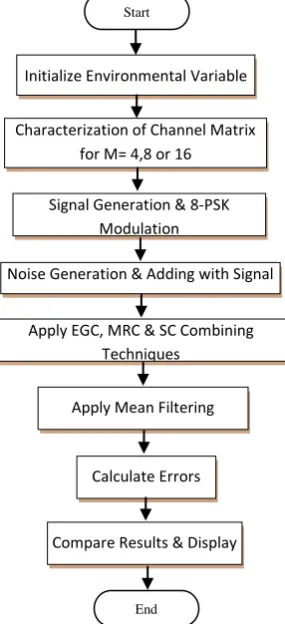
[image:2.595.75.525.530.657.2]The block diagram shows the Proposed Methodology. The Space Diversity with EGC, MRC and SC Liner Average Filtration Methodology in Fig. 2.1. In the proposed methodology EGC, MRC and SC modulation with Liner Average Filter has been used to minimize the Error Probability is calculated with SNR. The Block Diagram in the transmitter side the data is modulated by QPSK modulator the antenna diversity with 4, 8, and 16 is used. In receiver side Combining Techniques EGC, MRC & SC with Linear Average Filter for optimum performance of outcome.
Figure. 2.2 Flow chart of Proposed Methodology
After complete preparation of signal it is transmitter through wireless channel where signal encountered with noises and get corrupted. Due to these noises and interferences we have to use effective combining techniques. After application of combining technique we have applied linear average filter which significantly reduces the effect of noises.
At the end we will calculate the errors with and without filter application in system and in the next section results are displayed.
III. SIMULATIONRESULTS
This section explains the results of proposed methodology after simulation. The simulation of proposed system is under different antenna configurations i.e. 4 antenna at receiver and 4 at transmitter, similarly 8 or 16 antennas both side. The combining techniques (EGC, MRC and SC) is also compared with and without filtering. For enhancing the performance of the system mean filtering is also added with combining technique.
Figure. 3.1 BER vs SNR Curve using 4x4 antenna with Linear Average Filter
[image:3.595.87.230.58.371.2]The simulation of proposed system with equal gain combining(EGC), maximal ratio combining(MRC) and selection combining(SC) is shown in the Fig. 3.1 and the outcome with this technique using mean filtering is that , when we use 4 antennas with all the combining techniques we will get the better results with MRC with filtering. The optimum BER achieved is 1.9x10⁻⁷ at 18dB SNR.
Figure. 3.2 BER vs SNR Curve using 8x8 antenna with Linear Average Filter
The simulation of proposed system with equal gain combining(EGC), maximal ratio combining(MRC) and selection combining(SC) is shown in the Fig. 3.2 and the outcome with this technique using mean filtering is that , when we use 8 antennas with all the combining techniques we will get the better results with MRC with filtering. The optimum BER achieved is 2.9x10⁻⁷ at 11dB SNR.
0 2 4 6 8 10 12 14 16 18
10-7
10-6
10-5
10-4
10-3
Performance Wi-Max Mobile Using MIMO(4x4) and 16 Iterations
SNR
BER
EGC+Filter, N = 4 MRC+Filter, N = 4 SC+Filter, N = 4
0 2 4 6 8 10 12 14 16 18
10-7
10-6
10-5
10-4
10-3
Performance Wi-Max Mobile Using MIMO(8x8) and 16 Iterations
SNR
BER
EGC+Filter, N = 8 MRC+Filter, N = 8 SC+Filter, N = 8
Initialize Environmental Variable
Characterization of Channel Matrix for M= 4,8 or 16
Noise Generation & Adding with Signal
Start
End
Signal Generation & 8-PSK Modulation
Apply EGC, MRC & SC Combining Techniques
Apply Mean Filtering
Calculate Errors
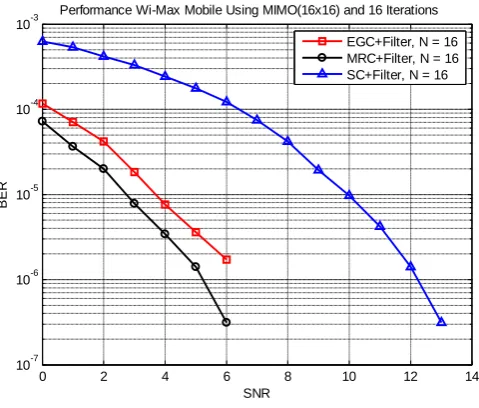
[image:3.595.317.559.367.564.2]Figure. 3.3 BER vs SNR Curve using 16x16 antenna with Linear Average Filter
The simulation of proposed system with equal gain combining(EGC), maximal ratio combining(MRC) and selection combining(SC) is shown in the Fig. 3.3 and the outcome with this technique using mean filtering is that , when we use 16 antennas with all the combining techniques we will get the better results with MRC with filtering. The optimum BER achieved is 3x10⁻⁷ at 6dB SNR.
IV. CONCLUSIONANDFUTURESCOPE
The wireless communication is the modern technique and should have robustness against noise and interference, so as we seen the previous section simulation results shows that MRC is best technique for combining in space diversity when higher number of MIMO configuration is used. The mean filter has enhanced the performance of this technique, and 8-PSK modulation scheme is used to make signal robust against interference. In future if the higher modulation technique is used with this system the performance will also increase.
V. REFERENCES
[1]. Nikfar, B.; Vinck, A.J.H., "Combining techniques performance analysis in spatially correlated MIMO-PLC systems," Power Line Communications and Its Applications (ISPLC), 2013 17th IEEE International Symposium on, vol., no., pp.1,6, 24-27 March 2013. [2]. Kamboj, A.; Mallik, R.K.; Agrawal, M.; Schober, R.,
"Diversity combining in FSO systems in presence of non-Gaussian noise," Signal Processing and Communications (SPCOM), 2012 International Conference on , vol., no., pp.1,5, 22-25 July 2012.
[3]. tzold, M., "The influence of severity of fading on the statistical properties of the
Amplitudes," Communications, IEEE Transactions on , vol.55, no.9, pp.1725,1735, Sept. 2007.
[5]. Chira, L.; Palade, T.; Dumitrean, R.; Puschita, E., "Performance analysis of spatial diversity schemes on an 802.11a PHY platform," Telecommunications in Modern Satellite, Cable and Broadcasting Services, 2005. 7th International Conference on , vol.1, no., pp.101,104 vol. 1, 28-30 Sept. 2005.
[6]. Mr. Jitender Singh, Mrs.Vineeta Khare, "Analysis of Spatial Diversity in MIMO". International Journal of Scientific Engineering and Technology (ISSN : 2277-1581), Volume No.1, Issue No.3, July 2012, pg : 153-156. [7]. A. J. Paulraj, D. A. Gore, R. U. Nabar, and H Bölcskei “An
overview of MIMO Communication-A Key to Gigabit Wireless", Proceedings of the IEEE, Vol. 92, No. 2, PP.198-218(Feb. 2004
[8]. M. Jankiraman, Space time Codes and MIMO systems, published by Artech House, 2004
[9]. L. Zheng and D. Tse, “Diversity and multiplexing: a fundamental tradeoff in multiple antenna channels,” IEEE Trans. Inf. Theory, vol. 49, pp. 1073–1096, May 2003 [10]. G. J. Foschini, ―Layered space-time architecture for
wireless communication in a fading environment when using multi-element antennas,‖ Bell Syst. Tech. J., pp. 41–59, Autumn 1996
[11]. H. Shin and J. H. Lee, “Capacity of multiple-antenna fading channels: spatial fading correlation, double scattering and keyhole,” IEEE Trans. Inf. Theory, vol. 49, pp. 2636–2647, Oct. 2003.
[12]. Haykin, Simon " Digital Communications" Toronto, Canada: John Wiley & Sons, 1988, http://en.wikipedia.org/ wiki/Special:BookSources/0-471-62947-2.
[13]. S. M. Alamouti, ―A simple transmit diversity technique for wireless communications,‖ IEEE J. Select. Areas Commun., vol. 16, no. 8, pp. 1451–1458, Oct. 1998. [14]. Hafeth Hourani "Overview of Diversity Techniques in
Wireless Communication Systems Helsinki University of Technology,S-72.333 Postgraduate Course in Radio Communications (2004/2005).
[15]. W H Tranter, K Sam Shanmugam, T S Rappaport, K L Kosbar, Principles of Communication System Simulation with Wireless Applications‖, Pearson Education.
[16]. Andreas Constanttinides, Assaf Shacham "MIMO wireless system, May 14, 2004.
[17]. Tommy Hult, Abbas Mohammed and Zhe Yang (2011). Cooperative Beamforming and Modern Spatial Diversity Techniques for Power Efficient Wireless Sensor Networks, Wireless Sensor Networks, (Ed.), ISBN: 978-953-307-325-5.
0 2 4 6 8 10 12 14
10-7
10-6
10-5
10-4
10-3
Performance Wi-Max Mobile Using MIMO(16x16) and 16 Iterations
SNR
BER
[20]. W. R. Braun and U. Dersch, “A Physical Mobile Radio channel Model,” IEEE Transactions on Vehicular Technology., Vol. 40, May 1991, p. 472-482.
[21]. KwangHyun Jeon; Bing Hui; KyungHi Chang; HyeongSook Park; YounOk Park, "SISO polarized flat fading channel modeling for dual-polarized antenna systems," Information Networking (ICOIN), 2012 International Conference on , vol., no., pp.368,373, 1-3 Feb. 2012.
[22]. Kamboj, A.; Mallik, R.K.; Agrawal, M.; Schober, R., "Diversity combining in FSO systems in presence of non-Gaussian noise," Signal Processing and Communications (SPCOM), 2012 International Conference on , vol., no., pp.1,5, 22-25 July 2012.
[23]. Faridzadeh, M.; Gholami, A.; Ghassemlooy, Z.; Rajbhandari, S., "Hybrid 2-PPM-BPSK-SIM with the spatial diversity for free space optical communications, "Communication Systems, Networks & Digital Signal Processing (CSNDSP), 2012 8th International Symposium on , vol., no., pp.1,5, 18-20 July 2012.