Available Online atwww.ijcsmc.com
International Journal of Computer Science and Mobile Computing
A Monthly Journal of Computer Science and Information Technology
ISSN 2320–088X
IJCSMC, Vol. 5, Issue. 2, February 2016, pg.218 – 223
Survey on Various Dehazing Techniques
F. Ragini Felicia Suruti
1, R. Balaji
2¹PG Scholar, Department of Computer Science and Engineering, Sri Krishna College of Engineering and Technology, Coimbatore, India
²Assistant Professor, Department of Computer Science and Engineering, Sri Krishna College of Engineering and Technology, Coimbatore, India
1
[email protected]; 2 [email protected]
Abstract— Haze is an atmospheric property where mist, dust, fog and smoke plays a major role in concealing
the contrast of the images. In this survey, various haze removal techniques are studied and compared. Many efficient haze removal algorithms are so far proposed. The fog removal algorithms fall under two categories namely, multiple images and single image techniques. The dark channel prior and color attenuation prior techniques of the single image haze removal have provided quite better results among the available techniques. The objective of this survey paper is to overcome the disadvantages of the earlier techniques of image processing applications.
Keywords— Haze removal, dehazing, Dark channel prior, Color Attenuation Prior, Fog removal, Dehazing Multiple images, Single image dehazing .
I. INTRODUCTION
Haze removal refers to different methods that aims in reducing or removing the degradation or alteration of color and contrast of images taken in bad weather conditions. The degradation of the image is due to various factors like object-camera motion, camera misfocus, bad weather conditions and others. Normally, bad weather such as fog, haze, mist, smoke, etc., in an image plays a major role in disturbing the clear scene. Haze formation is mainly due to the fact that light is absorbed and gets scattered by the turbid particles. Owing to this fact there is a notable delay in the color and contrast of an image. Removal of haze in an image helps in many computer vision and automatic systems application. Also the images must have a clear visibility of the scenes for applications such as surveillance, vehicles monitoring, object recognition, aerial imagery, video analysis/retrieval, remote sensing, object classification, etc., Haze removal becomes a very difficult task due to the fact that the concentration of haze is not equal in all places, the differ from place to place. Recovering the scene radiance of a hazy image requires depth information. This recovery of the depth map is a very challenging area where the depth must be restored with a little amount of information available. Many research have been carried out for removing haze with two major methods namely multiple image haze removal and single image haze removal has been proposed so far and they are widely used. Image enhancement is the process that enhances the contrast of fog picture. Image restoration understands the physical process of imaging under foggy weather. Several algorithms have been proposed to enhance the quality of images taken under bad weather conditions, focusing for instance on visibility.
II. HAZY IMAGE FORMATION
A. Components of Hazy image Formation
The formation of the hazy image is mainly influenced by the fact that the light from the camera source is absorbed and scattered by the turbid medium such as water droplets in the atmosphere. Scattering is caused by two fundamental phenomenon namely attenuation and air-light. Haze is thus referred as the addition of air-light and attenuation to an image, denoted as:
Haze = Attenuation + Air-light (1)
Narasimhan and Nayar [1] further derived the model and the equation can be expressed as
I(x) = j(x).t(x) + A (1-t(x)) (2)
Where 𝑥 denotes the position of the pixel, 𝐼 indicates the observed hazy image, the scene radiance j depicts the haze free image that is to be restored, 𝐴 is the global atmospheric air light, 𝑡 is the medium of transmission that describes the portion of the light that reaches the camera without getting scattered. I, J and A all are three dimensional vectors in the RGB color space. Since I value is known the main goal of dehazing is to find A and t and to restore scene radiance j as given in the above equation.
Therefore from the above equation it is clearly understood that, the image captured by the observer is the combination of both the attenuated version of the scene radiance with an additive form of haze layer, where the atmospheric light equals the colour of the haze.
Figure 1: Hazy Image Formation
B. Attenuation
Attenuation means the gradual loss in intensity of any kind of flux through a medium. On account of the scattering of atmospheric light, a fraction of light gets affected from the incident ray. The unscattered portion of light is called the medium transmission, which is transmitted to the observer. Mathematically attenuation can be expressed as:
Attenuation = t(x).j(x) (3)
Here, J(x) represents the scene radiance and t(x) is the medium transmission. The Attenuation describes the radiance of the scene and its distortion in the medium.
The transmission has a scalar value that has a range from 0 to 1 for each pixel and the value denotes the depth information of the scene objects directly. For a uniform homogenous atmosphere, the transmission t(x) is given as:
β represents the scattering coefficient of the atmosphere and d is the scene depth for the pixel x. The scattering coefficient β can be a constant under the homogeneous atmospheric condition. In ideal cases the range of d(x) is normally [0, +∞) since the objects in the image can be far away from the observer. The scene radiance gets attenuated exponentially with the depth. If the transmission is recovered then the depth map can also be recovered.
C. Air-light
This airlight shows that how the atmosphere acts as a source to reflect the environmental illumination towards the observer. Air-light is formed mainly due to the scattering of the light. Air-light is normally termed as adding more brightness to the scene. It is an additive property, measured as the distance between camera and object. The mathematical equation of air-light is denoted as:
Air-light =A(1-e-βd(x)) (5)
The image dehazing comes under constraint problem. Haze removal or image dehazing is one of the highly recommended computer vision applications that normally tries in removing the hazy areas from the captured hazy image which allows to a get a better and natural haze free image. When dehazing for a colour or gray image is performed the transmission coefficient 𝑡(or the alpha map) is unknown also the atmospheric light A and the scene radiance 𝐽 is unknown. Therefore if the airlight and the transmission 𝑡 are found then the scene radiance can be easily recovered.
III. DEHAZING METHODS
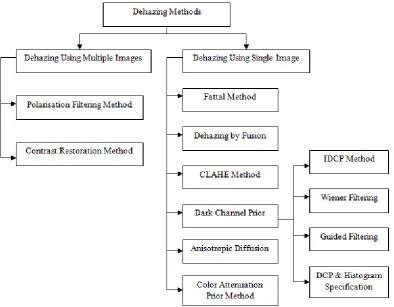
Dehazing is the process of providing a clear view of the image by eradicating the haze from the image. In the case of heavy fog the contrast of the image gets decreased. When the distance from the camera to the object is increased, the degradation of the image increases. The initial works for dehazing makes use of multiple input images of the same scene that are taken under bad weather condition. Recent works for dehazing uses only a single image for haze removal. It is a very difficult task to remove haze from a single image because the scene structure is not available completely. The classification of dehazing methods are provided in figure 2
3.1Dehazing Using Multiple Images
This technique uses multiple independent images of the same scene that are taken under different weather conditions. These techniques were used earlier before the arrival of the single image dehazing techniques. They are explained as follows.
A. Polarisation Filtering Method
Schechner and et al [2] proposed that usually the air-light that gets scattered by the atmospheric particles are partially polarized. Filtering the polarisation alone can’t remove the haze in the image. The hazy image formation process is described at first considering the polarization effect in the atmospheric scattering and then inverted it in order to get a haze free image. The image is usually composed of the two unknown components, the scene radiance in the absence of the haze and the air-light. To remove the haze from the image these two unknown components must be recovered using two independent images of the same scene. This can be easily obtained because usually the air-light is partially polarized. This paper also describes an approach that do not require the weather conditions to change and can be applied instantly. The images are taken through a polarizer and uses polarization filter. The polarization filter and the orientation of the filter improve the contrast of the single input image. Polarization filtering is used to determine the influence of haze in the image and then this haze is eliminated from the image to get the haze free image.
B. Contrast Restoration Method
In this method [3], a physics-based method is provided to restore contrast of the image from two or more images taken under uniform bad weather conditions. A monochrome atmospheric scattering model affected by homogeneous weather conditions is given. This model is applicable for both visible, near-IR spectra and for a wide range of weather conditions such as mist, haze and fog. It does not require the scattering properties of the atmosphere to be constant with respect to wavelength. Using the monochrome weather model, contrast of a scene degraded with distance is depicted. A simple contrast restoration technique is derived for scenes where depth segmentation is known. Changes in scene intensities, under different weather conditions present strong physical constraints owing to scene structure. These constraints are used to detect depth discontinuities and to recover the scene structure from two images taken during daytime. By using the scene structure, contrast is restored. Weather information or prior distributions on scene radiance do not required to be predicted accurately.
3.2Dehazing Using Single Image
The single image dehazing makes use of only a single input hazy image. This method relies upon some assumptions or the nature of the scene. It recovers the scene structure based on the prior information obtained from a single image. These methods became popular that more and more researches are carried out. The methods under this category are provided as follows.
A. Fattal Method
Rannan Fattal provide that [4] the shading and transmission of signals are un-correlated, by using this the airlight-albedo ambiguity can be resolved. Independent Component Analysis (ICA) is used here to estimate the transmission, and the color of the image is deducted by Markov Random Field (MRF). This method is capable to restore the contrast of complex hazy scene. The discontinuities in the depth or medium thickness of the haze are permitted. The pixels belonging to the same reflectance and the same constant surface albedo are grouped. The main idea in this method is to solve the airlight-albedo ambiguity by assuming that the surface shade and the scene transmission are uncorrelated.
B. Dehazing by Fusion
Schaul and et al [5] concentrated on the outdoor photography that the distance objects appear blurred and loses its color due to the degradation level of the atmospheric haze. The key idea used here is the fusion of visible and near infrared of the given input image to obtain a haze free image. It describes the multi-resolution approach using the edge preserving filter which is used to minimize the artifacts produced during the dehazing process. It denotes that from a given input hazy image both visible and near-infrared images can be extracted. This can be achieved by applying an edge preserving multi-resolution decomposition optimization framework to both visible and near infrared images. Pixel level fusion criteria are used to maximize the contrast in the hazy regions.
C. CLAHE Method
method makes use of histogram equalization to a contextual region. The original histogram is clipped and those pixels are redistributed to gray-level. Here each pixel intensity is reduced to maxima. At the end of the process, the hazy image that is processed in HSI color space is converted back to RGB color space.
D. Dark Channel Prior
Dark Channel prior technique [7] is the most popular technique of the above mentioned methods. It is based on the fact that most local patches in a not sky region has some pixels at very low intensity in atleast one color channel. From this low intensity pixel the thickness of the haze can be easily accessed and can restore a clear haze free image. This low intensity pixels are mainly due to three reasons namely colorful objects or surfaces (green grass, tree, blossom), shadows, dim objects or surfaces (dark tree trunk, stone). By using the low intensity pixels the transmission map can be estimated and combined with the haze imaging model and then soft matting technique is applied to recover a high quality haze free image. This method consists of different phases such as, image segmentation, estimation of atmospheric light and cost function. This method is very effective that several variations of this method are proposed so far. Some of the enhanced techniques of the DCP technique are explained below.
IDCP Method
The IDCP method [8] is known as improved dark channel prior method which has some improvements made in DCP method. In this method a novel estimation of atmospheric light has been provided. When compared to the Dark Channel Prior method, it can give better results and also it assumes that the substantial sky region of recovered image normally tends to be distorted. They work well in the areas having dense haze.
Wiener Filtering
Wiener filtering [9] is based on dark channel prior method and is used to solve the problems such as color distortion and halo effect in final image of the dark channel prior method. The, median filtering is used so that the edges might be preserved and is combined with wiener filtering by which the image restoration problem is converted into optimization problem. The fourier transform of the "ideal" version of a given image, and the blurring function are taken into account.
In this present reality, in any case, there are two issues with this system.The best method to solve the problem of real pictures containing noise is to use the Wiener filtering method. This technique is used to recover the contrast of a large white area for image. The running time of the algorithm is also less.
Guided Filtering
Guided image filtering [10] is used when Dark Channel Prior method fails to work on particular images, particularly in places where the large grey region is similar to the global atmospheric light. By using this method the air-light is estimated, based on the imaging law of very dense hazy regions, with high accuracy. Also, a replacement mechanism is developed for optimizing the rough transmission map, which is used to weaken the treatment in invalid areas. The transmission needs refinement as it is a fixed value and hence, it has halo effects in the region of discontinuous depth and block artefacts in the estimated scene radiance. In such case Guided Filter, which is also an edge-preserving smoothing operator, could eliminate halos effectively. The haze free image is thus obtained by preserving its edge.
DCP & Histogram Specification
The histogram specification [11] method is used along with the dark channel prior method to eliminate the following defects in the DCP approach like different intensity of irradiance through same thickness haze, have the same degree of attenuation that reduces the contrast of the image, the direct attenuation is not suitable to be a linear relation with image intensity, if the hazy image has a large background area or low contrast, DCP result will provide a bad result on dark background as it merges the scene with the thick haze. To prevent or avoid these defects, improved DCP with histogram specification is proposed to improve the contrast of the image. This involves rebuilding the histogram of image. Principle of the histogram specification states that in high intensity regions, there occur a lot of sharp points always. The starting of such a sharp point can be used as a boundary of foreground and background object. The image after haze removal using histogram specification appears to be darker than the hazy image.
E. Anisotropic Diffusion
F. Color Attenuation Prior Method
In this paper [13] a new method called color attenuation prior for single image dehazing is proposed. This simple and powerful technique helps to create a linear model for the scene depth of the hazy image. The white or gray light which is formed by the scattering of the illumination source tends to reduce the saturation by enhancing brightness. Hazy regions in the image are characterised by low saturation and high brightness because when the brightness gets increased the saturation is decreased. By using this information the concentration of haze influence by the air-light is found out. The concentration of haze is directly proportional to the depth of the image. So, by using this, the depth can be estimated. This strategy is known as color attenuation prior. By learning these parameters of the linear model, the gap between the hazy image and its corresponding depth map is mapped effectively. With the recovered information the haze from a single image can be removed easily. This method provides a higher efficiency when compared to other methods.
IV. CONCLUSION
Haze removal has been the area of interest for many researchers throughout a long period of time. Dehazing an image provides many applications in various areas or fields. Haze removal algorithms are more useful for remote sensing, navigation, object detection, satellite image identification, and many vision applications. The survey paper has shown many algorithms that has been developed to remove haze .Also variations in the same method is shown that is able to rectify the mistakes in the previous approach. Dehazing is an interesting area for research. Many algorithms that is far better than the previous one are proposed day to day. There are some drawbacks in the existing methods. Therefore the existing methods must be modified in such a way that it works better. In future many algorithms will be proposed to overcome the drawbacks of the existing methods.
REFERENCES
[1] S. G. Narasimhan and S. K. Nayar, “Chromatic framework for vision in bad weather,” in Proc. IEEE Conf. Comput. Vis. Pattern
Recognit. (CVPR), pp. 598–605, Jun. 2000.
[2] Y. Y. Schechner, S. G. Narasimhan, and S. K. Nayar, “Instant dehazing of images using polarization,” in Proc. IEEE Conf. Comput. Vis. PatternRecognit. (CVPR), pp. I-325–I-332, 2001.
[3] Narasimhan, Srinivasa G. and Shree K. Nayar, "Contrast restoration of weather degraded images", IEEE Transactions on Pattern Analysisand Machine Intelligence, vol. 25, no. 6,pp. 713-724, 2003.
[4] R. Fattal, “Single image dehazing,” ACM Trans. Graph., vol. 27, no. 3,p. 72, Aug. 2008.
[5] Schaul, Lex, Clement Fredembach and Sabine Susstrunk.”Color image dehazing using the near – infrared”International Conference on Image Processing(ICIP),16th IEEE Internatinal conference on IEEE 2009.
[6] Xu, Zhiyuan, Xiaoming Liu, and Na Ji. "Fog removal from color images using contrast limited adaptive histogram equalization." Image and Signal Processing, 2nd InternationalCongress on. IEEE, 2009.
[7] K. He, J. Sun, and X. Tang, “Single image haze removal using dark channel prior,” IEEE Trans. Pattern Anal. Mach. Intell., vol. 33, no. 12, pp. 2341–2353, Dec. 2011.
[8] Y. Xiong and H. Yan, “Improved Single Image Dehazing using Dark Channel Prior”, Journal of Computational Information Systems, vol. 9, pp. 5743-5750, 2013.
[9] Shuai, Yanjuan, Rui Liu, and Wenzhang He. "Image Haze Removal of Wiener Filtering Based on Dark Channel Prior." Computational Intelligence and Security (CIS), 2012 Eighth InternationalConference on. IEEE, 2012.
[10] K. He, J. Sun, and X. Tang, “Guided image filtering,” IEEE Trans.Pattern Anal. Mach. Intell., vol. 35, no. 6, pp. 1397–1409, Jun. 2013.
[11] S. Yang, Q. Zhu, J. Wang, D. Wu and Y. Xie, “An Improved Single Image Haze Removal Algorithm Based on Dark Channel Prior and Histogram Specification”, Proc. 3rd International Conf. On Multimedia Technology, Atlantis Press, pp. 279-292, 2013.
[12] A. K. Tripathi and S. Mukhopadhyay, “Single image fog removal using anisotropic diffusion”, IET Image Process, vol. 6, no. 7, pp. 966–975, 2012.