Sharding PoW-based Blockchains via Proofs of
Knowledge
Frederik Armknecht
University of Mannheim [email protected]
Jens-Matthias Bohli
NEC Laboratories Europe [email protected]
Ghassan O. Karame
NEC Laboratories Europe [email protected]
Wenting Li
NEC Laboratories Europe [email protected]
Abstract—Blockchains based on proofs of work (PoW) currently account for more than 90% of the total market capital-ization of existing digital cryptocurrencies. The security of PoW-based blockchains requires that new transactions are verified, making a proper replication of the blockchain data in the system essential. While existing PoW mining protocols offer considerable incentives for workers to generateblocks, workers do not have any incentives to storethe blockchain. This resulted in a sharp decrease in the number of full nodes that store the full blockchain, e.g., in Bitcoin, Litecoin, etc. However, the smaller is the number of replicas or nodes storing the replicas, the higher is the vulnerability of the system against compromises and DoS-attacks. In this paper, we address this problem and propose a novel solution, EWoK (Entangled proofs of WOrk and Knowledge). EWoK regulates in a decentralized-manner the minimum number of replicas that should be stored by tying replication to the only directly-incentivized process in PoW-blockchains—which is PoW itself. EWoK only incurs small modifications to existing PoW protocols, and is fully compliant with the specifications of existing mining hardware—which is likely to increase its adoption by the existing PoW ecosystem. EWoK plugs an efficient in-memory hash-based proof of knowledge and couples them with the standard PoW mechanism. We implemented EWoK and integrated it within commonly used mining protocols, such as GetBlockTemplate and Stratum mining; our results show that EWoK can be easily integrated within existing mining pool protocols and does not impair the mining efficiency.
I. INTRODUCTION
In spite of their huge energy consumption and low perfor-mance, Proof of Work based blockchains currently account for more than 90% of the total market capitalization of existing digi-tal cryptocurrencies [15] and are being used in a number of open blockchains such as Bitcoin, Litecoin, Dogecoin, and Ethereum. These blockchains implement a novel distributed consensus scheme based on Proof of Work (PoW) that scales to a large number of nodes. Here, participants “vote” with their computing power on the next set of transactions to be added by “mining” blocks—which effectively limits the power of individual users and makes Sybil attacks difficult.
Recall that the current difficulty level of PoW mining is prohibitively high that miners do not have incentives to operate solo. Instead, joining a mining pool emerges as an attractive option for miners to receive a portion of the block reward on a consistent basis. Here, rewards are shared between members of the mining pools, so calledworkers, based on the computational resources that they commit. There are currently
a number of models for profit sharing in mining pools, such as PPS, PPLNS, among others. In all these models, workers do not connect directly to the blockchain; instead, they only connect to the pool operator which defines their search space parameters (e.g., workers are typically required to solve a PoW with a reduced difficulty).
Although profitable, mining pools offer a clear departure from the original model outlined in Nakamoto’s whitepaper [39]. Namely, workers in a mining pool are mostly incentivized by obtaining the block reward and do not have strong incentives to store the blockchain, nor to operate a full Bitcoin node. In fact, most existing workers run dedicated mining protocols, such as Stratum mining [43] or GetBlockTemplate [24], in which they solve specific outsourced PoW puzzles without having to store any parts of the blockchain. This resulted in a sharp decrease in the number of full nodes that store the full blockchain (cf. Figure 4) and a considerable surge in the number of workers and lightweight blockchain clients (which only store a small subset of transactions).
Given that blockchain security relies on the availability of all events (and their order of execution), we argue that the lack of incentives to store the blockchain data poses a serious threat to the security and sustainability of the PoW-based blockchains. In theory, ensuring few ”trusted” replicas in the system suffices for security; however, the essence of blockchain is not to rely on ”trusted nodes”. Moreover, the smaller is the number of replicas, the higher is the vulnerability of the system against compromises and DoS-attacks.
In this paper, we address the problem and we propose a solution, EWoK (Entangled proofs of WOrk and Knowledge), to incentivize storing the blockchain data in the network. Our solution effectively divides the blockchain into shards and requires workers to locally store different shards in order to correctly solve the standard hash-based PoW. EWoK increases security by regulating in a decentralized-manner the minimum number of replicas that should be stored. EWoK achieves this by tying replication to the only directly-incentivized process in PoW-blockchains—which is PoW itself. In this sense, EWoK does not aim to increase the number of PoW-blockchains replications but distributes the responsibility of storing the blockchain ledger within those parties invested in making PoW-blockchains successful, even against abuse [3].
that propose a re-purposing of the PoW to e.g., prove storage of archival data [19], [30], [35], [40]. Such re-purposing— although beneficial—however obviates the need for hash-optimized equipment (e.g., ASICs and FPGAs that have limited RAM and storage capabilities) and would require investments in different types of machinery (e.g., storage and exponentiation-optimized machinery). Namely, one of the (many) reasons that led to the sustainability of the Bitcoin blockchain was the large investments made by several mainstream companies in large data centers that are equipped with dedicated PoW mining capabilities [32], [33]. Due to their large market cap, it is clear that drastic changes to the rules governing the dynamics of the PoW ecosystem will be widely resisted by the backing industry. Unlike these approaches, EWoK does not require any modifi-cation to PoW headers, is fully compliant with the specifimodifi-cations of existing mining hardware, and only incurs minor changes to the existing PoW protocols—which is likely to increase its adoption within the existing PoW ecosystem. EWoK plugs an efficient in-memory proof of knowledge into standard hash-based PoW mechanism to force workers to store (in-memory) a modest (but fixed) shard of the blockchain data. We integrated EWoK within existing mining pool protocols, such as GetBlockTemplate (GBT) and Stratum mining (STM); our results show that EWoK does not require any modification to these protocols and incurs marginal computational overhead to the existing PoW protocol adopted in existing PoW blockchains. By ensuring that individual workers store a small part of the blockchain, EWoK emerges as the first workable attempt to incentivize storage in the blockchain and to practically amortize the costs of dispersing the blockchain data amongst various workers. In summary, we make the following contributions in this work:
• Formal Framework: We propose the first formal framework and a security model for a PoW that incentivizes storage of parts of the blockchain data. Our model, dubbed p-covering blockchain, extends the existing model of PoW and requires that each worker independentlystores a fraction pof the blockchain data. • Concrete Instantiation:We describe a concrete scheme, dubbed EWoK, which extends existing mining protocols with efficient in-memory proofs of knowledge and couples them with the standard PoW mechanism. EWoK leverages two interconnected phases: in the first phase, the workers reach consensus on the exact set (including order) of transactions to be confirmed in a given block. In the second phase, the workers solve a proof of work instantiation based on this set of transactions that is entangled with a proof of work over their specific shard. We show that EWoK is secure in our generic p-covering model. • Prototype Implementation: We implement and evaluate
a prototype based on EWoK using GPU mining and integrate it with STM and GBT. Our results show that EWoK does not require nor solicit changes in existing mining hardware, and achieves a 2% higher hash rate than GBT and only deteriorates the hash rate of STM by 1%. The remainder of this paper is organized as follows. In
Section II, we briefly recall basic information about blockchains based on Proofs of Work (PoW) and shed lights on their shortcomings. In Section III, we introduce our extension of PoW-based blockchains,p-covering blockchain, which ensures that the blockchain is stored among the workers with a specified level of redundancy. In Section IV, we present EWoK and analyze its security. In Section V, we evaluate a prototype imple-mentation based on the integration of EWoK with GPU mining based on STM and GBT. In Section VI, we review related work in the area, and we conclude the paper in Section VII.
II. BACKGROUND& PROBLEMSTATEMENT
A. PoW-based Cryptocurrencies
PoW-based blockchains1 leverage Proofs of Work (PoW) as a public timestamping mechanism in order to prevent double-spending attacks. Namely, digital transactions are included inblocksthat are broadcasted in the entire network. Note that when miners do not share the same view in the network (e.g., due to network partitioning), they might work on different block chains, thus resulting in “forks” in the block chain. Block forks are inherently resolved by the system; the longest block chain will eventually prevail. Although perfect synchronization within the network is not required, the parties are assumed to be loosely synchronized.
To prevent double-spending of the same coin, PoW-based cryptocurrencies rely on the synchronous communication assumption along with a hash-based PoW concept. More specifically, to generate a block,minersmust find a block header that represents the solution of a PoW, i.e, when hashed, the result fulfills a certain criterion; for instance, it must be below a given target value (informallyH(blockheader)≤target.) If such a block header is found, miners then include it (as well as the additional fields) in a new block thus allowing any entity to verify the PoW. Upon successfully generating a block, a miner is granted a monetary reward (i.e., in the form of a coinbase transaction that specifies the ID of the recipient of the reward). The resulting block is forwarded to all peers in the network, who can then check its correctness by verifying the hash com-putation. If the block is deemed to be “valid”2, then blockchain nodes append it to their previously accepted blocks. Since each block links to the previously generated block, the Bitcoin block chaingrows upon the generation of a new block in the network.
An example of a Bitcoin block header is depicted in Figure 8 in the Appendix. Notice that the hash functionH and most of the values in the block header as the hash of the previous block
LBand the (current) targettargetare system-wide parameters or implicitly given and cannot be changed by the miner. In the sequel, we refer to these parameters asπblckhdr. The only
input parameters to the hash function that the worker can vary are directly a 4-byte noncenonceand indirectly the 32-byte rootMRof the Merkle hash tree. The Merkle tree is built over the transactions where the first leaf plays a special role by
1In Section III-B, we present a formal model for PoW blockchains. 2That is, the block contains correctly formed transactions that have not been
Algorithm 1 Work flow for solving the PoW.
Input: Non-changeable block header parametersπblckhdr 1: whilePoW not solveddo
2: Choose a new value forCBnonceto specify the coinbaseCB 3: Compute the Merkle rootMRover the coinbaseCB and the set of
transactionsT
4: fornonce∈ {0,1}32do
5: Computeh:=H(πblckhdr,MR,nonce) 6: ifh≤targetthen
7: break; {Solution found.}
8: end if
9: end for
10: end while
Output: The solutionsol = (CBnonce,nonce).
Block Height (4)
Work ID (V) Target (4)
Coinbase Txn (V)
Bits (V)
Transactions (V)
Coinbase Aux (100) Mutable (V) Coinbase Value (4)
Serialized Block (V) Other Fields PrevBlockHash (32)
Min Time (4) Max Time (4) Current Time (4)
block templat
e
submitblock Work ID (V)
Fig. 1: Sketch of a GBT work template and corresponding worker’s response. The pool operator outsources to its workers a block template that also contains the fieldCoinbaseAux. This field contains auxiliary information given by the pool operator which is used by the worker to populate parts of the coinbase transaction. Once a PoW solution is found, the worker constructs and serializes the corresponding block.
containing the coinbase transaction. The coinbase contains on the one hand information about the operator/worker (so that the mining reward can be claimed afterwards) and also a field (typically of 100 bytes) that can be fully changed depending on the underlying mining pool protocol. This field is used as an “extra nonce” to expand the search space available to workers (since the 32-bit nonce space can be exhausted very fast by dedicated mining hardware) without the need to frequently contact the pool operator for additional parameters. We refer to this field in the following byCBnonce. Note thatCBnonce is
not directly input to the hash function but affects it implicitly as it influences MR. Thus, we summarize the process of solving the PoW in Algorithm 1. Notice that validation here is straightforward: given the block header parameters πblckhdr
and the value CBnonce, one can compute the full block header
and check whether its hash value is below the target target. The main intuition behind PoW is that for peers to double-spend a given coin, they would have to replace the transaction where the coin was spent and the corresponding block where it appeared in, otherwise their misbehavior would be detected immediately. This means that for malicious peers to double-spend without being detected, they would not only have to redo all the work required to compute the block where that coin was spent, but also recompute all the subsequent blocks in the chain.
B. Mining Pool Protocols
The current difficulty level of mining valid blocks is so prohibitively high that it reduces the incentives for miners to
operate alone. Joining a mining pool is an attractive option to re-ceive a portion of the Bitcoin block reward on a consistent basis. Namely, mining pools offer a way for miners to contribute their resources to generate a block and to split the reward between all the pool members following a certain reward pay-ment scheme. Shares of the reward are assigned by the mining pool to its members (referred to as workers in the sequel) who presents valid proof-of-work. In more detail, a mining pool sets
targetbetween 1 and the blockchain’s target difficulty (denoted in the sequel as pool target level). Subsequently, a share is assigned to those workers that provide a block header that scores a difficulty level between the pools difficulty level and the currency’s difficulty level. The main purpose of these block headers is to show that the worker is contributing with a certain amount of processing power. Appendix A outlines popular revenue sharing models adopted by existing mining pools.
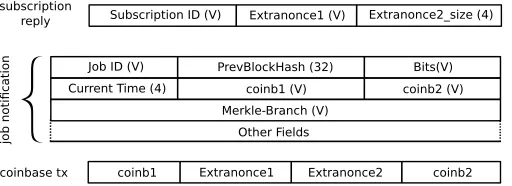
Most existing mining pools adopt two main mining protocols: GetBlockTemplate [24] (cf. Figure 1) and Stratum mining [43] (cf. Figure 2). These protocols are supported by all existing hash-optimized mining hardware, such as ASICs, FPGAs, and GPUs. Due to lack of space, we give a detailed overview of these protocols in Appendix B.
C. Lack of Storage Incentives
PoW mining is strongly incentivized by coinbase transactions and fee collections in the system. For example, each block generation in Bitcoin currently awards miners a fixed revenue of 12.5 BTCs and a variable profit of 0.7 BTCs. This has lead to a considerable surge in the number of miners/workers over the last couple of years (cf. Figure 3).
Unlike mining, where participants are rewarded for confirming transactions, running a full node and storing the full blockchain does not provide any incentive. The only benefit to run a node is to help protect the network. As shown in Figures 3 and 4, in the early years of adoption of PoW blockchains, the system started in a well-balanced state; the majority of miners were basically full nodes that store the full blockchain. Later on, with the proliferation of dedicated mining
Job ID (V)
Merkle-Branch (V)
PrevBlockHash (32) Bits(V) Current Time (4) coinb1 (V) coinb2 (V)
Other Fields
job noti
fi
cat
ion
Extranonce1
coinbase tx coinb1 Extranonce2 coinb2 subscription
reply Subscription ID (V) Extranonce1 (V) Extranonce2_size (4)
hardware, the surge of mining pools and lightweight clients, and the increase of the blockchain storage size, the mining process was almost completely decoupled from serving as a full node. This ecosystem change then outlined a lack of foresight in designing incentive mechanisms in existing PoW blockchains. For instance, as shown in Figure 4, the number of full Bitcoin nodes dropped from 200,000 in 2014 to approximately 5,000 in 2016. Given lack of incentives, this number is only expected to decrease in the future. Although developers allow nodes to “prune” the blockchain—thereby freeing considerable space on their hard drive, nodes still need to download the full blockchain before pruning actually happens. Most users nowadays run lightweight clients which do not store the blockchain and only seldomly verify transactions/blocks of interest [21].
D. Problem Statement
The decrease of the number of full nodes directly impacts the security of the blockchain. As already stated, it is essential that the full and correct blockchain is available within the system at any time for validating new transactions. While in theory one ”trusted” copy would suffice, this would contradict the fundamental decentralization principle of existing blockchains. Moreover, the less replicas are stored within the system, the more susceptible it becomes for compromise and (DoS) attacks. A promising idea is to tie the replication to the only directly-incentivized process in PoW-blockchains—which is mining itself. In fact, literature features a number of interesting proposals for re-purposing PoW to prove the storage of archival data, but as we show in the coming paragraphs, none of these are applicable to the considered problem.
Most PoW-based blockchains, such as Bitcoin, use a hash-based PoW that has the task to find an input that is hashed to a value with certain properties (see Example 1 in Section III-B). That is, a PoW usually requires many hash executions over randomly choseninputs. In Permacoin [30], the PoW is replaced by a Proof of Retrievability (PoR) over a large archival data file. This PoR essentially requires few iterations of a hash function on selected inputs (parts of the data file). Hence, Permacoin would require a drastic change in current mining hardware and consequently is less likely to be adapted by the community. Moreover, the archival data file needs to be known a-priori in its entirety to get extended by a maximum-distance-separable code and to allow the miners to pick their own selection of file shares to be stored in their local storage. That is, Permacoin does not support a dynamically increasing file—such as the blockchain ledger. In Retricoin [40], the authors adopt the basic approach of Permacoin but aim for a more efficient solution in terms of storage overhead, network bandwidth, and verification time. For the same reasons as above, Retricoin is not applicable to the problem at hand.
Spacemint [35], Burstcoin [1], and Filecoin [19] aim to replace PoW by a Proof of Space. This means that a miner has to prove that a certain amount of storage has been invested (instead of computation as in the case of a PoW). This would require likewise drastic changes in existing mining hardware.
Date
Number Of Miners
07/2013 01/2014 07/2014 01/2015
50000 100000 125000
Fig. 3: Evolution of the number of Bitcoin miners over time. Estimates are adapted from [31].
This immediately raises the following question. How can we ensure a minimum number of blockchain replicas without relying on any trusted parties and while being fully compliant to the current mining processes (cf. Section II-B)? An ideal solution here should allow in a flexible manner to adjust the system-wide minimum number of replicas without wasting computational and storage resources.
III. p-COVERINGBLOCKCHAIN
In this section, we introduce a formal model that extends PoW-based blockchains, dubbed p-covering blockchain. In a nutshell, ap-covering blockchain ensures that the blockchain is stored among the workers with a specified level of redundancy. We show at the end of this section how this solves the problem stated in Section II-D. In Section IV, we build on this model and propose a concrete instantiation of a p-covering blockchain which is fully compatible with existing hash-based mining hardware.
A. Notations
Throughout the rest of the paper, letλdenote the security parameter that determines the level of security and we denote byH a cryptographically secure hash function.
For a probabilistic algorithmA, we denote byy←A(x)the event that Aon input xoutputs y. To capture the notion of effort, we use the notation of steps as follows. LetStepsA(x)
denote the number of steps (i.e., machine/operation cycles) executed by algorithmA on inputx. This includes also idle steps, e.g., when an algorithm has to wait for some data.
B. Puzzle-Based Blockchains
We proceed with a short explanation of the basics of puzzle-based blockchains. Ablockchainrefers to a sequence of data entries, calledblocks. A blockchain is maintained by a set of stateful parties P and represents a data storage where the content is trusted by anyone in P without the need of a centrally trusted instance. A blockchain is dynamic in the sense that new data, i.e., blocks, are continuously appended (within each time epoch). Formally, we see a blockchain BC
0 50000 100000 150000 200000 250000
01/2014 07/2014 01/2015 07/2015 01/2016 07/2016
Fu
ll
N
o
d
e
s
Date
Fig. 4: Evolution of the number of Bitcoin full nodes over time. Estimates are adapted from [20], [21].
ent machines) who maintain the blockchain3, and an interactive algorithmConsensus. At each point in time, the blockchain is a sequence of blocks wheres= length(BC)denotes its current length. TheConsensusprotocol is executed between the parties inWto commonly agree on the next blockBlof the blockchain. To increase the costs for appending incorrect content to the blockchain, most existing (open) blockchains (e.g., Bitcoin, Litecoin, Ethereum) require the worker to solve a cryptographic puzzle first before appending a block.
Cryptographic Puzzle: Roughly speaking, acryptographic puzzleshould be easy to generate, hard to solve, and easy to verify. We adapt and extend the model from [6].
Definition 2 (Puzzle System): Let λ denote the security parameter. A puzzle system is defined by several spaces and procedures. It comprises a puzzle parameter space PPPS(λ),
a puzzle space PSPS(λ), a solution space SSPS(λ), and a
hardness space HSPS(λ). These spaces specify a publicly
known verification parameterπveri. Moreover, there exist three
algorithmsSamplePS,SolvePS, andVerifyPSdefined as follows:
• SamplePS(λ,h,πpuz)is a (possibly probabilistic) puzzle
instance sampling algorithm. On input the security parame-terλ, a hardness factorh∈ HSPS, and a puzzle parameter
πpuz∈ PPPS, it outputs a puzzle instancepuz∈ PSPS.
• SolvePS(λ, h, puz) is a probabilistic puzzle solving
algorithm. On input the security parameter λ, a hardness factor h∈ HSPS and a puzzle instance puz∈ PSPS, it
outputs a potential solutionsol∈ SSPS.
• VerifyPS(λ, h, πveri,puz,sol) is a deterministic puzzle
verification algorithm. On input the security parameter
λ, a hardness factor h ∈ HSPS, a puzzle instance
puz∈ PSPSand a potential solutionsol∈ SSPSit outputs
TRUE orFALSE.
A value puz is called avalid puzzle if there exists a puzzle parameterπpuz∈ PPPS such that:
Pr[puz←SamplePS(λ,h,πpuz)]>0.
For a given puz, one can efficiently, i.e., with an effort polynomial in λ, decide whether puzis a valid puzzle. The hardness factor hspecifies the effort to solve a puzzle using the SolvePS algorithm while λ specifies the difficulty
to cheat on the system, i.e., to violate the soundness. To make
3For the sake of simplicity, we restrict to the case that the set of workers
Wis fixed. It is straightforward to extend the definition (and the follow-up discussion) to capture dynamic sets of workers.
the notation more simple, we omit in the sequel the security parameterλand the hardness factorhif they are clear from the context. That is, we write SamplePS(πpuz) instead of SamplePS(λ,h,πpuz) and so on.
Naturally, a puzzle system should becomplete andsound. Completeness means that a solution found by SolvePS for a
correctly sampled puzzle will always be accepted:
Definition 3 (Completeness):We say that a puzzle systemPS
iscomplete, if for every hardness factorh∈ HSPS it holds that:
Pr
puz←SamplePS(πpuz);sol←
SolvePS(puz) :VerifyPS(πveri,puz,sol)
=FALSE
= negl(λ)
While the notion of completeness is the same for all puzzle systems that we consider, the definition of soundness may vary. Recall that most public blockchains are currently based on cryptographic puzzles that require a certain amount of workto be solved, i.e., to provide so-calledproof of work.
Proof of Work: AProof of Work(PoW) system is a puzzle system as defined in Definition 2 that requires a certain amount of work, i.e., computational effort, to be solved. Here, soundness means that for any attackerA, the effort to solve a puzzle cannot be lower (up to a function g) than the effort for running the ”official” solving algorithmSolveP oW.
Definition 4 (PoW Soundness):A PoW system isg-sound if for every PPT adversary A, any h∈ HSP oW and every
πpuz∈ PPP oW, it holds that:
Pr
puz←SampleP oW(πpuz);sol← A(puz) :VerifyP oW(πveri,puz,sol) = TRUE ∧StepsA(h,puz)≤
g(StepsSolve
P oW(h,puz))
= negl(λ).
The definition of PoW-based blockchains is straightforward: Definition 5 (PoW-based Blockchain):Ag-sound PoW-based blockchain is a blockchain system where the process of append-ing a new block requires to solve at least one g-sound PoW.
We stress that the underlying PoW system is part of the system parameters of the blockchain system. That is, we assume that all parties participating into the blockchain system use the same PoW system and in particular the same puzzle sampling algorithm. Consequently, a potential solution sol provided by one worker for a puzzlepuz is only accepted if
VerifyP oW(πveri,puz,sol) =TRUE. However, any worker can
select the puzzle parameterπpuz from a given range.
Example 1 (Hash-Based PoW—HPoW):Most PoW-based blockchains, such as Bitcoin, use a hash-based PoW as follows. Given a cryptographically secure hash function H
and a bitstringpuz, the task is to find a bitstringsolsuch that
H(puz,sol)≤target for a pre-defined targettarget. We dub this PoW as HPoW and we give a more formal description of HPoW in Appendix C. In particular, we argue that HPoW isid-sound whereid refers to the identity mapping. We will refer to HPoW multiple times within this paper.
C. Rational Workers
comprises one or several processing units and one local memory. That is, a worker can fetch data and store data to the local memory and can process data units. In addition, a worker can also request data from external data sources but as this requires network communication, downloading data takes significantly more time than simply reading it directly from local memory. The overall goal of a rational worker (i.e., the operator of the machine) is to maximize his probability in solving the PoW while minimizing his effort (which translate into costs).
Moreover, a worker is unlikely to alter its mining hardware characteristics unless such a move would drastically increase its advantage in solving PoW. Existing solutions that require the re-purposing of PoW, such as Permacoin, Filecoin, Retricoin [19], [30], [35], [40] are less likely to be adopted by workers since they obviate the need for hash-optimized ASICs and FPGAs equipment (that have limited RAM and storage capabilities) and would require investments in different types of machinery (e.g., storage and exponentiation-optimized machinery). For example, the hardness of solving a puzzle used in Permacoin [30] and Retricoin [40] relies on the assumption that a worker can only store part of the file—directly putting machines with larger RAM into strong advantage.
D. p-Covering Blockchain
As mentioned earlier, PoW miningis strongly incentivized by monetary rewards, gives no direct incentives to storethe blockchain data. In this respect, we argue that any secure PoW-based blockchains should ensure a minimum level of replication of blockchain data in the system. Otherwise, there might be not enough information to verify PoW solutions.
A promising approach would be to couple the notion of blockchain data storage with the well-incentivized PoW mining process in order to offer an inherent incentive for workers to continuously support the system by storing parts of the blockchain. We capture this by requiring each worker to store at least parts of the blockchain data in its local memory in order to produce a possible PoW solution.
To capture the notion of storage, we adopt the common con-cept ofknowledge extractors. A knowledge extractor algorithm
K is given access to an algorithmA, represented by KA. Note
that this access is non-black-box, e.g.,Kis allowed to rewindA. It is important to stress that both,KandA, have only access to the state ofA, i.e., no external inputs are allowed. The interpre-tation is thatKextracted the produced output from algorithmA. Definition 6 (p-Covering Blockchain): Consider a PoW-based blockchain system with respect to a g-sound PoW system and a blockchainBC. This blockchain system is said to be p-covering for0≤p≤1 if it holds for any block that it can be reconstructed from a uniformly selected worker with a probability≥p. Formally, there exists a knowledge extractor
K such that it holds any block BC[i]that:
PrhWuniform← W:BC[i]← KWi≥p. (1)
whereWuniform← W means thatW is uniformly sampled from
W. Note that when interacting withK, a worker has no access to external inputs and has access to local memory only.
Notice that the case where p= 0 corresponds to existing PoW-based blockchain systems (see Definition 5). That is, a
p-covering blockchain clearly generalizes PoW-based block-chain systems. Our goal in this paper is to devise an efficient
p-covering blockchain where p >0while(i)requiring minimal changes to existing PoW blockchains and (ii) while being compliant with the specifications of existing mining hardware. Such a p-covering blockchain would provide a solution to the problem stated in Section II-D as follows. Ap-covering blockchain ensures for any randomly selected block to be stored by ap-fraction so that the expected number of replicas per block is p· |W| where |W| is the number of workers. Moreover, the probability that a block is not included in any shard is at most (1−p)|W|. This ensures for any block a minimum number of decentralized replicas distributed over randomly selected miners. Note that these replicas are not meant to be frequently involved into the verification process but should be seen as a backup copy.
IV. EWOK: A PRACTICALp-COVERINGBLOCKCHAIN
In this section, we present our solution, EWoK, and analyze its security. We do this iteratively; namely, we start by presenting and formalizing our approach, before detailing the specifications of EWoK.
A. A Strawman Solution
We start by considering the following strawman design which combines the notion of proofs of knowledge [19], [30], [35], [40] with the standard PoW mechanism. To this end, we first introduce an extension of the PoW-notion that binds a PoW to a file. The core idea is that an algorithm can only efficiently solve a PoW if it has stored a certain fileF.
Definition 7 (File-Bound PoW):A PoW isg0-bound to some file F if there exists a knowledge extractor K such that it holds for every PPT adversary Aand every puzzle parameter
πpuz∈ PPP oW that:
Pr
puz←SampleP oW(πpuz);sol← A(puz); VerifyP oW(πveri,puz,sol) =TRUE;
StepsA(puz)≤g0(Steps
SolveP oW(puz)) :
F∗← KA:F∗6=F
= negl(λ).
Note the difference to the g-soundness of a PoW. There, the definition actually gives a lower bound specified by a functiong on the effort of any attacker. Here, the definition says that if an attacker aims to have an effort that is below a certain upper bound, specified byg0, it has to store the file
F. Namely, we see different types of thresholds with respect to the time effort an attacker can achieve:
1) StepsA(puz) ≤ g(StepsSolveP oW(puz)) is practically impossible if the blockchain system isg-sound.
2) g(StepsSolveP oW(puz)) < StepsA(puz) ≤
g0(Steps
SolveP oW(puz))is possible but only ifAstores the fileFif the blockchain system is g0-bound to the file F. 3) g0(StepsSolve
A strawman solution to realize a file-bound PoW is to couple the PoW with a proof of knowledge (PoK) with respect to a file F, being the blockchain BC in our case. Since checking knowledge of the full blockchain is infeasible, a reasonable approach is to challenge a random selection of blocks of the blockchain such that the response can only be computed if these blocks are presented. For coupling both concepts, a PoW and a PoK, one can proceed as follows:
1) A worker has to solve a PoW puzzle puz. We denote the solution found by the worker by sol.
2) Compute from sol a PoK-challenge over BC, e.g., by means of a pseudorandom function.
Since the ”file”, i.e., the blockchain, is publicly known, conceptually simple proofs of knowledge are possible. For instance, a straightforward approach is to require the hash over a pseudorandom selection of blocks. A summary of this strawman solution is given in Algorithm 4 in the Appendix.
Note that existing schemes that re-purpose PoW to prove storage of a file F [19], [30], [35], [40] follow a similar approach but cannot be directly used in our case where F is the entire blockchain. Namely, in these solutions, any worker that stores the full blockchain can immediately solve the puzzle and produce a new block. Given the still moderate size of the blockchain, machines equipped with large RAM space would have more advantage over a fast Gigahash worker. Moreover, these solutions typically assume that the file is fixed (e.g., Permacoin extends the file with an erasure code) which is not the case in the blockchain that constantly grows in size.
Although the aforementioned strawman solution already overcomes these limitations, we stress at this point that it does not necessarily satisfy Definition 6. Namely, although this solution ensures that it isg-bound to the blockchain in case that the underlying PoW isg-sound, it does not enforce that different workers store areplicated version of the blockchain. Namely, workers are typically equipped with dedicated mining hardware that only possess limited storage capabilities (typically few GBs of storage and RAM) and cannot store the full blockchain. As a consequence, this solution only ensures that the pool operator (or any other central entity) stores the full blockchain. In fact, one may consider one party that is only dedicated to solving the PoK at the end of the mining process. In any case, there is no guarantee that the workers store any parts of the blockchain. Notice that there are currently a handful of mining pools [22] whose operators already typically store the full blockchain.
In addition, any solution should be compatible with existing mining protocols. For example, in PoW blockchains, miners are rewarded by the transaction specified in the coinbase (cf. Section II-B)—which overcomes the need for a cumbersome key management process. Solutions such as Permacoin however deploy specific types of keys that eventually are used for signing the rewarding transaction. Note that these keys need to be updated regularly, incurring further computational effort incompatible on the hashing machines.
B. Sharding the Blockchain Storage
To overcome the limitations of the aforementioned strawman solution, we now introduce a further extension. Namely, we demand that each worker has to store a part of the file only, called ashard, which is determined by a sharding function. In EWoK, the shard is determined by data that is connected to the worker (to realize a distributed storage of the blockchain) but is independent of the puzzle (to encourage the storage in local memory). For the sake of generality, we define a sharding function over an abstract input spaceS.
Definition 8 (Sharding Function):Consider a fileF, divided into ` blocks F[i]. A sharding function shrd is a mapping that accepts inputs xfrom some input space S and outputs a fraction of the file, i.e., shrd(s) = [F[i1],...,F[i`0]] where 0≤i1< ... < i`0 and`0≤`. Slightly abusing notation, we say for a block F[i] thatF[i]∈shrd(s)if shrd(s) = [F[i1],...,F[i`0]] and there exists an indexij such thatij=i.
We say that the sharding function is p-covering with 0≤p≤1 if it holds for any blockF[i]that:
Prhx← S$ :F[i]∈shrd(s)i≥p.
wherex← S$ means thatxis uniformly sampled from S. We consider now a variant of file-bound PoW where efficiently solving a puzzle puz requires to solve a shard of the file F only. This is covered by requiring that a solving algorithm can only be time-optimal, i.e., the effort being below a certain threshold, if the algorithm has direct access to the involved shard.
Definition 9 (Shards-Bound PoW): Consider a PoW that is file-bound to some file F. Moreover, assume a sharding function shrd that is defined onPSP oW. That is, the input
space ofshrd is the puzzle space of PoW. The PoW is said to be g0-bound to (F,shrd) (orshards-boundfor short) if there exists a knowledge extractorKsuch that it holds for every PPT adversaryA, everyπpuz∈ PPP oW, and anyh∈ HSλ that:
Pr
puz←SampleP oW(πpuz);sol← A(puz); VerifyP oW(puz,sol) =TRUE;
StepsA(puz)≤g0(StepsSolve
P oW(puz)) :
F∗← KA:F∗6= shrd(puz)
= negl(λ).
Notice that by settingshrd(x) =Ffor allx∈ S, a shards-bound PoW becomes a file-bound PoW. The definition does not preventAto access external data sources, but this would imply higher time effort. Hence, a rational worker (cf. Section III-C) has strong incentives to store the whole shard locally.
means formally that any two different rationalW,W0∈ W and any blockBl:=BC[i] it holds that:
|Pr[E(W,Bl)∧E(W0,Bl)]
−Pr[E(W,Bl)]·Pr[E(W0,Bl)]| = negl(λ).
Our main goal is to devise a PoW-based blockchain system that is shards-bound with respect to a p-covering sharding function and with independent shards. This is motivated by the following result:
Theorem 1: A PoW-based blockchain system that is shards-bound for the identity function g0= idwith respect to ap-covering sharding function and that ensures independent shards is a p-covering blockchain (see Definition 6).
We show the theorem informally. Recall that we consider only rational workers that aim to solve the underlying PoW as fast as possible to compete with other workers. As the PoW is id-bound to the shard, a rational worker practically realizes the
SolveP oW algorithm with continuous access to the shard to his
specific puzzle. Notice that the best strategy for the worker is to have the shard loaded in RAM in order to minimize memory access overhead (from the network or from disk). The fact that the system ensures independent shards with respect to ap -covering sharding function ensures that each worker is storing a differentp-fraction of the blockchain and hence isp-covering. Notice that maintaining “correct replicas” within the RAM of individual miners in EWoK does not necessarily give more control to mining pools. Individual miners have shown great awareness of the dangers of centralization in the past and they are likely to change mining pools (to preserve their investments) whenever they feel that the pool operator is not acting in the interest of the system: see [3] for example. As such, we believe that EWoK places the additional responsibility of storing parts of the blockchain data within those nodes who are truly invested in making PoW blockchains successful.
In what follows, we present a concrete instantiation, EWoK, that practically instantiates a shard-bound PoW.
C. EWoK: Protocol Specification
We start by describing the sharding function (see Definition 8) that are used in EWoK, i.e., that are part of the specification of EWoK. Afterwards, we explain how to turn the Bitcoin PoW into a shards-bound PoW (see Definition 9).
1) Specification of the Sharding Function:
Recall that BC denotes the blockchain of sizesand BC[i] thei-th block. For the specification of the sharding function, EWoK divides the blockchain into chunks with equal chunk sizeN, i.e., the first N blocks form the first chunk and so on. The shard function selects pseudorandomly (withH) exactly one block per chunk. A complete description is given in Algorithm 2. The description is generic based on some input
x; in the following paragraphs, we discuss the specification of the input x.
This sharding function provides various advantages: • It is p-covering (see Section IV-D).
• It is independent of the current size of the blockchain.
Algorithm 2 Sketch of the sharding functionshrd in EWoK.
Input:Valuex∈ S
1: shard:= []{Initialize an empty shard} 2: fori= 1,...,ds
Nedo
3: Computej:=H(x,i) modN {Specifies which block within thei-th chunk is to be appended to the shard.}
4: Computeind:= (i−1)·N+j{Gives the total index of the block to be appended.}
5: Append(shard,BC[ind]){Appends the selected block to the shard. IfBC[ind]does not exist yet, this command is ignored.}
6: end for
Output: Shardshard.
• Although the shards grow over time (this is a consequence of thep-covering requirement), this does not affect or mod-ify the storage of blocks already contained in the shard. • The parameters can be reasonably chosen to ensure that shard’s size fit within the available memory of existing dedicated mining hardware (see Section V).
• It does not require any involved computation and supports mechanisms already contained in existing PoW-based blockchains. We confirm this by means of implementation in Section V.
2) Specification of the Shards-Bound PoW:
The shards-bound PoW in EWoK is composed of two phases, each using a variant of the hash-based PoW HPoW (cf. Section II-A) with targetstarget1 and target2, respectively. In the first phase, the workers reach consensus on the exact set (including order) of transactions to be confirmed in a given block. In the second phase, the workers solve a variant of HPoW based on this set that entangles the proof of work with a proof of knowledge on their specific shard. While this entanglement of PoW with PoK ensures that the PoW is shard-bound, it does not guarantee that different workers store independent shards. Since PoW (by design) does not embed any notion for coupling workers with a unique system-wide identity, the straightforward approach of coupling identities to shards is not possible4. Instead, EWoK gives economic incentives to the workers to store independent shards by ensuring that two workers operating over the same shard effectively decrease their mining capabilities. This is achieved by selecting the parameters such that on average, only one solution can be expected in the second phase. As a worker can vary both the set of transactions and the nonces, EWoK restricts the set of transactions in phase 1 and the set of allowed nonces in phase 2. In what follows, we explain EWoK in detail. We focus here on the description of the algorithms and discuss concrete suitable choices in subsequent sections.
Fixing the shard:Recall that the transactions exclude the coin-base transactionCB. In the sequel, we assume that the coinbase transaction is divided into two parts CB = (CB1, CB2)
such that CB1 contains all information that specify the
rewarding transaction for the miner. This is conforming with the operation of GBT and STM (cf. Section II). Each of these
4Notice that permission-based blockchains (e.g.,Hyperledger Fabric [4])
parts of CB plays a different role in EWoK. The first part,
CB1, determines the shard to which the PoW is bound. We
haveshard:=shardCB1:= shrd(H(CB1)). The second part,
CB2, is used as input for solving the PoW in the second phase.
First phase — fixing the transactions: Assume a set of transactions T∗ that are candidate for inclusion in the next block. The goal of this first phase is to reach consensus amongst workers of the same mining pool on the set of transactions (including order) to be used in the second phase. We will show in Section IV-D that this phase particularlyenforcesworkers to operate all over the same set of transactions. To achieve such consensus while leveraging existing mining hardware/software, EWoK deploys HPoW with target target1. That is, a set of
transactions T together with a specified order is said to be valid with respect to a noncenoncetransif it holds:
H(T,noncetrans)≤target1. (2)
In summary, the task of a worker in the first phase is to find a valid set of transactions together with the corresponding noncenoncetrans.
Second phase — mining a block: Given block header parameters πblckhdr and a valid set of transactions T together
with an appropriate value noncetrans, the second phase
mainly deals with the generation of the appropriate block header that solves a specific hash-based proof of work with respect to T. To this end, EWoK adopts the core idea from HPoW but entangles it with in-memory proofs of knowledge of the shard shardCB1 := shrd(H(CB1)). Let MR(CB, T) denote the root of the Merkle tree where CB defines the first leaf and the following leaves are specified byT. Recall that
CB1(part ofCB) determines the shard per worker. The task
is now to find a value CB2 and a valuenoncesuch that:
H(πblckhdr,MR((CB1,CB2),T), nonce)≤target2. (3)
Here, the value CB2 has the form CB2 =
(noncetrans,CBnonce), wherenoncetrans is output by the first
phase and only the second value,CBnonce, can be varied. To
cou-ple this PoW with a PoK over the shard shardCB1, the values ofCBnonceare derived from the blocks of the shard as follows.
Letftransdenote a function (e.g., a cryptographic hash) that
derives from a given set of transactionsT a characteristic value
vT=ftrans(T). We assume thatvT is computed once initially.
The computation ofCBnonceinvolvesvT, the blocks comprising
the shard, and a value pn called thepre-nonce (to reflect the fact that it will be used as a seed to determine another nonce):
CBnonce:= (H(vT,shardCB1[index],pn), pn). (4) Analogous to the first phase, we restrict the space of possible pre-nonces to enforce independent shards (cf. Definition 10). As the PoW is tied to a shard, workers who operate over the same shard share the same restricted nonce space and hence reduce their probability of success. As we show in Section IV-D, this gives incentives to rational workers to
Algorithm 3 The algorithmSolveEWoK.
Input:The block header parametersπblckhdrincluding hash functionH:
{0,1}∗→ {0,1}n, set of transactions T∗, thresholdstarget
1,target2, andδpre−nonce
Compute Shard
Split the coinbaseCB= (CB1,CB2)
Computeshard:= shrd(H(CB1)).
Find valid set of transactions (first phase) whileNo valid set of transactions founddo
Choose a set of transactionsT fromT∗(including an order) Choose valuenoncetrans
ifH(T ,noncetrans)≤target1 then
Valid set of transactions found. Break WHILE-loop.
end if end while
Solve Proof of Work (second phase)
ComputevT=ftrans(T)
whileProof of Work not solveddo
Choose a pre-noncepn≤δpre−nonce Compute indexindex:=find(vT,pn)
ComputeCBnonce:= (H(vT,shard[index],pn), pn)
SetCB= (CB1,(noncetrans,CBnonce))
fornonce∈ {0,1}32do
Computeh:=H(πblckhdr,MR(CB,T), nonce).
ifh≤target2then
PoW-solution found. Break WHILE-loop.
end if end for end while
Output: Solution(T ,CB,nonce).
choose different shards. To restrict the nonce space, EWoK enforces an upper boundδpre−noncewhen choosingpn:
pn valid ⇔ pn≤δpre−nonce. (5)
It remains to explain how the index index that determines which block of the shard of length `shrd is involved in the
computation ofCBnonce (see Equation 4) is computed. To this
end, we simply set
index:=find(vT,pn) :=H(vT,pn) mod`shrd. (6)
An overview of these steps is given in the last part of Algo-rithm 3. Ifh≤target2, a solution is found. The complete
solu-tion is then given byCBandnoncetogether with the valid set of transactionsT. The validation of a solution(T,CB,nonce) is straightforward and given in Algorithm 5 in the Appendix.
3) Practical Considerations:
Parameter Selection: To ensure a smooth migration from an HPoW-based blockchain to a EWoK-based blockchain, the overall computational effort for successful mining should remain the same. To this end, we suggest to set both target1
and target2 to 2×target where target denotes the target used in HPoW. This ensures that the work efforts for the proofs of work in phase 1 and 2, respectively, are about half the effort of the HPoW each.
gives incentives for storing independent shards. Second, one needs to take into account that two-phase PoW protocols tend to favor large mining pools when implemented in a naive way [16], [34]. The reason is that finding a solution to the two-phase puzzle is no longer a Poisson process, where every miner has in every moment the same probability to succeed. Instead, a solution can only be found in the second phase, and large mining pools will typically progress faster to the second stage. For example, assuming a 2-stage PoW (where both phases have equal difficulty) and only two miners where one miner has the double computing power of the other, the winning probability of the more powerful miner increases to 74% instead of the default 66.6%. Similar to [34], we mitigate this by ensuring that for any Phase 1 solution, there is only one possible Phase 2 solution. For example, assuming the difficulty in the Bitcoin network on the 10th of August 2017, this can be achieved by restricting the nonce space to approximately 70 bits. Note that a worker can control two values in phase 2, the 32-bit value nonceand the pre-nonce valuepn, so that we restrict the freedom of the latter to 38 bits. We validate this choice of parameters experimentally in Section V.
Note that while a worker could in addition also vary the timestamp, this is possible within a very small range only as otherwise the block becomes outdated. Thus, the impact of varying the timestamp can be neglected. Clearly, other tradeoffs are possible as long as the total effort of both phases equals approximately the effort of the HPoW and as long the set of allowed pre-nonces in phase 2 is not too large.
Work Flow: We stress that, in practice, the computation of the shard will be done only once by each worker. To ensure efficient execution of phases 1 and 2, the workers are likely to load their respective shards in RAM. We show in Section V that this is a reasonable assumption; namely, we show how to realize modest shard sizes (with approximately few hundred MBs) that can easily fit into the available RAM of most existing mining hardware. Notice, however, that the shard size will grow with the length of the blockchain. In this case, workers will continuously update their shards using the non-interactive deterministic sharding function specified in Algorithm 2. However, although the shards grow over time, EWoK ensures that this does not affect or modify the storage of blocks already contained in the shards stored by each worker. Moreover, as we show in Section IV-D, it is a good strategy for the operator to distribute the search for a valid set of trans-actions (phase 1) among the workers in the mining pool, e.g., by splitting the space of noncetrans values. Once one worker
succeeded, the solution of phase 1 (i.e., the fixed transaction set) is forwarded to the others who can then immediately start with phase 2. In this sense, Algorithm 3 should not be seen as a representation of the work of a single worker; instead, it summarizes all single processes occurring within a mining pool. As motivated in Section IV-A, we assume that the verification of the blocks is done by parties that store the full, public chain. Recall that pool operators currently store the full block-chain in order to verify new blocks and outsource new puzzles.
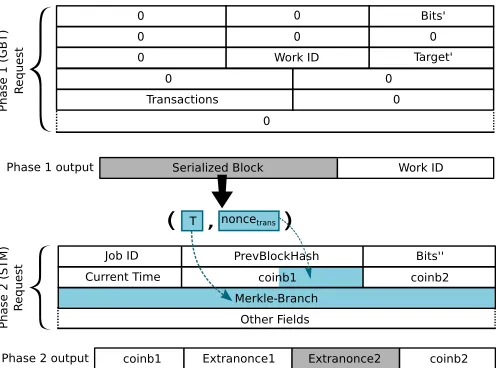
Instantiation: This aforementioned process can be best instantiated practically by first requiring all workers to solve a GBT work template where all other fields—besides the worker ID, the target difficult, and the set of transactions—are set to zero. Once a worker finds a solution for phase 1, he reports it in the serialized block output in GBT. For all practical reasons, if a worker is able to find a nonce for the exact set (and order) of transactions reported in the GBT work template, he can only submit the nonce and his worker ID back—without the need to serialize the entire resulting block.
Given the output of GBT in phase 1, the operator quickly constructs the sibling paths associated with the Merkle root and proceeds similarly to STM. Namely, the operator outsources a work template asking workers to solve the corresponding solution for phase 2. This process is detailed in Figure 9 in the Appendix. We stress at this point that this process does not necessarily require a large mining pool and can be equally applied e.g., by a solo miner.
While phase 2 of EWoK is compatible with all current mining hardwares, phase 1 might require some tailoring to make it compatible with existing non-programmable mining hardware in the market. For example, ASIC-based gigahash machines are optimized to compute hashes on inputs of 80 bytes while the transaction setT has typically a larger size. To accommodate this, one could first compute the hash of T before handing it over to the gigahash machine and pad the 32-byte output along with noncetrans to be 80 bytes. The security analysis
can be transported to this case in a straightforward manner.
D. Security Analysis
In this section, we analyze the security of our solution with re-spect to the model outlined in Section III. More precisely, we ar-gue that EWoK is a shards-bound blockchain system (Lemma 2) with respect to ap-covering sharding function (Lemma 1) and that it provides independent shards (Lemma 3). Based on this, it follows from Theorem 1 that EWoK is ap-covering blockchain. We base our arguments on the random oracle model with respect to the deployed hash functionH. That is, the outputs of the hash function for pairwise different inputs are independent and uniformly distributed in{0,1}n. Notice that, in EWoK, the
hash function is used in different contexts, e.g., for checking the validity of a set of transactions (cf. Equation 2) or when a solution for the PoW in the second phase has been found (cf. Equation 3). We assume a distinguished input message format in each context to have formally independentH-calls in the different phases.
Lemma 1: The sharding function in Algorithm 2 is (N1 − N
2n)-covering, where N denotes the chunk size and n the output size of the hash function. If 2nN, the sharding function is practically N1-covering.
number of possible outputs of the hash function is not a direct multiple, the higher indexes have a smaller probability of at least N1−N
2n to be selected.
Lemma 2:EWoK isid-bound to (shardCB1,shrd). Proof: We now show that the PoW used in the second phase of EWoK is id-bound to(shardCB1,shrd). Let Solve2 denote the algorithm that solves this PoW of the second phase, i.e., the last part of Algorithm 3. Notice that this PoW is actually a variant of HPoW (cf. Section III-B) that we showed to be id-sound. More precisely, the considered PoW is based on the task to find an input of a certain form to the hash function such that the output fulfills a certain condition. As the hash function invocations are independent and hence the outputs unpredictable, uniformly distributed values, the success probability of any solution-finding algorithm can be expressed by the number of hash queries based on different inputs. That is, the optimal solving algorithm consists of checking as many hash inputs as possible, being exactly the work flow ofSolve2.
Now, let SolveW denote the solution-finding algorithm
implemented by some workerW. In case of a rational attacker, it requires finding an appropriate value CBnonce such that
H(πblckhdr, MR(CB, T), nonce)≤target. Recall that the
values for CBnonce are indirectly given by
CBnonce:= (H(vT,shard[index],pn), pn)
where only the value pn is under full control of the worker. Notice that a worker who does not select the values CBnonce
as given above will eventually fail aspnis part of the solution to be published butH is preimage-resistant. Whenever a new valueCBnonceis to be determined based on a newpn, it requires
the execution of the hash function H over shard[index]. Similar to the above, a worker who does not useshard[index] will not be able to eventually produce a valid solution. While in principle the worker could fetch the block shard[index] from external sources, this increases the total number of steps due to additional idle steps when the algorithm waits for
shard[index]. Thus, the most efficient strategy for a worker is to store the necessary shard blocks shard[index] in its local memory. Moreover, we point out that the indexes index
are pseudorandomly generated, i.e., index:=find(vT, pn);
these indexes also differ between epochs due tovT. Therefore,
the indexes index cannot be predicted in the random oracle model, making all blocks of the shard equally necessary.
Lemma 3:EWoK ensures independent shards.
Proof: (Sketch) The mining process of EWoK includes two phases and each phase requires to solve a PoW. Consider an worker W implementing algorithms Solve1 andSolve2 to
solve the PoW in phase 1 and 2, respectively. Using the same arguments as in the proof of Lemma 2, it holds that bothSolve1
andSolve2execute continuously different attempts to solve the
respective PoW by selecting and trying different possible solu-tions. We call an attempt inSolve1to solve the PoW of the first
phase a type-1-attemptand definetype-2-attempts analogously. As the probability for successful mining grows linearly with the number of type-2-attempts only, the optimal strategy for any worker is to minimize the number of type-1-attempts and
to maximize the number of type-2-attempts. This encourages the strategy that once one worker has found a solution for the PoW in phase 1, it is shared with the other workers among the mining pool so that all workers proceed to phase 2.
Notice that the nonce space restriction deployed in phase 2 actually limits the number of possible type-2-attempts with respect to one choice ofCB1. Once all nonces have been used
with respect toCB1, one can either try to change to another
valid set of transactions or changeCB1. The first requires to run
further type-1-attempts—contradicting the optimal strategy. The second makes it necessary to determine and load another shard (as shard= shrd(CB1)into local memory (see arguments in
the proof sketch of Lemma 2)—preventing the worker to run further type-2-attempts. Thus, the best strategy is to allow for as many type-2-attempts as possible; this means that different workers should operate on different choices of CB1. As CB1
fixes pseudorandomly the shard, different valuesCB1 lead to
shards that are computationally indistinguishable from indepen-dently randomly selected shards. Moreover, sinceCB1specifies
the rewarding transaction, a miner cannot outsource this compu-tation to a different party as this party would have no incentives to run the computation on behalf of this miner. This ensures that the shards are stored independently in different RAM. It follows from Lemma 1, 2, and 3 that the prerequisites of Theorem 1 are given and hence that EWoK is an instantiation of a p-covering blockchain.
V. IMPLEMENTATION& EVALUATION
In what follows, we evaluate a prototype implementation of EWoK integrated within GPU mining. The purpose of our eval-uation is to validate the feasibility of integrating EWoK within existing mining protocols such as STM and GBT. By showing that EWoK can be instantiated within these protocols without modifications, we stress that EWoK can be immediately instanti-ated on other mining hardware, such as ASIC and FPGA mining. Notice that, in our implementation, we only focus on GPU min-ing owmin-ing to its popularity and reasonable value for the money.
A. Implementation Setup
We integrate EWoK within the popular open-source mining tool BFGMiner [8] implemented in C. BFGMiner is a middleware which resides on a host machine and communicates with the mining pool(s) to retrieve the work template. More specifically, BFGMiner uses OpenCL to define and assign the mining tasks to GPU. To this end, it first pre-calculates the intermediate state of the SHA-256 computation over parts of the PoW input data (i.e., the block header) and then feeds this intermediate state to the GPU worker which finalizes the hash function computations over different nonces in parallel.
We deploy our implementations on an Intel Core i5-7400 equipped with 8GB of RAM which implements the BFGMiner orchestration, and on an AMD Radeon RX480 GPU featuring 1120 MHz of clock frequency and 4GB of RAM.
0 100 200 300 400 500 600 700 800 900
GBT STM EWoK
Hash rate (MHash/s)
699.74 720.32 711.97
Phase 2
Phase 1
Fig. 5: Effective hash rate performance of EWoK when compared to GBT and STM.
transactions (phase 1) among the workers using GBT. Given the output of GBT in phase 1, the operator quickly constructs the sibling paths associated with the Merkle root and proceeds similarly to STM to solve the corresponding solution for phase 2. When benchmarking EWoK, we prepare a local pool by leveraging the BFTMiner implementation of the work templates. We only measure the performance of EWoK witnessed by the worker and do not evaluate the overhead incurred by EWoK on the operator (since this overhead is exactly similar to that witnessed by operators executing GBT and STM). In our setup, we assume a 1 MB block size and transaction sizes of approximately 250 Bytes conforming with the Bitcoin blockchain [11]. Each data point in our plots is averaged over 10 independent measurements; where appropriate, we include the corresponding 95% confidence intervals.
B. Performance Evaluation
We evaluate the performance of EWoK with respect to the achieved hash rate, the number of PoW solutions found per minute, and the GPU usage, when compared to existing mining protocols based on GBT and STM. We also evaluate the effective number of blockchain replicas enforced by EWoK within existing PoW-based blockchain deployments, such as Bitcoin, Litecoin, Dogecoin, and Ethereum.
Hash rate performance: In Figure 5, we evaluate the hash rate performance of EWoK when compared to GBT and STM as follows. We measure the time that the worker spends in preparing the block headers (in GBT) and searches for the corresponding PoW solutions (GBT and STM), and we count the number of hashes that the worker computed for each puzzle. Notice that EWoK is composed of two phases: phase 1 which is instantiated with GBT and phase 2 which we instantiate with STM. The runtime for phases 1 and 2 are similar since the target difficulty in both phases is the same. Therefore, we compute the hash rate of EWoK as the average hash rate exhibited by phases 1 and 2. Our results show that EWoK achieves 712 hashes per second and is almost 2% faster than GBT. Notice that phase 1 in EWoK incurs less hash computations than GBT since the worker only needs to compute the hash over the ordered transaction set instead of building the entire Merkle tree. Recall that STM achieves a higher hash rate
0 2 4 6 8 10 12
GBT STM EWoK
Utilitis (solutions/min)
5
4.62
9.91 9.907
Phase 1
Phase 2
Fig. 6: Number of solutions mined in EWoK when compared to GBT and STM.
Blockchain Size Growth Shard size
(GB) (GB/year) Initial 50MB 200MB 500MB
Bitcoin 136.34 38.24
Replicas 35.81 143.25 358.13 Growth
14.02 56.10 140.25 (MB/year)
Litecoin 46.27 1.63 Replicas 105.53 422.11 1055.29 Growth
1.77 7.06 17.66 (MB/year)
Dogecoin 21.57 2.68 Replicas 226.37 905.48 2263.71 Growth
6.21 24.82 62.05 (MB/year)
Ethereum 7.7 3.69 Replicas 634.13 2536.53 6341.31 Growth
23.93 95.72 239.3 (MB/year)
TABLE I: Number of blockchain replicas incurred by EWoK when integrated with Bitcoin, Litecoin, Dogecoin, and Ethereum assuming 100,000 workers.
performance than GBT since it only outsources to the worker a small number of additional information for computations to construct the Merkle root. Despite the additional operations in phase 2 when compared to STM, EWoK is only 1.1% slower than STM; our results therefore show that EWoK emerges as a strong tradeoff between the performance of GBT and STM.
Number of solutions per minute: We measure the number of effective solutions computed by EWoK when compared to GBT and STM. Here, we set the pool target difficulty [17] to be 2 (target 0x1d007fff) for GBT and STM. Following EWoK’s specification in Section IV-C, phases 1 and 2 in EWoK each exhibit half the difficulty (set to 1 with target 0x1d00ffff). Our results show that on average both phases 1 and 2 in EWoK achieve approximately double the number of effective PoW solutions due to the higher target: 9.9 solutions/min compared to 5 and 4.6 solutions/min for GBT and STM.
60 65 70 75 80 85 90 95 100
0 50 100 150 200 250 300 0
50 100 150 200 250 300
GPU Usage (%)
VRAM Usage (MB)
Time (s)
VRAM Mining VRAM Idle GBT
STM EWoK
Fig. 7: GPU usage of EWoK over time when compared to GBT and STM. Here, the white shaded areas in correspond to phase 1 of EWoK, while the gray shaded areas in the figure correspond to phase 2.
in EWoK, GBT, and STM is fixed at 113.80 MB, compared to the memory usage of 85.65 MB in the idle state. That is, in all investigated protocols, the worker only consumes approximately 30 MB even when mining.
Number of effective replicas: Table I shows the number of effective blockchain replicas achieved by EWoK with respect to the shard size when integrated with the Bitcoin, Litecoin, Dogecoin, and the Ethereum blockchains. Here, we assume that there are a total of 100,000 workers (adapted from [31]) and we vary the shard size in EWoK between 50 MB, 200 MB, and 500 MB by setting the chunk size accordingly. We measure the data growth per year for each of the investigated blockchains by analyzing their respective publicly available blockchain datasets. We implement the sharding routine described in Algorithm 2 which results in a pseudorandom distribution of shards amongst workers. We then compute the shard size averaged over all considered 100,000 workers. Our results show that assuming shard sizes of 200 MB and 500 MB results in the replication factor of almost 143 and 358 times, respectively, in the case of the Bitcoin blockchain, and almost 2500 and 6300 times (respectively) in the case of the Ethereum blockchain. Even small shard sizes of 50 MB result in a reasonable replication by 35 times in Bitcoin, 105 times in Litecoin, 226 times in Dogecoin, and 634 times in Ethereum. As mentioned earlier, EWoK enables workers to grow their shard sizes over time without affecting their existing stored shard. For example, given that the growth rate of the Bitcoin network is 38 GB per year, each worker’s shard grows almost by 140 MB per year in EWoK when current shard size is set to 500 MB. Table I summarizes the shard growth rate in the investigated blockchains. Our results confirm that EWoK can be easily integrated within existing dedicated mining hardware; most dedicated hardware mining are equipped with at least 500 MB RAM capacity and the growth rate of the shard sizes in EWoK is slow enough to easily fit into planned growth in RAM capacities in the foreseeable future.
VI. RELATEDWORK
Alternatives to PoW-based blockchains:In the recent years, a number of alternatives to PoW have been proposed [23]. For instance, Proof of Stake (PoS) [37] suggests to bias the
vote impact of participants based on the amount of “stake” they own in the respective blockchain system. The literature features a number of additional proposals [18], [28], [29], [36], [44] that rely on classical Byzantine fault tolerant consensus protocols in the hope to increase the consensus efficiency and achieve high transactional throughput.
Some proposals [14], [42] aim to replace the linear structure of a blockchain by other structures, e.g., a directed-acyclic-graph. PieceWork [2], [16] leverages a 2-phase PoW protocol similar to EWoK; none of these schemes are designed to incorporate proofs of knowledge over blockchain data shards. A number of other proposals propose to re-purpose PoW to prove storage of archival data [19], [30], [35], [40]. As discussed in Section II-D, all of these schemes are however not suited for ensuring the storage of the blockchain in existing PoW blockchains since they obviate the need for hash-optimized ASICs and FPGAs equipment (that have limited RAM and storage capabilities).
Proofs of Knowledge: Proofs of Knowledge (PoK) are crypto-graphic protocols in which a verifier is convinced that the prover knows some secret [7]. PoK are often based on zero-knowledge proofs, which have the property that the proof does not disclose any information not already known to the verifier [25]. Another line of work provides proofs that a certain file is stored without enforcing the verifier to keep a local copy, e.g. PDP and POR [5], [13], [26], [41]. Notice that the requirements in EWoK differ from these. One the one hand, we can assume that the knowledge, i.e. the blockchain, is fully known to the verifier. On the other hand, EWoK plugs a PoK that does not prove the avail-abilityof the knowledge but rather the existence of alocal copy.
VII. CONCLUSION
![Fig. 3: Evolution of the number of Bitcoin miners over time. Estimatesare adapted from [31].](https://thumb-us.123doks.com/thumbv2/123dok_us/7960877.1320625/4.612.354.517.55.172/fig-evolution-number-bitcoin-miners-time-estimatesare-adapted.webp)
![Fig. 4: Evolution of the number of Bitcoin full nodes over time.Estimates are adapted from [20], [21].](https://thumb-us.123doks.com/thumbv2/123dok_us/7960877.1320625/5.612.87.260.44.156/fig-evolution-number-bitcoin-nodes-time-estimates-adapted.webp)


![Fig. 8: Sketch of the PoW block header structure in Bitcoin adapted from [12].](https://thumb-us.123doks.com/thumbv2/123dok_us/7960877.1320625/15.612.119.489.50.86/fig-sketch-pow-block-header-structure-bitcoin-adapted.webp)