Adversarially Robust Property-Preserving
Hash Functions
Elette Boyle∗ IDC Herzliya
Rio Lavigne† MIT
Vinod Vaikuntanathan‡ MIT
February 20, 2019
Abstract
Property-preserving hashing is a method of compressing a large input xinto a short hashh(x)in such a way that givenh(x)andh(y), one can compute a propertyP(x,y)of the original inputs. The idea of property-preserving hash functions underlies sketching, compressed sensing and locality-sensitive hashing.
Property-preserving hash functions are usually probabilistic: they use the random choice of a hash function from a family to achieve compression, and as a consequence, err on some inputs. Traditionally, the notion of correctness for these hash functions requires that for ev-ery two inputsxandy, the probability thath(x)andh(y)mislead us into a wrong predic-tion ofP(x,y)is negligible. As observed in many recent works (incl. Mironov, Naor and Segev, STOC 2008; Hardt and Woodruff, STOC 2013; Naor and Yogev, CRYPTO 2015), such a correctness guarantee assumes that the adversary (who produces the offending inputs) has no information about the hash function, and is too weak in many scenarios.
We initiate the study of adversarial robustnessfor property-preserving hash functions, provide definitions, derive broad lower bounds due to a simple connection with commu-nication complexity, and show the necessity of computational assumptions to construct such functions. Our main positive results are two candidate constructions of property-preserving hash functions (achieving different parameters) for the (promise) gap-Hamming property which checks ifxandyare “too far” or “too close”. Our first construction relies on generic collision-resistant hash functions, and our second on a variant of the syndrome decoding assumption on low-density parity check codes.
∗
E-mail: [email protected]
†
E-mail: [email protected]. Research supported in part by an MIT-IBM grant and a DARPA Young Faculty Award.
‡
1
Introduction
The problem ofproperty-preserving hashing, namely how to compress a large input in a way that preserves a class of its properties, is an important one in the modern age of massive data. In particular, the idea of property-preserving hashing underlies sketching [MP80,MG82,AMS96, CM05,CCF04], compressed sensing [CDS01], locality-sensitive hashing [IM98], and in a broad sense, much of machine learning.
As two concrete examples in theoretical computer science, consider universal hash func-tions [CW77] which can be used to test the equality of data points, and locality-sensitive hash functions [IM98, Ind00] which can be used to test the`p-distance between vectors. In both cases, we trade off accuracy in exchange for compression. For example, in the use of universal hash functions to test for equality of data points, one stores the hashh(x)of a pointxtogether with the description of the hash functionh. Later, upon obtaining a pointy, one computesh(y)
and checks ifh(y) = h(x). The pigeonhole principle tells us that mistakes are inevitable; all one can guarantee is that they happen with an acceptably small probability. More precisely, universal hash functions tell us that
∀x6=y∈D,Pr[h← H:h(x)6=h(y)]≥1−
for some small. A cryptographer’s way of looking at such a statement is that it asks the ad-versary to pickxandyfirst; and evaluates her success w.r.t. a hash function chosen randomly from the familyH. In particular, the adversary has no information about the hash function when she comes up with the (potentially) offending inputs xand y. Locality-sensitive hash functions have a similar flavor of correctness guarantee.
The starting point of this work is that this definition of correctness is too weak in the face of adversaries with access to the hash function (either the description of the function itself or per-haps simply oracle access to its evaluation). Indeed, in the context of equality testing, we have by now developed several notions of robustness against such adversaries, in the form of pseu-dorandom functions (PRF) [GGM86], universal one-way hash functions (UOWHF) [NY89] and collision-resistant hash functions (CRHF). Our goal in this work is to expand the reach of these notions beyond testing equality; that is, our aim isto do unto property-preserving hashing what CRHFs did to universal hashing.
Several works have observed the deficiency of the universal hash-type definition in adver-sarial settings, including a wide range of recent attacks within machine learning in adversar-ial environments (e.g., [MMS+17,KW17,SND17,RSL18, KKG18]). Such findings motivate a
rigorous approach to combatting adversarial behavior in these settings, a direction in which significantly less progress has been made. Mironov, Naor and Segev [MNS08] showed in-teractive protocols for sketching in such an adversarial environment; in contrast, we focus on non-interactive hash functions. Hardt and Woodruff [HW13] showed negative results which say that linear functions cannot be robust (even against computationally bounded adversaries) for certain natural`p distance properties; our work will use non-linearity and computational assumptions to overcome the [HW13] attack. Finally, Naor and Yogev [NY15] study adversar-ial Bloom filters which compress a set in a way that supports checking set membership; we will use their lower bound techniques in Section5.
Motivating Robustness: Facial Recognition. In the context of facial recognition, authorities A and B store the captured imagesx of suspects. At various points in time, say authorityA
wishes to look upB’s database for a suspect with facex. Acan do so by comparingh(x)with
This application scenario motivated prior notions of fuzzy extractors and secure sketch-ing. As with secure sketches and fuzzy extractors, a locality-sensitive property-preserving hash guarantees that close inputs (facial images) remain close when hashed [DORS08]; this ensures that small changes in ones appearance do not affect whether or not that person is au-thenticated. However, neither fuzzy extractors nor secure sketching guarantees thatfarinputs remain far when hashed. Consider an adversarial setting, not where a person wishes to evade detection, but where she wishes to be mistaken for someone else. Her facex0will undoubtably be different (far) from her targetx, but there is nothing preventing her from slightly altering her face and passing as a completely different person when using a system with such a one-sided guarantee. This is where our notion of robustness comes in (as well as the need for cryptog-raphy): not only will adversarially chosen close xand x0 map to close h(x) andh(x0), but if adversarially chosenxandx0 arefar, they will be mapped to far outputs, unless the adversary is able to break a cryptographic assumption.
Comparison to Secure Sketches and Fuzzy Extractors. It is worth explicitly comparing fuzzy extractors and secure sketching to this primitive [DORS08], as they aim to achieve similar goals. Both of these seek to preserve the privacy of their inputs. Secure sketches generate random-looking sketches that hide information about the original input so that the original in-put can be reconstructed when given something close to it. Fuzzy extractors generate uniform-looking keys based off of fuzzy (biometric) data also using entropy: as long as the input has enough entropy, so will the output. As stated above, both guarantee that if inputs are close, they will ‘sketch’ or ‘extract’ to the same object. Now, the entropy of the sketch or key guar-antees that randomly generated far inputs will not collide, but there are no guarguar-antees about adversarially generated far inputs. To use the example above, it could be that once an adver-sary sees a sketch or representation, she can generate two far inputs that will reconstruct to the correct input.
Robust Property-Preserving Hash Functions. We put forth several notions ofrobustnessfor property-preserving hash (PPH) functions which capture adversaries with increasing power and access to the hash function. We then ask which properties admit robust property-preserving hash functions, and show positive and negative results.
• On the negative side, using a connection to communication complexity, we show that most properties and even simple ones such as set disjointness, inner product and greater-than do not admit non-trivial property-preserving hash functions.
• On the positive side, we provide two constructions of robust property-preserving hash functions (satisfying the strongest of our notions). The first is based on the standard cryp-tographic assumption of collision-resistant hash functions, and the second achieves more aggressive parameters under a new assumption related to the hardness of syndrome de-coding on low density parity-check (LDPC) codes.
• Finally, we show that for essentially any non-trivial predicate (which we call collision-sensitive), achieving even a mild form of robustness requires cryptographic assumptions.
We proceed to describe our contributions in more detail.
1.1 Our Results and Techniques
prove lower bounds. The second is that of two-input propertiesP :D×D → {0,1}, which compares two inputs. This second notion is more similar to standard notions of universal hashing and collision-resistance, stronger than the first, and where we get our constructions. We note that a two-input predicate has an analogous predicate-class P = {Px}x∈D, where
Px1(x2) =P(x1, x2).
The notion of a property can be generalized in many ways, allowing for promise properties which output0,1or~(a don’t care symbol), and allowing for more than2inputs. The sim-plest notion of correctness for property-preserving hash functions requires that, analogously to universal hash functions,
∀x, y∈DPr[h← H:H.Eval(h, h(x), h(y))6=P(x, y)] = negl(λ)
or for single-input predicate-classes
∀x∈DandP ∈ PPr[h← H:H.Eval(h, h(x), P)6=P(x)] = negl(λ)
whereλis a security parameter.
For the sake of simplicity in our overview, we will focus on two-input predicates.
Defining Robust Property-Preserving Hashing. We define several notions ofrobustnessfor PPH, each one stronger than the last. Here, we describe the strongest of all, calleddirect-access PPH.
In a direct-access PPH, the (polynomial-time) adversary is given the hash function and is asked to find a pair of bad inputs, namelyx, y ∈ Dsuch thatH.Eval(h, h(x), h(y))6= P(x, y). That is, we require that
∀p.p.t.A,Pr[h← H; (x, y)← A(h) :H.Eval(h, h(x), h(y))6=P(x, y)] = negl(λ).
The direct-access definition is the analog of collision-resistant hashing for general properties. Our other definitions vary by how much access the adversary is given to the hash function, and are motivated by different application scenarios. From the strong to weak, these include double-oracle PPH where the adversary is given access to a hash oracle and a hash evaluation oracle, and evaluation-oracle PPH where the adversary is given only a combined oracle. Def-initions similar to double-oracle PPH have been proposed in the context of adversarial bloom filters [NY15], and ones similar to evaluation-oracle PPH have been proposed in the context of showing attacks against property-preserving hash functions [HW13]. For more details, we refer the reader to Section2.
Connections to Communication Complexity and Negative Results. Property-preserving hash functions for a propertyP, even without robustness, imply communication-efficient pro-tocols for P in several models. For example, any PPH for P implies a protocol forP in the simultaneous messages model of Babai, Gal, Kimmel and Lokam [BGKL03] wherein Alice and Bob share a common random stringh, and hold inputs xandy respectively. Their goal is to send a single message to Charlie who should be able to compute P(x, y) except with small error. Similarly, another formalization of PPH that we present, called PPH for single-input predicate classes (see Section2) implies efficient protocols in the one-way communica-tion model [Yao79].
error that is negligible (in a security parameter); and (b) we are happy with protocols that communicaten−1bits (or the equivalent bound in the case of promise properties) whereas the communication lower bounds typically come in the form ofΩ(n)bits. In other words, the communication lower boundsas-isdo not rule out PPH.
At first thought, one might be tempted to think that the negligible-error setting is the same as the deterministic setting where there are typically lower bounds of n(and not justΩ(n)); however, this is not the case. For example, the equality function which has a negligible error public-coin simultaneous messages protocol (simply using universal hashing) with communi-cation complexityCC=O(λ)and deterministic protocols requireCC≥n. Thus, deterministic lower bounds do not (indeed, cannot) do the job, and we must better analyze the randomized lower bounds. Our refined analysis shows the following lower bounds:
• PPH for the Gap-Hamming (promise) predicate with a gap of √n/2 is impossible by refining the analysis of a proof by Jayram, Kumar and Sivakumar [JKS08]. The Gap-Hamming predicate takes two vectors in {0,1}n as input, outputs 1 if the vectors are very far, 0 if they are very close, and we do not care what it outputs for inputs in the middle.
• We provide a framework for proving PPHs are impossible for some total predicates, char-acterizing these classes asreconstructing. A predicate-class isreconstructingif, when only given oracle access to the predicates of a certain value x, we can efficiently determine
x with all but negligible probability.1 With this framework, we show that PPH for the Greater-Than (GT) function is impossible. It was known that GT requiredΩ(n)bits (for constant error) [RS15], but we show a lower bound of exactlyn if we want negligible error. Index and Exact-Hamming are also reconstructing predicates.
• We also obtain a lower bound for a variant of GT: the (promise) Gap-k GT predicate which on inputsx, y ∈ [N = 2n], outputs1ifx−y > k, 0ify−x > k, and we do not care what it outputs for inputs in between. Here, exactlyn−log(k)−1bits are required for a perfect PPH. This is tight: we show that with fewer bits, one cannot even have a non-robust PPH, whereas there is a perfect robust PPH that compresses ton−log(k)−1
bits.
New Constructions. Our positive results are two constructions of a direct-access PPH for gap-Hamming forn-length vectors for large gaps of the form∼O(n/logn)(as opposed to an
O(√n)-gap for which we have a lower bound). Let us recall the setting: the gap Hamming predicate Pham, parameterized by n, d and , takes as input two n-bit vectors x and y, and
outputs1if the Hamming distance betweenxandyis greater thand(1 +), 0if it is smaller thand(1−)and a don’t care symbol~otherwise. To construct a direct-access PPH for this (promise) predicate, one has to construct a compressing family of functionsHsuch that
∀p.p.t. A,Pr[h← H; (x, y)← A(h) :Pham(x, y)6=~
∧ H.Eval(h, h(x), h(y))6=Pham(x, y)] = negl(λ). (1)
Our two constructions offer different benefits. The first provides a clean general approach, and relies on the standard cryptographic assumption of collision-resistant hash functions. The second builds atop an existing one-way communication protocol, supports a smaller gap and better efficiency, and ultimately relies on a (new) variant of the syndrome decoding assumption on low-density parity check codes.
Construction 1. The core idea of the first construction is to reduce the goal of robust Ham-ming PPH to the simpler one of robust equality testing; or, in a word, “subsampling.” The intuition is to notice that ifx1∈ {0,1}nandx2 ∈ {0,1}nareclose, thenmost small enough subsets of indices ofx1andx2will match identically. On the other hand, ifx1andx2arefar, then most
large enough subsetsof indices will differ.
The hash function construction will thus fix a collection of sets S = {S1, . . . , Sk}, where eachSi ⊆[n]is a subset of appropriately chosen sizes. The desired structure can be achieved by defining the subsetsSi as the neighbor sets of a bipartite expander. On inputx ∈ {0,1}n, the hash function will consider the vectory= (x|S1, . . . ,x|Sk)wherex|Sdenotes the substring ofxindexed by the setS. The observation above tells us that ifx1 andx2are close (resp. far), then so arey1 andy2.
Up to now, it is not clear that progress has been made: indeed, the vector yis not com-pressing (in which case, why not stick withx1,x2 themselves?). However,y1,y2 satisfy the desired Hamming distance properties with fewer symbols over alarge alphabet, {0,1}s. As a final step, we can then leverage (standard) collision-resistant hash functions (CRHF) to com-press these symbols. Namely, the final output of our hash function h(x) will be the vector
(g(x|S1), . . . , g(x|Sk)), where each substring ofxis individually compressed by a CRHFg. The analysis of the combined hash construction then follows cleanly via two steps. The (computational) collision-resistence property ofgguarantees that any efficiently found pair of inputsx1,x2will satisfy that their hash outputs
h(x1) = (g(x1|S1), . . . , g(x1|Sk)) and h(x2) = (g(x2|S1), . . . , g(x2|Sk)) are close if and only if it holds that
(x1|S1, . . . ,x1|Sk) and (x2|S1, . . . ,x2|Sk)
are close as well; that is, x1|Si = x2|Si for most Si. (Anything to the contrary would imply finding a collision in g.) Then, the combinatorial properties of the chosen index subsets Si ensures (unconditionally) that any such inputsx1,x2must themselves be close. The remainder of the work is to specify appropriate parameter regimes for which the CRHF can be used and the necessary bipartite expander graphs exist.
Construction 2. The starting point for our second construction is a simple non-robust hash function derived from a one-way communication protocol for gap-Hamming due to Kushile-vitz, Ostrovsky, and Rabani [KOR98]. In a nutshell, the hash function is parameterized by a random sparsem×nmatrixAwith1’s in1/dof its entries and0’s elsewhere; multiplying this matrix by a vectorz“captures” information about the Hamming weight ofz. However, this can be seen to be triviallynot robustwhen the hash function is given to the adversary. The ad-versary simply performs Gaussian elimination, discovering a “random collision”(x, y)in the function, where, with high probabilityx⊕y will have large Hamming weight. This already breaks equation (1).
The situation is somewhat worse. Even in a very weak, oracle sense, corresponding to our evaluation-oracle-robustness definition, a result of Hardt and Woodruff [HW13] shows that there are nolinear functions hthat are robust for the gap-`2 predicate. While their result does not carry over as-is to the setting of `0 (Hamming), we conjecture it does, leaving us with two options: (a) make the domain sparse: both the Gaussian elimination attack and the Hardt-Woodruff attack use the fact that Gaussian elimination is easy on the domain of the hash function; however making the domain sparse (say, the set of all strings of weight at mostβn
both attacks crucially exploit linearity. We will pursue both options, and as we will see, they are related.
But before we get there, let us ask whether we even need computational assumptions to get such a PPH. Can there be information-theoretic constructions? The first observation is that by a packing argument, if the output domain of the hash function has size less than
2n−n·H(d(1+)n ) ≈2n−dlogn(1+)(for smalld), there are bound to be “collisions”, namely, two far points (at distance more thand(1 +)) that hash to the same point. So, you really cannot com-press much information-theoretically, especially asdbecomes smaller. A similar bound holds when restricting the domain to strings of Hamming weight at mostβnfor constantβ <1.
With that bit of information, let us proceed to describe in a very high level our construction and the computational assumption. Our construction follows the line of thinking of Apple-baum, Haramaty, Ishai, Kushilevitz and Vaikuntanathan [AHI+17] where they used the
hard-ness of syndrome decoding problems to construct collision-resistant hash functions. Indeed, in a single sentence, our observation is that their collision-resistant hash functions are locality-sensitive by virtue of being input-local, and thus give us a robust gap-Hamming PPH (albeit under a different assumption).
In slightly more detail, our first step is to simply take the construction of Kushilevitz, Os-trovsky, and Rabani [KOR98], and restrict the domain of the function. We show that finding two close points that get mapped to far points under the hash function is simply impossible (for our setting of parameters). On the other hand, there exist two far points that get mapped to close points under the hash functions (in fact, they even collide). Thus, showing that it is hard to find such points requires a computational assumption.
In a nutshell, our assumption says that given a random matrixAwhere each entry is chosen from the Bernoulli distribution with Ber(1/d) with parameter1/d, it is hard to find a large Hamming weight vectorxwhereAx (mod 2)has small Hamming weight. Of course, “large” and “small” here have to be parameterized correctly (see Section4.2for more details), however we observe that this is a generalization of the syndrome decoding assumption for low-density parity check (LDPC) codes, made by [AHI+17].
In our second step, we remove the sparsity requirement on the input domain of the predi-cate. We show a sparsification transformation which takes arbitraryn-bit vectors and outputs
n0 > n-bitsparse vectors such that (a) the transformation is injective, and (b) the expansion introduced here does not cancel out the effect of compression achieved by the linear transfor-mationx → Ax. This requires careful tuning of parameters for which we refer the reader to Section4.2.
The Necessity of Cryptographic Assumptions. The goal of robust PPH is to compress be-yond the information theoretic limits, to a regime where incorrect hash outputs exist but are hard to find. If robustness is required even when the hash function is given, this inherently ne-cessitates cryptographic hardness assumptions. A natural question is whether weaker forms of robustness (where the adversary sees only oracle access to the hash function) similarly require cryptographic assumptions, and what types of assumptions are required to build non-trivial PPHs of various kinds.
polynomially-computable functions with high probability in polynomial time, and using this we get a representation of the hash function/set, which can be used to find offending inputs.
2
Defining Property-Preserving Hash Functions
Our definition of property preserving hash functions (PPHs) comes in several flavors, depend-ing on whether we support total or partial predicates; whether the predicates take a sdepend-ingle input or multiple inputs; and depending on the information available to the adversary. We discuss each of these choices in turn.
Total vs. Partial Predicates. We considertotal predicatesthat assign a0 or1 output to each element in the domain, andpromise (or partial) predicatesthat assign a0or 1to a subset of the domain and a wildcard (don’t-care) symbol~to the rest. More formally, atotal predicateP on a domain X is a function P : X → {0,1}, well-defined as0 or 1 for every inputx ∈ X. A
promise predicate P on a domainX is a functionP : X → {0,1,~}. Promise predicates can be used to describe scenarios (such as gap problems) where we only care about providing an exact answer on a subset of the domain.
Our definitions below will deal with the more general case of promise predicates, but we will discuss the distinction between the two notions when warranted.
Single-Input vs Multi-Input Predicates. In the case of single-input predicates, we consider a class of propertiesP and hash a single inputxintoh(x) in a way that givenh(x), one can computeP(x) for anyP ∈ P. Here,his a compressing function. In the multi-input setting, we think of a single fixed property P that acts on a tuple of inputs, and require that given
h(x1), h(x2), . . . , h(xk), one can computeP(x1, x2, . . . , xk). The second syntax is more expres-sive than the first, and so we use the multi-input syntax for constructions and the single-input syntax for lower bounds2.
Before we proceed to discuss robustness, we provide a working definition for a property-preserving hash function for the single-input syntax. For the multi-input predicate definition and further discussion, see appendixA.
Definition 1. A (non-robust) η-compressing Property Preserving Hash (η-PPH) family H = {h :
X → Y}for a functionηand a class of predicatesP requires the following two efficiently computable algorithms:
• H.Samp(1λ)→his a randomized p.p.t. algorithm that samples a random hash function fromH
with security parameterλ.
• H.Eval(h, P, y)is a deterministic polynomial-time algorithm that on input the hash functionh, a predicateP ∈ Pandy∈Y (presumablyh(x)for somex∈X), outputs a single bit.
Additionally,Hmust satisfy the following two properties:
• η-compressing, namely,log|Y| ≤η(log|X|), and
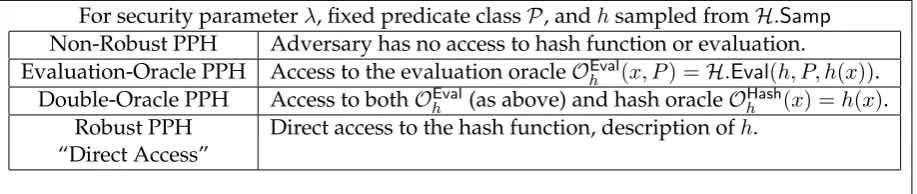
For security parameterλ, fixed predicate classP, andhsampled fromH.Samp Non-Robust PPH Adversary has no access to hash function or evaluation. Evaluation-Oracle PPH Access to the evaluation oracleOEval
h (x, P) =H.Eval(h, P, h(x)). Double-Oracle PPH Access to bothOEval
h (as above) and hash oracleOHashh (x) =h(x). Robust PPH Direct access to the hash function, description ofh.
“Direct Access”
Figure 1: A table comparing the adversary’s access to the hash function within different ro-bustness levels of PPHs.
• robust, according to one of four definitions that we describe below, leading to four notions of PPH: definition2(non-robust PPH),3(evaluation-oracle-robust PPH or EO-PPH), 5 (double-oracle-robust PPH or DO-PPH), or7 (direct-access robust PPH or DA-PPH). We will refer to the strongest form, namely direct-access robust PPH as simply robust PPH when the intent is clear from the context. See also figure1for a direct comparison between these.
The Many Types of Robustness. We will next describe four definitions of robustness for PPHs, starting from the weakest to the strongest. Each of these definitions, when plugged into the last bullet of Definition 1, gives rise to a different type of property-preserving hash function. In each of these definitions, we will describe an adversary whose goal is to produce an input and a predicate such that the hashed predicate evaluation disagrees with the truth. The difference between the definitions is in what an adversary has access to, summarized in figure1.
2.1 Non-Robust PPH
We will start by defining the weakest notion of robustness which we call non-robust PPH. Here, the adversary has no information at all on the hash function h, and is required to produce a predicate P and a valid input x, namely where P(x) 6= ~, such that H.Eval(h, P, x) 6= P(x)
with noticeable probability. WhenP is the family of point functions (or equality functions), this coincides with the notion of2-universal hash families [CW77]3.
Here and in the following, we use the notationPr[A1;. . .;Am : E]to denote the probability that eventEoccurs following an experiment defined by executing the sequenceA1, . . . , Amin order.
Definition 2. A family of PPH functionsH={h :X → Y}for a class of predicatesP is a family of
non-robustPPH functions if for anyP ∈ P andx∈Xsuch that forP(x)6=~,
Pr[h← H.Samp(1λ) : H.Eval(h, P, h(x)))6=P(x)]≤negl(λ).
2.2 Evaluation-Oracle Robust PPH
In this model, the adversary has slightly more power than in the non-robust setting. Namely, she can adaptively query an oracle that hash← H.Samp(1λ)in its head, on inputsP ∈ Pand
x ∈ X, and obtain as output the hashed evaluation resultH.Eval(h, P, h(x)). Let Oh(x, P) =
H.Eval(h, P, h(x)).
Definition 3. A family of PPH functionsH={h :X → Y}for a class of predicatesP is a family of
evaluation-oracle robust (EO-robust)PPH functions if, for any PPT adversaryA,
Pr[h← H.Samp(1λ); (x, P)← AOh(1λ) :
P(x)6=~∧ H.Eval(h, P, h(x))6=P(x)]≤negl(λ).
The reader might wonder if this definition is very weak, and may ask if it follows just from the definition of a non-robust PPH family. In fact, for total predicates, we show that the two definitions are the same. At a high level, simply querying the evaluation oracle on (even adaptively chosen) inputs cannot reveal information about the hash function since with all but negligible probability, the answer from the oracle will be correct and thus simulatable without oracle access. The proof of the following lemma is in AppendixB.1.
Lemma 4. LetP be a class of total predicates onX. A non-robust PPHHforP is also an Evaluation-Oracle robust PPH forP for the same domainXand same codomainY.
However, when dealing withpromisepredicates, an EO-robustness adversary has the abil-ity to make queries that do not satisfy the promise, and could get information about the hash function, perhaps even reverse-engineering the entire hash function itself. Indeed, Hardt and Woodruff [HW13] show that there are no EO-robustlinearhash functions for a certain
promise-`p distance property; whereas, non-robust linear hash functions for these properties follow from the work of Indyk [IM98,Ind00].
2.3 Double-Oracle PPH
We continue our line of thought, giving the adversary more power. Namely, she has access to two oracles, both have a hash functionh ← H.Samp(1λ)in their head. The hash oracleOHash
h , parameterized byh ∈ H, outputsh(x)on inputx ∈X. The predicate evaluation oracleOEval
h , also parameterized byh ∈ H, takes as input P ∈ P andy ∈ Y and outputs H.Eval(h, P, y). WhenP is the family of point functions (or equality functions), this coincides with the notion of psuedo-random functions.
Definition 5. A family of PPH functionsH={h :X → Y}for a class of predicatesP is a family of
double-oracle-robust PPH (DO-PPH)functions if, for any PPT adversaryA,
Pr[h← H.Samp(1λ); (x, P)← AOHashh ,OhEval(1λ) :
P(x)6=~∧ H.Eval(h, P, h(x))6=P(x)]≤negl(λ).
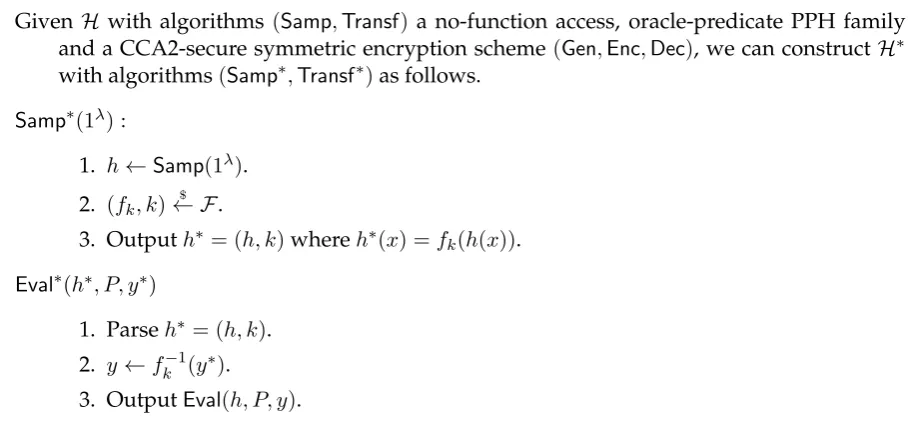
We show that any evaluation-oracle-robust PPH can be converted into a double-oracle-robust PPH at the cost of a computational assumption, namely, one-way functions. In a nut-shell, the observation is that the output of the hash function can be encrypted using a sym-metric key that is stored as part of the hash description, and the evaluation proceeds by first decrypting.
Lemma 6. LetP be a class of (total or partial) predicates onX. Assume that one-way functions exist. Then, any EO-robust PPH forPcan be converted into a DO-robust PPH forP.
2.4 Direct-Access Robust PPH
Finally, we define the strongest notion of robustness where the adversary is given the descrip-tion of the hash funcdescrip-tion itself. WhenP is the family of point functions (or equality functions), this coincides with the notion of collision-resistant hash families.
Definition 7. A family of PPH functionsH={h :X → Y}for a class of predicatesP is a family of
direct-access robustPPH functions if, for any PPT adversaryA,
Pr[h← H.Samp(1λ); (x, P)← A(h) :
P(x)6=~∧ H.Eval(h, P, h(x)))6=P(x)]≤negl(λ).
We will henceforth focus ondirect-access-robustproperty-preserving hash functions and re-fer to them simply as robust PPHs.
3
Property Preserving Hashing and Communication Complexity
In this section, we identify and examine a relationship between property-preserving hash fam-ilies (in the single-input syntax) and protocols in the one-way communication (OWC) model. A OWC protocol is a protocol between two players, Alice and Bob, with the goal of evaluating a certain predicate on their inputs and with the restriction that only Alice can send messages to Bob.
Our first observation is that non-robust property-preserving hash functions and OWC pro-tocols [Yao79] are equivalent except for two changes. First, PPHs require the parties to be computationally efficient, and second, PPHs also require protocols that incur error negligible in a security parameter. It is also worth noting that while we can reference lower-bounds in the OWC setting, these lower bounds are typically of the formΩ(n)and are not exact. On the other hand, in the PPH setting, we are happy with getting a single bit of compression, and so anΩ(n)lower bound still does not tell us whether or not a PPH is possible. So, while we can use previously known lower bounds for some well-studied OWC predicates, we need to refine them to be exactlynin the presence of negligible error. We also propose a framework (for total predicates) that yields exactlynlower bounds for INDEXn, GREATERTHAN,and EXACTHAM-MING.
3.1 PPH Lower Bounds from One-Way Communication Lower Bounds
In this section, we will review the definition of OWC, and show how OWC lower bounds imply PPH impossibility results.
Definition 8. [Yao79,KNR95] Aδ-error public-coin OWC protocolΠfor a two-input predicateP :
{0,1}n× {0,1}n→ {0,1}consists of a spaceRof randomness, and two functionsg
a:X1×R →Y
andgb :Y ×X2×R→ {0,1}so that for allx1 ∈X1andx2 ∈X2,
Pr[r ←R;y =ga(x1;r) : gb(y, x2;r)6=P(x1, x2)]≤δ.
Aδ-error public-coin OWC protocolΠfor aclass of predicatesP ={P :{0,1}n → {0,1}}, is
defined much the same as above, with a functionga:X×R→Y, and another functiongb :Y × P → {0,1}, which instead of taking a second input, takes a predicate from the predicate class. We sayΠhas
δ-error if
LetProtocolsδ(P)denote the set of OWC protocols with error at mostδ for a predicateP, and for everyΠ∈Protocolsδ(P), letYΠbe the range of messages Alice sends to Bob (the range ofga) for protocolΠ.
Definition 9. The randomized, public-coinOWC complexityof a predicateP with errorδ, denoted
RδA→B(P), is the minimum over allΠ∈Protocolsδ(P)ofdlog|YΠ|e.
For a predicate classP, we define the randomized, public-coin OWC complexity with errorδ, de-notedRA→Bδ (P), is the minimum over allΠ∈Protocolsδ(P)ofdlog|YΠ|e.
A PPH scheme for a two-input predicate4P yields a OWC protocol forP with communi-cation comparable to a single hash output size.
Theorem 10. LetP be any two-input predicateP andP ={Px}x∈{0,1}n be the corresponding
pred-icate class wherePx2(x1) = P(x1, x2). Now, letHbe a PPH in any model for P that compressesn
bits tom=ηn. Then, there exists a OWC protocolΠsuch that the communication ofΠismand with negligible error.
Conversely, the amount of possible compression of any (robust or not) PPH familyH :{h :X →
Y}is lower bounded byRA→Bnegl(λ)(P). Namely,log|Y| ≥RA→Bnegl(λ)(P).
Essentially, the OWC protocol is obtained by using the public common randomnessr to sample a hash functionh=H.Samp(1λ;r), and then Alice simply sends the hashh(x1)of her input to Bob. See AppendixC.1for the proof.
3.2 OWC and PPH lower bounds for Reconstructing Predicates
We next leverage this connection together with OWC lower bounds to obtain impossibility results for PPHs. First, we will discuss the total predicate case; we consider some partial predicates in section3.3.
As discussed, to demonstrate the impossibility of a PPH, one must give an explicitn-bit communication complexity lower bound (not just Ω(n)) for negligible error. We give such lower bounds for an assortment of predicate classes by a general approach framework we refer to as reconstructing. Intuitively, a predicate class is reconstructingif, when given only access to predicates evaluated on an inputx, one can, in polynomial time, determine the exact value ofxwith all but negligible probability.
Definition 11. A classP of total predicatesP : {0,1}n → {0,1}, isreconstructing if there exists
a PPT algorithm L (a ’learner’) such that for allx ∈ {0,1}n, given randomnessr and oracle access to
predicatesPonx, denotedOx(P) =P(x),
Pr
r[L Ox
(r)→x]≥1−negl(n).
Theorem 12. IfP is a reconstructing class of predicates on input space{0,1}n, then a PPH does not
exist forP.
Proof. We will prove this by proving the following OWC lower bound:
Rnegl(n)A→B (P) =n.
By Theorem10, this implies a PPH cannot compress the input and still be correct.
4Or rather, for the induced class of single-input predicatesP={P
x2}x2∈{0,1}n, wherePx2(x1) =P(x1, x2); we
We show that if Alice communicates any fewer thannbits to Bob, then there exists at least one pair of(x, P) ∈ {0,1}n× Psuch that the probability that the OWC protocol outputsP(x) correctly is non-negligible. Our strategy is to generate pairs (x, P) over some distribution such that, for every fixed choice of randomness of the OWC protocol, the probability that the sampled(x, P)evaluates incorrectly will be1/poly(n). We first prove that such a distribution violates the negligible-error correctness of OWC.
A bad distribution violates correctness. Let D be the distribution producing (x, P), rΠ be the randomness of a OWC protocolΠ, andgb(ga(x), P) = gb(ga(x;rΠ), P;rΠ)for ease of nota-tion. Suppose, for sake of contradiction, that our distribution had a non-negligible chance of producing an error (it is a “bad” distribution), but the correctness of the OWC protocol held. So, we have
1
poly =(x,P)∼D,rΠPr [P(x)=6 gb(ga(x), P)]
= X
(x,P)
Pr
(x,P)[
D= (x, P)] Pr[P(x)6=gb(ga(x), P)|(x, P) =D],
while the definition of negligible-error OWC protocol states that for every(x, P)pair,Pr[P(x)6=
gb(ga(x), P)]≤ negl(n). If we plug innegl(n)for the value ofPr[P(x) 6= gb(ga(x), P)|(x, P) = D], then we get
Pr
(x,P)∼D,rΠ
[P(x)6=gb(ga(x), P)] = negl(n)· X
(x,P)
Pr
(x,P)[D= (x, P)] = negl(n).
This is a contradiction, and therefore the existence of a distribution producing input-predicate pairs(x, P)that break the OWC protocol with1/polyprobability, violates the (negligible error) correctness.
Generating a bad distribution. So, fix any randomness of the OWC protocol. We will now generate such a distributionD, blind to the randomness of the protocol, that violates correct-ness of the protocol with 1/poly(n) probability. LetLbe the learner forP. We generate this attack as follows:
1. x← {$ 0,1}n.
2. r← U$ r(to fix the randomness forL).
3. SimulateL(r), answering each queryPtoOxcorrectly by computingP(x), keeping a list
P1, . . . , Ptof each predicate query that wasnotanswered with⊥. 4. i←$ [t].
5. Output(x, Pi).
We will show that the probability this attack succeeds will be Ω(1/t), wheret is the total number of queries L makes to Ox. Since L is PPT, with all but negligible probability, t = poly(n), and therefore the attack succeeds with1/poly(n)probability.
Chosexorx0in a pair. We will first compute the probability that we chose anxthat was part of some pair hashing to the same string. LetP airsbe a maximal set of non-overlapping pairs(x, x0)that map to the same things. That is for(x, x0)and(y, y0)inP airs, then none ofx, x0, y, y0 can equal each other. The fraction of elements that show up inP airsis at least1/4. ThereforePrx[choosexorx0 in a pair]≥ 14.
Chosexandx0thatL(r)reconstructs. Now assume that we have chosen either anx orx0 in
P airs(that is, fix x andx0). The probability that L distinguishes between x and x0 is at least the probability thatL correctly reconstructs both x andx0. Via a union bound,
Prr[LOx(r) =x∧LOx0(r) =x0]≥1−2negl(n) = 1−negl(n).
Choseithat distinguishesxandx0. Next, assume all previous points. Leti∗ ∈[t]be the first query at whichPi∗(x)6=Pi∗(x0). Because we fixedr,L(r)now behaves deterministically,
although adapts to query inputs, and soPi∗will be thei∗’th query fromLto both oracles
Ox andOx0, and must be answered differently (Pi∗(x) 6= Pi∗(x0)). Sincega(x) = ga(x0),
we have that gb(ga(x), Pi∗) = gb(ga(x0), Pi∗) and so either gb(ga(x), Pi∗) 6= Pi∗(x) or
gb(ga(x0), Pi∗)6=Pi∗(x0).
The probability we guessi=i∗is 1t.
Chose the bad input fromxorx0. Assuming all previous points in this list, we get that for one of xor x0, the predicate Pi is evaluated incorrectly bygb. Since we have assumed we chose one ofx or x0 (uniformly), the probability we chose the xor x0 that evaluate incorrectly is1/2.
The probability the attack succeeds. Putting all of these points together, after fixing the hash function randomness (and sufficiently largen),
Pr
L[gb(ga(x), Pi)6=Pi(x)]≥
1
4 ·(1−negl(n))· 1
t ·
1 2 ≥
1 10t.
To recap: we have shown that for every randomness for a OWC protocol, we can produce an input and predicate such that the protocol fails with polynomial-chance. This implies that the OWC protocol does not have negligible error, and furthermore that no PPH can exist for such a predicate class.
Reconstructing using INDEXn, GREATERTHAN, or EXACTHAMMING
We turn to specific examples of predicate classes and sketch why they are reconstructing. For formal proofs, we refer the reader to AppendixC.2.
• The INDEXnclass of predicates{P1, . . . , Pn}is defined overx∈ {0,1}nwherePi(x) =xi, thei’th bit ofx. INDEXnis reconstructing simply because the learnerLcan just query the each of thenindices of the input and exactly reconstruct:xi =Pi(x).
• The GREATERTHAN class of predicates {Px}x∈[2n] is defined over x ∈ [2n] = {0,1}n where Px2(x1) = 1 if x1 > x2 and 0 otherwise. GREATERTHAN is reconstructing be-cause we can run a binary search on the input space, determining the exact value of x
innqueries. GREATERTHANis an excellent example for how an adaptive learnerLcan reconstruct.
index ofx independently. For each index,Lmakes polynomially many random-string queriesrtoOx; if thei’th bit ofrequalsxi, thenris more likely to be withinn/2hamming distance ofx, and if the bits are different,ris more likely to not be withinn/2hamming distance of x. The proof uses techniques from [JKS08], and is an example where the learner uses randomness to reconstruct.
We note that it was already known that INDEXn and EXACTHAMMING(n/2) had OWC complexity ofn-bits for any negligible error [KNR95], though no precise lower bound for ran-domized OWC protocols was known for GREATERTHAN. What is new here is our unified framework.
3.3 Lower bounds for some partial predicates
In the previous section, we showed how the ability to reconstruct an input using a class of total predicates implied that PPHs for the class cannot exist. This general framework, un-fortunately, does not directly extend to the partial-predicate setting, since it is unclear how to define the behavior of an oracle for the predicate. Nevertheless, we can still take existing OWC lower bounds and their techniques to prove impossibility results in this case. We will show that GAPHAMMING(n, n/2,1/√n)(the promise version of EXACTHAMMING) cannot ad-mit a PPH, and that while Gap-kGREATERTHANhas a perfectly correct PPH compressing to
n−log(k)−1bits, compressing any further results in polynomial error (and thus no PPH with more compression).
First, we define these partial predicates.
Definition 13. The definitions forGAPHAMMING(n, d, )and Gap-kGREATERTHANare:
• TheGAPHAMMING(n, d, )class of predicates{Px}x∈{0,1}nhasPx2(x1) = 1if||x1−x2||0 ≥
d(1 +),0if||x1−x2||0≤d(1−), and~otherwise.
• The Gap-kGREATERTHANclass of predicates{Px}x∈[2n]hasPx2(x1) = 1ifx1 > x2+k,0if
x1 < x2−k, and~otherwise.
Now, we provide some intuition for why these lower bounds (and the upper bound) exist.
Gap-Hamming. Our lower bound will correspond to a refined OWC lower bound for the Gap-Hamming problem in the relevant parameter regime. Because we want to prove that we cannot even compress by a single bit, we need to be careful with our reduction: we want the specific parameters for which we have a lower bound, and we want to know just how the error changes in our reduction.
Theorem 14. There does not exist a PPH forGAPHAMMING(n, n/2,1/√n).
To prove, we show the OWC complexityRA→Bnegl(n) (GAPHAMMING(n, n/2,1/√n)) = n. A
Ω(n)OWC lower bound for Gap-Hamming in this regime has been proved in a few different ways [Woo04, Woo07, JKS08]. Our proof will be a refinement of [JKS08] and is detailed in appendixC.3.1.
The high-level structure of the proof is to reduce INDEXnto GAPHAMMINGwith the correct parameters. Very roughly, theith coordinate of an inputx ∈ {0,1}ncan be inferred from the bias it induces on the Hamming distance betweenxand random public vectors. The reduction adds negligible error, but since we requirenbits for negligible-error INDEXn, we also require
Notice that this style of proof looks morally as though we are “reconstructing” the inputx
using INDEXn. However, the notion of getting a reduction from INDEXnto another predicate-class in the OWC model is not the same as being able to query an oracle about the predicate and reconstruct based off of oracle queries. Being able to make a similar reconstructing charac-terization of partial-predicates as we have for total predicates would be useful and interesting in proving more lower bounds.
Gap-k GreaterThan. This predicate is a natural extension of GREATERTHAN: we only care about learning thatx1 < x2if|x1 −x2|is larger thank(the gap). Intuitively, a hash function can maintain this information by simply removing thelog(k)least significant bits from inputs and directly comparing: if h(x1) = h(x2), they can be at most k apart. We can further re-move one additional bit using the fact that we knowx2when givenh(x1)(considering Gap-k GreaterThan as the corresponding predicate class parameterized byx2).
For the lower bound, we prove a OWC lower bound, showingRA→Bnegl(n)(P) =n−log(k)−1. This will be a proof by contradiction: if we compress ton−log(k)−2bits, we obtain many collisions that are more than3.5kapart. These far collisions imply the existence of inputs that the OWC protocol must fail on, even given the gap. We are able to find these inputs the OWC must fail on with polynomial probability, and this breaks the all-but-negligible correctness of the protocol. Our formal theorem statement is below.
Theorem 15. There exists a PPH with perfect correctness for Gap-k GREATERTHAN compressing fromnbits ton−log(k)−1. This is tight: no PPH for Gap-kGREATERTHANcan compress to fewer thann−log(k)−1bits.
For the proof, see appendixC.3.2.
4
Two Constructions for Gap-Hamming PPHs
In this section, we present two constructions of PPHs for GAPHAMMING. Recall from section 3.3that the gap-Hamming propertyP =GAPHAMMING(n, d, )is parameterized by the input domain{0,1}n, an integerd∈[n]and a parameter∈
R≥0, so thatP(x1,x2) = 1if||x1⊕x2||0≥
d(1 +)and0 if||x1 ⊕x2||0 ≤ d(1−). Both of our constructions will distinguish between
d(1−)-close and d(1 +)-far vectors for d ≈ O(n/logn). This means that the gap is quite large, approximatelyO(n/logn).
Our two constructions offer different benefits. The first provides a clean general approach, and relies on the standard cryptographic assumption of collision-resistant hash functions. The second takes a different approach, building on a one-way communication protocol for GAPHAMMING of [KOR98]. The latter construction supports a smaller gap and better effi-ciency, and ultimately relies on a (new) variant of the syndrome decoding assumption on low-density parity check codes. Both our constructions are two-input PPH construction, which are more general than single-input constructions that support a predicate class (see Lemma33).
4.1 A Gap-Hamming PPH from Collision Resistance
Our first construction is a robustm/n-compressing GAPHAMMING(n, d, )PPH for anym =
nΩ(1), d = o(n/logλ) and any constant > 0. Security of the construction holds under the (standard) assumption that collision-resistant hash function families (CRHFs) exist.
are close, then most small enough subsets of indices of x1 and x2 will match identically. On the other hand, ifx1 andx2 arefar, then most large enough subsetsof indices will differ. This leads us to the first idea for the construction, namely, fix a collection of setsS ={S1, . . . , Sk} where eachSi ⊆ [n]is a subset of appropriately chosen size s. On inputx ∈ {0,1}n, output y= (x|S1, . . . ,x|Sk)wherex|Sdenotes the substring ofxindexed by the setS. The observation above tells us that ifx1andx2are close (resp. far), so arey1andy2.
However, this does not compress the vectorx. Since the union of all the setsS
i∈[k]Sihas to be the universe[n](or else, finding a collision is easy), it turns out that we are just comparing the vectors index-by-index. Fortunately, it is not necessary to outputx|Siby themselves; rather we can simply output the collision-resistant hashes. That is, we will let the PPH hash of x, denoted y, be (g(x|S1), . . . , g(x|Sk)) where g is a collision resistant hash function randomly drawn from a CRHF family.
This simple construction works as long ass, the size of the setsSi, isΘ(n/d), and the collec-tionSsatisfies that any subset of disagreeing input indicesT ⊆[n]has nonempty intersection with roughly the corresponding fraction of subsetsSi. The latter can be achieved by selecting theSi of sizeΘ(n/d)at random, or alternatively as defined by the neighbor sets of a bipartite expander. We are additionally constrained by the fact that the CRHF must be secure against adversaries running in timepoly(λ). So, lett= t(λ)be the smallest output size of the CRHF such that it ispoly(λ)-secure. Since the input sizesto the CRHF must beω(t)so thatgactually compresses, this forcesd=o(n/t).
Before presenting our construction more formally, we define our tools.
• We will use a family of CRHFs that take inputs of variable size and produce outputs of
tbits and denote it byHt ={h : {0,1}∗ → {0,1}t}. We implicitly assume a procedure for sampling a seed for the CRHF given a security parameter 1λ. One could set t =
ω(logλ)and assume the exponential hardness of the CRHF, or sett=λO(1) and assume polynomial hardness. These choices will result in different parameters of the PPH hash function.
• We will use an(n, k, D, γ, α)-bipartite expanderG = (L∪R, E)which is aD-left-regular bipartite graph, with|L|=nand|R|=ksuch that for everyS ⊂Lfor which|S| ≤γn, we have|N(S)| ≥ α|S|, whereN(S) is the set of neighbors ofS. For technical reasons, we will need the expander to beδ-balanced on the right, meaning that for everyv ∈ R, |N(v)| ≥(1−δ)nD/k.
A simple probabilistic construction shows that for everyn ∈ N,k = o(n)and constant
a ∈ (0,1), and any γ = o(nlog(n/k)k ) andD = Θ(log(1/γ))so that for every δ > 0, δ -balanced(n, k, D, γ, α)-bipartite expanders exist. In fact, there are even explicit efficient constructions that match these parameters [CRVW02]. The formal lemma statement and proof are given in AppendixD.1.
We next describe the general construction, and then discuss explicit parameter settings and state our formal theorem.
Setting the Parameters. The parameters required for this construction to be secure and con-structible are as follows.
• Letn∈Nand constant >0.
Robust GAPHAMMING(n, d, )PPH familyHfrom any CRHF Our(n, m, d, )-robust PPH familyH= (H.Samp,H.Eval)is defined as follows.
• H.Samp(1λ, n). Fix a δ-balanced (n, k, D, γ, α)-bipartite expander G = (L∪R, E)
(either deterministically or probabilistically). Sample a CRHFg← Ht. Outputh = (G, g).
• H.Hash(h = (G, g),x). For everyi ∈[k], compute the (ordered) set of neighbors of thei-th right vertex inG, denotedN(i). Letxˆ(i) := x|N(i) bexrestricted to the set
N(i). Output
h(x) := g(ˆx(1)), . . . , g(ˆx(k))
as the hash ofx.
• H.Eval(h = (G, g),y1,y2). Compute the thresholdτ = D·d·(1−). Parse y1 =
(ˆy(1)1 , . . . ,yˆ(k)1 )andy2= (ˆy(1)2 , . . . ,yˆ (k)
2 ). Compute
∆0 =
k X
i=1
1(ˆy1(i)6= ˆy2(i)),
where1denotes the indicator predicate. If∆0 ≤τ, outputCLOSE. Otherwise, out-putFAR.
wheren is the size of the left side of the graph, kis the size of the right,D is the left-degree,γnis the upper bound for an expanding set on the right that expands to a set of sizeαtimes the original size.
• These building blocks yield the following parameters for the construction: compression isη = kt/nand our center for the Gap-Hamming problem is bounded by (1+)γn ≤ d <
k D(1−).
If we consider what parameter settings yield secure CRHFs with output sizetand for what parameters we have expanders, we have a PPH construction where given anynand, there exists ad = o(n) andη = O(1)such that Construction1is a robust PPH for gap-Hamming. We will see that the smallertis, the stronger the CRHF security assumption, but the better our compression.
Now, given these settings of parameters, we will formally prove Construction1is a robust Gap-Hamming PPH.
Theorem 16. Letλbe a security parameter. Assuming that exponentially secure CRHFs exist, for any polynomialn=n(λ), and any constants, η >0, Construction1is anη-compressing robust property preserving hash family forGAPHAMMING(n, d, ) whered = o(n/logλlog logλ). Assuming only that polynomially secure CRHFs exist, for any constantc >0, we achieved=o(n/λc).
Proof. Before getting into the proof, we more explicitly define the parameters ti include param-eters associated with the expander in our construction. Once we have defined these parame-ters, we will show how each of these parameters is used to prove the construction is correct and robust. So, in total, we have the following paramters and implied constraints for our construction (including the graph):
1. Letn∈Nbe the input size and let >0be any constant. 2. Our CRHF isHt={g:{0,1}∗→ {0,1}t}.
3. Our expander will be aδ-balanced(n, k, D, γ, α)-expander, wherek < n/t,γ =o(nlog(n/k)k ),
D= Θ(log(1/γ)), andα > D·d(1−)γn .
4. Our center for the gap-hamming problem isd, and is constrained by 1+γn ≤d < D(1−)k .
5. Constraint 4 implies thatk=nΩ(1), sinceγn·D(1−)1+ < k.
Now, we prove our construction is well-defined and efficient. Fix anyδ, a ∈ (0,1). Using lemma 47, proved in the appendix, we know that δ-balanced (n, k, D, γ, α = an)-bipartite expanders exist and can be efficiently sampled for k = o(n/logn), D = Θ(log logn), and
γ = ˜Θ(1/logn). Thus, samplingGbefore running the construction is efficient. Once we have aG, sampling and running a CRHFk = O(n) times is efficient. Comparingkoutputs of the hash function is also efficient. Therefore, each ofH.Samp, H.Hash, andH.Evalis efficient in
λ= poly(n).
Now, we prove that Construction1is compressing. Points 2 and 3 mean thatm = k·t < n/t·t=n, as required.
Lastly, we will prove our construction is robust. LetAbe a PPT adversary. We will show thatA (in fact, even an unbounded adversary) cannot findx1 andx2 such that||x1 −x2|| ≤
• First, consider anyx1,x2 ∈ {0,1}nwhere||x1−x2||0 ≤d(1−). Let∆ =||x1−x2||0. So, consider the setS ⊂Lcorresponding to the indices that are different betweenx1andx2, andT =N(S)⊂R. The maximum size ofT is|S| ·D, the degree of the graph.
For every i ∈ T, we get that the intermediate computation has xˆ(i)1 6= ˆx(i)2 , but for ev-ery j 6∈ T, we have xˆ(j)1 = ˆx2(j) which implies yˆ1(j) = ˆy(j)2 after applying g. Therefore Pk
i=11(ˆy (i) 1 6= ˆy
(i) 2 )≤
P
i∈S1(ˆy (i) 1 6= ˆy
(i) 2 ) +
P
j6∈S1(ˆy (j) 1 6= ˆy
(j)
2 )≤∆·D.
We set the thresholdτ =D·d·(1−)in the evaluation. Point 4 guarantees thatτ < k
(and implicitly impliesk > D(1−)), so becauseD·∆≤D·d(1−) =τ < k,H.Evalwill evaluate∆0 ≤τ. Thus,H.Evalwill always evaluate toCLOSEin this case, regardless of the choice of CRHF.
• Now consider||x1−x2||0 ≥ d(1 +), and again, let∆ = ||x1 −x2||0 and defineS ⊂ L andT ⊂Ras before.
By point 4 again (γn ≤ d(1 +)), we can restrict S to S0 where |S0| = γn, and by the properties of expanders|N(S0)| ≥γn·α. Now, point 3 guarantees thatτ =D·d·(1−)< α·γn. So, for everyi ∈ T0,xˆ(i)1 6= ˆx(i)2 , and |T0| ≥ α·γn > τ. Now we want to argue that with all but negligible probability over our choice ofg,gwill preserve this equality relation, and so ∆0 = |T0|. Given that our expander is δ-balanced for some constant
δ >0, we have that|xˆ(i)1 |=|xˆ(i)2 |=|N(ri)| ≥(1−δ)nD/k. Now, point 3 states that the constraints havek < n/t, implyingn/k > t. So,(1−δ)D·n/k >(1−δ)D·t.
This means that every input to g will be larger than the output ((1−δ) is a constant andD = ω(1)), and so if g(ˆx(i)1 ) = g(ˆx(i)2 ) butxˆ(i)1 6= ˆx(i)2 for anyi, then our adversary has found a collision, which happens with all but negligible probability for adversaries running in timepoly(λ).
Therefore, with all but negligible probability over the choice ofgand adversarially cho-senx1 andx2 in this case,∆0 = Pm
0
i=11(ˆy (i) 1 6= ˆy
(i)
2 ) ≥ α·γn = τ, andH.Evaloutputs
FAR.
4.2 A Gap-Hamming PPH from Sparse Short Vectors
In this section, we present our second family of robust property-preserving hash (PPH) func-tions for gap Hamming distance. The construction proceeds in three steps: in Section4.2.1, we start with an (unconditionally) secure non-robust PPH; in Section4.2.2, we build on this to construct a robust PPH with a restricted input domain; and finally, in Section4.2.3, we show how to remove the restriction on the input domain.
The construction is the same as the collision-resistant hash function construction in the work of [AHI+17]. In a single sentence, our observation is that theirinput-localhash functions are locality-sensitive and thus give us a robust gap-Hamming PPH (albeit under a different assumption). We proceed to describe the construction in full for completeness.
4.2.1 Non-Robust Gap-Hamming PPH
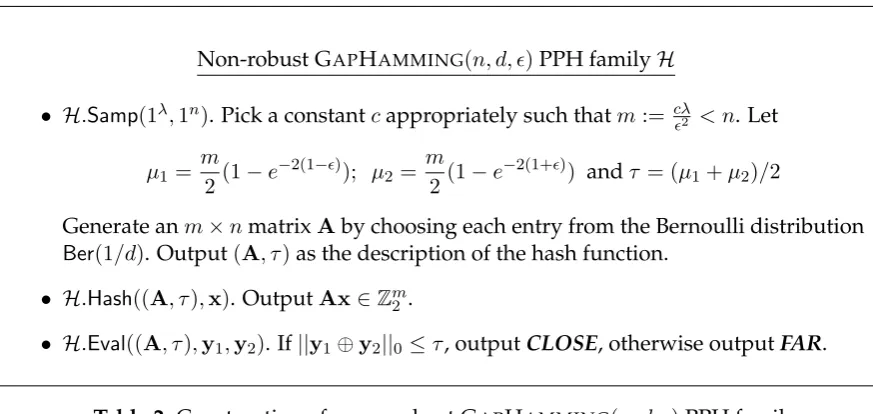
Non-robust GAPHAMMING(n, d, )PPH familyH
• H.Samp(1λ,1n). Pick a constantcappropriately such thatm:= cλ2 < n. Let
µ1=
m
2(1−e
−2(1−)
); µ2=
m
2 (1−e
−2(1+)
) andτ = (µ1+µ2)/2
Generate anm×nmatrixAby choosing each entry from the Bernoulli distribution Ber(1/d). Output(A, τ)as the description of the hash function.
• H.Hash((A, τ),x). OutputAx∈Zm 2 .
• H.Eval((A, τ),y1,y2). If||y1⊕y2||0≤τ, outputCLOSE, otherwise outputFAR.
Table 2: Construction of a non-robust GAPHAMMING(n, d, )PPH family.
about the Hamming weight ofz; in particular, it distinguishes between the cases that the Ham-ming weight is much larger thandversus much smaller. Furthermore, since this hash function is linear, it can be used to compress two inputsxandyindependently and later compute their Hammingdistance. The construction is described in Table2.
Lemma 17([KOR98]). Letλbe a security parameter. For everyn∈ N,d∈[n]and= Ω(pλ/n), Construction2is a non-robust PPH forGAPHAMMING(n, d, ).
Proof. First, we note that His compressing. We havem = cλ2 and = Ω( p
λ/n). Therefore, if we have chose c appropriately, there exists another constant c0 < 1 such that m ≤ c0n. Compression is why we require a lower bound on epsilon.
Now, we show thatHsatisfies the non-robust notion of correctness. For anyx1 andx2 ∈ {0,1}n, letz=x
1⊕x2.H.Eval(Ax1,Ax2)tests if||Az||0 ≤τ. We will show that for allz, with all but negligible probability over our choice ofA, this threshold test will evaluate correctly.
To do this, we will invoke the (information theoretic) XOR lemma. That is, if ||z||0 = k, then forai
$
←Ber(p)n,Pr[a
i·z= 1] = 12(1−(1−2p)k). Our hash function hasp= 1/d, so now, we will apply this to our two cases forz:
• ||z||0 ≤d(1−). We have thatPr[ai·z= 1] = 12(1−(1−2d)d(1−))∼ 21(1−e2(11−))by the XOR lemma. We get that for allzsuch that||z||0 ≤d(1−),
E
A
[||Az||0] =m·Pr ai
[ai·z= 1]≤
m
2(1− 1
e2(1−)) :=µ1
• ||z||0 ≥d(1 +). Again, using the XOR lemma, and plugging ink =d(1 +), we have that,
E
A
[||Az||0] =m·Pr ai
[ai·z= 1]≥
m
2(1− 1
e2(1+)) :=µ2
• ||z||0 ≤d(1−). Recall that µ1 = m2(1−e2(11−)). Letτ = (1 +δ)µ1. A Chernoff bound states that
Pr
A[||Az||0≥τ]≤e
−δµ1/3
Now we will ensure thate−δµ1/3 = negl(λ). Using τ, we can compute δ exactly to be 1
2(
e−2(1−)−e−2(1+)
(1−e−2(1−)) ). We will use the fact thate
2−e−2 >4
for all >0.
Now, using our expression forµ1, we get that
e−δµ1/3= exp[−δ·m
2(1−e
−2(1−))]
= exp[−1
2 ·
e−2(1−)−e−2(1+)
1−e−2(1−) !
· cλ
22(1−e
−2(1−))]
= exp[−1
2(e
−2(1−)−e−2(1+))· cλ
22]
∼exp[−1
2 · 4 e2 ·
cλ
22] = exp[ −cλ
e2 ] = negl(λ)
• ||z||0 ≥d(1 +). Recall thatµ2 = m2(1− e2(1+)1 ). Given our expression ofτ, we have that
τ = (1−δ)µ2. We will use the same strategy as in the previous case to show correctness, showing
e−δ2µ2/2≤e−λ
So, recall thatδ= 12(e−2(1(1−e−)−−e2(1−−2(1+))) ), and notice that(1−e
−2(1+))≥1−e−2 > 4 5 for all
>0. We compute
e−δ2µ2/2 = exp[−δ2m
2(1−e
−2(1+)
)]
≤exp[−δ2 cλ
22 ·
4
5] = exp[− 2 5 ·δ
2cλ
2]
≤exp[−2
5 · 1 4
e−2(1−)−e−2(1+)
(1−e−2(1−)) !2
·cλ
2]
≤exp[−1
10 ·
e−2(1−)−e−2(1+)
1
!2 ·cλ
2]
≤exp[−1
10 ·(e
−2(e2−e−2))2·cλ
2]
≤exp[−1
10 · 162
e4 ·
cλ
2] = exp[−
8cλ
5e4] = negl(λ)
In both cases, the probability that we choose a bad matrixAfor a fixed inputzis negligible in the security parameter, proving the lemma.
4.2.2 Robust Gap-Hamming PPH with a Sparse Domain
lemma17, we computed the probability that afixedlow-weight vector maps to a high-weight vector (on multiplication by the sparse matrixA). The number of low-weight vectors is small enough that by a union bound, the probability thatthere existsa low-weight vector that maps to a high-weight vector is small as well.
To address the second line of attack, we unfortunately cannot make an information-theoretic argument (to be expected, as we compress beyond the information theoretic limits). Indeed, one possible attack is simply to use Gaussian elimination on A to come up with non-zero (probably high-weight) vector that maps to 0. Because A has a non-trivial null-space, this attack is likely to succeed.
To thwart such attacks, we leverage one of the following two loopholes that circumvent Gaussian elimination: (1) our first approach is to consider linear functions withsparsedomains, restricting the input to be vectors of weight≤βnfor constantβ <1/2, and so Gaussian elim-ination no longer works; and (2) building on this, we extend this to anon-linearconstruction where the domain is the set of all strings of a certain length. Our construction relies on the fol-lowing hardness assumption that we refer to as the “sparse short vector” (SSV) assumption. The SSV assumption is a variant of the syndrome decoding problem on low-density parity-check codes, and roughly states that it is hard to find a preimage of a low-weight syndrome vector for which the preimage has “medium” weight.
Definition 18. Letn∈ N. Letβ, α, ηˆ ∈ [0,1]andω, τ ∈ [n]. The( ˆβ, α, ω, τ, η)-SSV (Sparse Short Vector) assumption states that for any PPT adversaryAgiven anηn×nmatrixAwith entries sampled fromBer(α),
Pr A∼Ber(α)ηn×n
h
A(A)→z∈ {0,1}n:ω≤ ||z||
0≤βnˆ and||Az||0 ≤τ i
= negl(n).
On the Assumption. We now consider attacks on the SSV assumption which help us refine the parameter settings.
One way to attack the assumption is to solve the syndrome decoding problem for sparse parity-check matrices (also called the binary short vector problem or bSVP in [AHI+17]). In particular, find aβˆ-sparsez such thatAz = 0. To thwart these attacks, and at the same time have a compressing PPH construction, we need at the very minimum thatH( ˆβ/2)> η >2 ˆβ.
η < H( ˆβ/2)ensures compression. Recall that we hash elementsx1 andx2 in the hopes of being able to approximate their hamming distance. We havez=x1⊕x2is the vector we want to compute gap-hamming on, and so to guaranteez has sparsity βˆ,x1 andx2 need sparsity
ˆ
β/2 =β. Vectorx1,x2 ∈ {0,1}nof weight at mostβn/ˆ 2require (asymptotically)H( ˆβ/2)nbits each to describe, and soηnneeds to be less than that.
η > 2 ˆβ is for security. Ifηn≤2 ˆβn, then we are able to use Gaussian elimination to find a
ˆ
β-sparse vector. Consider anηn×nmatrixA, and the firstηn×ηnsquare of it, call itA0. Use Gaussian elimination to compute anηn-length vectorz0 such thatA0z0 = 0. Paddingz0 with
0’s, we getzwhereAz=0. We expect||z||0 =ηn/2, and sinceηn/2≤βnˆ , we have broken the assumption.
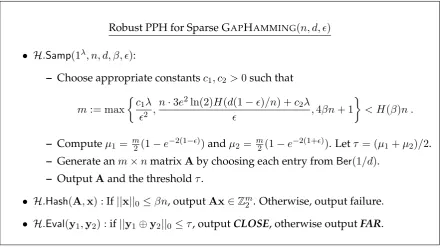
combina-Robust PPH for Sparse GAPHAMMING(n, d, )
• H.Samp(1λ, n, d, β, ):
– Choose appropriate constantsc1, c2>0such that
m:= max
c1λ
2 ,
n·3e2ln(2)H(d(1−)/n) +c2λ
,4βn+ 1
< H(β)n .
– Computeµ1= m2(1−e−2(1−))andµ2 = m2(1−e−2(1+)). Letτ = (µ1+µ2)/2.
– Generate anm×nmatrixAby choosing each entry fromBer(1/d).
– OutputAand the thresholdτ.
• H.Hash(A,x) :If||x||0 ≤βn, outputAx∈Zm
2 . Otherwise, output failure.
• H.Eval(y1,y2) :if||y1⊕y2||0 ≤τ, outputCLOSE, otherwise outputFAR.
Table 3: Construction of a robust PPH for sparse-domain GAPHAMMING(n, d, ).
torially [Gal63,LS02], and, presumably, computationally. For a more detailed discussion, we refer the reader to [AHI+17].
We will set the sparsity parameterα ≥ c/nfor a large enough constantc, or to be conser-vativeα≥logn/nto ensure that w.h.p. there are no all-0 columns.
Finally, we point out that when the matrix A is uniformly random and not sparse, SSV (where the adversary has to map small vectors to tiny vectors) is equivalent to bSVP (where the adversary has to map small vectors to0). We briefly sketch how to reduce bSVP to SSV for a uniformly randomA. The reduction takes an instance of bSVP, a matrixB= [B1||B2]where B2is square, and generates the matrixA:=B−12 B1as an instance of SSV. If the adversary finds x1,x2such thatB2−1B1x1 =x2solving SSV, then we have[B1||B2]·[xT1||xT2] = 0, solving bSVP. However, this reduction does not work whenA is sparse, though this connection indicates that the SSV problem is also hard.
Robust Hashing Construction for Gap-Hamming. Let the problem β-Sparse Gap-Hamming
be the same as GAPHAMMING, except we restrict the domain to be over x ∈ {0,1}n with sparsity||x||0≤βn. Our construction of a robust PPH forSparse Gap-Hammingis as follows.
Settings Parameters from SSV Assumption to the Sparse Domain Construction Our main tool in this construction is the SSV assumption. So, here we consider a very conservative parameter setting for the SSV assumption, and show what parameters we acheive for ourβ -Sparse Gap-Hamming construction.
• n∈Nand= Ω(pλ/n).
• Let the(β, α, ω= (1 +)/α, τ, η)-SSV be true for the following parameters: 0< β≤0.04
is a constant (this needs to be true in order to have4β < H(β)),α ≥logn/n,τ = ηn4 (e−