Abstract – Teaching mathematics, physics, chemistry remained a challenge for centuries. It has become more challenging in the twenty-first century due to rapid advancement of technologies. With the rapid advancement of technologies, mathematics, physics and other science subjects are developing at an accelerated rate. Day by day new topics are being added and the old topics are getting facelift. But the teaching methodology of these subjects remained stagnant for centuries. This is creating a huge gap between the required skill and the actual skill of students. Majority of the students struggling to keep pace with the new developments. One of the main problems in the present technique of teaching science is that it teaches mathematics, physics, chemistry, etc., in isolation. Students learn many topics in isolation. I have developed an integrated teaching technique which teaches science in an integrated way. The new teaching methodology is based on the philosophy that “I listen-I forget, I see-I remember, I do-I understand”. The objective is to teach mathematics and science in an easy and enjoyable way within a short period of time.
In this paper, an attempt has been made to demonstrate the conic section in mathematics with the parametric equations clubbed with Kepler’s Law of planetary motion of physics with the use of MS Excel to model and demonstrate related topics. Here the topic starts with the definition of conic section, then demonstration of ellipses with different construction methods, like compression method, major and minor axis method, latus rectum methods, etc, and then explain Kepler’s law with the help of new knowledge. Later the ellipse theory is used to explain other conic sections. The intergradations of theory and practical helps in better understanding of the subject.
Index Terms—homogenous, coordinates, Kepler’s law, conic sections, transformation
I. INTRODUCTION
athematics in an abstract subject and the definition of mathematics is also abstract and philosophical. One of the search in internet produces the definition of mathematics as - “the abstract science of number, quantity and space, either as abstract concept (pure mathematics) or as applied to other disciplines such as physics and engineering (applied mathematics).
As per Wikipedia, definitions of mathematics vary widely and different schools of thought, particularly philosophy, have suggested radically different and controversial accounts. There are hundreds of definition of mathematics. Different people tried to define mathematics differently. Absence of proper definition of mathematics makes mathematics ambiguous and teaching of mathematics more ambiguous and difficult. So before proceeding to main article, I am trying to
put my definition with some explanation for consideration. Some of the activities like counting, comparing, measuring involve different number systems and their binary operations. Here, no high level mathematics is involved. But when we are required to find the area of a circle, we cannot directly measure the area. We measure the diameter of the circle and calculate the area of the circle by using the established relationship between area and diameter:
𝐴𝑟𝑒𝑎 =𝜋
4× 𝑑𝑖𝑎𝑚𝑒𝑡𝑒𝑟2
Here, our intention was to understand and calculate a parameter (Area) of a system (Circle). As the area of a circle cannot be measured directly, we have measured the diameter (length) and calculated the area. So with this reasoning mathematics is the activity to know more about a system and its behavior. Hence, mathematics is the activity to find unknown parameters of a system (which cannot be measured directly) from some known parameter of the system. For the circle, the known parameter was length and the unknown parameter is the area.
Further refinement of the definition will suggest that it is the establishment of the relationship between different parameters of a system. So there will be a known parameter and an unknown parameter. If we try to interpret these two parameters as x and y, then it represents a point. This information removes the abstractness of mathematics and helps in teaching mathematics in an easy and enjoyable way.
II. OBJECTIVE AND SCOPE
As we have defined mathematics as a process of finding a point in space, it removes the abstraction of mathematics and gives a direction for solving mathematical problems. Now, we are concerned with finding a point in space. More specifically it can be said that mathematics is to find an unknown parameter (y) when a known parameter (x) is given. So, we term x as an independent variable and y is the dependent variable. So mathematics is the process of finding one unknown when a known parameter is given. This information sets clear objective of doing mathematics but how this information helps in learning mathematics when there are millions of systems around the world?
There is a good news. When systems are infinite, the line representing their relationship is finite. Hence instead of learning millions of systems in isolation, it is better to learn the characteristics of lines, then learning mathematics will become easy and enjoyable.
Another problem of teaching mathematics is the difficulty in reproduction of the system being taught. For the case of a circle as mentioned earlier, it is easy to define a circle but very difficult to draw it. This is another issue that makes
Teaching Mathematics in Twenty–First Century:
An Integrated Approach
Chanchal Dass
M
understanding of mathematical concepts very difficult. In this paper, I will try to follow the geometrical definition of mathematical concepts and discuss easy way reproducing mathematical concepts with the help of MS Excel.
III. RESEARCH METHODOLOGY
In this paper I will explain about conic sections. I will start with a circle, define the circle and then try to generate data to draw the circle and then draw the circle with this information. I will describe ellipse and then establish Kepler’s law and finally relate this idea with other conic sections like parabola and hyperbola.
A. Circle
The definition of circle states that a circle is the set of all points in a plane that are equidistant from a fixed point. The fixed point is called the center of the circle and the distance from the center to a point on the circle is called radius of the circle.
Now if the center is at a point with coordinates (h, k) and (x, y) is any point on the circle, then from the distance formula we can write, 𝑟 = √(𝑥 − ℎ)2+ (𝑦 − 𝑘)2, where r is the radius of the circle.
If the center of the circle is at the origin, h = 0, k = 0, then equation of circle becomes 𝑟 = √𝑥2+ 𝑦2 or𝑥2
𝑟2+
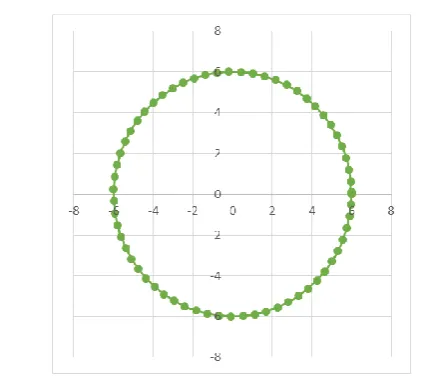
𝑦2 𝑟2= 1. This is an implicit equation and generating the data of x and y from this relationship for drawing the circle in very difficult. The circle can be easily generated from the polar form in which, x = rcos(t) and y = rsin(t), where r is the radius of the circle and t is the angle. For a circle, r is constant and t varies from 0 to 2π radians. Let r = 2. We have generated the circle in MS-Excel as shown in figure– 1.
B. Linear Transformation
There are six types of transformations. They are: 1. Scaling
2. Shearing 3. Reflection 4. Rotation 5. Translation 6. Projection
With the help of a 2x2 matrix, transformations like scaling, shearing, reflection and rotation can be achieved. For translation and projection, we are required to introduce homogenous co-ordinate system and a 3x3 matrix is required for these transformations.
B.1 Transformation Matrix
A transformation matrix is a 2x2 matrix like [𝑎 𝑏
𝑐 𝑑]. The
elements a and d are called main diagonal elements and result in scaling. Scaling in related to enlargement or compression of an object. The characteristic of scaling is that it increases or decreases size. When uniform scaling is applied, the object retains its shape but size changes.
The elements c and d in the transformation matrix are called the off diagonal elements. These elements result in shearing of the object.
Reflection can be achieved from an easy maneuver of the four elements a, b, c and d. If a = -1, [−1 0
0 1], then the
object is reflected about y – axis. If the matrix is [1 0
0 −1],
then the reflection is about x axis. For the matrix [0 1
1 0],
the reflection is about the y = x line.
Rotation of an object requires special treatment. Here all the points related to the object is to be rotated at an equal angle. This is achieved by the transformation matrix
[ cos 𝑡 sin 𝑡
− sin 𝑡 cos 𝑡], where ‘t’ is the angle of rotation. B.2 Addition of scroll bar
Scroll bar is a special tool in MS Excel through which the value of a parameter can be changed from a minimum value to a maximum value. The scroll bar is available in the developer menu. The scroll can bar be added in the worksheet to change the rotation angle (t) uniformly for the four elements of the rotation matrix.
B.3. Homogenous coordinate system
[image:2.595.53.265.459.648.2]With a 2x2 transformation matrix, we have achieved four types of transformations: scaling, shearing, reflection and rotation. For translation and projection transformations we are required to use homogeneous coordinate system. Homogeneous coordinate system was introduced by August Ferdinand Mobius during 1827. In homogeneous coordinate system, 3 elements (x, y, h) are used to represent a point in space. In Cartesian coordinate system 2 elements (x, y) are required to represent a point in space. First two elements in homogeneous co-ordinate system and the 2 elements in Cartesian co-ordinate system carry same meaning. The third element of the homogeneous co-ordinate system represents a point in a plane h distance away from a plane whose h value is 1. So a point (x, y) in Cartesian Co-ordinate and a point (x, y, 1) in homogeneous co-ordinate are same. If h is greater than or less than 1, then it represents a point in a plane away from the plane with h=1. If a point with h>1 is projected back to a plane with h=1, then the object will appear smaller. This is the case with the points at infinity. When we see an object far away from my place, we see it much smaller than its actual size. When h<1, then the object appears larger in size.
B.4.Matrix Multiplication
We have learned that any object can be transformed by matrix multiplication. A 2x2 transformation matrix can transform a large object comprised of thousands of points. The requirement for matrix multiplication is that the number column of first matrix should be equal to the number of rows in the second matrix. MS Excel has a very good tool for matrix multiplication. The function is: MMULT(array1, array2). How to use the function is given below:
STEP 1: Select an empty array of cells, where you want the output to be displayed. The dimensions of the array should be that of the expected product of the multiplication. Like if you’re multiplying an MxN and an NxL matrix, the output will be an MxL matrix.
STEP 2: Go to the formula bar. Type (without quotes): ‘=MMULT(<manually select the MxN matrix>, <NxL matrix>)’.
STEP 3: Press F2. Then press Ctrl+Shift+Enter
We will take up a triangle with vertices (1, 0), (3, 0), (2, 3) to demonstrate different transformations. The data for the transformation, corresponding matrices, resulting objects and their graphs are given below:
Table I: Scale up 4 times X Y Scaling X* Y*
[ 1 0 3 0 2 1 30
] × [2 00 2] = [
2 0 6 0 4
2 60
]
Table II: Scale down 4 times
X Y Scaling X* Y*
[ 1 0 3 0 2 1 30
] × [0.5 0
0 0.5] = [
0.5 0
1.5 0
1 0.5 1.50
]
Table III: 90o rotation X Y Rotation X* Y*
[ 1 0 3 0 2 1 30
] × [ 0 1
−1 0] = [
0 1
0 3
−3
0 21
]
Table IV: Shearing X Y Shearing X* Y*
[ 1 0 3 0 2 1 30
] × [1 21 1] = [
1 2 3 6 5
1 72
]
Table V: Reflection about Y axis X Y
Reflection about Y
axis
X* Y*
Fig. 4: Rotation by 90o
0 1 2 3 4
-4 -3 -2 -1 0 1 2 3 4
Original Rotated
Fig. 5: Shearing
0 1 2 3 4 5 6 7 8
0 1 2 3 4 5 6
Original Sheared
Fig 6. Reflection about Y axis
0 1 2 3
-3 -2 -1 0 1 2 3
Original Reflection
Fig. 2. Scale up 4 times
1, 0 3, 0
2, 3
1, 0 2, 0 6, 0
4, 6
2, 0 0
1 2 3 4 5 6 7
0 1 2 3 4 5 6 7
Original Scaled
1, 0 3, 0
2, 3
1, 0
0.5, 0 1.5, 0
1, 1.5
0.5, 0 0 1 2 3 4
0 1 2 3 4
[ 1 0 3 0 2 1 30
] × [−1 00 1] = [
−1 0 −3 0 −2
−1 30
[image:4.595.61.262.35.615.2]]
Table VI: Reflection about X axis X Y
Reflection about X
axis
X* Y*
[ 1 0 3 0 2 1 30
] × [10 −10 ] = [
1 0
3 0
2
1 −30
[image:4.595.92.246.43.364.2]]
Table VII: Translation by 5 and 4 units in x and y directions respectively
[
1 0 1 3 0 1 2 1 30 11
] × [1 0 00 1 0 5 4 1
] = [
6 4 1 8 4 1 7 6 74 11
]
The above discussion shows how a simple 2x2 or 3x3 matrix can be used for different types of transformation of an object. This technique can be used to create other conic sections.
C. Ellipse
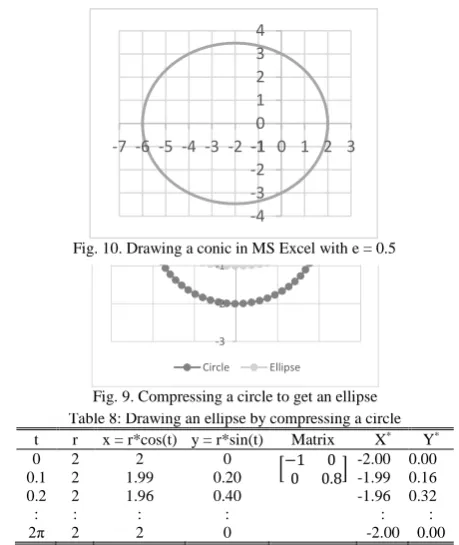
Earlier are have drawn. An ellipse can be thought of a compressed circle. If the major axis is a and the minor axis is b then, compression ratio, k =b/a is called coefficient of compression. The quantity 1-k = 1-b/a is called the compression of the ellipse. When k=1, a=b and the ellipse is a circle. For drawing an ellipse, we will apply uniform scaling to scale y-axis to obtain running axis.
Table 8: Drawing an ellipse by compressing a circle
t r x = r*cos(t) y = r*sin(t) Matrix X* Y*
0 2 2 0 [−1 0
0 0.8] -2.00 0.00
0.1 2 1.99 0.20 -1.99 0.16
0.2 2 1.96 0.40 -1.96 0.32
: : : : : :
2π 2 2 0 -2.00 0.00
D. Conics
If a point moves in such a way that the ratio of its distance from a fixed point to its distance from a fixed line remains constant, then the following theorem are true:
I. If the ratio is equal to one, the curve is a parabola II. If the ratio is between 0 and 1, then it is an ellipse III. If the ratio is greater than 1, then it is a hyperbola
This ratio is denoted by e. The parametric equation of the conic section is:
𝑟 = 𝑝
1 ± 𝑒 cos 𝑡
Where r is the distance of the point from the foci, p is the semi-latus rectum, e is the eccentricity, t is the angle of the point from the major axis.
E. Drawing a conic in MS-Excel
Let p=3 and e=0.5. Then:
𝑟 = 𝑝
1 + 𝑒 cos 𝑡=
3 1 + 0.3 × cos 𝑡
[image:4.595.309.539.151.424.2]Where t = 0 to 2π radians
Table 9: Drawing a conic in MS Excel
t 𝑟 = 𝑝
1 + 𝑒 cos 𝑡 x = r*cos(t) y = r*sin(t)
0 2 2 0
0.1 2.003336112 1.99 0.20
Fig 7. Reflection about X axis
-3 -2 -1 0 1 2 3
0 1 2 3
Original Reflection
Fig. 8. Translation
0 1 2 3 4 5 6 7 8
0 1 2 3 4 5 6 7 8
Original Translated
Fig. 9. Compressing a circle to get an ellipse
-3 -2 -1 0 1 2 3
-3 -2 -1 0 1 2 3
Circle Ellipse
Fig. 10. Drawing a conic in MS Excel with e = 0.5
-4 -3 -2 -1 0 1 2 3 4
[image:4.595.58.262.380.614.2] [image:4.595.307.517.670.791.2]0.2 2.013377837 1.97 0.40
: : : :
2π 2 2 0
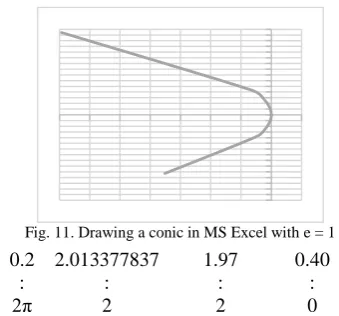
In this way an ellipse can be created easily with the value of e as 0.5. Now we put a scroll bar in the worksheet to change the value of e. We can get a circle by changing the value of e to 0. If the value of e=1, then we get a parabola. If the value of e is greater than 1, then we will get a hyperbola.
IV. KEPLER’S LAWS
Kepler’s laws describe the motion of planets around the sun.
The first law states that the orbit of a planet is an ellipse with the sun at one of the foci.
The second law states that the line segment joining the
planet and the sun sweeps equal areas at equal time intervals.
The third law states that the square of the orbital period of a planet is proportional to the cube of the semi – major axis of its orbit.
These works were published in between 1609 to 1619 A.D. If we consider the motion of earth around the sun, then earth’s orbit has an eccentricity of 0.0167.
A. Draw the planet orbit
As discussed earlier, draw the planet orbit with e as 0.0167 and p as 3. The origin (0, 0) is one of the foci and let the sun be placed here. The origin (0, 0) is one of the foci
and let the sun be placed here. The sun, the planet and orbit is shown in figure.
B. Draw the sun
As mentioned earlier, the sun is placed at (0, 0). A point is drawn at (0, 0) and formatted with a larger marker.
C. Draw the planet
The Position of planet changes with t. For a particular t, the position of the planet can be calculated from the formula, x=rcos(t) and y=rsin(t) where r can be calculated as r=p/(1+ecos(t)). For this, we add a slider to get different values of t. With the value of given t, p and l, we can calculate the position of the planet at time t. The position of planet, sun, orbit and the line joining planet and sun (r) is shown in figure 12.
D. The distance between the planet and the sun
The distance between planet and sun changes constantly. The minimum and maximum distance between sun and planet can be calculated from the formula r = p/(1+ecos(t)). The distance is minimum when cos(t) = 1 i.e. t = 0. The distance is maximum when cos(t) = -1 i.e. t = π. Hence, rmax = p/(1-e) and rmin = p/(1+e). The maximum, minimum and current distance with corresponding circles are shown in figure 13.
E. Semi-major and semi-minor axis:
The semi-major axis is the arithmetic mean of rmin and rmax. Therefore, if e = 0.5, p = 3, then rmin = 2 and rmax = 6. In this case, a = (2+6)/2 = 4. The semi-minor axis is the geometric mean between rmin and rmax and for our case
𝑏 = √2 × 6 = √12.
F. Foci and center of the ellipse
As a is 4, then the other foci of the ellipse is 4 units from origin and the center of the ellipse is 2 units, from the foci (sun). Hence, in our case, the center of the ellipse is at (-2, 0), the other foci is at (-4, 0) and shown is the figure 14. Sun
Planet
-4 -3 -2 -1 0 1 2 3 4
[image:5.595.78.248.51.209.2]-7 -6 -5 -4 -3 -2 -1 0 1 2 3
Fig. 13. Maximum, minimum and current distance between the planet and the sun
Orbit
Sun Planet
r_min
r_max
r_current
-8 -6 -4 -2 0 2 4 6 8
-8 -6 -4 -2 0 2 4 6 8
Fig. 11. Drawing a conic in MS Excel with e = 1
[image:5.595.81.261.664.785.2]G. Semi-latus rectum and semi major axis
There will be two semi-latus rectum from two foci and their ordinates will be (-4, 0) and (-4, 3). The co-ordinates of the semi-minor axis are (-2, 0), (-2, √12). The semi-latus rectum and semi-minor axis are shown in figure.
H. General Definition of ellipse
An ellipse is the set of all points in a plane, the sum of whose distances from two fixed points in the plane is constant. As we have calculated the center (-2, 0), position of the point at an angle of 125o as (-2.41245, 3.4456), the foci (-4, 0) and (0, 0) we can calculate the distances and see if the sum of distances remains the same or not. The distances of the point from the foci are by:
𝑑1= √(−4 − (−2.4126))2+ (0 − 3.4456)2= 3.79367
𝑑2= √(0 − (−2.4126))2+ (0 − 3.4456)2= 4.206324
Now d = d1 + d2 is the sum of the distances of the point from the foci = 8.0. Now if we go on changing the position of the point by varying the angle t, it will be observed that the sum of distances of the point from the foci always remain 8 in our case.
I. Area of the ellipse and eccentricity
The area of an ellipse A is calculated from the formula A = πab where a and b are the major and the semi-minor axis respectively. When a = b, ellipse becomes a circle, and the area is calculated as A = πa2. Again, when a = d, the eccentricity is zero. The eccentricity e can be calculated from 𝑒 =𝑟𝑚𝑎𝑥−𝑟𝑚𝑖𝑛
𝑟𝑚𝑎𝑥+𝑟𝑚𝑖𝑛. Here 𝑒 =
6−2 6+2= 0.5.
V. KEPLER’S SECOND LAW
It says that a line joining a planet and the sun sweeps out equal areas during equal intervals of time. It is to be noted that the planet travels faster when it is closer to sun and the planet is slower when it is farther from the sun. Period (P) is
the time taken by a planet for one revolution around the sun. For the case of earth, the period is one year. In a small time dT, the planet sweeps out a small triangle having base line r, and height rdT. So the constant areal velocity is 𝑑𝐴𝑑𝑇=12𝑟2 𝑑𝑡𝑑𝑇.
As the period of revolution of the planet is P, then total area swept in one revolution is 𝑃 ×1
2𝑟 2 𝑑𝑡
𝑑𝑇. This area is equal
to the area πab. Hence,
𝑃 ×1
2𝑟2 𝑑𝑡
𝑑𝑇= 𝜋𝑎𝑏
=> 𝑟2𝑑𝑡
𝑑𝑇=
2𝜋𝑎𝑏 𝑃
The right hand side is a constant. But we know that r of the planet is continuously changing from rmin to rmax, hence to keep the right hand side constant, when r increases, 𝑑𝑡
𝑑𝑇 is to
be decreased and vice versa. 𝑑𝑡
𝑑𝑇 is the angular velocity.
VI. KEPLER’S THIRD LAW
The square of the orbital period of a planet is directly proportional to the cube of the semi-major axis of its orbit. Mathematically, this law can be written as:
𝑇2∝ 𝑎3 => 𝑇2= 𝑔𝑎3
=> 𝑔 =𝑇 2
𝑎3
Here, a is the orbit’s semi-major axis, T is the time period of revolution, and g is the proportionality quotient T2/a3.
VII. CONCLUSION
Majority of the theories and subjects discussed in this paper are available in many literature and internet. But it was only description about the topics. When these topics are being taught, it becomes difficult to visualize and understand. Now, MS Excel is available is which these concepts can be easily modeled, reproduced and demonstrated. This makes the concepts easier to understand. When student gets these tools, they can even experiment different possibilities and explore at their own time and own pace.
REFERENCES
[1] Jones H., Computer Graphics through Key Mathematics. ISBN:
1-85233-422-3, Published by Springer
[2] Stewart J., Calculus with Early Transcendental Functions. ISBN:
81-3135-1980-5, Published by Cenage Learning
[3] Ygodsky M., Mathematical handbook higher mathematics. Published
by Mir Publishers, Moscow
[4] Vince J., Geometry for Computer Graphics. ISBN: 1-85233-834-2,
Published by Springer
[5] Rogers D.F., Adams J.A., Mathematical Elements for Computer
[image:6.595.72.261.67.199.2]Graphics. ISBN-13: 978-0-07-048677-5, Published by Tata McGraw Hill
Fig. 14. Foci and center of the ellipse
Orbit
Sun Planet
Centre
-4 -3 -2 -1 0 1 2 3 4
-7 -6 -5 -4 -3 -2 -1 0 1 2 3 4 5 6 7 8
Fig. 15. Semi-latus rectum and semi minor axis of the ellipse
Orbit
Sun Planet
Centre Foci 2
Semi-Latus Rectum 2
Semi-Latus Rectum 1 Semi-Minor Axis
-4 -3 -2 -1 0 1 2 3 4
[image:6.595.78.258.275.394.2]-7 -6 -5 -4 -3 -2 -1 0 1 2 3 4 5 6 7 8
Fig. 16. Kepler’s Second Law: areal velocity
At time T+dT
At time T
-4 -3 -2 -1 0 1 2 3 4