© 2014, IJCSMC All Rights Reserved 314
Available Online atwww.ijcsmc.com
International Journal of Computer Science and Mobile Computing
A Monthly Journal of Computer Science and Information Technology
ISSN 2320–088X
IJCSMC, Vol. 3, Issue. 9, September 2014, pg.314 – 323
RESEARCH ARTICLE
Face Image Retrieval Using Pose Specific
Set Sparse Feature Representation
Abdul Afeef N
1, Sebastian George
21
Department of Computer Science, Viswajyothi College of Engineering and Technology Kerala, India
2Assistant Professor of Computer Science, Viswajyothi College of Engineering and Technology Kerala, India
Abstract— There are largely available consumer photos are available in our life, among those a big percentage of photos are photos with human faces. Thus content based face image retrieval is an emerging technology for many applications. A new method for content based face image retrieval is proposed. Given a query face image, content based face image retrieval find similar faces from the database. There were mainly three steps- preprocessing, feature extraction and face retrieval. Preprocessing included face detection and landmark detection. After preprocessing, extract pose specific uniform LBP features from the face. Novel set sparse feature representation is used to represent extracted pose specific LBP feature as sparse code using a pre-defined set. After 15 attributes from face is used to make face representation more distinguish. Finally set sparse feature representation is used as inverted index in face retrieval to find similarity score of query face image with database face images. It has applications in automatic face annotation, crime investigation etc. Top results related to a query face image with existing method and memory usage were analyzed. Experimental results shows that proposed method have better top results and efficient in memory usage compared to existing method.
Keywords— Face image retrieval, sparse feature representation, pose specific feature
I. INTRODUCTION
Due to the popularity of digital devices and the rise of social network and photo sharing services (e.g., Facebook, Flickr), there are largely growing consumer photos available in our life. Among all those photos, a big percentage of them are photos with human faces. The importance and the sheer amount of human face photos make manipulations (e.g., search and mining) of large-scale human face images a really important research problem and enable many real world applications. The main goal is to address one of the important and challenging problems, content-based face image retrieval. Given a query face image, content-based face image retrieval tries to find similar face images from a large image database. It is an enabling technology for m any applications including automatic face annotation, crime investigation.
© 2014, IJCSMC All Rights Reserved 315
identity constraints [4] integrate partial identity information in sparse feature representation for better face image retrieval results. Combining attributes and fisher vectors [5] improves the performance of retrieval of particular objects as well as categories. Scalable face image retrieval using attribute enhanced sparse codewords uses both low level features such as uniform LBP features and high level human attributes for better retrieval results.
Traditional methods for face image retrieval usually use low-level features to represent faces, but low-level features are lack of semantic meanings and face images usually have high intra-class variance (e.g., expression, posing), so the retrieval results are unsatisfactory. To tackle this problem, use identity based quantization and identity-constrained sparse coding, but these methods might require clean training data and massive human annotations. Many of the face image retrieval techniques does not consider pose of the face for extracting features from the face. So same person of different poses may represented by dissimilar features and different classes. Traditional sparse coding for face image retrieval represent a feature by a linear combination of column vectors of a dictionary. Number of sparse codewords depends on size of the dictionary and sometimes it may resulted in representing same person in different classes.
The main objective of this work is to provide a new perspective on content-based face image retrieval by incorporating pose specific extraction of components and features from face. Pose specific uniform LBP feature is extracted from the face which is then represented as sparse codewords. A novel representation called set sparse feature representation is proposed to represent extracted pose specific uniform LBP features from the face using a pre-defined set. 15 attributes are used to make represented set sparse feature more distinguish. In retrieval stage, set sparse code is inversely indexed with image list to find similarity score for better face image retrieval. The main characteristics of proposed methods are 1) Pose of the face is considered in feature extraction and 2) Set sparse feature representation is used to find sparse code of extracted features.
II. OVERALL DESIGN OF PROPOSED METHOD
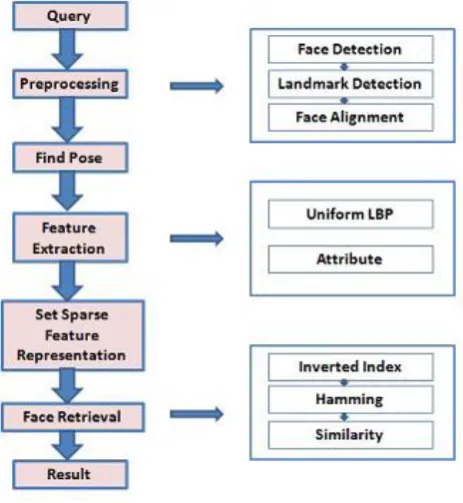
The overall design of proposed face image retrieval technique is shown in Figure 1. Initilally select the query image and preprocessing such as face detection, 66 landmark detection and face alignment are done for the query face image. After preprocessing, find pose of the face image such as left or right. Then extract pose specific four components from the face such as eyebrow, eye, nose and mouth. In feature extraction step, compute 59 dimensional uniform LBP feature from components and select 15 attributes of face image. Then novel set sparse feature algorithm is used to create representative sparse code for the face image and attributes are used for better distinguishing power. Finally in retrieval stage, sparse code inversely indexed with image list and compute similarity score with database images after finding hamming distance of query with database images.
© 2014, IJCSMC All Rights Reserved 316
III.MODULE DESCRIPTION
The system includes four main components
1. Select Query Image. 2. Preprocessing. 3. Find Pose.
4. Feature Extraction.
5. Set Sparse Feature Representation. 6. Face Retrieval.
1. Select Query Image
Content based face image retrieval aims to retrieve similar face images from the database of given query image. Initially select a query image which needs to retrieve similar face images from database. Figure 2 shows the selected query image.
Fig 2 Query image
2. Preprocessing
After selecting query face image, preprocessing is done to query image. It mainly consist of three steps such as face detection, landmark detection and face alignment.
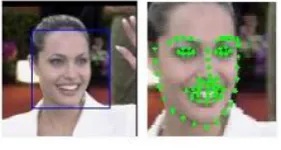
Use Viola-Jones face detector to locate face in the query image. It returns a four dimensional row vector which gives the information about top left corner of the face, width and height of face from top left corner. First value represent x coordinate of the top left pixel of face and second value represent y coordinate of that pixel. Third and fourth value represent width and height respectively from top left corner of the face. Using this, find four corners of the face. Using these four corners, a rectangular box is drawn around face. Figure 3 shows corresponding face for the query image in Figure 2.
Fig 3 Detected face
After face detection, 66 landmarks are located in detected face image. It uses active shape model to locate landmark. It returns 132 dimensional column vector which contain x and y coordinates of detected landmarks. These landmarks are used for finding pose and extracting pose specific components such as eyebrow, eye, nose and mouth. Figure 4 shows detected landmarks of detected face image in Figure 2.
© 2014, IJCSMC All Rights Reserved 317
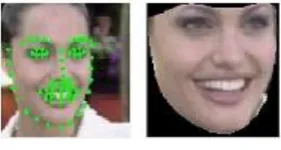
After locating 66 landmarks from detected face image, face is aligned using the detected landmarks. For that, boundary landmarks are selected and store the x and y coordinates of boundary points in different column vector. Then extract largest possible polygon that can extract using boundary points as aligned face image. Figure 5 shows corresponding aligned face image for the landmark detected face in Figure 2.
Fig 5 Aligned face
3. Find Pose
The proposed method considers pose of the query face image to extract components from the face. It uses four landmarks from the 66 located points. Let the difference between x coordinates of landmark 48 and 4 be 'A' and difference between x coordinates of 12 and 54 b e 'B' . If the value of A greater than B, then set the pose as right, else set the pose of the query face image as left. This pose is then used in the feature extraction stage to extract pose specific component extraction from the face such as eyebrow, eye, nose and mouth. Figure 6 shows the pose of query face image.
Fig 6 Right pose
4. Feature Extraction
After finding pose of the query face image, extract pose specific components from the face. If pose equals right, then extract right eyebrow, eye, nose and mouth. Figure 7 shows extracted pose specific components from query face image. Then extract 59 dimensional uniform LBP using algorithm1. Then select 15 attributes [7] of query face image for set sparse feature representation and finally for the indexing stage. Selected attributes are, male, white, youth, senior, black hair, blond hair, bald, no eyewear, mustache, chubby, straight hair, receding hairline, bushy eyebrows, big nose and big lips.
Fig 7 Pose specific components
Uniform LBP is defined for a non-boundary pixel in a patch by using eight neighbouring pixels around it. Let 'c' be the centre pixel and p1 to p8 be eight neighbouring pixels from left bottom in clockwise direction.
Compare centre pixel 'c' with each pi, i from 1 to 8. If pi > c, set ai= 1, else 0. Then orderly arrange all ai's and
find number of transition in bits. If transition less than three, it considered as uniform and its uniform LBP value is set as decimal value of ai from 1 to 8. If transition greater than two, it considered as non-uniform and set
© 2014, IJCSMC All Rights Reserved 318
Algorithm1 : Compute-59dimULBP
Input : Extracted Components, pose
Output : ULBP59
1. Start
2. InitializeprevULBP59as empty
3. Select components
(a) If pose equals right, select right components and convert to gray
(b) Else select left components and flip using algorithm2
4. For each selected components (order : eyebrow, eye, nose, mouth)
(a) Extract all 10x10 square patches row-wise
(b) For each square patch
i. Compute ULBP values for all 64 non-boundary pixels
ii. Compute histogram of ULBP
iii. Append histogram with prevULBP59
5. SetULBP59equalsprevULBP59
6. End
If the pose of face is left, then it needs to flip the extracted left components before extracting ULBP. Algorithm2 flip the extracted let components as look like right components for the standardisation of component shape for all database images.
Algorithm2 : Flip
Input : Extracted Left Components
Output : Flipped Left Components
1. Start
2. For each input (order : left eye brow, eye , nose and mouth)
(a) Convert to gray image
(b) Find number of rows and columns
(c) Set n as number of columns and m as rows
(d) Initialize Flipped as zero matrix of m rows and n columns (e) For each column i from 1 to n
i. Set column i of Flipped as column(n-i+1) of input
3. Set Flipped Left Components as set of outputs from step2
4. End
5. Set Sparse Feature Representation
© 2014, IJCSMC All Rights Reserved 319
ULBP59 from algorithm1 and gives back the result set sparse feature as output. set sparse feature contains most of the elements as zero and others as ones.
Algorithm3 : Set Sparse Feature Face
Input : ULBP59
Output : Set Sparse Feature
1. Start
2. Find number of rows m and columns n of ULBP59
3. Combine adjacent two columns of ULBP59(So n/2 columns)
4. Assign set as [1 2 10 15 20]
5. Initialize Set Sparse Feature as empty 6. For i increment from 1 to n/2
6.1 For j increment from 1 to m 6.1.1 Set num asULBP59(i,j)
6.1.2 Initialize temp as empty 6.1.3 For i decrement from 5 to 1
6.1.3.1 Set Curr = Set(i)
61.3.2 Check flag as num >= Curr
1) If`flag equals 1
i. Append 1 to starting of temp
ii. Set num as reminder of num/Curr
iii. Set Curr=Set(i-1)
2) Else
i. Append 0 to starting of temp
ii. Set Curr = Set(i-1)
iii. Goto step 6.1.3
6.1.4 Append temp to Set Sparse Feature 6.1.5 If j < m, goto step 6.1, else goto step 6
7. End
Algorithm4 is used for further increasing the distinguishing power of the extracted set sparse feature by using the 15 attributes from face. It takes the inputs set sparse feature and 15attributes and gives back final
Attr_Set_Sp_Code which is used in the final retrieval stage for inverted indexing.
Algorithm4 : Attribute Set Sparse Face
Input : set sparse feature , 15 Attributes
Output : Attr_Set_Sp_Co de
1. Start
2. For i increment from 1 to 15
(a) If positive attribute fi equals 1
© 2014, IJCSMC All Rights Reserved 320
3. Select n attributes say a1 to an from f1 to f15(1<= n <= 15)
4. Set the length of`set sparse feature equals m
5. Append rem(m/n) zeros at the end of set sparse feature
6. Set new length of set sparse feature equals m_new
7. Divide m_new into equal n partitions of length len
8. Set zero_append as zero vector of size len
9. Initialize temp as empty matrix
10. For each partition i increment form 1 to n
(a) Set Add_part as partition i
(b) If ai = 1, append zero_append at the end of Add_part
(c) Else append zero_append at the start of Add_part (d) Append Add_part at the end of temp
11. Set attr as row vector f1 to f15
12. Set attr_inv as 1- attr
13. Set attr_temp as empty 14. For i increment from 1 to 80
(a) If`mod(i,2) equals 1, append attr at end of`attr_temp
(b) Else append attr_inv at end of`attr_temp
15. Append attr_temp at the end of temp
16. Set final Attr_Set_Sp_Code as temp
17. End
6. Face Retrieval
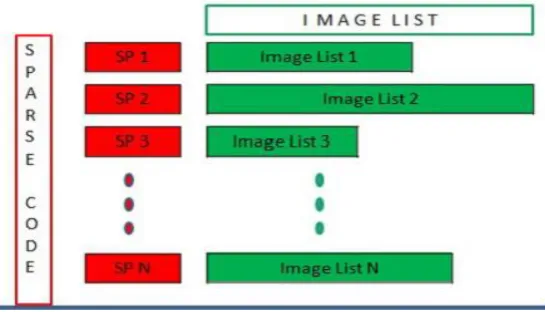
It mainly consist of three steps. Inverted indexing, hamming distance calculation and similarity score calculation. In inverted indexing, sparse code is inversely indexed with image list. For the computed set sparse code for the query face image, we check the matched sparse codes of the input query. Then we list all the images from the inverted index which matches the sparse codes of the query face image. Then hamming distance is calculated for images from the inverted index by XORing the input 15 binary attributes with 15 binary attributes from the images in inverted index. Then finally similarity score is calculated for the images which have hamming distance less than a threshold, threshold can change from 0 to 15. For the effective retrieval threshold is set to 4.
© 2014, IJCSMC All Rights Reserved 321
Figure 8 shows the inveted indexing of sparse code with image list. Hamming distance is calculated by counting number of ones in the XOR ed output of input with database sparse code matched images from inverted index. Figure 9 shows the computation of hamming distance.
( ) {
(1)
Fig 9 Computation of hamming distance
Equation 1 shows computation of similarity score. S(i,j) is the similarity score between image i and j. ci and
cj are the sparse code for the face image i and j. Finally retrieve top 10 similarity scored images as the result of
query face image. Figure 10 shows the retrieval results corresponding to query face in Figure 2.
Fig 10 Retrieval result
IV.EXPERIMENTAL RESULTS
The proposed content based face retrieval technique has been evaluated and compared with an existing content based face retrieval method [1] in the same scenario. The objective is to evaluate the accuracy of retrieving top results and memory utilization for storing sparse code using the proposed technique with respect to existing method. All the algorithms were implemented using MATLAB.
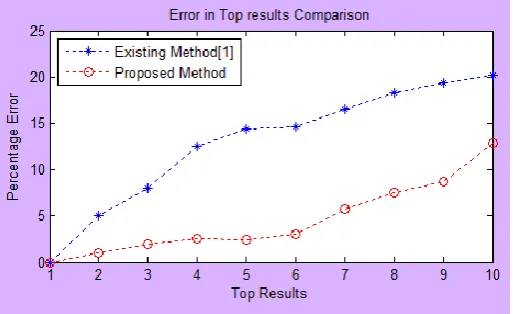
Error rate analyses the number of false retrieval related to query image. For this, consider 500 results obtained from 50 query images in the database. 50 images consist of 5 persons and each person has 10 images each. Each of 50 images given as query image and analysed retrieval results. It also analysed top n results, where n varies from 1 to 10. Error rate is calculated using the equation 2. Then related improvement in top results is analysed using the equation 3. Figure 11 shows error in to results comparison between existing [1] and proposed method.
© 2014, IJCSMC All Rights Reserved 322
( ) (2)
( ) ( )[ ] ( ) ( )[ ] (3)
Fig 12 Memory usage comparison
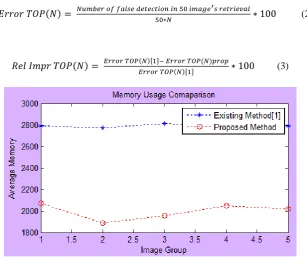
Analysing memory aims to count number of sparse codes for storing the face. We analyse average number of sparse codes needed for storing each person's face in the database and compared with existing method. Experimental results shows that proposed method have better memory utilisation compared to existing method [1]. Average number of sparse code for a person is calculated using equation 4 where Sparse(i) is the sparse code for ith face image. Figure 12 shows memory usage comparison between existing [1] and proposed method.
( ) ∑ ( )
( ) ( )
(4)
V. CONCLUSIONS
An efficient content based face image retrieval system is proposed which uses pose specific component extraction for feature computation. It also proposed a novel set sparse feature algorithm to represent extracted feature as sparse code using a set. Attributes from face are used to further improving the distinguishing power in sparse representation. Finally inverted index is used in retrieval stage. It has applications in automatic f ace annotation, crime investigation etc. This work analysed top results related to a query image with existing method and memory usage. Experimental results shows that proposed method have better top results and efficient in memory usage compared to existing method.
REFERENCES
[1] Bor-Chun Chen, Yan-Ying Chen, Yi n-Hsi Kuo, and Wi nston H. Hsu, "Scalable Face Image Retrieval Using Attribute-Enhanced Sparse Codewords", in IEEE Trans on Multimedia, vol. 15, no. 5, Aug 2013.
[2] U. Park and A. K. Jain, “Face matching and retrieval using soft biometrics", in IEEE Trans. Inf. Forensics
Security, vol. 5, no. 3, pp. 406-415, Sep 2010.
[3] Z. Wu, Q. Ke, J. Sun, and H.-Y. Shum, “Scalable face image retrieval with identity-based quantization and multi-reference re-ranking”, inProc. IEEE Conf. Computer Vision and Pattern Recognit, 2010.
[4] B.-C. Che n, Y.-H . Kuo,Y.-Y. Chen, K.-Y. Chu, and W. Hsu, “Semi-supervised face image retrieval using sparse coding with identity constraint”, in in P roc. ACM Mul -timedia, 2011.
[5] M. Douze, A. Ramisa, and C. Schmid, ”Combining attributes and fisher vectors for efficient image retrieval”, inProc. IEEE Conf. Computer Vision and Pattern Recognit. 2011.
[6] N. Kumar, A. C. Berg, P. N. Belhumeur, and S. K. Nayar, “Attribute and simile classifiers for face
© 2014, IJCSMC All Rights Reserved 323
[7] N. Kumar, A. C. Berg, P. N. Belhumeur, and S. K. Nayar, “Describable visual attributes for face
verification and image search”, in IEEE Trans. Pattern Anal. Mach. Intel l., Special Issue on Real-World Face Recognition vol. 33, no. 10, pp. 1962-1977, Oct. 2011.
[8] P. Viola and M. Jones, “Rapid object detection using a boosted cascade of simple features”, in Proc. IEEE
Conf. Computer Vision and Pattern Recognit., 2001.
[9] S. Milb orrow and F. Nicollsl, “Locating facial features with an extended active shape model”, inProc. Eur. Conf. Computer Vision, 2008.
[10] J. Yang, K. Yu, Y. Gong, and T. Huang, “Linear spatial pyramid matching using sparse coding for image
classification” in Proc. IEEE Conf. Computer Vision and Pattern Recognit.,2009.
[11] A. Coates and A. Y. Ng, “The importance of encoding versus training with sparse coding and vector