A Monthly Journal of Computer Science and Information Technology
ISSN 2320–088X
IJCSMC, Vol. 2, Issue. 7, July 2013, pg.190 – 195
RESEARCH ARTICLE
© 2013, IJCSMC All Rights Reserved
190
An Efficient Resource Management and
Scheduling Technique for Fault Tolerance
in Grid Computing
Deeptanoy Ghosh1, Ramandeep Singh2, Jimmy Laishram3 1
CSE, Lovely Professional University, India
2
CSE, Lovely Professional University, India
3
CSE, Lovely Professional University, India
1 [email protected]; 2 [email protected]; 3 [email protected]
Abstract— In Grid computing, scheduling techniques are based on queues, easy to implement but not very effective in mapping jobs after well determined parameters. If a certain user needs a specific resource, usually she/he has to log on directly on specific resource and to access the scheduling service. A more advanced method is to have a schedule-based approach. This approach is usually most effective when the submitted jobs are in batch mode (a new task will trigger either rescheduling, either will be placed in a temporary queue if it has a low priority, until a significant amount of jobs are queued, depending on the scheduling algorithm used). The proposed technique will give the user a single view where the user can log into the Grid resource management system, submit jobs and check the status of his jobs just like he does when he submits a job to any single resource.
Key Terms: - Alea2; EASY; EDF; FCFS; Grid
I. INTRODUCTION
© 2013, IJCSMC All Rights Reserved
191
II. LITERATURE REVIEW
In this literature review, we will provide a review of a limited number of studies related to the grid computing with resource management and scheduling. Law, 2000, proposed a randomized resource discovery algorithm called “absorption algorithm” based on a strongly connected graph[7]. Authors discussed, this algorithm is developed in two stages. In stage 1, a network of n nodes is partitioned into clusters; each cluster has its leader node and all nodes in a cluster know their leader. At this stage, an ultimate leader is determined in the network. In stage 2, the ultimate leader of the network broadcasts the pointers to the each member of the network in one time step. The authors claimed that this absorption algorithm takes Ο(log n) steps time complexity, can send Ο(nlog n) number of messages, and can pass Ο(n2 log n) number of pointers with high probability. Nithiapidary
M, 2005, present a scheduling strategy that performs dynamic job grouping activity at runtime and convey the detailed analysis by running simulations [8]. He proposed job processing granularity size is introduced to facilitate the job grouping activity in determining the total amount of jobs that can be processed in a resource within a specified time. The job grouping strategy results in increased performance in terms of low processing time and cost if it is applied to a Grid application with a large number of jobs where each user job holds small processing requirements. Sending/receiving each small job individually to/from the resources will increase the total communication time and cost. K. Somasundaram, 2008, proposed a new scheduling algorithm called Optimum Resource Constraint (ORC) scheduling algorithm which includes the combination of both the Best fit allocation and Round Robin scheduling to allocate the jobs in queue pool [9]. ORC improved the efficiency of load balancing and dynamicity capability of the Grid resources. They measured the performance of ORC algorithm on a Grid computing with maximum number of jobs and nodes. The ORC scheduling reduces the waiting time of job and allocates the jobs to processor based on its capability and increase the processing time of job. The proposed method will calculate the capability of jobs and processor to allocate the jobs. It will reduce the waiting time of jobs in queue and turnaround time. Thus the overall performance of the Grid has increased. Rosemarry P, 2012, cited that, if we provide an optimize algorithm to queue of the scheduler using various scheduling methods like Shortest Job First, First in First out, Round robin then the job scheduling system is responsible to select best suitable machines in a grid for user jobs [10]. Management and scheduling system generates job schedules for each machine in the grid by taking static restrictions and dynamic parameters of jobs and machines into consideration. The main purpose was to develop an efficient job scheduling algorithm to maximize the resource utilization and minimize processing time of the jobs. All queues can be optimized by using various scheduling algorithms depending upon the performance criteria to be improved based on response time and throughput.
III. PROBLEM FORMULATION
Most of the scheduling techniques used in computing grids are based on queues, easy to implement but not very effective in mapping jobs after well determined parameters. If a certain user needs a specific resource (for performance reasons or special requirements) usually she/he has to log on directly on specific resource and to access the scheduling service. A more advanced method is to have a schedule-based approach. This allow advanced reservation of resources, dynamically remapping jobs on more appropriate resources and optimization of the schedule based on optimization methods (such as local search based methods). This approach is usually most effective when the submitted jobs are in batch mode (a new task will trigger either rescheduling, either will be placed in a temporary queue if it has a low priority, until a significant amount of jobs are queued, depending on the scheduling algorithm used).
IV. PROPOSED WORK
© 2013, IJCSMC All Rights Reserved
192
scheduling algorithms, allows a process to move between queues. Every queue has its own scheduling algorithm. There are three scheduling algorithm (First Come First Serve, EDF, EASY-BF) used. This scheme leaves I/O-bound and interactive processes in the higher-priority queues. In this paper, the three algorithms are used in loops for each queue in order to find out a best combination for a particular type of job and according to certain performance criteria.
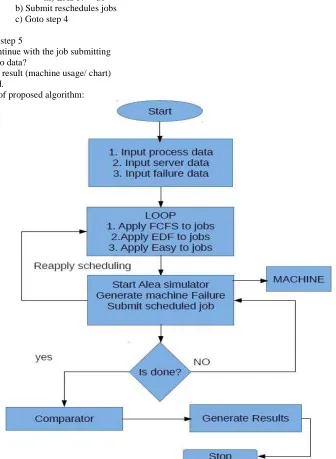
Algorithm: Step 1: Start
Step2: Load machine data, failure data, job data Step 3: Submit job using Alea and Gridsim simulation Step 4: Listen to machine failure
if (machine failure? YES)
a) Accept result and reschedule jobs using
i) FCFS: calculate machine usage per cluster/ machine ii) EDF: ---do----
iii) EASY: ---do--- b) Submit reschedules jobs c) Goto step 4
Else goto step 5
Step 5: Continue with the job submitting Step 6: If no data?
Print result (machine usage/ chart) Step 7: End.
Flowchart of proposed algorithm:
© 2013, IJCSMC All Rights Reserved
193
V. EXPERIMENTAL RESULTS
The algorithms were implemented in the Alea 2 grid simulator for testing. The settings assume that a job can span a resource, but cannot span multiple resources. A resource can run concurrently multiple jobs if there is enough processing elements to support the jobs’ requirements. The tested set contains 12000 jobs processed by a FCFS algorithm [11] [12], EDF [13] and EASY [14] [15] algorithm. First, we simulate involving complex real-life data set from the Czech national Grid infrastructure MetaCentrum. MetaCentrum to demonstrate the simulation capability of the Alea 2. These data allow us to perform very realistic simulations, involving all characteristics. For example, we use precise information concerning the machine parameters, the information about machine failures and restarts, or the specific job requirements concerning the target machine properties.
All experiments were performed on Intel Centrino Duo 2.2GHz PC with 3GB of RAM. Unless otherwise indicated, the JVM (Java Virtual Machine) was limited by 1GB of available RAM. The experiment involved 12000 jobs that were originally executed on 14 clusters having 1152 processors.
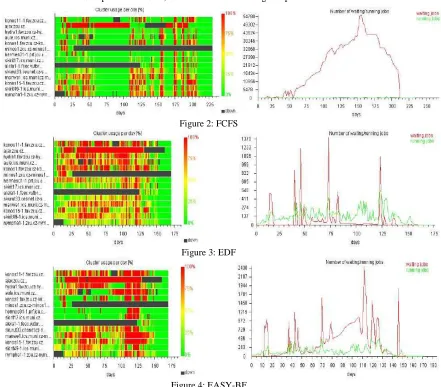
Through the experiment, we have compared three different scheduling algorithms: FCFS, EDF and EASY-BF. The visualization for the implementation of these algorithms is described below in detail with appropriate screenshots.
Comparison of FCFS, EDF and EASY-BF using complex data set.
Figure 2: FCFS
Figure 3: EDF
Figure 4: EASY-BF
© 2013, IJCSMC All Rights Reserved
194
utilization. This is the main goal of the EASY-BF algorithm. As we can see, EASY-BF is able to increase the machine usage by using the backfilling approach. Still, EASY-BF does not allow delaying the execution start of the first job in the queue, which restricts it from making more aggressive decisions that would increase the utilization even more. EDF algorithm does not apply such restrictions and thanks to the application of a more efficient schedule-based approach it produces the best results.
VI. CONCLUSION AND FUTURE SCOPE
For the simulation purpose, Alea 2 simulator has been successfully used in our work which focuses on the area of cluster and Grid resource scheduling and was able to simulate scheduling under different setups involving various data sets and objective functions [16] [17] [18]. Alea 2 has a visualization interface that allows faster debugging and tuning of the studied algorithms.. Through the experiment it has found that FCFS is not able to schedule jobs fluently. It generates huge peak of waiting jobs during the time. For the same reason, the resulting makespan is also much higher than in the remaining algorithms. On the other hand EASY-BF is capable of a higher resource utilization and reduction of the number of waiting jobs through the time. EDF produces the best results. As can be seen, these several other graphical outputs help the user to understand and compare the scheduling process of different scheduling algorithms. Since Grid Computing is the most popular research area in distributed environment now days because of the improving needs of users day by day. A standard still has to be set in the field. A number of techniques are available but with disadvantages of their own along with advantages. This paper will help in improving the efficiency of the grid system as well as fault tolerance capability.
REFERENCES
[1] Abramson D, Buyya Rajkumar, Giddy J, A computational economy for grid computing and its implementation in the Nimrod-G resource broker, Future Generation Computing Systems, 18(8), 2002, 1061-1074.
[2] Abhang Swati Ashok, Durole Pankaj Hari, Grid Computing: Various Job Scheduling Strategies, Emerging Trends in Computer Science and Information Technology, Proceedings published in International Journal of Computer Applications, 2012.
[3] Buyya R, Abramson D, Stockinger H, Giddy J, Economic models for resource management and scheduling in Grid computing, The Journal of Concurrency and Computation 14 (13-15), 2002, 1507-1542.
[4] Buyya R, Venugopal S, A gentle introduction to grid computing and technologies, CSI Communications 9, 9–19, 2005, July.
[5] Garg S.K, Siegel H, Buyya R, Time and cost trade-off management for scheduling parallel applications on utility grids, 2009, Future Generation Computer Systems.
[6] Safwana Haque and Isah Abdul Azeez, Resource Management in Grid Computing: A Review. Greener Journal of Science Engineering and Technological Research ISSN: 2276-7835 2012, Vol. 2 (1), pp. 024-031.
[7] Ching Law, Kai-Yeung Siu, An O(log n) Randomized Resource Discovery Algorithm, MIT-AUTOID-TR-004, 2000.
[8] Nithiapidary Muthuvelu, Junyang Liu, Nay Lin Soe, Srikumar Venugopal, Anthony Sulistio and Rajkumar Buyya, A Dynamic Job Grouping-Based Scheduling for Deploying Applications with Fine-Grained Tasks on Global Grids, 2005.
[9] K. Somasundaram and S. Radhakrishnan, Node Allocation In Grid Computing Using Optimal Resource Constraint (ORC) Scheduling, International Journal of Computer Science and Network Security, VOL.8 No.6.
[10]Rosemarry P, Ravinder Singh, Dilip Sisodia and Payal Singhal, GROUPING BASED JOB SCHEDULING ALGORITHM USING PRIORITY QUEUE AND HYBRID ALGORITHM IN GRID COMPUTING, International Journal of Grid Computing & Applications, Vol.3, No.4, 2012.
[11]Zafril Rizal M Azmi, Wan Nurulsafawati Wan Manan, Kamalrulnizam Abu Bakar, Abdul Hanan Abdullah, and Mohd Shahir Shamsir, Scheduling Grid Jobs Using Priority Rule Algorithms and Gap Filling Techniques, International Journal of Advanced Science and Technology, 2011, Vol. 37.
[12]A.D.Techiouba, G.Capannini, Ranieri Baraglia, D.Puppin, and M.Pasquali, BACKFILLING STRATEGIES FOR SCHEDULING STREAMS OF JOBS ON COMPUTATIONAL FARMS.
[13]Zafril Rizal M.Azmi, Kamalrulnizam Abu Bakar, Abdul Hanan Abdullah, and Mohd Shahir Shamsir, Early Gap-Early Deadline First (EG-EDF) Scheduling Technique with Simulated Annealing Optimizer for Grid Computing.
© 2013, IJCSMC All Rights Reserved
195
Scheduling Framework for Large Computing Farms.
[15]Sivakumar Viswanathan, Bharadwaj Veeravalli, and Thomas G. Robertazzi, Resource-Aware Distributed Scheduling Strategies for Large-Scale Computational Cluster/Grid Systems, IEEE TRANSACTIONS ON PARALLEL AND DISTRIBUTED SYSTEMS, Vol. 16, 2007.
[16]Raksha Sharma, Vishnu Kant Soni, Manoj Kumar Mishra, Prachet Bhuyan, 2010, A Survey of Job Scheduling and Resource Management in Grid Computing, World Academy of Science, Engineering and Technology.
[17]Kaur H, A SYSTEMATIC APPROACH TO SIMULATE AND COMPARE THE PERFORMANCE OF STATIC VS DYNAMIC TASK SCHEDULING ALGORITHM ON GRIDSIM, International Journal of Computer Science & Information Technology, 2012, Vol. 2 No. 11, 880 ISSN No. 2231-2471.