
On Side-Channel Vulnerabilities of Bit
Permutations: Key Recovery and Reverse
Engineering
Jakub Breier1, Dirmanto Jap1, Xiaolu Hou2 and Shivam Bhasin1
1Physical Analysis and Cryptographic Engineering
Temasek Laboratories
2School of Computer Science and Engineering
Nanyang Technological University, Singapore Email: {jbreier, djap, sbhasin}@ntu.edu.sg
Abstract—Lightweight block ciphers rely on simple operations to allow compact implementation. Thanks to its efficiency, bit permutation has emerged as an optimal choice for state-wise diffusion. It can be implemented by simple wiring or shifts. However, as recently shown by Spectre and Meltdown attacks, efficiency and security often go against each other. In this work, we show how bit permutations introduce a side-channel vulnerability that can be exploited to extract the secret key from the cipher. Such vulnerabilities are specific to bit permutations and do not occur in other state-wise diffusion alternatives. We propose Side-Channel Assisted Differential-Plaintext Attack (SCADPA) which targets this vulnerability in bit permutation operation. SCADPA is experimentally demonstrated onPRESENT -80 on an 8-bit microcontroller, with the best case key recovery in 17 encryptions. The attack is then extended to latest bit-permutation based cipher GIFT, allowing full key recovery in 36 encryptions. We also propose and experimentally verify an automatic threshold method which can be easily applied to SCADPA, allowing automation of the attack. Moreover, SCADPA on bit permutations has other applications. Application for reverse engineering secret sboxes in PRESENT-like proprietary ciphers is shown. We also highlight a special case, where fixing one vulnerability opens another one. This is shown by applying SCADPA on some assembly level fault attack countermeasures, rendering it less secure than unprotected implementations. Lastly, we also provide several different attack scenarios, such as targeting different encryption modes.
I. Introduction
The area of smart devices brings forward the question about energy efficiency. In the past, where desktop computers were the norm, chip manufacturers could afford to release devices with high computational power at the expense of the power consumption. However, this trend is changing rapidly, thanks to shrinking size of mobile devices and emergence of Internet of Things. Often, the raw computational power is lowered, while keeping the battery last longer. It is therefore crucial for the algorithm designers to develop smaller and more efficient designs that would fit such resource-constrained devices. This affects the area of cryptography as well, where we can see more efficient algorithms emerge every year. Recently, NIST
has launched a call for proposal to standardize lightweight crypto algorithms [1].
This work focuses on lightweight block ciphers which use bit permutation based diffusion layer to achieve efficient implementations. Common examples of such block ciphers
are PRESENT [2], which is an ISO standard, GIFT [3], etc.
Bit permutation is an interesting design choice as it has negligible area footprint in hardware and can be implemented with only wires [2]. Other ciphers, such asGIFT, with careful permutation choices can be optimized for both hardware and software implementations.
It was recently shown that through Spectre and Melt-down [4] attacks on modern processor architectures, that architectural optimizations for efficiency or performance can result in a security disaster. In this paper, we bring forward a specific vulnerability of bit permutation based diffusion function, which can be simply exploited using side-channel. The exploit arises from the simple structure of bit permutation and is not easily found in diffusion functions of standard ciphers (like MixColumns in AES). The demonstrated vul-nerability is more serious in low-cost platforms like 8-bit microcontrollers due to serialized execution of the algorithm. Such design vulnerabilities further make the need of counter-measures critical, however, lightweight and countercounter-measures do not often go hand-in-hand. To resist theoretical attacks, cipher designers add extra rounds to avoid vulnerabilities due to simple diffusion layer. Since the proposed attack exploits all the information in the first round, extra rounds will not add any security.
side-channel leakage. Here, SCADPA is chosen plaintext attack, where the plaintexts are chosen to effectively exploit the bit-permutation leakage. It observes the difference of propagation through side-channel, thus revealing the differential of Sbox output. With the knowledge of the plaintext, this differential can be solved to reveal the corresponding key candidates.
Unlike usual side-channel attacks (SCA [5]), SCADPA is not a statistical attack but rather a differential attack. For a carefully chosen set of plaintexts, it observes differential on an internal sensitive value. As we show later, these diff eren-tials for bit permutation ciphers can be obtained by simply subtracting the power measurements. Once the internal diff er-entials are known, the attack is similar to classical differential cryptanalysis for secret key retrieval. While cryptanalysis can be applied on a full cipher and handle high complexity, we manage to restrict the attack to a single round, thus keeping the complexity negligible. In some cases, multiple plaintext pairs might be needed to determine a unique key candidate. With the demonstrated experiments onPRESENT-80, SCADPA can reveal the key in 17 encryptions for the best case and 65 in the worst case. The methodology is further capable of reverse engineering secret Sboxes inPRESENT-like ciphers with 17−46 encryptions. Further, we extend our attack on GIFT-64-128 and we show that a fault injection countermeasure based on redundancy can be rendered less secure than an unprotected design by SCADPA.
A. Related Works
Chosen plaintext side-channel attacks have previously been proposed in different context. A side-channel based collision attack [6] was proposed under chosen plaintext setting. It detects collision in some internal value of initial rounds of the cipher to retrieve the key. This attack was extended to break secret AES-like ciphers [7]. Some proposed attacks also used chosen plaintext setting to amplify power [8] or timing [9] side-channel leakage. Apart from block ciphers, chosen plaintexts attack were also applied to break public key cryptography [10] and hash functions (HMAC [11]). Recently, a chosen plaintext attack on DES third round was proposed in [12], exploiting the Feistel structure in the design. The key motivation of the attack was that most countermeasures protect only corner rounds for area-security trade-off, enabling attack on internal rounds. To the best of our knowledge, SCADPA is the first attack proposition to exploit the diffusion function in a block cipher.
Reverse Engineering via Side-Channel. Side-Channel
Analysis for Reversed Engineering (SCARE) was first intro-duced in by Novak et al. [13], who proposed a recovery of one of the two secret Sboxes of algorithm A3/A8 used in GSM. Rivain and Roche [14] showed how to recover an equivalent representation of SPN cipher with a fixed first word of a round key. The most recent article up to date, published by Clavier et al. [15] shows a recovery of the secret cipher blocks of
AES-like ciphers by both side-channel analysis and ineffective fault analysis.
B. Our Contribution
The contributions of this paper are as follows1:
• We identify a specific vulnerability in bit-permutation based diffusion functions exploitable through side-channel, and we propose a specific attack called SCADPA, which exploits the identified vulnerability. • We present a practical demonstration of SCADPA on a
low cost platform, using PRESENT-80 lightweight cipher as a target algorithm.
• We provide a comprehensive analysis of SCADPA in numerous test scenarios including application to 8-bit and 32-bit architectures.
• We further evaluate SCADPA on GIFT, a recent bit-permutation cipher designed for optimal performance across platforms.
• We extend SCADPA methodology to reverse engineer secret Sbox inPRESENT-like ciphers.
• We demonstrate that redundancy-based countermeasures against fault injection attacks, such as Internal Redun-dancy Countermeasure [17] greatly increase the success rate of SCADPA as compared to a standard unprotected counterpart.
C. Organization
The rest of the paper is organized as follows. Section II recalls basics of PRESENT-80 block cipher, followed by Sec-tion III which describes the key methodology of SCADPA. Ex-perimental validation of SCADPA on an 8-bit microcontroller is presented in Section IV. Section V describes the attack on block cipher GIFT. Extension of the attack to recovery of secret Sboxes is provided in Section VI. Section VII shows how SCADPA can be extended to 32-bit architectures, with minor modifications. Some discussions are provided in Section VIII, exploring attacks on countermeasures, different block cipher operation modes, vulnerability of other diffusion functions etc. Final conclusions are drawn in Section IX.
II. Background
In this part, we first provide a high-level overview of
PRESENTcipher in Section II-A. In Section II-B, we focus on permutation layer of PRESENT, while detailing the properties that are exploited by SCADPA.
A. PRESENTCipher
PRESENT is a lightweight block cipher based on
Substitution-Permutation Network (SPN) [2]. Therefore, it
1This paper is an extended version of [16]. While the original paper outlines
the basic method to use Side-Channel Assisted Differential Plaintext Attacks (SCADPA), this paper provides new methods, targets, results, and use cases. More specifically, we add the following:
• extension of SCADPA to lightweight cipherGIFT,
• new method to reverse engineer Sboxes, with results onPRESENTand
GIFT,
• extension of SCADPA to 32-bit architectures,
consists of three operations: addRoundKey is a bit-wisexor
of the state with the round key; sBoxLayer is a nibble-wise nonlinear substitution;pLayeris a bit permutation. The structure of one round of the cipher is depicted in Figure 1.
PRESENTconsists of 31 rounds, followed by a post-whitening
addRoundKeyat the end. The variant used in our experiments,
PRESENT-80, has a secret key of size 80 bits and a block size of 64 bits. Table I shows PRESENTSbox that is executed on all 16 nibbles of thePRESENT-80 state during thesBoxLayer. The Sbox function is further denoted asS(.).
Fig. 1: Structure of one round of PRESENT-80 cipher.
TABLE I:PRESENTS-box.
x 0 1 2 3 4 5 6 7
S(x) C 5 6 B 9 0 A D
x 8 9 A B C D E F
S(x) 3 E F 8 4 7 1 2
B. Bit Permutation Properties of PRESENT-80
There are three main properties of the pLayer, resulting from the optimal diffusion requirement, that are exploited in the following:
1) Output of one nibble is distributed into four distinct nibbles.
2) Input to one nibble consists of outputs from four distinct nibbles.
3) InpLayer, the cipher state can be split into four different groups of four nibbles, where one input group affects exactly one output group.
Examining these properties, it can be seen that by changing chosen four nibbles in the plaintext, it is possible to affect the whole cipher state after the first permutation.
Figure 2 shows this behavior by changing the first and the eighth nibble of the plaintext. The underlying implementa-tion computes sBoxLayer nibble-wise while addRoundKey
is computed byte-wise owing to the ALU support for bit-wise xor. This is to achieve the best speed-memory trade-off. Similarly, in 32-bit architectures, sBoxLayer would be im-plemented as a 4-bit or 8-bit look-up table andaddRoundKey
withpLayerwould be done on 32-bit words, to achieve best
speed-memory trade-off.
By observing the changing nibbles in round 2, the change in Sbox output at round 1 can be determined. This value directly
Fig. 2: Bytes in round 2 that could be potentially affected by changing the first and the eighth nibble of the plaintext.
depends on the secret key which can be exploited for key retrieval. In the following, we use side-channel measurements to observe the changed nibbles.
III. SCADPA Methodology
In this part we first explain how the SCADPA method works in Section III-A, followed by steps to choose optimal plaintexts for the attack in Section III-B. Next, we provide an attack example in Section III-C. Finally, we state the attack complexity in Section III-D. Although this section is based
on PRESENT-80, the techniques are generally applicable on
similar ciphers.
A. SCADPAProcedure
Using the information from the previous part, we propose SCADPA. SCADPA exploits the permutation properties to observe changed nibbles and retrieve differential at Sbox output in round 1. The differential can be solved for key retrieval by using a standard differential attack on non-linear layer.
The attack steps can be summarized as follows:
Step 1: Encrypt a chosen plaintext p, by using an unknown secret keyk, denoted as Ek(p).
Step 2: Capture the power/EM leakage of the Device Under Test (DUT) during the second encryption round to get the tracet.
Step 3: Choose another plaintext p0 , p that differs exactly in one nibble atith position. The nibble at positioni
in plaintext pis denoted piandxi=pi⊕ki. Similarly,
x0i =p0i⊕ki.
Step 4: Capture the leakage for Ek(p0) to gett0.
Step 5: Calculate ∆t=t−t0.
Step 6: By examining∆t, get the Sbox output change ∆Si=
S(xi)⊕S(x0i) of round 1 in the position where the
plaintext had changed.
Step 7: Calculate all possible candidates for key nibblekisuch
that with input pair pi andp0i, the change determined
Step 8: Repeat steps 3-7 with another p0i, taking intersection of all the calculated key candidates, until there is just one candidate forki.
Step 9: Repeat steps 3-8 for alli∈[0,15] to recover the whole round key.
Step 10: Compute the remaining 16 bits of the secret key by exhaustive search or repeating SCADPA on the next round.
B. SCADPAAcceleration by Optimal Plaintext Choice
In order to reduce the key complexity and retrieve the secret key with fewer number of encryptions, it is possible to change the value of multiple nibbles in the plaintext. Based on the permutation layer, multiple nibbles can be changed without affecting same locations in the next round and hence, can be analyzed independently. The optimal methodology executes the following steps:
Step 1: Keep the record of nibbles of key that have not been recovered (I={0, . . . ,15})
Step 2: Start by choosing one nibble (ni∈I) and calculate all
possible affected nibbles at the beginning of the next round (Ni).
Step 3: Choose another nibble (nj ∈I,nj ,ni) and check if
the affected nibbles interfere (check if Ni∩Nj =∅).
If true, keep nj, else, move to other nibble . Repeat,
until no nibble remaining, then update I\ {ni,nj, ...}.
Step 4: Choose plaintext set that changes only on these nibble positions ({ni,nj, ...}).
Step 5: Repeat step 2-4, until I=∅
Another option is to choose the pair difference in the plain-text that could minimize the key candidate. This is dependent on the Sbox used. In the case of PRESENT, as shown later in Figure 3, for one plaintext pair, there could be either 2 or 4 key candidates. However, even with two plaintext pairs, there is still slight chance on getting more than 1 key candidate.
A natural question would be – ‘how many nibbles of
PRESENT can we attack at once by using SCADPA?’ As can
be seen in Figure 2, one nibble can affect up to half of the state at the next roundaddRoundKey. Nibbles 0−7 (“group 1”) affect bytes 0,2,4,6, while nibbles 8−15 (“group 2”) affect the remaining bytes 1,3,5,7. Therefore, by combining one nibble from each group, we can retrieve two nibbles at the same time while avoiding the interference. This knowledge can help us to reduce the number of encryptions to half. Parallelization of attack to two nibbles is limited by the byte-wise granularity
of addRoundKey. The followingsBoxLayerwith nibble-wise
granularity would allow up to 4 nibbles in parallel, however at the cost of needed profiling.
C. Attack Example
We illustrate our method by a simple example that shows how to recover one nibble of the round key i.e. i=1. We fix
pi=0x0andp0i=0xA. After observing the∆t, we figure out
that∆Si=0x2. By knowing that∆pi=0xA, there can be two
candidates forki:0xFand0x5. We make another experiment,
now with p0
i =0x3. By capturing another trace, we determine
∆Si = 0x6, giving us four different candidates for ki: 0xC,
0xD, 0xE, and 0xF. The only intersecting candidate is 0xF, therefore we know that the key nibble has to be this value. The retrieval of∆Sifrom real power traces is explained in the
following section.
D. Attack Complexity
In this section, we compute the attack complexity for single key nibble retrieval and full round key retrieval.
The single nibble retrieval complexity depends on the un-derlying Sbox function, being the only non-linear function in the derived differential equation. Table II shows the extended Difference Distribution Table (DDT) forPRESENTSbox. Input difference to the Sbox is denoted as δ, while the output difference is denoted as∆. From this table, it can be observed that one needs two input differences to uniquely identify the Sbox input. Therefore, to fully recover the first round key with a chosen plaintext model and one nibble recovery at a time, the attack requires one reference trace and 32 difference traces, resulting to 33 encryptions in total. However, the method from Section III-B provides more optimized way to mount the attack, with two nibbles at a time, resulting to 17 encryptions in total.
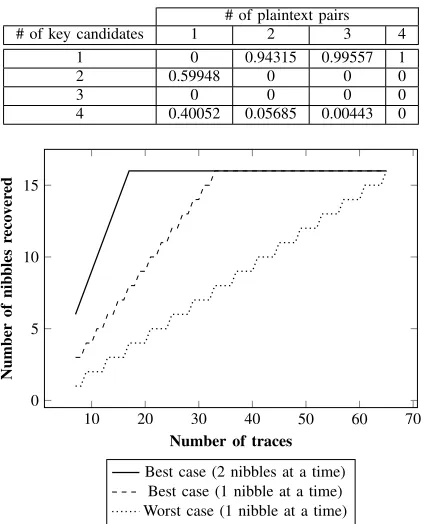
Now, we can consider a known plaintext model which is more relaxed requirement. As can be seen in Table III, using a single plaintext pair ∆p0i for determining ∆S, it will yield 2 key candidates in≈60% of cases and 4 candidates for the rest. By adding additional plaintext pair, the probability of identifying a unique key candidate ki are 94.3%, 99.5% and
100% for 2, 3 and 4 plaintext pair respectively. Since, the same reference plaintext can be used, with 5 encryptions a unique key candidate can be identified in worst case. The numbers would change for an Sbox other than PRESENT, but will stay comparable.
Figure 3 shows the complexities for different scenarios. As mentioned previously, the best case requires 17 encryptions. In case we can choose the optimal plaintexts but for some reason can only recover one nibble at a time,SCADPAwill require 33 encryptions. The worst case only recovers one nibble at a time while using the conservative reduction of candidates and not exploiting any specific Sbox properties. In this case, it will require 4 values to reduce the key candidate to 1 per nibble. Hence, it will require 65 encryptions.
Please note that it is also possible to make a search on remaining candidates. For example, if we have 2 candidates for each nibble, we can determine the value with a brute-force search with complexity of 216. For such case, it would only require 9 encryptions in case we target two nibbles at a time. Similarly, operating at nibble wise granularity at the following
sBoxLayercan recover the key in 9 encryptions as well.
IV. ExperimentalResults
TABLE II: Extended difference distribution table forPRESENTSbox. Columns represent input difference, rows represent output difference and entries are Sbox inputs.
∆ δ 1 2 3 4 5 6 7 8 9 a b c d e f
1 9a 36 078f 5e 1c 24bd
2 8e 34 09 5f 1d 67ab 2c
3 cdef 46 12 3b 0a 58 79
4 47 8d 35ac 0b 2f 169e
5 cdef 0145 2389 67ab
6 9b cdef 37 06 25 18 4a
7 67ab 03 8c 5d 2e 49 1f
8 17 ad 6f 4e 2389 0c 5b
9 0145 9d be 2a 7c 3f 68
a 02 56 bf 9c 7d 1a 48 3e
b 8b 27 35ac 169e 4f 0d
c 8a 26 0145 9f bc 7e 3d
d 2389 57 af 4c 1b 6d 0e
e 13 ae 24bd 6c 59 078f
f 24bd 169e 078f 35ac
TABLE III: Probability of determining key candidates.
# of plaintext pairs # of key candidates 1 2 3 4
1 0 0.94315 0.99557 1 2 0.59948 0 0 0
3 0 0 0 0
4 0.40052 0.05685 0.00443 0
10 20 30 40 50 60 70 0
5 10 15
Number of traces
Number
of
nib
bles
reco
v
er
ed
Best case (2 nibbles at a time) Best case (1 nibble at a time) Worst case (1 nibble at a time)
Fig. 3: Number of traces required for recovering key nibbles of PRESENT.
respectively. Section IV-C shows a way of automating the recognition of the Sbox output differences.
A. Setup
As a DUT, we used a standard 8-bit microcontroller from Atmel, ATmega328P, mounted on Arduino UNO development board. We have measured an electromagnetic emanation with a Langer RF-U 5-2 probe. Signal was captured with LeCroy WaveRunner 610 Zi oscilloscope.
We have used an implementation of PRESENT-80 cipher, where sBoxLayer is computed nibble-wise and the rest of
the operations are done byte-wise. Sampling rate was set at 500 MS/s, while the addRoundKey takes≈7000 samples. A difference introduced in the first round could be observed during the second round. We chose to observe the difference at the secondaddRoundKeyas in our case the start of round was easily identifiable by visual inspection of the trace. Choice of observing the difference on addRoundKey has an advantage and a disadvantage. The advantage being that precise profiling was not needed as compared to locating time instants for
sBoxLayer. The disadvantage is that sinceaddRoundKey is
done byte-wise, the observed differences are limited to byte level. Observed differences on the following sBoxlayercan be nibble precise, given appropriate profiling.
B. Results
To support our method, we have conducted experiments showing the possibility of distinguishing∆S.
Fig 4 shows differences in power consumption captured in the secondaddRoundKey, by calculating∆t. The implemen-tation we used computes theaddRoundKeyin a reverse order, therefore the difference peaks follow this order. In order to improve signal-to-noise ratio and produce clear plots, both t
andt0were averaged from multiple executions. Nevertheless, it was possible to see the difference and raw traces. By observing this difference, the output difference of sBoxLayerin round 1, i.e. ∆Si, can be clearly distinguished. Once ∆Si and ∆pi
are known, it can be used to solve the value of secret key ki,
as shown in the previous section.
C. Automatic Recognition of the Difference
If we look at Figure 4, it is obvious that determination of differences can be automated. For this purpose, one can use a simple algorithm that sets the threshold, enabling the sepa-ration of interesting areas from the random noise. Following steps can be done in order to make the automatic difference recognition:
(a)
0 1,000 2,000 3,000 4,000 5,000 6,000 7,000
−1 0 1 2
·10−2
∆S=0x01
Time samples
Amplitude
(mV)
(b)
0 1,000 2,000 3,000 4,000 5,000 6,000 7,000
−1 0 1 2
·10−2
∆S=0x02
Time samples
Amplitude
(mV)
(c)
0 1,000 2,000 3,000 4,000 5,000 6,000 7,000
−1 0 1 2 ·10
−2
∆S=0x0A
Time samples
Amplitude
(mV)
(d)
0 1,000 2,000 3,000 4,000 5,000 6,000 7,000
−2
−1 0 1 2
·10−2
∆S=0x0F
Time samples
Amplitude
(mV)
Fig. 4: Difference traces∆t showing addRoundKey of round 2, revealing the output difference of the Sbox at round 1. Bytes are processed in a reversed order, therefore the pattern showing the difference also has to be reversed. Difference between the Sbox outputs for the plots (highlighted by the gray background) is as follows: (a) 0x01, (b)0x02, (c)0x0A, and (d) 0x0F.
and t0 come from the same plaintext, i.e. there is no difference in the Sbox output.
Step 2: Set the basic positive and negative threshold to be
r+=µ+σ andr−=µ−σ, respectively.
Step 3: Choosento be a multiplier ofr+andr−in a following way: start from n = 1 and increment the value by 1 until all the points of the trace fall between the positive and negative threshold.
Step 4: Use these values for all the measured traces to indicate points where the difference traces cross the thresholds. Step 5: By the density distribution of the crossing points,
together with the timing, determine ∆S.
Thresholds for ∆S =0x01are stated in Figure 5.
0 1,000 2,000 3,000 4,000 5,000 6,000 7,000
−1 0 1 2
·10−2
∆S=0x01
Time samples
Amplitude
(mV)
Fig. 5: Threshold that enables determination of the∆S. Values used for thresholding were: µ = 3.452×10⁻⁵, σ = 1.453× 10⁻³,n=4.
V. SCADPA Applied onLightweightCipherGIFT
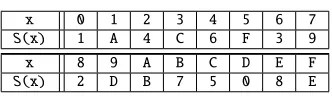
GIFT[3] is a lightweight block cipher, designed to improve the efficiency and correct the weaknesses of PRESENT. Similar toPRESENT,GIFT is based on Substitution-Permutation Net-work (SPN), where each round is composed of substitution layer (SubCells), permutation layer (PermBits) and key addition (AddRoundKey).GIFT has 128-bit key and supports either 64-bit or 128-bit plaintext. The design of 4-bit Sbox (SubCells) and the permutation layer of GIFT is different
from PRESENT, however, the idea of SCADPA can still be
applied.
TABLE IV:GIFTSubCells.
x 0 1 2 3 4 5 6 7
S(x) 1 A 4 C 6 F 3 9
x 8 9 A B C D E F
S(x) 2 D B 7 5 0 8 E
Given the case of GIFT-64-128 (64-bit), the first 32 bits of the input to the permutation layer will go to bytes 0, 2, 4, and 6, whereas the other half will go to the remaining bytes. In general, the diffusion of each nibble after theSubCellscan be formulated as shown in Table V. In summary, each bit in the nibble will go to different bytes in the subsequent round and the order of the targeted byte is as denoted in the table. Here, [i0, ...,ij−1]ndenotes right circular shift byn elements in the
array. In this case, SCADPA can be applied using the same rationale as for the case of PRESENT-80, described earlier, since the affected bytes follow the same diffusion pattern.
One of the challenges is due to the key addition performed in GIFT. Here, the key is separated into eight 16-bit words. Two words are used in each round, that is, forGIFT-64-128, there will only be 32-bit key for each round. For each round, the key is extracted as follows: take the first two words,k0and k1 (referred to as U andV, respectively). At the next round, the key is rearranged as follows:
k7||k6||. . .||k1||k0 ←k1≫2||k0≫12||. . .||k3||k2.
Here, ≫ i is an i bits right rotation within a 16-bit word. The round keys U and V are then xor-ed with the state as follows:b4i+1←b4i+1⊕uiandb4i←b4i⊕vi,∀i∈ {0, ...,15}. A
0 10 20 30 40 50 60 70 80 0
10 20 30
Number of traces
Number
of
nib
bles
reco
v
er
ed
Best case (2 nibbles at a time) Best case (1 nibble at a time)
Fig. 6: The number of key nibbles retrieved by given number of traces attackingGIFT-64-128 targeting multiple rounds.
bits 63/127 (most significant bit, depending on the version of algorithm), 23, 19, 15, 11, 7, 3. Thus, for the attack, in each round, only 32 bits of the key can be recovered.
TABLE V:GIFT: affected bytes after bit permutation for each nibble.
Bits in targeted nibblei Bytes affected in next round
[b0,b1,b2,b3]0≤i≤7 [0,2,4,6](imod 4)
[b0,b1,b2,b3]8≤i≤15 [1,3,5,7](imod 4)
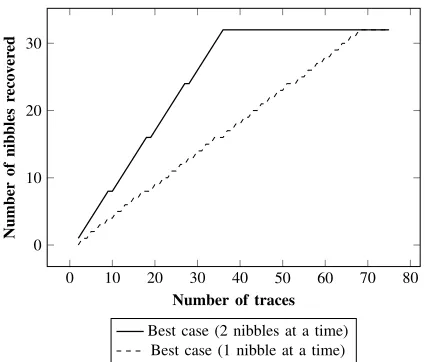
In order to recover the rest of the key, the attack can then be performed on multiple consecutive rounds. Since the first round key has been recovered, to achieve the differential at the next round, the attacker can just “peel off” the first round and continue with SCADPA in the same way on the subsequent round. To recover the whole 128-bit key, this has to be repeated 4×, or 3×with brute-forcing the last 32 key bits. In Figure 6, we show the result of attackingGIFT-64-128. As can be seen in the plot, 68 traces are required to recover all the 128 key bits in case only one nibble is changed each time. In the best case, when two nibbles are targeted at a time, the attack requires 36 traces (4 reference traces and then 32 differential traces). This is due to the reason that for GIFT, on top of the longer key length, with each nibble we can only recover 2 bits, compared to 4 bits for PRESENT.
VI. ReverseEngineering ofSecretCiphers
As mentioned in the literature [15], one can still find solutions that are using secret cipher components despite the Kerckhoffs’ principle. Often industry and agencies would use secret cipher for some specific applications. However, confi-dence in security of a cipher is only developed by detailled and lengthy analysis. This, for example, is the case of AES which has been extensively studied for over two decades without discovering a serious flaw. A common practice to design secret ciphers is to take a well studied cipher and replace
an operation with a secret operation of equivalent security properties. Replacing Sbox of a well studied cipher like AES or PRESENT, with a secret Sbox of same cryptographic strength as the original, results in a new secret cipher.
For a PRESENT-like cipher, each round function consists of three operations in the following order: key addition, Sbox and bit permutation. In this section, we extend the SCADPA approach to recover secret components of PRESENT-like ciphers. The assumptions for the test scenario is as follows:
• Exactly one of the substitution layer or the permutation layer is replaced by a secret component, but not both. • The attacker can feed chosen plaintext and observe the
output ciphertext, without the knowledge of the secret key.
• All Sboxes are identical, which is important to keep the design lightweight.
In Section VI-A, we demonstrate how Sbox can be recovered using SCADPA with known bit permutation. Section VI-B then describes how to recover bit permutation without the assumption whether Sbox is known or not, by using a fault injection.
A. Recovery of Secret Sbox
Let us consider a PRESENT-like cipher using a secret Sbox, while the permutation layer is unchanged (or known). We describe a method that can reverse engineer the secret Sbox as well as recover the first round key with at most 46 measurements by using SCADPA – 16 for the first key nibble and 30 for the rest (this can be optimized to 17 according to Section III-B). Following the above notations, letS denote the secret Sbox operation and let k0 denote the first nibble of the first round key. The 16 measurements which use all the possible values of p0 give us an array of Sbox output differences, saydif, such that
dif[i]=S(k0)⊕S(k0⊕i).
Note that in the caseS(0)=0 andk0=0, the arraydifis the unique solution for the secret Sbox. All the possible solutions for the Sbox and corresponding k0 can be calculated using Algorithm 1. Line 1 considers different values ofk0 and line 2 iterates through different values of S(k0). With each fixed pair ofk0 andS(k0), an Sbox solution is uniquely determined using dif(line 4). For each Sbox solution, there is a unique value for the first round key using the measurement results and SCADPA. This gives the secret Sbox as well as the secret key used in the original encryption algorithm.
In the following, we describe the steps to reverse engineer the Sbox in detail:
Step 1: Run SCADPA for 16 different values of the first plaintext nibble p0.
Step 2: Run SCADPA in a normal way for the rest of the nibbles pi; 1≤i≤15, i.e. with 2-3 different values of
pi.
Algorithm 1: Calculate all Sbox candidates and corre-spondingk0
Input : dif: array of output differences
Output:ARRAYAof(Sbox,key): array of tuples of candidate Sboxes and correspondingk0 value
1 forint k: 0 to 15do 2 forint m: 0 to 15do 3 forint i: 0 to 15do
4 newSbox[i⊕k]=dif[i]⊕m;
5 A.add(newSbox,k);
6 returnA;
Step 4: For each pair of Sbox and first nibble of the first round key returned by Algorithm 1, using the information from Step 2, we can construct a cipher. In total we have 256 potential cipher solutions. In this way, each candidate for Sbox will also yield a unique candidate for the first round key.
Step 5: Run each of the ciphers with the given plaintext and compare the ciphertext with the one obtained from the original algorithm. If the ciphertexts are equal, the Sbox value and the first round key value can be determined.
When it comes to reverse engineering of secret Sbox used in GIFT, the measurement part works in the same way as explained before. However, there is an advantage for the attacker – GIFT does not use pre-whitening key, therefore, the input toSubCellslayer in the first round is known to the attacker. This reduces the search space from 256 to 16 in Step 3.
Obviously, in case the permutation layer is not known to the attacker, she cannot use SCADPA. However, in the following part, we describe a way to reverse engineer this part of the cipher with a usage of fault injection. Since reverse engineering the permutation does not require knowledge of the Sbox, the attacker can first recover permutation using the following attack and then apply SCADPA for Sbox recovery.
B. Recovery of Secret Bit Permutation
Another operation that can be secret is the bit permutation. To successfully recover this layer, SCADPA alone is not sufficient since it can only identify the permutation with byte precision. This is because SCADPA is limited to initial rounds of the cipher, whose output is not observable by the attacker. A difference inserted at plaintext will be untraceable when traversing all the rounds of the cipher. Therefore, to recover the bit permutation, the difference must be inserted at later rounds. This can be achieved by specialized equipment often used in fault injection attacks. The attacker introduces differences in the last round of the cipher and observes the changes in the ciphertext. Therefore, it is similar to differential fault analysis, but only targeting the last permutation layer of the cipher.
We assume the bit permutation is of optimal diffusion. As it turns out, this property can be helpful in designing an efficient reverse engineering method. More specifically, the structure
of the four Sbox groups is the same, meaning that as long as the secret design uses optimal diffusion, it is sufficient for the attacker to get information about one group to know the whole permutation. Along with the initial assumptions, we assume a fault model where the attacker can introduce bit flip faults in the last round at the Sbox output before the permutation layer. By flipping bits before the permutation layer, the attacker can identify fault propagation in the ciphertext, revealing the bit position before the permutation. She just repeats this 16×, for the whole Sbox group and then uses this information to identify the whole permutation layer. Note that in case the permutation is not regular, the attacker has to flip all the bits in the state, resulting to 64 faults.
VII. Extension ofSCADPAto32-bitArchitectures
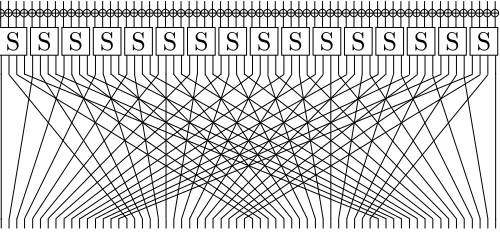
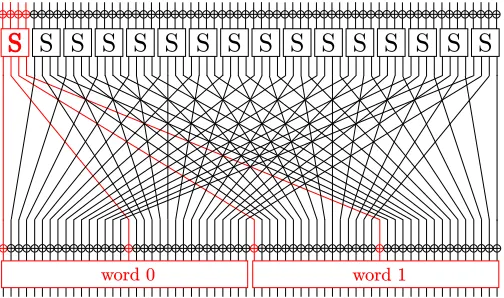
When considering the attack on 32-bit architectures, one has to distinguish between different possibilities of implementing the round function. In case the operations are computed on 4/8-bit blocks, the attack can be carried out in the same way as in Section III-A. However, in caseaddRoundKeyis computed as xor of 32-bit blocks, the attacker gains less information about the processed data and therefore, an updated attack strategy has to be used. This behavior is depicted in Figure 7, where one can easily observe that two output bits of each Sbox go to one word while the other two bits go to another word. In this part, we will describe the method of use for such case.
Fig. 7: PRESENT implemented on 32-bit architecture, where
addRoundKeyis computed on 32-bit words. One can easily see that from one Sbox, the output bits are split equally between the two words.
When the attacker obtains the difference of the traces, ∆t, she can distinguish three possible cases when observing the
addRoundKey:
• onlyword0has changed, indicated byY|N, • onlyword1has changed, indicated by N|Y, • both words have changed, indicated byY|Y.
Step 6 in SCADPA procedure (Section III-A) will be changed as follows:
Step 6: By examining∆t, get the change of Sbox output be-tweenS(xi) andS(xi0), which is denoted byY(N)|Y(N)
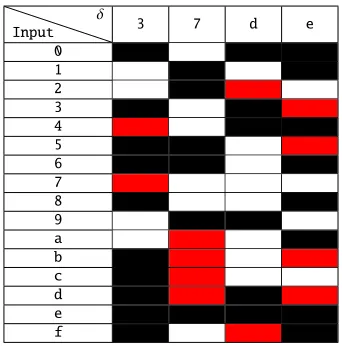
ForPRESENT Sbox, the information the attacker can get is stated in Table VI, which represents a DDT with output diff er-ence following the three cases described above. Now, she can construct an optimal attack strategy that will require the lowest number of traces, depending on the chosen plaintext. She will iterate through possible combinations of input differences until she finds a combination that yields a unique solution for the Sbox input. To be more specific, for PRESENTSbox, the minimal number of input differences needed is 4. One such combination is stated in Table VII, for differences0x3, 0x7, 0xd, 0xe. For example, the attacker first measures the trace for p=0, which will serve as a reference trace. Then to attack
ith nibble of the first round key she measures the traces for
pi=0x3, 0x7, 0xd, 0xe, respectively. The four differences
between the four traces and the reference trace will uniquely determine the input of Sbox for the first encryption, i.e. pi⊕ki.
Considering that attacker needs one reference trace and 4 other traces per nibble, the total number of chosen plaintexts to fully recover the round key is 65.
A. More Precise Attacker Model
Now, let us consider a more powerful attacker where she is able to distinguish not only whether there is a change in each of the 32-bit words, but also what is the Hamming weight of such change. This knowledge can help her dis-tinguish how many bits of the Sbox output were changed and therefore, she needs lower number of encryptions to recover the key. Let us denote this difference as ∆HWj =
HammingWeight(wordj⊕word0j), where j ∈ 0,1 is index of
the word. Thus for two different plaintext nibbles pi,p0i,∆HW0
and ∆HW1 are the Hamming weights of the first and last two bits ofS(ki⊕pi)⊕S(ki⊕p0i) respectively. Step 6 in SCADPA
procedure (Section III-A) will be changed as follows:
Step 6: By examining ∆t, get the change of Sbox output betweenS(xi) andS(x0i):∆HW0 and∆HW1.
ForPRESENTSbox, Table VIII shows the DDT for this case – columns denoting the input difference and rows denoting
∆HWi for each word. One can easily see that for such case,
the attacker only needs two difference traces on top of the reference trace to uniquely identify the Sbox input. Therefore, she needs 33 encryptions in total, same as the single nibble attack described for 8-bit architecture.
B. Reverse Engineering
Now let us consider the reverse engineering problem de-scribed in Section VI-A for 32-bit architecture. In this case, the array difcannot be obtained directly. However, the attacker can still calculate different candidates fordifusing the same amount of SCADPA measurements as detailed in Step 1 and 2 of Section VI-A. In this section, we illustrate how to achieve this for each of the two attacker capabilities discussed above. In case the attacker can observe the change of word0and
word1 as described in the beginning of this section, instead of dif, the attacker can obtain an arraydifY N of length 15,
such that
• difY N[i]=Y|N if the first two bits ofS(k0)⊕S(k0⊕i) are non-zero and the second two bits ofS(k0)⊕S(k0⊕i) are zero;
• difY N[i] =N|Y if the first two bits of S(k0)⊕S(k0⊕i) are zero and the second two bits ofS(k0)⊕S(k0⊕i) are non-zero;
• difY N[i]=Y|Y if the first two bits ofS(k0)⊕S(k0⊕i) are non-zero and the second two bits ofS(k0)⊕S(k0⊕i) are non-zero.
Due to the fact that Sbox is a bijective function onF42, for any SboxS, the valuesS(k0)⊕S(k0⊕i) fori=1,2, . . . ,15 are always a permutation of the 15 values of 1,2,3, . . . ,15. Thus, in the arraydifY N, we will have exactly 3 ofY|N, 3 ofN|Y
and 9 of Y|Y. Furthermore, for any i, we have the following observations:
• ifdifY N=Y|N, there are 3 possibilities forS(k0)⊕S(k0⊕ i): 1000,0100,1100;
• ifdifY N=N|Y, there are 3 possibilities forS(k0)⊕S(k0⊕ i): 0010,0001,0011;
• ifdifY N=Y|N, there are 9 possibilities forS(k0)⊕S(k0⊕ i): 0101,0110,0111,1001,1010,1011,1101,1110,1111. Hence, for the arraydifY N, the attacker has 33×33×99=324
possible solutions for dif. Then she can continue with steps 3-5 as in Section VI-A. In this way, the number of ciphers she needs to check is 324×28 ≈246. This still stays with in the brute force complexity.
Now, we consider the case the attacker can observe Ham-ming weight of the differences as described in Section VII-A. Then, from the SCADPA measurements she can obtain an arraydifHW of length 15, such that difHW[i]= ∆HWi0|δHWi1,
where∆HWi0 and∆HWi1 are the Hamming weights of the first
and last two bits ofS(ki)⊕S(ki⊕i) respectively. By a similar
ar-gument as above, there are respectively 4,2,2,2,2,1,1,1 per-mutations of 11,12,21,10,01,20,02,22 in the array difHW.
And for each i, the possible values of S(k0)⊕S(k0⊕i) are respectively 4,2,2,2,2,1,1,1 for 11,12,21,10,01,20,02,22. Hence, in this case, the number of ciphers the attacker needs to check is 216×28 =224.
VIII. Discussion
In this part we will first discuss how side-channel coun-termeasures affect the successful application of SCADPA in Section VIII-A. Section VIII-B then explains how a fault attack countermeasure based on redundancy can increase implementation vulnerability w.r.t. SCADPA. Next, we show possibilities of attacking different block cipher modes of operation in Section VIII-C. Finally, in Section VIII-D we state alternatives for permutation layer as well as countermeasures that prevent successful application of SCADPA.
A. Side-Channel Countermeasures
TABLE VI: Extended difference distribution table for PRESENT Sbox, where the columns follow the input difference, rows follow the change of the two output words and entries represent the Sbox inputs – w0denotesword0,w1denotesword1.
w0|w1
δ 1 2 3 4 5 6 7 8 9 a b c d e f
N|Y cdef 46 129a 36 8e 03478f 3b 09 05af 5e 1d 15678abc 279c 24bd
Y|N 8a 47 26 01458d 179f abcd 3567acef 4e 02389b 0c 2f 35bd 169e
Y|Y 012345 012357 03568 0134578 279a 02345 12569e 0124567 1248bd 12367 1467 234567 0349de 0146 0357
6789ab 9bcdef bcdef 9abcdef bcef 6abcd 89acdef 89bcd acdf 89abef 8aef 8acf
TABLE VII: Example of output differences for input difference
0x3, 0x7, 0xd, 0xe. White color indicatesY|N, red color
N|Y, and black color indicates both words changed – Y|Y. Each row is unique, and therefore, enables recognition of the Sbox input.
Input δ
3 7 d e
0 1 2 3 4 5 6 7 8 9 a b c d e f
implementation of the countermeasure can still render the attack possible. For instance, an unbalanced implementation of hiding will still allow to observe the difference. Similarly for masking,∆S would depend uponpi⊕mi⊕p0i⊕m
0
i. If masks
mi,m0i are totally independent and uniformly distributed, the
attack is not possible, however with biases in the mask, the attack can still be carried out with increased effort. Shuffling of the order of the Sboxes and/or key additions would make the attack harder since only the hamming weight could be directly observed, instead of the difference value.
Nevertheless, countermeasures can incur significant over-heads. Thus, for lightweight cryptography specially oriented for low-cost platforms, the functions must be carefully chosen to avoid such vulnerabilities.
B. Internal Redundancy Countermeasure
Recently, a software countermeasure against fault attacks, called Internal Redundancy Countermeasure (IRC) [17], was proposed. IRC utilizes a redundancy within an instruction to protect against simple data faults and instructions skips. To do this, data blocks, together with reference blocks are duplicated and concatenated within one instruction, as can be seen in Figure 8. While the data blocks contain user data that is being encrypted, the reference blocks are protecting against instruction skips, and are not interesting for the attacker since their value is known. The proposal was aimed at 32-bit
Fig. 8: Block concatenation for Internal Redundancy Counter-measure (IRC).
Fig. 9: Construction of four redundant blocks out of one 32-bit block according to IRC.
architectures, leading to four blocks of 8-bits per instruction. Therefore, one 32-bit data block is split into four 32-bit redundant blocks, as stated in Figure 9.
Such countermeasure therefore effectively transforms a 32-bit implementation into an 8-32-bit one in the view of SCADPA methodology. Splitting the data to smaller chunks means they can be analyzed separately in the same way as in the case of 8-bit implementation stated in Section III-A. In case of
PRESENT, it means that the difference in addRoundKey will be distinguishable according to Figure 2.
This behavior can be seen in Figure 10, which shows the difference between the unprotected implementation and IRC protected implementation of PRESENTon 32-bit architectures. According to results from Section VII, this requires 65 traces in total for unprotected 32-bit implementation. However, only 17 traces will be required in case of the IRC protected implementation. This is a common example where fixing one vulnerability open doors for other vulnerabilities.
C. Attack on Different Modes of Operation
TABLE VIII: Extended difference distribution table for PRESENT Sbox, where the columns follow the input difference and rows follow the Hamming weight of the two output words.
δHW0|δHW1 δ
1 2 3 4 5 6 7 8 9 a b c d e f
0|1 9a 36 8e 03478f 09 5f 5e 1d 167abc 2c 24bd
1|0 47 8d 17 ad 356acf 4e 02389b 0c 2f 5b 169e
1|1 0145 029bcdef 56cdef 0134579bdf 9bce 06 25 2a 18 23789d 17ac 34678abf 3e 468a
0|2 cdef 46 12 3b 0a 58 79
2|0 8a 26 0145 9f bc 7e 3d
1|2 67ab 038b 8c 27 35ac 1569de 4f 2e 049d 1f
2|1 2389 1357 ae af 4c 24bd 16bc 6d 59 0e 078f
2|2 24bd 169e 078f 35ac
0 10 20 30 40 50 60 70 0
5 10 15
Number of traces
Number
of
nib
bles
reco
v
er
ed
PRESENTIRC, 32-bit implementation UnprotectedPRESENT, 32 bit implementation
Fig. 10: Number of nibbles recovered for unprotected imple-mentation and for the one protected with IRC for different number of traces.
Enc Nonce, Ctr
C0
k
P0
Enc Nonce, Ctr
C1
k
P1
Enc Nonce, Ctr
C2
k
P2
· · · Enc Nonce, Ctr
Cn k
Pn
Fig. 11: Counter (CTR) mode of operation (encryption) [20].
(CTR) mode (Figure 11), the input to the encryption algorithm consists of a nonce and a counter. While the nonce is a random number, counter normally increases by 1 after each block. While the nonce stays fixed, the incrementing counter satisfies the chosen plaintext criteria of SCADPA as discussed in Section III. The attack allows to recover few nibbles directly affected by the counter in the first round. For the remaining nibbles, chosen nonce or attack on second round can be carried out in a similar way.
On the other hand, when targeting Cipher Block Chaining (CBC) mode, one has to aim at the decryption module (Figure 12). This comes from the property of CBC where the plaintext is first xor-ed with the IV (first block) or with ciphertext from the previous block. In this case,
chosen-Dec
P0
k
C0
Dec
P1
k
C1
Dec
P2
k
C2
IV
· · · Dec
Pn
k
Cn
· · · Dec
Pn
k
Cn
Fig. 12: Cipher Block Chaining (CBC) mode of operation (decryption) [20].
plaintext attack changes to chosen-ciphertext, without the knowledge of plaintext. The same hold for Propagating Cipher Block Chaining (PCBC) mode.
D. Alternatives for Diffusion Layer
Certain diffusion function do not offer vulnerabilities that are exploited by SCADPA in bit permutation. AES[21], the
NIST standard for symmetric key cryptography, is a relevant example.AESencrypts 128-bit data block with a 128/192/256 bits secret key in 10/12/14 rounds. The data is organised in a 4×4 matrix of bytes called state and the round function is applied upon it. A round comprises of four operations i.e.
SubBytes (SB), ShiftRows (SR), MixColumns (MC) and
AddRoundKeys (ARK). SB is a 8×8 non-linear table look
up and ARK is the round key addition. We concentrate on diffusion functions i.e. SR and MC. SR applies a cyclic shift on the rows (1, 2, 3, 4) with offsets (0, 1, 2, 3). MC operates on four bytes of each column of the state. The four bytes are combined using an invertible linear transformation. When a difference is inserted at the input, irrespective of its value, the difference is always propagated on all four bytes, preventing
∆S leakage. This is illustrated in Figure 13.
Recent trends show that it is possible to design a lightweight cipher with similar diffusion function and not only rely on bit permutations. SKINNY [22], PRINCE [23] are common examples. Other ultra-lightweight ciphers like SIMON and
SPECK[24], use several bit shifts applied to a partial interme-diate state to provide the diffusion. Furthermore, only a binary operation is used to provide non-linearity. Both operations combined would prevent a successful application of SCADPA.
IX. Conclusions
SB SR MC ARK
Fig. 13: Difference Diffusion in AES.
side-channel assisted methodology called SCADPA to exploit it. With a practical case study on low-cost microcontroller running PRESENT-80, we were able to practically recover the secret key with as low as 17 encryptions and an exhaustive search with complexity of 216. In case of GIFT, the number of encryptions in the best case was 36. We extend the method-ology to enable the recovery of secret Sboxes inPRESENT-like ciphers. We further discuss how the application of redundancy-based fault attack countermeasures increases success rates of SCADPA. Several attacker models are presented, with different complexities of retrieving the key. To avoid the presented attacks, usage of more complex yet low-cost diffusion function is encouraged.
In the future work, it would be interesting to look at pos-sibilities of exploiting different side-channel countermeasures. Especially, if randomness in masking is biased or the leakage characteristics of hiding are not uniform.
References
[1] K. A. McKay, L. Bassham, M. S. Turan, and N. Mouha, “Report on lightweight cryptography,”NIST DRAFT NISTIR, vol. 8114, 2016. [2] A. Bogdanov, L. R. Knudsen, G. Leander, C. Paar, A. Poschmann, M. J.
Robshaw, Y. Seurin, and C. Vikkelsoe, “PRESENT: An ultra-lightweight block cipher,” inCHES, vol. 4727. Springer, 2007, pp. 450–466. [3] S. Banik, S. K. Pandey, T. Peyrin, Y. Sasaki, S. M. Sim, and Y. Todo,
“GIFT: A Small Present,” Cryptographic Hardware and Embedded
Systems-CHES, pp. 25–28, 2017.
[4] M. Lipp, M. Schwarz, D. Gruss, T. Prescher, W. Haas, S. Mangard, P. Kocher, D. Genkin, Y. Yarom, and M. Hamburg, “Meltdown,”ArXiv
e-prints, Jan. 2018.
[5] P. Kocher, J. Jaffe, and B. Jun, “Differential power analysis,” inAdvances
in cryptology - CRYPTO’99. Springer, 1999, pp. 789–789.
[6] K. Schramm, T. Wollinger, and C. Paar, “A new class of collision attacks and its application to DES,” inFSE, vol. 2887. Springer, 2003, pp. 206–222.
[7] C. Clavier, Q. Isorez, and A. Wurcker, “Complete SCARE of AES-Like Block Ciphers by Chosen Plaintext Collision Power Analysis,” in
INDOCRYPT, vol. 8250. Springer, 2013, pp. 116–135.
[8] N. Veyrat-Charvillon and F.-X. Standaert, “Adaptive chosen-message side-channel attacks.” inACNS, vol. 6123. Springer, 2010, pp. 186–199.
[9] J. Kelsey, B. Schneier, D. Wagner, and C. Hall, “Side channel cryptanal-ysis of product ciphers,”Computer Security - ESORICS 98, pp. 97–110, 1998.
[10] B. den Boer, K. Lemke, and G. Wicke, “A DPA Attack against the Modular Reduction within a CRT Implementation of RSA,” inCHES, vol. 2523. Springer, 2002, pp. 228–243.
[11] L. Guo, L. Wang, D. Liu, W. Shan, Z. Zhang, Q. Li, and J. Yu, “A chosen-plaintext differential power analysis attack on HMAC-SM3,” in
Computational Intelligence and Security (CIS), 2015 11th International
Conference on. IEEE, 2015, pp. 350–353.
[12] O. Reparaz and B. Gierlichs, “A first-order chosen-plaintext dpa attack on the third round of des,” 2017, https://eprint.iacr.org/2017/1257. [13] R. Novak, “Side-channel attack on substitution blocks,” inACNS, vol.
2846. Springer, 2003, pp. 307–318.
[14] M. Rivain and T. Roche, “SCARE of secret ciphers with SPN structures,”
inInternational Conference on the Theory and Application of Cryptology
and Information Security. Springer, 2013, pp. 526–544.
[15] C. Clavier, Q. Isorez, D. Marion, and A. Wurcker, “Complete reverse-engineering of aes-like block ciphers by scare and fire attacks,”
Cryp-tography and Communications, vol. 7, no. 1, pp. 121–162, 2015.
[16] J. Breier, D. Jap, and S. Bhasin, “SCADPA: Side-Channel Assisted Differential-Plaintext Attack on Bit Permutation Based Ciphers (To be published),” inDesign, Automation and Test in Europe (DATE), 2018. IEEE, 2018, pp. 1–6.
[17] B. Lac, A. Canteaut, J. J. Fournier, and R. Sirdey, “Thwarting fault attacks using the internal redundancy countermeasure (irc),” Cryptology ePrint Archive, Report 2017/910, 2017, https://eprint.iacr.org/2017/910. [18] P. Hoogvorst, J.-L. Danger, and G. Duc, “Software Implementation of
Dual-Rail Representation,” inCOSADE, 2011, Darmstadt, Germany. [19] E. Prouff and M. Rivain, “Masking against side-channel attacks: A
formal security proof,” in Annual International Conference on the
Theory and Applications of Cryptographic Techniques. Springer, 2013,
pp. 142–159.
[20] J. Jean, “TikZ for Cryptographers,” https://www.iacr.org/authors/tikz/, 2016.
[21] N. F. Pub, “197: Advanced encryption standard (AES),”Federal
infor-mation processing standards publication, vol. 197, no. 441, p. 0311,
2001.
[22] C. Beierle, J. Jean, S. Kölbl, G. Leander, A. Moradi, T. Peyrin, Y. Sasaki, P. Sasdrich, and S. M. Sim, “The SKINNY Family of Block Ciphers and its Low-Latency Variant MANTIS,” Cryptology ePrint Archive, Report 2016/660, 2016, http://eprint.iacr.org/2016/660.
[23] J. Borghoff, A. Canteaut, T. Güneysu, E. B. Kavun, M. Knezevic, L. R. Knudsen, G. Leander, V. Nikov, C. Paar, C. Rechbergeret al., “PRINCE– a low-latency block cipher for pervasive computing applications,” in
International Conference on the Theory and Application of Cryptology
and Information Security. Springer, 2012, pp. 208–225.
[24] R. Beaulieu, S. Treatman-Clark, D. Shors, B. Weeks, J. Smith, and L. Wingers, “The SIMON and SPECK lightweight block ciphers,” in
2015 52nd ACM/EDAC/IEEE Design Automation Conference (DAC),
![Fig. 12: Cipher Block Chaining (CBC) mode of operation(decryption) [20].](https://thumb-us.123doks.com/thumbv2/123dok_us/7985095.1324813/11.612.52.562.86.353/fig-cipher-block-chaining-cbc-mode-operation-decryption.webp)

