The Application Of Directed Graphs In
Development Of Effective Standard Rubik
Completion Algorithms
Wijaya, Dafik, Fatahillah
Abstract: C ompletion Algorithm of standard rubik has been developed with many strategies by the experts. This research focuses on the development of standard rubik algorithms using strategy s olve OLL stage and PLL stage at the same time. The proc ess of developing this algorithm refers to ADDIE model which consists of five stages , namely analysis , design, development, implement ation and evaluation. The result of the c ompletion algorithm validation is included in the valid criteria with a c orrelation c oefficient value 0,87. Bas ed on the trials that have been conducted in Jember with a total of 15 subjects, it is found that the total average of response questionnaire result is 1,89 or percentage 94,5%. Based on the trials, it is obtained that the result of practitioner observation average is 4,56 or percentage 91,2%. While the effectiveness test of algorithm is not only from analyzing the shape of the graph made. From the three problems, it is found that every development algorithm has graph shape simpler than graph of ordinary algorithm. The effectiveness test of algorithm also uses debugging test and profiling test, the result is that every development algorithm can solve every problem and every development algorithm has less step than ordinary algorithm.
Index Terms: Development Research, Algorithm, Standard Rubik‘s Cube, Directed Graph, ADDIE model, Effectiveness, Mathematics
—————————— ——————————
1.
INTRODUCTION
Rubik, often called the ―Rubik‘s Cube‖, is a mechanical puzzle that has colors on each side. There are many types of rubik variations, ranging from shapes to sizes. Rubik to be discussed is a 3x3x3 rubik or it can also be called a standard rubik. Rubik cube was created by a Hungarian professor named Erno Rubik in 1974. Initially the game was named ―Magic cube‖ by its creator, but then in 1980 it was renamed ―Rubik‘s cube‖. As time goes by, rubik is not only in the form of a cube but there are also pyramid and various kinds [1]. Rubik is not only a mathematical toy to sharpen the brain but also has a close relation with combinatorics and graphs as a branch of mathematics. Learning mathematics is a means of scientific and logical thinking and has an important role in efforts to improve the quality of human resources. Learning is a learning process that involves teachers and learners [2]. Mathematics is a very important science that is mastered by everyone in supporting human life [3]. Mathematics learning can also be done by playing a game like a standard rubik. The standard rubik has 43.252.003.274.489.856.000 or around 43 quintilion patterns [4]. A graph is a set ) )), where ) is a finite infinite set of elements called vertices or points, and ) is a set (may be empty) of pairs of non ordered from the points ) which is called edge.
————————————————
Wijaya is currently pursuing bachelor’s degree program in mathematics education in University of Jember, Indonesia, PH-089508175672. E-mail: [email protected]
Dafik is an associate professor in mathematics education at University of Jember, Indonesia, PH-082113035007. E-mail: [email protected]
Fatahillah is an associate master’s in mathematics education at University of Jember, Indonesia, PH-081230495959. Email: [email protected]
) is called the set of points from and ) is called the set of sides of [5]. Graphs can be used on a standard rubik algorithm as a point-to-point transfer so as to form a line. That pattern of displacement can be made into a graph [6]. Not just an arbitrary movement, but the graphs formed later are the ones that can solve the rubik problem after it has been scrambled. For this reason, a standard rubik completion algorithm is needed. Algorithm means having repetition of processes or iterations to get a new result [7]. Strategy becomes an important thing in an algorithm. The experts have created methods to solve the standard rubik of course with different strategies. The strategy used in this research is completing layers in sequence. The strategy is the same as the technique for beginners, but the difference is in layer 3. In the technique for beginners, layer 3 is still divided into 2 stages namely Orientation Last Layer (OLL) and Permutation Last Layer (PLL) but in this study OLL and PLL will be completed at the same time . This research is a type of development research. If it is associated with education, development means a gradual change towards a level that tends to be higher, broader and deeper which can be created as a whole perfection or maturity [8]. In development research, development models are needed to ensure quality [9]. The development model is a conceptual design process in an effort to improve the function of a pre-existing model, through the addition of learning components that are considered to be able to improve the quality of the objective achievement, that is why this study uses ADDIE models [10].
3993
Fig. 1. Center, edge and corner
1. Center is the middle part of each side of the standard rubik. 2. Edge is the middle part of edges which has 2 colors in
standard rubik.
3. Corner is the tip part of edges which has 3 colors in standard rubik.
The Rubik can be played in several ways as follows:
1. Playing ordinary means finishing rubik without additional conditions such as time and others.
2. Speedcubing means completing the rubik quickly and the completion time is recorded.
3. One-Handedcubing means completing the Rubik by using one hand.
4. Blindfoldcubing means finishing rubik with eyes closed. 5. Jugglingcubing means completing a Rubik by turning and
throwing a Rubik.
In the rubik game, of course, many methods have been developed by rubik experts such as the Fridrich Method, Roux Method, Petrus Method, Waterman Method, Heise Method and many more. Techniques for beginners are used to facilitate the use of algorithms that will be developed. The standard rubik completion algorithm is formed from several notations. The basic notation in rubik is divided into 6 namely Front (F), Back (B), Left (L), Right (R), Up (U), Down (D). Notation is used to determine which part of the rubik is moved like Front (F) means the front. In rubik notation there is also an accent (‗). Adding an accent means turning the rubik counterclockwise. In addition to the accent there is also a Double (2) which means to rotate it twice. In the notation there is also such a thing as rotation. Rotation in rubik there are 3 namely , and . Rotation means rotating the whole rubik in the desired axis. The accent (‗) also applies to rotation [11].
2. METHOD
The type of this research is development research. Development research aims to produce a product that will later be tested for validity, practicality, and effectiveness. The research trial was held in Jember with 15 respondents. The development model used is the ADDIE model which consists of 5 stages, namely analysis stage, design stage, development stage, implementation stage and the last is evaluation stage.
Fig. 2. The stages of ADDIE model
Preliminary analysis
Subject analysis
Problem analysis
Concept analysis
Algorithm design
Draft I
Expert validation
Valid
Draft
Testing
Revision
Analysis Revision
𝑖 = 1 2 3 … Draft I𝑖
Product Analysis Product Test analysis
Analysis
Design
Develop
Implementation
2.1 Analysis Stage
The analysis stage is the phase where the researcher looks for and analyzes the things that are important in the study such as objectives, players, concepts and tests.
2.2 Design Stage
The design stage aims to design an algorithm consisting of algorithm selection, format selection, initial algorithm design, and test preparation on the algorithm.
2.3 Development Stage
The development stage is carried out to produce the draft II algorithm. Draft II is a revised algorithm based on expert advice.
2.4 Implementation Stage
The implementation stage is the distribution phase of the developed algorithm. Data collection techniques in this study used expert validation, observation, tests, questionnaires and interviews.
2.5 Evaluation Stage
The evaluation stage is the stage where the data obtained is processed so that later the data obtained is valid, practical and effective.
3. RESULT AND DISCUSSION
3.1 Analysis Stage
This development research produces a valid, practical and effective algorithm. The results of this study are processed through the stages of ADDIE namely, analysis, design, development, implementation and evaluation as the following: a. Analysis
In the analysis stage, it is determined from the preliminary analysis, subject analysis, concept analysis and test analysis. At this phase the activity undertaken is to examine the underlying problems in the development of a standard rubik solving algorithm. One of the problems faced is the difficulty of solving standard rubik using expert methods so that researchers use techniques for beginners to facilitate users. Ineffective use of the algorithm is also a problem for players to use so many steps. Algorithms are also not presented in book form but also in animation using Macromedia Flash 8 software. Concept analysis is also carried out to link the completion algorithm with graphs so that later graphs are generated according to the objectives to be achieved. At this stage the test analysis is also carried out. There are 2 tests to be tested, they are profiling and debugging.
b. Design
At this stage, an algorithm will be developed from the 3 basic algorithms:
1. F U R U ‗R‘ F ‗ 2. R ‗U‘ R U ‗R‘ U2 R 3. R U R ‗U R U2 R‘
From the three basic algorithms, 22 development algorithms are obtained for 88 problems. But in the discussion only three
falls into the medium category because conditions are often encountered and many players do not memorize the resolution algorithm. Problem 3 falls into the difficult category because conditions are rarely encountered and many players do not memorize the resolution algorithm. Here are 3 problems and the solution algorithm.
TABLE 1
ALGORITHM DESIGN
c. Develop
3995 TABLE 2
THE RESULT OF ALGORITHM VALIDATION
Analysis of the practicality of the development algorithm through observation sheets where at the time of implementation there were 5 observers who did the assessment. Based on the analysis of the algorithm observation sheet it is said to be practically proven from an average total of 4.56 or with a percentage of 91.2% and categorized as good. The results of observations by practitioners can be seen in Table 3.
TABEL 3
THE RESULT OF PRACTITIONERS OBSERVATIONS
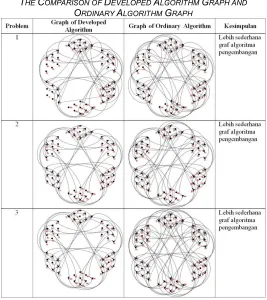
Practicality analysis was also supported by interviews with 3 research subjects. The interview was carried out after the introduction of an algorithm developed using Macromedia Flash version 8 was carried out. Based on the results of the interview during the learning process there were practitioners who had difficulty using the algorithm because they recalled the notations so that they were sometimes reversed. The effectiveness test is done to find out how effective the algorithm that has been developed. Data analyzed included cognitive, psychomotor, and affective aspects. Cognitive aspects are obtained through comparison between 2 graphs produced from ordinary algorithms and developed algorithms. Comparison of graphs between ordinary and development algorithms can be seen in table 4.
TABLE 4
THE COMPARISON OF DEVELOPED ALGORITHM GRAPH AND ORDINARY ALGORITHM GRAPH
From the three problems above, a simpler graph is formed from the development algorithm so that it can be said that the cognitive aspects of the development algorithm are more effective. The second aspect, which is psychomotor, is obtained through tests. The test is divided into 2 namely debugging and profiling tests. Both of these tests are carried out in Macromedia Flash 8. In the debugging test, it will be proven that the development algorithm and ordinary can solve standard rubik until all the pieces are in correct place. Profiling tests will be compared in many steps needed between the development algorithm and the ordinary algorithm. Both tests can be seen in Figure 3, Figure 4 and Figure 5.
Fig. 4. Solving Problem 2 in Macromedia Flash 8
Fig. 5. Solving Problem 3 in Macromedia Flash 8
From Figure 1, Figure 2 and Figure 3 it is proven that for each algorithm can solve every problem. From this figure, we also get the comparison of many steps of each problem, this can be seen in Table 5 below.
TABLE 5
THE COMPARISON OF MANY STEPS EVERY PROBLEM
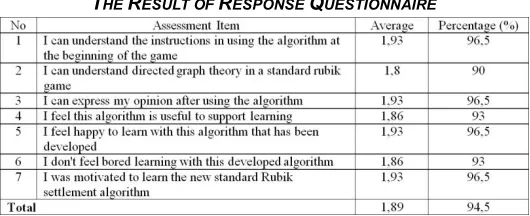
From these results, it isproven that the development algorithm has fewer steps than the ordinary algorithm. These results also prove that the algorithm has an average of 11 steps less than the usual algorithm. The last aspect is affective obtained through the questionnaire response, based on the results of an average total of 1.89 with a percentage of 94.5% and categorized well. The results of the questionnaire responses for each indicator can be seen in table 6.
TABEL 6
THE RESULT OF RESPONSE QUESTIONNAIRE
The implementation stage in this study was carried out in Jember. The implementation stage of this research begins with the introduction of the developed algorithm. When introducing the algorithm, the observer pays attention to the researcher as a practitioner and fills in the practitioner‘s observation sheet. The algorithm that has been developed in this study has the advantage that the algorithm is presented in Macromedia Flash software 8. In addition, the algorithm is presented in the form of directed graphs so that it is easier to find out the movement of each notation. After that the research subjects were asked to solve one problem using ordinary and developed algorithms. Research subjects were also given a user response questionnaire. Researchers also randomly chose research subjects to be interviewed.
e. Evaluation
This stage is carried out to determine the level of effectiveness and practicality of the developed algorithm so that it is not only valid but also practical and effective.
4. CONCLUSION AND SUGGESTIONS
The results of the validation of the development algorithm in the form of directed graphs are included in the valid criteria with a correlation coefficient of 0.87 including the ―Very High‖ category. Based on the results of the trial, the results of using the algorithm are included in the level of practicality with the category of ―Good‖ with the percentage reaching 91.2%. Then the level of effectiveness is included in the category of ―Good‖ on all aspects. Cognitive aspects show that graphs formed from algorithm development are simpler so that they are more effective. In the psychomotor aspect, each development algorithm has fewer steps than an ordinary algorithm so it is more effective. Affective aspects obtained a percentage of 94.5%. Suggestions from the results of this study that can be put forward by researchers are that for other researchers who develop similar studies should display using 3D software to make it easier for users to see the movement of the algorithm. The researcher also suggests adding the basic algorithm so that the developed algorithm has more variants.
5. DISCUSSION
3997
REFERENCE
[1] Fauzan, Ahmad. 2012. Rubik‘s Blindfold Completion with Graph Visualization. Unpublished. Paper IF2091 Discrete Structure – Sem. I Year 2011/2012.
[2] R. P. Murtikusuma, A. Fatahillah, and L. A. Monalisa, ―Development of Combinatorics Learning Plan Based on National Qualification Framework and Local Wisdom‖ J. EDUCATION, vol. 4, no. 3, pg. 41-44, 2017.
[3] A. Fatahillah, Y. F. W. N. Tiyas, and Susanto, ―Analysis of Student Errors in Solving Mathematical Story Problems Based on Newman‘s Stages and Scaffolding Forms Given,‖ Kadikma, vol. 8, no. 1, pp. 40–51, 2017.
[4] Rokicki, Tomas. 2008. Twenty-Five Moves Suffice for Rubik‘s Cube. http://arxiv.org/abs/0803.3435 (accessed January 13, 2019).
[5] Slamin. 2009. Network Design Graph Theory Approach. Jember: Universitas Jember.
[6] Sam, M., dan Yuliani. 2016. Application of Prim Algorithm to Build Minimum Spanning Tree in Optimizing the National Transmission Network of South Sulawesi Province. Dinamika Journal 7(1): 50-61.
[7] Maulana, Gun Gun. 2017. Basic Algorithm Learning and Programming using Web-Based Algorithms. Mechanical Engineering Journal 6: 69-73
[8] Arifin, Zainal. 2012. Curriculum Development Concepts and Models. Bandung: PT. Remaja Rosdakarya.
[9] Sagala, Syaiful. 2005. Concepts and Meanings of Learning. Bandung: Penerbit Alfabeta
[10] Sugiarta, Awandi Nopyan. 2007. Development of Management Model of Collaborative Learning Program for the Independence of Street Children at the Shelter House (Focused Study at the Shelter House in Bekasi City). Unpublished. Repository UPI.
[11] Akbar, Fairozal Zulhaydar, dkk. 2012. Solving Rubik‘s Cube Game with Genetic Algorithm Method. Technical Information Journal Page 1-7.
[12] Hakim, Ahmad Naufal. 2018. The Application of Graphs in Rubik‘s Cube Game. Unpublished. IF2120 Discrete Mathematics Paper - Sem. I of 2018/2019