Grades of Openness. Open and Closed Articles in
Norway
Susanne Mikki 1,*, Øyvind L. Gjesdal 2 and Tormod E. Strømme 3
1 University of Bergen; [email protected] 2 University of Bergen; [email protected] 3 University of Bergen; [email protected]
* Correspondence: [email protected]; Tel.: +47-909-082-66
Abstract: Based on the total scholarly article output of Norway, we investigated the coverage and degree of openness according to three bibliographic services 1) Google Scholar, 2) oaDOI by Impact Story and 3) 1findr by 1science.
According to Google Scholar, we find that more than 70% of all Norwegian articles are openly available. However, degrees are profoundly lower according to oaDOI and 1findr, respectively 31% and 52%. Varying degrees are mainly caused by different interpretations of openness, with oaDOI being most restrictive. Furthermore, open shares vary considerably by discipline, with the Medcine and Health sciences at the upper and the Humanities at the lower end.
We also determined the citation frequencies using Cited-by values as of Google Scholar, applying year and subject normalization. We find a significant citation advantage for open articles. However, this is not the case for all types of openness. In fact, the category Open Access journals was by far lowest cited, indicating that young journals with a declared open access policy still lack recognition.
Keywords: bibliometrics; publication statistics; open access; citation impact
1. Introduction
There is a growing demand to make research freely available to everyone. This has resulted in several developments over the last few years. Firstly, Governments, funders and institutions are increasingly mandating open access (OA) to research publications. The Norwegian Government introduced a mandate on open access to scholarly articles in August 2017 [1] with the aim of making all Norwegian publicly funded research open access by 2024. Secondly, the Max Planck Digital Library initiative, OA2020 [2], which seeks to transform the publishing system by replacing the subscription model with an open access model, has been followed by a rise in open access big deals with publishers. Thirdly, social sharing networks have increasingly made scholarly publications freely available, often in breach with copyright regulations [3]. Finally, the website Sci-Hub illegally hosts more than 70 million research articles, providing access to the majority of recently-published articles worldwide [4]. In total, these initiatives have resulted in a rapid increase in research publications that are free to read on the internet.
This is confirmed by large-scale studies on the state of open access (none of these studies include Sci-Hub in their analysis). A study by ScienceMetrix that analyzed articles published between 1996 and 2013 found a global open access level of over 45% [5]. The study was conducted using a custom automated system that would later become the proprietary database 1findr. Martín-Martín, et al. [6] used Google Scholar to analyze open access levels to articles published between 2009 and 2014 across all countries and fields of research and found that 54.6% were freely available. A similar study by Mikki [7] using Google Scholar, but limited to scholarly articles from Norway between 2011 and 2015, found that 68% were freely available. Piwowar, et al. [8] used the Unpaywall database (formerly known as oaDOI) to analyze OA levels. Unlike the other studies, the Unpaywall database only matches articles with DOIs and adheres to a stricter definition of open access by only including articles that are available on journals' websites or in repositories. Based on three different 100K
samples the study estimates that at least 28% of the scholarly literature is OA with levels up to 45% for 2015. By using the Unpaywall data through the interface of Web of Science (WoS), Bosman and Kramer [9] analyzed articles published between 2010 and 2017. They found increasing levels of OA with up to almost 30% in 2016. Lower levels than reported by Piwowar, et al. [8] are due to policy decisions by WoS, excluding non-peer-reviewed article versions (typically in Pre-print archives) elsewhere provided by Unpaywall.
The most influential definition of OA comes from the 2002 Budapest Open Access Initiative (BOAI) and defines open access (to peer-reviewed literature) as “free availability on the public internet, permitting any users to read, download, copy, distribute, print, search, or link to the full texts of these articles, crawl them for indexing, pass them as data to software, or use them for any
other lawful purpose, without financial, legal, or technical barriers” [10]. In a later recommendation
the BOAI separates between gratis and libre open access, where gratis OA removes price barriers, while
libre OA also removes permission barriers [11]. The understanding of open access as “free to read” (gratis OA) is commonly held and also valid for the freely available articles in this study. However, there are questions concerning legality and permanency. Many articles that are currently available might be removed due to copyright violations, others that publishers have made freely available, might be put behind paywalls. Based on these concerns the term open access will only be used on subsets of the findings in this study. In general, we will use the terms freely or openly available articles.
The citation impact of open and closed articles has been discussed repeatedly, finding a significant advantage for open articles [5,7,12,13]. Previous methodological issues in study design such as citation normalization, open access time lags and possible selection bias, the latter arguing that high quality papers are preferable published openly [14], have since then been taken in consideration and more carefully handled. Thanks to Unpaywall, we are now also able to distinguish between types of openness and determine which type results in what degree of impact. So far gold articles seem to be lowest cited (17% below average), right behind closed articles (10% below average) [8], and open journals still struggle with their reputation.
In this study, we investigate the three influential services (Google Scholar, oaDOI and 1findr) and their ability to provide the community with full texts. We base our investigation on the total scholarly article output of all higher education institutions in Norway. The data from oaDOI and 1findr was collected during the winter 2017/2018 and we are aware that recent changes and improvements has been made to these services which might lead to different results.
In particular, we aim to answer the following questions: 1. How large is the open access share according to oaDOI? 2. What type of open access is provided?
3. How does the citation impact vary by type of open access?
4. How does this share compare to Google Scholar’s free share?
5. How does this share compare to 1findr’s free share?
6. How open are the different subject field?
2. Applied services, data and method
The entire scholarly peer-reviewed publication output of Norwegian higher education institutions is registered in Cristin [15]. We presume holdings complete since governmental funding is directly linked to that output and quality control mechanisms severe. For the purpose of this study, data are limited to articles, published between 2011 and 2016.
Based on these data we queried Google Scholar, oaDOI and 1findr. Preferably, we used the article DOI as a unique identifier for querying. For articles with missing or erroneous DOIs, we queried CrossRef to enrich our data set.
Applying the REST API provided by CrossRef, we used the ISSN in conjunction with other
document parameters, ex.
query, based on ISSN matches, was somewhat too restrictive and a more flexible combination of metadata in future searches would be wise. Even though, we missed some DOIs, we do not expect results to be affected notably.
We scored the results using the open source library SimMetrics, comparing titles by different similarity measures (Cosine and Jaccard), returning values between 0 and 1. We then weighted returned results differently for Publishing Year (0.5), First Author Name (0.7) and Title (1 for both Cosine and Jaccard); giving highest weight to the Title, confer values in brackets. According to this weighting, the sum of all similarities is equal to 3.7 for exact matches. We considered records with values larger than 2.2 to be exact matches and thereby managed to enrich our dataset with 2663 DOIs (4%). When multiple results were returned, we selected the one based on max score.
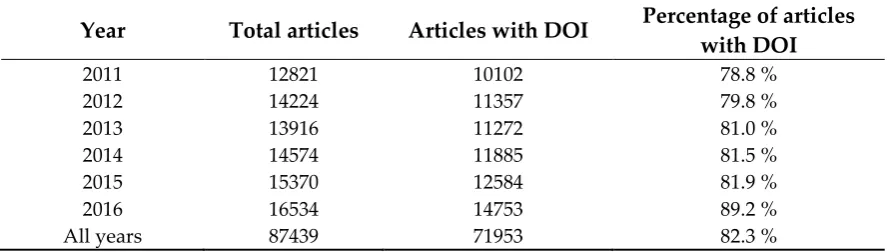
As shown in Table 1, the share of all documents with a DOI is 82.3%. Of 87439 articles, 71953 had or could be allocated a DOI. We also found that the proportion of articles with a DOI increased continuously from 78.8% in 2011 to 89.2% in 2016.
Table 1. Number of articles indexed in Cristin and number of articles with DOIs.
Year
Total articles
Articles with DOI
Percentage of articles
with DOI
2011 12821 10102 78.8 %
2012 14224 11357 79.8 %
2013 13916 11272 81.0 %
2014 14574 11885 81.5 %
2015 15370 12584 81.9 %
2016 16534 14753 89.2 %
All years 87439 71953 82.3 %
2.1. Applied services
Of the investigate services, Google Scholar is by far the largest container of scholarly bibliographic records [16]. According to our earlier study, it covers the entire article output of Norway [7].
For Google Scholar, no API is available for querying and extracting data. Instead, an in-house script was developed for automatic web scraping, based either on the article DOI or the article title.
For articles published between 2011 and 2015, we applied the data sampled earlier [7]. For articles published in 2016, we repeated the developed routines, adjusted the script according to changes performed by Google Scholar, and manually solved the appearing CAPTCHAs (Completely Automated Public Turing test to tell Computers and Humans Apart). Queries were carried out off Campus in order to avoid full-text links to library subscriptions. Finally, we carefully compared input and output titles to eliminate eventually false matches.
We only tracked Google Scholar’s best full-text location and disregarded additional versions. Neither did we control for copyright compliance nor involved usage licenses. Still, Google Scholar is an important driver for open access, and serves in this study as a valuable comparative measure.
Focus of this study, lies on oaDOI and its outstanding ability to distinguish between types of openness. Since our investigation, the service has been growing and by now harvests over 50,000 publishers and includes about 20 million open documents [17].
The service is run by Impactstory, a nonprofit organization, using open source codes, making reuse and further development possible. For the cause of our study, we queried the older and less enhanced version, oaDOI, using the available API through the OpenRefine software.
The third investigated service is 1findr by 1science. According to their homepage, it consists of 90 million scholarly articles, whereof 27 million freely available [18]. By the time of investigation, 1findr was not launched free for academic use. However, for the purpose of this study, the service kindly provided an API for querying. As for Google Scholar, we foremost used the DOI in our query, otherwise the title. For the title queries, we used a fuzzy search operator. We then compared the results from 1findr with the input data using SimMetrics in order to determine matching articles.
2.2. Categories of open availability
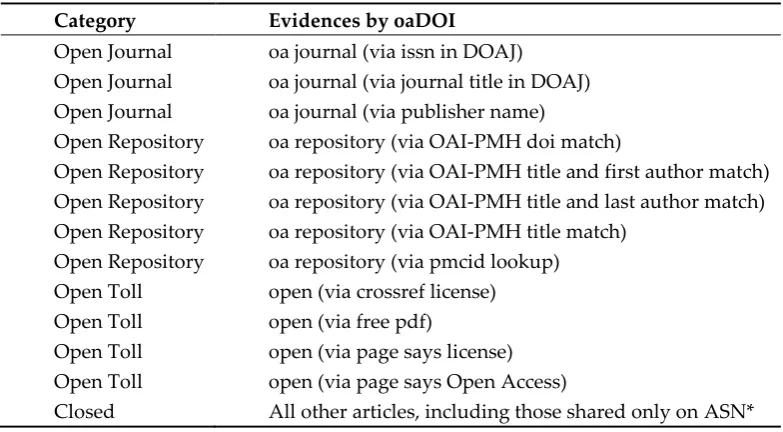
In the following discussion on open availability, we stick to the different classifications given by the investigated services. According to oaDOI, the following evidences of openness are given (Table 2).
Table 2. oaDOI, categories of open availability.
Category Evidences by oaDOI
Open Journal oa journal (via issn in DOAJ)
Open Journal oa journal (via journal title in DOAJ) Open Journal oa journal (via publisher name)
Open Repository oa repository (via OAI-PMH doi match)
Open Repository oa repository (via OAI-PMH title and first author match) Open Repository oa repository (via OAI-PMH title and last author match) Open Repository oa repository (via OAI-PMH title match)
Open Repository oa repository (via pmcid lookup) Open Toll open (via crossref license) Open Toll open (via free pdf)
Open Toll open (via page says license) Open Toll open (via page says Open Access)
Closed All other articles, including those shared only on ASN* *ASN: Academic Social Networks
For the aim of this study, evidences are grouped by 1. Open Journal: Typically indexed by the DOAJ
2. Open Repository: Open full-text in approved OA repositories
3. Open Toll: Free via publisher sites, with and without an open license in a toll-access journal 4. Closed: All remaining articles
OaDOI specifies a particular category for articles that are open (via free pdf) without being licensed as so. Interestingly, this is the largest “open” category, typically consisting of delayed open content, hidden gold access and last but not least content, opened by the publishers themselves (probably to retain their marked position [19]). The unclarified status of these articles make that category questionable concerning permanence of openness and reuse rights.
According to 1findr, the following categories of availability are defined (Table 3).
Table 3. 1findr, categories of availability.
Category Description
CL Closed
GO Gold: via DOAJ, hybrid, free to read
The wide categories of GR and UN are problematic, since versions might be uploaded in infringement with copyright, and academic social networks (ASN) might claim registration and login before giving access. Nevertheless, we found 1findr useful to both determine coverage and availability.
2.3. Citations and subject fields
For the citation analysis, we used article data from 2011 to 2015. Citation counts were extracted from Google Scholar [7]. Furthermore, all articles were allocated a subject field (in total 85 fields) according to the journal they are published in. These fields are defined and approved by the national publishing committee [20]. In addition to publishing year, citation data are normalized by these fields.
3. Results and discussion
In this chapter, we present and compare results by service. We furthermore relate our findings to similar studies in the existing scientific literature.
3.1. OaDOI
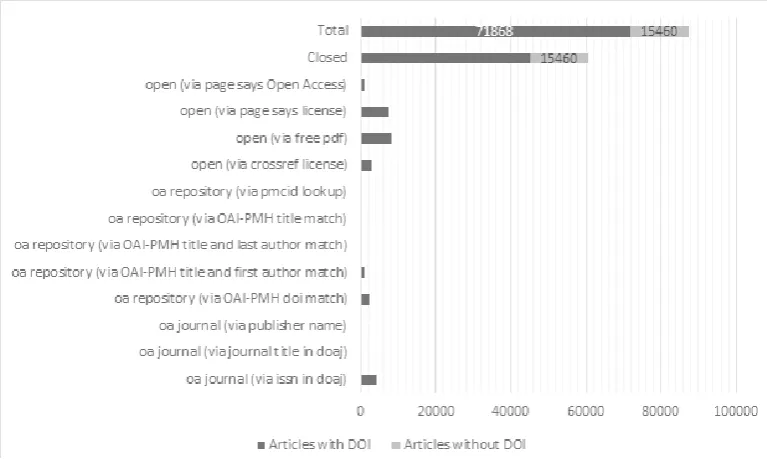
As mentioned in the previous section, we searched oaDOI by DOI whenever available. The articles that were missing a DOI were added to the Closed category (15460 articles), Figure 1.
Articles may be openly available through multiple categories, for example Open Toll and Open Repositories. If nothing else is stated, Open Toll takes precedence over Open Repository. In other words, categories are exclusive and reflect oaDOI’s Best_location, presuming the original publisher site to be the primary and preferred location for the article. Since the self-archived content only represents the proportion of articles that are not provided openly elsewhere, this category is underrepresented and does not adequately reflect the entire volume of self-archived content available in repositories. When we change the precedence of categories and choose self-archived content first, we find that this category increases from 4% to 18% (Figure 2).
For our sample, the two largest open categories are open (via page says license), typically hybrid and open (via free pdf) typically free to read, without an open license (Figure 1).
According to our merged categories (confer Table 2), we find that for all articles, including articles without a DOI, 31% are open, thereof 22% via Open Toll, 5% via Open Journal (typically DOAJ) and 4% via Open Repository.
Open availability is gradually increasing during the investigated period from 27% in 2011 to 34% in 2016 (Figure 2). However, these shares are considerably lower than reported by Piwowar, et al. [8] finding an open share of 44.7% for 2015, using a CrossRef sample. When we exclude articles without DOIs, the open share increases from 34% to 38%. This is still significantly lower than expected and may be explained by that oaDOI, at the time of investigation, did not sufficiently harvest open repositories or otherwise failed to locate available full-texts.
The category Open Journal makes up 5% (Figure 2, All Years). As argued above, this category might be shadowed by other categories, in particular the category Open Toll. When giving precedence to Open Journal, in case of multiple occurrences, this share increases to 16% in 2016, a reasonable amount, however still considerably lower than the findings of 20% open access for 2016 at the University of Bergen [21]. OaDOI’s underrepresentation of articles in that category, typical DOAJ-journals, may be explained by many of these journals missing DOIs for articles represented in the Cristin-data.
The bar All years* in Figure 2 reflects the total amount of self-archived articles, i.e. articles also available in Open Toll or Open Journal. The share of Open Repository increases then from 4% to 18%. Thanks to the effort of libraries and thanks to strong open access requirements, a major part of open articles indeed are available in repositories.
Figure 2.Open articles according to oaDOI’s Best_location, 2011-2016. The bar All years* reflects the total amount of self-archived articles, otherwise classified under Open Toll and Open Journal.
3.2. OaDoi compared to Google Scholar
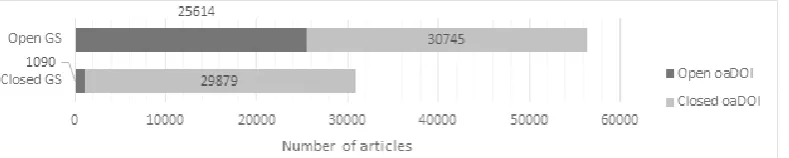
Applying Google Scholar’s link provider on our data, we find 56383 articles (64%) freely available, twice as many compared to oaDOI (Figure 3). Figure 3 also shows 1090 articles that were closed in Google Scholar, but open in oaDOI. A reason might be that oaDOI-searches were performed one year later than searches in Google Scholar, and articles meanwhile might have been made open.
3.3. Citation frequencies by type of openness
We determined the citation frequencies using Cited-by values as of Google Scholar and applying year and subject normalization. We find a significant citation advantage for open articles (Figure 4a)). However, this is not true for all types of openness according to oaDOI’s classification. The category Open Journal in fact was by far the lowest cited. This disadvantage is even larger here than reported by Piwowar, et al. [8]. The categories, Open Toll and Open Repository score highest, with Open Repository at the very top. Articles belonging to Open Repository are most often cited both for self-archived only and all self-self-archived articles (Figure 4b and c).
Findings indicate that there indeed exists a so-called selection bias [22], where authors are more inclined to upload their most influential articles. Often these articles are a result of research, which is supported by high-profile funding institutions with clear open access requirements. To fulfill these requirements, authors seem to self-archiving their work but continue to publish in traditional subscription-based journals.
Figure 4. Mean relative citation frequencies of articles indexed in a) Google Scholar, b) oaDOI
Best_location, here Open Repository refers to self-archived-only, and c) oaDOI, giving precedence to Open Repository, i.e. all self-archived articles. The analysis is based on articles published between 2011 and 2015.
3.4. Openness by subject
Within the Norwegian system, all journals are assigned one and only one subject of in total 85 different subjects. These 85 subjects are in turn exclusively assigned to four main subject categories [20]. The open scholarly article output by these main subject categories is shown in Figure 5. The difference by service is obvious. While open shares for Mathematics, Natural sciences and Technology (MNT) and Medicine and health sciences are 70% for Google Scholar, the respective values for oaDOI are 32% and 42%, all open categories accumulated. Compared to Medicine and health sciences, oaDOI obviously seems not to MNT subjects adequately.
Figure 5. Open availability by subject (absolute numbers on bars) for a) Google Scholar and b) oaDOI Best_location. Articles published between 2011 and 2015.
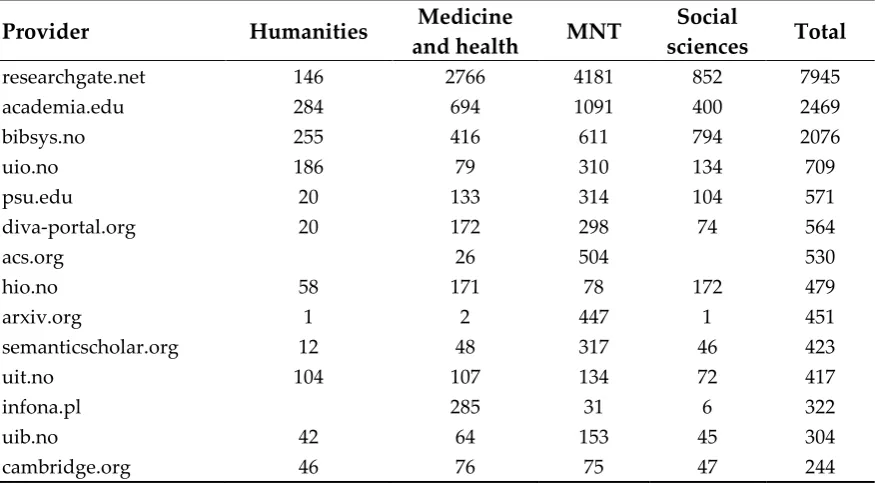
A closer look at what is open via Google Scholar only, i.e. closed according to oaDOI, reveals that top providers for that closed content are researchgate.net and academia.edu (Table 4), confirming that academic social network (ASN) indeed are important players in the field [6,7]. Since oaDOI excludes ASNs as full-text sources these findings are not surprising. In addition, and more surprising is that open repositories, in particular Norwegian repositories such as bibsys.no, uio.no and diva-portal.org, are listed at the top of Table 4 as well. The same is true for arxiv.org and other recognized archives.
Table 4. Full-text provided by Google Scholar and not provided by oaDOI (2011-2015). The first column contains the full-text provider according to Google Scholar’s best location.
Provider
Humanities
Medicine
and health
MNT
Social
sciences
Total
researchgate.net 146 2766 4181 852 7945
academia.edu 284 694 1091 400 2469
bibsys.no 255 416 611 794 2076
uio.no 186 79 310 134 709
psu.edu 20 133 314 104 571
diva-portal.org 20 172 298 74 564
acs.org 26 504 530
hio.no 58 171 78 172 479
arxiv.org 1 2 447 1 451
semanticscholar.org 12 48 317 46 423
uit.no 104 107 134 72 417
infona.pl 285 31 6 322
uib.no 42 64 153 45 304
ntnu.no 2 5 166 32 205
novus.no 154 38 192
bmj.com 189 189
idunn.no 33 120 153
tandfonline.com 8 75 20 18 121
3.5. 1findr
Finally, we briefly present some figures retrieved from 1findr. By time of downloading and testing, we were able to retrieve 81% of all our articles (Table 5). Articles not retrieved, similarly, to what we found for oaDOI, except for ASNs, belong to proceedings and Norwegian journals (16852 articles, 19%).
Table 5. Number of articles indexed by 1findr, 2011-2016.
articles %
indexed by 1findr 70476 81 %
not-indexed by 1findr 16852 19 %
Total 87328 100 %
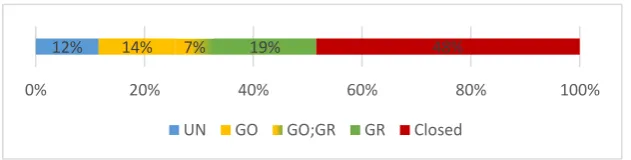
The overall openness score for 1findr is 52% (Figure 6). For type of open availability, as defined by the service (Table 3), the combined category of GO and GO;GR, representing all Gold open access articles, is the largest (21%). These findings are reasonable and in agreement with our earlier findings on open access publishing according to DOAJ [21].
Figure 6. Open availability by 1findr for articles published between 2011-2016.
Since categories given by 1findr and oaDOI are defined differently are therefore not fully comparable. The largest difference is that 1findr considers articles via ASNs as open GR.
4. Conclusions
In our study, we compared open availability by service and found that different services returned considerably different results. Google Scholar is by far the largest full-text provider. It links 70% of the Norwegian article output to a free version. Corresponding shares for 1findr and oaDOI are 52% and 31% respectively.
Different shares of openness are primarily caused by the services’ different mission and what they choose to include in their results. For example, the investigated services, Google Scholar and 1findr, include academic social networks, which may contain material in violation with copyright, have weak or unclear open access policies or do not guarantee persistent access. The dispute between publishers and ResearchGate proofs the instability of these platforms as sources of full texts [23].
At the time of our investigation, the open share according to oaDOI was relatively low (31%). Meanwhile, oaDOI has changed its harvesting routines from mainly harvesting aggregated services
12% 14% 7% 19% 48%
0% 20% 40% 60% 80% 100%
to harvesting the original repositories directly. In addition, oaDOI has reorganized its service under the brand Unpaywall. Our first tests seem to return significant higher recalls, which makes the service more relevant for further use and build upon services. We are also pleased to see that the service has added metadata on available document versions (submitted, accepted or published). All these measures are important and help the community to progress in building a true open access infrastructure.
We only had a short look at 1findr. Apart from our concerns to include academic social networks as full text providers, 1findr returns reasonable open shares (52%). It is praiseworthy that the service recently opened their holdings for institutional use.
In future studies, it will be useful to consider open access policies implemented by funders, as these mandates are likely to heavily influence on the direction of open access. The European Commission has mandated open access to scientific articles in Horizon 2020 [24]. They list two ways to meet the requirements: 1) Self-archiving a peer-reviewed version of an article in a repository (with a maximum of 6-12 months embargo) or 2) Publishing an article open access and then depositing the published version in a repository. These requirements are in line with the Norwegian Governments' mandate and mandates in other countries.
The requirement that all articles are to be made available through repositories ensures that articles are permanently open access. It will also make it easier to collect data on open access publishing and monitoring ongoing developments.
Although there is a rise in open access publishing and more publications are made openly available, we observe that the available content is mainly free to read and not necessarily free to reuse and redistribute. Restriction on reuse hinders an effective research flow and harms the idea of an open science. In the digital age and with the described services as important drivers towards open access, time seems overdue to reshape the publishing scene.
Supplementary Materials: Data are openly available on BORA (https://bora.uib.no/handle/1956/18308). Author Contributions: Conceptualization, Susanne Mikki, Tormod E. Strømme and Øyvind L. Gjesdal; Methodology, Susanne Mikki and Øyvind Gjesdal; Validation, Susanne Mikki, Tormod E. Strømme and Øyvind L. Gjesdal ; Formal Analysis, Susanne Mikki; Original Draft Preparation, Susanne Mikki; Writing-Review & Editing, Tormod E. Strømme; Visualization, Susanne Mikki;
Funding: This work is a result of our project Free, scholarly publications, funded by the National library of Norway (Ref a68f29d9).
Acknowledgments: We will thank Hemed Ali Al Ruwehy for some of the data preparation and Ingrid Cutler and Irene Eikefjord for reading and discussing the manuscript.
Conflicts of Interest: The authors declare no conflict of interest. The funders had no role in the design of the study; in the collection, analyses, or interpretation of data; in the writing of the manuscript, and in the decision to publish the results.
References
1. Ministry of Education and Research in Norway. National goals and guidelines for open access to research
articles. h
ttps://www.regjeringen.no/en/dokumenter/national-goals-and-guidelines-for-open-access-to-research-articles/id2567591/
2. Max Planck Digital Library. Open Access 2020. https://oa2020.org/ (20.08.2018),
3. Jamali, H.R. Copyright compliance and infringement in ResearchGate full-text journal articles.
Scientometrics 2017, 112, 241-254. https://doi.org/10.1007/s11192-017-2291-4
5. Archambault, É.; Caruso, J.; Nicol, A. State-of-art analysis of OA strategies to peer-review publications; 2014.
Retrieved from h
ttp://www.science-metrix.com/sites/default/files/science-metrix/publications/d_2.1_sm_ec_dg-rtd_oa_policies_in_the_era_update_v05p_0.pdf
6. Martín-Martín, A.; Costas, R.; van Leeuwen, T.; Delgado López-Cózar, E. Evidence of open access of
scientific publications in Google Scholar: A large-scale analysis. Journal of Informetrics 2018, 12, 819-841. https://doi.org/10.1016/j.joi.2018.06.012
7. Mikki, S. Scholarly publications beyond pay-walls: increased citation advantage for open publishing.
Scientometrics 2017, 113, 1529-1538. https://doi.org/10.1007/s11192-017-2554-0
8. Piwowar, H.; Priem, J.; Larivière, V.; Alperin, J.P.; Matthias, L.; Norlander, B.; Farley, A.; West, J.;
Haustein, S. The state of OA: a large-scale analysis of the prevalence and impact of Open Access articles.
PeerJ 2018, 6, e4375. https://doi.org/10.7717/peerj.4375
9. Bosman, J.M.; Kramer, B. Open access levels: a quantitative exploration using Web of Science and oaDOI
data. PeerJ Preprints 2018, 6:e3520v1. https://doi.org/10.7287/peerj.preprints.3520v1
10. Chan, L.; Cuplinskas, D.; Eisen, M.; Friend, F.; Genova, Y.; Guédon, J.-C.; Hagemann, M.; Harnad, S.;
Johnson, R.; Kupryte, R. Budapest open access initiative.
http://www.budapestopenaccessinitiative.org/read
11. Suber, P. Open access. MIT Press: Cambridge, Mass, 2012.
12. McCabe, M.J.; Snyder, C.M. Identifying the effect of Open Access on citations using a panel of scientific
journals. Economic Inquiry 2014, 52, 1284-1300. https://onlinelibrary.wiley.com/doi/abs/10.1111/ecin.12064 https://doi.org/10.1111/ecin.12064
13. Archambault, E.; Côté, G.; Struck, B.; Voorons, M. Research impact of paywalled versus open access
papers. Science-Metrix and 1science 2016. http://www.1science.com/oanumbr.html
14. Davis, P.M.; Walters, W.H. The impact of free access to the scientific literature: a review of recent research.
Journal of the Medical Library Association: JMLA 2011, 99, 208. https://doi.org/10.3163/1536-5050.99.3.008 15. Cristin. Current Research Information System in Norway https://www.cristin.no/english/
16. Orduna-Malea, E.; Ayllón, J.M.; Martín-Martín, A.; Delgado López-Cózar, E. Methods for estimating the
size of Google Scholar. Scientometrics 2015, 104, 931-949. https://doi.org/10.1007/s11192-015-1614-6 https://doi.org/10.1007/s11192-015-1614-6
17. Impactstory. Unpaywall. https://unpaywall.org/ (27.08.2018),
18. 1sciene. 1findr. https://www.1science.com/1findr/ (27.08.2018),
19. Posada, A.; Chen, G. Preliminary Findings: Rent Seeking by Elsevier. 2017.
h
ttp://knowledgegap.org/index.php/sub-projects/rent-seeking-and-financialization-of-the-academic-publishing-industry/preliminary-findings/ (04.04.2018),
20. Det nasjonale publiseringsutvalget. NPI. https://npi.nsd.no/fagfeltoversikt (13.04.2018),
21. Mikki, S.; Zygmuntowska, M. Vitenskapelig publisering ved Universitetet i Bergen: Publiseringsstatistikk
2005-2016. Bergen, Norway, 2017. http://hdl.handle.net/1956/15881
22. Craig, I.D.; Plume, A.M.; McVeigh, M.E.; Pringle, J.; Amin, M. Do open access articles have greater citation
impact?: a critical review of the literature. Journal of Informetrics 2007, 1, 239-248. https://doi.org/10.1016/j.joi.2007.04.001
23. Coalition for Responsible Sharing. Coalition statement. h
ttp://www.responsiblesharing.org/coalition-statement/
24. European Research Council. Guidelines on Implementation of Open Access to Scientific Publications and