991
PSO Optimized Communication Modeling For
Wireless Sensor Network With Mobile Sink
Pawan Kumar, Sukhjinder Kaur
Abstract:In wireless systems, the clustering approach is becoming very much popular these days. The key features for these protocols are the cluster head selection and the data transmission mode in the network. A significant number of researches have been made many approaches in this domain. Along with this, sink mobility is a novel aspect which acts as allurement for researchers. The route selection for data gathering by the mobile sink from the cluster head decision should be fast and effective. Moreover, the network must have long lifespan. To overcome these constraints, a mechanism of finding optimum path for the mobile sink using PSO algorithm with enhanced cluster heads selection is proposed in this paper. MATLAB tool is used to analyze proposed system. The simulation results show better results in terms of increased lifetime, less energy consumption etc. A comparative analysis is also made in this paper with traditional ACO algorithm which shows that proposed algorithm (PSO-MS) surpasses the traditional work (IACO-MS).
Index Terms— Wireless sensor networks, Particle Swarm Optimization, Energy efficiency,• Mobile sink , Clustering
————————————————————
1
I
NTRODUCTIONIOT is an extremely embedded and thorough implementation of the latest information technology. For the new era of industrial, green and intelligent networks it has great importance under a sustainable economy and modern society [1]. Wireless sensor networks (WSN), which are a strong basis for the quick growth of Internet of things (IoT), can be regarded as a significant technology category under Internet of Things. A standard WSN comprises a set of static, mobile or a combination of both static and mobile sensor nodes that can interact effectively for information exchange. WSNs with a mobility capacity throughout the region are known as Wireless Mobile Sensor networks. In business, private and medical applications, sensor networks are optimally used to monitor and locate events continuously. There are numbers of applications for WSN, including the surveillance of environment, industrial manufacturing tracking, oil exploration, patient acoustic information processing, natural or man-made crisis tracking, such as severe weather, volcanic activity, battlefield monitoring and earthquakes [2]. In connection with power, buffer storage room and, most significantly, energy resources, the nodes are restricted in this system.
1.1 Challenges and limitation of wireless sensor networks The main challenges faced in the research of WSN are limited process power, bandwidth of communication and storage space. This creates novel and distinctive difficulties in the field of information management and handling. The routing clustering techniques [3] helps to reduce energy consumption during transmission of information between nodes or bases. The main feature used to evaluate the efficiency of any sensor network is network lifetime [4]. The network lifespan is determined through the remaining energy of the system, so effective utilization of energy resources is the primary and most significant task in WSN. Literature illustrates energy efficiency in WSNs using some of the previous schemes: power preservation, energy conservation, power collection and effective transmission [5].
1.2 Data Gathering based on Mobile Sink
In WSNs that have static sinks, sensor nodes normally convey multi-hop data to the sink node. Certain nodes close to the sink will use their energy much more quickly than other nodes which are far from the sink, because more information will be transmitted through these nodes than other nodes which are outlying. The major issues are the multi-hop paths and the distribution of traffic of data to the sink. This problem is called the hot spot issue and the respective sensor nodes are called hot nodes. In latest years, the adoption of sink technology has been used to extend WSNs [1]. Contrary to WSNs, hot-spot problems can be alleviated and energy consumption between the sensor nodes can be balanced through portable sink-based methods. The portable sink nodes can move through the sensing area to obtain information over comparatively short distances. There have been reports of significant energy gains expanding the life span of the network. It is essential to discover an optimal path for mobile sink to reach certain meeting nodes. The use of Mobile Sink (MS) moving in the network area for data gathering is an approach to attain a balanced system [6]. Mobile Sink does not have energy restrictions, although energy in the nodes is restricted. In the network, sink mobility reduces the use of energy in the adjacent nodes. It also reduced useless energy consumption [7], such as the creation of the clusters and the choice of Cluster heads. Mobile Sink is regarded as a tiny car moving on the ground and gathering information straight or via multi-hop from nodes. This reduces communications range to a minimum of energy consumption and maximum throughput [8].
2
RELATED
WORK
M. Akbar, et.al [9] suggested the method used to collect the clustering information, and the information is collected from member nodes via CHs. This minimizes energy consumption and thus increases the performance of this system. Though, during transmission of data, cluster head nodes absorb more energy and are quickly exhausted. F. Tashtarian, et.al [10] examined mobile sink in event-driven applications. Applications of wireless sensor networks are available where MS travels at reduced speed to collect sensor information from the sensor unit. In specified time frames, the information are gathered. Convex optimization system was used by the authors to promote method of vector regression. Two distinct methods to enhance the life span of the network were also suggested in [11] which were delay tolerance and tolerance based on queue. Authors also suggested an algorithm for _____________________________-
Pawan Kumar is currently pursuing masters degree in Sri Sukhmani Institute of Engineering & Technology, Derabassi, Punjab, India. E-mail: [email protected]
992 column generation of information from nodes to mobile sink.
Sharma S, et.al [12] suggested a (RRP) rendezvous-based routing protocol which covers the energy efficiency requirements and reduces end-to-end latency. This protocol contains two distinct ways to transmit information. The suggested protocol performs well as other protocols in energy consumption, end-to-end latency and network life. Wang J, et.al [13] proposed a MS based energy-efficient dynamic adjustment algorithm. By establishing certain communication regulations that handle route rebuilding, the entire network reconfiguration event will not occur with the movement of the sink node. The method of the cluster head rotation effectively alleviated the hot spot issue and also prevented frequent choice of cluster head and rebuilding of the intra-cluster route. Chen M, et.al [14] suggested an energy-efficient routing protocol for shortest data transmission route based MS. The coordinate values of each node are calculated in this protocol, depending on the position of common node’s ID and sink node.The shortest path has been discovered by evaluating the coordinate characteristics of sensor nodes to transfer information to the sink, It is recognized from the related work done in this field that the current systems utilize mobile sink for information collection. The MS-based systems, though, focus primarily on the random movement; in which the some schemes based on ACO, cuckoo search, etc [1],[15],[22] had been proposed by the authors for extracting the route of the mobile sink. Similarly, when clouds are formed and selection of cluster head is done, more energy is consumed by the clustering methods which decrease the life time of the network. Moreover, QoS provided by the factors taken into account is not much effective. Thus, this paper will therefore introduce an MS oriented routing approach to: Maximize network lifespan Reduce energy use Maximize packet delivery.
3
PRESENT
WORK
Wireless sensor networks are energy based networks. The energy is the major factor that highly influences the networks longevity. Thus while performing, data transmission and routing the energy is considered as the major parameter. As in traditional work the author developed a CH selection approach by considering the energy of nodes as the only factor. On the basis of the amount of the residual energy, selection of cluster heads was made. Along with this, the concept of mobile sink node was also introduced to resolve the hot spot issues. Now after reviewing this work properly, some limitations are observed as follows: The CH selection criteria are not
sufficient enough to enhance the efficiency and lifespan of the network. Since there are some other factors as well, that can affect the CH selection criteria and network lifespan. Another major backlog of the traditional work is that the author had implemented the ACO algorithm [1] for finding the optimal path. The ACO is classic optimization technique in which the analysis on the basis on theory is quite difficult and the convergence is time consuming. Therefore, a PSO based MS trajectory scheduling along with multiple QOS factors CH selection approach is proposed in this paper. The factors those are considered in the present work are discussed as follow: Energy: The remaining energy of the nodes is considered as a factor for CH selection. Distance: The distance of the candidate nodes to its adjacent nodes is another factor that is considered. Delay: Delay is the time taken by the node for transmitting the data packets to the destination node. Packet Delivery Ratio: The node with the highest PDR has highest probability of becoming a CH. The node with in cluster, with the high amount of remaining energy, lesser distance to the adjacent nodes, higher PDR and lesser delay will leads to the enhancement in the performance and lifetime of the network. Fitness function for the proposed PSO-MS routing is based on the minimization of the distance to travel from all the cluster heads. It is represented by the below written equation:
CHcount
n n D Minimum
Fitness
1
Where n is varying from 1 to number of CHs in the network, D is the distance between the optimized route selected between CHs.
4 SIMULATION
SETUP
The simulation environment is set up with the parameters listed in Table 1. The following table represents the values of different simulation parameters:
Radio Energy Model
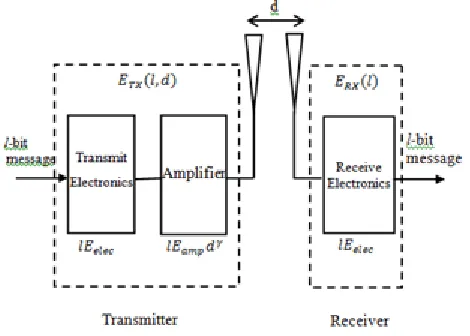
In this work, we employ energy model of radio (REM) as given in Fig. 1.
Fig. 1. Radio Energy Model
In the REM, radio and power amplifiers are operated using transmitter where transmitter utilizes energy to do so. Furthermore, energy is utilized by the receiver in order to operate the radio [20], [21], [24]. The radios can control the power and thus the minimum energy required is to reach the TABLE1
SIMULATION PARAMETERS.
PARAMETER NAME VALUE
Network Size [200,200] 𝑚
Number Of Nodes (N) [50, 200]
Transmission Radius 𝑅 50 M
Packet Length (L) 2000 BITS
Initial Energy (𝐸) 0.5 J
993 intended recipients. The energy loss model is implemented for
long and small ranges due to the attenuation. In order to perform signal to range ration (SNR) while broadcast of l-bit packets over distance d, then energy released in radios is defined as:
,
{
lEelec l fsd24d mp l elec lE
d
l
E
rx
,If d d0,If d d0
Where Eelec represents energy reduced per bit to operate the electronic circuitry, εfs and εmp are dependent on amp model, distance among sender and receiver is denoted by d, and d0 denotes threshold transmission distance. The threshold
distance d0 is given by: fs mp d0
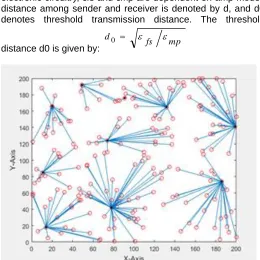
Fig. 2. Network Architecture
The network architecture in which the simulations have been performed is illustrated in fig 2. The size of network is 200 * 200 m^2. In the above figure, nodes are assigned to the cluster module sections. Cluster heads are denoted by black colour and red colour represents the nodes. Cluster heads are scattered in the network in accordance with the different sections. The packet length for delivery is 2000 bits. Before sending the packets, the energy at initial level is set at 0.5 J. Other parameters that are taken for simulation purpose are given in table1.
5
RESULTS
AND
DISCUSSION
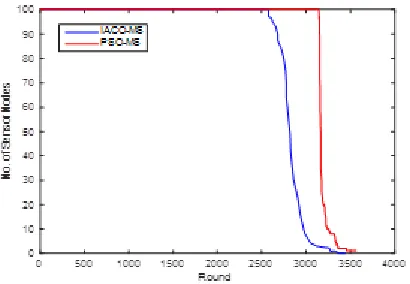
In this paper, a mechanism using PSO algorithm is introduced in order to resolve the hotspot problem. As this method assists to find the optimal route for mobile sink to conserve energy in WSN, various parameters are taken into consideration such as network lifetime, energy consumption and packet delivery. The effectiveness of proposed algorithm is analysed through simulation. Comparisons are made between existing algorithms, namely, IACO-MS with the proposed algorithm i.e. Particle swarm Optimization based Mobile Sink trajectory (PSO-MS). Fig. 3 reveals the comparison of proposed work with the current work [1] in terms of the lifespan of the network. Life time is a significant metric for system’s effectiveness. Lifetime can be described as the rounds operated before the termination of the operation by the first
node due to lack of energy. From the graph, number of rounds performed before the depletion of the nodes constituted to 2600 rounds whereas, in the proposed mode rounds start from 3146. Thus, it shows that PSO-MS has better performance than IACO-MS. This is because the selection criterion is chosen after a deep literature survey.
Fig. 3. Comparison of network lifetime
Various simulations have been performed and the outcomes are recorded in table 2 and 3 for network lifetime and energy consumption respectively. In table 2, the number of rounds is given before the nodes start depleting. Rounds are recorded with respect to different number of nodes.
TABLE2
ROUND WHEN THE FIRST NODE DIES IN THE TERMS OF TRADITIONAL AND PROPOSED SYSTEM
Number of nodes
ACO–M IACO-MS PSO-MS
100 2400 2600 3146
200 2100 2400 3315
300 2000 2200 2947
994 Fig. 4. Comparison of energy consumption
The use of proposed algorithm (PSO-MS) increases the data gathered by the sink as compared to other existing algorithms. Fig. 4 illustrates about the number of packets delivered in the particular energy. The number of packets delivered by PSO-MS is higher than traditional system in the same energy. Moreover, time delay is also reduced with the help of this novel algorithm. Therefore, proposed PSO-MS provides better cluster head selection with optimal rote for mobile sink.
Fig. 5. Comparison of packet delivery
6
CONCLUSION
In this dissertation, a novel energy-efficient mechanism based on Particle Swarm optimization is presented for wireless sensor networks having mobile sinks. The selection of cluster heads is enhanced by using fuzzy rules and extended parameters. This work enable mobile sink to collect the data in an effective way due to implementation of PSO (optimization algorithm). Optimal trajectory is for mobile sink is discovered due to improvements made in the selection criterion of cluster heads. The simulation results show that the proposed system (PSO-MS) is more effective than the traditional works done in this domain. This approach extends lifespan of WSN and formed an energy efficient network with more data delivery. In future, the work will be done to reduce the processing time and other QoS factors can be taken into consideration to make it more reliable.
R
EFERENCES[1] JinWang, Jiayi Cao, R. Simon Sherratt, ―An Improved Ant Colony Optimization-Based Approach With Mobile Sink For Wireless Sensor Networks‖, Springer, Pp 1-13, 2017. [2] H. J. Visser and R. J. M. Vullers, ―RF Energy Harvesting
and Transport For Wireless Sensor Network Applications: Principles and Requirements,‖ Proceedings of the IEEE, vol. 101, no. 6, pp.1410–1423, 2013.
[3] Prerna, sanjay kumar, ―Energy Efficient Clustering Algorithm for WSN‖, International Conference on Signal Processing and Integrated Networks (SPIN), IEEE, Pp 990-993, 2015.
[4] Vinay Kumar, Sanjeev Jain and Sudarshan Tiwari, ―Energy Efficient Clustering Algorithms in Wireless Sensor Networks: A Survey‖, International Journal of Computer Science Issues, Vol. 8, Issue 5, No 2, September 2011. [5] J. N. Al-Karaki and A. Kamal, ―Routing Techniques In
Wireless Sensor Networks: A Survey,‖ vol. 11, pp. 6– 28, Dec. 2004.
[6] Mariam Akbar, Nadeem Javaid, ―Balanced Transmissions Based Trajectories of Mobile Sink in Homogeneous Wireless Sensor Networks‖, Hindawi Journal of Sensors, Pp 1-16, Volume 2017.
[7] S. Basagni, A. Carosi, E. Melachrinoudis, C. Petrioli, and Z. M.Wang, ―Controlled Sink Mobility For Prolonging Wireless Sensor Networks Lifetime,‖ Wireless Networks, vol. 14, no. 6, pp. 831–858, 2008.
[8] S. R. Gandham, M. Dawande, R. Prakask, and S. Venkatesan, ―Energy Efficient Schemes For Wireless Sensor Networks With Multiple Mobile Base Stations,‖ in Proceedings of the IEEE Global Telecommunications Conference (GLOBECOM’03), pp. 377–381, San Francisco, Calif, USA, December 2003.
[9] M. Akbar, N. Javaid, M. Imran, A. Rao, M. S. Younis, and I. A. Niaz, ―A Multi-Hop Angular Routing Protocol For Wireless Sensor Networks,‖ International Journal of Distributed Sensor Networks, vol. 12, no. 9, 2016.
[10]F. Tashtarian, M. H. Yaghmaee Moghaddam, K. Sohraby, and S. Effati, ―On Maximizing The Lifetime Of Wireless Sensor Networks In Event-Driven Applications With Mobile Sinks,‖ IEEE Transactions on Vehicular Technology, vol. 64, no. 7, pp. 3177–3189, 2015.
[11]B. Behdani, Y. S. Yun, J. C. Smith, and Y. Xia, ―Decomposition Algorithms For Maximizing The Lifetime Of Wireless Sensor Networks With Mobile Sinks,‖ Computers and Operations Research, vol. 39, no. 5, pp. 1054–1061, 2012.
[12]Sharma S, Puthal D, Jena SK et al (2016), ―Rendezvous Based Routing Protocol For Wireless Sensor Networks With Mobile Sink‖, J Supercomput 73(3):1168–1188 [13]Wang J, Cao J, Ji S et al (2017), ―Energy-Efficient
Cluster-Based Dynamic Routes Adjustment Approach For Wireless Sensor Networks With Mobile Sinks‖, J Supercomput 73(7):3277–3290
[14]Chen M, Xu X, Zhang S, Feng G (2012), ―Energy Efficient Routing Protocol In Mobile-Sink Wireless Sensor Networks‖, Telkomnika Indonesian J Electr Eng 10(8):2056–2062. doi:10.11591/telkomnika. v10i8.1640 [15]Gadekar Vaishali, M.K. Nighot, ―An Efficient ACO Scheme
for Mobile-Sink Based WSN‖, ICICT, Volume 3, Pp 1-5, 2016.
995 for WSN with Multiple Mobile Sink and Single Static Sink‖,
ICCCT, Pp 197-199, 2012.
[17]Naween Kumar, Dinesh Dash, ―Maximum Data Gathering Through Speed Control of Path-Constrained Mobile Sink In WSN‖, ISED, Pp 1-4, 2017.
[18]Yan Zhao, Qianping Wang, Dong Jiang, Wanrong Wu, Li Hao, Ke Wang, ―An Agent-based Routing Protocol with Mobile Sink for WSN in Coal Mine‖, ICPCA, Volume 2, Pp 857-862, 2008.
[19]Vicky Kumar, Ashok Kumar, Gaurav, Manjeet Singh, ―Improving Network Lifetime &Amp; Reporting Delay In Wireless Sensor Networks Using Multiple Mobile Sinks‖, ICCSGD, Pp 1675-1678, 2016.
[20]Andrey Materukhin, Vladimir Shakhov, Olga Sokolova, ―An Efficient Method for Collecting Spatio-Temporal Data in the WSN using Mobile Sinks‖, IMCECIS, Pp 118-120, 2017.
[21]Ying Yang, Yisheng Miao, ―A Path Planning Method for Mobile Sink in Farmland Wireless Sensor Network‖, ITNEC, Pp 1157-1160, 2017.
[22]Baljinder Singh, Pankaj Aggarwal, ―Using Hybrid ACO/PSO Enhance NN RZ Leach for Mobile Sink in WSN's‖, IEMCON, Pp 546-552, 2017.
[23]Afsah Sharmin, F. Anwar, S. M. A. Motakabber, ―A Noble Approach of ACO Algorithm for WSN‖, ICCCE, Pp 152-156, 2018.