© 2014, IJCSMC All Rights Reserved
693
Available Online atwww.ijcsmc.com
International Journal of Computer Science and Mobile Computing
A Monthly Journal of Computer Science and Information Technology
ISSN 2320–088X
IJCSMC, Vol. 3, Issue. 10, October 2014, pg.693 – 699
RESEARCH ARTICLE
XEN-SERVER- MOBILE OPPORTUNISTIC
NETWORK USING FOR ENHANCED QOS IN
WIRELESS SENSOR
R.Ramya
1, M.Geetha
21
Research Scholar
2
Assistant Professor Department of Computer Science
1,2
Muthayammal College of Arts & Science, Rasipuram
1
[email protected]
2
[email protected]
ABSTRACT: The Providing Quality of Service (QoS) support in Mobile Opportunistic Networks is a particularly active
research area with a number of proposals being made to support real-time applications that are based upon the interaction
between the xen-server and a QoS provisioning mechanism. This paper builds upon such ideas and presents QoS-aware
Shortest Multipath Source (Q-SMS) steering protocol that have been shown to offer significant network improvement when
compared to best protocol proposed schemes. Q-SMS essentially modifies the previously proposed SMS scheme to explicitly
provide QoS assurance. The new proposed scheme allows nodes to obtain and then use estimation of the residual capacity to
make appropriate admission control decisions. In this paper we develop a QOS-based, Robust Multipath Steering (QRMS)
protocol for mobile Opportunistic networks to allot weights to individual links, depending on the metrics link quality, channel
quality and end-to-end delay. In this paper, a cross layer based multipath steering (CBMS) protocol to improve QoS in mobile
Opportunistic networks to allot weights to individual links, depending on the metrics link quality, channel quality and
end-to-end delay is developed. This paper presents a new approach based on xen-server for supporting enhanced QoS. The objective
of this multipath steering is to improve the reliability and throughput and favour load balancing. In this approach, initially
multiple loop-free and link disjoint paths are computed and then a mobile steering backbone is created based on the
characteristics of mobile nodes in the network.
Index Term: Q-SMS, MSB, QRMS, XEN-SERVER, CBMS
1. INTRODUCTION
Service (QoS) support from the network. Possible QoS support can be achieved by finding a route to satisfy the application requirements. The cross-layer optimized energy-aware multipath steering protocol (EMRP) for mobile Opportunistic networks is proposed. By sharing the information among the physical layer, the MAC sub-layer and the network layer, EMRP efficiently utilizes the network resources such as the node energy and the link bandwidth. Simulation results show that the protocol prolongs the network lifetime, increases the volume of packets delivered, lowers the energy dissipation per bit of data deliveryand shortens the end-to-end delay.
2. RELATED WORK
One of the basic characteristics of a mobile Opportunistic network is the multi-hop connection, in which mobile nodes cooperate to relay traffic to the distant destination node that would otherwise be out of direct communication range. Therefore, nodes in MANET serve not only as hosts, but also as routers. The multi-hop connection can also increase network capacity and decrease the energy consumption for transmission. However, due to the frequently changing network topology and limited resources of energy and wireless bandwidth, steering in MANET is an extremely challenging task. Basically, the steering protocol which chooses the best route between the source and destination nodes to fulfill the multi-hop transmission is called single path steering. In cases of highly dynamic network topology and strictly limited resources, however, single path steering is not the best solution. Multipath steering protocols are then introduced, which provides redundant and alternative routes to assure successful data packet transmission and, at the same time, reduce the key relay nodes’ power consumption, alleviating the network partitioning problem caused by the energy exhaustion of these nodes. Permission to make digital or hard copies of all or part of this work for personal or classroom use is granted without fee provided that copies are not made or distributed for profit or commercial advantage and that copies bear this notice and the full citation on the first page. To copy otherwise, or republish, to post on servers or to redistribute to lists, requires prior specific permission and/or a fee. Another key issue in MANET protocol design is cross layer optimization. Based on the OSI 7-layer model, traditional network protocol design explicitly defines and strictly restricts the information exchanged between 7-layers. However, this prevents efficient protocol design in MANET. For example, under the layering restriction, MANET steering protocols are unable to retrieve energy and location information from the underlying data link layer and physical layer and, thus, unable to calculate good routes based on such information.
Cross layer design and Cross layer optimization:
© 2014, IJCSMC All Rights Reserved
695
3. RATE MONOTONIC ALGORITHM (RMA)
We had already pointed out that RMA is an important event-driven scheduling algorithm. This is a static priority algorithm and is extensively used in practical applications. RMA assigns priorities to tasks based on their rates of occurrence. The lower the occurrence rate of a task, the lower is the priority assigned to it. A task having the highest occurrence rate (lowest period) is accorded the highest priority. RMA has been proved to be the optimal static priority real-time task scheduling algorithm. The interested reader may see [12] for a proof. In RMA, the priority of a task is directly proportional to its rate (or, inversely proportional to its period). That is, the priority of any task Ti is computed as: priority,
where pi is the period of the task Ti and k is a constant. Using this simple expression, plots of priority values of tasks under RMA for tasks of
different periods can be easily obtained.
3.1. QoS-aware SMS (Q-SMS) Steering Scheme
A novel and practical QoS steering scheme referred to as the QoS-aware Shortest Multipath Source (Q-SMS) steering scheme is proposed. The proposed scheme modifies and extends the route discovery and maintenance of SMS [23] to provide QoS assurance. The QoS extension allows nodes to use their estimation of the residual capacity to make better admission control decisions. The Q-SMS steering scheme achieves high good put, low delays and overheads in the presence of mobility and traffic load and enables natural integration with the local residual capacity estimation. This section describes the residual capacity estimation, route discovery with admission control, QoS route reply phase, QoS route maintenance phase and path selection of the proposed scheme.
4. ROUTE DISCOVERY WITH ADMISSION CONTROL
Q-SMS is an on-demand QoS-aware steering scheme that utilizes a cross-layer design. Therefore, the steering scheme depends on the application requirements. Q-SMS finds a route to the destination by flooding the network with a QoS route request (QRREQ). Q-SMS extends RREQ packet format of SMS with the capacity constraint. The capacity constraint consists of the required capacity (C
req) and minimum
available capacity (C
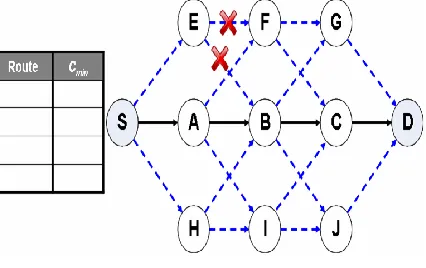
Figure . Admission control in RREQ propagation
Figure 1 shows an example of Q-SMS route discovery with admission control, where S is the source node and D is the destination node. S initiates the route discovery phase by sending QRREQ packet to the neighbors with reverse shortest hop count [23] and capacity constraints. In this example, node A has sufficient capacity on its QoS portion of allocated capacity, so it forwards QRREQ to neighboring nodes. However, node E does not have enough capacity in the QoS portion, so it does not forward QRREQ to D through B and F even though it can reach D. In this fashion if QRREQ reaches the destination by satisfying the reverse shortest hop count and the capacity constraint, then the destination replies with a QRREP packet back to source node using the reverse path identified within the QRREQ packet.
4.1 Performance Metrics
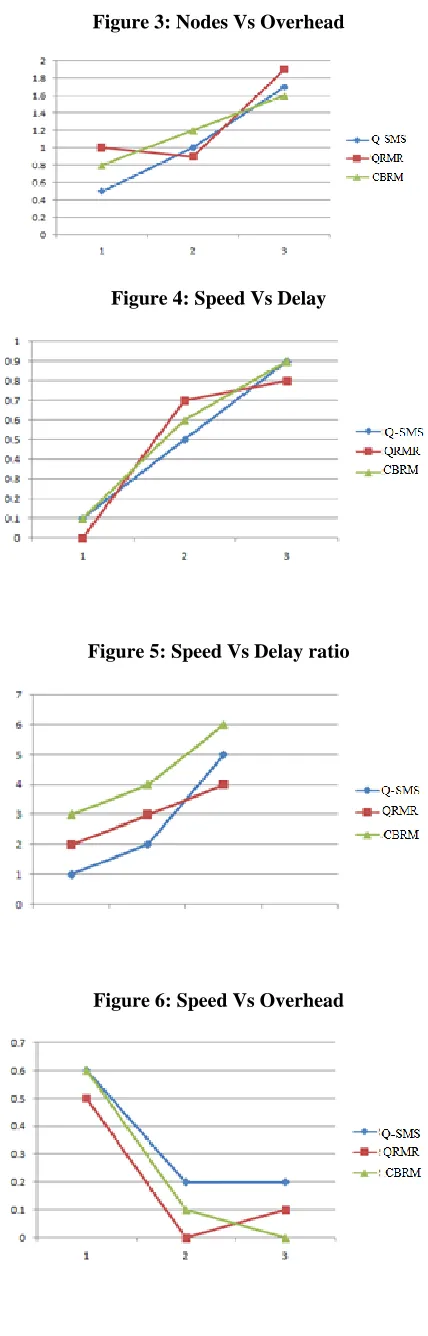
We measure up to our QRMR protocol with the AOMDV [6] protocol. We evaluate mainly the performance according to the following metrics, by varying the nodes as 35, 60, 85 and 200.
Organize overhead: The control overhead is defined as the total number of steering control packets normalized by the total number of received data packets.
Average end-to-end delay: The end-to-end-delay is averaged over all surviving data packets from the sources to the destinations.
Average Packet Delivery Ratio: It is the ratio of the No. of packets received successfully and the total no. of packets sent.
Figure 1: Nodes Vs Delay
© 2014, IJCSMC All Rights Reserved
697
Figure 3: Nodes Vs Overhead
Figure 4: Speed Vs Delay
Figure 5: Speed Vs Delay ratio
5. CONCLUSION
In this paper, an energy-aware xen-server for mobile Opportunistic networks is proposed. As a cross-layer design, QRMR utilizes the information from the physical and the Q-SMS protocol to select better routes. Mobile Opportunistic networks require a complex management to efficiently exploit the networks resources also covering the heavily demanded QoS constraints in current multimedia applications. This paper presents a cross-layer design that tries to combine the functionality of the Steering layer with Medium Access Control (MAC) information and physical layer parameters to provide the steering algorithm with the more accurate information about the environment. Simulations results indicate that Q-SMS Protocol network lifetime and achieve lower energy dissipation per bit of data delivery, higher volume of packets delivered and lower end-to-end delay.
REFERENCES
[1] Xiaobing Hou and David Tipper, "Impact of Failures on Steering in Mobile Opportunistic Networks Using DSR", in Web Protocols White Papers, University of Pittsburgh, November 2002.
[2] Mahesh K. Marina and Samir R. Das, "On- Demand Multipath Distance Vector Steering in Opportunistic Networks", in proceedings of 9th IEEE International Conference on Network Protocols, pp: 14- 23, 11- 14 November 2001.
[3] Andre Schumacher, Harri Haanpaa, Satu Elisa Schaeffer, and Pekka Orponen, "Load Balancing by Distributed Optimization in Opportunistic Networks", in proceedings of 2nd International Conference on Mobile Ad-hoc and Sensor Networks, vol. 4325, pp: 874- 885, Berlin- Heidelberg, 2006.
[4] Jangeun Jun and Mihail L. Sichitiu, "Fairness and QoS in Multihop Wireless Networks", in proceedings of 58th IEEE Conference on Vehicular Technology, vol. 5, 6- 9 October 2003, pp: 2936- 2940.
[5] Michael Gerharz, Christian de Waal, Matthias Frank and Paul James, "A Practical View on Quality-of-Service Support in Wireless Opportunistic Networks", Proc. of the 3rd IEEE Workshop on Applications and Services in Wireless Networks (ASWN), Berne, Switzerland, July 2003, pp: 185-196.
[6] Duc A. Tran and Harish Raghavendra, "Congestion Adaptive Steering in Mobile Opportunistic Networks", IEEE Transactions on Parallel and Distributed Systems, Vol. 17, no. 11, November 2006.
[7] Xiaoqin Chen, Haley M. Jones, A .D .S. Jayalath, "Congestion-Aware Steering Protocol for Mobile Opportunistic Networks", in proceedings of 6th IEEE Conference on Vehicular Technology,30 September- 3 October, Baltimore, 2007, pp: 21- 25.
[9] Jianbo Xue, Patrick Stuedi and Gustavo Alonso, "ASAP: An Adaptive QoS Protocol for Mobile Opportunistic Networks", IEEE Proceedings on Personal, Indoor and Mobile Radio Communications, vol. 3, pp: 2616- 2620, 7- 10 September 2003, Doi: 10.1109/PIMRC.2003.1259201.
[10] Jangeun Jun and Mihail L. Sichitiu, "Fairness and QoS in Multihop Wireless Networks", in proceedings of 58th IEEE Conference on Vehicular Technology, vol. 5, pp: 2936- 2940, 6- 9 October 2003, Doi: 10.1109/VETECF.2003.1286161.
[11] Michael Gerharz, Christian de Waal, Matthias Frank and Paul James, "A Practical View on Quality-of-Service Support in Wireless Opportunistic Networks", Proc. of the 3rd IEEE Workshop on Applications and Services in Wireless Networks (ASWN), pp: 185-196, Berne, Switzerland, July 2003.
[12] Duc A. Tran and Harish Raghavendra, "Congestion Adaptive Steering in Mobile Opportunistic Networks", IEEE Transactions on Parallel and Distributed Systems, Vol. 17, no. 11, November 2006.
[13] IETF Mobile Opportunistic Networks (MANET) Working Group, http://www.ietf.org/html.charters/manet-charter.html
© 2014, IJCSMC All Rights Reserved
699
[15] S. Lee, M. Gerla, “Split Multipath Steering with Maximally Disjoint Paths in Opportunistic Networks”, Proc. IEEE International Conference on Communication, Helsinki, June 2001, pp. 3201–3205.
[16] C.S. Murthy, B.S. Manoj, Opportunistic Wireless Networks Architectures and Protocols, Prentice Hall, NJ, USA, 2004.
[17] K.D. Sajal, A. Mukherjee, et al., "Improving quality-of-service in Opportunistic wireless networks with adaptive multi-path steering," In Proceedings of IEEE Globecom 2000, San Francisco, CA, Nov. 2000, pp. 261-265.