A NEW MODEL FOR SECONDARY NONDISJUNCTION:
THE ROLE OF DISTRIBUTIVE PAIRING
RHODA F. GRELL
Biology Diuision, Oak Ridge National Laboratory,* Oak Ridge, Tennessee
Received July 30, 1962
A
HYPOTHESIS has recently been proposed to account for the relation be- tween crossing-over and disjunction in the female of Drosophila melano- gaster (R. F. GRELL 1962). According to this view, two kinds of pairing occur at meiosis. The first kind, exchange pairing, precedes and is a requisite for exchange. If exchange occurs, the pattern for the second, distributive pairing, is set and regular disjunction ensues. If exchange does not occur, a pair OF homologues will, in the absence of other noncrossover elements, pair distributively with one another and again disjoin regularly. In terms of segregation, the consequences of exchange and distributive pairing are indistinguishable and the regular dis junc- tion of the noncrossover tetrad cannot be shown to depend on a postexchange event.Upon the addition of a no-exchange heteromorph or of a no-exchange hetero- 10gue,~ the disjunction of the noncrossover tetrad is altered. Distributive pairing now occurs between heteromorphs or between heterologues as well as between homologues. This permits a distinction to be made between those homologues that segregate from one another and those that disjoin from a third element. When the third element is a heteromorphic Y chromosome, the consequences of XYX pairing are recognizable as exceptional X progeny. It is well known that these are noncrossovers for the
X
chromosomes (BRIDGES 1916; GERSHENSON1935). When the third element is a heterologue, situations may be contrived that free only one member of a homologous pair to associate distributively with the heterologue and segregate from it. In such a case it has been shown that the member that segregates from the heterologue is, similarly, a noncrossover (R. F. GRELL 1962).
The rationale for postulating the occurrence of a second type of pairing, i.e., distributive pairing, subsequent to exchange, depends on the demonstration that pairing between no-exchange heteromorphs or between no-exchange hetemlopes does not reduce crossing-over between homologues and hence is not accomplished at the expense of pairing between homologues. That this is true for heterologues
IPortions of this work were taken from a dissertation submitted to the University of
Tennessee for the partial fulfillment of the requirements for the degree of Doctor of Philosophy
and were done while the author was a holder of a U.S. Public Health Service Special Research
Fellowship, GF- 10,916-C 1.
2 Operated by Union Carbide Corporation for the United States Atomic Energy Commission.
3 The term heterologue is used as a synonym for nonhomologue.
1738 RHODA F. GRELL
has beeii established (R. F. GRELL 1962), The purpose of this paper is to present evidence that the Y-dependent nondisjunction of the X chromosomes (i.e., sec- ondary nondisjunction in contrast to nondisjunction of the X chromosomes in the absence of a Y, or primary nondisjunction) does not cause a n equivalent reduction in crossing-over between the X's.
Previous studies of the effect of a Y chromosome on crossing-over and nondis- junction of the X's have been limited to instances in which crossing-over is high and nondisjunction is low, as with normal X's or in which the reverse is true as with the delta-49 or the C1B heterozygote. When the frequency of either process is low, it is difficult to determine whether a Y-induced change in one is ac- companied by a correlated change in the other. It becomes more informative to examine the relation in inversion heterozygotes where intermediate levels of exchange and nondisjunction prevail. In the experiments presented below the normal situation is reexamined under carefully controlled conditions, and is used as a standard for the various X inversions studied. These include small inversions distally, medially, and proximally placed, as well as large inversions. The results show that the presence of a Y chromosome may increase or decrease total crossing-over. When a reduction is observed, it is not correlated with the fre- quency of secondary nondisjunction. The alteration by the Y is qualitatively predictable and depends primarily on the location of the inversion. These studies indicate that XXY associations that lead to secondary exceptions occur after the exchange event and represent distributiue pairing between the Y and the non- crossover X chromosomes.
MATERIALS A N D M E T H O D S
General experimental plan: The present experiments were designed to test the effect oi a Y chromosome on crossing-over and disjunction of the X's. The test was made for the normal X and for six inversion heterozygotes. For the results to be meaningful, the presence of the Y should constitute the sole variable between each test case and its control. Other factors known to affect the rate of crossing- over include the genetic background of the flies, the age of the mother, and the temperature during development. The following provisions to eliminate differ- ences arising from these sources were incorporated into the plan of the experi- ments. Test (XXY) and control (XX) females were obtained as regular sisters from XXY mothers, insuring uniformity of genetic background for the two groups. Females, not older than ten hours, were mated singly in vials to three males for % hours and then transferred to bottles. Parents were removed after six days. The temperature was maintained at 25" +- 0.5"C throughout.
Materials: The X chromosome mutants used in the study with their symbols and genetic location are: yellow ( y , O.O), yellow2 ( y 2 , O.O), scute (sc, O.O), crossveinless (cu, 13.7), vermilion ( U , 33.0), wavy (wy, 41.9), forked ( f , 56.7), Bar ( B , 57.0) and carnation (car, 62.5). Six inversions were tested. Three of these, namely, In ( 1 ) scute7 ( sc7), I n ( 1 ) 65 ( LINDSLEY, EDINGTON and VON HALLE
DISTRIBUTIVE P A I R I N G I N NONDISJUNCTION 1739
versions. Two others, namely, In ( 1 )Austin B (AB) and In ( 1 ) BarM1 (B"' ) reduce crossing-over proximal to the inversions to less than three units. The sixth one, I n ( 1 ) scutes (sc8)
,
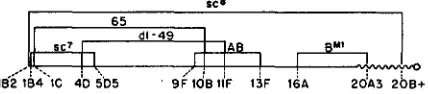
only permits the recovery of doubles within the inversion. The genetic lengths of the inversions and their breakpoints, as far as these are known, are shown in Figure 1. Additional rearrangements utilized for these studies are Inp ( 1 ) scutev1 (scvl) (MULLER and VALENCIA 1947), Dp (1 ) BapV6(E. H. GRELL, unpublished data) and an attached XY (LINDSLEY and NOVITSKI 1950). Fuller descriptions of the mutants and rearrangements may be found in BRIDGES and BREHME (1944) or in the references cited.
Methods
Normal X chromosomes: The effect of an unmarked Canton-S Y chromosome on crossing-over between two isosequential X chromosomes was measured for the six regions, y%v, cu-U, U-wy, wy-f, f-car, and car-spa, comprising the entire X chromosome. The region between car and the spindle fiber attachment was measured by the use of Inp ( 1 ) scvl, a pericentric inversion of the X chromo- some ihat places y + to the right of the centromere. The left arm of X which carried a deficiency for the tip was subsequently replaced with a normal
X
chromosome carrying the markers ys, sc, U , and f so that the chromosome now carried a duplication for the y locus. Its homologue carried the mutants y2, cu,w y , and car. Male progeny only were scored for crossovers.
To determine if crossover values were altered by the presence of the y + duplication, the experiment was repeated using X chromosomes marked for the same five regions between y and car but lacking the y f duplication.
Since the test employed sisters, some of which carried the unmarked Y while others did not, a method for distinguishing between the two types was necessary. Classification of XXY females when one X carries an inversion is readily ac- complished by observing the high frequency of secondary exceptions from such females. When both X's are normal, the rate of secondary nondisjunction is too low to permit a reliable distinction to be made between XX and XXY mothers. The method that was devised for identifying the presence of a Y in such mothers utilizes an X chromosome carrying a rearrangement of the bar locus, BEv5, in the tester male. XX females heterozygous for Bsv6 display a variegated position effect for B that ranges from a weak to an intermediate bar. In the presence of an extra
Y, the expression of Bsv6 is much more extreme. From a mating of XXY females to males carrying Bsv6, two approximately equal classes of regular daughters are
FIGURE 1.-Diagram of approximate sizes and positions of the X chromosome inversions
utilized. Cytological breakpoints on the salivary gland chromosome map are >given at the limits
1740 RHODA F. GRELL
distinguishable, those with very narrow bar eyes (X/X,BSV6/Y) and those with weak to medium (rarely extreme) bar eyes (X/X,BSV6). A mating of XX females to BsVG males produces the latter class exclusively. This method is completely reliable for identifying the presence of an extra Y chromosome in a mother. Disjunction of the X chromosomes was followed by the presence of the nmtants y and BSV6 in the tester males. The phenotype of the exceptional males was
y Bsv6, whereas regular males were
Znuersion heterozygotes: Experimental procedures for testing the six inversion heteroq-gotes conformed in all respects to those used for the normal X's. Crossing- over and disjunction was studied in sisters, part of which carried a n unmarked, Canton-S Y chromosome. Markers (f-, cu, U , wy, f, cur), identical to those employed for the normal X, were utilized for the crossover studies. Disjunction of the X's was followed by the presence of y and B in the male tester SO that
exceptional males were yB and regular males were ys or y + and B+ or B".
Identification of Y-bearing mothers was readily accomplished by noting those females that produced a high frequency of exceptions (10-33 percent, depending on the inversion).
or y+ and B + .
RESULTS A N D ANALYSES
BRIDGES (1 91 6) demonstrated that when an extra Y chromosome is present in the female, the frequency of X nondisjunction is greatly increased. Since ex- ceptional females, i.e., females arising from XX
-
Y segregations are noncross- overs, whereas regular progeny, i.e., individuals arising from X t,XY segre-gations are predominantly crossovers, BRIDGES assumed that exceptions arise from heterosynapsis between the X and Y prior to exchange. If meiotic pairing does, in fact, occur exclusively before exchange, the frequency of secondary nondisjunction should then be a measure of the frequency with which the Y pairs with one X (or both X's as postulated by COOPER 1948) to produce no- exchange tetrads.
BRIDGES' model is, therefore, testable, for it predicts a decrease in crossing-over in the presence of a Y, that is correlated with the frequency of X nondisjunction. The experiments reported below compare P (the predicted frequency of crossing- over in XXY females) with observed frequencies. The calculated reduction i n crossing-over, as estimated by the frequency of secondary exceptions, will vary depending on the pairing model postulated. If a n invariable bivalent-univalent model is assumed, the frequency of nondisjunction measures 50 percent of the no-exchange tetrads, since the remaining 50 percent are contributed to the regu- lar classes. An invariable XYX trivalent, that disjoins a5 XX t)Y, will con-
tribute noncrossovers to the exceptional classes 100 percent of the time. A tri- valent model has been adopted in estimating P so that the predicted reduction in crossing-over is the minimal one.
TABLE 1 Crossover and disjunction values for th following crosses: I. ys sc v f.scVJ y+/ys cv cw (YCS) * 0 X y HW Bsv5 8 2. y* wy car/sc v f (YGS) * 0 X y Hw Bsv6 8 Crossover units No. of Non- male disjunction Region 1 2 3 4 5 6
E
2
Genotype progeny+ (percent) 33 or sc-cu cu-U U-wy WY-f f<Qr car-y+ Total
+/+
2433 0 10.93 f 0.63 21.58 -C 0.83 7.77 f 0.54 14.71 ,2 0.72 7.56 f 0.54 4.69 2 0.43 67.24 f 0.95v) W
+/+/Y 2090 1.82 13.68 f0.75 23.062 0.92 9.71 f 0.65 13.M-c 0.75 6.94f 0.56 3.06 f 0.38 70.09f 1.00
+/+
1758 0 12.0020.77 21.9620.98 8.70f0.67 14.9020.85 6.2020.57 ... . . 63.76f1.142
v+/+/Y 2460 2.20 14.33 f 0.71 23.022 0.86 8.73 f 0.57 14.202 0.71 6.16 f 0.49 . . . . . . . . . . 66.44-C 0.95 P = 62.36 f 1.12
2
05
P = 65.98 f 0.96'i
.(
2
E
e
dz
0Experiment
Eo
El
Et
E,
H tj
xx
4.73 57.62 36.00 1.64z
I * (YC-5) designates Y-8 present in some crosses; P=predicted crossing over in XXY females.+
Corrected for lethality of exceptions.z
0 21 742 R H O D A F. GRELL
females is obtained by reducing the observed crossover frequency in XX iemales by the percent of secondary nondisjunction in XXY females. P is calculated by the formula P = B (1 - A ) where B is the total number of crossovers among the male progeny from XX mothers divided by the total number of male progeny (corrected for lethal exceptions) from XX mothers and A is twice the number of
male exceptions from XXY mothers divided by the total number of male progeny (corrected for lethal exceptions) from XXY mothers. I n Experiment 1, which measures crossing-over from the tip to the centromere,
P
turned out to be 65.98. The approximate standard error of P is (1 - A ) Var. B4-
B2 Var. A and is found to be f 0.96. The observed crossover value for XXY females, 70.09 2 1.00 is significantly greater than P.In the second experiment, crossing-over was measured for the five regions between y 2 and car. Here
P
is calculated as 62.36 2 1.12. Again the observed value for XXY females, 66.44 & 0.95, is significantly greater than P according to a “t” test.Comparisons of total crossing-over (Table 1 ) show no significant difference between XX females in Experiments 1 and 2 after an adjustment is made for region 6. A similar result is observed for XXY females from the two experiments. Furthermore, a comparison of regional crossover values for the two sets of XX females and for the two sets of XXY females shows no significant difference. Nondisjunction frequencies for XXY females are approximately two percent in each experiment and no primary exceptions are observed in either control. The striking similarity in the amount of crossing-over and nondisjunction in the two experiments indicates that the presence of the y+ duplication does not signifi- cantly alter exchange or disjunction. Furthermore, this similarity, in the absence of close genetic background control also permits the conclusion that differences in crossover frequency in XX and XXY sisters may be validly attributed to the effect of the Y chromosome.
A comparison of regional crossing-over in XX and XXY sisters (Table 1) shows that the Y causes a marked increase in region 1 (Experiments 1 and 2) and a decrease in region 6 (Experiment 1 )
.
While the increase might be ascribed to a physiological effect of the Y and the decrease to competitive pairing by the Y as a consequence of shared proximal homology with the X, the BRIDGES’ model also predicts a uniform reduction in crossing-over in regions 2-5 for XXY females. No reduction is observed. The overall effect of the Y is to increase exchange.The results from tetrad analyses of these data utilizing the method of WEIN-
STEIN (1936) are given i n Table 2. The effect of the Y in Experiment 1 is to increase Ez’s (double-exchange tetrads) at the expense of El’s (single-exchange tetrads) without affecting Eo’s (no-exchange tetrads). In Experiment 2, the presence of the Y appears to decrease Eo’s. It is evident that in neither experiment does the presence of the Y increase the frequency of Eo’s as predicted by the BRIDGES model.
Distal inuersions: Crossover and disjunction values for XX and XXY females
TABLE 3 Crossover and disjunction values for the following crosses:
U +I
3. 1n(i)sc7/v wy f car (~0-s) * 0 x
XY,
y B/Y 8 4. In(1)65,yf/uwycar (Yc-s)* P x XY, yB/Y 8 5. In(1)dl-49, uf/yS car (YCS)* P x XY, y B/Y 8 l-4 v,-
-
5
3
7
2
2
s!
Crossover uts tr! No of Non- male disjunction Region 1 2 3 4 5 Genotype progeny+ (percent) y-’-cu cu--U v-WY wr-f f-CQr Total sc7/+ 1847 0.09 5.09 f 0.51 6.39 f 0.57 12.24 f 0.76 8.93 It 0.66 32.65 f 1.09 1589 26.31 5.22 k 0.56 6.17 f 0.60 10.13 f 0.76 5.85 f 0.59 27.37 f 1.12 P = 24.06 f 0.88 2.490 0.96 2.66 f 0.32 10.44 f 0.61 8 71 f: 0.57 21.80 f 0.83 2.84f0.34 11.14f0.65 5.72-CO.48 19.70f0.82 2325 25.89 P = 16.16 f 0.64
z!
3{sc7/+fl21 4 6,
dl-#/+ 1052 0.78 0 1973 50.58 0.25 f 0.11 4 2.08 f 0.44 3.41 rt: 0.56 5.49 f 0.70
0 # 2
1 744 RHODA F. GRELL
Total crossover values for all inversion heterozygotes represent crossing-over outside of the inversion and necessarily are underestimates of the true values.
The calculated P value for XXY females heterozygous for sc7 is 24.06 I+ 0.88 which is significantly lower than the observed value of 27.37 f 1.12. Although
the Y causes a reduction in total crossing-over, its effect is limited to the proximal regions, particularly between f and car. The more distal segments, cu-U, and
u-wy, show no significant difference.
The P value for XXY females heterozygous for In( 1)65 is 16.16 f 0.64 and
the observed value of 19.70 -i- 0.82 is significantly higher than this. The reduction observed in total crossing-over with the Y (Table 3) is again attributable to a reduction in the proximal region between f and car while the more distal regions
(u-wy and wy-f) show no significant difference.
In ( 1 ) dl-49, although approximately equal in length to In( 1 ) 65, drastically reduces both proximal and distal crossing-over by virtue of its more medial position so that crossing-over is lower than with I n ( 1 ) 65. Since at least one half of the segregations in dl-49/+/Y females are nondisjunctional for the X chromo- somes, a trivalent model predicts a 50 percent reduction in crossing-over or a P value of 2.71 f 0.35. The observed value (4.10 f 0.45) is significantly higher
than this.
Proximal and medial inversions: Crossover and nondisjunction values for XX and XXY females carrying the heterozygous inversions AB and BM1 are given in Table 4.
The calculated P for In(l)AB/+/Y females is 12.84 ’.0.67. An observed value of 26.26 f 0.93 greatly exceeds P as well as the In(l)AB/+ value of
18.17 2 0.92. A P value of 26.03
*
0.82, estimated for Zn(l)BM1/+/Y females, is also exceeded by an observed value of 35.40 -t 0.91.Znversion(I)scut&: Table 5 gives crossover and nondisjunction values for XX and XXY females that are heterozygous for the scutes inversion. This inversion has one break between ac and sc and the second proximal to bb so that it includes
most of the X chromosome. As the products of a single crossover within an X
inversion are not included in the egg nucleus ( STURTEVANT and BEADLE 1936), the recovered crossovers are all doubles. The observed crossover value for XXY females (11.97 f 0.80) is significantly higher than the calculated P (7.04 f
0.44) or the observed value for Zn(l)sc8/+ females (8.72 2 0.56).
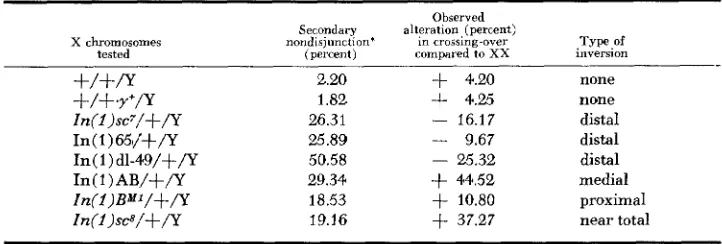
Crossing-over and disjunction in X X Y females: The effects of the Y chromo- some on X crossing-over and X disjunction are summarized in Table 6.
TABLE 4 Crossover and disjunction values for the following crosses: 6. In( 1)AB, sc cv/yz U f car (YcS) * 0 X
E,
y B/Y 8 7. In(I)BJfl, wy/ya cu U f (YC-S)* 0 xE,
y B/Y 8 ~ Crossover units No. of Non- male disjunction Genotype progenyt (percent) 1754 0.45 2243 29.34 2316 0.35 2752 18.53 Region 1 2 3 4 5 y"v cu-u U-wy wr-f f-car TotalU E "1
8.29 f 0.66 7.78 f 0.M . . . . , . . . . . 0.51 -+ 0.17 1.59 f 0.30 18.17 f 0.92
4 E
15.25 f 0.76 9.36 f 0.62 . . . . . . . . . . 0.22 rt 0.10 1.43 f 0.25 26.26 k 0.93 P = 12.84 f 0.67
2
13.17 f 0.70 14.98 f 0.74 2.68 +- 0.34 1.12 rt 0.22 . . . . . . . . . . 31.95 f 0.978
v14,43 f 0.67 17.41 f 0.72 2.91 f 0.32 .65 rt 0.15 . . . . . . . . . . 35.41) f 0.91
%
z
P
=
26.03
&
0.82
3 kJ
2
5
* (Yo-S) designates Yo-S present in some crosses; €'=predicted crossover values for XXY females. Con-eLted for lethality of exceptions. TABLE 5 Crossover and disjunction values for the following cross: 8. In(I)s@, U f car/ya cu (YC-S) * 0 x
xy,
y B/Y 8 i4 Crossover unitsn
2
1746 RHODA F. GRELL
TABLE 6
Effect of Y on X crossing-over and X disjunction
X chromosomes
tested
Secondary nondisjunction’
(percent)
2.20
1.88
26.31 25.89 50.58 29.34 18.53 19.16
Observed alteration, (percent)
in crossing-over compared to XX
+
4.20+
4.25- 16.17
- 9.67
- 25.32
+
44.52+
10.80+
37.27Type .of
none none distal distal distal medial proximal near total
inversion
* Primary nondisjunction less than one percent in all cases
about two percent secondary nondisjunction shows a four percent increase in crossing-over, whereas 65/+/Y with 25.9 percent secondary nondisjunction has a nine percent decrease and B*’/+/Y with 18 percent secondary nondisjunction has a 10.8 percent increase.
It appears that the two effects of the
Y
do not arise from a single cause, i.e., XYX preexchange pairing, but rather that they are attributable to separate and independent causes. The problem becomes one of providing a mechanism whereby the Y, although not contributing to the E, class by preexchange pairing, associates exclusively with this class at disjunction. The hypothesis that is proposed postu- lates that XYX associations that lead to X nondisjunction occur after exchange, at distributiue pairing. It further postulates that these associations occur only between the Y chromosome and those X chromosomes that have not engaged in cxchange with one another.On the other hand, the Y must affect exchange prior to distributive pairing. Reference to Table 6 shows that a correlation exists between the position of the inversion in the chromosome and the effect of the Y on crossing-over. Distal inversion heterozygotes (sc7, 65, dl-49) show a decrease with a Y whereas proxi- mal or medial inversions (AB, B M 1 ) show a n increase. These results are more easily interpretable by reference to the normal X. Here, we see the Y is effective in increasing distal crossing-over and decreasing it proximally. These localized effects appear to be enhanced with certain inversions. Thus, distal inversions that eliminate regions of increase but retain regions of decrease show a total decrease in crossing-over with a Y whereas the reverse holds true for proximal or medial inversions. A more detailed analysis of these effects is presented below.
DISTRIBUTIVE PAIRING I N NONDISJUNCTION 1747
normal X were taken as standard or equivalent to 100 percent. When the cross- over value for a particular region of the inversion heterozygote is divided by the crossover value of the same region in the normal X, the quotient is a measure of the effect of the inversion on crossing-over in that region.
The quotients for each region are given in Figure 2. The number in parenthesis beside each quotient is the crossover value for that region. An examination of Figure 2 shows, as is well known, that the regions closest to the inversion break- point exhibit the greatest crossover reduction. For the distal inversions, sc7 and 65, a marked increase over normal is observed in region 5, so that crossing-over here reaches 144 percent for sc7 and 140.5 percent for 65. Such an intrabrachial effect in which an inversion in one arm causes an increase in crossing-over in the same arm, has, to the writer's knowledge, not been previously described for Drosophila. This observation suggests the possibility that an inversion may have a dual effect, increasing crossing-over throughout the genome, including the arm of the inversion, and at the same time decreasing crossing-over in the vicinity of the inversion because of pairing difficulties. Only in those regions distant enough from the breakpoint for the second effect to become weaker than the first is the increase observed. A similar increase, observed with BM1 in region 1, is not sig- nificant but might become so if a marker more distal than cu were used.
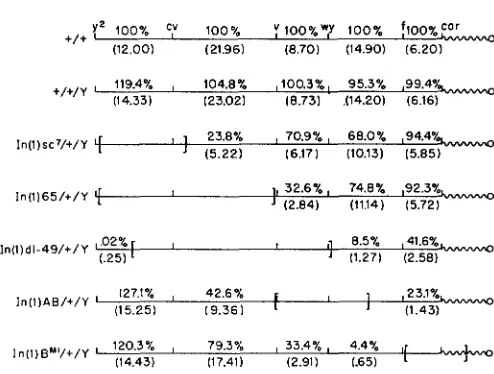
Effect of the Y chromosome on X crossing-over: Regional changes in crossing- over in the normal X and in inversion heterozygotes attributable to the presence of the Y chromosome are calculated by the method described in the previous section. Figure 3 shows the percent of crossing-over for each region compared with XX values taken as standard.
With two normal X's, the Y induces an increase of about 20 percent in region 1 but no significant change in regions 2-5, and the overall effect of the
Y
is to increase crossing-over. With distal inversions, sc7 and 65, the Y causes the intra- brachial effect to disappear so that crossing-over in region 5 is about normalREGION 1 2 3 4 5
*
1009. 1009. 100%wy 100% ~ 1 0 0 % ~+'+ (12.00) (21.96) (8.70) (14.90) (6.20)
23.2% , 73.4% , 82.1% J44D%
In(l)rcI/+ f
'
(5.09) (6.391 (12.24) (8.93)-
Inl1)65/+
t
I 1, 30.5% , 70.1% J40.5YCw__y,(2.66) (10.44) (8.71)
r I I 1 14.0% , 55%
(0.0) (2.08) (3.41)
In(l)dl-49/+ I
69.1% 35.4.1. I, I 1 ,25.6 %
-(7.78) (1.59)
In(I)A8/+ 18,29) '
68.2% , 30.8% , 7.5% ,I
(14.98) (2.68) (1.12)
'
'--L-.,J"(l)BM'/+
'
'Ogm '(I 3.1 7 )
FIGURE 2.-Effects of heterozygous X chromosome inversions on X crossing-over. The
1748 RHODA F. GRELL
y' 100% cy 100% y l O o % ~ Y 100% f l O O % L
+/+
(12.00) (21.96) (8.70) (14.90) (6.20)
+/+/y
,
119.4% , 104.8% ,100.3%, 95.3% ,99.4'(14.33) (23.02) 18.73) . .(14.20) (6.16-
, 1 23.8% , 70.9% , 68.0% ,94.4%-
in(l)sc'/+/~
'
(5.221 ( 6 1 7 ) (10.13) (5.85)
t 1, 32.6%, 74.8% ,92.3%-
'
(2.84) (1114) (5.72)I n (1 65 /+/U f
I I ,I 8.5% ,4l.6%
'
(1.271 (2.58)-ln(l)dl-49/+/Y lo'%[
(.25)
42.6% I
(9.361
in(l)AB/+/Y 1 '27.'% '
(15.25)
FIGURE 3.-Effect of a Y chromosome on X crossing-over (see Figure 2 for explanation).
(cf. Figures 2 and 3). With proximal and medial inversions, BM1 and AB, the Y increases crossing-over in region I so that it reaches about 20 percent above normal. For
BM*
the change is from 109.8 percent to 120.3 percent and only involves a n increase of about ten percent over the XX condition. For AB the change is from 69.1 percent to 127.1 percent so that the frequency of crossing- over is almost doubled over the XX condition.The total effect of the Y on crossing-over in inversion heterozygotes is, there- fore, the sum of several separate effects, each of which depend on the position of the inversion in the chromosome. The decrease found with distal inversions arises from: (1) the elimination for crossover measurement o l a distal region of Y- induced increase, and (2) the elimination of the intrabrachial effect by the Y. The Y-induced increase observed with proximal or medial inversions arises from the retention of the region of Y-induced increase for crossover measurement and from the enhancement of this effect with the AB inversion.
DISCUSSION
BRIDGES (1916) showed that the presence of a Y chromosome in the female significantly increases the frequency of nondisjunction of the X's. Since sec- ondary exceptions, in contrast to most regulars, are noncrossovers, this result was interpreted to mean that the difference between the two types was initiated at a stage preceding crossing-over and that exceptions arose from those cases in which XY instead of XX synapsis occurred. Independent assortment of the other X
chromosome at disjunction of the bivalent should lead to diplo X and nullo X
gametes one half of the time and to exceptional progeny one fourth of the time. The remaining half of the X noncrossovers, produced in this way, would become XY and X gametes and contribute to the regular classes.
DISTRIBUTIVE PAIRING I N NONDISJUNCTION 1749
frequency of secondary nondisjunction to 50 percent, and the frequency o€ ex- ceptions to 33 percent. As pointed out by GERSHENSOX (1935) for the ClB heterozygote and by STURTEVANT and BEADLE (1936) for dl-49, secondary non- disjunction can significantly exceed this postulated maximal limit. COOPER (1948) proposed that both X’s paired with the Y to form a trivalent and that disjunction of the trivalent occurred predominantly as directed segregation of both X’s from the Y, permitting a theoretical possibility of 100 percent exceptional progeny. This hypothesis offers an excellent solution to the disjunction problem but poses certain difficulties concerning pairing specificities that will be considered below. The second prediction concerns crossing-over. BRIDGES recognized that those X and XY gametes arising from postulated heterosynapsis of the X and Y prior to exchange should increase the frequency of noncrossovers among the regular offspring and that the contribution from
this
source should be equivalent to twice the number of exceptions. Instead, on comparing the observed crossover frequen- cies among Lhe regular progeny from XXY females with those from XX females, BRIDGES found for all cases studied an average increase of about 13 percent. It should be noted that until the method for comparing crossing-over between regular XX and XXY sisters with normal X’s was devised (described above under Results and Analyses), exceptional XXY and regular XX nonsisters were utilized for such studies.STURTEVANT and BEADLE (1936) analyzed the crossing-over data for XX and XXY females presented by BRIDGES and OLBRYCHT (1926). Rather than com- paring crossing-over among the regular progeny from XX and XXY females as BRIDGES did, they calculated crossover frequencies on the basis of total progeny with a correction for lethal exceptions. A decrease of 3.7 percent observed among the XXY progeny, which was localized in the proximal regions, chiefly between g and f, was attributed to competitive pairing between the X’s and the Y as a consequence Df shared proximal homology.
STURTEVANT and BEADLE (1936) also secured information on the effect of the Y on crossing-over in dl-49 heterozygotes. Here the measurement is limited to the region to the right of the proximal breakpoint of the dl-49 inversion (about 41 on the genetic map) since crossing-over distal to the inversion is practically eliminated. Their results show, as for the normal X, a proximal decrease in crossing-over in the presence of a Y.
FALK (1955) studied the effect of the Y on crossing-over between ec and car in normal X’s. Employing COOPER’S modification of the BRIDGES’ model and assum- ing all heterosynapsis occurred as a trivalent followed by XX H Y disjunction,
FALK compared crossing-over frequency among regulars from XX and XXY females directly, omitting a correction for exceptions. FALK reasoned that if XYX association prior to exchange led exclusively to exceptions, and failure of XYX association to normal pairing and crossing-over, crossover values among the regular progeny should be the same whether or not a Y was present. His data show, instead, an increase of approximately 13 units in the progeny from XXY mothers.
1750 RHODA F. GRELL
model or its modified form with respect to crossing-over but they strongly sug- gest that the expectation for a n increase i n Eo’s, which is positively correlated with the frequency of nondisjunction, is not realized. Furthermore, a careful scrutiny of the hypothesis of trivalent formation before exchange discloses several weaknesses. If it is assumed that synapsis at this time requires homology, then it is not readily apparent why a Y chromosome, for which a n X possesses incal- culably less homology than it does for its own homologue, whether normal or inverted, can become a preferred partner for a n X, particularly when, in the absence of a Y, X disjunction is highly regular. Yet it would have to become SO
to effect nondisjunction frequencies as high as 80 percent (COOPER 1948).
Secondly, a trivalent formed by one X pairing with the short arm of the Y chromosome and the other with the long arm requires a region of shared basal homology between the X and the long arm of the Y chromosome. Although NEU-
HAUS (1939) has presented evidence for such a region, LINDSLEY’S results (1955) do not support this claim. Third, if both arms of the Y do possess homology for the X, and trivalent association ensues, there is no apparent reason why crossing- over in the euchromatic segments of the X should not still be expected. Directed segregation of both X’s from the Y should contribute crossovers as well as non- crossovers to the exceptional classes. Yet, it is well established that secondary exceptions are noncrossovers. The alternate assumption, that heterosynapsis prior to exchange is not based on homology, presents the same paradox encountered in attempting to interpret preexchange association between nonhomologues since the precise, highly specific pairing required for exchange appears incompatible with nonspecific association.
The present experiments have tested the validity of a trivalent model of hetero- synapsis prior to exchange in a variety of situations. The predicted reduction i n crossing-over, based upon secondary nondisjunction frequency, was never ob- served. Tetrad analysis of crossing-over between normal X’s showed that no increase in the E, class occurred with a Y. A summary of the results from six inversion heterozygotes (Table 6) demonstrates that the effect of the Y on dis- junction is independent of its effect on crossing-over. In the words of STURTEVANT
and BEADLE (1936), “It becomes necessary, therefore, to search for a new inter- pretation of secondary exceptions.’’
In 1929, E. G. ANDERSON found that a heterozygous X-autosomal translocation increased the frequency of primary and secondary nondisjunction. In spite of a marked reduction of crossovers among the female exceptions from XXY mothers, the percent of crossovers among the combined regular and exceptional progeny from such mothers was apparently the same as that found in the progeny from XX mothers. ANDERSON concluded that synapsis and crossing-over between the X’S was not affected by the presence of a Y chromosome but, that after crossing- over had taken place, the Y could cause the more loosely paired X chromosomes to be distributed to the same pole. GERSHENSON (1935), from a study of the effect of the Y chromosome on crossing-over in CIB heterozygotes, judged that ANDER-
DISTRIBUTIVE PAIRING I N NONDISJUNCTION 1751
ClB/+ constitute only about one percent of the total, this experiment, while highly suggestive, is not sensitive enough to adequately test the ANDERSON hypothesis.
The results obtained in the present experiments corroborate, in a general way, ANDERSON’S finding that the presence of the Y does not reduce crossing-over in the X. While localized effects of the Y proximally o r distally alter total crossover frequency, it is clear that the Y does not, by competitive pairing prior to exchange, increase the Eo class to cause a uniform reduction in crossing-over throughout the chromosome.
In ANDERSON’S experiments the exceptions include crossovers as well as non- crossovers because contributions to secondary exceptions from heterozygous X- autosomal translocations arise from two different sources. The first is the conse- quence of the segregation of the normal X o r both
X
centromeres from the Y and concerns onlyX
noncrossovers. The second does not involve the Y, but results from 3: 1 disjunction in which the normal X and both parts of the X translocation go to the same pole to produce crossover exceptions. When secondary nondisjunc- tion is studied with nontranslocated X’s, the exceptions are found to be virtually all noncrossovers (BRIDGES 1916; GERSHENSON 1935; FALK 1955). It is then clear that those X’s that are directed to the same pole by the Y are X’s that have not been involved in a crossover with one another.The distributive pairing hypothesis postulates that elements, whether homol- ogues or nonhomologues, if not involved in exchange with other elements, may pair distributively and segregate. The Y chromosome, which does not participate in exchange, is always available for distributive pairing. Its role is not to increase
Eo’s by pairing with the X’s competitively before exchange, but rather to direct
Eo’s to the same pole by pairing with them distributively after exchange. In pairing with noncrossover X chromosomes, the Y functions in precisely the same kind of role as it does when it engages in distributive pairing with an autosome. The amount of secondary nondisjunction thus becomes an indirect measure of the number of noncrossover elements available for distributive pairing. Since the frequency of Eo’s are generally an indication of the total amount of crossing- over, secondary nondisjunction might be expected to be inversely related to ex- change frequency. In the present studies the following seriation with respect to the increase in percent of secondary nondisjunction is observed:
+/+
= 2.2;B M 1 / + = 18.5; 65/+ = 25.9; sc7/+ = 26.3; AB/+ = 29.3; dl-49/+ = 50.6. Cross-
over frequencies, given in the same order are
+/+
= 66.4; B”/+ = 35.4; 65/+ = 19.7; sc7/+ = 27.4; AB/+ = 26.3; dl-49/+ = 4.1. Although the two se- quences, except for In (1 ) 65, show an inverse relation, the frequency of second- aries provides a more reliable estimate of the number of Eo’s than does the cross- over value, since crossing-over inside the inversion is not measured. Thus, the disproportion between crossing-over and secondaries for In ( 1 ) 65 probably indi- cates a sizable amount of crossing-over within the inversion.1752 RHODA F. GRELL
are increased through the use of heterozygous inversions, the fraction of the total X tetrads that pair distributively with the Y increases. It appears likely that the fraction of total Eo’s pairing distributively with the Y also increases. For instance,
STURTEVANT and BEADLE (1 936) calculate that about 70 percent of the X tetrads from &-49/+/Y females are noncrossovers and the results given above indicate about 50 percent of these are nondisjunctional. This means that 5/7 of the non- crossover X tetrads or about 70 percent pair distributively with the Y. If these estimates are valid, the ability of the dl-49 inversion to cause a n increase i n association between the Y and the noncrossover X chromosomes may mean that heterozygous rearrangements are effective in reducing distributive pairing be- tween noncrossover homologues. The increase in primary nondisjunction that is observed with all of the heterozygous X inversions (Tables 3-5) lends additional support to this hypothesis.
Previous experiments have shown that distributive pairing of nonhomologues is competitive and preferential (GRELL and GRELL 1960). While the factors responsible for preferences among elements are unknown, it appears that ho- mology may not be of prime importance. Studies of competitive pairing ( GRELL
and GRELL 1960) show that two elements possessing the same fourth chromosome proximal heterochromatin but different euchromatin and exhibiting highly regu- lar segregation, will, upon the introduction of a Y chromosome assort independ- ently of one another. Moreover, one of the two will now segregate with equal regularity from the newly introduced Y. The high frequency of secondary non- disjunction observed with X-inversion heterozygotes suggests euchromatic ho- mology, likewise, cannot be the critical factor in distributive pairing of the X’S.
Yet, the failure of an extra Y chromosome to affect the regular segregation of two noncrossover fourth chromosomes may mean that here, unlike the X situation, euchromatic homology plays a major role in distributive pairing.
The events postulated by this model cannot at present be correlated with known cytological stages during meiosis. If all crossing-over occurs at a prezygo- tene stage, exchange pairing might then correspond to “effective pairing” and distributive pairing to cytologically observable pachytene pairing and thus con- form to a scheme postulated by PRITCHARD (1960). The possibility cannot be ruled out that crossing-over occurs at pachytene, in which case distributive pair- ing would probably be initiated at a postpachytene stage.
S U M M A R Y
1. The effect of a n unmarked, Canton-S Y chromosome on crossing-over and disjunction of the X chromosomes has been measured in sisters with two isose- quential X’s as well as in those heterozygous for Zn(l)sc7, Zn(l)BM’, I n ( l ) A B , In (1 ) 65, In ( 1 ) dl-49 and Zn(l)sc8. The results show that although the presence
DISTRIBUTIVE PAIRING I N NONDISJUNCTION 1753
These findings are incompatible with a model that postulates heterosynapsis prior to exchange as the source of the no-exchange X chromosomes that are recovered as exceptions.
2. Since the Y chromosome associates only with noncrossover X tetrads at disjunction, yet does not cause a corresponding decrease in X recombination, it is proposed that XYX associations, that give rise to exceptions, occur subsequent to exchange, at distributive pairing.
3. In the presence of a
Y,
isosequential X’s show the following changes in crossing-over: a significant increase distally, a significant decrease proximally(car to s p a ) and a net increase in crossing-over. Tetrad analysis discloses that the addition of a Y does not increase the frequency of Eo’s but that it increases
Ez’s at the expense of El’s.
4. XX females, heterozygous for the distal inversions sc7 and 65, show an intrabrachial increase in crossing-over (f to car) of about 40 percent. Heterozy- gotes for B”’ show a distal increase (y-CO) that might
be
significant if a marker more distal than cu were used.5 . The effect of a
Y
chromosome on crossing-over in X-inversion heterozygotesis correlated
with
the position of the inversion. In XXY females heterozygous for distal inversions a decrease is seen in total crossing-over caused by the elimi- nation of the proximal intrabrachial effect. In XXY females heterozygous for proximal or medial inversions a distal increase and, hence, a net increase in crossing-over is seen.ACKNOWLEDGMENT
The author wishes to thank DR. MAX DELBRUCK for his valuable comments and criticism of the manuscript and DR. MARVIN KASTENBAUM of the Mathe- matical Panel of Oak Ridge National Laboratory for his assistance in the statisti- cal treatment of the data.
LITERATURE CITED
ANDERSON, E. G., 1929
BRIDGES, C. B., 1916
BRIDGES, C. B., and K. S. BREHME, 1944
BRIDGES, C. B., and T. M. OLBRYCHT, 1926
COOPER, K. W., 1948
FALK, R., 1955
GERSHENSON, S. M., 1935
GRELL, R. F., 1962
Studies on a case of high non-disjunction in Drosophila melanogaster.
Non-disjunction as proof of the chromosome theory of heredity. Genetics
The Mutants of Drosophila rnelanogaster. Carnegie
The multiple stock “Xple” and its use. Genetics 11:
A new theory of secondary non-disjunction in female Drosophila melam-
Some preliminary observations on crossing-over and non-disjunction. Hereditas
The mechanism of non-disjunction in the CIB stock of Drosophila
A new hypothesis on the nature and sequence of meiotic events in t h e Z. Ind. Abst. Vererb. 51: 397-441.
1 : 1-52,107-163.
Inst. Wash. Publ. 552.
41-56.
gaster. Proc. Natl. Acad. Sci. US. 34: 179-187.
41: 376-383.
melanogaster. J. Genet. 30: 115-125.
1754 RHODA F. GRELL
GRELL, R. F., and E. H. GRELL, 1964 The behavior of nonhomologous chromosomal elements
involved in nonrandom assortment in Drosophila melanogastm. Proc. Natl. Acad. Sci. U.S.
LINDSLEY, D. L., 1955 Spermatogonial exchange between the X and Y chromosomes of Drosophila melanogaster. Genetics 40 : 24-44.
LINDSLEY, D. L., C. W. EDINGTON, and E. S. VON HALLE, 1960 Sex-linked recessive lethals in
Drosophila whose expression is suppressed by the Y chromosome. Genetics 45: 1649-1670.
LINDSLEY, D. L., and E. NOVITSKI, 1950 The synthesis of an attached XY chromosome.
Drosophila Inform. Serv. 24: 84-85.
MULLER, H. J., and J. VALENCIA, 1947 Three scute alleles involving gross rearrangements.
Drosophila Inform. Serv. 21 : 69-70.
NEUHAUS, M. E., 1939 A cytogenetic study of the Y chromosome of Drosophila melamgmter.
J. Genet. 37: 229-254.
PRITCHARD, R. H., 1960 Localized negative interferences and its bearing on models of gene
recombination. Genet. Res. 1: 1-24.
STURTEVANT, A. H., and G. W. BEADLE, 1936 The relations of inversions in the X chromosome
of Drosophila melanogaster to crossing-over and disjunction. Genetics 21 : 554-604. WEINSTEIN, A., 1936 The theory of multiple-strand crossing-over. Genetics 21 : 155-199.