Available online: https://edupediapublications.org/journals/index.php/IJR/ P a g e | 4832
“
Experimental Exploration of Different Shaped Isolated Footings
under SL and IL on Different Types of Soil”
SHUBHANGI NI JOSHI , ARPI T CHAWDA
ABSTRACT
In this study work, with the experimental investigations work an attempt has been made to study the behavior and suitability of various shaped footing specimens which may be a choice for lying of foundation. For this purpose the area of footing specimens has been kept same as 400 cm2 for all shapes of footings and thereafter the dimension are fixed accordingly. As a consideration for knowing of effect of settlement the dissertation work is studied under black cotton soil and sandy soil as two different strata. any civil engineering structure must rest on a strong foundation or as per the strength criteria. Bearing capacity and settlement are the two major criteria for designing of foundation. Also it is not always subjected to monotonic loading but it may be subjected to impact loading. The examples are lifts, bridges foundation, machine foundation, offshore structure, wind waves etc.
Available online: https://edupediapublications.org/journals/index.php/IJR/ P a g e | 4833
scope.
I NTRODUCTION
In this dissertation work, with the experimental work an attempt has been made to study the behavior of various shaped footing specimens which may be a choice for laying of foundation. For this purpose the area of footing specimens has been kept same as 400 cm2 for all shapes of footings and thereafter the
dimension are fixed accordingly. As a consideration for knowing of effect of settlement the dissertation work is studied under black cotton soil and sandy soil as two different strata. Also, in this dissertation work, the loading on the footing has been differentiated as Point and Impact loading so that settlement tests were conducted on all specimens and load intensity–settlement curves are to be plotted. It is also required to verify the suitability of the shape as per loading on different types of soil. It is concluded after studying the load intensity settlement behavior that hexagonal footing shows least settlement while square footing shows maximum settlement at same loading intensity. Experimentally it is found that hexagonal footing shows better performance while square footing shows poor behavior.
Objectives of Study
To establish load settlement behavior for various shaped footings. This will enable the construction
practices to be adopted for various shapes instead of conventional types followed.
To determine the suitability of various shaped footings by physical tests.
To compare the settlements of various shaped footings under point and impact loading which may
be the practical aspects of the loading types.
To conclude for suitability of a particular type of footing and settlement behavior.
Available online: https://edupediapublications.org/journals/index.php/IJR/ P a g e | 4834
M20 is used. Loading tests were performed on sandy soil and clayey soil prepared in cubical brick mould tank, applied through concrete model footings resting on the surface of sa nd and clay layers which are filled in three or four layers are filled in the tank. A loading frame of 1000 KN capacity, to find out the load- settlement behavior of layered soil by providing one soft layered soil to other soft layered soil
The loading arrangement consisted of a soil filled tank load cell, In-Situ settlement indicator and dial gauge.
Two identical tank of size 75 cm x 75 cm x 40 cm was filled with soil and another one with black cotton soil. Total height of fill was kept as 30 cm. It was filled in three layers of equal thickness. In each stage soil was filled and compacted keeping density equal to field density. The reaction frame was fitted to the tank keeping centre of frame vertically above the centre
of tank.
The specimen was also levelled. The load cell was placed above the CG of footing. Dial gauges were fitted at opposite points on the specimens.
RESULT
In this section results data are obtained for load and settlements under static and impact load for sandy soil and black cotton soil. The load-settlement curves for both the types of soil and loadings have been plotted to determine the suitability of shape for footings.
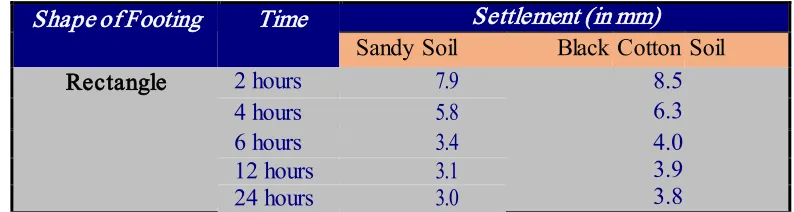
Case1: Static Loading by Physical arrangements Static Load= 1000N
Table 1 (Settlement in footing on applying static load of 1000 KN
Shape of Footing Time Settlement (in mm)
Sandy Soil Black Cotton Soil
Rectangle 2 hours 7.9 8.5
6.3 4.0 3.9 3.8
4 hours 5.8
6 hours 3.4
12 hours 3.1
Available online: https://edupediapublications.org/journals/index.php/IJR/ P a g e | 4835
Square
Hexagon
Circular
72 hours 3.0 3.6
8.5 6.5 4.0 3.8 3.6 3.2 7.2 5.9 3.4 3.1 3.0 2.9 7.5 7.2 7.1 3.9 3.6 3.6
2 hours 8.0
4 hours 6.0
6 hours 3.5
12 hours 3.4
24 hours 3.3
72 hours 3.1
2 hours 6.8
4 hours 5.2
6 hours 3.3
12 hours 3.2
24 hours 3.2
72 hours 3.1
2 hours 7.1
4 hours 6.9
6 hours 6.8
12 hours 3.7
24 hours 3.5
72 hours 3.2
Graphical Comparisons for Static Loading Case:
Available online: https://edupediapublications.org/journals/index.php/IJR/ P a g e | 4836
Time vs Settlement for Static load of 1000 N on Sandy soil. Graph 1(Time Vs Settlement on Sandy Soil)
Time vs Settlement for Static load of 1000 N on Black cotton soil.
Available online: https://edupediapublications.org/journals/index.php/IJR/ P a g e | 4837 Case2 Impact Loading by Physical arrangements.
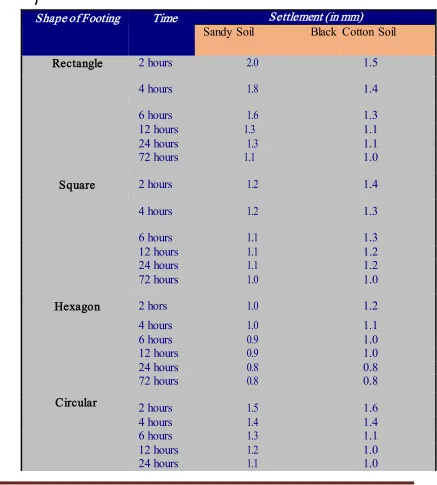
Table 2 (Settlement in footing when impact load is 500
KN
Impact Load= 500N
)
Shape of Footing Time Settlement (in mm)
Sandy Soil Black Cotton Soil
Rectangle 2 hours 2.0 1.5
4 hours 1.8 1.4
6 hours 1.6 1.3
12 hours 1.3 1.1
24 hours 1.3 1.1
72 hours 1.1 1.0
Square 2 hours 1.2 1.4
4 hours 1.2 1.3
6 hours 1.1 1.3
12 hours 1.1 1.2
24 hours 1.1 1.2
72 hours 1.0 1.0
Hexagon 2 hors 1.0 1.2
4 hours 1.0 1.1
6 hours 0.9 1.0
12 hours 0.9 1.0
24 hours 0.8 0.8
72 hours 0.8 0.8
Circular 2 hours 1.5 1.6
4 hours 1.4 1.4
6 hours 1.3 1.1
12 hours 1.2 1.0
Available online: https://edupediapublications.org/journals/index.php/IJR/ P a g e | 4838
72 hours 1.1 0.9
A graphical comparison has been made to compare rate of settlement for different soil conditions and for various shapes of footings for the impact loading application as case2.
Time vs. Settlement for Impact load of 500 N on Sandy soil.
Available online: https://edupediapublications.org/journals/index.php/IJR/ P a g e | 4839
Rectangle
Square
Hexagon
Circular
2.5
2
1.5
1
0.5
0
2hrs 4hrs 6hrs 12hrs 24hrs 72hrs
Time vs. Settlement for Impact load of 500 N on Black
cotton soil. Graph 4(Time Vs Settlement Black cotton
soil)
Available online: https://edupediapublications.org/journals/index.php/IJR/ P a g e | 4840
Hexagonal footing results better in terms of less settlement for both black cotton soil and sandy soil under static & Impact loading cases. This may be due to the reason that a hexagonal footing possess the following;
It has more axis and as axis increases, load distribution results better.
The critical area is large in hexagonal footing. As area increases the settlement decreases.
Settlement were more in Black Cotton Soil (cohesive soil) than Sandy Soil (cohesion less soil).
Cohesive soil has less permeability, so more water is expelled out in consolidation process.
REFERENCES
[1] Lutenegger, A. J. furthermore, Adams, M. T. "Trademark load-settlement conduct of shallow establishments", FONDSUP, Magnan (éd.), Paris, Vol. 2. pp. 381–392, 2004.
[2] Lutenegger, A. J. what's more, Adams, M. T. "Bearing Capacity of Footings on Compacted St. Louis, Missouri, pp. 1216-1224, 1998.
[3] Ismael, N. F. "Admissible weight from stacking tests on Kuwaiti soils", Canadian Geotechnical Journal, Vol. 22(2), pp. 151–157, 1985.
[4] Gavin, K., Adekunle, A. what's more, O'Kelly, B. "A field examination of vertical balance reaction on sand", Proceedings of the Institution of Civil Engineers
Geotechnical Engineering, Vo. 162, Issue GE5, pp. 257-267, 2009.