No. Candidate word EN paraphrase Lingsoft WordMngr DeKo
1a Hundekuchen dog biscuit + + +
b Hundetorte “dog cake” + – +
c Hundenapf dog’s bowl + – +
d Hundesnapf “dog’s bowl” + – –
2a Studentenschaft student body + + +
b Maurerschaft “bricklayers’ body” – – +
3a katzenhaft cat-like + + +
b fischhaft “fish-like” – + +
4a lesbar readable + + +
b schreibbar “writeable” – – +
c schmeckbar “tasteable” + – +
Table 1: Complex words and their analyses in Gertwol, WordManager and DeKo.
Word formation Category free/ Simplex Comp./Der. Examples EN paraphrase
type bound stem stem
Derivation noun free Hund Hünd- hündisch servile
bound -tion -tiön- Informatiönchen “little piece of information”
verb free send(en) send- Sendung broadcasting
adj. free blau bläu- bläulich bluish
Compounding noun free Hund Hunde- Hundekuchen dog biscuit
bound -tion -tions Informationssperre news blackout
verb free send(en) sende- Sendezeit broadcasting time
adj. free blau blau blaugrau blue-grey
Table 2: Example data for simplex stem, derivational and compounding stem
2.2. Selectional Properties of Affixes
It is a well established fact that derivational affixes se-lect bases by category: e.g. -bar(“-able”) combines pro-ductively only with (transitive) verbs.
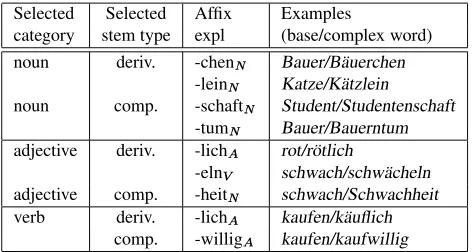
But there are other properties which play a role in the selection behaviour of affixes. One of them is the stem type: the affix -lich, for example, combines with the derivational stem, the same way as -lein, -chen and other affixes do. A few derivational affixes, however, se-lect the compounding stem, the same one as used in com-pound formation. Examples are-haft, -losor the “semi-affixes” (-frei, -freudig,. . . ):Bauer/bauernhaft, bauernlos (“farmer”/“farmer-like”, “free of farmers”), with the same stem as Bauernhaus (“farmhouse”). For each deriva-tional affix, the stem type which it selects can be identified (prominent examples are given in Table 3).
Some affixes in addition select only native (e.g.-lich) or only neoclassical stems (e.g.-abel), whereas others take bases of both types (e.g.-isch).
3. Acquisition of Stem Data
In the perspective of a stem-oriented approach to the analysis of complex words, which follows the descriptive work of Fuhrhop (1998), the acquisition problem is reduced to the task of finding, for each noun, verb and adjective lemma, next to the simplex stem also the derivational and compounding stem(s).
Selected Selected Affix Examples
category stem type expl (base/complex word) noun deriv. -chen Bauer/Bäuerchen
-lein Katze/Kätzlein noun comp. -schaft Student/Studentenschaft
-tum Bauer/Bauerntum adjective deriv. -lich rot/rötlich
-eln schwach/schwächeln adjective comp. -heit schwach/Schwachheit verb deriv. -lich kaufen/käuflich
comp. -willig kaufen/kaufwillig
Table 3: Examples of affixes classified by their selection in terms of category and stem type of the base
3.1. Architecture
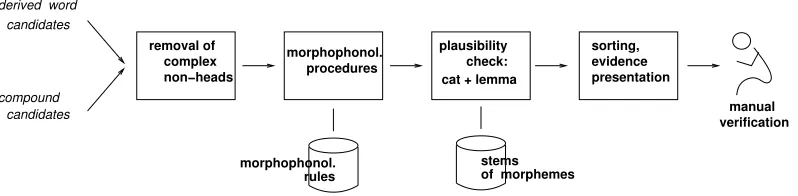
The principle of the acquisition architecture is quite simple. The procedures rely on the existing linguistic re-sources, i.e., a dictionary of about 20.000 simplex lemmas7
and knowledge about morphophonological restrictions for affixes. The tool suite is schematized in Figure 1.
Candidates in our acquisition experiments come from a list of 2.14 million word form types extracted from corpora of news texts totalling about 200 million word forms.
Corpus word Proposed analyses Lemma hyp. Deriv. Stem ---Aufständchen Aufstand[nomen][masc][++]chen[suffix] Aufstand Aufständ Aufsätzchen Aufsatz[nomen][masc][++]chen[suffix] Aufsatz Aufsätz Auftrittchen Auftritt[nomen][masc][++]chen[suffix] Auftritt Auftritt Ausflügchen Ausflug[nomen][masc][++]chen[suffix] Ausflug Ausflüg Auspüffchen Auspuff[nomen][masc][++]chen[suffix] Auspuff Auspüff Autochen Auto[nomen][neut][++]chen[suffix] Auto Auto Autolein Auto[nomen][neut][++]lein[suffix] Auto Auto Baggerlein Bagger[nomen][masc][++]lein[suffix] Bagger Bagger
Figure 2: Examples of the input to manual correction (left) and the (processed) result: derivation stems of nouns
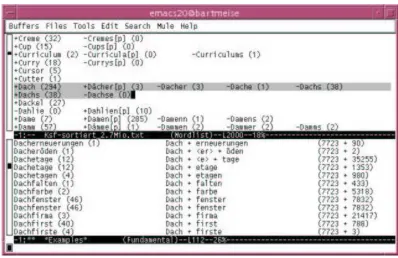
Figure 3: Screen shot of the Emacs mode for manual correction of compounding stems, with markings
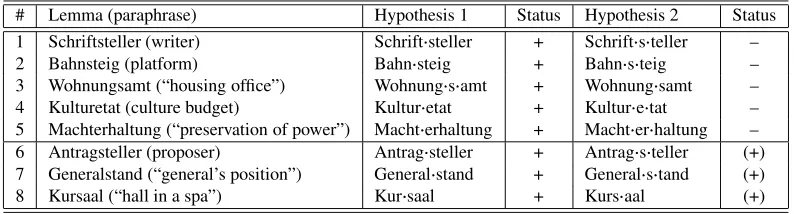
nouns; however, the compound stem hypotheses for exam-ples (1) through (5) under hypothesis 2 are wrong.
Table 4 also contains examples of cases where the am-biguity cannot be solved with our approach (examples (6) to (8), marked with “(+)” on the wrong but possible anal-ysis). In Antragsteller, the compound stem
hypothe-sis is not wrong, as Antragsformular (“application for-m”), Antragsfrist(“deadline for application”) show.
Sim-ilarly,Generals- is found inGeneralsuniform (“general’s uniform”), Generalsbesprechung(“general’s conference”).
In the case ofKursaal,Kurs-can indeed not be a compound stem of Kur(“cure”), but it is a compound stem ofKurs
(“rate”). To decide that the second hypothesis for the anal-ysis of the examples (6) to (8) in Table 4 is unacceptable, we need world knowledge rather than linguistic knowledge. We have extracted noun+noun compounds from a 200 million word corpus with ambiguous analyses in the above-mentioned sense. Among the top 150 ambiguous items, sorted according to their frequency of occurrence in the cor-pus (these items have a total frequency of 72.795 in 200 million), only 17 ambiguities could not be resolved with the methods described here; thus 88,67 % of the types from
this small sample are analysed correctly.
4.3. Improving Generalisation Power
Moreover, we can generalise over large portions of the complex vocabulary, by formulating entries for the deriva-tional and compounding stems of affixes: the stems are in-herited from the affixes (i.e. the derivational heads) to the derived words. Examples of a few frequent affixes are given in Table 5, below, along with the type frequency of the com-pounds where they occur as non-heads, as well as with the token frequency of the respective compounds, each within our 200 million words news corpus. In addition, we give one example of each type.
These types alone make up for 14 % of all noun+noun compounds in our corpus.
5. Conclusion
qual-# Lemma (paraphrase) Hypothesis 1 Status Hypothesis 2 Status
1 Schriftsteller (writer) Schrift steller + Schrift s teller –
2 Bahnsteig (platform) Bahn steig + Bahn s teig –
3 Wohnungsamt (“housing office”) Wohnung s amt + Wohnung samt –
4 Kulturetat (culture budget) Kultur etat + Kultur e tat –
5 Machterhaltung (“preservation of power”) Macht erhaltung + Macht er haltung –
6 Antragsteller (proposer) Antrag steller + Antrag s teller (+)
7 Generalstand (“general’s position”) General stand + General s tand (+)
8 Kursaal (“hall in a spa”) Kur saal + Kurs aal (+)
Table 4: Examples of ambiguities at the level of compound component identification
Simplex Type f Token f Derivation Examples Compounding Examples
stem stem stem
-ung 36.876 412.993 — — -ungs- Bildungslücke
-heit 2.888 43.556 -heit- einheitlich -heits- Einheitsessen
-(t)ion 12.586 108.691 -(t)iön- Funktiönchen -(t)ions- Funktionsumfang
-ist 1.651 8.452 -ist- linguistisch -isten- Linguistenarbeit
Table 5: Simplex, derivation and compounding stems of frequent derivational affixes
ity and make the manual checking relatively easy and effi-cient.
The approach is linguistically sound, in that it does not require us to assume the existence of linking elements the linguistic status of which is not very clear (are they mor-phemes, do they have a category, do they have selectional properties, etc.). In comparison with the rule approach (cf. section 1.3.), we expect that our approach will consider-ably reduce the number of ambiguities in the analysis of complex items (cf. Table 4).
It should be noted, however, that the rule approach and the subregularity approach produce at least reasonable re-sults on a large portion of German compounds. From 21.424 compounds analysed with our tools, 43.22 % have a compounding stem which is identical to the simplex stem. Another 54.89 % have one of the nine linking elements-s-, -n-, -en-, -e-, -er-, -es-, -o-, -nen-, -ns-, -ien-, -ens-, and only less than 2% have elision and/or umlaut, possibly with linking elements (there is considerably more Umlautung in derivation). Thus, for a rough first analysis, a less sophisti-cated approach may be sufficient.
Our approach has, however, additional potential with re-spect to the analysis of neoclassical word formation. In line with the stem approach and with Lüdeling et al. (2002), we also assume the existence of two (or more) stems (called ‘short’ and ‘long’, for the moment) in neoclassi-cal word formation. Thus, we note the stems demonstr-and demonstrat-, to cover demonstrieren, Demonstrant,
demonstrabel vs. Demonstration, demonstrativ. Such
stems can again be acquired with the same principles and tools as shown, because of the selection preferences of neo-classical affixes. Acquiring a sizeable lexicon of stems for neoclassical word formation will be the next major applica-tion of the tool suite described here.
6. Acknowledgements
This work has been developed in the context of the DeKoproject, a research project funded in the time frame comprised between January 2000 and May 2001 by the Land Baden-Württemberg, in its Forschungsschwerpunkt-programm.
The authors would like to thank Anke Lüdeling who has decisively contributed to the modelling approach adopted here, and to Julia Weidenkaff and Gerhard Kremer who did the manual checking work and influenced the form which the acquisition process took by commenting on earlier ver-sions.
7. References
Baayen, Harald (1991). “Quantitative Aspects of Morpho-logical Productivity.” In G. Booij and J. v. Marle, eds., Yearbook of Morphology 2, 109 – 150. Foris, Dordrecht. Baayen, Harald (2001). Word Frequency Distributions.
Kluwer Academic Publishers, Dordrecht, 2001.
Domenig, Marc and ten Hacken, Pius (1992).Word Man-ager: A system for Morphological Dictionaries. Olms, Hildesheim.
Fuhrhop, Nanna (1998).Grenzfälle morphologischer Ein-heiten. Stauffenburg-Verlag, Tübingen.
Hausser, R. (1996).Linguistische Verifikation. Dokumen-tation zur Ersten Morpholympics 1994. Max Niemeyer Verlag, Tübingen, 1996
Koskenniemi, K. and Haapalainen, M.: “GERTWOL – Lingsoft Oy”, in (Hausser 1996): 121-140.
Langer, Stefan: “Zur Morphologie und Semantik von No-minalkomposita”, in: (Schröder et al. (Ed.) 1998), 83-96 Lüdeling, Anke and Schmid, Tanja and Kiokpasoglou, Sawwas: “Neoclassical word formation in German”, in: Yearbook of Morphology 2001, to appear 2002
for the automatic analysis of complex words”, to appear in:Proceedings of Euralex 2002, Copenhagen, 2002 Schmid, Tanja and Lüdeling, Anke and Säuberlich, Bettina
and Heid, Ulrich and Möbius, Bernd: “DeKo: Ein System zur Analyse komplexer Wörter”, in: Henning
Lobin (Ed.): Sprach- und Texttechnologie in digitalen
Medien- Proceedings der GLDV-Frühjahrstagung 2001 (Gießen), 49-57; see also:
http://www.uni-giessen.de/fb09/ascl/gldv2001
Schröder, Bernhard and Lenders, Winfried and Hess,
Wolf-gang and Portele, Thomas (Ed.): Computer,