interoperability and reusability of language data resources and NLP tools/systems, even though their primary objectives are totally different.
In principle, most of the existing language data resources and NLP tools/systems have been created independently, resulting in a situation where data format, annotation scheme, access method and other features are all idiosyncratic. To address this issue, standardization is inevitable: standardized APIs are
necessary for NLP tools/systems; standardized data semantics as well as data format are required for language data resources. In addition and importantly, these standards should be designed based on a comprehensive shared ontology which covers all possible elements of a language infrastructure. In this sense, a language infrastructure, particularly that in an open environment, should be ontology-based.
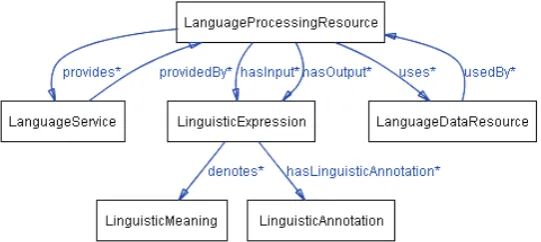
Figure 1: Top-level of the Language Service Ontology
Figure 13 illustrates the top-level of the language service ontology that was proposed in (Hayashi et al., 2008) with respect to the Language Grid infrastructure. Each box in the figure denotes a top-level class or concept in the ontology. As depicted in the figure,
LanguageService is providedBy
LanguageProcessingResource which takes LinguisticExpression as input/output, and uses LanguageDataResource. Note that, in a service-oriented point view, any data resource has to be coupled with a kind of processing resource which provides an access function. Note also, that
LinguisticExpression denotes
LinguisticMeaning, and can have multiple LinguisticAnnotation.
Figure 2: Configuration of Language Data Resource and the Accessor
Each top-level class in the figure is defined in
3 All the diagrams have been produced with OntoViz plugin
of Protégé ontology editor.
further detail as a sub-ontology. Figure 2 develops one-step further the language data resource class (into
Corpus and Lexicon classes), and the
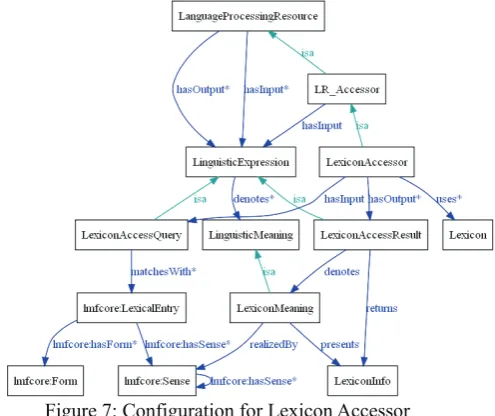
corresponding language processing resource class. As shown in the figure, the language processing resource is divided into LinguisticProcessor, which represents usual NLP tools/systems, and LR_Accessor, which is further divided into two sub-classes according to type of the language data resources that are used; LexiconAccessor targets Lexicon, while CorpusAccessor accesses to Corpus. The rest of the paper discusses Lexicon and the corresponding LexiconAccessor sub-ontologies.
3.
Ontologization of LMF
In the language service ontology, the sub-ontology or taxonomy of lexicons may be defined based on a service-oriented perspective, resulting in a situation where the taxonomy may not be linguistically or lexicographically motivated. However it would be far better to ground the service-oriented taxonomy to some lexicon ontology that is based on shared linguistic and lexicological principles.
simply means to give a corresponding OWL representation to the constructs in the framework.
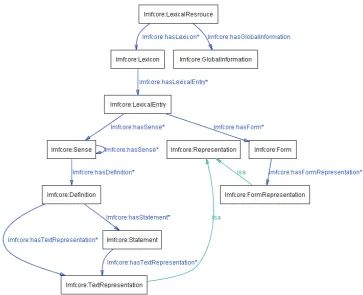
Figure 3 illustrates the ontological configuration for the LMF core model. Although the specifications of LMF are given by using UML (Unified Modeling Language) diagrams, we can convert these diagrams relatively straight forward on OWL by applying some conversion conventions; for example, we have converted the aggregation in UML into hasXXX property. As stated in the figure, we have defined the LMF core package as an independent sub-ontology; the namespace lmfcore prefixed to the entities indicates this situation. All the other extensions are defined in another sub-ontology which imports the LMF core ontology; the namespace lmfall represents the whole sub-ontology. This account is somehow different from the original LMF specification, where, managing all types of lexicon in a single ontological space is not
considered. However this account gives us an opportunity to stipulate a range of lexical resources in a unique ontological space, and this is mandatory in a service-oriented language infrastructure.
Figure 4 shows a part of the LMF NLP Semantics extension, which is associated in particular with the lexical semantic notions of the extension. Note that this extension has been defined by sub-classing the classes in the LMF core package. The point is certain sub-class of the lexicon class is defined so as to have a particular type of the lexical entry. For example, in Figure 4,
lmf.Sem.Lexicon, as a sub-class of
lmfcore:Lexicon, is defined as having
lmf.Sem.LexicalEntry that is, in turn, a sub-class of lmfcore:LexicalEntry. Again, this account is somehow different from the original LMF specification, where, for example, sub-classing of the lexicon class is not allowed.
Figure 3: Configuration for LMF core package
4.
LMF-based Lexicon Taxonomy
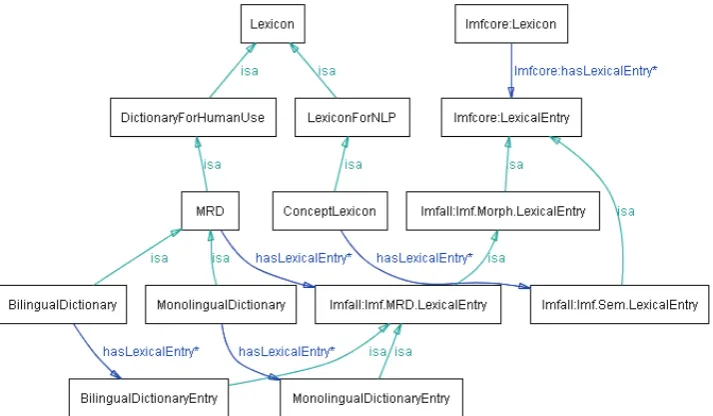
Shown in Figure 5 is an extremely simplified view of the lexicon taxonomy, which is presented just to show the notion of service-oriented lexicon taxonomy; where the top-level class Lexicon is first divided into
DictionaryForHumanUse and
LexiconForNLP. The former includes a class for so-called machine readable dictionaries (MRD), which is further divided into MonolingualDictionary and BilingualDictionary. The latter, on the other hand, derives a class for computational concept lexicon (ConceptLexicon), which has been introduced in order to stipulate WordNet-type lexical resources.
As seen in this figure, the configuration of the
When we are to represent and incorporate some new type of lexicon, we should first introduce a new lexical entry sub-class for the target lexicon in the
service-oriented taxonomy, and then appropriately relate it to somewhere in the lexical entry taxonomy of the ontologized LMF.
Figure 4: Configuration for LMF NLP Semantic Extension
Figure 5: Service-oriented Lexicon Taxonomy: A partial and simplified view
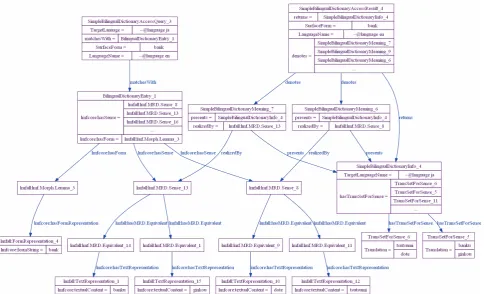
Figure 8: An Instance-level Example of Bilingual Dictionary Access (partial)
Figure 9: Fragments of the SAWSDL document for Simple Bilingual Dictionary Accessor
...
<wsdl:portType name="SimpleBilingualDictionary"> <wsdl:operation name="serachSimpleBilingualDictionary"
sawsdl:modelReference="http://langrid.nict.go.jp/lso/lso#SimpleBilingualDictionaryAccessor">
<wsdl:input message="sbd:serachSimpleBilingualDictionaryRequest"/> <wsdl:output message="sbd:serachSimpleBilingualDictionaryResponse"/> </wsdl:operation>
...
<xsd:element name="serachSimpleBilingualDictionaryRequest" type="sbd:SearchQuery">
</xsd:element>
<xsd:element name="serachSimpleBilingualDictionaryResponse" type="sbd:SearchResults">
</xsd:element> ...
<xsd:complexType name="SearchQuery"
sawsdl:modelReference="http://langrid.nict.go.jp/lso/lso#SimpleBilingualLexiconAccessQuery">
<xsd:sequence>
<xsd:element name="SurfaceForm" type="xsd:string"></xsd:element> <xsd:element name="LanguageName" type="xsd:language"></xsd:element> <xsd:element name="TargetLanguage" type="xsd:language"></xsd:element> </xsd:sequence>
</xsd:complexType> ...
<xsd:complexType name="SearchResults">
sawsdl:modelReference="http://langrid.nict.go.jp/lso/lso#SimpleBilingualDictionaryInfo">
<xsd:sequence>
<xsd:element name="Language" type="xsd:language"></xsd:element> <xsd:element name="TransSetForSense" type="sbd:TransSetForSenseType"
maxOccurs="unbounded" minOccurs="1"></xsd:element> </xsd:sequence>
</xsd:complexType>
<xsd:complexType name="TransSetForSenseType"> <xsd:sequence>
<xsd:element name="Translation" type="xsd:string" maxOccurs="unbounded" minOccurs="1"></xsd:element> </xsd:sequence>