Proceedings of the 55th Annual Meeting of the Association for Computational Linguistics (Short Papers), pages 629–634 Vancouver, Canada, July 30 - August 4, 2017. c2017 Association for Computational Linguistics
Proceedings of the 55th Annual Meeting of the Association for Computational Linguistics (Short Papers), pages 629–634 Vancouver, Canada, July 30 - August 4, 2017. c2017 Association for Computational Linguistics
Representing Sentences as Low-Rank Subspaces
Jiaqi Mu, Suma Bhat, and Pramod Viswanath University of Illinois at Urbana Champaign
{jiaqimu2, spbhat2, pramodv}@illinois.edu
Abstract
Sentences are important semantic units of natural language. A generic, distributional representation of sentences that can cap-ture the latent semantics is beneficial to multiple downstream applications. We ob-serve a simple geometry of sentences – the word representations of a given sen-tence (on average 10.23 words in all Se-mEval datasets with a standard deviation
4.84) roughly lie in a low-rank subspace
(roughly, rank 4). Motivated by this ob-servation, we represent a sentence by the
low-rank subspace spanned by its word
vectors. Such an unsupervised represen-tation is empirically validated via seman-tic textual similarity tasks on 19 different datasets, where it outperforms the sophis-ticated neural network models, including skip-thought vectors, by 15% on average.
1 Introduction
Real-valued word representations have brought a fresh approach to classical problems in NLP, rec-ognized for their ability to capture linguistic reg-ularities: similar words tend to have similar rep-resentations; similar word pairs tend to have
sim-ilar difference vectors (Bengio et al., 2003;Mnih
and Hinton,2007;Mikolov et al.,2010;Collobert et al., 2011; Huang et al., 2012; Dhillon et al.,
2012; Mikolov et al., 2013; Pennington et al.,
2014; Levy and Goldberg, 2014; Arora et al.,
2015;Stratos et al., 2015). Going beyond words, sentences capture much of the semantic informa-tion. Given the success of lexical representations, a natural question of great topical interest is how to extend the power of distributional representations to sentences.
There are currently two approaches to represent
sentences. A sentence contains rich syntactic in-formation and can be modeled through sophisti-cated neural networks (e.g., convolutional neural
networks (Kim,2014;Kalchbrenner et al.,2014),
recurrent neural networks (Sutskever et al.,2014;
Le and Mikolov, 2014; Kiros et al., 2015; Hill et al.,2016) and recursive neural networks (Socher et al., 2013)). Another simple and common ap-proach ignores the latent structure of sentences: a prototypical approach is to represent a sentence by summing or averaging over the vectors of the
words in this sentence (Wieting et al., 2015;Adi
et al.,2016;Kenter et al.,2016).
Recently,Wieting et al.(2015);Adi et al.(2016)
reveal that even though the latter approach ignores all syntactic information, it is simple, straightfor-ward, and remarkably robust at capturing the sen-tential semantics. Such an approach successfully outperforms the neural network based approaches on textual similarity tasks in both supervised and unsupervised settings.
We follow the latter approach but depart from representing sentences in a vector space as in these prior works; we present a novel Grassmannian property of sentences. The geometry is motivated by (Gong et al., 2017;Mu et al.,2016) where an interesting phenomenon is observed – the local context of a given word/phrase can be well rep-resented by a low rank subspace. We propose to generalize this observation to sentences: not only do the word vectors in a snippet of a sentence (i.e., a context for a given word defined as several words surrounding it) lie in a low-rank subspace, but the entire sentence (on average 10.23 words in all Se-mEval datasets with standard deviation 4.84) fol-lows this geometric property as well:
Geometry of Sentences:The word rep-resentations lie in a low-rank subspaces (rank 3-5) for all words in a target
tence.
The observation indicates that the subspace con-tains most of the information about this sentence, and therefore motivates a sentence representation method: the sentences should be represented in the space of subspaces (i.e., the Grassmannian mani-fold) instead of a vector space; formally:
Sentence Representation: A sentence can be represented by a low-rank sub-space spanned by its word representa-tions.
Analogous to word representations of similar words being similar vectors, the principle of sen-tence representations is: similar sensen-tences should have similar subspaces. Two questions arise: (a) how to define the similarity between sentences and (b) how to define the similarity between sub-spaces.
The first question has been already addressed by the popular semantic textual similarity (STS) tasks. Unlike textual entailment (which aims at in-ferring directional relation between two sentences) and paraphrasing (which is a binary classifica-tion problem), STS provides a unified framework of measuring the degree of semantic equivalence (Agirre et al.,2012,2013,2014,2015) in a contin-uous fashion. Motivated by the cosine similarity between vectors being a good index for word sim-ilarity, we generalize this metric to subspaces: the similarity between subspaces defined in this paper
is the`2-norm of the singular values between two
subspaces; note that the singular values are in fact the cosine of the principal angles.
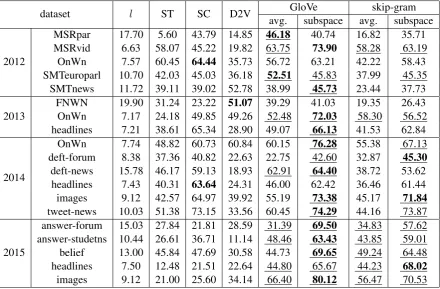
The key justification for our approach comes from empirical results that outperform state-of-the-art in some cases, and being comparable in others. In summary, representing sentences by subspaces outperforms representing sentences by averaged word vectors (by 14% on average) and sophisticated neural networks (by 15%) on 19 dif-ferent STS datasets, ranging over difdif-ferent do-mains (News, WordNet definition, and Twitter).
2 Geometry of Sentences
Assembling successful distributional word
repre-sentations (for example, GloVe (Pennington et al.,
2014)) into sentence representations is an active
research topic. Different from previous studies
(for example, doc2vec (Mikolov et al., 2013),
skip-thought vectors (Kiros et al.,2015), Siamese
CBOW (Kenter et al., 2016)), our main
contri-bution is to represent sentences usingnon-vector
space representations: a sentence can be well rep-resented by the subspace spanned by the con-text word vectors – such a method naturally builds on any word representation method. Due to the widespread use of word2vec and GloVe, we use their publicly available word
representa-tions – word2vec(Mikolov et al.,2013) trained
us-ing Google News1 and GloVe (Pennington et al.,
2014) trained using Common Crawl2 – to test our
observations.
Observation Let v(w) ∈ Rd be the d
-dimensional word representation for a given word
w ∈ V, and s = (w1, . . . , wn) be a given
sen-tence. Consider the following sentence where
n= 32:
They would not tell me if there was any pension left here, and would only tell me if there was (and how much there was) if they saw I was entitled to it.
After stacking the (non-functional) word vectors
v(w)to form ad×nmatrix, we observe that most
energy (80% for GloVe and 72% for word2vec) of
such a matrix is contained in a rank-N subspace,
whereN is much smaller thann(for comparison,
we chooseN to be 4 and thereforeN/n≈13%).
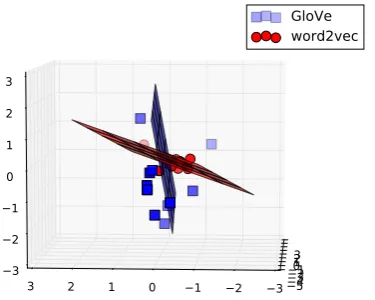
Figure 1 provides a visual representation of this
geometric phenomenon, where we have projected
the d-dimensional word representations into
3-dimensional vectors and use these 3-3-dimensional word vectors to get the subspace for this sentence
(we setN = 2here for visualization), and plot the
subspaces as 2-dimensional planes.
Geometry of Sentences The example above generalizes to a vast majority of the sentences: the word representations of a given sentence roughly reside in a low-rank subspace, which can be ex-tracted by principal component analysis (PCA).
Verification We empirically validate this ge-ometric phenomenon by collecting 53,396
sen-tences from the SemEval STS share tasks (Agirre
et al., 2012, 2013, 2014, 2015) and plotting the
fraction of energy being captured by the top N
components of PCA in Figure2forN = 3,4,5,
1https://code.google.com/archive/p/ word2vec/
HLT. Association for Computational Lin-guistics, Atlanta, Georgia, pages 758–764.
http://cs.jhu.edu/ ccb/publications/ppdb.pdf.
Hongyu Gong, Suma Bhat, and Pramod Viswanath. 2017. Geometry of compositionality. Association for Advancement of Artificial Intelligence (AAAI).
Felix Hill, Kyunghyun Cho, and Anna Korhonen. 2016. Learning distributed representations of sentences from unlabelled data. arXiv preprint arXiv:1602.03483.
Eric H Huang, Richard Socher, Christopher D Man-ning, and Andrew Y Ng. 2012. Improving word representations via global context and multiple word prototypes. InProceedings of the 50th Annual Meet-ing of the Association for Computational LMeet-inguis- Linguis-tics: Long Papers-Volume 1. Association for Com-putational Linguistics, pages 873–882.
Nal Kalchbrenner, Edward Grefenstette, and Phil Blunsom. 2014. A convolutional neural net-work for modelling sentences. arXiv preprint arXiv:1404.2188.
Tom Kenter, Alexey Borisov, and Maarten de Rijke. 2016. Siamese cbow: Optimizing word embed-dings for sentence representations. arXiv preprint arXiv:1606.04640.
Yoon Kim. 2014. Convolutional neural
net-works for sentence classification. arXiv preprint arXiv:1408.5882.
Ryan Kiros, Yukun Zhu, Ruslan R Salakhutdinov, Richard Zemel, Raquel Urtasun, Antonio Torralba, and Sanja Fidler. 2015. Skip-thought vectors. In Advances in neural information processing systems. pages 3294–3302.
Quoc V Le and Tomas Mikolov. 2014. Distributed rep-resentations of sentences and documents. InICML. volume 14, pages 1188–1196.
Omer Levy and Yoav Goldberg. 2014. Neural word embedding as implicit matrix factorization. In Ad-vances in neural information processing systems. pages 2177–2185.
Tomas Mikolov, Kai Chen, Greg Corrado, and Jef-frey Dean. 2013. Efficient estimation of word representations in vector space. arXiv preprint arXiv:1301.3781.
Tomas Mikolov, Martin Karafi´at, Lukas Burget, Jan Cernock`y, and Sanjeev Khudanpur. 2010. Recur-rent neural network based language model. In Inter-speech. volume 2, page 3.
Andriy Mnih and Geoffrey Hinton. 2007. Three new graphical models for statistical language modelling. InProceedings of the 24th international conference on Machine learning. ACM, pages 641–648.
Jiaqi Mu, Suma Bhat, and Pramod Viswanath. 2016. Geometry of polysemy. arXiv preprint arXiv:1610.07569.
Jeffrey Pennington, Richard Socher, and Christopher D Manning. 2014. Glove: Global vectors for word representation. InEMNLP. volume 14, pages 1532– 43.
Richard Socher, Alex Perelygin, Jean Y Wu, Jason Chuang, Christopher D Manning, Andrew Y Ng, and Christopher Potts. 2013. Recursive deep models for semantic compositionality over a sentiment tree-bank. InProceedings of the conference on empirical methods in natural language processing (EMNLP). Citeseer, volume 1631, page 1642.
Karl Stratos, Michael Collins, and Daniel Hsu. 2015. Model-based word embeddings from decomposi-tions of count matrices. In Proceedings of ACL. pages 1282–1291.
Ilya Sutskever, Oriol Vinyals, and Quoc V Le. 2014. Sequence to sequence learning with neural net-works. InAdvances in neural information process-ing systems. pages 3104–3112.
John Wieting, Mohit Bansal, Kevin Gimpel, and Karen Livescu. 2015. Towards universal para-phrastic sentence embeddings. arXiv preprint arXiv:1511.08198.
dataset l ST SC D2V GloVe skip-gram
avg. subspace avg. subspace
2012
MSRpar 17.70 5.60 43.79 14.85 46.18 40.74 16.82 35.71
MSRvid 6.63 58.07 45.22 19.82 63.75 73.90 58.28 63.19
OnWn 7.57 60.45 64.44 35.73 56.72 63.21 42.22 58.43
SMTeuroparl 10.70 42.03 45.03 36.18 52.51 45.83 37.99 45.35
SMTnews 11.72 39.11 39.02 52.78 38.99 45.73 23.44 37.73
2013 FNWNOnWn 19.90 31.24 23.227.17 24.18 49.85 49.2651.07 39.2952.48 41.0372.03 19.3558.30 26.4356.52
headlines 7.21 38.61 65.34 28.90 49.07 66.13 41.53 62.84
2014
OnWn 7.74 48.82 60.73 60.84 60.15 76.28 55.38 67.13
deft-forum 8.38 37.36 40.82 22.63 22.75 42.60 32.87 45.30
deft-news 15.78 46.17 59.13 18.93 62.91 64.40 38.72 53.62
headlines 7.43 40.31 63.64 24.31 46.00 62.42 36.46 61.44
images 9.12 42.57 64.97 39.92 55.19 73.38 45.17 71.84
tweet-news 10.03 51.38 73.15 33.56 60.45 74.29 44.16 73.87
2015
answer-forum 15.03 27.84 21.81 28.59 31.39 69.50 34.83 57.62
answer-studetns 10.44 26.61 36.71 11.14 48.46 63.43 43.85 59.01
belief 13.00 45.84 47.69 30.58 44.73 69.65 49.24 64.48
headlines 7.50 12.48 21.51 22.64 44.80 65.67 44.23 68.02
images 9.12 21.00 25.60 34.14 66.40 80.12 56.47 70.53
Table 1: Pearson’s correlation (x100) on SemEval textual similarity task using 19 different datasets,
where l is the average sentence length of each dataset. Results that are better than the baselines are