Evaluation of Web-based Corpora: Effects of Seed Selection and Time Interval
Motoko Ueyama
SSLMIT, University of Bologna 136 Corso della Repubblica
47100 Forl, Italy [email protected]
Abstract
Recently, there have been efforts to construct written corpora by using the WWW. A promising approach to build Web corpora is to run automated queries to search engines and download pages found in this way. This makes it possible to build corpora rapidly and economically, but we cannot control what are contained in resulting corpora. Under these circumstances, it is important to verify the general nature of Web corpora. This study, in particular, investigated effects of two essential factors on three Japanese corpora that we built: seed terms used for queries; and time interval between different corpus construction sessions, which measures the stability of query results over time. We evaluated the corpora qualitatively, in terms of domains, genres and typical lexical items. Results show these two patterns: 1) both seed selection and time interval affect the distribution of text and lexicon; 2) the effect of seed selection is much stronger. The prominent effect of seed selection suggests that a good understanding of the cause-and-effect relation between seeds and retrieved documents is an important step to gain some control over the characteristics of Web corpora, in particular, for the construction of general corpora meant to represent a language as a whole.
1.
Introduction
1.1. Automated methods to construct Web corpora A considerable amount of work has been conducted on the use of the Web as a linguistic data source for various tasks (e.g., Kilgarriff and Grefenstette, 2003). A promising ap-proach is to build corpora by running automated queries to search engines and post-processing the retrieved pages. This approach differs from the traditional method of corpus construction, where one needs to spend considerable time collecting the texts to include, but having good control on corpus contents. In contrast, the automated approach, de-spite the absence of quality control, makes it possible to construct corpora quickly and economically. This is good news for researchers in urgent need of large-scale balanced corpora for the language of their interest, but with no access to such corpora. This is the case for researchers working on the majority of the world’s languages, including Japanese. The pioneering work in the automatic construction of Web corpora has been done by the CorpusBuilder project (e.g., Ghani et al., 2003). Baroni and Bernardini (2004) intro-duced the BootCaT tools, a free suite of Perl scripts for the automated construction of corpora via Google queries. The BootCaT tools were used for developing general corpora by Baroni and Ueyama (2004), Ueyama and Baroni (2005) and Sharoff (2006).
Despite a considerable amount of work on ways to use the Web as a linguistic data source, only few studies have evaluated Web corpora qualitatively. Fletcher (2004) found his English Web corpus to be characterized by a more in-teractive style, and to be more varied in comparison with the British National Corpus (henceforth BNC; Aston and Burnard, 1998). Sharoff (2006) adapted the BootCaT tools to build Web corpora including English, finding his En-glish Web corpus to be richer in topic domains than the BNC. The findings of both studies challenge the view that Web corpora are not fit for linguistic research. In our last study (Ueyama and Baroni, 2005), we qualitatively
evalu-ated two Japanese Web corpora built with the the BootCaT tools. On the basis of our manual classification data, we found in both corpora many documents to be produced by non-professional writers and characterized by everyday life topics and high occurrences of an informal, spontaneous, interactive style. This confirms the findings of Fletcher and Sharoff. We also found that this type of text was more dom-inant in our Japanese corpora than in any of Sharoff’s cor-pora. This difference may be due to differences in seed choice. Many of our seeds pertain to everyday life, while this is not the case of Sharoff’s seeds selected from existing traditional corpora (e.g. BNC).
1.2. Goals of the study
clas-sification methods and present our results, while section 4. presents the evaluation of typical lexical items of each cor-pus. Finally, in section 5. we discuss our findings and con-clude by suggesting directions for future research.
2.
Corpus construction
We built the Genki 2004 and 2005 corpora with the same procedure and seeds, but at two different times: July 2004 and April 2005, respectively (also analyzed in Ueyama and Baroni, 2005). The BNC-web 2005 corpus was built in Au-gust 2005, using the same procedure but different seeds.
2.1. Automated url search
For the two Genki corpora, to look for pages reason-ably varied and not excessively technical, we decided to query a search engine (Google in our case) for words belonging to a basic Japanese vocabulary. Thus, we randomly picked 100 words from the word list of a Japanese Textbook, Genki (Banno et al., 1999). For the BNC-web 2005 corpus, we randomly selected 100 from Sharoff’s (2006) list of 500 seeds extracted from the BNC (available at http://corpus.leeds.ac. uk/internet/seeds-en), and translated those in Japanese. Reflecting the nature of the BNC, seeds for the BNC-web 2005 corpus vary more in topics than the ones for the two Genki corpora.
All the three corpora were built with the BootCaT tools (Baroni and Bernardini, 2004). We randomly combined the 100 seeds into 100 triplets, and used each triplet for an automated query to Google via the Google APIs (http: //www.google.com/apis). The rationale for com-bining the words was that in this way we were more likely to find pages with connected text (that contain at least 3 un-related content words). We used the same triplets to build the two Genki corpora, while we created and used a new set of 100 triplets in for the BNC-web 2005 corpus. For each query, we retrieved maximally 10 urls from Google, and discarded duplicate urls. This gave us a total of 894 unique urls, 993, and 908 for Genki 2004, Genki 2005 and BNC-web 2005, respectively. Notice that, while for the purposes of this study we are satisfied with these sizes, the same pro-cedure could be used to build larger corpora.
To find the number of common urls, we compared the two Genki corpora and found 187 urls in common, leaving 707 and 806 urls in the Genki 2004 only and in the Genki 2005 only, respectively. With respect to the Genki 2005 url list, the overlap is of less than 20%. To see if those urls were identical in contents, we randomly picked 20 out of the 187 common urls and examined the text, finding only 13 of the 20 urls (65%) to be identical. The overlap decreases even more between Genki 2005 and BNC-web 2005: only 11 urls (1% overlap with respect to the Genki 2005 url list).
2.2. Retrieving and post-processing text
The web page correponding to each url was automatically retrieved and formatted as text by removing “boilerplate” such as the HTML tags (using Perl’s HTML::TreeBuilder as text function and simple regular expressions). Since Japanese pages can be encoded in different character sets
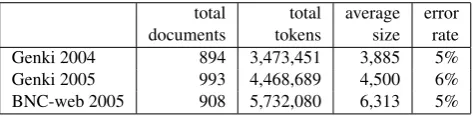
total total average error documents tokens size rate Genki 2004 894 3,473,451 3,885 5% Genki 2005 993 4,468,689 4,500 6% BNC-web 2005 908 5,732,080 6,313 5%
Table 1: Total documents, total tokens, average size, and error rate of the Genki 2004, Genki 2005, and BNC-web 2005 corpora
(e.g., shift-jis, euc-jp, utf-8), our script detects the char-acter set of the page, using the HTML code, and con-verts that into utf-8. The ChaSen tool (Matsumoto at al, 2000) was used to tokenize the text. ChaSen expects input and outpu to be coded in euc-jp, while our text-processing scripts are designed for utf-8 input. We converted text back and forth between utf-8 and euc-jp with the recode tool (http://recode.progiciels-bpi.ca/). The tokenization results are shown in table 1. Comparing the two Genki corpora, we noticed that in Genki 2005 not only more and different urls but also urls with more text were retrieved, as indi-cated by the increased average document size. BNC-web 2005, in turn, shows an increase of the total tokens of about 27%, and an increase of average document size of about 40% with respect to Genki 2005, although the total docu-ment count decreases. Finally, we found that some pages did not contain any substantial text: e.g., the ones not de-coded properly. The ratio of such pages was about 5% for all the corpora. We believe that this error rate is tolerable in the sense that the great majority of text is usable.
3.
Corpus classification
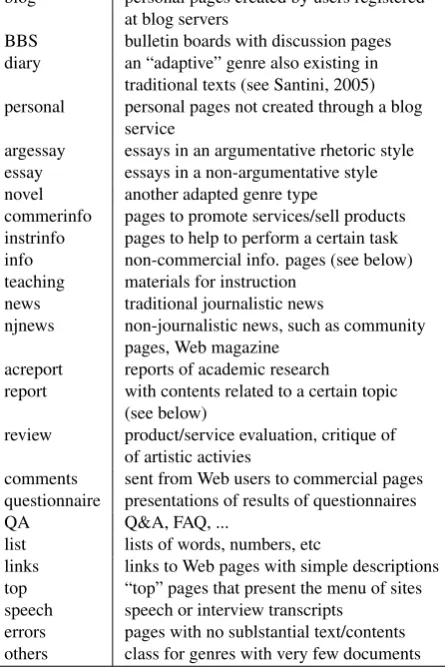
We manually classified all 894 pages of Genki 2004, and 300 randomly picked from each of Genki and BNC-web 2005, in terms of domains and genres. For the domain anal-ysis, we adopted Sharoff’s (2006) BNC-based classification system, so that we can compare our results directly with his. We used the nine categories listed in table 2. For the genre analysis, we first went through a good amount of the Web pages to have a general idea about genre distributions, and selected 27 types (see table 3). We split each of info and es-say into sub-categories depending on rhetorical types (i.e., argumentative, instructional...). We also distinguished jour-nalistic from non-jourjour-nalistic news (news and njnews), and academic from non-academic reports (acreport and report). Note the difference between info and report: the former pertains to information about a certain topic, e.g., concert information (the time and place of the event, etc.), while the latter presents contents relevant to the topic, e.g., a report about the experience of going to the concert.
3.1. Results: domains 3.1.1. Effects of time interval
natscsi agriculture, astronomy, meteorology, ... appsci computing, engineering, medicine, transport, ... socsci law, history, sociology, language, education, ... politics
business e-commerce pages, company homepages, ... life general topics related to everyday life arts literature, visual arts, performing arts, ... leisure sports, travel, entertainment, fashion, hobbies ... error encoding errors, duplicates, ...
Table 2: Domain types
blog personal pages created by users registered at blog servers
BBS bulletin boards with discussion pages diary an “adaptive” genre also existing in
traditional texts (see Santini, 2005) personal personal pages not created through a blog
service
argessay essays in an argumentative rhetoric style essay essays in a non-argumentative style novel another adapted genre type
commerinfo pages to promote services/sell products instrinfo pages to help to perform a certain task info non-commercial info. pages (see below) teaching materials for instruction
news traditional journalistic news
njnews non-journalistic news, such as community pages, Web magazine
acreport reports of academic research
report with contents related to a certain topic (see below)
review product/service evaluation, critique of of artistic activies
comments sent from Web users to commercial pages questionnaire presentations of results of questionnaires QA Q&A, FAQ, ...
list lists of words, numbers, etc
links links to Web pages with simple descriptions top “top” pages that present the menu of sites speech speech or interview transcripts
errors pages with no sublstantial text/contents others class for genres with very few documents
Table 3: Genre types
corpus. The percentage values are also plotted in figure 1. In both corpora, life, business and leisure are the three major domains, and in Genki 2005 there is an increase in life and leisure that both contain ” personal intrest” pages. The other domains are distributed in a similar way. Despite some differences, we conclude that the effect of time inter-val is not very strong, since the two corpora share a major characeristic, i.e., the dominance of “personal interest” and commercial pages.
In comparison with Sharoff’s (2006) results for corpora in English, Russian, German, the total percentage of socsci and politics is only about 10% in our Genki corpora, while his corpora show higher percentages, ranging from 15% to 29% in the three languages. Another difference is that in our corpora the sum of life and leisure is higher than 50%, while in Sharoff’s corpora the value ranges from 25% (En-glish) to 51% (Russian). These differences are likely to be
Genki 2004 Genki 2005
# avg. # avg.
of docs size of docs size appsci 24 (2.7%) 2451 8 (2.7%) 3914 arts 41 (4.6%) 6313 14 (4.7%) 3167 business 219 (24.5%) 2564 53 (17.7%) 2245 error 47 (5.3%) 4522 18 (6%) 13396 leisure 185 (20.7%) 3706 68 (22.7%) 3557 life 284 (31.8%) 4586 109 (36.3%) 4611 natsci 10 (1.1%) 3328 1 (0.3%) 1640 politics 7 (0.8%) 5826 1 (0.3%) 1573 socsci 77 (8.6%) 4151 28 (9.3%) 8564 total 894 (100%) 3885 300 (100%) 4744
Table 4: Distribution of topic domains in the Genki 2004 and 2005 corpora
Figure 1: Percentage distribution of topic domains in the Genki 2004 and 2005 corpora.
mainly caused by seed differences. Most of our seeds are related to everyday life, whereas Sharoff’s seeds tend to re-flect some of the “higher” domains attested in his corpora.
3.1.2. Effects of seed selection
To investigate seed selection effects on domain distribu-tions, we compared Genki and BNC-web 2005. Results are summarized in table 5, and the percentage values are plot-ted in figure 2. Genki and BNC-web 2005 show more dra-matic differences than the two Genki corpora. BNC-web 2005 shows higher proportions of appsci, business, natsci, politics, and socsci, and a decrease in leisure and life. These cue two changes that are likely to be caused by the change of seeds: an increase in scientific and socio-political pages, and a decrease in “personal interest” pages. Strictly speak-ing, the comparison of these two corpora is not ideal to find seed selection effects by excluding time interval ef-fects, since they were not built at the same time. However, considering the greater differences between these two (at a 4-month interval) than those between the two Genki cor-pora (at a 10-month interval), it seems to be OK to conclude that the domain distribution depends more on seed selection than on time interval.
Genki 2005 BNC-web 2005 # avg. # avg. of docs size of docs size appsci 8 (2.7%) 3914 17 (5.7%) 3702 arts 14 (4.7%) 3167 15 (5%) 8469 business 53 (17.7%) 2245 75 (25%) 2465 error 18 (6%) 13396 15 (5%) 4480 leisure 68 (22.7%) 3557 36 (8.7%) 7684 life 109 (36.3%) 4611 30 (10%) 6813 natsci 1 (0.3%) 1640 21 (7%) 2957 politics 1 (0.3%) 1573 65 (21.7%) 6037 socsci 28 (9.3%) 8564 36 (12%) 7103 total 300 (100%) 4744 300 (100%) 5188
Table 5: Distribution of topic domains in the Genki 2005 and BNC-web 2005 corpora
Figure 2: Percentage distribution of topic domains in the Genki 2005 and BNC-web 2005 corpora.
from his seed list), although not constructed at the same time. The domain distribution is plotted for our BNC-web 2005 corpus and his English corpus (I-EN) in figure 3. We find two main differences. First, two major domains in BNC-web 2005 are business and politics, while appsci and socsci in I-EN. Second, in I-EN, most pages of socsci are legal texts, but there is almost no case of this text type in BNC-web 2005, where the majority of sosci pages be-long to other subdomains, e.g., sociology or education. For the other domains, we found no obvious difference. These results suggest that Web documents in different languages can vary in domain distirubtions.
3.2. Results: genres
3.2.1. Effects of time interval
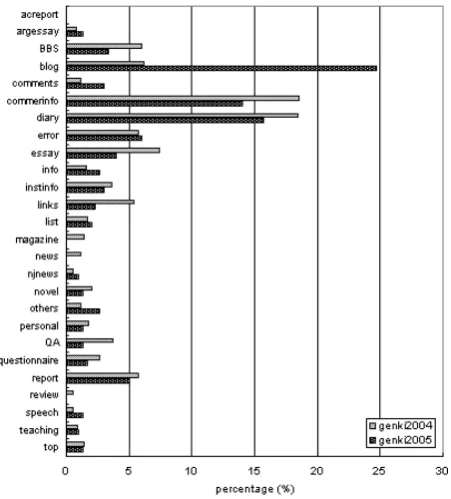
The genre distributions in the two Genki corpora are pre-sented in table 6, and the percentage values are plotted in figure 4. In both corpora, a good portion of the distribu-tion is occupied by the genres typical of personal prose, i.e., BBS, blog, diary, essay and personal pages. The sum of these genres is 39.9% in Genki 2004 and 49% in Genki 2005. This indicates that the web corpora are likely to in-clude a good amount of spontaneous prose composed by non-professional writers. This pattern matches with the dominance of “personal interest” pages in the results of the domain analysis of the Genki corpora. Since this text type is not available in traditional corpora, web corpora can be a very precious new linguistic resource. We also notice a
Figure 3: Percentage distribution of domain types in our Japanese corpus (BNC2005) and Sharoff’s English corpus (I-EN).
Figure 4: Percentage distribution of genre types in the Genki 2004 and 2005 corpora.
sharp increase in the overall ratio of these genres between 2004 and 2005, suggesting the possibility that the Japanese Web is becoming richer in personal prose. Another promi-nent genre is commerinfo: 18.6% in 2004 and 14% of docu-ments in 2005. The sum of all these genres is 58.5% in 2004 and 63% in 2005, which indicates the dominacne of per-sonal and commercial genres. In contrast, the ratio of news is very low, and there is no single case of acreport (aca-demic research reports) in either corpus. This may again be caused by our seed selection, as was probably the case for the low proportion of politics and socsci in the results of the domain analysis of the Genki corpora. The genres with almost no good chunk of prose, such as links, top and list have a relatively low ratio, which is good news.
3.2.2. Effects of seed selection
ef-Genki 2004 Genki 2005
# avg. # avg.
of docs size of docs size acreport 0 (0%) 0 0 (0%) 0 argessay 7 (0.8%) 3158 4 (1.3%) 3524 BBS 54 (6.0%) 8243 10 (3.3%) 9329 blog 55 (6.2%) 3959 74 (24.7%) 4604 comments 10 (1.1%) 2040 9 (3.0%) 7248 commerinfo 166 (18.6%) 2433 42 (14.0%) 2393 diary 165 (18.5%) 5019 47 (15.7%) 5284 error 51 (5.7%) 4171 18 (6.0%) 13396 essay 66 (7.4%) 3414 12 (4.0%) 4897 info 14 (1.6%) 1813 8 (2.7%) 2296 instinfo 32 (3.6%) 2790 9 (3.0%) 3588 links 48 (5.4%) 1768 7 (2.3%) 2327 list 15 (1.7%) 4949 6 (2.0%) 550 magazine 13 (1.5%) 4332 0 (0%) 0 news 10 (1.1%) 3316 0 (0%) 0 njnews 5 (0.6%) 5109 3 (1.0%) 1426 novel 18 (2.0%) 10367 4 (1.3%) 3236 others 10 (1.1%) 4207 8 (2.7%) 7780 personal 16 (1.8%) 2138 4 (1.3%) 1909 QA 33 (3.7%) 2966 4 (1.3%) 2759 questionnaire 24 (2.7%) 3724 5 (1.7%) 1393 report 51 (5.7%) 2367 15 (5.0%) 3492 review 5 (0.6%) 5733 0 (0%) 0 speech 5 (0.6%) 9131 4 (1.3%) 2671 teaching 8 (1.9%) 5362 3 (1.0%) 3741 top 13 (1.5%) 1623 4 (1.3%) 2893 total 894 (100%) 3885 300 (100%) 4744
Table 6: Distribution of genre types in the Genki 2004 and 2005 corpora
fects. The results are presented in table 7 and figure 5. Some dramatic changes emerge from the results. BNC-web 2005 shows a sharp decrease in blog and diary, while there is a substantial increase in genres where academic, journal-istic or public contents are presented, e.g., acreport, arges-say, news and report. These changes match with the results of the domain analysis of the same corpora showing an in-crease in scientific and sociopolitical topics in BNC-web 2005. We also notice that the magnitude of the changes be-tween Genki and BNC-web 2005 in the genre distribution is much greater than that between the two Genki corpora, in correspond with the results of the domain classification.
4.
Typical lexical items
To examine how time interval and seed selection affect Web corpora lexically, we examined typical lexical items in our three Japanese corpora. For the two pairs (Genki 2004 vs. 2005 and Genki vs. BNC-web 2005), we compared the frequency of occurrence of each “word” (as tokenized by ChaSen) by computing the log-likelihood ratio association measure (Dunning, 1993; Sharoff, 2006), and evaluated the lists of words ranked by that measure, focusing on the top 300 items in each list. In the lists of both Genki corpora, we did not find any systematic difference except for the follow-ing one. The Genki 2004 list contains more items related to business or finance (e.g.,tenpo“store,”gokakunin “con-firmation”) – 29 instances out of the top 300 list – while
Genki 2005 BNC-web 2005
# avg. # avg.
of docs size of docs size acreport 0 (0%) 0 8 (2.7%) 11172 argessay 4 (1.3%) 3524 25 (8.3%) 4916 BBS 10 (3.3%) 9329 4 (1.3%) 19757 blog 74 (24.7%) 4604 19 (6.3%) 7228 comments 9 (3.0%) 7248 3 (1.0%) 1325 commerinfo 42 (14.0%) 2393 48 (16.0%) 1693 diary 47 (15.7%) 5284 16 (5.3%) 8079 error 18 (6.0%) 13396 15 (5.0%) 4480 essay 12 (4.0%) 4897 11 (3.7%) 6179 info 8 (2.7%) 2296 21 (7.0%) 3325 instinfo 9 (3.0%) 3588 10 (3.3%) 3324 links 7 (2.3%) 2327 0 (0%) 0 list 6 (2.0%) 550 5 (5%) 7876 magazine 0 (0%) 0 12 (4%) 8039 news 0 (0%) 0 13 (4.3%) 6065 njnews 3 (1.0%) 1426 4 (1.3%) 5418 novel 4 (1.3%) 3236 5 (1.7%) 14522 others 8 (2.7%) 7780 9 (3.0%) 3868 personal 4 (1.3%) 1909 18 (6.0%) 6517 QA 4 (1.3%) 2759 0 (0%) 0 questionnaire 5 (1.7%) 1393 0 (0%) 0 report 15 (5.0%) 3492 36 (12.0%) 3320
review 0 (0%) 0 0 (0%) 0
speech 4 (1.3%) 2671 6 (2.7%) 4248 teaching 3 (1.0%) 3741 4 (2.0%) 348 top 4 (1.3%) 2893 8 (1.3%) 11172 total 300 (100%) 4744 300 (100%) 5188
Table 7: Distribution of genre types in the Genki 2005 and BNC-web 2005 corpora
we find only 3 in the Genki 2005 list. This may be ex-plained by the higher ratio of business pages in Genki 2004, as reported earlier. In contrast, some dramatic difference has emerged from the comparison of Genki and BNC-web 2005. The BNC-web 2005 list contains a high ratio of terms used in socio-political text, i.e., 43% of the list (e.g.,seefu “government”,kenpoo“constitution”), while no instance of this sort is found in the Genki 2005 list. This must be due to the change of seed selection that has caused the increase of socio-political text in BNC-web 2005. These results in-dicate that seed selection also impacts on the lexical distri-bution much more than time interval.
5.
Discussion and conclusion
The qualitative evaluation of our Japanese Web corpora co-herently shows the following: 1) both seed selection and time interval affect the nature of the resulting Web cor-pus; 2) the effect of seed selection is much stronger than that of time interval. The difference between the two ex-amined factors may be partly explained in the following way. Seed selection directly pertains to the way of sam-pling documents from the Web, but this is not the case for time interval. Time interval rather relates to changes in extrinsic factors of Web documents, such as indexing and ranking of Web documents by search engines, web-page updates, and so on. Such extrinsic factors largely char-acterize the dynamic nature of Web documents, but they impact on the overall distribution of the resulting Web cor-pora much less than seed selection. It may be interesting to observe chronological changes by repeatedly constructing Web corpora with a certain fixed time interval and the same procedure used to build Genki 2004 and 2005.
The prominent effect of seed selection suggests that a good understanding of the cause-and-effect relation be-tween seeds and retrieved documents is an important step to gain some control over the nature of Web corpora, partic-ularly, for constructing general balanced corpora meant to represent a language as a whole. This boils down to a need to understand distributional properties of Web documents and then find a good method to randomly sample a set of documents that represent those properties with minimal bias toward certain domains, and seed selection is a crucial part of this process. As far as we know, this line of research has not been widely pursued yet, except for the preliminary study by Ciaramita and Baroni (2006). They propose and test an automated, quantitative, knowledge-poor method to evaluate the randomness of a Web corpus, and their results indicate that medium frequency seeds might lead to a less biased corpus than either high frequency terms or terms se-lected from the whole frequency range. We are interested in further testing the effect of different seed sets picked on the basis of frequencies and topic domains, to see how the properties of seed sets correlate with the distributional properties of the resulting corpus.
6.
References
G. Aston, and L. Burnard. 1998.The BNC Handbook: Ex-ploring the British National Corpus with SARA. Edin-burgh: Edinburgh University Press.
E. Banno, Y. Onno, Y. Sakane and C. Shinagawa. 1999. Genki: An integrated course in elementary Japanese. Tokyo: The Japan Times.
M. Baroni and S. Bernardini. 2004. BootCaT: Boot strap-ping corpora and terms from the Web.Proceedings of the Fourth Language Resources and Evaluation Conference, Lisbon, Portugal.
M. Baroni and M. Ueyama. 2004. Retrieving Japanese spe-cialized terms and corpora from the World Wide Web. Proceedings of KONVENS 2004.
M. Ciaramita and M. Baroni. 2006. A figure of merit for the evaluation of Web-corpus randomness.Proceedings of EACL 2006.
T. Dunning. 1993. Accurate methods for the statistics of surprise and coincidence.Computational Linguistics, 19(1): 61-74.
D. Fetterly, M. Manasse, M. Najork, and J. Wiener. 2004. A large-scale study of the evolution of Web pages. Soft-ware: Practice & Experience, 34: 213-237.
W. Fletcher. 2004. Making the Web more useful as a source for linguistic corpora. In U. Cornnor and T. Upton, ed-itors, Corpus Linguistics in North America 2002: Se-lections from the Fourth North America Symposium of the American Association for Applied Corpus Linguistics (Amsterdam: Rodopi). Available on-line from http: //miniappolis.com/KWiCFinder/
R. Ghani, R. Jones, and D. Mladenic. 2003.Building mi-nority language corpora by learning to generate Web search queries, Knowledge and Information Systems 2003.
H. Goto. 2003. Linguistic theories & linguistic re-sources: corpora and other data (Gengo riron to gengo shiryoo: coopasu to coopasu igai no deeta). Nihon-gogaku (Japanese Language Studies), 22: 6-15. Avail-able on-line fromhttp://www.sal.tohoku.ac. jp/∼gothit/nhnggk0304.html
A. Kilgarriff and G. Grefenstette. 2003. Introduction to the special issue on the Web as Corpus.Computational Lin-guistics, 29(3): 333-347.
Y. Matsumoto, A. Kitauchi, T. Yamashita, Y. Hirano, H. Matsuda, K. Takaoka, and M. Asahara. 2000. Morpho-logical analysis system ChaSen version 2.2.1 manual. NIST Technical Report.
M. Santini. 2005. Genres in formation? An exploratory study of Web pages using cluster analysis. Proceedings of CLUK 05. Available from http://www.itri. brighton.ac.uk/∼Marina.Santini/
S. Sharoff. 2006. Creating general-purpose corpora using automated search engine queries.