German Verb Patterns and Their Implementation in an Electronic Dictionary
Marc Luder
University of Z¨urich
Binzm¨uhlestr. 14/16, CH-8050 Z¨urich [email protected]
Abstract
Here we describe an electronic lexical resource for German and the structure of its lexicon entries, notably the structure of verbal single-word and multi-word entries. The verb as the center of the sentence structure, as held by dependency models, is also a basic principle of the JAKOB narrative analysis application, for which the dictionary is the background. Different linguistic layers are combined for construing lexicon entries with a rich set of syntactic and semantic properties, suited to represent the syntactic and semantic behavior of verbal expressions (verb patterns), extracted from transcripts of real discourse, thereby lexicalizing the specific meaning of a specific verb pattern in a specific context. Verb patterns are built by the lexicographer by using a parser analyzing the input of a test clause and generating a machine-readable property string with syntactic characteristics and propositions for semantic characteristics grounded in an ontology. As an example, the German idiomatic expressionan den Karren fahren(to come down hard on somebody) demonstrates the overall structure of a dictionary entry. The goal is to build unique dictionary entries (verb patterns) with reference to the whole of their properties.
Keywords:electronic dictionary, multi-word units, dependency parsing
1.
Introduction
This paper describes an electronic lexical resource for Ger-man, especially spoken GerGer-man, and the structure of ver-bal dictionary entries as used therein, based on principles of dependency linguistics. Motivation and background for this lexicon is a computer-based text and narrative analysis application.JAKOB narrative analysis1was conceived and developed at the University of Zurich as a systematic inter-pretative tool for research, documentation, and practical ex-amination of everyday narratives in psychotherapy (Boothe et al., 2010). One step of the narrative analysis procedure is the coding of the vocabulary with specific psychodynamic categories revealing motives and conflicts of the narrator. The category system is represented in the lexicon as a prop-erty of the lexicon entries. Tape-recorded and transcribed discourse of psychotherapy sessions is analyzed sentence by sentence by the JAKOB application, words and expres-sions are matched with lexicon entries with the goal of cod-ing the text with the appropriate categories. The main em-phasis of the lexicon lies on verbs, verbal expressions, and verb patterns. Dependency and valency linguistic models put the verb in the center of the sentence structure; the argu-ments areactantsandcircumstants, described by Tesni`ere (1976) as “actors in a little drama”. This stage metaphor, with the verb in the central position, is also a basic prin-ciple of the JAKOB narrative analysis, where a storyteller is presenting a dramaturgically constructed plot with dif-ferent actions (verbs) by difdif-ferent actors playing difdif-ferent roles in the story (Boothe, 2011). Semantic and syntactic valency and dependency are most important, as are also the relations between the two.
1JAKOB narrative analysis (Erz¨ahlanalyse JAKOB):
http://www.jakob.uzh.ch
2.
Background
Semantic valency and dependency models are tightly con-nected to concepts of frame semantics. When describ-ing properties of verb complements, extra ldescrib-inguistic factors like discourse context, situation, real-world knowledge, and knowledge about social practices are equally important and constrain the potential word combinations.
In the literature, there are different possibilities for the de-scription of semantic valency. Semantic roles, also known as deep cases or theta-roles were introduced incase gram-mar(Fillmore, 2003). Number and properties of these roles vary widely between different studies about the concept. Authors in the tradition ofgenerative grammardescribe se-mantic components as selectional restrictions that specify the possible semantic properties of the arguments of a verb. InCorpus Pattern Analysis(CPA) (Hanks, 2008), semantic types are organized in a large hierarchically organized on-tology (Hanks and Pustejovsky, 2005). Examples from the different hierarchical levels areAnything, Physical Object, Human, Eventuality, Abstract. A subset of this ontology defines the semantic types of nouns in the present lexicon project.
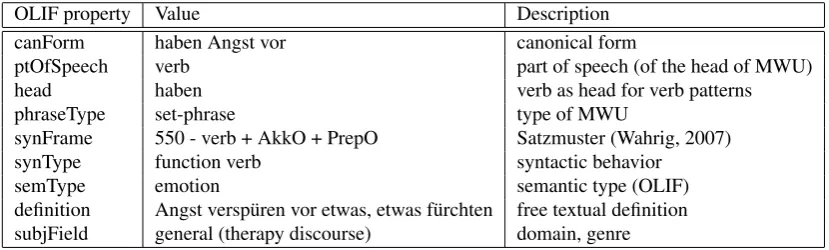
OLIF property Value Description
canForm haben Angst vor canonical form
ptOfSpeech verb part of speech (of the head of MWU)
head haben verb as head for verb patterns
phraseType set-phrase type of MWU
synFrame 550 - verb + AkkO + PrepO Satzmuster (Wahrig, 2007)
synType function verb syntactic behavior
semType emotion semantic type (OLIF)
definition Angst versp¨uren vor etwas, etwas f¨urchten free textual definition
subjField general (therapy discourse) domain, genre
Table 1: OLIF properties (Example:Angst haben vor etwas(to fear something))
Attribute Value Description
canForm lesen (to read) canonical form
natclause jmd liest etwasn prototypical clause, placeholders for arguments
bauplan 500: 1 - - L2 subj Human 2 lesen VVFIN machine-generated pattern string L0 root n/a 3 - - L2 obja Document
4 ber APPR L2 pp n/a 5 - - L4 pn Anything
pattern [[Human]] lesen ([[Document]]) ({¨uber [[Anything]]}) human readable verb pattern (Hanks, 2008)
Table 2: Additional Lexical Properties for Verb Entries (Example:lesen(to read))
man, and something is replaced byAnything. The lexico-grapher then has to decide about the appropriateness of the semantic types and normally has to edit and refine them by choosing a more convenient type. On the head of the string
bauplan, Wahrig’s (2007) three-digit number of the Satz-muster gives information about the syntactic properties of the verb pattern. The string bauplanis composed of the three-digit Wahrig number, followed by 6 values for each word of the natclause string:
1. sequential number
2. canForm (lemma)
3. part of speech
4. link to root position (L0)
5. syntactic information
6. semantic type
4.2. Property: pattern
The property bauplanshould provide all necessary infor-mation required by NLP applications, but the format of this property is confusing and not easy to read. So we implemented a propertypattern, corresponding to the En-glish verb patterns proposed by Hanks (2008) and present-ing the verb and its arguments and possible semantic types in human-readable format. Verb patternsrepresent the se-mantic properties of all the elements of a construction, and the meaning of the pattern as a whole is composed from the semantic types of the single elements. Therefore, the de-scription of the pattern meaning is more accurate than the OLIF propertysemType, which describes the semantic type of the verb expression as a whole.
4.3. Example lexicon entry
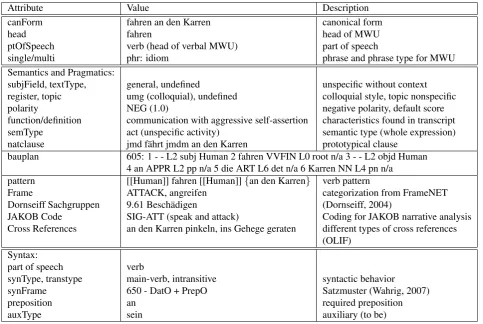
An elaborated example of a multi-word lexicon entry is pre-sented in Table (3) for the German idiomatic expression “an den Karren fahren” (to come down hard on someone). Besides the mentioned new semantic and syntactic features of the lexicon entries, we decided to introduce extended pragmatic properties. The original OLIF property subj-Field represents the knowledge domain to which the lex-ical entry is assigned, according to the language used in different domains, e.g. agriculture,audiovisual,aviation. As this property does not cover the required spectrum of pragmatic descriptions suited for disambiguating polyse-mous expressions, we extended the OLIF structure with the pragmatic/functional properties textType, register and
topic. The propertysubjFieldmarks the larger context of a situation (external, nonlinguistic criteria), whereas text-Type(also discourse type, communication type) represents internal linguistic criteria likenarrative,descriptionor ar-gumentation. The values forregisterrelate to local patterns of style and social situation, e.g. formal,informal,ironic,
colloquial. The values for topic eventually are very im-portant for local meaning constitution, together with subj-Fieldthey denote the local subject of the current discourse unit with heterogeneous items likecooking,job,sports, as collected by the analysis of the transcripts. Unfortunately, these pragmatic features are very difficult to assign to the entries without the context of discourse, so their contribu-tion to meaning construccontribu-tion is limited.
Attribute Value Description
canForm fahren an den Karren canonical form
head fahren head of MWU
ptOfSpeech verb (head of verbal MWU) part of speech
single/multi phr: idiom phrase and phrase type for MWU
Semantics and Pragmatics:
subjField, textType, general, undefined unspecific without context
register, topic umg (colloquial), undefined colloquial style, topic nonspecific
polarity NEG (1.0) negative polarity, default score
function/definition communication with aggressive self-assertion characteristics found in transcript
semType act (unspecific activity) semantic type (whole expression)
natclause jmd f¨ahrt jmdm an den Karren prototypical clause
bauplan 605: 1 - - L2 subj Human 2 fahren VVFIN L0 root n/a 3 - - L2 objd Human 4 an APPR L2 pp n/a 5 die ART L6 det n/a 6 Karren NN L4 pn n/a
pattern [[Human]] fahren [[Human]]{an den Karren} verb pattern
Frame ATTACK, angreifen categorization from FrameNET
Dornseiff Sachgruppen 9.61 Besch¨adigen (Dornseiff, 2004)
JAKOB Code SIG-ATT (speak and attack) Coding for JAKOB narrative analysis
Cross References an den Karren pinkeln, ins Gehege geraten different types of cross references (OLIF)
Syntax:
part of speech verb
synType, transtype main-verb, intransitive syntactic behavior
synFrame 650 - DatO + PrepO Satzmuster (Wahrig, 2007)
preposition an required preposition
auxType sein auxiliary (to be)
Table 3: Elaborated Example:an den Karren fahren(to come down hard on somebody)
For the purpose of comparison, Table (4) demonstrates all the different constructions with the elementKarren(cart) and their respective frequencies in the mentioned corpora5. The OLIF propertycross referenceallows for a multitude of cross reference types, like synonymy, near-synonymy, and diverse association and connotation types, e.g. for con-structions with similar or complementary meanings in ac-tive and passive forms, likeins G¨artchen trampen(to tread on so.’s toes), orins Gehege geraten(to get in each other’s way).
The lexicographic work is also comprehending the task of analyzing the corpus data for related meanings and colloca-tions. The three most salient collocation candidates for the nominal expression an den Karren in the deWAC-corpus are:
• pinkeln (4 / 5.8), (to pee)
• fahren (65 / 2.5), (to drive)
• spannen (4 / 2.49)6, (to put to, to yoke)
• (Total 92)
5
Corpora WIL, AMA, GUS = Psychotherapy discourse, AGD = Archiv f¨ur Gesprochenes Deutsch, CHTK = Schweizer Textko-rpus, deWAC = Internet based corpus
6Frequency and association score from the Sketch Engine
(logDice score).
5.
Conclusion
We present a new dictionary entry structure, combining syntactic, semantic, and pragmatic properties in verb en-tries for single-word and multi-word units in the context of their patterns of usage.
The verb patterns allow for a more accurate syntactic and semantic description of verbal expressions in the dictionary, therefore reducing the ambiguity between different yet re-lated entries. In the JAKOB narrative analysis application, the same parser used for building the lexicon is also used for parsing the text input from transcripts. The structures of the analyzed text sentences and the structures of lexical verb entries are compared, and patterns of text sentences are matched with patterns of the dictionary.
Construction / Corpora WIL AMA GUS AGD CHTK deWAC
an den Karren fahren 13 0 0 0 0 62
den Karren ziehen 1 0 0 0 3 33
den Karren aus dem Dreck ziehen 0 0 0 0 1 75
den Karren schleppen 1 0 0 0 0 4
sich vor den Karren spannen lassen 0 0 0 0 0 129
vor den Karren spannen 0 0 0 0 0 98
den Karren in den Dreck fahren 0 0 0 0 0 44
Karren (simple noun) 15 5 0 52 125 3598
Table 4: Frequencies of Constructions withKarren(cart)
6.
References
Brigitte Boothe, Genevi`eve Grimm, Marie-Luise Hermann, and Marc Luder. 2010. JAKOB Narrative Analysis: The psychodynamic conflict as a narrative model. Psy-chotherapy Research, 20(5):511–525.
Brigitte Boothe. 2011. Das Narrativ: Biografisches Erz¨ahlen im psychotherapeutischen Prozess. Schattauer, Stuttgart.
Franz Dornseiff. 2004. Der deutsche Wortschatz nach Sachgruppen. de Gruyter, Berlin, 8 edition.
Charles J. Fillmore, editor. 2003. Form and Meaning in Language: Papers on semantic roles, volume 1 ofCSLI lecture notes. CSLI Publications, Leland and CA. Adele E. Goldberg. 1995. Constructions: A
construc-tion grammar approach to argument structure. Univ. of Chicago Press, Chicago.
Patrick Hanks and James Pustejovsky. 2005. A Pattern Dictionary for Natural Language Processing. Revue Francaise de Langue Appliqu´ee, 10(2):1–19.
Patrick Hanks. 2008. Lexical Patterns: From Hornby to Hunston and beyond. In Elisenda Bernal and Janet DeCesaris, editors,Proceedings of the XIII. Euralex In-ternational Congress, pages 89–129, Barcelona. Patrick Hanks. 2010. How People Use Words to Make
Meanings.NLPCS 2010 Proceedings, pages 1–11. Adam Kilgarriff, Pavel Rychl´y, Pavel Smrz, and David
Tugwell. 2004. The Sketch Engine. Proc EURALEX 2004, Lorient, France.
Manfred Klenner, Stefanos Petrakis, Simon Clematide, and Marc Luder. 2012. Compositional Syntax-based Phrase-level Polarity Annotation for German. Linguistic Issues in Language Technology - LiLT, 7(15).
Manfred Klenner. 2009. S¨usse Beklommenheit, schmerzvolle Ekstase: Automatische Sentiment-analyse in den Werken von Eduard von Keyserling. In Christian Chiarcos, Richard Eckart de Castilho, and Manfred Stede, editors, Von der Form zur Bedeutung: Texte automatisch verarbeiten, pages 91–97. Gunter Narr, T¨ubingen.
Marc Luder and Simon Clematide. 2010. Constructing a Constructional MWE Lexicon for psycho-conceptual Annotation: Evaluation of CPA and DuELME for Lex-icographic Description. In Anne Dykstra and Tanneke Schoonheim, editors,Proceedings of the XIV Euralex In-ternational Congress, pages 152–153, Leeuwarden.
Marc Luder. 2011. Konstruktionen im Lexikon - Konstruk-tionen in der Erz¨ahlanalyse. BOD, Hamburg.
Rosamund Moon. 2008. Sinclair, Phraseology, and Lexicography. International Journal of Lexicography, 21(3):243–254.
Gerold Schneider. 2008. Hybrid Long-Distance Func-tional Dependency Parsing. Ph.D. thesis, Institute of Computational Linguistics, University of Zurich. Rico Sennrich, Gerold Schneider, Martin Volk, and
Mar-tin Warin. 2009. A New Hybrid Dependency Parser for German. In Christian Chiarcos, Richard Eckart de Castilho, and Manfred Stede, editors,Von der Form zur Bedeutung: Texte automatisch verarbeiten, pages 115– 124. Gunter Narr, T¨ubingen.
Lucien Tesni`ere. 1976. El´ements de syntaxe structurale. Klincksieck, Paris, 2nd edition.
Helmut Thom¨a and Horst K¨achele. 2006. Psychoanalytis-che Therapie: Praxis, volume 2. Springer, Heidelberg, 3rd edition.